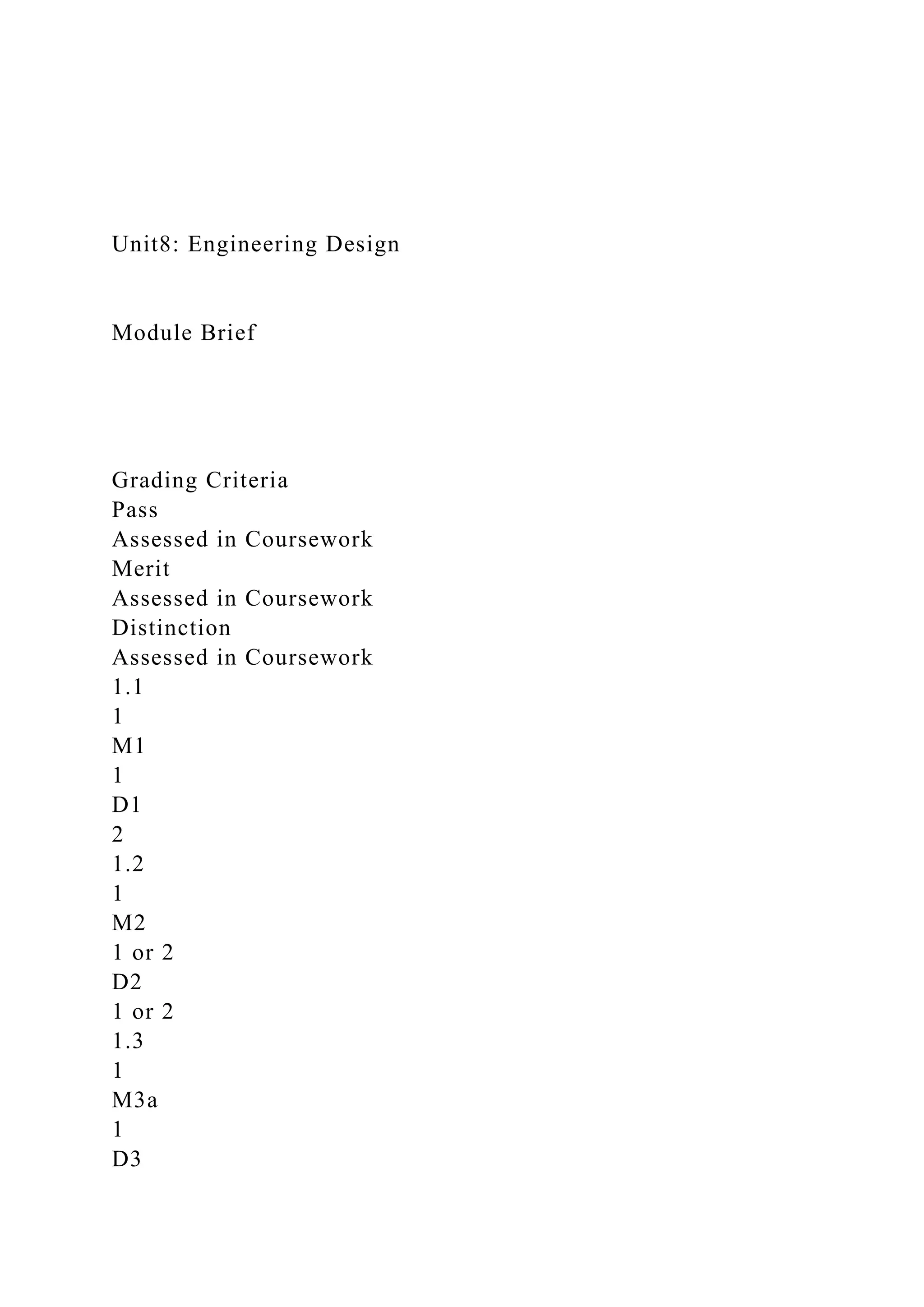
Unit8: Engineering Design
Module Brief
Grading Criteria
Pass
Assessed in Coursework
Merit
Assessed in Coursework
Distinction
Assessed in Coursework
1.1
1
M1
1
D1
2
1.2
1
M2
1 or 2
D2
1 or 2
1.3
1
M3a
1
D3
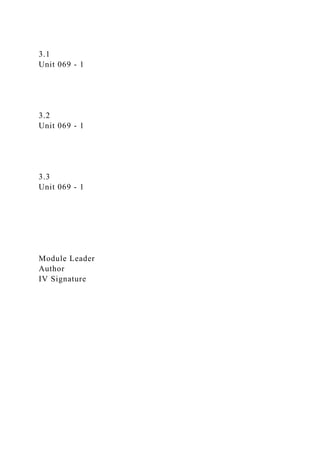
1 or 2
1.4
2
M3b
2
2.1
1
2.2
2
2.3
2
2.4
2
2.5
2
3.1
Unit 069 - 1
3.2
Unit 069 - 1
3.3
Unit 069 - 1
Module Leader
Author
IV Signature
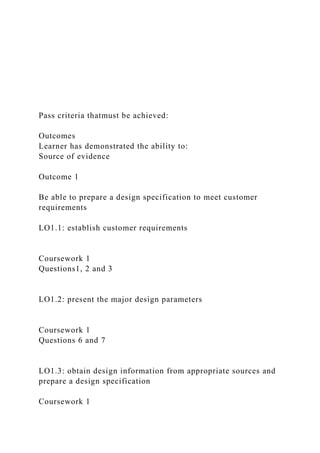
Pass criteria thatmust be achieved:
Outcomes
Learner has demonstrated the ability to:
Source of evidence
Outcome 1
Be able to prepare a design specification to meet customer
requirements
LO1.1: establish customer requirements
Coursework 1
Questions1, 2 and 3
LO1.2: present the major design parameters
Coursework 1
Questions 6 and 7
LO1.3: obtain design information from appropriate sources and
prepare a design specification
Coursework 1
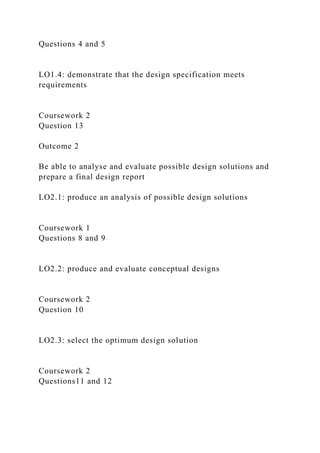
Questions 4 and 5
LO1.4: demonstrate that the design specification meets
requirements
Coursework 2
Question 13
Outcome 2
Be able to analyse and evaluate possible design solutions and
prepare a final design report
LO2.1: produce an analysis of possible design solutions
Coursework 1
Questions 8 and 9
LO2.2: produce and evaluate conceptual designs
Coursework 2
Question 10
LO2.3: select the optimum design solution
Coursework 2
Questions11 and 12
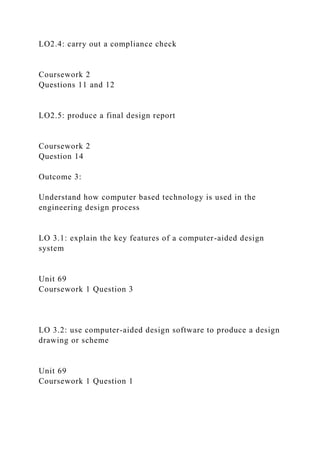
LO2.4: carry out a compliance check
Coursework 2
Questions 11 and 12
LO2.5: produce a final design report
Coursework 2
Question 14
Outcome 3:
Understand how computer based technology is used in the
engineering design process
LO 3.1: explain the key features of a computer-aided design
system
Unit 69
Coursework 1 Question 3
LO 3.2: use computer-aided design software to produce a design
drawing or scheme
Unit 69
Coursework 1 Question 1
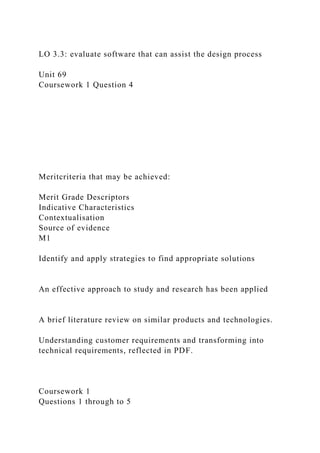
LO 3.3: evaluate software that can assist the design process
Unit 69
Coursework 1 Question 4
Meritcriteria that may be achieved:
Merit Grade Descriptors
Indicative Characteristics
Contextualisation
Source of evidence
M1
Identify and apply strategies to find appropriate solutions
An effective approach to study and research has been applied
A brief literature review on similar products and technologies.
Understanding customer requirements and transforming into
technical requirements, reflected in PDF.
Coursework 1
Questions 1 through to 5
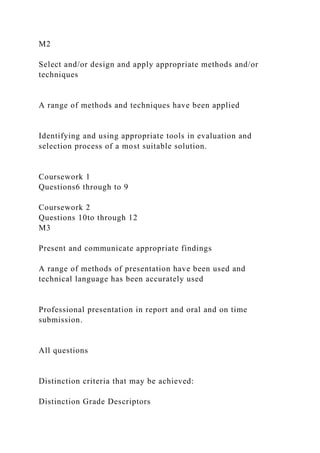
M2
Select and/or design and apply appropriate methods and/or
techniques
A range of methods and techniques have been applied
Identifying and using appropriate tools in evaluation and
selection process of a most suitable solution.
Coursework 1
Questions6 through to 9
Coursework 2
Questions 10to through 12
M3
Present and communicate appropriate findings
A range of methods of presentation have been used and
technical language has been accurately used
Professional presentation in report and oral and on time
submission.
All questions
Distinction criteria that may be achieved:
Distinction Grade Descriptors
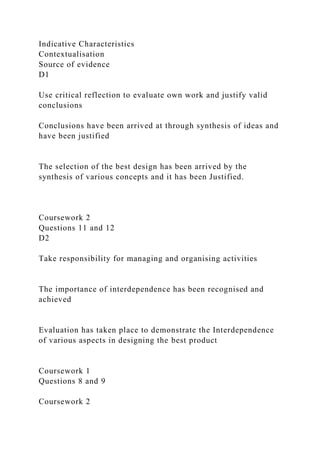
Indicative Characteristics
Contextualisation
Source of evidence
D1
Use critical reflection to evaluate own work and justify valid
conclusions
Conclusions have been arrived at through synthesis of ideas and
have been justified
The selection of the best design has been arrived by the
synthesis of various concepts and it has been Justified.
Coursework 2
Questions 11 and 12
D2
Take responsibility for managing and organising activities
The importance of interdependence has been recognised and
achieved
Evaluation has taken place to demonstrate the Interdependence
of various aspects in designing the best product
Coursework 1
Questions 8 and 9
Coursework 2
Questions 10 and 14
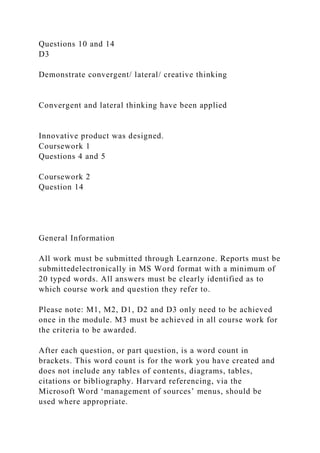
D3
Demonstrate convergent/ lateral/ creative thinking
Convergent and lateral thinking have been applied
Innovative product was designed.
Coursework 1
Questions 4 and 5
Coursework 2
Question 14
General Information
All work must be submitted through Learnzone. Reports must be
submittedelectronically in MS Word format with a minimum of
20 typed words. All answers must be clearly identified as to
which course work and question they refer to.
Please note: M1, M2, D1, D2 and D3 only need to be achieved
once in the module. M3 must be achieved in all course work for
the criteria to be awarded.
After each question, or part question, is a word count in
brackets. This word count is for the work you have created and
does not include any tables of contents, diagrams, tables,
citations or bibliography. Harvard referencing, via the
Microsoft Word ‘management of sources’ menus, should be
used where appropriate.
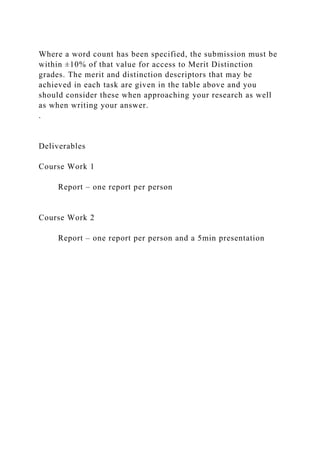
Where a word count has been specified, the submission must be
within ±10% of that value for access to Merit Distinction
grades. The merit and distinction descriptors that may be
achieved in each task are given in the table above and you
should consider these when approaching your research as well
as when writing your answer.
.
Deliverables
Course Work 1
Report – one report per person
Course Work 2
Report – one report per person and a 5min presentation
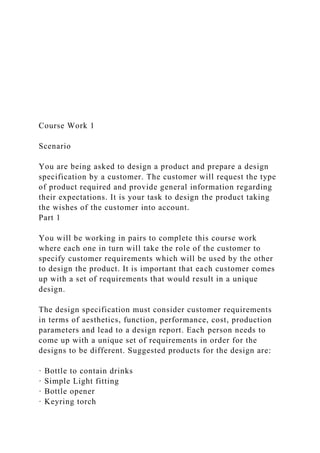
Course Work 1
Scenario
You are being asked to design a product and prepare a design
specification by a customer. The customer will request the type
of product required and provide general information regarding
their expectations. It is your task to design the product taking
the wishes of the customer into account.
Part 1
You will be working in pairs to complete this course work
where each one in turn will take the role of the customer to
specify customer requirements which will be used by the other
to design the product. It is important that each customer comes
up with a set of requirements that would result in a unique
design.
The design specification must consider customer requirements
in terms of aesthetics, function, performance, cost, production
parameters and lead to a design report. Each person needs to
come up with a unique set of requirements in order for the
designs to be different. Suggested products for the design are:
· Bottle to contain drinks
· Simple Light fitting
· Bottle opener
· Keyring torch
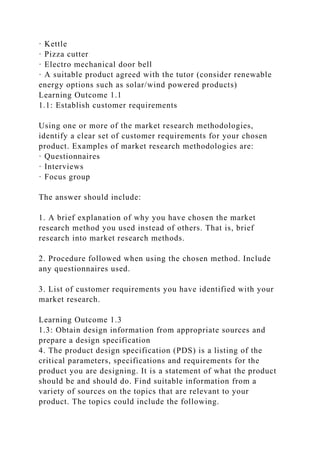
· Kettle
· Pizza cutter
· Electro mechanical door bell
· A suitable product agreed with the tutor (consider renewable
energy options such as solar/wind powered products)
Learning Outcome 1.1
1.1: Establish customer requirements
Using one or more of the market research methodologies,
identify a clear set of customer requirements for your chosen
product. Examples of market research methodologies are:
· Questionnaires
· Interviews
· Focus group
The answer should include:
1. A brief explanation of why you have chosen the market
research method you used instead of others. That is, brief
research into market research methods.
2. Procedure followed when using the chosen method. Include
any questionnaires used.
3. List of customer requirements you have identified with your
market research.
Learning Outcome 1.3
1.3: Obtain design information from appropriate sources and
prepare a design specification
4. The product design specification (PDS) is a listing of the
critical parameters, specifications and requirements for the
product you are designing. It is a statement of what the product
should be and should do. Find suitable information from a
variety of sources on the topics that are relevant to your
product. The topics could include the following.
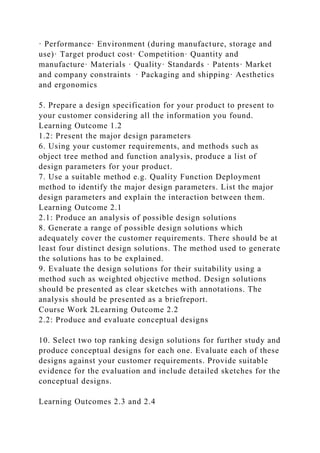
· Performance· Environment (during manufacture, storage and
use)· Target product cost· Competition· Quantity and
manufacture· Materials · Quality· Standards · Patents· Market
and company constraints · Packaging and shipping· Aesthetics
and ergonomics
5. Prepare a design specification for your product to present to
your customer considering all the information you found.
Learning Outcome 1.2
1.2: Present the major design parameters
6. Using your customer requirements, and methods such as
object tree method and function analysis, produce a list of
design parameters for your product.
7. Use a suitable method e.g. Quality Function Deployment
method to identify the major design parameters. List the major
design parameters and explain the interaction between them.
Learning Outcome 2.1
2.1: Produce an analysis of possible design solutions
8. Generate a range of possible design solutions which
adequately cover the customer requirements. There should be at
least four distinct design solutions. The method used to generate
the solutions has to be explained.
9. Evaluate the design solutions for their suitability using a
method such as weighted objective method. Design solutions
should be presented as clear sketches with annotations. The
analysis should be presented as a briefreport.
Course Work 2Learning Outcome 2.2
2.2: Produce and evaluate conceptual designs
10. Select two top ranking design solutions for further study and
produce conceptual designs for each one. Evaluate each of these
designs against your customer requirements. Provide suitable
evidence for the evaluation and include detailed sketches for the
conceptual designs.
Learning Outcomes 2.3 and 2.4
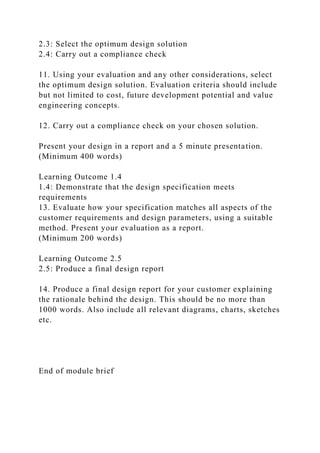
2.3: Select the optimum design solution
2.4: Carry out a compliance check
11. Using your evaluation and any other considerations, select
the optimum design solution. Evaluation criteria should include
but not limited to cost, future development potential and value
engineering concepts.
12. Carry out a compliance check on your chosen solution.
Present your design in a report and a 5 minute presentation.
(Minimum 400 words)
Learning Outcome 1.4
1.4: Demonstrate that the design specification meets
requirements
13. Evaluate how your specification matches all aspects of the
customer requirements and design parameters, using a suitable
method. Present your evaluation as a report.
(Minimum 200 words)
Learning Outcome 2.5
2.5: Produce a final design report
14. Produce a final design report for your customer explaining
the rationale behind the design. This should be no more than
1000 words. Also include all relevant diagrams, charts, sketches
etc.
End of module brief
Unit8 Engineering DesignModule BriefGrading C.docx

Unit8 Engineering DesignModule BriefGrading C.docx

  • 1.
    Unit8: Engineering Design ModuleBrief Grading Criteria Pass Assessed in Coursework Merit Assessed in Coursework Distinction Assessed in Coursework 1.1 1 M1 1 D1 2 1.2 1 M2 1 or 2 D2 1 or 2 1.3 1 M3a 1 D3
  • 2.
  • 3.
    3.1 Unit 069 -1 3.2 Unit 069 - 1 3.3 Unit 069 - 1 Module Leader Author IV Signature
  • 4.
    Pass criteria thatmustbe achieved: Outcomes Learner has demonstrated the ability to: Source of evidence Outcome 1 Be able to prepare a design specification to meet customer requirements LO1.1: establish customer requirements Coursework 1 Questions1, 2 and 3 LO1.2: present the major design parameters Coursework 1 Questions 6 and 7 LO1.3: obtain design information from appropriate sources and prepare a design specification Coursework 1
  • 5.
    Questions 4 and5 LO1.4: demonstrate that the design specification meets requirements Coursework 2 Question 13 Outcome 2 Be able to analyse and evaluate possible design solutions and prepare a final design report LO2.1: produce an analysis of possible design solutions Coursework 1 Questions 8 and 9 LO2.2: produce and evaluate conceptual designs Coursework 2 Question 10 LO2.3: select the optimum design solution Coursework 2 Questions11 and 12
  • 6.
    LO2.4: carry outa compliance check Coursework 2 Questions 11 and 12 LO2.5: produce a final design report Coursework 2 Question 14 Outcome 3: Understand how computer based technology is used in the engineering design process LO 3.1: explain the key features of a computer-aided design system Unit 69 Coursework 1 Question 3 LO 3.2: use computer-aided design software to produce a design drawing or scheme Unit 69 Coursework 1 Question 1
  • 7.
    LO 3.3: evaluatesoftware that can assist the design process Unit 69 Coursework 1 Question 4 Meritcriteria that may be achieved: Merit Grade Descriptors Indicative Characteristics Contextualisation Source of evidence M1 Identify and apply strategies to find appropriate solutions An effective approach to study and research has been applied A brief literature review on similar products and technologies. Understanding customer requirements and transforming into technical requirements, reflected in PDF. Coursework 1 Questions 1 through to 5
  • 8.
    M2 Select and/or designand apply appropriate methods and/or techniques A range of methods and techniques have been applied Identifying and using appropriate tools in evaluation and selection process of a most suitable solution. Coursework 1 Questions6 through to 9 Coursework 2 Questions 10to through 12 M3 Present and communicate appropriate findings A range of methods of presentation have been used and technical language has been accurately used Professional presentation in report and oral and on time submission. All questions Distinction criteria that may be achieved: Distinction Grade Descriptors
  • 9.
    Indicative Characteristics Contextualisation Source ofevidence D1 Use critical reflection to evaluate own work and justify valid conclusions Conclusions have been arrived at through synthesis of ideas and have been justified The selection of the best design has been arrived by the synthesis of various concepts and it has been Justified. Coursework 2 Questions 11 and 12 D2 Take responsibility for managing and organising activities The importance of interdependence has been recognised and achieved Evaluation has taken place to demonstrate the Interdependence of various aspects in designing the best product Coursework 1 Questions 8 and 9 Coursework 2
  • 10.
    Questions 10 and14 D3 Demonstrate convergent/ lateral/ creative thinking Convergent and lateral thinking have been applied Innovative product was designed. Coursework 1 Questions 4 and 5 Coursework 2 Question 14 General Information All work must be submitted through Learnzone. Reports must be submittedelectronically in MS Word format with a minimum of 20 typed words. All answers must be clearly identified as to which course work and question they refer to. Please note: M1, M2, D1, D2 and D3 only need to be achieved once in the module. M3 must be achieved in all course work for the criteria to be awarded. After each question, or part question, is a word count in brackets. This word count is for the work you have created and does not include any tables of contents, diagrams, tables, citations or bibliography. Harvard referencing, via the Microsoft Word ‘management of sources’ menus, should be used where appropriate.
  • 11.
    Where a wordcount has been specified, the submission must be within ±10% of that value for access to Merit Distinction grades. The merit and distinction descriptors that may be achieved in each task are given in the table above and you should consider these when approaching your research as well as when writing your answer. . Deliverables Course Work 1 Report – one report per person Course Work 2 Report – one report per person and a 5min presentation
  • 12.
    Course Work 1 Scenario Youare being asked to design a product and prepare a design specification by a customer. The customer will request the type of product required and provide general information regarding their expectations. It is your task to design the product taking the wishes of the customer into account. Part 1 You will be working in pairs to complete this course work where each one in turn will take the role of the customer to specify customer requirements which will be used by the other to design the product. It is important that each customer comes up with a set of requirements that would result in a unique design. The design specification must consider customer requirements in terms of aesthetics, function, performance, cost, production parameters and lead to a design report. Each person needs to come up with a unique set of requirements in order for the designs to be different. Suggested products for the design are: · Bottle to contain drinks · Simple Light fitting · Bottle opener · Keyring torch
  • 13.
    · Kettle · Pizzacutter · Electro mechanical door bell · A suitable product agreed with the tutor (consider renewable energy options such as solar/wind powered products) Learning Outcome 1.1 1.1: Establish customer requirements Using one or more of the market research methodologies, identify a clear set of customer requirements for your chosen product. Examples of market research methodologies are: · Questionnaires · Interviews · Focus group The answer should include: 1. A brief explanation of why you have chosen the market research method you used instead of others. That is, brief research into market research methods. 2. Procedure followed when using the chosen method. Include any questionnaires used. 3. List of customer requirements you have identified with your market research. Learning Outcome 1.3 1.3: Obtain design information from appropriate sources and prepare a design specification 4. The product design specification (PDS) is a listing of the critical parameters, specifications and requirements for the product you are designing. It is a statement of what the product should be and should do. Find suitable information from a variety of sources on the topics that are relevant to your product. The topics could include the following.
  • 14.
    · Performance· Environment(during manufacture, storage and use)· Target product cost· Competition· Quantity and manufacture· Materials · Quality· Standards · Patents· Market and company constraints · Packaging and shipping· Aesthetics and ergonomics 5. Prepare a design specification for your product to present to your customer considering all the information you found. Learning Outcome 1.2 1.2: Present the major design parameters 6. Using your customer requirements, and methods such as object tree method and function analysis, produce a list of design parameters for your product. 7. Use a suitable method e.g. Quality Function Deployment method to identify the major design parameters. List the major design parameters and explain the interaction between them. Learning Outcome 2.1 2.1: Produce an analysis of possible design solutions 8. Generate a range of possible design solutions which adequately cover the customer requirements. There should be at least four distinct design solutions. The method used to generate the solutions has to be explained. 9. Evaluate the design solutions for their suitability using a method such as weighted objective method. Design solutions should be presented as clear sketches with annotations. The analysis should be presented as a briefreport. Course Work 2Learning Outcome 2.2 2.2: Produce and evaluate conceptual designs 10. Select two top ranking design solutions for further study and produce conceptual designs for each one. Evaluate each of these designs against your customer requirements. Provide suitable evidence for the evaluation and include detailed sketches for the conceptual designs. Learning Outcomes 2.3 and 2.4
  • 15.
    2.3: Select theoptimum design solution 2.4: Carry out a compliance check 11. Using your evaluation and any other considerations, select the optimum design solution. Evaluation criteria should include but not limited to cost, future development potential and value engineering concepts. 12. Carry out a compliance check on your chosen solution. Present your design in a report and a 5 minute presentation. (Minimum 400 words) Learning Outcome 1.4 1.4: Demonstrate that the design specification meets requirements 13. Evaluate how your specification matches all aspects of the customer requirements and design parameters, using a suitable method. Present your evaluation as a report. (Minimum 200 words) Learning Outcome 2.5 2.5: Produce a final design report 14. Produce a final design report for your customer explaining the rationale behind the design. This should be no more than 1000 words. Also include all relevant diagrams, charts, sketches etc. End of module brief