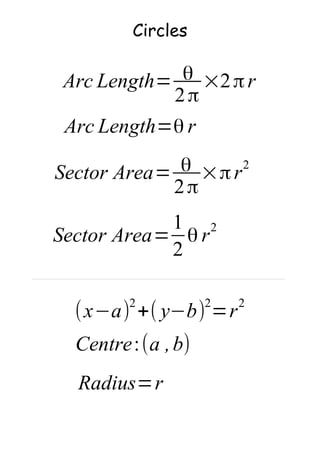
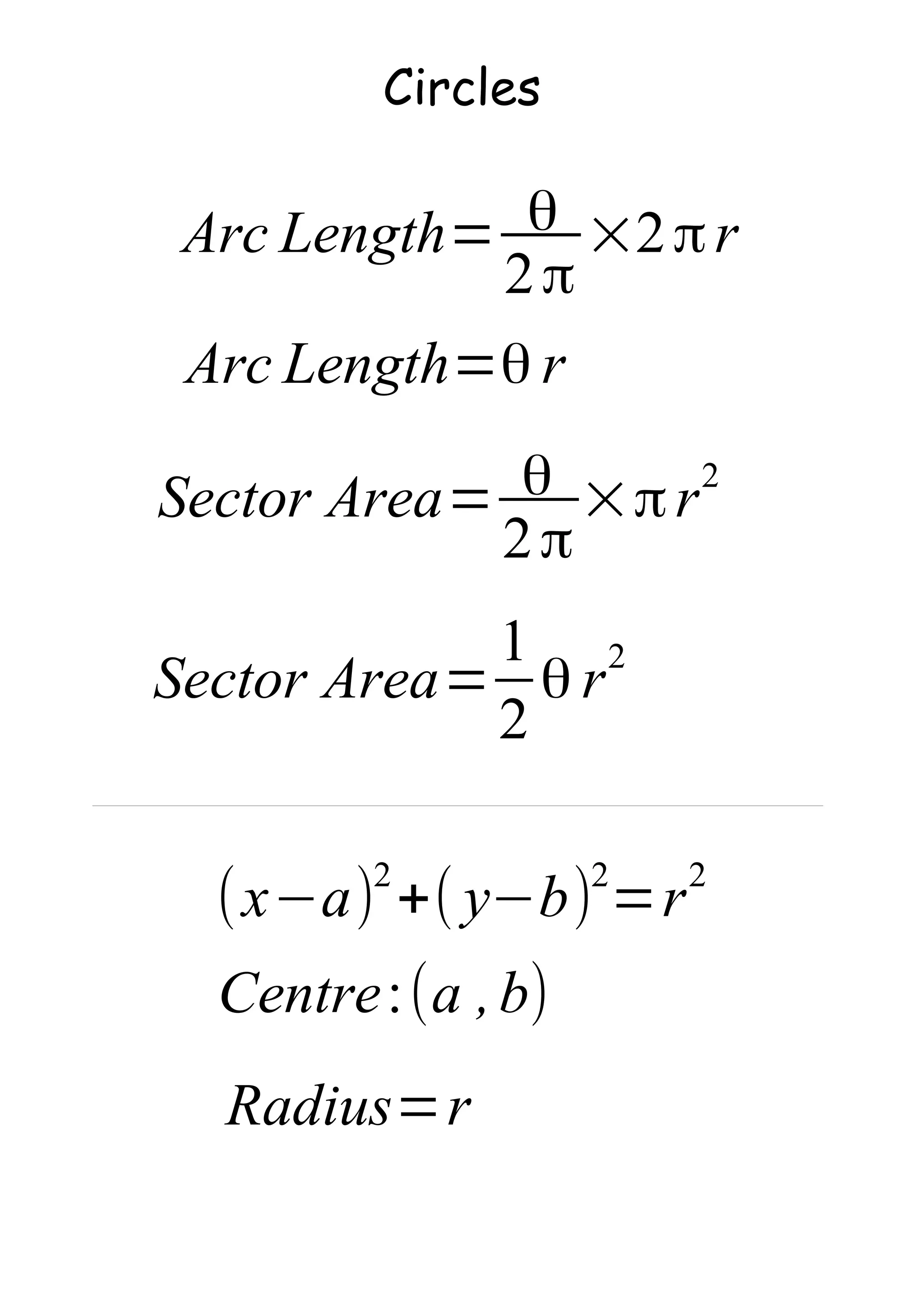
Arc Length= θ
2π
×2πr
Arc Length=θ r
Sector Area= θ
2π
×πr2
Sector Area=
1
2
θ r
2
Circles
(x−a)
2
+( y−b)
2
=r
2
Centre:(a ,b)
Radius=r
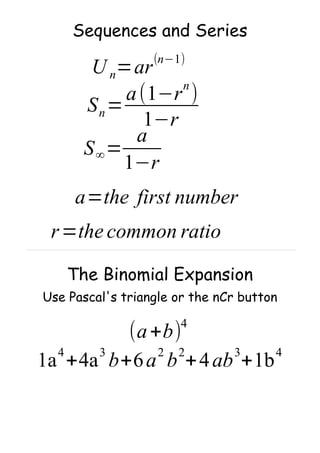
Sequences and Series
U n=ar
(n−1)
a=the first number
r=the common ratio
Sn=
a(1−r
n
)
1−r
S∞=
a
1−r
The Binomial Expansion
Use Pascal's triangle or the nCr button
(a+b)
4
1a
4
+4a
3
b+6a
2
b
2
+4ab
3
+1b
4
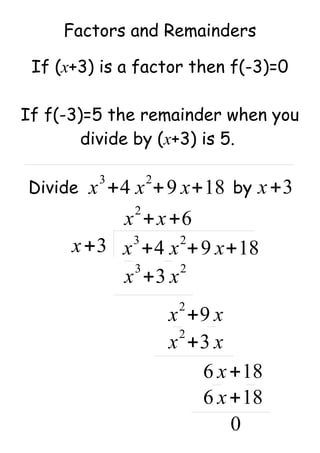
Factors and Remainders
x+3
If (x+3) is a factor then f(-3)=0
If f(-3)=5 the remainder when you
divide by (x+3) is 5.
x
2
+x+6
x
3
+4 x
2
+9 x+18
x
3
+3 x
2
x
2
+9 x
x
2
+3 x
6 x+18
6 x+18
0
x
3
+4 x
2
+9 x+18 x+3
x+3
Divide by
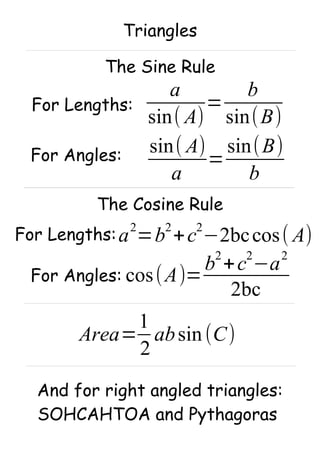
Triangles
a
sin( A)
=
b
sin(B)
a2
=b2
+c2
−2bccos( A)
Area=
1
2
absin(C)
cos(A)=
b
2
+c
2
−a
2
2bc
sin( A)
a
=
sin(B)
b
The Sine Rule
The Cosine Rule
For Lengths:
For Lengths:
For Angles:
For Angles:
And for right angled triangles:
SOHCAHTOA and Pythagoras
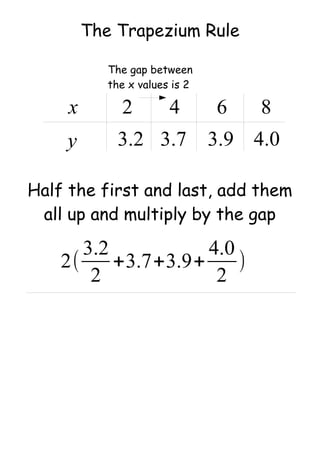
The Trapezium Rule
2(
3.2
2
+3.7+3.9+
4.0
2
)
x
y
2 4 6 8
3.2 3.7 3.9 4.0
The gap between
the x values is 2
Half the first and last, add them
all up and multiply by the gap
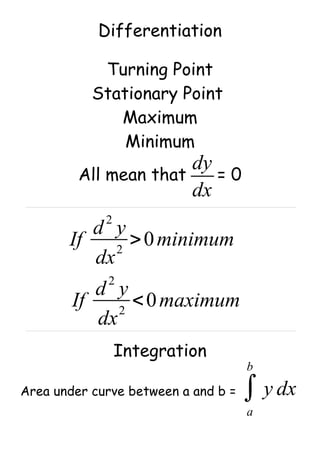
Differentiation
dy
dx
Turning Point
Stationary Point
Maximum
Minimum
All mean that = 0
If
d2
y
dx2
>0minimum
If
d
2
y
dx2
<0maximum
Differentiation
Integration
Area under curve between a and b = ∫
a
b
y dx
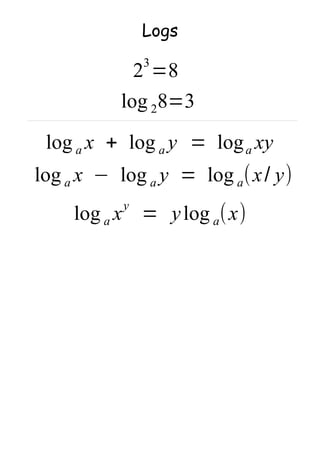
Logs
2
3
=8
log 82 =3
log xa + log ya = log xya
log xa − log ya = log (x/ y)a
log x
y
a = ylog (x)a
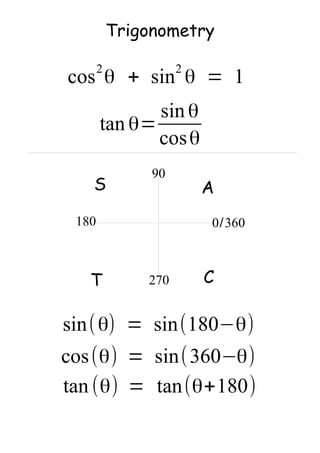
Trigonometry
cos
2
θ + sin
2
θ = 1
tan θ=
sinθ
cosθ
C
AS
T
0/360
90
180
270
sin(θ) = sin(180−θ)
cos(θ) = sin(360−θ)
tan (θ) = tan(θ+180)

C2notes 3