C2.5 Salts and Electrolysis
Mr D Powell
Animated Science
2015
C2 5.5 Changes at the electrodes
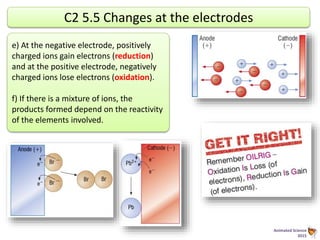
e) At the negative electrode, positively
charged ions gain electrons (reduction)
and at the positive electrode, negatively
charged ions lose electrons (oxidation).
f) If there is a mixture of ions, the
products formed depend on the reactivity
of the elements involved.
Animated Science
2015
Movement of Ions...
During electrolysis ions move towards the
electrodes.
The direction they move in depends on their
charge.
1. Positive ions move towards the negative
electrode (the cathode).
2. Negative ions move towards the positive
electrode (the anode).
When ions reach an electrode, they either lose
or gain electrons depending on
their charge.
Negatively charged ions lose electrons to
become neutral atoms. Positively charged ions
form neutral atoms by gaining electrons.
TASK: Can you draw a labelled
diagram (BASIC) and
explain how ions move
during electrolysis with a
paragraph of text
(Medium). Can you add a
real example you know of
(Harder)
Animated Science
2015
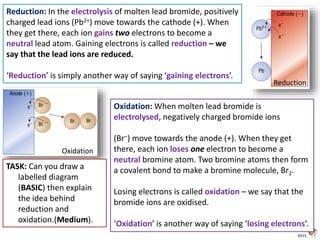
Reduction: In the electrolysis of molten lead bromide, positively
charged lead ions (Pb2+) move towards the cathode (+). When
they get there, each ion gains two electrons to become a
neutral lead atom. Gaining electrons is called reduction – we
say that the lead ions are reduced.
‘Reduction’ is simply another way of saying ‘gaining electrons’.
Oxidation: When molten lead bromide is
electrolysed, negatively charged bromide ions
(Br–) move towards the anode (+). When they get
there, each ion loses one electron to become a
neutral bromine atom. Two bromine atoms then form
a covalent bond to make a bromine molecule, Br2.
Losing electrons is called oxidation – we say that the
bromide ions are oxidised.
‘Oxidation’ is another way of saying ‘losing electrons’.
TASK: Can you draw a
labelled diagram
(BASIC) then explain
the idea behind
reduction and
oxidation.(Medium).
Oxidation
Reduction
Animated Science
2015
HT – “Half Equations” & “Redox”
Animated Science
2015
Effect of Water – (Harder)
When we carry out electrolysis in water the situation is
made more complicated by the fact that water contains
ions.
The rule for working out what will happen is to remember
that if two elements can be produced at an electrode, the
less reactive element will usually be formed.
Hydrogen is less reactive than potassium, so it is produced
at the negative electrode rather than potassium when we
electrolyse a solution of a potassium compound
If we think about the positive electrode
(anode) we find that we get OH- ions
from the water produced (giving O2(g))
unless the solution has a high
concentration of halide ion (group VII).
Then we have the halide discharged
instead.
Animated Science
2015
HT - Half Equations – Extra Help...
Step Result
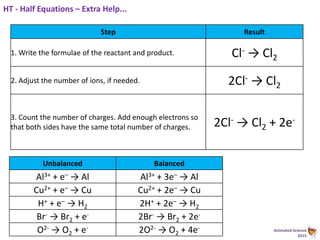
1. Write the formulae of the reactant and product. Cl- → Cl2
2. Adjust the number of ions, if needed. 2Cl- → Cl2
3. Count the number of charges. Add enough electrons so
that both sides have the same total number of charges. 2Cl- → Cl2 + 2e-
Unbalanced Balanced
Al3+ + e– → Al Al3+ + 3e– → Al
Cu2+ + e– → Cu Cu2+ + 2e– → Cu
H+ + e– → H2 2H+ + 2e– → H2
Br- → Br2 + e- 2Br- → Br2 + 2e-
O2- → O2 + e- 2O2- → O2 + 4e-

C2.5.5 Changes at Electrodes

  • 1.
    C2.5 Salts andElectrolysis Mr D Powell
  • 2.
    Animated Science 2015 C2 5.5Changes at the electrodes e) At the negative electrode, positively charged ions gain electrons (reduction) and at the positive electrode, negatively charged ions lose electrons (oxidation). f) If there is a mixture of ions, the products formed depend on the reactivity of the elements involved.
  • 3.
    Animated Science 2015 Movement ofIons... During electrolysis ions move towards the electrodes. The direction they move in depends on their charge. 1. Positive ions move towards the negative electrode (the cathode). 2. Negative ions move towards the positive electrode (the anode). When ions reach an electrode, they either lose or gain electrons depending on their charge. Negatively charged ions lose electrons to become neutral atoms. Positively charged ions form neutral atoms by gaining electrons. TASK: Can you draw a labelled diagram (BASIC) and explain how ions move during electrolysis with a paragraph of text (Medium). Can you add a real example you know of (Harder)
  • 4.
    Animated Science 2015 Reduction: Inthe electrolysis of molten lead bromide, positively charged lead ions (Pb2+) move towards the cathode (+). When they get there, each ion gains two electrons to become a neutral lead atom. Gaining electrons is called reduction – we say that the lead ions are reduced. ‘Reduction’ is simply another way of saying ‘gaining electrons’. Oxidation: When molten lead bromide is electrolysed, negatively charged bromide ions (Br–) move towards the anode (+). When they get there, each ion loses one electron to become a neutral bromine atom. Two bromine atoms then form a covalent bond to make a bromine molecule, Br2. Losing electrons is called oxidation – we say that the bromide ions are oxidised. ‘Oxidation’ is another way of saying ‘losing electrons’. TASK: Can you draw a labelled diagram (BASIC) then explain the idea behind reduction and oxidation.(Medium). Oxidation Reduction
  • 5.
    Animated Science 2015 HT –“Half Equations” & “Redox”
  • 6.
    Animated Science 2015 Effect ofWater – (Harder) When we carry out electrolysis in water the situation is made more complicated by the fact that water contains ions. The rule for working out what will happen is to remember that if two elements can be produced at an electrode, the less reactive element will usually be formed. Hydrogen is less reactive than potassium, so it is produced at the negative electrode rather than potassium when we electrolyse a solution of a potassium compound If we think about the positive electrode (anode) we find that we get OH- ions from the water produced (giving O2(g)) unless the solution has a high concentration of halide ion (group VII). Then we have the halide discharged instead.
  • 7.
    Animated Science 2015 HT -Half Equations – Extra Help... Step Result 1. Write the formulae of the reactant and product. Cl- → Cl2 2. Adjust the number of ions, if needed. 2Cl- → Cl2 3. Count the number of charges. Add enough electrons so that both sides have the same total number of charges. 2Cl- → Cl2 + 2e- Unbalanced Balanced Al3+ + e– → Al Al3+ + 3e– → Al Cu2+ + e– → Cu Cu2+ + 2e– → Cu H+ + e– → H2 2H+ + 2e– → H2 Br- → Br2 + e- 2Br- → Br2 + 2e- O2- → O2 + e- 2O2- → O2 + 4e-

Editor's Notes

  • #3 ■ the electrolysis of molten lead bromide or zinc chloride ■ investigation of the electrolysis of any solutions of a soluble ionic compound, eg copper chloride, sodium chloride, zinc bromide, zinc iodide ■ a demonstration of the Hoffman voltameter ■ the electroplating of copper foil with nickel in a nickel sulfate solution ■ the movement of ions, eg by electrolysis of a crystal of KMnO4 on filter paper dampened with sodium chloride solution, or electrolysis of CuCrO4 in a saturated urea solution using a U-tube ■ using conductivity sensors to monitor conductivity and changes in conductivity.