Download to read offline
![IOSR Journal of Electrical and Electronics Engineering (IOSR-JEEE)
e-ISSN: 2278-1676,p-ISSN: 2320-3331, Volume 10, Issue 2 Ver. III (Mar – Apr. 2015), PP 13-19
www.iosrjournals.org
DOI: 10.9790/1676-10231319 www.iosrjournals.org 13 | Page
Simulation and Modelling of Adaptive Fuzzy Logic Speed
Controller for BLDC Motor
Deepa.M.U1
, Rajesh.A.V2
1
(EEE, College Of Engineering Perumon,India)
2
(EEE, College Of Engineering Perumon, India)
Abstract:The paper presents the analysis and modelling of BLDC motor with adaptive fuzzy logic controller for
achieving improved performance of BLDC servomotor drive. For designing controllers it is necessary to know
the exact model of the system. Here it has to be assumed that the system parameters never change during
operating conditions, but practically the mechanical load parameters like inertia and friction may change due
to change in load.. In this paper, adaptive fuzzy logic controller for BLDC motor has been proposed. The
controller consists of two structures, one is fuzzy PI controller and the other is fuzzy PD controller. Based on
the speed error signal received, switching takes place between these two controllers. Comparison is made
between P, PI and the proposed adaptive fuzzy logic controller. In order to improve the performance during
transient and steady state phase adaptive fuzzy logic controller has been developed.
Keywords: BLDC Motor, Adaptive Fuzzy logic controller, PI controller, PD controller , P controller
I. Introduction
The BLDC motors which are replacing the brushed dc motors are more frequently finding their way
into an increasing number of medical, servo control and drive system applications. The operating characteristics
of BLDC motor resemble that of a dc motor, hence its name BLDC motor[1]. BLDC motors are predominantly
surface-magnet machines with wide permanent magnet pole-arcs and concentrated stator windings. The design
is based on a square waveform distribution of the air-gap flux density waveform as well as the winding density
of the stator phases in order to match the operational characteristics of the self-controlled inverter .Having the
armature windings on the stator helps the conduction of heat from the windings. Since there are no windings on
the rotor, electrical losses in the rotor are minimal. There are three classifications of the BLDC motor: single-
phase, two-phase and three-phase. The single-phase and three-phase motors are the most widely used. There are
two types of stator windings: trapezoidal and sinusoidal, which refers to the shape of the back electromotive
force (BEMF) signal[3]. The shape of the BEMF is determined by different coil interconnections and the
distance of the air gap. In addition to the BEMF, the phase current also follows a trapezoidal and sinusoidal
shape. A sinusoidal motor produces smoother electromagnetic torque than a paper. trapezoidal motor, though at
a higher cost due to their use of extra copper windings. A BLDC motor uses a simplified structure with
trapezoidal stator windings . Another advantage of using BLDC motor they have low electric noise and long
lifetime since there are no brushes and commutator therefore no arcs from brushes to generate noise, which
cause EMI problem[3].
The primary disadvantage of BLDC is cost, though this is no inherent reason due to the motor itself;
the construction of a BLDC motor is actually simpler than that of brushed DC motor or AC induction motor.
The higher cost of BLDC motor is caused by the additional driver circuit for BLDC motor[5]. However if the
application requires adjustable speed, accurate position control, or requires a driver circuit, then BLDC motor is
not only advantageous but also less expensive overall. Brushless DC motors use electric switches to realize
current commutation, and thus continuously rotate the motor. These electric switches are usually connected in
an H-bridge structure for a single-phase BLDC motor. Usually the high-side switches are controlled using pulse-
width modulation (PWM), which converts a DC voltage into a modulated voltage, which easily and efficiently
limits the startup current, control speed and torque. Generally, raising the switching frequency increases PWM
losses, though lowering the switching frequency limits the system’s bandwidth and can raise the ripple current
pulses to the points where they become destructive or shut down the BLDC motor driver[4].
For designing controllers it is necessary to know the exact model of the system. Here it has to be
assumed that the system parameters never change during operating conditions, but practically the mechanical
load parameters like inertia and friction may change due to change in load .The main disadvantage of the
conventional controllers is that they can provide better transient and steady state responses only when they are
designed remain unchanged. But practically the parameters may change during operation. If PI controller is
used, when the motor is disturbed, it requires fine tuning of proportional gain (Kp) and integral time constant
(Ti). In this paper, the controller consists of two structures , one is fuzzy PI controller and the other is fuzzy PD
controller.](https://image.slidesharecdn.com/c010231319-160705061737/85/C010231319-1-320.jpg)
![IOSR Journal of Electrical and Electronics Engineering (IOSR-JEEE)
e-ISSN: 2278-1676,p-ISSN: 2320-3331, Volume 10, Issue 2 Ver. III (Mar – Apr. 2015), PP 13-19
www.iosrjournals.org
DOI: 10.9790/1676-10231319 www.iosrjournals.org 13 | Page
Simulation and Modelling of Adaptive Fuzzy Logic Speed
Controller for BLDC Motor
Deepa.M.U1
, Rajesh.A.V2
1
(EEE, College Of Engineering Perumon,India)
2
(EEE, College Of Engineering Perumon, India)
Abstract:The paper presents the analysis and modelling of BLDC motor with adaptive fuzzy logic controller for
achieving improved performance of BLDC servomotor drive. For designing controllers it is necessary to know
the exact model of the system. Here it has to be assumed that the system parameters never change during
operating conditions, but practically the mechanical load parameters like inertia and friction may change due
to change in load.. In this paper, adaptive fuzzy logic controller for BLDC motor has been proposed. The
controller consists of two structures, one is fuzzy PI controller and the other is fuzzy PD controller. Based on
the speed error signal received, switching takes place between these two controllers. Comparison is made
between P, PI and the proposed adaptive fuzzy logic controller. In order to improve the performance during
transient and steady state phase adaptive fuzzy logic controller has been developed.
Keywords: BLDC Motor, Adaptive Fuzzy logic controller, PI controller, PD controller , P controller
I. Introduction
The BLDC motors which are replacing the brushed dc motors are more frequently finding their way
into an increasing number of medical, servo control and drive system applications. The operating characteristics
of BLDC motor resemble that of a dc motor, hence its name BLDC motor[1]. BLDC motors are predominantly
surface-magnet machines with wide permanent magnet pole-arcs and concentrated stator windings. The design
is based on a square waveform distribution of the air-gap flux density waveform as well as the winding density
of the stator phases in order to match the operational characteristics of the self-controlled inverter .Having the
armature windings on the stator helps the conduction of heat from the windings. Since there are no windings on
the rotor, electrical losses in the rotor are minimal. There are three classifications of the BLDC motor: single-
phase, two-phase and three-phase. The single-phase and three-phase motors are the most widely used. There are
two types of stator windings: trapezoidal and sinusoidal, which refers to the shape of the back electromotive
force (BEMF) signal[3]. The shape of the BEMF is determined by different coil interconnections and the
distance of the air gap. In addition to the BEMF, the phase current also follows a trapezoidal and sinusoidal
shape. A sinusoidal motor produces smoother electromagnetic torque than a paper. trapezoidal motor, though at
a higher cost due to their use of extra copper windings. A BLDC motor uses a simplified structure with
trapezoidal stator windings . Another advantage of using BLDC motor they have low electric noise and long
lifetime since there are no brushes and commutator therefore no arcs from brushes to generate noise, which
cause EMI problem[3].
The primary disadvantage of BLDC is cost, though this is no inherent reason due to the motor itself;
the construction of a BLDC motor is actually simpler than that of brushed DC motor or AC induction motor.
The higher cost of BLDC motor is caused by the additional driver circuit for BLDC motor[5]. However if the
application requires adjustable speed, accurate position control, or requires a driver circuit, then BLDC motor is
not only advantageous but also less expensive overall. Brushless DC motors use electric switches to realize
current commutation, and thus continuously rotate the motor. These electric switches are usually connected in
an H-bridge structure for a single-phase BLDC motor. Usually the high-side switches are controlled using pulse-
width modulation (PWM), which converts a DC voltage into a modulated voltage, which easily and efficiently
limits the startup current, control speed and torque. Generally, raising the switching frequency increases PWM
losses, though lowering the switching frequency limits the system’s bandwidth and can raise the ripple current
pulses to the points where they become destructive or shut down the BLDC motor driver[4].
For designing controllers it is necessary to know the exact model of the system. Here it has to be
assumed that the system parameters never change during operating conditions, but practically the mechanical
load parameters like inertia and friction may change due to change in load .The main disadvantage of the
conventional controllers is that they can provide better transient and steady state responses only when they are
designed remain unchanged. But practically the parameters may change during operation. If PI controller is
used, when the motor is disturbed, it requires fine tuning of proportional gain (Kp) and integral time constant
(Ti). In this paper, the controller consists of two structures , one is fuzzy PI controller and the other is fuzzy PD
controller.](https://image.slidesharecdn.com/c010231319-160705061737/75/C010231319-1-2048.jpg)
![Simulation and Modelling of Adaptive Fuzzy Logic Speed Controller for BLDC Motor
DOI: 10.9790/1676-10231319 www.iosrjournals.org 14 | Page
II. Modelling Of Bldc Motor
The BLDCM has three stator windings and a permanent magnet rotor on the rotor. Rotor induced
currents can be neglected due to the high resistivity of both magnets and stainless steel. No damper winding are
modeled the circuit equation of the three windings in phase variables are obtained[5].
Fig:1 BLDC motor drive system
The electrical part of DC brushless motor and relationship between currents, voltage, and back
electromotive force and rotor velocity is derived using Kirchhoff’s voltage law. The equations involved inthe
modeling of PMBLDC motor shown in Fig. 1 arederived as
Vab= R( ia-ib) + Ld/dt( ia-ib) + Ea-Eb (1)
Vbc= R( ib-ic) + Ld/dt( ib-ic) + Eb-Ec (2)
Vca= R( ic-ia) + Ld/dt( ic-ia) + Ec-Ea (3)
Where:
R : per phase Stator resistance
L : per phase Stator inductance
The instantaneous stator phase currents are represented by ia, iband ic as. The instantaneous stator line voltages
are represented by Vab, Vbcand Vcawhereas Ea, Eb and Ec represent the instantaneous back emf’s. The
relationship between the phase current is given by
ia+ib+ic = 0 (4)
From the above equation,
ic = - ( ia+ib) (5)
Using Eq(5) the line voltage Eq(1)and (2) can be rewritten as ,
Vab = R( ia-ib) + Ld/dt( ia-ib) + Ea-Eb (6)
Vbc= R( ia+2ib) + Ld/dt( ia+2ib) + Ea-Eb (7)
The electromagnetic torque developed by the motor can be expressed as
Te = (Ea ia + Eb ib + Ec ic)/ω (8)
Since this electromagnetic torque is utilized to overcome the opposing torques of inertia and load, it can be
written as
Te = TL+ JMdω/dt +BM ω (9)
Where TLis the load torque, JM is the inertia, and BM is the frictional constant of the BLDC servomotor. The
load torque can be expressed in terms of load inertia JL and friction BL components as
TL = JLdω/dt + BLω (10)
The output power developed by the motor is](https://image.slidesharecdn.com/c010231319-160705061737/85/C010231319-2-320.jpg)
![Simulation and Modelling of Adaptive Fuzzy Logic Speed Controller for BLDC Motor
DOI: 10.9790/1676-10231319 www.iosrjournals.org 15 | Page
P = Te ω (11)
E = Ea = Eb = Ec = Kb ω (12)
The parameters that are likely to vary during the working conditions are R, JM, JL, BM, and BL.
Increase in the value of energy storage inertia elements JMand JLwill increase the settling time of the speed
response or vice versa. The decrease in the values of power consuming friction components BM and BL will
increase the deceleration time of the speed response or vice versa[7].
Table: Selected Specifications For Bldc Motor Drive
Specifications Value
Stator phase resistance (Ω) 1
Stator phase inductance (H) 0.001
Flux Linkage established b;ja3y magnets 0.175
Voltage constant 0.1466
Torque constant 1.4
Moment of inertia (JM) 0.0008
Friction Factor (BM) 0.001
Pole pairs 4
Fig: 2 Modelling of BLDC motor
III. Adaptive Fuzzy Logic Controller For Bldc Motor
Several studies show, both in simulations and experimental results, that Fuzzy Logic control yields
superior results with respect to those obtained by conventional control algorithms thus, in industrial electronics
the FLC control has become an attractive solution in controlling the electrical motor drives with large parameter
variations like machine tools and robots. However, the FL Controllers design and tuning process is often
complex because several quantities, such as membership functions, control rules, input and output gains, etc
must be adjusted[4-6].Fuzzy logic has rapidly become one of the most successful of today’s technology for
developing sophisticated control system.. The past few years have witnessed a rapid growth in number and
variety of application of fuzzy logic. The application range from consumer products such as cameras, camcorder
and washing machines [8].
In the proposed system, the controller consists of two controller, fuzzy PD and fuzzy PI controller
inorder to improve the performance during transient and steady state. Based on the error signal received,
switching takes place between these controllers accordingly. The first step while designing the controller will be
to decide the state variables of the drive system which will be taken as the input signals to the controller. Here
both speed and change in speed error are used as inputs to the controller. The output of the controller, the
control signal will be given to the inverter section where the voltage will be controlled, thereby controlling the
speed. After specifying the fuzzy sets and the membership function for seven sets, the triangular membership
functions are used to define the degree of membership [10].](https://image.slidesharecdn.com/c010231319-160705061737/85/C010231319-3-320.jpg)
![Simulation and Modelling of Adaptive Fuzzy Logic Speed Controller for BLDC Motor
DOI: 10.9790/1676-10231319 www.iosrjournals.org 17 | Page
In a proportional controller the output signal is proportional to the error signal. It amplifies the error
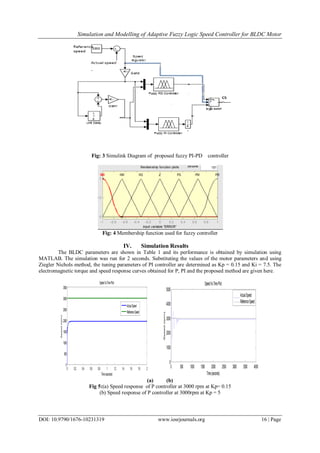
signal and increases the loop gain. Fig 5(a) represents the speed response of BLDC motor when P controller
withKp = 0.15 is used . From Fig 5 (a) it is clear that the steady state error is large, where the reference speed is
3000 rpm. Also in a P controller the steady state error tends to depend inversely upon the proportional gain, so if
the gain is made larger the error goes down. But as the gain increases the system eventually becomes unstable
and this unstability can be clearly observed from Fig 5 (b).
Fig6: Speed responseof PI controller at 3000rpm
Fig 6 represents speed response of the system,when PI controller is used. The PI controller consists of
both proportional and integral controllers where the proportional controller will have the effect of reducing rise
time but it will never eliminate the steady state error while, the integral controller eliminates the steady stste
error but may make the transient response worse. Thus in Fig 6 it can be noticed that the steady state error is
eliminated. But it causes an overshoot which may create problems in the system[9].
Fig 7:speed response at 3000 rpm when proposed controller is used.
The response of the system when the proposed controller is used is given in Fig 7. The proposed
controller consists of a fuzzy PI and fuzzy PD block as discussed above. The speed responses are given in Fig
7 where 3000rpm is taken as the reference speed. From the graph above it can be noticed that the proposed
controller eliminates all the problems that a simple PI controller had. With the newly developed proposed
controller, the drive system will have superior rise time and settling time characteristics.
0 0.1 0.2 0.3 0.4 0.5 0.6 0.7 0.8 0.9 1
0
500
1000
1500
2000
2500
3000
3500
Time (seconds)
Speed(rpm)
Speed Vs Time Plot:
Actual Speed
Reference Speed
0 0.5 1 1.5 2 2.5 3 3.5 4 4.5
x10
4
0
1000
2000
3000
Time(seconds)
Speed(rpm)
SpeedVsTimePlot:
ActualSpeed
ReferenceSpeed](https://image.slidesharecdn.com/c010231319-160705061737/85/C010231319-5-320.jpg)
![Simulation and Modelling of Adaptive Fuzzy Logic Speed Controller for BLDC Motor
DOI: 10.9790/1676-10231319 www.iosrjournals.org 18 | Page
Fig 8: Speed response of PI controller when T=2Nm
Fig 9: Speed response of proposed controller when T= 2Nm
It is to be noticed from Fig (8) that speed response of proposed controller changes when the load
changes due to change in the system parameters thus we have to fine tune the propotional gain constant and
integral time constant with respect to the load change, which is a tedious task. But from Fig (7) and (9) we can
notice that the response of the proposed controller response does not change even if there is a change in load
i.e., it is self tuned, which makes the task easier.
V. Conclusion
A fuzzy logic controller (FLC) has been employed for the speed control of PMBLDC motor drive and
analysis of results of the performance of a fuzzy controller is presented. The modelling and simulation of the
complete drive system is described in this thesis. Effectiveness of the model is established by performance
prediction over a wide range of operating conditions. A performance comparison between the fuzzy logic
controller and the conventional PI and P controller has been carried out by simulation runs confirming the
validity and superiority of the fuzzy logic controller for implementing the fuzzy logic controller to be adjusted
such that manual tuning time of the classical controller is significantly reduced. Fuzzy logic speed controller
improved the performance of PMBLDC drive of the fuzzy logic speed controller.
References
Journal Papers:
[1]. E. Kaliappan,C.Chellamuthu,Modelling,simulation and experimental analysis of permanent magnet brushless DC motors for
sensorless operation,Archives of Electrical Engineering ,vol.61(4),pp.499-515(2012).
[2]. R.Shanmughasundaram, member IEEE, K>Muhammad Zakariah and N.Yadaiash, IEEE, Implementation and performance analysis
of digital controllers for BLDC motor drives , IEEE/ASME transactions on mechatronics, vol.19,no.1,February 2014.
[3]. Tae-Hyung Kim, Hyung-Woo Lee ,Advanced sensorless drive technique for multiphase BLDC motor, 30th
annual conference of
the IEEE industrialelectronics society, November 26, 2004, Busan,Korea.
[4]. Omar Aydogdu, Ramzan Akkaya, An Effective real coded GA based fuzzy controller for speed control of BLDC motor without
speed sensor, Turjelec Eng & Compsci, Vol.19, no. 3, 2011.
[5]. Xiaoxi, Wang Yufei, Liyaondong and Wang Xiangheng, Performance analysis of Multiphase permanent magnet brush;less dc
motor drives.
0 0.2 0.4 0.6 0.8 1 1.2 1.4 1.6 1.8 2
0
500
1000
1500
2000
2500
3000
3500
Time (seconds)
Speed(rpm)
Speed Vs Time Plot:
Actual Speed
Reference Speed
0 0.5 1 1.5 2 2.5 3 3.5 4 4.5
x 10
4
0
1000
2000
3000
4000
Speed(rpm)
Time(s)
Actual speed
Referencespeed](https://image.slidesharecdn.com/c010231319-160705061737/85/C010231319-6-320.jpg)
![Simulation and Modelling of Adaptive Fuzzy Logic Speed Controller for BLDC Motor
DOI: 10.9790/1676-10231319 www.iosrjournals.org 19 | Page
[6]. S.K.Safi, P.P.Acarlney, A.G.Jack, Analysis and simulation of the high speed torque performance of the brushless dc motor drives,
IEE proceedings power app., vol.49, no.5, October 2012.
[7]. Foudad Mrad and Ghassan Deeb, Experimental Comparative Analysis of Adaptive fuzzy logic controllers, IEEE transactions on
Control System technologies, vol.10, no.2 ,pp.250-255, 2002.
[8]. M.Ali Akcayol, Aydin Cetin, and Cetin Elmas, An Educational Tool for fuzzy logic controlled ADCM, IEEE transactions on
Education, vl.45, no.1, pp.33-42, 2002.
[9]. K.Premkumar, Dr.B.V.Manikandan, Adaptive fuzzy logic speed controller for BLDC motor, International Conference on
Power,Energyand control, 978-1-4673-6030-2/13.
Books:
[1]. T.J.E Miller,BrushlessPermanent magnet and reluctance motor drives, Clarendon Press, Oxford Science Publications1989.
[2]. R.Krishnan, Electric Motor drives – Modelling , Analysis and Control, Prentice Hall, Upper Saddle River, 2001.](https://image.slidesharecdn.com/c010231319-160705061737/85/C010231319-7-320.jpg)

This document summarizes a paper that presents an adaptive fuzzy logic speed controller for a brushless DC (BLDC) motor. It begins with an introduction to BLDC motors and their modeling. It then discusses the limitations of traditional PI controllers for BLDC motors when system parameters change. The document proposes an adaptive fuzzy logic controller with two structures - a fuzzy PI controller and fuzzy PD controller that switch based on speed error. Simulation results show the proposed controller has better transient and steady state performance than P, PI, and fixed-gain controllers when system parameters change. It concludes the adaptive fuzzy logic controller improves BLDC motor drive performance by self-tuning without needing to manually adjust gains.


![[000007]](https://cdn.slidesharecdn.com/ss_thumbnails/000007-211028000533-thumbnail.jpg?width=640&height=640&fit=bounds)


