Gagan Deep 
Rozy Computech Services 
3rd Gate, K.U., Kurukshetra-136119 
M- 9416011599 
Email – rozygag@yahoo.com
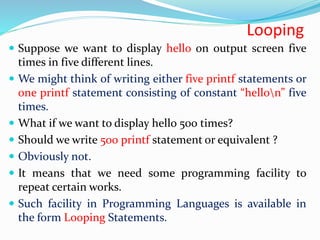
Looping 
Suppose we want to display hello on output screen five 
times in five different lines. 
We might think of writing either five printf statements or 
one printf statement consisting of constant “hellon” five 
times. 
What if we want to display hello 500 times? 
Should we write 500 printf statement or equivalent ? 
Obviously not. 
It means that we need some programming facility to 
repeat certain works. 
Such facility in Programming Languages is available in 
the form Looping Statements.
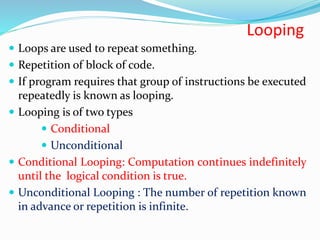
Looping 
Loops are used to repeat something. 
Repetition of block of code. 
If program requires that group of instructions be executed 
repeatedly is known as looping. 
Looping is of two types 
Conditional 
Unconditional 
Conditional Looping: Computation continues indefinitely 
until the logical condition is true. 
Unconditional Looping : The number of repetition known 
in advance or repetition is infinite.
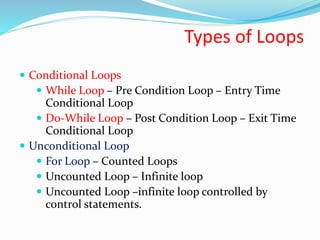
Types of Loops 
Conditional Loops 
While Loop – Pre Condition Loop – Entry Time 
Conditional Loop 
Do-While Loop – Post Condition Loop – Exit Time 
Conditional Loop 
Unconditional Loop 
For Loop – Counted Loops 
Uncounted Loop – Infinite loop 
Uncounted Loop –infinite loop controlled by 
control statements.
while Statement 
The while statement is used to carry out looping 
operations, in which a group of statement is executed 
repeatedly, until some condition has been satisfied. 
The general form of statement is 
while (test expression) 
statement to be executed; 
or 
while (test expression) 
{ statements to be executed }
Program 1-4 First 10 Natural Numbers 
#include <stdio.h> 
void main() 
{ int i=0; 
while(i<=9) // i<10 
printf(“%d”, i++); 
}/*here we can’t use ++i – that gives 
different result*/ 
//only a statement 
#include <stdio.h> 
void main() 
{ int i=0; 
while(i<=9) // i<10 
{ printf(“%dn”, i); 
i++; }//compound statement 
} //we also can use ++i 
#include <stdio.h> 
void main() 
{ int i=10; 
while(i<=9) // i<10 
{ printf(“%d”, i); 
i++; } 
// doesn’t work body of loop 
} 
#include <stdio.h> 
void main() 
{ int i=9; 
while(i>=0) // i>-1 
{ printf(“%d”, i); 
i--; } //--i 
}//decrement – decreasing order
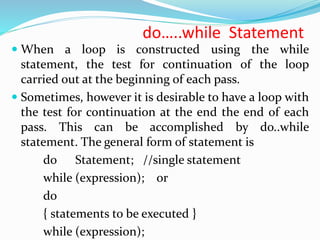
do…..while Statement 
When a loop is constructed using the while 
statement, the test for continuation of the loop 
carried out at the beginning of each pass. 
Sometimes, however it is desirable to have a loop with 
the test for continuation at the end the end of each 
pass. This can be accomplished by do..while 
statement. The general form of statement is 
do Statement; //single statement 
while (expression); or 
do 
{ statements to be executed } 
while (expression);
Program 5-8 First 10 Natural Numbers 
#include <stdio.h> 
void main() 
{ int i=0; 
do 
printf(“%d”, i++); 
while(i<=9); } 
#include <stdio.h> 
void main() 
{ int i=0; 
do 
{printf(“%dn”, i); 
i++; } 
while(i<=9) ; } 
#include <stdio.h> 
void main() 
{ int i=10; 
do //first execute then check 
{ printf(“%d”, i); 
i++; } while(i<=9) ; } 
// prints 10(execute one time) 
#include <stdio.h> 
void main() 
{ int i=9; 
do{ printf(“%d”, i); 
i--; } 
while(i>=0) ; }
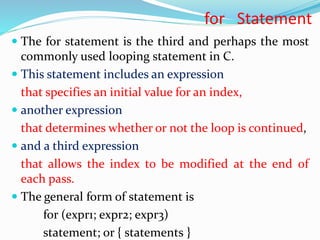
for Statement 
The for statement is the third and perhaps the most 
commonly used looping statement in C. 
This statement includes an expression 
that specifies an initial value for an index, 
another expression 
that determines whether or not the loop is continued, 
and a third expression 
that allows the index to be modified at the end of 
each pass. 
The general form of statement is 
for (expr1; expr2; expr3) 
statement; or { statements }
Print 1 to 10 Program 9-12 
#include<stdio.h> 
#include<stdio.h> 
void main() 
void main() 
{int i; 
{ 
for(i=1;i<=10;i++) 
for(int i=1;i<=10;++i) 
printf(“%d”,i); } 
printf(“%d”,i); } 
#include<stdio.h> 
void main() 
{ 
for(int i=1;i<=10;i=i+1) 
printf(“%d”,i); 
} 
#include<stdio.h> 
void main() 
{int i=1; 
for( ; i<=10; ) 
{ printf(“%d”,i); 
i++ ; } 
}//you can also use ++i
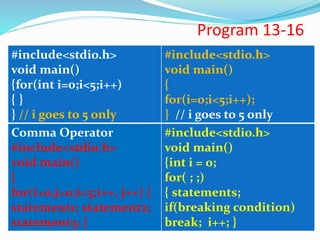
Program 13-16 
#include<stdio.h> 
void main() 
{for(int i=0;i<5;i++) 
{ } 
} // i goes to 5 only 
#include<stdio.h> 
void main() 
{ 
for(i=0;i<5;i++); 
} // i goes to 5 only 
Comma Operator 
#include<stdio.h> 
void main() 
{ 
for(i=0,j=0;i<5;i++, j++) { 
statement1; statement2; 
statement3; } 
#include<stdio.h> 
void main() 
{int i = 0; 
for( ; ;) 
{ statements; 
if(breaking condition) 
break; i++; }
Program 17-18 
Reverse Number 
#include<stdio.h> 
void main() 
{n, r, rn=0; 
scanf(“%d”, &n); 
while (n!=0) { 
r=n%10; n=n/10 ; 
rn=rn*10+r; } 
printf(“Reverese Number 
=%d”, rn); 
} 
Palindrome Number 
#include<stdio.h> 
void main() 
{n, r, T, rn=0; 
scanf(“%d”, &n); T=n; 
while (T!=0) { 
r=T%10; T=T/10 ; 
rn=rn*10+r; } 
if (rn==n) 
printf(“Palindrome Number); 
else 
printf(“Non-Palindrome 
Number); 
}
Program 19 
Prime Number 
#include<stdio.h> 
void main() 
{n, i; 
scanf(“%d”, &n); 
while (n % i != 0) 
i++; 
if (n==i) 
printf(“%d is prime”, n); 
}
If you have any queries you can 
contact me at : 
rozygag@yahoo.com

C lecture 3 control statements slideshare

  • 1.
    Gagan Deep RozyComputech Services 3rd Gate, K.U., Kurukshetra-136119 M- 9416011599 Email – rozygag@yahoo.com
  • 2.
    Looping Suppose wewant to display hello on output screen five times in five different lines. We might think of writing either five printf statements or one printf statement consisting of constant “hellon” five times. What if we want to display hello 500 times? Should we write 500 printf statement or equivalent ? Obviously not. It means that we need some programming facility to repeat certain works. Such facility in Programming Languages is available in the form Looping Statements.
  • 3.
    Looping Loops areused to repeat something. Repetition of block of code. If program requires that group of instructions be executed repeatedly is known as looping. Looping is of two types Conditional Unconditional Conditional Looping: Computation continues indefinitely until the logical condition is true. Unconditional Looping : The number of repetition known in advance or repetition is infinite.
  • 5.
    Types of Loops Conditional Loops While Loop – Pre Condition Loop – Entry Time Conditional Loop Do-While Loop – Post Condition Loop – Exit Time Conditional Loop Unconditional Loop For Loop – Counted Loops Uncounted Loop – Infinite loop Uncounted Loop –infinite loop controlled by control statements.
  • 6.
    while Statement Thewhile statement is used to carry out looping operations, in which a group of statement is executed repeatedly, until some condition has been satisfied. The general form of statement is while (test expression) statement to be executed; or while (test expression) { statements to be executed }
  • 7.
    Program 1-4 First10 Natural Numbers #include <stdio.h> void main() { int i=0; while(i<=9) // i<10 printf(“%d”, i++); }/*here we can’t use ++i – that gives different result*/ //only a statement #include <stdio.h> void main() { int i=0; while(i<=9) // i<10 { printf(“%dn”, i); i++; }//compound statement } //we also can use ++i #include <stdio.h> void main() { int i=10; while(i<=9) // i<10 { printf(“%d”, i); i++; } // doesn’t work body of loop } #include <stdio.h> void main() { int i=9; while(i>=0) // i>-1 { printf(“%d”, i); i--; } //--i }//decrement – decreasing order
  • 8.
    do…..while Statement Whena loop is constructed using the while statement, the test for continuation of the loop carried out at the beginning of each pass. Sometimes, however it is desirable to have a loop with the test for continuation at the end the end of each pass. This can be accomplished by do..while statement. The general form of statement is do Statement; //single statement while (expression); or do { statements to be executed } while (expression);
  • 9.
    Program 5-8 First10 Natural Numbers #include <stdio.h> void main() { int i=0; do printf(“%d”, i++); while(i<=9); } #include <stdio.h> void main() { int i=0; do {printf(“%dn”, i); i++; } while(i<=9) ; } #include <stdio.h> void main() { int i=10; do //first execute then check { printf(“%d”, i); i++; } while(i<=9) ; } // prints 10(execute one time) #include <stdio.h> void main() { int i=9; do{ printf(“%d”, i); i--; } while(i>=0) ; }
  • 10.
    for Statement Thefor statement is the third and perhaps the most commonly used looping statement in C. This statement includes an expression that specifies an initial value for an index, another expression that determines whether or not the loop is continued, and a third expression that allows the index to be modified at the end of each pass. The general form of statement is for (expr1; expr2; expr3) statement; or { statements }
  • 11.
    Print 1 to10 Program 9-12 #include<stdio.h> #include<stdio.h> void main() void main() {int i; { for(i=1;i<=10;i++) for(int i=1;i<=10;++i) printf(“%d”,i); } printf(“%d”,i); } #include<stdio.h> void main() { for(int i=1;i<=10;i=i+1) printf(“%d”,i); } #include<stdio.h> void main() {int i=1; for( ; i<=10; ) { printf(“%d”,i); i++ ; } }//you can also use ++i
  • 12.
    Program 13-16 #include<stdio.h> void main() {for(int i=0;i<5;i++) { } } // i goes to 5 only #include<stdio.h> void main() { for(i=0;i<5;i++); } // i goes to 5 only Comma Operator #include<stdio.h> void main() { for(i=0,j=0;i<5;i++, j++) { statement1; statement2; statement3; } #include<stdio.h> void main() {int i = 0; for( ; ;) { statements; if(breaking condition) break; i++; }
  • 13.
    Program 17-18 ReverseNumber #include<stdio.h> void main() {n, r, rn=0; scanf(“%d”, &n); while (n!=0) { r=n%10; n=n/10 ; rn=rn*10+r; } printf(“Reverese Number =%d”, rn); } Palindrome Number #include<stdio.h> void main() {n, r, T, rn=0; scanf(“%d”, &n); T=n; while (T!=0) { r=T%10; T=T/10 ; rn=rn*10+r; } if (rn==n) printf(“Palindrome Number); else printf(“Non-Palindrome Number); }
  • 14.
    Program 19 PrimeNumber #include<stdio.h> void main() {n, i; scanf(“%d”, &n); while (n % i != 0) i++; if (n==i) printf(“%d is prime”, n); }
  • 15.
    If you haveany queries you can contact me at : rozygag@yahoo.com