Exception handling in java
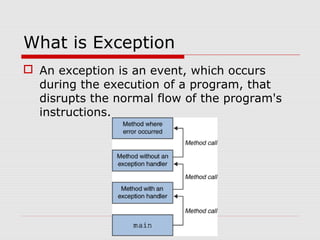
What is Exception
 An exception is an event, which occurs
during the execution of a program, that
disrupts the normal flow of the program's
instructions.
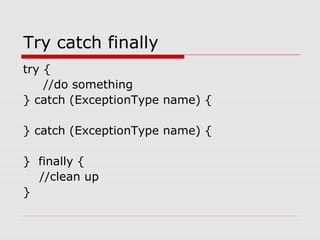
Try catch finally
try {
//do something
} catch (ExceptionType name) {
} finally {
//clean up
}
Advantages
 Separating Error-Handling Code from
"Regular" Code
 Propagating Errors Up the Call Stack
 Grouping and Differentiating Error
Types
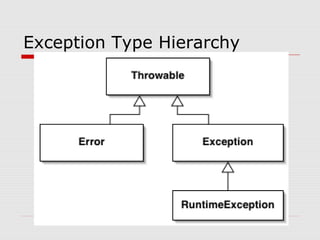
Exception Type Hierarchy
Checked exceptions
 Part of the method signature
 Compile type checking
 Requires programmer to handle the
exception or declare the method as
throws exception
 Unique to java
 e.g. FileNotFoundException
Unchecked exceptions
 No need to declare the exception in
method’s signature
 No compile time checking
 Usually indicate programming error
 e.g. NullPointerException
Error
 Indicate error in the underlying JVM
 Error are external to the application
 Application does not usually have to
deal with these class of Exceptions
 e.g. OutOfMemoryError
When to throw exceptions
 Exceptions indicate a broken contract
 Precondition (e.g. file is open for read)
 Postcondition (e.g. read a character from
file)

 Your method encounters an abnormal
condition that it can't handle
 If your method is unable to fulfill its
contract, throw either a checked or
unchecked exception.
What to throw?
 Exceptions v/s Errors
 Errors are for JVM
 Exceptions for rest of us

 Checked v/s Unchecked exceptions
 Can caller recover from this error?
 Yes: checked
 No: unchecked
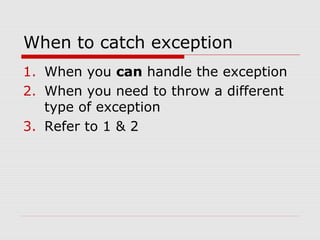
When to catch exception
1. When you can handle the exception
2. When you need to throw a different
type of exception
3. Refer to 1 & 2
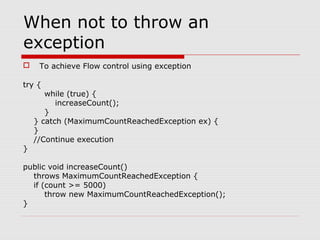
When not to throw an
exception


To achieve Flow control using exception

try {

}

while (true) {
increaseCount();
}
} catch (MaximumCountReachedException ex) {
}
//Continue execution

public void increaseCount()
throws MaximumCountReachedException {
if (count >= 5000)
throw new MaximumCountReachedException();
}
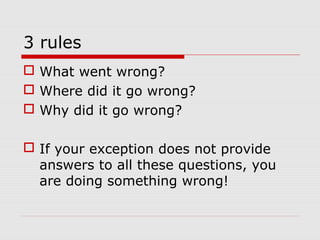
3 rules
 What went wrong?
 Where did it go wrong?
 Why did it go wrong?
 If your exception does not provide
answers to all these questions, you
are doing something wrong!
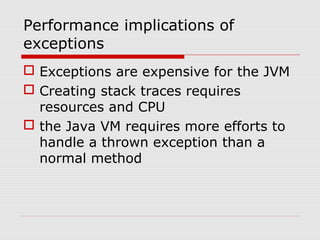
Performance implications of
exceptions
 Exceptions are expensive for the JVM
 Creating stack traces requires
resources and CPU
 the Java VM requires more efforts to
handle a thrown exception than a
normal method
Anti Patterns










Log and Throw
Throwing Generic Exception
Catching Generic Exception
Destructive Wrapping
Log and Return Null
Catch and Ignore (a.k.a. Head in the Sand)
Throw from Within Finally
Multi-Line Log Messages
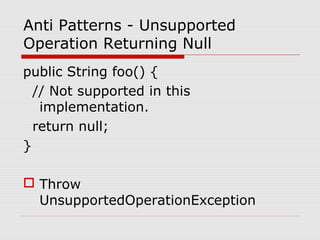
Unsupported Operation Returning Null
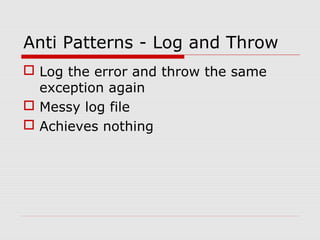
Anti Patterns - Log and Throw
 Log the error and throw the same
exception again
 Messy log file
 Achieves nothing
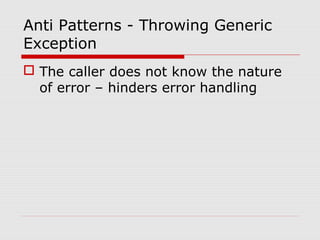
Anti Patterns - Throwing Generic
Exception
 The caller does not know the nature
of error – hinders error handling
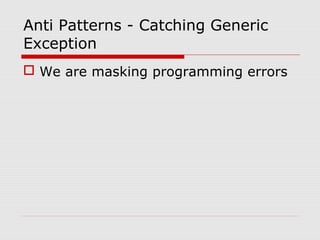
Anti Patterns - Catching Generic
Exception
 We are masking programming errors
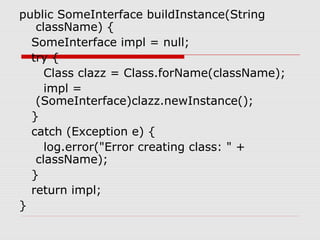
public SomeInterface buildInstance(String
className) {
SomeInterface impl = null;
try {
Class clazz = Class.forName(className);
impl =
(SomeInterface)clazz.newInstance();
}
catch (Exception e) {
log.error("Error creating class: " +
className);
}
return impl;
}
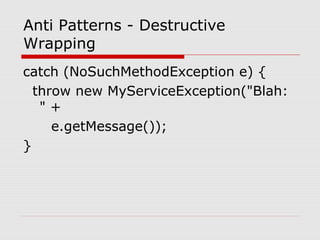
Anti Patterns - Destructive
Wrapping
catch (NoSuchMethodException e) {
throw new MyServiceException("Blah:
"+
e.getMessage());
}
Anti Patterns - Log and Return Null
catch (NoSuchMethodException e) {
LOG.error("Blah", e);
return null;
}
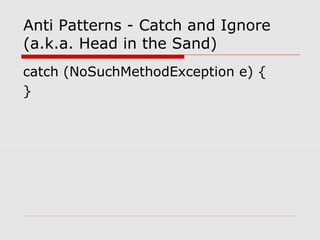
Anti Patterns - Catch and Ignore
(a.k.a. Head in the Sand)
catch (NoSuchMethodException e) {
}
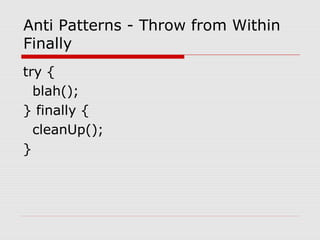
Anti Patterns - Throw from Within
Finally
try {
blah();
} finally {
cleanUp();
}
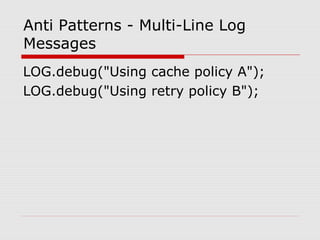
Anti Patterns - Multi-Line Log
Messages
LOG.debug("Using cache policy A");
LOG.debug("Using retry policy B");
Anti Patterns - Unsupported
Operation Returning Null
public String foo() {
// Not supported in this
implementation.
return null;
}
 Throw
UnsupportedOperationException
Best practices
 Throw checked exception when caller can recover
from error
 Throw runtime exception when the caller cannot
recover
 Throw runtime exception for programming error
 Throw early, catch late
 Use NestedException
 Don’t catch an exception if you cant do any thing
about it.
 Log exception only once, and at the latest possible
time
 Default Error Page in presentation layer for all
Runtime Exceptions
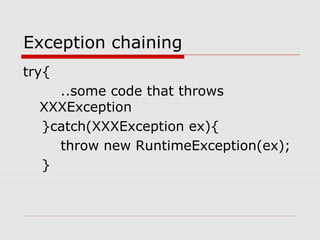
Exception chaining
try{
..some code that throws
XXXException
}catch(XXXException ex){
throw new RuntimeException(ex);
}
Exception logging
 Log all internal states
 Log all parameters to the method
that failed
 Log all data required to trace the
error
 Ensure log statements don’t cause
NPE*
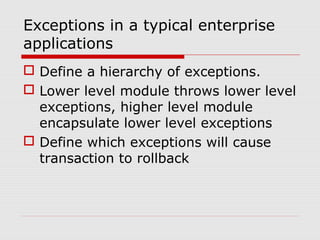
Exceptions in a typical enterprise
applications
 Define a hierarchy of exceptions.
 Lower level module throws lower level
exceptions, higher level module
encapsulate lower level exceptions
 Define which exceptions will cause
transaction to rollback
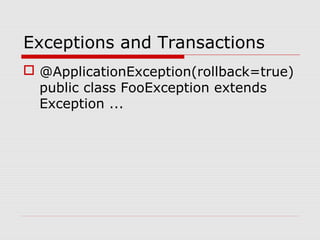
Exceptions and Transactions
 @ApplicationException(rollback=true)
public class FooException extends
Exception ...
Questions
references
Best practices in EJB exception handling
http://www.ibm.com/developerworks/library/j-ejbexcept.html
Beware the dangers of generic Exceptions
http://www.javaworld.com/javaworld/jw-10-2003/jw-1003generics.html
Exception Handling in Web Applications
http://weblogs.java.net/blog/crazybob/archive/2004/02/exception_han
dl.html
Designing with Exceptions
http://www.artima.com/designtechniques/desexceptP.html
Build a better exception-handling framework
http://www.ibm.com/developerworks/java/library/j-ejb01283.html
References (cont…)
JAVA EXCEPTIONS
http://www.javaolympus.com/J2SE/Exceptions/JavaExceptions.jsp
Exception-Handling Antipatterns
http://today.java.net/pub/a/today/2006/04/06/exception-handling-antipatterns.html
Three Rules for Effective Exception Handling
http://today.java.net/pub/a/today/2003/12/04/exceptions.html
13 Exceptional Exception Handling Techniques
http://www.manageability.org/blog/stuff/exceptional-exception-handling-techniques
Best Practices for Exception Handling
http://www.onjava.com/pub/a/onjava/2003/11/19/exceptions.html
Lesson: Exceptions
http://java.sun.com/docs/books/tutorial/essential/exceptions/index.html

Exception handling in java

  • 1.
  • 2.
    What is Exception An exception is an event, which occurs during the execution of a program, that disrupts the normal flow of the program's instructions.
  • 3.
    Try catch finally try{ //do something } catch (ExceptionType name) { } catch (ExceptionType name) { } finally { //clean up }
  • 4.
    Advantages  Separating Error-HandlingCode from "Regular" Code  Propagating Errors Up the Call Stack  Grouping and Differentiating Error Types
  • 5.
  • 6.
    Checked exceptions  Partof the method signature  Compile type checking  Requires programmer to handle the exception or declare the method as throws exception  Unique to java  e.g. FileNotFoundException
  • 7.
    Unchecked exceptions  Noneed to declare the exception in method’s signature  No compile time checking  Usually indicate programming error  e.g. NullPointerException
  • 8.
    Error  Indicate errorin the underlying JVM  Error are external to the application  Application does not usually have to deal with these class of Exceptions  e.g. OutOfMemoryError
  • 9.
    When to throwexceptions  Exceptions indicate a broken contract  Precondition (e.g. file is open for read)  Postcondition (e.g. read a character from file)  Your method encounters an abnormal condition that it can't handle  If your method is unable to fulfill its contract, throw either a checked or unchecked exception.
  • 10.
    What to throw? Exceptions v/s Errors  Errors are for JVM  Exceptions for rest of us  Checked v/s Unchecked exceptions  Can caller recover from this error?  Yes: checked  No: unchecked
  • 11.
    When to catchexception 1. When you can handle the exception 2. When you need to throw a different type of exception 3. Refer to 1 & 2
  • 12.
    When not tothrow an exception  To achieve Flow control using exception try { } while (true) { increaseCount(); } } catch (MaximumCountReachedException ex) { } //Continue execution public void increaseCount() throws MaximumCountReachedException { if (count >= 5000) throw new MaximumCountReachedException(); }
  • 13.
    3 rules  Whatwent wrong?  Where did it go wrong?  Why did it go wrong?  If your exception does not provide answers to all these questions, you are doing something wrong!
  • 14.
    Performance implications of exceptions Exceptions are expensive for the JVM  Creating stack traces requires resources and CPU  the Java VM requires more efforts to handle a thrown exception than a normal method
  • 15.
    Anti Patterns          Log andThrow Throwing Generic Exception Catching Generic Exception Destructive Wrapping Log and Return Null Catch and Ignore (a.k.a. Head in the Sand) Throw from Within Finally Multi-Line Log Messages Unsupported Operation Returning Null
  • 16.
    Anti Patterns -Log and Throw  Log the error and throw the same exception again  Messy log file  Achieves nothing
  • 17.
    Anti Patterns -Throwing Generic Exception  The caller does not know the nature of error – hinders error handling
  • 18.
    Anti Patterns -Catching Generic Exception  We are masking programming errors
  • 19.
    public SomeInterface buildInstance(String className){ SomeInterface impl = null; try { Class clazz = Class.forName(className); impl = (SomeInterface)clazz.newInstance(); } catch (Exception e) { log.error("Error creating class: " + className); } return impl; }
  • 20.
    Anti Patterns -Destructive Wrapping catch (NoSuchMethodException e) { throw new MyServiceException("Blah: "+ e.getMessage()); }
  • 21.
    Anti Patterns -Log and Return Null catch (NoSuchMethodException e) { LOG.error("Blah", e); return null; }
  • 22.
    Anti Patterns -Catch and Ignore (a.k.a. Head in the Sand) catch (NoSuchMethodException e) { }
  • 23.
    Anti Patterns -Throw from Within Finally try { blah(); } finally { cleanUp(); }
  • 24.
    Anti Patterns -Multi-Line Log Messages LOG.debug("Using cache policy A"); LOG.debug("Using retry policy B");
  • 25.
    Anti Patterns -Unsupported Operation Returning Null public String foo() { // Not supported in this implementation. return null; }  Throw UnsupportedOperationException
  • 26.
    Best practices  Throwchecked exception when caller can recover from error  Throw runtime exception when the caller cannot recover  Throw runtime exception for programming error  Throw early, catch late  Use NestedException  Don’t catch an exception if you cant do any thing about it.  Log exception only once, and at the latest possible time  Default Error Page in presentation layer for all Runtime Exceptions
  • 27.
    Exception chaining try{ ..some codethat throws XXXException }catch(XXXException ex){ throw new RuntimeException(ex); }
  • 28.
    Exception logging  Logall internal states  Log all parameters to the method that failed  Log all data required to trace the error  Ensure log statements don’t cause NPE*
  • 29.
    Exceptions in atypical enterprise applications  Define a hierarchy of exceptions.  Lower level module throws lower level exceptions, higher level module encapsulate lower level exceptions  Define which exceptions will cause transaction to rollback
  • 30.
    Exceptions and Transactions @ApplicationException(rollback=true) public class FooException extends Exception ...
  • 31.
  • 32.
    references Best practices inEJB exception handling http://www.ibm.com/developerworks/library/j-ejbexcept.html Beware the dangers of generic Exceptions http://www.javaworld.com/javaworld/jw-10-2003/jw-1003generics.html Exception Handling in Web Applications http://weblogs.java.net/blog/crazybob/archive/2004/02/exception_han dl.html Designing with Exceptions http://www.artima.com/designtechniques/desexceptP.html Build a better exception-handling framework http://www.ibm.com/developerworks/java/library/j-ejb01283.html
  • 33.
    References (cont…) JAVA EXCEPTIONS http://www.javaolympus.com/J2SE/Exceptions/JavaExceptions.jsp Exception-HandlingAntipatterns http://today.java.net/pub/a/today/2006/04/06/exception-handling-antipatterns.html Three Rules for Effective Exception Handling http://today.java.net/pub/a/today/2003/12/04/exceptions.html 13 Exceptional Exception Handling Techniques http://www.manageability.org/blog/stuff/exceptional-exception-handling-techniques Best Practices for Exception Handling http://www.onjava.com/pub/a/onjava/2003/11/19/exceptions.html Lesson: Exceptions http://java.sun.com/docs/books/tutorial/essential/exceptions/index.html

Editor's Notes

  • #21 Class not found Class cast to the interface SomeInterface Both types of exceptions are handled in the catch block, but that’s not evident by casual inspection of the code.