C Language Programming 
for the 8051 
Prof. Cherrice Traver EE/CS-152: Microprocessors 
and Microcontrollers
Overview 
Prof. Cherrice Traver EE/CS-152: Microprocessors 
and Microcontrollers 
• C for microcontrollers 
– Review of C basics 
– Compilation flow for SiLabs IDE 
– C extensions 
– In-line assembly 
– Interfacing with C 
• Examples 
• Arrays and Pointers 
• I/O Circuitry 
• Functions and Header Files 
• Multitasking and multithreading
C for Microcontrollers 
• Of higher level languages, C is the closest 
to assembly languages 
– bit manipulation instructions 
– pointers (indirect addressing) 
• Most microcontrollers have available C 
compilers 
• Writing in C simplifies code development 
for large projects. 
Prof. Cherrice Traver EE/CS-152: Microprocessors 
and Microcontrollers
Available C Compilers 
• Kiel – integrated with the IDE we have 
been using for labs. 
• Reads51 – available on web site ( 
http://www.rigelcorp.com/reads51.htm) 
• Freeware: SDCC - Small Device C 
Compiler (http://sdcc.sourceforge.net/) 
• Other freeware versions … 
Prof. Cherrice Traver EE/CS-152: Microprocessors 
and Microcontrollers
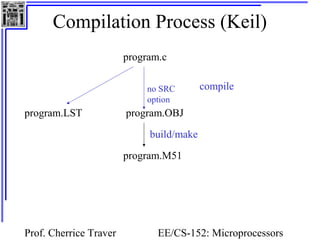
Compilation Process (Keil) 
program.c 
no SRC 
option 
program.OBJ 
program.M51 
compile 
Prof. Cherrice Traver EE/CS-152: Microprocessors 
and Microcontrollers 
program.LST 
build/make
Modular Programming 
• Like most high level languages, C is a 
modular programming language (but NOT 
an object oriented language) 
• Each task can be encapsulated as a function. 
• Entire program is encapsulated in “main” 
function. 
Prof. Cherrice Traver EE/CS-152: Microprocessors 
and Microcontrollers
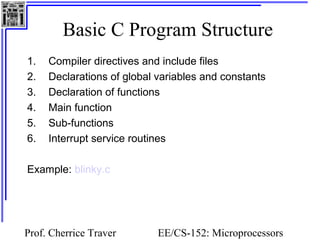
Basic C Program Structure 
1. Compiler directives and include files 
2. Declarations of global variables and constants 
3. Declaration of functions 
4. Main function 
5. Sub-functions 
6. Interrupt service routines 
Prof. Cherrice Traver EE/CS-152: Microprocessors 
and Microcontrollers 
Example: blinky.c
Back to C Basics 
• All C programs consists of: 
– Variables 
– Functions (one must be “main”) 
Prof. Cherrice Traver EE/CS-152: Microprocessors 
and Microcontrollers 
• Statements 
• To define the SFRs as variables: 
#include <c8051F020.h>
Variables 
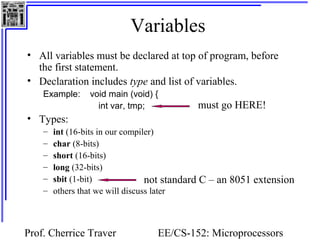
• All variables must be declared at top of program, before 
the first statement. 
• Declaration includes type and list of variables. 
Example: void main (void) { 
must go HERE! 
Prof. Cherrice Traver EE/CS-152: Microprocessors 
and Microcontrollers 
int var, tmp; 
• Types: 
– int (16-bits in our compiler) 
– char (8-bits) 
– short (16-bits) 
– long (32-bits) 
– sbit (1-bit) 
– others that we will discuss later 
not standard C – an 8051 extension
Variables 
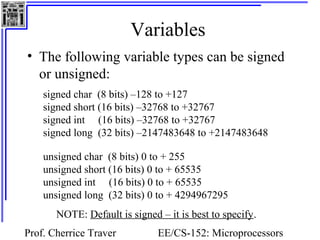
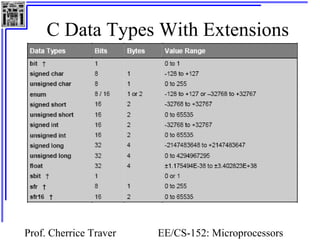
• The following variable types can be signed 
or unsigned: 
signed char (8 bits) –128 to +127 
signed short (16 bits) –32768 to +32767 
signed int (16 bits) –32768 to +32767 
signed long (32 bits) –2147483648 to +2147483648 
unsigned char (8 bits) 0 to + 255 
unsigned short (16 bits) 0 to + 65535 
unsigned int (16 bits) 0 to + 65535 
unsigned long (32 bits) 0 to + 4294967295 
NOTE: Default is signed – it is best to specify. 
Prof. Cherrice Traver EE/CS-152: Microprocessors 
and Microcontrollers
Statements 
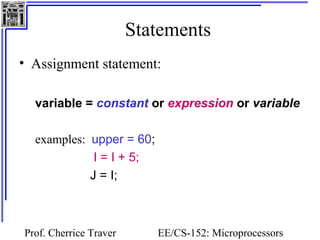
• Assignment statement: 
variable = constant or expression or variable 
Prof. Cherrice Traver EE/CS-152: Microprocessors 
and Microcontrollers 
examples: upper = 60; 
I = I + 5; 
J = I;
Operators 
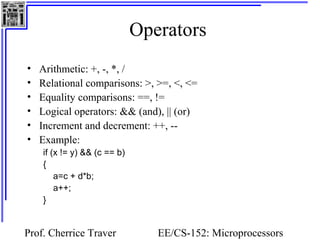
• Arithmetic: +, -, *, / 
• Relational comparisons: >, >=, <, <= 
• Equality comparisons: ==, != 
• Logical operators: && (and), || (or) 
• Increment and decrement: ++, -- 
• Example: 
Prof. Cherrice Traver EE/CS-152: Microprocessors 
and Microcontrollers 
if (x != y) && (c == b) 
{ 
a=c + d*b; 
a++; 
}
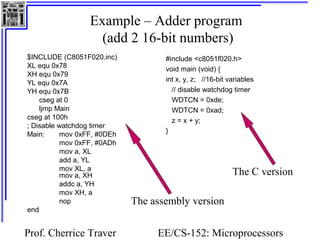
Example – Adder program 
(add 2 16-bit numbers) 
Prof. Cherrice Traver EE/CS-152: Microprocessors 
and Microcontrollers 
$INCLUDE (C8051F020.inc) 
XL equ 0x78 
XH equ 0x79 
YL equ 0x7A 
YH equ 0x7B 
cseg at 0 
ljmp Main 
cseg at 100h 
; Disable watchdog timer 
Main: mov 0xFF, #0DEh 
mov 0xFF, #0ADh 
mov a, XL 
add a, YL 
mov XL, a 
mov a, XH 
addc a, YH 
mov XH, a 
nop 
end 
#include <c8051f020.h> 
void main (void) { 
int x, y, z; //16-bit variables 
// disable watchdog timer 
WDTCN = 0xde; 
WDTCN = 0xad; 
z = x + y; 
} 
The C version 
The assembly version
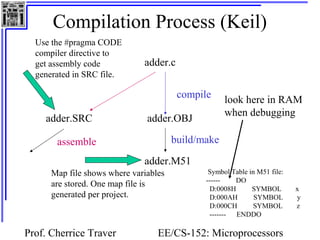
Compilation Process (Keil) 
adder.c 
compile 
adder.OBJ 
adder.M51 
look here in RAM 
when debugging 
Prof. Cherrice Traver EE/CS-152: Microprocessors 
and Microcontrollers 
adder.SRC 
build/make 
Use the #pragma CODE 
compiler directive to 
get assembly code 
generated in SRC file. 
Map file shows where variables 
are stored. One map file is 
generated per project. 
Symbol Table in M51 file: 
------ DO 
D:0008H SYMBOL x 
D:000AH SYMBOL y 
D:000CH SYMBOL z 
------- ENDDO 
assemble
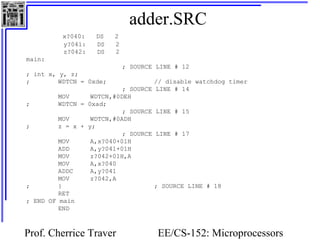
adder.SRC 
Prof. Cherrice Traver EE/CS-152: Microprocessors 
and Microcontrollers 
x?040: DS 2 
y?041: DS 2 
z?042: DS 2 
main: 
; SOURCE LINE # 12 
; int x, y, z; 
; WDTCN = 0xde; // disable watchdog timer 
; SOURCE LINE # 14 
MOV WDTCN,#0DEH 
; WDTCN = 0xad; 
; SOURCE LINE # 15 
MOV WDTCN,#0ADH 
; z = x + y; 
; SOURCE LINE # 17 
MOV A,x?040+01H 
ADD A,y?041+01H 
MOV z?042+01H,A 
MOV A,x?040 
ADDC A,y?041 
MOV z?042,A 
; } ; SOURCE LINE # 18 
RET 
; END OF main 
END
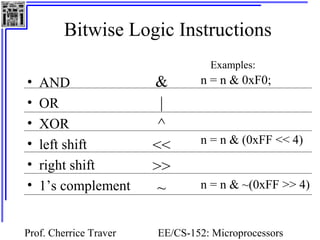
Bitwise Logic Instructions 
Examples: 
Prof. Cherrice Traver EE/CS-152: Microprocessors 
and Microcontrollers 
• AND 
• OR 
• XOR 
• left shift 
• right shift 
• 1’s complement 
& 
| 
^ 
<< 
>> 
~ 
n = n & 0xF0; 
n = n & (0xFF << 4) 
n = n & ~(0xFF >> 4)
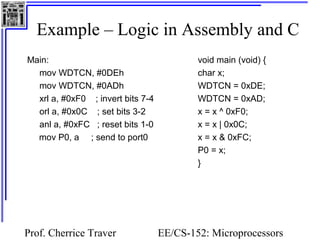
Example – Logic in Assembly and C 
Prof. Cherrice Traver EE/CS-152: Microprocessors 
and Microcontrollers 
Main: 
mov WDTCN, #0DEh 
mov WDTCN, #0ADh 
xrl a, #0xF0 ; invert bits 7-4 
orl a, #0x0C ; set bits 3-2 
anl a, #0xFC ; reset bits 1-0 
mov P0, a ; send to port0 
void main (void) { 
char x; 
WDTCN = 0xDE; 
WDTCN = 0xAD; 
x = x ^ 0xF0; 
x = x | 0x0C; 
x = x & 0xFC; 
P0 = x; 
}
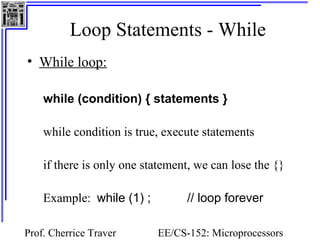
Loop Statements - While 
Prof. Cherrice Traver EE/CS-152: Microprocessors 
and Microcontrollers 
• While loop: 
while (condition) { statements } 
while condition is true, execute statements 
if there is only one statement, we can lose the {} 
Example: while (1) ; // loop forever
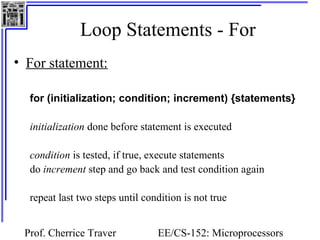
Loop Statements - For 
Prof. Cherrice Traver EE/CS-152: Microprocessors 
and Microcontrollers 
• For statement: 
for (initialization; condition; increment) {statements} 
initialization done before statement is executed 
condition is tested, if true, execute statements 
do increment step and go back and test condition again 
repeat last two steps until condition is not true
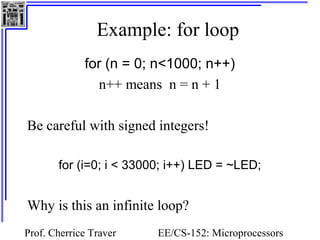
Example: for loop 
for (n = 0; n<1000; n++) 
n++ means n = n + 1 
Be careful with signed integers! 
for (i=0; i < 33000; i++) LED = ~LED; 
Why is this an infinite loop? 
Prof. Cherrice Traver EE/CS-152: Microprocessors 
and Microcontrollers
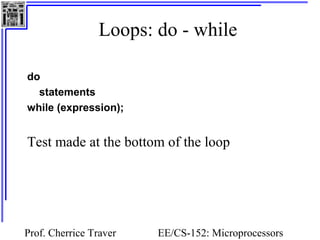
Loops: do - while 
do 
statements 
while (expression); 
Test made at the bottom of the loop 
Prof. Cherrice Traver EE/CS-152: Microprocessors 
and Microcontrollers
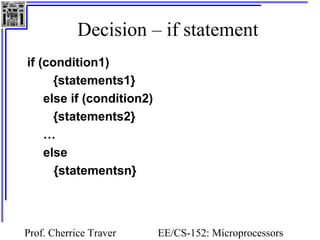
Decision – if statement 
Prof. Cherrice Traver EE/CS-152: Microprocessors 
and Microcontrollers 
if (condition1) 
{statements1} 
else if (condition2) 
{statements2} 
… 
else 
{statementsn}
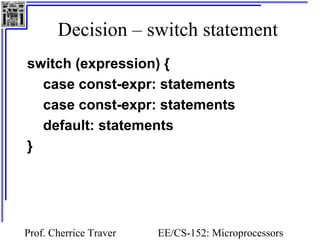
Decision – switch statement 
switch (expression) { 
case const-expr: statements 
default: statements 
} 
Prof. Cherrice Traver EE/CS-152: Microprocessors 
and Microcontrollers
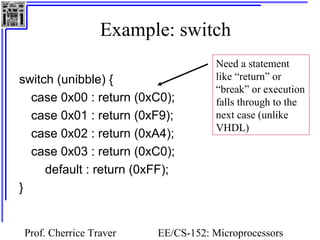
Example: switch 
switch (unibble) { 
case 0x00 : return (0xC0); 
case 0x01 : return (0xF9); 
case 0x02 : return (0xA4); 
case 0x03 : return (0xC0); 
default : return (0xFF); 
Prof. Cherrice Traver EE/CS-152: Microprocessors 
and Microcontrollers 
} 
Need a statement 
like “return” or 
“break” or execution 
falls through to the 
next case (unlike 
VHDL)
Revisit Toggle and Blink5 
Prof. Cherrice Traver EE/CS-152: Microprocessors 
and Microcontrollers
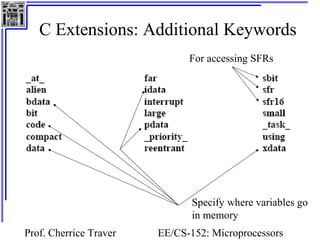
C Extensions: Additional Keywords 
For accessing SFRs 
Specify where variables go 
in memory 
Prof. Cherrice Traver EE/CS-152: Microprocessors 
and Microcontrollers
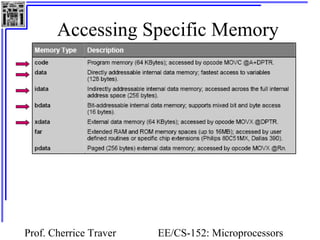
Accessing Specific Memory 
Prof. Cherrice Traver EE/CS-152: Microprocessors 
and Microcontrollers
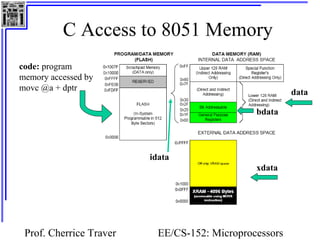
C Access to 8051 Memory 
code: program 
memory accessed by 
movc @a + dptr data 
idata 
Prof. Cherrice Traver EE/CS-152: Microprocessors 
and Microcontrollers 
bdata 
xdata
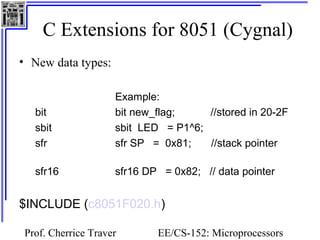
C Extensions for 8051 (Cygnal) 
Prof. Cherrice Traver EE/CS-152: Microprocessors 
and Microcontrollers 
• New data types: 
Example: 
bit bit new_flag; //stored in 20-2F 
sbit sbit LED = P1^6; 
sfr sfr SP = 0x81; //stack pointer 
sfr16 sfr16 DP = 0x82; // data pointer 
$INCLUDE (c8051F020.h)
C Data Types With Extensions 
Prof. Cherrice Traver EE/CS-152: Microprocessors 
and Microcontrollers
Declaring Variables in Memory 
char data temp; 
char idata varx; 
int xdata array[100]; 
char code text[] = “Enter data”; 
Prof. Cherrice Traver EE/CS-152: Microprocessors 
and Microcontrollers
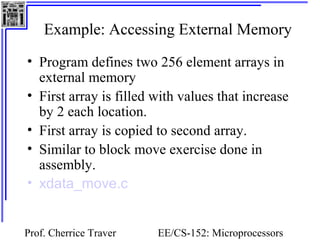
Example: Accessing External Memory 
• Program defines two 256 element arrays in 
external memory 
• First array is filled with values that increase 
by 2 each location. 
• First array is copied to second array. 
• Similar to block move exercise done in 
assembly. 
• xdata_move.c 
Prof. Cherrice Traver EE/CS-152: Microprocessors 
and Microcontrollers
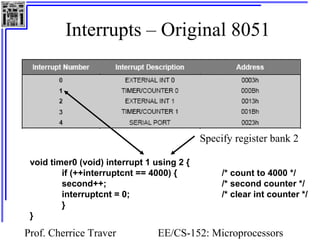
Interrupts – Original 8051 
void timer0 (void) interrupt 1 using 2 { 
if (++interruptcnt == 4000) { /* count to 4000 */ 
second++; /* second counter */ 
interruptcnt = 0; /* clear int counter */ 
} 
Prof. Cherrice Traver EE/CS-152: Microprocessors 
and Microcontrollers 
} 
Specify register bank 2
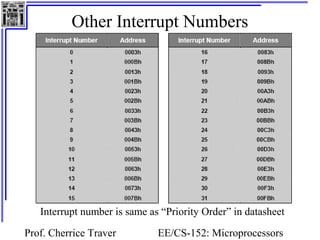
Other Interrupt Numbers 
Interrupt number is same as “Priority Order” in datasheet 
Prof. Cherrice Traver EE/CS-152: Microprocessors 
and Microcontrollers
Revisit Timer Exercise 
Blinking! 
Prof. Cherrice Traver EE/CS-152: Microprocessors 
and Microcontrollers
In-line Assembly 
• When it is more efficient, or easier, can 
insert assembly code in C programs. 
#pragma asm 
put your assembly code here 
#pragma endasm 
Prof. Cherrice Traver EE/CS-152: Microprocessors 
and Microcontrollers
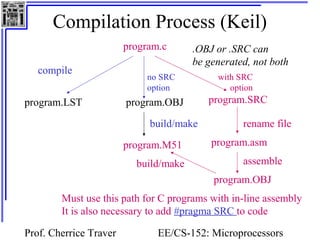
Compilation Process (Keil) 
program.c 
program.OBJ 
program.M51 
.OBJ or .SRC can 
be generated, not both 
rename file 
program.asm 
build/make assemble 
Prof. Cherrice Traver EE/CS-152: Microprocessors 
and Microcontrollers 
compile 
program.LST 
build/make 
program.SRC 
program.OBJ 
no SRC 
option 
with SRC 
option 
Must use this path for C programs with in-line assembly 
It is also necessary to add #pragma SRC to code
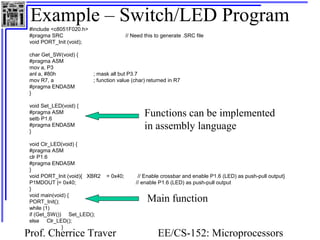
Example – Switch/LED Program 
#include <c8051F020.h> 
#pragma SRC // Need this to generate .SRC file 
void PORT_Init (void); 
char Get_SW(void) { 
#pragma ASM 
mov a, P3 
anl a, #80h ; mask all but P3.7 
mov R7, a ; function value (char) returned in R7 
#pragma ENDASM 
} 
void Set_LED(void) { 
#pragma ASM 
Functions can be implemented 
setb P1.6 
#pragma ENDASM 
in assembly language 
} 
void Clr_LED(void) { 
#pragma ASM 
clr P1.6 
#pragma ENDASM 
} 
void PORT_Init (void){ XBR2 = 0x40; // Enable crossbar and enable P1.6 (LED) as push-pull output} 
P1MDOUT |= 0x40; // enable P1.6 (LED) as push-pull output 
} 
void main(void) { 
PORT_Init(); 
while (1) 
if (Get_SW()) Set_LED(); 
else Clr_LED(); 
Prof. Cherrice Traver EE/CS-152: Microprocessors 
and Microcontrollers 
} 
Main function
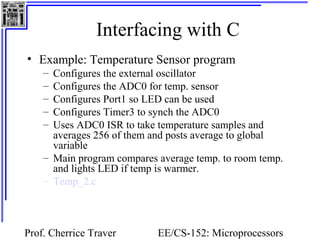
Interfacing with C 
• Example: Temperature Sensor program 
– Configures the external oscillator 
– Configures the ADC0 for temp. sensor 
– Configures Port1 so LED can be used 
– Configures Timer3 to synch the ADC0 
– Uses ADC0 ISR to take temperature samples and 
averages 256 of them and posts average to global 
variable 
– Main program compares average temp. to room temp. 
and lights LED if temp is warmer. 
– Temp_2.c 
Prof. Cherrice Traver EE/CS-152: Microprocessors 
and Microcontrollers
Revisit DAC0 Program 
And “C” the difference! 
Prof. Cherrice Traver EE/CS-152: Microprocessors 
and Microcontrollers
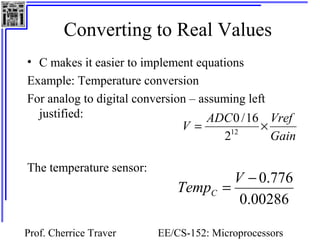
Converting to Real Values 
• C makes it easier to implement equations 
Example: Temperature conversion 
For analog to digital conversion – assuming left 
justified: 
V = ADC ´ Vref 212 
Temp = V - 0.776 C 
Prof. Cherrice Traver EE/CS-152: Microprocessors 
and Microcontrollers 
The temperature sensor: 
Gain 
0 /16 
0.00286
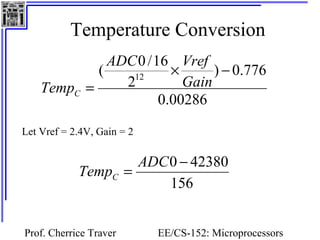
Temperature Conversion 
ADC Vref 
( 0 /16 12 ´ - 
= Gain 
0.00286 
) 0.776 
Temp = ADC0 - 42380 C 
Prof. Cherrice Traver EE/CS-152: Microprocessors 
and Microcontrollers 
2 
TempC 
Let Vref = 2.4V, Gain = 2 
156
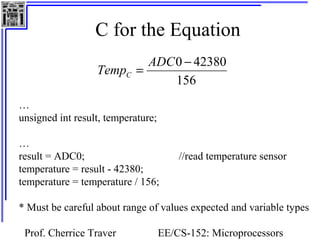
C for the Equation 
Temp = ADC0 - 42380 C 
156 
… 
unsigned int result, temperature; 
… 
result = ADC0; //read temperature sensor 
temperature = result - 42380; 
temperature = temperature / 156; 
* Must be careful about range of values expected and variable types 
Prof. Cherrice Traver EE/CS-152: Microprocessors 
and Microcontrollers
Make it REAL! 
Temperature Conversion 
Prof. Cherrice Traver EE/CS-152: Microprocessors 
and Microcontrollers
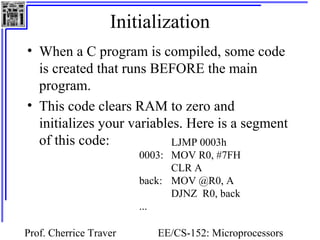
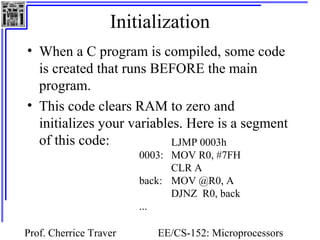
Initialization 
• When a C program is compiled, some code 
is created that runs BEFORE the main 
program. 
• This code clears RAM to zero and 
initializes your variables. Here is a segment 
of this code: LJMP 0003h 
0003: MOV R0, #7FH 
CLR A 
back: MOV @R0, A 
DJNZ R0, back 
Prof. Cherrice Traver EE/CS-152: Microprocessors 
and Microcontrollers 
...
Arrays in C 
• Useful for storing data 
type arr_name[dimension] 
Prof. Cherrice Traver EE/CS-152: Microprocessors 
and Microcontrollers 
char temp_array[256] 
Array elements are stored in 
adjacent locations in memory. 
temp_array[0] 
temp_array[1] 
temp_array[2] 
temp_array[3] 
... 
temp_array[253] 
temp_array[254] 
temp_array[255]
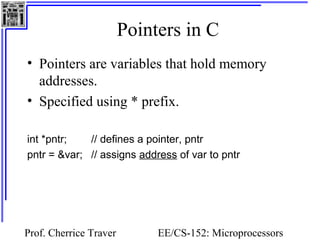
Pointers in C 
• Pointers are variables that hold memory 
addresses. 
• Specified using * prefix. 
int *pntr; // defines a pointer, pntr 
pntr = &var; // assigns address of var to pntr 
Prof. Cherrice Traver EE/CS-152: Microprocessors 
and Microcontrollers
Pointers and Arrays 
Note: the name of an array is a pointer to 
the first element: 
*temp_array is the same as temp_array[0] 
So the following are the same: 
Prof. Cherrice Traver EE/CS-152: Microprocessors 
and Microcontrollers 
n = *temp_array; 
n = temp_array[0]; 
and these are also the same: 
n = *(temp_array+5); 
n = temp_array[5]; 
temp_array[0] 
temp_array[1] 
temp_array[2] 
temp_array[3] 
…
Arrays 
• In watch window, address (pointer) of first 
element array is shown. 
• Array is not initialized as you specify when 
you download or reset, but it will be when 
Main starts. 
unsigned char P0_out[4] = {0x01,0x02,0x04,0x08}; 
Prof. Cherrice Traver EE/CS-152: Microprocessors 
and Microcontrollers
Array Example 
Prof. Cherrice Traver EE/CS-152: Microprocessors 
and Microcontrollers
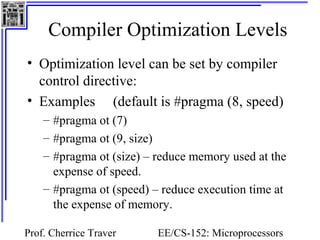
Compiler Optimization Levels 
• Optimization level can be set by compiler 
control directive: 
• Examples (default is #pragma (8, speed) 
– #pragma ot (7) 
– #pragma ot (9, size) 
– #pragma ot (size) – reduce memory used at the 
expense of speed. 
– #pragma ot (speed) – reduce execution time at 
the expense of memory. 
Prof. Cherrice Traver EE/CS-152: Microprocessors 
and Microcontrollers
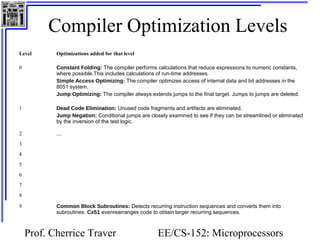
Compiler Optimization Levels 
Level Optimizations added for that level 
0 Constant Folding: The compiler performs calculations that reduce expressions to numeric constants, 
where possible.This includes calculations of run-time addresses. 
Simple Access Optimizing: The compiler optimizes access of internal data and bit addresses in the 
8051 system. 
Jump Optimizing: The compiler always extends jumps to the final target. Jumps to jumps are deleted. 
1 Dead Code Elimination: Unused code fragments and artifacts are eliminated. 
Jump Negation: Conditional jumps are closely examined to see if they can be streamlined or eliminated 
by the inversion of the test logic. 
2 .... 
3 
4 
5 
6 
7 
8 
9 Common Block Subroutines: Detects recurring instruction sequences and converts them into 
subroutines. Cx51 evenrearranges code to obtain larger recurring sequences. 
Prof. Cherrice Traver EE/CS-152: Microprocessors 
and Microcontrollers
Example: 7-seg Decoder 
// Program to convert 0-F into 7-segment equivalents. 
#pragma debug code) 
#pragma ot (9) 
#include <c8051f020.h> 
#define NUM_SAMPLES 16 
unsigned char SEGS7[16] = {0xC0, 0xF9, 0xA4, 0xB0, 0x99, 0x92, 
0x82, 0xF8, 0x80, 0x90, 0x88, 0x83, 0xC6, 0xA1, 0x86, 0x8E}; 
xdata unsigned char samples[NUM_SAMPLES]; 
Prof. Cherrice Traver EE/CS-152: Microprocessors 
and Microcontrollers 
void main (void) 
{ 
char i; // loop counter 
WDTCN = 0xde; 
WDTCN = 0xad; 
for (i=0; i < NUM_SAMPLES; i++) 
{samples[i] = SEGS7[i];} 
while (1); 
}
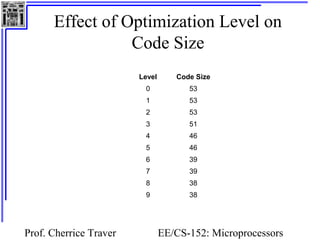
Effect of Optimization Level on 
Code Size 
Level Code Size 
0 53 
1 53 
2 53 
3 51 
4 46 
5 46 
6 39 
7 39 
8 38 
9 38 
Prof. Cherrice Traver EE/CS-152: Microprocessors 
and Microcontrollers
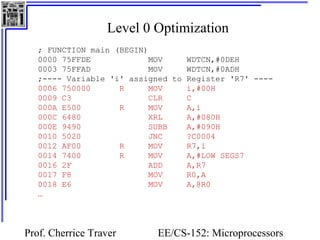
Level 0 Optimization 
; FUNCTION main (BEGIN) 
0000 75FFDE MOV WDTCN,#0DEH 
0003 75FFAD MOV WDTCN,#0ADH 
;---- Variable 'i' assigned to Register 'R7' ---- 
0006 750000 R MOV i,#00H 
0009 C3 CLR C 
000A E500 R MOV A,i 
000C 6480 XRL A,#080H 
000E 9490 SUBB A,#090H 
0010 5020 JNC ?C0004 
0012 AF00 R MOV R7,i 
0014 7400 R MOV A,#LOW SEGS7 
0016 2F ADD A,R7 
0017 F8 MOV R0,A 
0018 E6 MOV A,@R0 
… 
Prof. Cherrice Traver EE/CS-152: Microprocessors 
and Microcontrollers
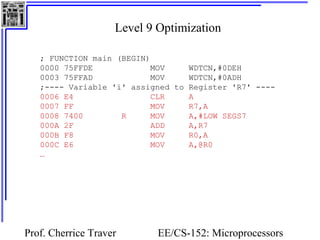
Level 9 Optimization 
; FUNCTION main (BEGIN) 
0000 75FFDE MOV WDTCN,#0DEH 
0003 75FFAD MOV WDTCN,#0ADH 
;---- Variable 'i' assigned to Register 'R7' ---- 
0006 E4 CLR A 
0007 FF MOV R7,A 
0008 7400 R MOV A,#LOW SEGS7 
000A 2F ADD A,R7 
000B F8 MOV R0,A 
000C E6 MOV A,@R0 
… 
Prof. Cherrice Traver EE/CS-152: Microprocessors 
and Microcontrollers
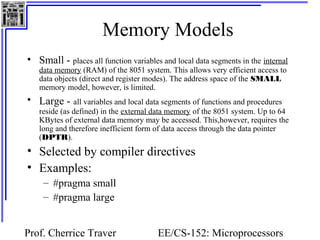
Memory Models 
• Small - places all function variables and local data segments in the internal 
data memory (RAM) of the 8051 system. This allows very efficient access to 
data objects (direct and register modes). The address space of the SMALL 
memory model, however, is limited. 
• Large - all variables and local data segments of functions and procedures 
reside (as defined) in the external data memory of the 8051 system. Up to 64 
KBytes of external data memory may be accessed. This,however, requires the 
long and therefore inefficient form of data access through the data pointer 
(DPTR). 
• Selected by compiler directives 
• Examples: 
Prof. Cherrice Traver EE/CS-152: Microprocessors 
and Microcontrollers 
– #pragma small 
– #pragma large
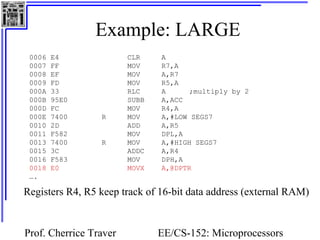
Example: LARGE 
0006 E4 CLR A 
0007 FF MOV R7,A 
0008 EF MOV A,R7 
0009 FD MOV R5,A 
000A 33 RLC A ;multiply by 2 
000B 95E0 SUBB A,ACC 
000D FC MOV R4,A 
000E 7400 R MOV A,#LOW SEGS7 
0010 2D ADD A,R5 
0011 F582 MOV DPL,A 
0013 7400 R MOV A,#HIGH SEGS7 
0015 3C ADDC A,R4 
0016 F583 MOV DPH,A 
0018 E0 MOVX A,@DPTR 
…. 
Registers R4, R5 keep track of 16-bit data address (external RAM) 
Prof. Cherrice Traver EE/CS-152: Microprocessors 
and Microcontrollers
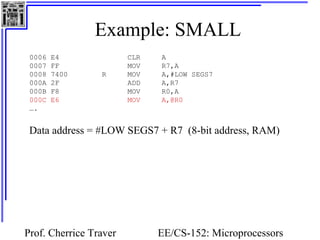
Example: SMALL 
0006 E4 CLR A 
0007 FF MOV R7,A 
0008 7400 R MOV A,#LOW SEGS7 
000A 2F ADD A,R7 
000B F8 MOV R0,A 
000C E6 MOV A,@R0 
…. 
Data address = #LOW SEGS7 + R7 (8-bit address, RAM) 
Prof. Cherrice Traver EE/CS-152: Microprocessors 
and Microcontrollers
Initialization 
• When a C program is compiled, some code 
is created that runs BEFORE the main 
program. 
• This code clears RAM to zero and 
initializes your variables. Here is a segment 
of this code: LJMP 0003h 
0003: MOV R0, #7FH 
CLR A 
back: MOV @R0, A 
DJNZ R0, back 
Prof. Cherrice Traver EE/CS-152: Microprocessors 
and Microcontrollers 
...
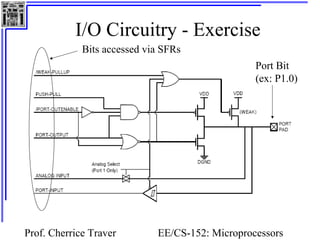
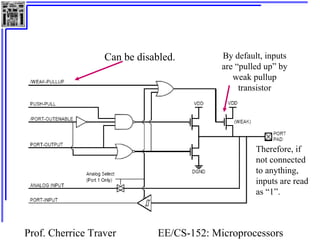
I/O Circuitry - Exercise 
Bits accessed via SFRs 
Prof. Cherrice Traver EE/CS-152: Microprocessors 
and Microcontrollers 
Port Bit 
(ex: P1.0)
By default, inputs 
are “pulled up” by 
weak pullup 
transistor 
Prof. Cherrice Traver EE/CS-152: Microprocessors 
and Microcontrollers 
Therefore, if 
not connected 
to anything, 
inputs are read 
as “1”. 
Can be disabled.
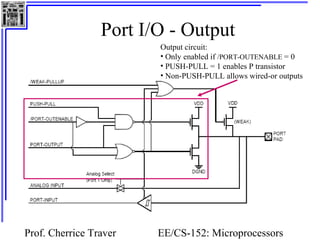
Port I/O - Output 
Output circuit: 
• Only enabled if /PORT-OUTENABLE = 0 
• PUSH-PULL = 1 enables P transistor 
• Non-PUSH-PULL allows wired-or outputs 
Prof. Cherrice Traver EE/CS-152: Microprocessors 
and Microcontrollers
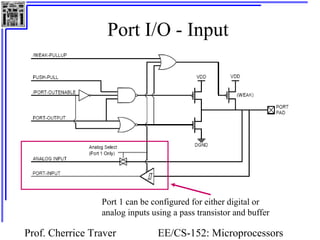
Port I/O - Input 
Port 1 can be configured for either digital or 
analog inputs using a pass transistor and buffer 
Prof. Cherrice Traver EE/CS-152: Microprocessors 
and Microcontrollers
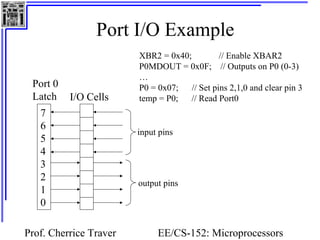
Port I/O Example 
XBR2 = 0x40; // Enable XBAR2 
P0MDOUT = 0x0F; // Outputs on P0 (0-3) 
…P 
0 = 0x07; // Set pins 2,1,0 and clear pin 3 
temp = P0; // Read Port0 
input pins 
Prof. Cherrice Traver EE/CS-152: Microprocessors 
and Microcontrollers 
Port 0 
Latch 
output pins 
76543210 
I/O Cells
Keypad Interface 
Prof. Cherrice Traver EE/CS-152: Microprocessors 
and Microcontrollers
C for Large Projects 
• Use functions to make programs modular 
• Break project into separate files if the 
programs get too large 
• Use header (#include) files to hold 
definitions used by several programs 
• Keep main program short and easy to 
follow 
• Consider multi-tasking or multi-threaded 
implementations 
Prof. Cherrice Traver EE/CS-152: Microprocessors 
and Microcontrollers
Functions 
• The basis for modular structured 
programming in C. 
return-type function-name(argument declarations) 
{ 
declarations and statements 
Prof. Cherrice Traver EE/CS-152: Microprocessors 
and Microcontrollers 
}
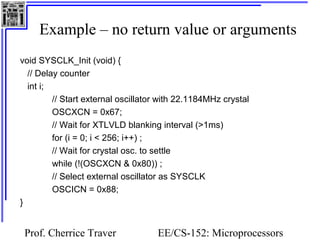
Example – no return value or arguments 
Prof. Cherrice Traver EE/CS-152: Microprocessors 
and Microcontrollers 
void SYSCLK_Init (void) { 
// Delay counter 
int i; 
// Start external oscillator with 22.1184MHz crystal 
OSCXCN = 0x67; 
// Wait for XTLVLD blanking interval (>1ms) 
for (i = 0; i < 256; i++) ; 
// Wait for crystal osc. to settle 
while (!(OSCXCN & 0x80)) ; 
// Select external oscillator as SYSCLK 
OSCICN = 0x88; 
}
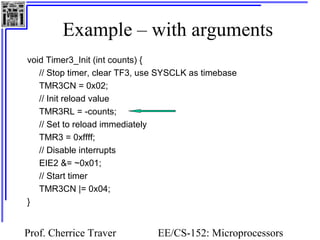
Example – with arguments 
void Timer3_Init (int counts) { 
// Stop timer, clear TF3, use SYSCLK as timebase 
TMR3CN = 0x02; 
// Init reload value 
TMR3RL = -counts; 
// Set to reload immediately 
TMR3 = 0xffff; 
// Disable interrupts 
EIE2 &= ~0x01; 
// Start timer 
TMR3CN |= 0x04; 
} 
Prof. Cherrice Traver EE/CS-152: Microprocessors 
and Microcontrollers
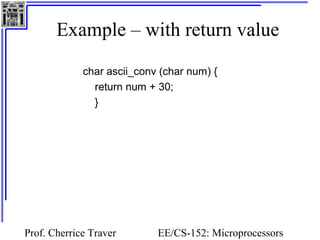
Example – with return value 
char ascii_conv (char num) { 
return num + 30; 
} 
Prof. Cherrice Traver EE/CS-152: Microprocessors 
and Microcontrollers
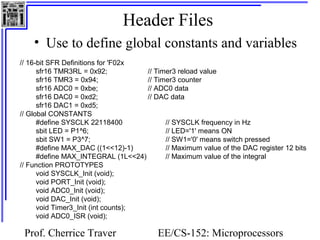
Header Files 
• Use to define global constants and variables 
Prof. Cherrice Traver EE/CS-152: Microprocessors 
and Microcontrollers 
// 16-bit SFR Definitions for 'F02x 
sfr16 TMR3RL = 0x92; // Timer3 reload value 
sfr16 TMR3 = 0x94; // Timer3 counter 
sfr16 ADC0 = 0xbe; // ADC0 data 
sfr16 DAC0 = 0xd2; // DAC data 
sfr16 DAC1 = 0xd5; 
// Global CONSTANTS 
#define SYSCLK 22118400 // SYSCLK frequency in Hz 
sbit LED = P1^6; // LED='1' means ON 
sbit SW1 = P3^7; // SW1='0' means switch pressed 
#define MAX_DAC ((1<<12)-1) // Maximum value of the DAC register 12 bits 
#define MAX_INTEGRAL (1L<<24) // Maximum value of the integral 
// Function PROTOTYPES 
void SYSCLK_Init (void); 
void PORT_Init (void); 
void ADC0_Init (void); 
void DAC_Init (void); 
void Timer3_Init (int counts); 
void ADC0_ISR (void);
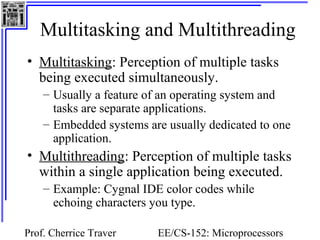
Multitasking and Multithreading 
• Multitasking: Perception of multiple tasks 
being executed simultaneously. 
– Usually a feature of an operating system and 
tasks are separate applications. 
– Embedded systems are usually dedicated to one 
application. 
• Multithreading: Perception of multiple tasks 
within a single application being executed. 
– Example: Cygnal IDE color codes while 
echoing characters you type. 
Prof. Cherrice Traver EE/CS-152: Microprocessors 
and Microcontrollers
Multitasking and Multithreading 
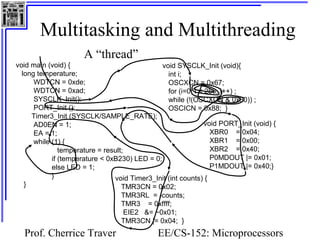
void SYSCLK_Init (void){ 
int i; 
OSCXCN = 0x67; 
for (i=0; i < 256; i++) ; 
while (!(OSCXCN & 0x80)) ; 
OSCICN = 0x88; } 
Prof. Cherrice Traver EE/CS-152: Microprocessors 
and Microcontrollers 
A “thread” 
void main (void) { 
long temperature; 
WDTCN = 0xde; 
WDTCN = 0xad; 
SYSCLK_Init(): 
PORT_Init (); 
Timer3_Init (SYSCLK/SAMPLE_RATE); 
AD0EN = 1; 
EA = 1; 
while (1) { 
temperature = result; 
if (temperature < 0xB230) LED = 0; 
else LED = 1; 
} 
} 
void PORT_Init (void) { 
XBR0 = 0x04; 
XBR1 = 0x00; 
XBR2 = 0x40; 
P0MDOUT |= 0x01; 
P1MDOUT |= 0x40;} 
void Timer3_Init (int counts) { 
TMR3CN = 0x02; 
TMR3RL = -counts; 
TMR3 = 0xffff; 
EIE2 &= ~0x01; 
TMR3CN |= 0x04; }
Multi-tasking/threading Implementations 
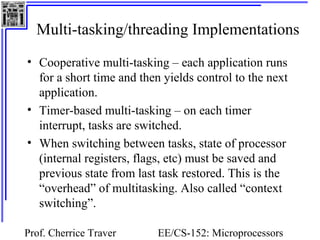
• Cooperative multi-tasking – each application runs 
for a short time and then yields control to the next 
application. 
• Timer-based multi-tasking – on each timer 
interrupt, tasks are switched. 
• When switching between tasks, state of processor 
(internal registers, flags, etc) must be saved and 
previous state from last task restored. This is the 
“overhead” of multitasking. Also called “context 
switching”. 
Prof. Cherrice Traver EE/CS-152: Microprocessors 
and Microcontrollers
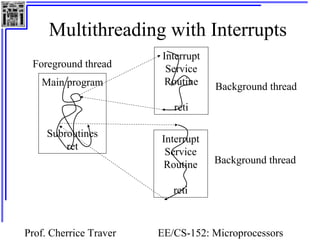
Multithreading with Interrupts 
Background thread 
Prof. Cherrice Traver EE/CS-152: Microprocessors 
and Microcontrollers 
Main program 
Subroutines 
ret 
Interrupt 
Service 
Routine 
reti 
Interrupt 
Service 
Routine 
reti 
Foreground thread 
Background thread
Real-Time Operating Systems 
(RTOS) 
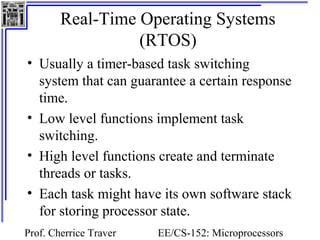
• Usually a timer-based task switching 
system that can guarantee a certain response 
time. 
• Low level functions implement task 
switching. 
• High level functions create and terminate 
threads or tasks. 
• Each task might have its own software stack 
for storing processor state. 
Prof. Cherrice Traver EE/CS-152: Microprocessors 
and Microcontrollers

C language programming

  • 1.
    C Language Programming for the 8051 Prof. Cherrice Traver EE/CS-152: Microprocessors and Microcontrollers
  • 2.
    Overview Prof. CherriceTraver EE/CS-152: Microprocessors and Microcontrollers • C for microcontrollers – Review of C basics – Compilation flow for SiLabs IDE – C extensions – In-line assembly – Interfacing with C • Examples • Arrays and Pointers • I/O Circuitry • Functions and Header Files • Multitasking and multithreading
  • 3.
    C for Microcontrollers • Of higher level languages, C is the closest to assembly languages – bit manipulation instructions – pointers (indirect addressing) • Most microcontrollers have available C compilers • Writing in C simplifies code development for large projects. Prof. Cherrice Traver EE/CS-152: Microprocessors and Microcontrollers
  • 4.
    Available C Compilers • Kiel – integrated with the IDE we have been using for labs. • Reads51 – available on web site ( http://www.rigelcorp.com/reads51.htm) • Freeware: SDCC - Small Device C Compiler (http://sdcc.sourceforge.net/) • Other freeware versions … Prof. Cherrice Traver EE/CS-152: Microprocessors and Microcontrollers
  • 5.
    Compilation Process (Keil) program.c no SRC option program.OBJ program.M51 compile Prof. Cherrice Traver EE/CS-152: Microprocessors and Microcontrollers program.LST build/make
  • 6.
    Modular Programming •Like most high level languages, C is a modular programming language (but NOT an object oriented language) • Each task can be encapsulated as a function. • Entire program is encapsulated in “main” function. Prof. Cherrice Traver EE/CS-152: Microprocessors and Microcontrollers
  • 7.
    Basic C ProgramStructure 1. Compiler directives and include files 2. Declarations of global variables and constants 3. Declaration of functions 4. Main function 5. Sub-functions 6. Interrupt service routines Prof. Cherrice Traver EE/CS-152: Microprocessors and Microcontrollers Example: blinky.c
  • 8.
    Back to CBasics • All C programs consists of: – Variables – Functions (one must be “main”) Prof. Cherrice Traver EE/CS-152: Microprocessors and Microcontrollers • Statements • To define the SFRs as variables: #include <c8051F020.h>
  • 9.
    Variables • Allvariables must be declared at top of program, before the first statement. • Declaration includes type and list of variables. Example: void main (void) { must go HERE! Prof. Cherrice Traver EE/CS-152: Microprocessors and Microcontrollers int var, tmp; • Types: – int (16-bits in our compiler) – char (8-bits) – short (16-bits) – long (32-bits) – sbit (1-bit) – others that we will discuss later not standard C – an 8051 extension
  • 10.
    Variables • Thefollowing variable types can be signed or unsigned: signed char (8 bits) –128 to +127 signed short (16 bits) –32768 to +32767 signed int (16 bits) –32768 to +32767 signed long (32 bits) –2147483648 to +2147483648 unsigned char (8 bits) 0 to + 255 unsigned short (16 bits) 0 to + 65535 unsigned int (16 bits) 0 to + 65535 unsigned long (32 bits) 0 to + 4294967295 NOTE: Default is signed – it is best to specify. Prof. Cherrice Traver EE/CS-152: Microprocessors and Microcontrollers
  • 11.
    Statements • Assignmentstatement: variable = constant or expression or variable Prof. Cherrice Traver EE/CS-152: Microprocessors and Microcontrollers examples: upper = 60; I = I + 5; J = I;
  • 12.
    Operators • Arithmetic:+, -, *, / • Relational comparisons: >, >=, <, <= • Equality comparisons: ==, != • Logical operators: && (and), || (or) • Increment and decrement: ++, -- • Example: Prof. Cherrice Traver EE/CS-152: Microprocessors and Microcontrollers if (x != y) && (c == b) { a=c + d*b; a++; }
  • 13.
    Example – Adderprogram (add 2 16-bit numbers) Prof. Cherrice Traver EE/CS-152: Microprocessors and Microcontrollers $INCLUDE (C8051F020.inc) XL equ 0x78 XH equ 0x79 YL equ 0x7A YH equ 0x7B cseg at 0 ljmp Main cseg at 100h ; Disable watchdog timer Main: mov 0xFF, #0DEh mov 0xFF, #0ADh mov a, XL add a, YL mov XL, a mov a, XH addc a, YH mov XH, a nop end #include <c8051f020.h> void main (void) { int x, y, z; //16-bit variables // disable watchdog timer WDTCN = 0xde; WDTCN = 0xad; z = x + y; } The C version The assembly version
  • 14.
    Compilation Process (Keil) adder.c compile adder.OBJ adder.M51 look here in RAM when debugging Prof. Cherrice Traver EE/CS-152: Microprocessors and Microcontrollers adder.SRC build/make Use the #pragma CODE compiler directive to get assembly code generated in SRC file. Map file shows where variables are stored. One map file is generated per project. Symbol Table in M51 file: ------ DO D:0008H SYMBOL x D:000AH SYMBOL y D:000CH SYMBOL z ------- ENDDO assemble
  • 15.
    adder.SRC Prof. CherriceTraver EE/CS-152: Microprocessors and Microcontrollers x?040: DS 2 y?041: DS 2 z?042: DS 2 main: ; SOURCE LINE # 12 ; int x, y, z; ; WDTCN = 0xde; // disable watchdog timer ; SOURCE LINE # 14 MOV WDTCN,#0DEH ; WDTCN = 0xad; ; SOURCE LINE # 15 MOV WDTCN,#0ADH ; z = x + y; ; SOURCE LINE # 17 MOV A,x?040+01H ADD A,y?041+01H MOV z?042+01H,A MOV A,x?040 ADDC A,y?041 MOV z?042,A ; } ; SOURCE LINE # 18 RET ; END OF main END
  • 16.
    Bitwise Logic Instructions Examples: Prof. Cherrice Traver EE/CS-152: Microprocessors and Microcontrollers • AND • OR • XOR • left shift • right shift • 1’s complement & | ^ << >> ~ n = n & 0xF0; n = n & (0xFF << 4) n = n & ~(0xFF >> 4)
  • 17.
    Example – Logicin Assembly and C Prof. Cherrice Traver EE/CS-152: Microprocessors and Microcontrollers Main: mov WDTCN, #0DEh mov WDTCN, #0ADh xrl a, #0xF0 ; invert bits 7-4 orl a, #0x0C ; set bits 3-2 anl a, #0xFC ; reset bits 1-0 mov P0, a ; send to port0 void main (void) { char x; WDTCN = 0xDE; WDTCN = 0xAD; x = x ^ 0xF0; x = x | 0x0C; x = x & 0xFC; P0 = x; }
  • 18.
    Loop Statements -While Prof. Cherrice Traver EE/CS-152: Microprocessors and Microcontrollers • While loop: while (condition) { statements } while condition is true, execute statements if there is only one statement, we can lose the {} Example: while (1) ; // loop forever
  • 19.
    Loop Statements -For Prof. Cherrice Traver EE/CS-152: Microprocessors and Microcontrollers • For statement: for (initialization; condition; increment) {statements} initialization done before statement is executed condition is tested, if true, execute statements do increment step and go back and test condition again repeat last two steps until condition is not true
  • 20.
    Example: for loop for (n = 0; n<1000; n++) n++ means n = n + 1 Be careful with signed integers! for (i=0; i < 33000; i++) LED = ~LED; Why is this an infinite loop? Prof. Cherrice Traver EE/CS-152: Microprocessors and Microcontrollers
  • 21.
    Loops: do -while do statements while (expression); Test made at the bottom of the loop Prof. Cherrice Traver EE/CS-152: Microprocessors and Microcontrollers
  • 22.
    Decision – ifstatement Prof. Cherrice Traver EE/CS-152: Microprocessors and Microcontrollers if (condition1) {statements1} else if (condition2) {statements2} … else {statementsn}
  • 23.
    Decision – switchstatement switch (expression) { case const-expr: statements case const-expr: statements default: statements } Prof. Cherrice Traver EE/CS-152: Microprocessors and Microcontrollers
  • 24.
    Example: switch switch(unibble) { case 0x00 : return (0xC0); case 0x01 : return (0xF9); case 0x02 : return (0xA4); case 0x03 : return (0xC0); default : return (0xFF); Prof. Cherrice Traver EE/CS-152: Microprocessors and Microcontrollers } Need a statement like “return” or “break” or execution falls through to the next case (unlike VHDL)
  • 25.
    Revisit Toggle andBlink5 Prof. Cherrice Traver EE/CS-152: Microprocessors and Microcontrollers
  • 26.
    C Extensions: AdditionalKeywords For accessing SFRs Specify where variables go in memory Prof. Cherrice Traver EE/CS-152: Microprocessors and Microcontrollers
  • 27.
    Accessing Specific Memory Prof. Cherrice Traver EE/CS-152: Microprocessors and Microcontrollers
  • 28.
    C Access to8051 Memory code: program memory accessed by movc @a + dptr data idata Prof. Cherrice Traver EE/CS-152: Microprocessors and Microcontrollers bdata xdata
  • 29.
    C Extensions for8051 (Cygnal) Prof. Cherrice Traver EE/CS-152: Microprocessors and Microcontrollers • New data types: Example: bit bit new_flag; //stored in 20-2F sbit sbit LED = P1^6; sfr sfr SP = 0x81; //stack pointer sfr16 sfr16 DP = 0x82; // data pointer $INCLUDE (c8051F020.h)
  • 30.
    C Data TypesWith Extensions Prof. Cherrice Traver EE/CS-152: Microprocessors and Microcontrollers
  • 31.
    Declaring Variables inMemory char data temp; char idata varx; int xdata array[100]; char code text[] = “Enter data”; Prof. Cherrice Traver EE/CS-152: Microprocessors and Microcontrollers
  • 32.
    Example: Accessing ExternalMemory • Program defines two 256 element arrays in external memory • First array is filled with values that increase by 2 each location. • First array is copied to second array. • Similar to block move exercise done in assembly. • xdata_move.c Prof. Cherrice Traver EE/CS-152: Microprocessors and Microcontrollers
  • 33.
    Interrupts – Original8051 void timer0 (void) interrupt 1 using 2 { if (++interruptcnt == 4000) { /* count to 4000 */ second++; /* second counter */ interruptcnt = 0; /* clear int counter */ } Prof. Cherrice Traver EE/CS-152: Microprocessors and Microcontrollers } Specify register bank 2
  • 34.
    Other Interrupt Numbers Interrupt number is same as “Priority Order” in datasheet Prof. Cherrice Traver EE/CS-152: Microprocessors and Microcontrollers
  • 35.
    Revisit Timer Exercise Blinking! Prof. Cherrice Traver EE/CS-152: Microprocessors and Microcontrollers
  • 36.
    In-line Assembly •When it is more efficient, or easier, can insert assembly code in C programs. #pragma asm put your assembly code here #pragma endasm Prof. Cherrice Traver EE/CS-152: Microprocessors and Microcontrollers
  • 37.
    Compilation Process (Keil) program.c program.OBJ program.M51 .OBJ or .SRC can be generated, not both rename file program.asm build/make assemble Prof. Cherrice Traver EE/CS-152: Microprocessors and Microcontrollers compile program.LST build/make program.SRC program.OBJ no SRC option with SRC option Must use this path for C programs with in-line assembly It is also necessary to add #pragma SRC to code
  • 38.
    Example – Switch/LEDProgram #include <c8051F020.h> #pragma SRC // Need this to generate .SRC file void PORT_Init (void); char Get_SW(void) { #pragma ASM mov a, P3 anl a, #80h ; mask all but P3.7 mov R7, a ; function value (char) returned in R7 #pragma ENDASM } void Set_LED(void) { #pragma ASM Functions can be implemented setb P1.6 #pragma ENDASM in assembly language } void Clr_LED(void) { #pragma ASM clr P1.6 #pragma ENDASM } void PORT_Init (void){ XBR2 = 0x40; // Enable crossbar and enable P1.6 (LED) as push-pull output} P1MDOUT |= 0x40; // enable P1.6 (LED) as push-pull output } void main(void) { PORT_Init(); while (1) if (Get_SW()) Set_LED(); else Clr_LED(); Prof. Cherrice Traver EE/CS-152: Microprocessors and Microcontrollers } Main function
  • 39.
    Interfacing with C • Example: Temperature Sensor program – Configures the external oscillator – Configures the ADC0 for temp. sensor – Configures Port1 so LED can be used – Configures Timer3 to synch the ADC0 – Uses ADC0 ISR to take temperature samples and averages 256 of them and posts average to global variable – Main program compares average temp. to room temp. and lights LED if temp is warmer. – Temp_2.c Prof. Cherrice Traver EE/CS-152: Microprocessors and Microcontrollers
  • 40.
    Revisit DAC0 Program And “C” the difference! Prof. Cherrice Traver EE/CS-152: Microprocessors and Microcontrollers
  • 41.
    Converting to RealValues • C makes it easier to implement equations Example: Temperature conversion For analog to digital conversion – assuming left justified: V = ADC ´ Vref 212 Temp = V - 0.776 C Prof. Cherrice Traver EE/CS-152: Microprocessors and Microcontrollers The temperature sensor: Gain 0 /16 0.00286
  • 42.
    Temperature Conversion ADCVref ( 0 /16 12 ´ - = Gain 0.00286 ) 0.776 Temp = ADC0 - 42380 C Prof. Cherrice Traver EE/CS-152: Microprocessors and Microcontrollers 2 TempC Let Vref = 2.4V, Gain = 2 156
  • 43.
    C for theEquation Temp = ADC0 - 42380 C 156 … unsigned int result, temperature; … result = ADC0; //read temperature sensor temperature = result - 42380; temperature = temperature / 156; * Must be careful about range of values expected and variable types Prof. Cherrice Traver EE/CS-152: Microprocessors and Microcontrollers
  • 44.
    Make it REAL! Temperature Conversion Prof. Cherrice Traver EE/CS-152: Microprocessors and Microcontrollers
  • 45.
    Initialization • Whena C program is compiled, some code is created that runs BEFORE the main program. • This code clears RAM to zero and initializes your variables. Here is a segment of this code: LJMP 0003h 0003: MOV R0, #7FH CLR A back: MOV @R0, A DJNZ R0, back Prof. Cherrice Traver EE/CS-152: Microprocessors and Microcontrollers ...
  • 46.
    Arrays in C • Useful for storing data type arr_name[dimension] Prof. Cherrice Traver EE/CS-152: Microprocessors and Microcontrollers char temp_array[256] Array elements are stored in adjacent locations in memory. temp_array[0] temp_array[1] temp_array[2] temp_array[3] ... temp_array[253] temp_array[254] temp_array[255]
  • 47.
    Pointers in C • Pointers are variables that hold memory addresses. • Specified using * prefix. int *pntr; // defines a pointer, pntr pntr = &var; // assigns address of var to pntr Prof. Cherrice Traver EE/CS-152: Microprocessors and Microcontrollers
  • 48.
    Pointers and Arrays Note: the name of an array is a pointer to the first element: *temp_array is the same as temp_array[0] So the following are the same: Prof. Cherrice Traver EE/CS-152: Microprocessors and Microcontrollers n = *temp_array; n = temp_array[0]; and these are also the same: n = *(temp_array+5); n = temp_array[5]; temp_array[0] temp_array[1] temp_array[2] temp_array[3] …
  • 49.
    Arrays • Inwatch window, address (pointer) of first element array is shown. • Array is not initialized as you specify when you download or reset, but it will be when Main starts. unsigned char P0_out[4] = {0x01,0x02,0x04,0x08}; Prof. Cherrice Traver EE/CS-152: Microprocessors and Microcontrollers
  • 50.
    Array Example Prof.Cherrice Traver EE/CS-152: Microprocessors and Microcontrollers
  • 51.
    Compiler Optimization Levels • Optimization level can be set by compiler control directive: • Examples (default is #pragma (8, speed) – #pragma ot (7) – #pragma ot (9, size) – #pragma ot (size) – reduce memory used at the expense of speed. – #pragma ot (speed) – reduce execution time at the expense of memory. Prof. Cherrice Traver EE/CS-152: Microprocessors and Microcontrollers
  • 52.
    Compiler Optimization Levels Level Optimizations added for that level 0 Constant Folding: The compiler performs calculations that reduce expressions to numeric constants, where possible.This includes calculations of run-time addresses. Simple Access Optimizing: The compiler optimizes access of internal data and bit addresses in the 8051 system. Jump Optimizing: The compiler always extends jumps to the final target. Jumps to jumps are deleted. 1 Dead Code Elimination: Unused code fragments and artifacts are eliminated. Jump Negation: Conditional jumps are closely examined to see if they can be streamlined or eliminated by the inversion of the test logic. 2 .... 3 4 5 6 7 8 9 Common Block Subroutines: Detects recurring instruction sequences and converts them into subroutines. Cx51 evenrearranges code to obtain larger recurring sequences. Prof. Cherrice Traver EE/CS-152: Microprocessors and Microcontrollers
  • 53.
    Example: 7-seg Decoder // Program to convert 0-F into 7-segment equivalents. #pragma debug code) #pragma ot (9) #include <c8051f020.h> #define NUM_SAMPLES 16 unsigned char SEGS7[16] = {0xC0, 0xF9, 0xA4, 0xB0, 0x99, 0x92, 0x82, 0xF8, 0x80, 0x90, 0x88, 0x83, 0xC6, 0xA1, 0x86, 0x8E}; xdata unsigned char samples[NUM_SAMPLES]; Prof. Cherrice Traver EE/CS-152: Microprocessors and Microcontrollers void main (void) { char i; // loop counter WDTCN = 0xde; WDTCN = 0xad; for (i=0; i < NUM_SAMPLES; i++) {samples[i] = SEGS7[i];} while (1); }
  • 54.
    Effect of OptimizationLevel on Code Size Level Code Size 0 53 1 53 2 53 3 51 4 46 5 46 6 39 7 39 8 38 9 38 Prof. Cherrice Traver EE/CS-152: Microprocessors and Microcontrollers
  • 55.
    Level 0 Optimization ; FUNCTION main (BEGIN) 0000 75FFDE MOV WDTCN,#0DEH 0003 75FFAD MOV WDTCN,#0ADH ;---- Variable 'i' assigned to Register 'R7' ---- 0006 750000 R MOV i,#00H 0009 C3 CLR C 000A E500 R MOV A,i 000C 6480 XRL A,#080H 000E 9490 SUBB A,#090H 0010 5020 JNC ?C0004 0012 AF00 R MOV R7,i 0014 7400 R MOV A,#LOW SEGS7 0016 2F ADD A,R7 0017 F8 MOV R0,A 0018 E6 MOV A,@R0 … Prof. Cherrice Traver EE/CS-152: Microprocessors and Microcontrollers
  • 56.
    Level 9 Optimization ; FUNCTION main (BEGIN) 0000 75FFDE MOV WDTCN,#0DEH 0003 75FFAD MOV WDTCN,#0ADH ;---- Variable 'i' assigned to Register 'R7' ---- 0006 E4 CLR A 0007 FF MOV R7,A 0008 7400 R MOV A,#LOW SEGS7 000A 2F ADD A,R7 000B F8 MOV R0,A 000C E6 MOV A,@R0 … Prof. Cherrice Traver EE/CS-152: Microprocessors and Microcontrollers
  • 57.
    Memory Models •Small - places all function variables and local data segments in the internal data memory (RAM) of the 8051 system. This allows very efficient access to data objects (direct and register modes). The address space of the SMALL memory model, however, is limited. • Large - all variables and local data segments of functions and procedures reside (as defined) in the external data memory of the 8051 system. Up to 64 KBytes of external data memory may be accessed. This,however, requires the long and therefore inefficient form of data access through the data pointer (DPTR). • Selected by compiler directives • Examples: Prof. Cherrice Traver EE/CS-152: Microprocessors and Microcontrollers – #pragma small – #pragma large
  • 58.
    Example: LARGE 0006E4 CLR A 0007 FF MOV R7,A 0008 EF MOV A,R7 0009 FD MOV R5,A 000A 33 RLC A ;multiply by 2 000B 95E0 SUBB A,ACC 000D FC MOV R4,A 000E 7400 R MOV A,#LOW SEGS7 0010 2D ADD A,R5 0011 F582 MOV DPL,A 0013 7400 R MOV A,#HIGH SEGS7 0015 3C ADDC A,R4 0016 F583 MOV DPH,A 0018 E0 MOVX A,@DPTR …. Registers R4, R5 keep track of 16-bit data address (external RAM) Prof. Cherrice Traver EE/CS-152: Microprocessors and Microcontrollers
  • 59.
    Example: SMALL 0006E4 CLR A 0007 FF MOV R7,A 0008 7400 R MOV A,#LOW SEGS7 000A 2F ADD A,R7 000B F8 MOV R0,A 000C E6 MOV A,@R0 …. Data address = #LOW SEGS7 + R7 (8-bit address, RAM) Prof. Cherrice Traver EE/CS-152: Microprocessors and Microcontrollers
  • 60.
    Initialization • Whena C program is compiled, some code is created that runs BEFORE the main program. • This code clears RAM to zero and initializes your variables. Here is a segment of this code: LJMP 0003h 0003: MOV R0, #7FH CLR A back: MOV @R0, A DJNZ R0, back Prof. Cherrice Traver EE/CS-152: Microprocessors and Microcontrollers ...
  • 61.
    I/O Circuitry -Exercise Bits accessed via SFRs Prof. Cherrice Traver EE/CS-152: Microprocessors and Microcontrollers Port Bit (ex: P1.0)
  • 62.
    By default, inputs are “pulled up” by weak pullup transistor Prof. Cherrice Traver EE/CS-152: Microprocessors and Microcontrollers Therefore, if not connected to anything, inputs are read as “1”. Can be disabled.
  • 63.
    Port I/O -Output Output circuit: • Only enabled if /PORT-OUTENABLE = 0 • PUSH-PULL = 1 enables P transistor • Non-PUSH-PULL allows wired-or outputs Prof. Cherrice Traver EE/CS-152: Microprocessors and Microcontrollers
  • 64.
    Port I/O -Input Port 1 can be configured for either digital or analog inputs using a pass transistor and buffer Prof. Cherrice Traver EE/CS-152: Microprocessors and Microcontrollers
  • 65.
    Port I/O Example XBR2 = 0x40; // Enable XBAR2 P0MDOUT = 0x0F; // Outputs on P0 (0-3) …P 0 = 0x07; // Set pins 2,1,0 and clear pin 3 temp = P0; // Read Port0 input pins Prof. Cherrice Traver EE/CS-152: Microprocessors and Microcontrollers Port 0 Latch output pins 76543210 I/O Cells
  • 66.
    Keypad Interface Prof.Cherrice Traver EE/CS-152: Microprocessors and Microcontrollers
  • 67.
    C for LargeProjects • Use functions to make programs modular • Break project into separate files if the programs get too large • Use header (#include) files to hold definitions used by several programs • Keep main program short and easy to follow • Consider multi-tasking or multi-threaded implementations Prof. Cherrice Traver EE/CS-152: Microprocessors and Microcontrollers
  • 68.
    Functions • Thebasis for modular structured programming in C. return-type function-name(argument declarations) { declarations and statements Prof. Cherrice Traver EE/CS-152: Microprocessors and Microcontrollers }
  • 69.
    Example – noreturn value or arguments Prof. Cherrice Traver EE/CS-152: Microprocessors and Microcontrollers void SYSCLK_Init (void) { // Delay counter int i; // Start external oscillator with 22.1184MHz crystal OSCXCN = 0x67; // Wait for XTLVLD blanking interval (>1ms) for (i = 0; i < 256; i++) ; // Wait for crystal osc. to settle while (!(OSCXCN & 0x80)) ; // Select external oscillator as SYSCLK OSCICN = 0x88; }
  • 70.
    Example – witharguments void Timer3_Init (int counts) { // Stop timer, clear TF3, use SYSCLK as timebase TMR3CN = 0x02; // Init reload value TMR3RL = -counts; // Set to reload immediately TMR3 = 0xffff; // Disable interrupts EIE2 &= ~0x01; // Start timer TMR3CN |= 0x04; } Prof. Cherrice Traver EE/CS-152: Microprocessors and Microcontrollers
  • 71.
    Example – withreturn value char ascii_conv (char num) { return num + 30; } Prof. Cherrice Traver EE/CS-152: Microprocessors and Microcontrollers
  • 72.
    Header Files •Use to define global constants and variables Prof. Cherrice Traver EE/CS-152: Microprocessors and Microcontrollers // 16-bit SFR Definitions for 'F02x sfr16 TMR3RL = 0x92; // Timer3 reload value sfr16 TMR3 = 0x94; // Timer3 counter sfr16 ADC0 = 0xbe; // ADC0 data sfr16 DAC0 = 0xd2; // DAC data sfr16 DAC1 = 0xd5; // Global CONSTANTS #define SYSCLK 22118400 // SYSCLK frequency in Hz sbit LED = P1^6; // LED='1' means ON sbit SW1 = P3^7; // SW1='0' means switch pressed #define MAX_DAC ((1<<12)-1) // Maximum value of the DAC register 12 bits #define MAX_INTEGRAL (1L<<24) // Maximum value of the integral // Function PROTOTYPES void SYSCLK_Init (void); void PORT_Init (void); void ADC0_Init (void); void DAC_Init (void); void Timer3_Init (int counts); void ADC0_ISR (void);
  • 73.
    Multitasking and Multithreading • Multitasking: Perception of multiple tasks being executed simultaneously. – Usually a feature of an operating system and tasks are separate applications. – Embedded systems are usually dedicated to one application. • Multithreading: Perception of multiple tasks within a single application being executed. – Example: Cygnal IDE color codes while echoing characters you type. Prof. Cherrice Traver EE/CS-152: Microprocessors and Microcontrollers
  • 74.
    Multitasking and Multithreading void SYSCLK_Init (void){ int i; OSCXCN = 0x67; for (i=0; i < 256; i++) ; while (!(OSCXCN & 0x80)) ; OSCICN = 0x88; } Prof. Cherrice Traver EE/CS-152: Microprocessors and Microcontrollers A “thread” void main (void) { long temperature; WDTCN = 0xde; WDTCN = 0xad; SYSCLK_Init(): PORT_Init (); Timer3_Init (SYSCLK/SAMPLE_RATE); AD0EN = 1; EA = 1; while (1) { temperature = result; if (temperature < 0xB230) LED = 0; else LED = 1; } } void PORT_Init (void) { XBR0 = 0x04; XBR1 = 0x00; XBR2 = 0x40; P0MDOUT |= 0x01; P1MDOUT |= 0x40;} void Timer3_Init (int counts) { TMR3CN = 0x02; TMR3RL = -counts; TMR3 = 0xffff; EIE2 &= ~0x01; TMR3CN |= 0x04; }
  • 75.
    Multi-tasking/threading Implementations •Cooperative multi-tasking – each application runs for a short time and then yields control to the next application. • Timer-based multi-tasking – on each timer interrupt, tasks are switched. • When switching between tasks, state of processor (internal registers, flags, etc) must be saved and previous state from last task restored. This is the “overhead” of multitasking. Also called “context switching”. Prof. Cherrice Traver EE/CS-152: Microprocessors and Microcontrollers
  • 76.
    Multithreading with Interrupts Background thread Prof. Cherrice Traver EE/CS-152: Microprocessors and Microcontrollers Main program Subroutines ret Interrupt Service Routine reti Interrupt Service Routine reti Foreground thread Background thread
  • 77.
    Real-Time Operating Systems (RTOS) • Usually a timer-based task switching system that can guarantee a certain response time. • Low level functions implement task switching. • High level functions create and terminate threads or tasks. • Each task might have its own software stack for storing processor state. Prof. Cherrice Traver EE/CS-152: Microprocessors and Microcontrollers