   Static Code Analysis
   Survey of Tools
   Cppcheck
   Goal: Provide confidence that code is correct
    just by looking at it (without building or
    executing it).

   Helps us find easy bugs buried in thousands
    of lines of code (not something people are
    great at).
   Formal Methods

   Code Metrics

   Reviews and Inspection
   Formal Methods:
    ◦ Mathematical!
    ◦ Require a mathematical model and assertions!
    ◦ Often require modeling the system as a finite state machine
      and verifying each state and transition.
   Code Metrics
   Reviews and Inspection
   Formal Methods:
    Too difficult! Static analysis is supposed to save time.
   Code Metrics
   Reviews and Inspection
   Formal Methods:
     Too difficult! Static analysis is supposed to save time.
   Code Metrics:
• Identify areas where bugs are likely.
• Based on measures of code complexity rooted in graph
  theory (e.g. Cyclomatic complexity).
   Reviews and Inspection
   Formal Methods:
     Too difficult! Static analysis is supposed to save time.
   Code Metrics:
     Good, but doesn’t directly identify defects.
   Reviews and Inspection
   Formal Methods:
     Too difficult! Static analysis is supposed to save time.
   Code Metrics:
     Good, but doesn’t directly identify defects.
   Reviews and Inspection
• Just look at the code and try to find suspicious
  patterns.
• Basically what we do when performing code reviews.
   Formal Methods:
     Too difficult! Static analysis is supposed to save time.
   Code Metrics:
     Good, but doesn’t directly identify defects.
   Reviews and Inspection
    Works pretty well!
   Static Code Analysis
   Survey of Tools
   Cppcheck
   Three Popular Commercial Tools:

    ◦ PC-Lint

    ◦ Klocwork Insight

    ◦ Coverity Prevent

   One Free Software Tool:

    ◦ Cppcheck
   PC-Lint
    ◦   Commercial
    ◦   Works for C code
    ◦   Often reports many false positives.
    ◦   Probably the cheapest after Cppcheck (which is free)


   Klocwork Insight
   Coverity Prevent
   Cppcheck
   PC-Lint
   Klocwork Insight
    ◦ Commercial
    ◦ A spin-out of Nortel Networks
    ◦ Also includes project management and project
      visualization capabilities.

   Coverity Prevent
   Cppcheck
   PC-Lint
   Klocworks Insight
   Coverity Prevent
    ◦ Commercial
    ◦ Identified over 6000 bugs across 53 open-source
      projects.
    ◦ Developed from research at Stanford University.

   Cppcheck
   PC-Lint
   Klocworks Insight
   Coverity Prevent
   Cppcheck
    ◦   Open source
    ◦   Under active development.
    ◦   Has found > 400 bugs in open-source projects.
    ◦   Free!
   Static Code Analysis
   Survey of Tools
   Cppcheck
   Detects bugs in C and C++ source that compilers
    normally do not warn about!

   Cross-platform (Windows, Linux, etc)

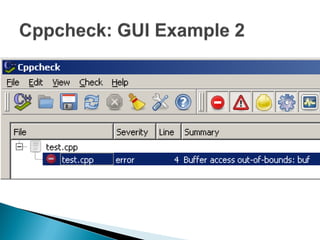
   Fancy Qt-based GUI client!
    ◦ Also available in a command-line version

   Usable via plugins from various IDEs (but not VS):
    ◦ Eclipse
    ◦ Code::Blocks
    ◦ Hudson, Jenkins
   Packages maintained for FreeBSD, Debian and
    Ubuntu systems (sudo apt-get install cppcheck)


   Used to find bugs in many open-source
    projects:
    ◦ Linux Kernel: > 40 bugs found+fixed
    ◦ VLC Player: > 20 bugs found+fixed
    ◦ Others: 7-zip, curl, git, etc
   Bounds checking for array overruns
   Memory and resource leaks
   Unused private class functions
   Use of deprecated functions
   Wrong # of arguments given to printf or scanf
   Switch cases that fall through suspiciously
   Dozens of others…
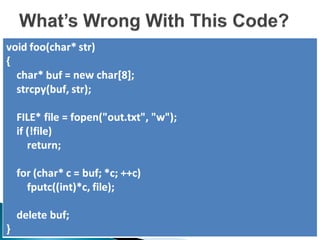
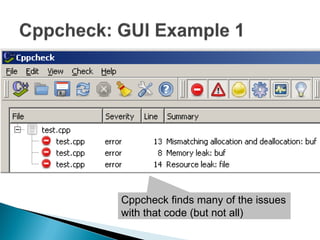
Possible buffer overrun


      Memory leak: buf


Should be “delete[] buf”

      Resource leak: file
Cppcheck finds many of the issues
with that code (but not all)
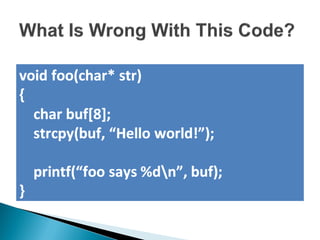
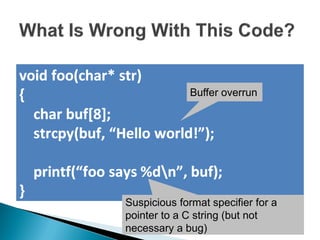
Buffer overrun


Suspicious format specifier for a
pointer to a C string (but not
necessary a bug)
   Bounds checking for array overruns
   Unused private class functions
   Use of deprecated functions
   Memory and resource leaks
   Dozens of others…
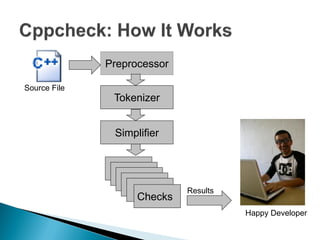
Preprocessor

Source File
               Tokenizer


               Simplifier


                             Results
                    Checks
                                       Happy Developer
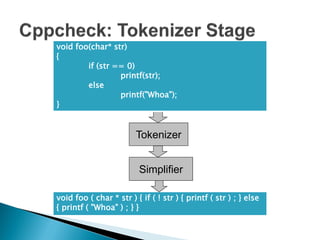
void foo(char* str)
{
        if (str == 0)
                 printf(str);
        else
                 printf("Whoa");
}


                         Tokenizer


                          Simplifier

void foo ( char * str ) { if ( ! str ) { printf ( str ) ; } else
{ printf ( "Whoa" ) ; } }
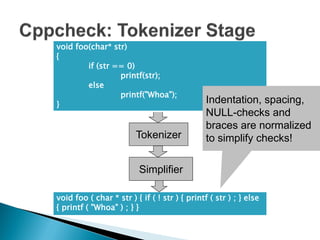
void foo(char* str)
{
        if (str == 0)
                 printf(str);
        else
                 printf("Whoa");
}                                              Indentation, spacing,
                                               NULL-checks and
                                               braces are normalized
                         Tokenizer             to simplify checks!

                          Simplifier

void foo ( char * str ) { if ( ! str ) { printf ( str ) ; } else
{ printf ( "Whoa" ) ; } }
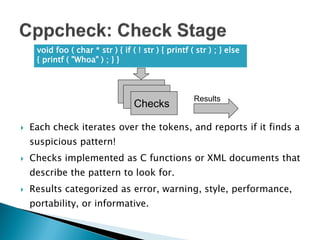
void foo ( char * str ) { if ( ! str ) { printf ( str ) ; } else
     { printf ( "Whoa" ) ; } }


                                                      Results
                                   Checks

   Each check iterates over the tokens, and reports if it finds a
    suspicious pattern!
   Checks implemented as C functions or XML documents that
    describe the pattern to look for.
   Results categorized as error, warning, style, performance,
    portability, or informative.
 Cppcheck    is a free tool for finding
    bugs in C++ source code.

   It works by parsing the source
    code, splitting it into tokens and
    finding suspicious patterns in the
    tokens.
 Official project page:
  ◦ http://cppcheck.sourceforge.net/
 Official source repository:
  ◦ https://github.com/danmar/cppc
    heck
Static Code Analysis and Cppcheck

Static Code Analysis and Cppcheck

  • 2.
    Static Code Analysis  Survey of Tools  Cppcheck
  • 3.
    Goal: Provide confidence that code is correct just by looking at it (without building or executing it).  Helps us find easy bugs buried in thousands of lines of code (not something people are great at).
  • 4.
    Formal Methods  Code Metrics  Reviews and Inspection
  • 5.
    Formal Methods: ◦ Mathematical! ◦ Require a mathematical model and assertions! ◦ Often require modeling the system as a finite state machine and verifying each state and transition.  Code Metrics  Reviews and Inspection
  • 6.
    Formal Methods: Too difficult! Static analysis is supposed to save time.  Code Metrics  Reviews and Inspection
  • 7.
    Formal Methods: Too difficult! Static analysis is supposed to save time.  Code Metrics: • Identify areas where bugs are likely. • Based on measures of code complexity rooted in graph theory (e.g. Cyclomatic complexity).  Reviews and Inspection
  • 8.
    Formal Methods: Too difficult! Static analysis is supposed to save time.  Code Metrics: Good, but doesn’t directly identify defects.  Reviews and Inspection
  • 9.
    Formal Methods: Too difficult! Static analysis is supposed to save time.  Code Metrics: Good, but doesn’t directly identify defects.  Reviews and Inspection • Just look at the code and try to find suspicious patterns. • Basically what we do when performing code reviews.
  • 10.
    Formal Methods: Too difficult! Static analysis is supposed to save time.  Code Metrics: Good, but doesn’t directly identify defects.  Reviews and Inspection Works pretty well!
  • 11.
    Static Code Analysis  Survey of Tools  Cppcheck
  • 12.
    Three Popular Commercial Tools: ◦ PC-Lint ◦ Klocwork Insight ◦ Coverity Prevent  One Free Software Tool: ◦ Cppcheck
  • 13.
    PC-Lint ◦ Commercial ◦ Works for C code ◦ Often reports many false positives. ◦ Probably the cheapest after Cppcheck (which is free)  Klocwork Insight  Coverity Prevent  Cppcheck
  • 14.
    PC-Lint  Klocwork Insight ◦ Commercial ◦ A spin-out of Nortel Networks ◦ Also includes project management and project visualization capabilities.  Coverity Prevent  Cppcheck
  • 15.
    PC-Lint  Klocworks Insight  Coverity Prevent ◦ Commercial ◦ Identified over 6000 bugs across 53 open-source projects. ◦ Developed from research at Stanford University.  Cppcheck
  • 16.
    PC-Lint  Klocworks Insight  Coverity Prevent  Cppcheck ◦ Open source ◦ Under active development. ◦ Has found > 400 bugs in open-source projects. ◦ Free!
  • 17.
    Static Code Analysis  Survey of Tools  Cppcheck
  • 18.
    Detects bugs in C and C++ source that compilers normally do not warn about!  Cross-platform (Windows, Linux, etc)  Fancy Qt-based GUI client! ◦ Also available in a command-line version  Usable via plugins from various IDEs (but not VS): ◦ Eclipse ◦ Code::Blocks ◦ Hudson, Jenkins
  • 19.
    Packages maintained for FreeBSD, Debian and Ubuntu systems (sudo apt-get install cppcheck)  Used to find bugs in many open-source projects: ◦ Linux Kernel: > 40 bugs found+fixed ◦ VLC Player: > 20 bugs found+fixed ◦ Others: 7-zip, curl, git, etc
  • 20.
    Bounds checking for array overruns  Memory and resource leaks  Unused private class functions  Use of deprecated functions  Wrong # of arguments given to printf or scanf  Switch cases that fall through suspiciously  Dozens of others…
  • 22.
    Possible buffer overrun Memory leak: buf Should be “delete[] buf” Resource leak: file
  • 23.
    Cppcheck finds manyof the issues with that code (but not all)
  • 25.
    Buffer overrun Suspicious formatspecifier for a pointer to a C string (but not necessary a bug)
  • 26.
    Bounds checking for array overruns  Unused private class functions  Use of deprecated functions  Memory and resource leaks  Dozens of others…
  • 27.
    Preprocessor Source File Tokenizer Simplifier Results Checks Happy Developer
  • 28.
    void foo(char* str) { if (str == 0) printf(str); else printf("Whoa"); } Tokenizer Simplifier void foo ( char * str ) { if ( ! str ) { printf ( str ) ; } else { printf ( "Whoa" ) ; } }
  • 29.
    void foo(char* str) { if (str == 0) printf(str); else printf("Whoa"); } Indentation, spacing, NULL-checks and braces are normalized Tokenizer to simplify checks! Simplifier void foo ( char * str ) { if ( ! str ) { printf ( str ) ; } else { printf ( "Whoa" ) ; } }
  • 30.
    void foo (char * str ) { if ( ! str ) { printf ( str ) ; } else { printf ( "Whoa" ) ; } } Results Checks  Each check iterates over the tokens, and reports if it finds a suspicious pattern!  Checks implemented as C functions or XML documents that describe the pattern to look for.  Results categorized as error, warning, style, performance, portability, or informative.
  • 31.
     Cppcheck is a free tool for finding bugs in C++ source code.  It works by parsing the source code, splitting it into tokens and finding suspicious patterns in the tokens.
  • 32.
     Official projectpage: ◦ http://cppcheck.sourceforge.net/  Official source repository: ◦ https://github.com/danmar/cppc heck