Mohammed Sikander
Tech Lead
CRANES SOFTWARE
mohammed.sikander@cranessoftware.com
Applying Range Based For loop –
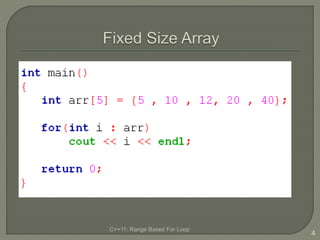
• Fixed Size Arrays
• Vector and List
• Array
2
C++11: Range Based For Loop
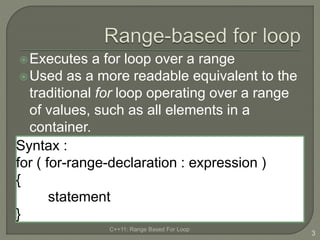
Executes a for loop over a range
Used as a more readable equivalent to the
traditional for loop operating over a range
of values, such as all elements in a
container.
C++11: Range Based For Loop
3
Syntax :
for ( for-range-declaration : expression )
{
statement
}
4
C++11: Range Based For Loop
5
C++11: Range Based For Loop
6
7
C++11: Range Based For Loop
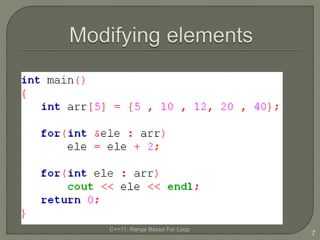
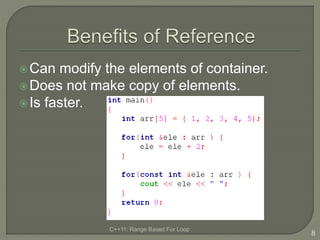
Can modify the elements of container.
Does not make copy of elements.
Is faster.
C++11: Range Based For Loop
8
C++11: Range Based For Loop
9
10
C++11: Range Based For Loop
11
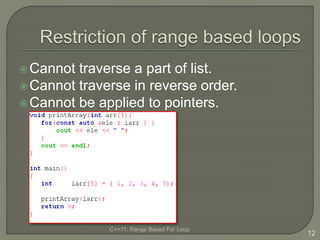
Cannot traverse a part of list.
Cannot traverse in reverse order.
Cannot be applied to pointers.
C++11: Range Based For Loop
12
C++11: Range Based For Loop
13
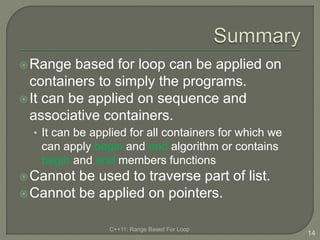
Range based for loop can be applied on
containers to simply the programs.
It can be applied on sequence and
associative containers.
• It can be applied for all containers for which we
can apply begin and end algorithm or contains
begin and end members functions
Cannot be used to traverse part of list.
Cannot be applied on pointers.
C++11: Range Based For Loop
14

C++ 11 range-based for loop

Editor's Notes

  • #5 #include <iostream> using namespace std; int main() { int arr[5] = {5 , 10 , 12, 20 , 40}; for(int i : arr) cout << i << endl; return 0; }
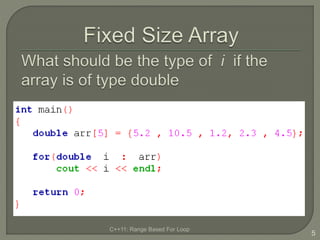
  • #6 #include <iostream> using namespace std; int main() { double arr[5] = {5.2 , 10.5 , 1.2, 2.3 , 4.5}; for(double i : arr) cout << i << endl; return 0; }
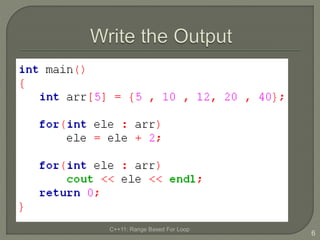
  • #7 #include <iostream> using namespace std; int main() { int arr[5] = {5 , 10 , 12, 20 , 40}; for(int ele : arr) ele = ele + 2; for(int ele : arr) cout << ele << endl; return 0; }
  • #8 #include <iostream> using namespace std; int main() { int arr[5] = {5 , 10 , 12, 20 , 40}; for(int &ele : arr) ele = ele + 2; for(int ele : arr) cout << ele << endl; return 0; }
  • #9  int main() { int arr[10] = { 1, 2, 3, 4, 5, 6, 7, 8, 9, 10 }; for(int &ele : arr ) { ele = ele + x; } for( const int &ele : arr ) { cout << ele << " "; } return 0; }
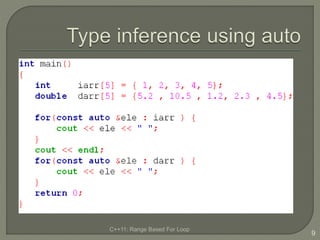
  • #10 #include <iostream> using namespace std; int main() { int iarr[5] = { 1, 2, 3, 4, 5}; double darr[5] = {5.2 , 10.5 , 1.2, 2.3 , 4.5}; for(const auto &ele : iarr ) { cout << ele << " "; } cout << endl; for(const auto &ele : darr ) { cout << ele << " "; } return 0; }
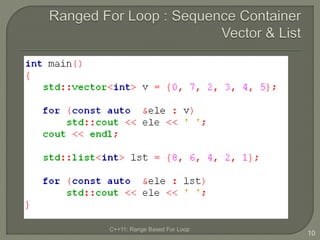
  • #11 #include <iostream> #include <vector> #include <list> using namespace std; int main() { std::vector<int> v = {0, 7, 2, 3, 4, 5}; for (const auto &ele : v) std::cout << ele << ' '; cout << endl; std::list<int> lst = {8, 6, 4, 2, 1}; for (const auto &ele : lst) std::cout << ele << ' '; }
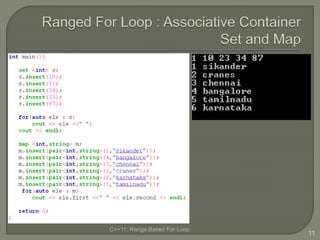
  • #12 #include <iostream> #include <set> #include <map> using namespace std; int main(){ set <int> s; s.insert(10); s.insert(1); s.insert(34); s.insert(23); s.insert(87); for(auto ele : s) cout << ele <<" "; cout << endl; map <int,string> m; m.insert(pair<int,string>(1,"sikander")); m.insert(pair<int,string>(4,"bangalore")); m.insert(pair<int,string>(3,"chennai")); m.insert(pair<int,string>(2,"cranes")); m.insert(pair<int,string>(6,"karnataka")); m.insert(pair<int,string>(5,"tamilnadu")); for(auto ele : m) cout << ele.first <<" " << ele.second << endl; return 0; }
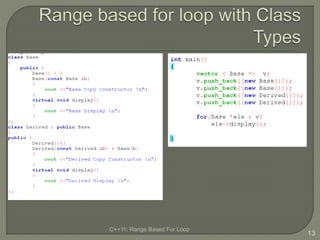
  • #14 #include <iostream> #include <vector> #include <map> using namespace std; class Base { public : Base() { } Base(const Base &b) { cout <<"Base Copy Constructor \n"; } virtual void display() { cout <<"Base Display \n"; } }; class Derived : public Base { public : Derived(){} Derived(const Derived &b) : Base(b) { cout <<"Derived Copy Constructor \n"; } virtual void display() { cout <<"Derived Display \n"; } }; int main() { vector < Base *> v; v.push_back((new Base())); v.push_back((new Base())); v.push_back((new Derived())); v.push_back((new Derived())); for(Base *ele : v) ele->display(); }