- Made by SHRABANTI PROGRAMING  IN
Every C++ program must have at least one function called main(). When we run a C++ program, the first statement executed will be at the beginning of main() and the last statement at the end of  main(). Therefore, the main() is also known as driver function as it drives the program. The Von-Neumann architecture of computers supports only sequential  processing. The normal flow of execution of statements in a high-level  language program is also in the sequential order, that is, each statement is executed in its order of occurrence in the program. Some problems often require  That the normal flow of control be altered depending on the requirements.  C++ supports a number of control structures to perform the processing.  FLOW  OF  CONTROL INTRODUCTION
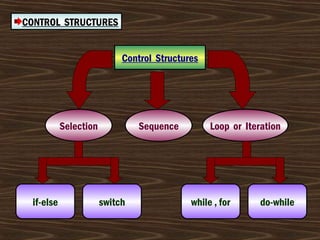
CONTROL  STRUCTURES Control  Structures Loop  or  Iteration if-else Sequence Selection switch while , for do-while
These are the instructions given to the computer to perform some action and form the smallest executable unit within a C++ program. A semicolon (;) terminates a statement. SIMPLE  STATEMENT :  It is a single statement. COMPOUND STATEMENT :  It is a group of statements separated from each other by a  semicolon(;). This group of statements is also called a block  of code enclosed within a pair of curly braces { }. The  significance of the block is that the group of statements  enclosed within the curly braces is   treated as a single unit. STATEMENTS
The statements written within a sequential structure are called selection or conditional statements because we select the execution of a particular statement after checking some condition. If the condition is proved then a particular action  would be performed and if the condition is false, some other action would be performed. The conditional statements are as follows: if-statement if-else statement nested if switch CONDITIONAL  STATEMENTS  (SELECTION)
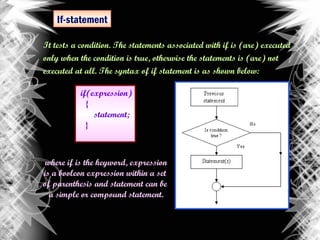
It tests a condition. The statements associated with if is (are) executed only when the condition is true, otherwise the statements is (are) not executed at all. The syntax of if statement is as shown below: If-statement if(expression) { statement; } where if is the keyword, expression is a booleon expression within a set  of parenthesis and statement can be  a simple or compound statement.
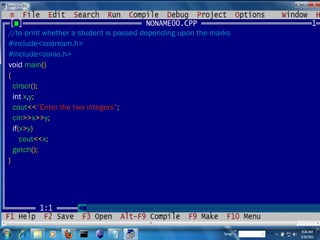
//to print whether a student is passed depending upon the marks #include<iostream.h> #include<conio.h> void  main () { clrscr (); int  x , y ; cout << “Enter the two integers” ; cin >> x >> y ; if ( x > y ) cout << x ; getch (); }
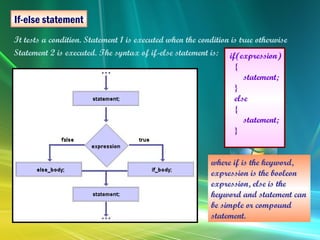
It tests a condition. Statement 1 is executed when the condition is true otherwise Statement 2 is executed. The syntax of if-else statement is: If-else statement if(expression) { statement; } else { statement; } where if is the keyword, expression is the booleon expression, else is the keyword and statement can  be simple or compound statement.
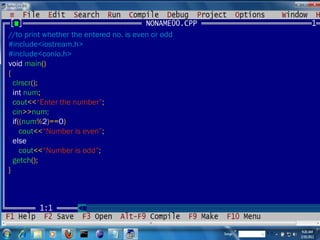
//to print whether the entered no. is even or odd #include<iostream.h> #include<conio.h> void  main () { clrscr (); int  num ; cout << “Enter the number” ; cin >> num; if (( num % 2 )== 0 ) cout << “Number is even” ; else cout << “Number is odd” ; getch (); }
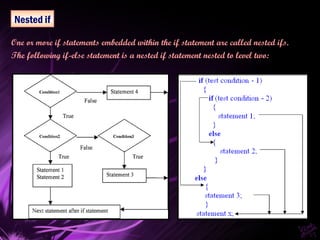
One or more if statements embedded within the if statement are called nested ifs. The following if-else statement is a nested if statement nested to level two: Nested if
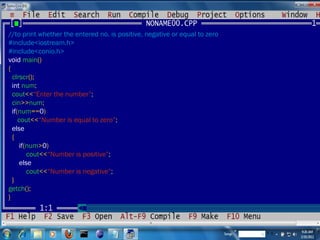
//to print whether the entered no. is positive, negative or equal to zero #include<iostream.h> #include<conio.h> void  main () { clrscr (); int  num ; cout << “Enter the number” ; cin >> num ; if ( num == 0 ) cout << “Number is equal to zero” ; else {  if ( num > 0 ) cout << “Number is positive” ; else cout << “Number is negative” ; } getch (); }
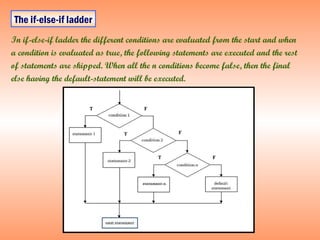
In if-else-if ladder the different conditions are evaluated from the start and when a condition is evaluated as true, the following statements are executed and the rest of statements are skipped. When all the n conditions become false, then the final else having the default-statement will be executed.  The if-else-if ladder
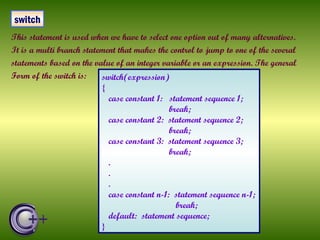
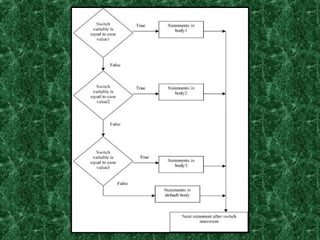
This statement is used when we have to select one option out of many alternatives. It is a multi branch statement that makes the control to jump to one of the several statements based on the value of an integer variable or an expression. The general  Form of the switch is:  switch switch(expression) { case constant 1:  statement sequence 1; break; case constant 2:  statement sequence 2; break; case constant 3:  statement sequence 3; break; . . .  case constant n-1:  statement sequence n-1; break; default:  statement sequence; }
 
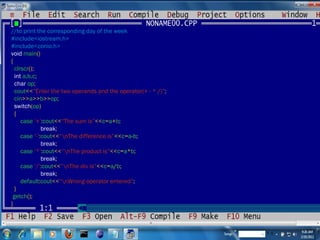
//to print the corresponding day of the week #include<iostream.h> #include<conio.h> void  main () { clrscr (); int  a,b,c ; char  op ; cout << “Enter the two operands and the operator(+ - * /)” ; cin >> a >> b >> op ; switch ( op ) { case  ‘+’ : cout << “The sum is” << c = a + b ; break ; case  ‘-’ : cout << “\nThe difference is” << c = a - b ; break ; case  ‘*’ : cout << “\nThe product is” << c = a * b ; break ; case  ‘/’ : cout << “\nThe div is” << c = a / b ; break ; default : cout << “\nWrong operator entered” ; } getch (); }
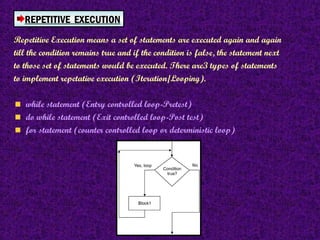
Repetitive Execution means a set of statements are executed again and again till the condition remains true and if the condition is false, the statement next to those set of statements would be executed. There are3 types of statements to implement repetative execution (Iteration/Looping). while statement (Entry controlled loop-Pretest) do while statement (Exit controlled loop-Post test) for statement (counter controlled loop or deterministic loop) REPETITIVE  EXECUTION
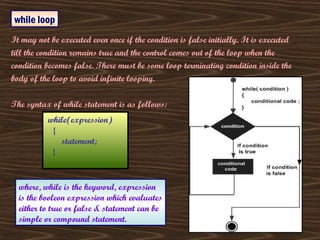
It may not be executed even once if the condition is false initially. It is executed till the condition remains true and the control comes out of the loop when the  condition becomes false. There must be some loop terminating condition inside the  body of the loop to avoid infinite looping. The syntax of while statement is as follows: while loop while(expression) { statement; } where, while is the keyword, expression is the booleon expression which evaluates either to true or false & statement can be simple or compound statement.
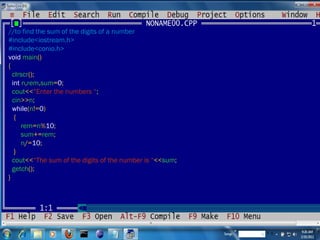
//to find the sum of the digits of a number #include<iostream.h> #include<conio.h> void  main () { clrscr (); int  n , rem , sum = 0 ; cout << “Enter the numbers “ ; cin >> n ; while ( n != 0 ) { rem = n % 10 ; sum += rem ; n /= 10 ; } cout << “The sum of the digits of the number is “ << sum ; getch (); }
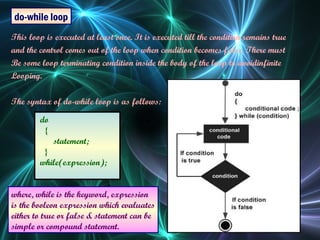
This loop is executed at least once. It is executed till the condition remains true and the control comes out of the loop when condition becomes false. There must  Be some loop terminating condition inside the body of the loop to avoidinfinite  Looping. The syntax of do-while loop is as follows: do-while loop do { statement; } while(expression); where, while is the keyword, expression is the booleon expression which evaluates either to true or false & statement can be simple or compound statement.
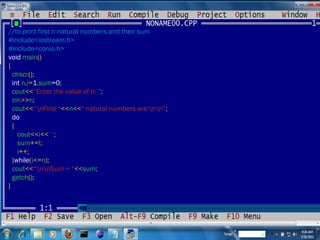
//to print first n natural numbers and their sum #include<iostream.h> #include<conio.h> void  main () { clrscr (); int  n , i = 1 ,sum =0 ; cout << “Enter the value of n: ” ; cin >> n ; cout << “\nFirst “ << n << “ natural numbers are:\n\n” ; do { cout << i << ‘ ‘ ; sum += I ; i ++; } while ( i <= n ); cout << “\n\nSum = “ << sum ; getch (); }
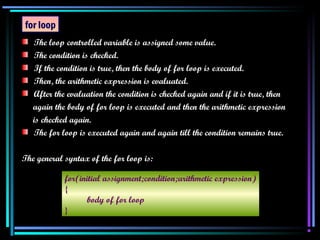
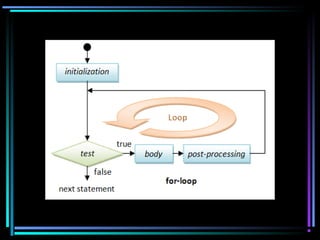
The loop controlled variable is assigned some value. The condition is checked. If the condition is true, then the body of for loop is executed. Then, the arithmetic expression is evaluated. After the evaluation the condition is checked again and if it is true, then again the body of for loop is executed and then the arithmetic expression is checked again. The for loop is executed again and again till the condition remains true. The general syntax of the for loop is: for loop for(initial assignment;condition;arithmetic expression) { body of for loop }
 
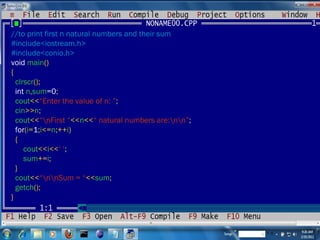
//to print first n natural numbers and their sum #include<iostream.h> #include<conio.h> void  main () { clrscr (); int  n , sum =0 ; cout << “Enter the value of n: ” ; cin >> n ; cout << “\nFirst “ << n << “ natural numbers are:\n\n” ; for ( i = 1 ; i <= n ;++ i ) { cout << i << ‘ ‘ ; sum += i ; } cout << “\n\nSum = “ << sum ; getch (); }
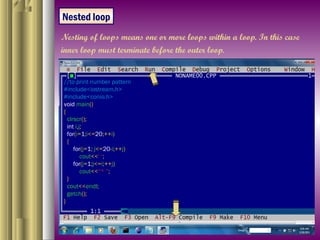
Nesting of loops means one or more loops within a loop. In this case  inner loop must terminate before the outer loop.   Nested loop //to print number pattern #include<iostream.h> #include<conio.h> void  main () { clrscr (); int  i , j ; for ( i = 1 ; i <= 20 ;++ i ) { for ( j = 1 ;  j <= 20 - i ;++ j ) cout << ‘ ‘ ;  for ( j = 1 ; j <= i ;++ j ) cout << “* “ ; } cout << endl ; getch (); }
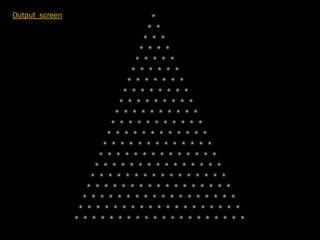
* *  *  *  *  * *  *  *  * *  *  *  *  * *  *  *  *  *  *  *  *  *  *  *  *  * *  *  *  *  *  *  *  * *  *  *  *  *  *  *  *  * *  *  *  *  *  *  *  *  *  * *  *  *  *  *  *  *  *  *  *  * *  *  *  *  *  *  *  *  *  *  *  * *  *  *  *  *  *  *  *  *  *  *  *  * *  *  *  *  *  *  *  *  *  *  *  *  *  * *  *  *  *  *  *  *  *  *  *  *  *  *  *  * *  *  *  *  *  *  *  *  *  *  *  *  *  *  *  * *  *  *  *  *  *  *  *  *  *  *  *  *  *  *  *  * *  *  *  *  *  *  *  *  *  *  *  *  *  *  *  *  *  * *  *  *  *  *  *  *  *  *  *  *  *  *  *  *  *  *  *  * *  *  *  *  *  *  *  *  *  *  *  *  *  *  *  *  *  *  *  *  Output  screen
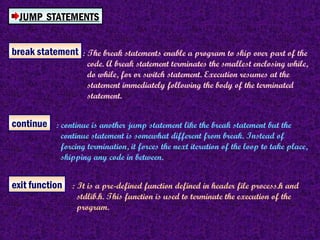
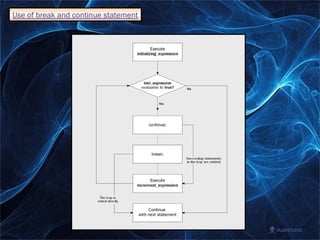
JUMP  STATEMENTS break statement : The break statements enable a program to skip over part of the  code. A break statement terminates the smallest enclosing while,  do while, for or switch statement. Execution resumes at the  statement immediately following the body of the terminated  statement.  continue : continue is another jump statement like the break statement but the continue statement is somewhat different from break. Instead of forcing termination, it forces the next iteration of the loop to take place, skipping any code in between. exit function : It is a pre-defined function defined in header file process.h and stdlib.h. This function is used to terminate the execution of the  program.
Use of break and continue statement
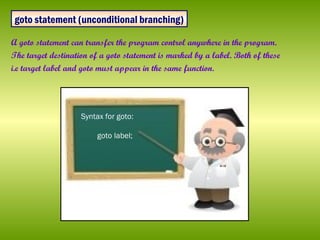
A goto statement can transfer the program control anywhere in the program. The target destination of a goto statement is marked by a label. Both of these i.e target label and goto must appear in the same function.  goto statement (unconditional branching) Syntax for goto: goto label;
END

Flow of control ppt

  • 1.
    - Made bySHRABANTI PROGRAMING IN
  • 2.
    Every C++ programmust have at least one function called main(). When we run a C++ program, the first statement executed will be at the beginning of main() and the last statement at the end of main(). Therefore, the main() is also known as driver function as it drives the program. The Von-Neumann architecture of computers supports only sequential processing. The normal flow of execution of statements in a high-level language program is also in the sequential order, that is, each statement is executed in its order of occurrence in the program. Some problems often require That the normal flow of control be altered depending on the requirements. C++ supports a number of control structures to perform the processing. FLOW OF CONTROL INTRODUCTION
  • 3.
    CONTROL STRUCTURESControl Structures Loop or Iteration if-else Sequence Selection switch while , for do-while
  • 4.
    These are theinstructions given to the computer to perform some action and form the smallest executable unit within a C++ program. A semicolon (;) terminates a statement. SIMPLE STATEMENT : It is a single statement. COMPOUND STATEMENT : It is a group of statements separated from each other by a semicolon(;). This group of statements is also called a block of code enclosed within a pair of curly braces { }. The significance of the block is that the group of statements enclosed within the curly braces is treated as a single unit. STATEMENTS
  • 5.
    The statements writtenwithin a sequential structure are called selection or conditional statements because we select the execution of a particular statement after checking some condition. If the condition is proved then a particular action would be performed and if the condition is false, some other action would be performed. The conditional statements are as follows: if-statement if-else statement nested if switch CONDITIONAL STATEMENTS (SELECTION)
  • 6.
    It tests acondition. The statements associated with if is (are) executed only when the condition is true, otherwise the statements is (are) not executed at all. The syntax of if statement is as shown below: If-statement if(expression) { statement; } where if is the keyword, expression is a booleon expression within a set of parenthesis and statement can be a simple or compound statement.
  • 7.
    //to print whethera student is passed depending upon the marks #include<iostream.h> #include<conio.h> void main () { clrscr (); int x , y ; cout << “Enter the two integers” ; cin >> x >> y ; if ( x > y ) cout << x ; getch (); }
  • 8.
    It tests acondition. Statement 1 is executed when the condition is true otherwise Statement 2 is executed. The syntax of if-else statement is: If-else statement if(expression) { statement; } else { statement; } where if is the keyword, expression is the booleon expression, else is the keyword and statement can be simple or compound statement.
  • 9.
    //to print whetherthe entered no. is even or odd #include<iostream.h> #include<conio.h> void main () { clrscr (); int num ; cout << “Enter the number” ; cin >> num; if (( num % 2 )== 0 ) cout << “Number is even” ; else cout << “Number is odd” ; getch (); }
  • 10.
    One or moreif statements embedded within the if statement are called nested ifs. The following if-else statement is a nested if statement nested to level two: Nested if
  • 11.
    //to print whetherthe entered no. is positive, negative or equal to zero #include<iostream.h> #include<conio.h> void main () { clrscr (); int num ; cout << “Enter the number” ; cin >> num ; if ( num == 0 ) cout << “Number is equal to zero” ; else { if ( num > 0 ) cout << “Number is positive” ; else cout << “Number is negative” ; } getch (); }
  • 12.
    In if-else-if ladderthe different conditions are evaluated from the start and when a condition is evaluated as true, the following statements are executed and the rest of statements are skipped. When all the n conditions become false, then the final else having the default-statement will be executed. The if-else-if ladder
  • 13.
    This statement isused when we have to select one option out of many alternatives. It is a multi branch statement that makes the control to jump to one of the several statements based on the value of an integer variable or an expression. The general Form of the switch is: switch switch(expression) { case constant 1: statement sequence 1; break; case constant 2: statement sequence 2; break; case constant 3: statement sequence 3; break; . . . case constant n-1: statement sequence n-1; break; default: statement sequence; }
  • 14.
  • 15.
    //to print thecorresponding day of the week #include<iostream.h> #include<conio.h> void main () { clrscr (); int a,b,c ; char op ; cout << “Enter the two operands and the operator(+ - * /)” ; cin >> a >> b >> op ; switch ( op ) { case ‘+’ : cout << “The sum is” << c = a + b ; break ; case ‘-’ : cout << “\nThe difference is” << c = a - b ; break ; case ‘*’ : cout << “\nThe product is” << c = a * b ; break ; case ‘/’ : cout << “\nThe div is” << c = a / b ; break ; default : cout << “\nWrong operator entered” ; } getch (); }
  • 16.
    Repetitive Execution meansa set of statements are executed again and again till the condition remains true and if the condition is false, the statement next to those set of statements would be executed. There are3 types of statements to implement repetative execution (Iteration/Looping). while statement (Entry controlled loop-Pretest) do while statement (Exit controlled loop-Post test) for statement (counter controlled loop or deterministic loop) REPETITIVE EXECUTION
  • 17.
    It may notbe executed even once if the condition is false initially. It is executed till the condition remains true and the control comes out of the loop when the condition becomes false. There must be some loop terminating condition inside the body of the loop to avoid infinite looping. The syntax of while statement is as follows: while loop while(expression) { statement; } where, while is the keyword, expression is the booleon expression which evaluates either to true or false & statement can be simple or compound statement.
  • 18.
    //to find thesum of the digits of a number #include<iostream.h> #include<conio.h> void main () { clrscr (); int n , rem , sum = 0 ; cout << “Enter the numbers “ ; cin >> n ; while ( n != 0 ) { rem = n % 10 ; sum += rem ; n /= 10 ; } cout << “The sum of the digits of the number is “ << sum ; getch (); }
  • 19.
    This loop isexecuted at least once. It is executed till the condition remains true and the control comes out of the loop when condition becomes false. There must Be some loop terminating condition inside the body of the loop to avoidinfinite Looping. The syntax of do-while loop is as follows: do-while loop do { statement; } while(expression); where, while is the keyword, expression is the booleon expression which evaluates either to true or false & statement can be simple or compound statement.
  • 20.
    //to print firstn natural numbers and their sum #include<iostream.h> #include<conio.h> void main () { clrscr (); int n , i = 1 ,sum =0 ; cout << “Enter the value of n: ” ; cin >> n ; cout << “\nFirst “ << n << “ natural numbers are:\n\n” ; do { cout << i << ‘ ‘ ; sum += I ; i ++; } while ( i <= n ); cout << “\n\nSum = “ << sum ; getch (); }
  • 21.
    The loop controlledvariable is assigned some value. The condition is checked. If the condition is true, then the body of for loop is executed. Then, the arithmetic expression is evaluated. After the evaluation the condition is checked again and if it is true, then again the body of for loop is executed and then the arithmetic expression is checked again. The for loop is executed again and again till the condition remains true. The general syntax of the for loop is: for loop for(initial assignment;condition;arithmetic expression) { body of for loop }
  • 22.
  • 23.
    //to print firstn natural numbers and their sum #include<iostream.h> #include<conio.h> void main () { clrscr (); int n , sum =0 ; cout << “Enter the value of n: ” ; cin >> n ; cout << “\nFirst “ << n << “ natural numbers are:\n\n” ; for ( i = 1 ; i <= n ;++ i ) { cout << i << ‘ ‘ ; sum += i ; } cout << “\n\nSum = “ << sum ; getch (); }
  • 24.
    Nesting of loopsmeans one or more loops within a loop. In this case inner loop must terminate before the outer loop. Nested loop //to print number pattern #include<iostream.h> #include<conio.h> void main () { clrscr (); int i , j ; for ( i = 1 ; i <= 20 ;++ i ) { for ( j = 1 ; j <= 20 - i ;++ j ) cout << ‘ ‘ ; for ( j = 1 ; j <= i ;++ j ) cout << “* “ ; } cout << endl ; getch (); }
  • 25.
    * * * * * * * * * * * * * * * * * * * * * * * * * * * * * * * * * * * * * * * * * * * * * * * * * * * * * * * * * * * * * * * * * * * * * * * * * * * * * * * * * * * * * * * * * * * * * * * * * * * * * * * * * * * * * * * * * * * * * * * * * * * * * * * * * * * * * * * * * * * * * * * * * * * * * * * * * * * * * * * * * * * * * * * * * * * * * * * * * * * * * * * * * * * * * * * * * * * * * * * * * * * * * * * * * * Output screen
  • 26.
    JUMP STATEMENTSbreak statement : The break statements enable a program to skip over part of the code. A break statement terminates the smallest enclosing while, do while, for or switch statement. Execution resumes at the statement immediately following the body of the terminated statement. continue : continue is another jump statement like the break statement but the continue statement is somewhat different from break. Instead of forcing termination, it forces the next iteration of the loop to take place, skipping any code in between. exit function : It is a pre-defined function defined in header file process.h and stdlib.h. This function is used to terminate the execution of the program.
  • 27.
    Use of breakand continue statement
  • 28.
    A goto statementcan transfer the program control anywhere in the program. The target destination of a goto statement is marked by a label. Both of these i.e target label and goto must appear in the same function. goto statement (unconditional branching) Syntax for goto: goto label;
  • 29.