Prepared by
Mohammed Sikander
Technical Lead
Cranes Software International Limited
This document will help you to understand the
concepts of C++ through simple programs.The
topics covered in this document are
 Static Data Members
 Static Member Functions
 Static Objects
 Constant Data Members
 Constant Member Functions
 Constant Objects
mohammed.sikander@cranessoftware.com 2
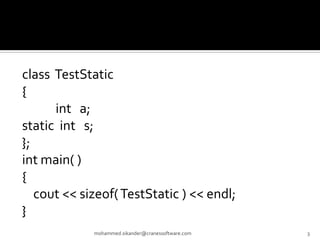
class TestStatic
{
int a;
static int s;
};
int main( )
{
cout << sizeof(TestStatic ) << endl;
}
mohammed.sikander@cranessoftware.com 3
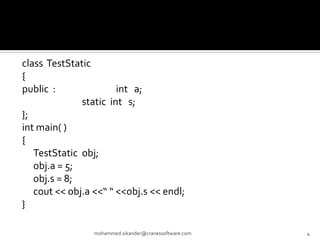
class TestStatic
{
public : int a;
static int s;
};
int main( )
{
TestStatic obj;
obj.a = 5;
obj.s = 8;
cout << obj.a <<“ “ <<obj.s << endl;
}
mohammed.sikander@cranessoftware.com 4
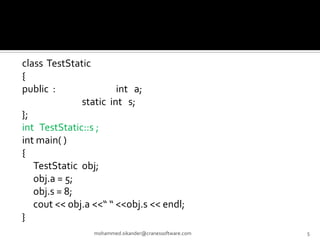
class TestStatic
{
public : int a;
static int s;
};
int TestStatic::s ;
int main( )
{
TestStatic obj;
obj.a = 5;
obj.s = 8;
cout << obj.a <<“ “ <<obj.s << endl;
}
mohammed.sikander@cranessoftware.com 5
class TestStatic
{
public : int a;
static int s;
};
int TestStatic::s ;
mohammed.sikander@cranessoftware.com 6
int main( )
{
TestStatic sagar , maha;
sagar.a = 5 ; sagar.s = 5;
maha.a = 10 ; maha.s = 10;
cout <<sagar.a << sagar.s << endl;
cout << maha.a << maha.s << endl;
}
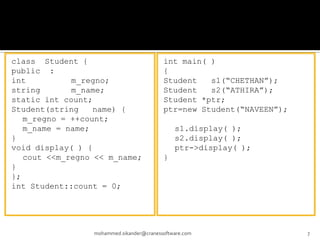
class Student {
public :
int m_regno;
string m_name;
static int count;
Student(string name) {
m_regno = ++count;
m_name = name;
}
void display( ) {
cout <<m_regno << m_name;
}
};
int Student::count = 0;
mohammed.sikander@cranessoftware.com 7
int main( )
{
Student s1(“CHETHAN”);
Student s2(“ATHIRA”);
Student *ptr;
ptr=new Student(“NAVEEN”);
s1.display( );
s2.display( );
ptr->display( );
}
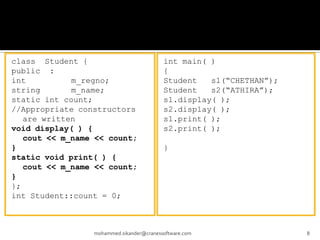
class Student {
public :
int m_regno;
string m_name;
static int count;
//Appropriate constructors
are written
void display( ) {
cout << m_name << count;
}
static void print( ) {
cout << m_name << count;
}
};
int Student::count = 0;
mohammed.sikander@cranessoftware.com 8
int main( )
{
Student s1(“CHETHAN”);
Student s2(“ATHIRA”);
s1.display( );
s2.display( );
s1.print( );
s2.print( );
}
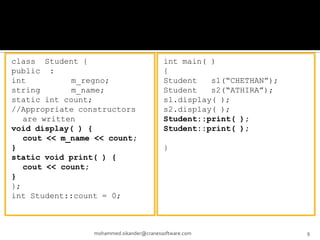
class Student {
public :
int m_regno;
string m_name;
static int count;
//Appropriate constructors
are written
void display( ) {
cout << m_name << count;
}
static void print( ) {
cout << count;
}
};
int Student::count = 0;
mohammed.sikander@cranessoftware.com 9
int main( )
{
Student s1(“CHETHAN”);
Student s2(“ATHIRA”);
s1.display( );
s2.display( );
Student::print( );
Student::print( );
}
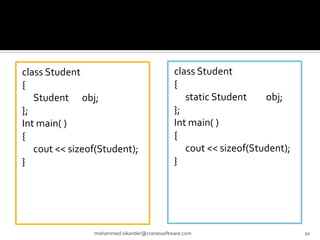
class Student
{
Student obj;
};
Int main( )
{
cout << sizeof(Student);
}
mohammed.sikander@cranessoftware.com 10
class Student
{
static Student obj;
};
Int main( )
{
cout << sizeof(Student);
}
mohammed.sikander@cranessoftware.com 11
class Student
{
static Student obj;
Student( ) { }
public :
static Student *getInstance( )
{
return &obj;
}
void display( )
{
cout <<“Display Function”;
}
};
Student Student::obj;
int main( )
{
Student s1;
Student *ptr;
ptr = Student::getInstance( );
ptr->display( );
}
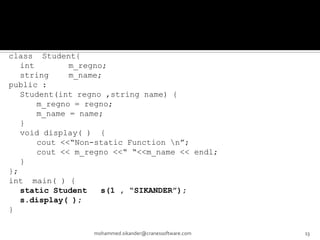
 Can static objects invoke non-static
functions. Demonstrate through code
mohammed.sikander@cranessoftware.com 12
class Student{
int m_regno;
string m_name;
public :
Student(int regno ,string name) {
m_regno = regno;
m_name = name;
}
void display( ) {
cout <<“Non-static Function n”;
cout << m_regno <<“ “<<m_name << endl;
}
};
int main( ) {
static Student s(1 , “SIKANDER”);
s.display( );
}
mohammed.sikander@cranessoftware.com 13
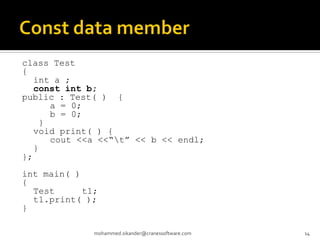
class Test
{
int a ;
const int b;
public : Test( ) {
a = 0;
b = 0;
}
void print( ) {
cout <<a <<“t” << b << endl;
}
};
int main( )
{
Test t1;
t1.print( );
}
mohammed.sikander@cranessoftware.com 14
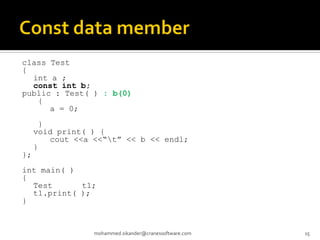
class Test
{
int a ;
const int b;
public : Test( ) : b(0)
{
a = 0;
}
void print( ) {
cout <<a <<“t” << b << endl;
}
};
int main( )
{
Test t1;
t1.print( );
}
mohammed.sikander@cranessoftware.com 15
class Test
{
int a ;
const int b;
public : Test(int x , int y ) : b(y){
a = x;
}
void print( ) const ;
};
void Test::print( )
{
cout <<a <<“t” << b << endl;
}
int main( )
{
Test t1 = Test(5 , 10);
t1.print( );
}
mohammed.sikander@cranessoftware.com 16
class MyStack
{
public :
int *buffer;
int top;
const int SIZE ;
public :
MyStack(int sz = 5)
{
top = -1;
SIZE = sz;
buffer = new int[sz];
}
};
Sikander 17
int main( )
{
MyStack s1 = MyStack(10);
cout << sizeof(s1);
}
1. classTest {
2. int a ;
3. const int b;
4. public :Test(int x , int y ) : b(y){
5. a = x;
6. }
7. void print( ) const {
8. ++a;
9. ++b;
10. }
11. void display( ) {
12. ++a;
13. ++b;
14. }
15. };
mohammed.sikander@cranessoftware.com 18
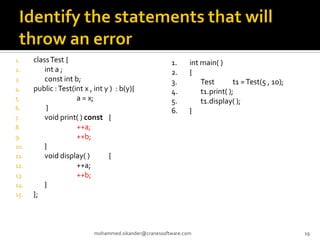
1. int main( )
2. {
3. Test t1 =Test(5 , 10);
4. t1.print( );
5. t1.display( );
6. }
1. classTest {
2. int a ;
3. const int b;
4. public :Test(int x , int y ) : b(y){
5. a = x;
6. }
7. void print( ) const {
8. ++a;
9. ++b;
10. }
11. void display( ) {
12. ++a;
13. ++b;
14. }
15. };
mohammed.sikander@cranessoftware.com 19
1. int main( )
2. {
3. Test t1 =Test(5 , 10);
4. t1.print( );
5. t1.display( );
6. }
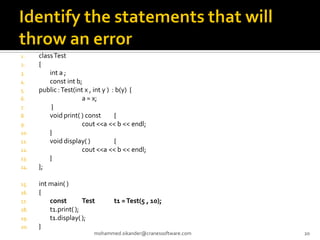
1. classTest
2. {
3. int a ;
4. const int b;
5. public :Test(int x , int y ) : b(y) {
6. a = x;
7. }
8. void print( ) const {
9. cout <<a << b << endl;
10. }
11. void display( ) {
12. cout <<a << b << endl;
13. }
14. };
15. int main( )
16. {
17. const Test t1 =Test(5 , 10);
18. t1.print( );
19. t1.display();
20. }
mohammed.sikander@cranessoftware.com 20
1. classTest
2. {
3. int a ;
4. const int b;
5. public :Test(int x , int y ) : b(y) {
6. a = x;
7. }
8. void funa( ) const {
9. }
10. void funb( ) {
11. }
12. };
mohammed.sikander@cranessoftware.com 21
1. Data member a can be modified in funa;
2. Data member a can be modified in funb;
3. Data member b can be modified in funa;
4. Data member b can be modified in funb;
mohammed.sikander@cranessoftware.com 22
classA
{
public :
A( ) {
cout <<"Default Constructor " << endl;
}
A(int x){
cout <<"A Para Constructor "<<endl;
}
~A( ){
cout <<"A Destructor "<<endl;
}
void operator = (constA &x){
cout <<"A = operator" << endl;
}
};
mohammed.sikander@cranessoftware.com 23
classTest
{
A a ;
public :Test( )
{
a = 0;
}
};
int main( )
{
Test t1;
}

Static and const members

  • 1.
    Prepared by Mohammed Sikander TechnicalLead Cranes Software International Limited
  • 2.
    This document willhelp you to understand the concepts of C++ through simple programs.The topics covered in this document are  Static Data Members  Static Member Functions  Static Objects  Constant Data Members  Constant Member Functions  Constant Objects mohammed.sikander@cranessoftware.com 2
  • 3.
    class TestStatic { int a; staticint s; }; int main( ) { cout << sizeof(TestStatic ) << endl; } mohammed.sikander@cranessoftware.com 3
  • 4.
    class TestStatic { public :int a; static int s; }; int main( ) { TestStatic obj; obj.a = 5; obj.s = 8; cout << obj.a <<“ “ <<obj.s << endl; } mohammed.sikander@cranessoftware.com 4
  • 5.
    class TestStatic { public :int a; static int s; }; int TestStatic::s ; int main( ) { TestStatic obj; obj.a = 5; obj.s = 8; cout << obj.a <<“ “ <<obj.s << endl; } mohammed.sikander@cranessoftware.com 5
  • 6.
    class TestStatic { public :int a; static int s; }; int TestStatic::s ; mohammed.sikander@cranessoftware.com 6 int main( ) { TestStatic sagar , maha; sagar.a = 5 ; sagar.s = 5; maha.a = 10 ; maha.s = 10; cout <<sagar.a << sagar.s << endl; cout << maha.a << maha.s << endl; }
  • 7.
    class Student { public: int m_regno; string m_name; static int count; Student(string name) { m_regno = ++count; m_name = name; } void display( ) { cout <<m_regno << m_name; } }; int Student::count = 0; mohammed.sikander@cranessoftware.com 7 int main( ) { Student s1(“CHETHAN”); Student s2(“ATHIRA”); Student *ptr; ptr=new Student(“NAVEEN”); s1.display( ); s2.display( ); ptr->display( ); }
  • 8.
    class Student { public: int m_regno; string m_name; static int count; //Appropriate constructors are written void display( ) { cout << m_name << count; } static void print( ) { cout << m_name << count; } }; int Student::count = 0; mohammed.sikander@cranessoftware.com 8 int main( ) { Student s1(“CHETHAN”); Student s2(“ATHIRA”); s1.display( ); s2.display( ); s1.print( ); s2.print( ); }
  • 9.
    class Student { public: int m_regno; string m_name; static int count; //Appropriate constructors are written void display( ) { cout << m_name << count; } static void print( ) { cout << count; } }; int Student::count = 0; mohammed.sikander@cranessoftware.com 9 int main( ) { Student s1(“CHETHAN”); Student s2(“ATHIRA”); s1.display( ); s2.display( ); Student::print( ); Student::print( ); }
  • 10.
    class Student { Student obj; }; Intmain( ) { cout << sizeof(Student); } mohammed.sikander@cranessoftware.com 10 class Student { static Student obj; }; Int main( ) { cout << sizeof(Student); }
  • 11.
    mohammed.sikander@cranessoftware.com 11 class Student { staticStudent obj; Student( ) { } public : static Student *getInstance( ) { return &obj; } void display( ) { cout <<“Display Function”; } }; Student Student::obj; int main( ) { Student s1; Student *ptr; ptr = Student::getInstance( ); ptr->display( ); }
  • 12.
     Can staticobjects invoke non-static functions. Demonstrate through code mohammed.sikander@cranessoftware.com 12
  • 13.
    class Student{ int m_regno; stringm_name; public : Student(int regno ,string name) { m_regno = regno; m_name = name; } void display( ) { cout <<“Non-static Function n”; cout << m_regno <<“ “<<m_name << endl; } }; int main( ) { static Student s(1 , “SIKANDER”); s.display( ); } mohammed.sikander@cranessoftware.com 13
  • 14.
    class Test { int a; const int b; public : Test( ) { a = 0; b = 0; } void print( ) { cout <<a <<“t” << b << endl; } }; int main( ) { Test t1; t1.print( ); } mohammed.sikander@cranessoftware.com 14
  • 15.
    class Test { int a; const int b; public : Test( ) : b(0) { a = 0; } void print( ) { cout <<a <<“t” << b << endl; } }; int main( ) { Test t1; t1.print( ); } mohammed.sikander@cranessoftware.com 15
  • 16.
    class Test { int a; const int b; public : Test(int x , int y ) : b(y){ a = x; } void print( ) const ; }; void Test::print( ) { cout <<a <<“t” << b << endl; } int main( ) { Test t1 = Test(5 , 10); t1.print( ); } mohammed.sikander@cranessoftware.com 16
  • 17.
    class MyStack { public : int*buffer; int top; const int SIZE ; public : MyStack(int sz = 5) { top = -1; SIZE = sz; buffer = new int[sz]; } }; Sikander 17 int main( ) { MyStack s1 = MyStack(10); cout << sizeof(s1); }
  • 18.
    1. classTest { 2.int a ; 3. const int b; 4. public :Test(int x , int y ) : b(y){ 5. a = x; 6. } 7. void print( ) const { 8. ++a; 9. ++b; 10. } 11. void display( ) { 12. ++a; 13. ++b; 14. } 15. }; mohammed.sikander@cranessoftware.com 18 1. int main( ) 2. { 3. Test t1 =Test(5 , 10); 4. t1.print( ); 5. t1.display( ); 6. }
  • 19.
    1. classTest { 2.int a ; 3. const int b; 4. public :Test(int x , int y ) : b(y){ 5. a = x; 6. } 7. void print( ) const { 8. ++a; 9. ++b; 10. } 11. void display( ) { 12. ++a; 13. ++b; 14. } 15. }; mohammed.sikander@cranessoftware.com 19 1. int main( ) 2. { 3. Test t1 =Test(5 , 10); 4. t1.print( ); 5. t1.display( ); 6. }
  • 20.
    1. classTest 2. { 3.int a ; 4. const int b; 5. public :Test(int x , int y ) : b(y) { 6. a = x; 7. } 8. void print( ) const { 9. cout <<a << b << endl; 10. } 11. void display( ) { 12. cout <<a << b << endl; 13. } 14. }; 15. int main( ) 16. { 17. const Test t1 =Test(5 , 10); 18. t1.print( ); 19. t1.display(); 20. } mohammed.sikander@cranessoftware.com 20
  • 21.
    1. classTest 2. { 3.int a ; 4. const int b; 5. public :Test(int x , int y ) : b(y) { 6. a = x; 7. } 8. void funa( ) const { 9. } 10. void funb( ) { 11. } 12. }; mohammed.sikander@cranessoftware.com 21 1. Data member a can be modified in funa; 2. Data member a can be modified in funb; 3. Data member b can be modified in funa; 4. Data member b can be modified in funb;
  • 22.
  • 23.
    classA { public : A( ){ cout <<"Default Constructor " << endl; } A(int x){ cout <<"A Para Constructor "<<endl; } ~A( ){ cout <<"A Destructor "<<endl; } void operator = (constA &x){ cout <<"A = operator" << endl; } }; mohammed.sikander@cranessoftware.com 23 classTest { A a ; public :Test( ) { a = 0; } }; int main( ) { Test t1; }