FS 90756
“The use of CFD to assess valve performance and operation in extreme conditions”
BVAA Conference
Tuesday 12th May 2015
Alex Roff – Engineering Director
Overview:
 Introduction.
 The use of CFD in the valve industry.
 CFD case study – Joule Thomson effect in a valve.
 Industry simulation trends.
 Questions.
FS 90756
Introduction
FS 90756
 Simulation can be used in the valve industry to gain confidence and verify the performance of equipment.
 Representing operating conditions for valves and actuators can be challenging and in some cases an impossible task.
 Where test facilities are available, testing can be expensive.
 Gives you the ability to understand what is happening within the valve itself.
 Ability to find the limit of operation of the components, as opposed to just verifying test conditions.
 Gain confidence in a design before metal is cut.
 Demonstrate an increased understanding to customers and compliance to the relevant design codes.
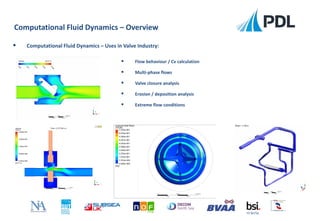
 Flow behaviour / Cv calculation
 Multi-phase flows
 Valve closure analysis
 Erosion / deposition analysis
 Extreme flow conditions
Computational Fluid Dynamics – Overview
FS 90756
 Computational Fluid Dynamics – Uses in Valve Industry:
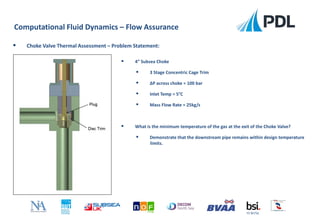
 4” Subsea Choke
 3 Stage Concentric Cage Trim
 ΔP across choke ≈ 100 bar
 Inlet Temp ≈ 5°C
 Mass Flow Rate ≈ 25kg/s
 What is the minimum temperature of the gas at the exit of the Choke Valve?
 Demonstrate that the downstream pipe remains within design temperature
limits.
Computational Fluid Dynamics – Flow Assurance
FS 90756
 Choke Valve Thermal Assessment – Problem Statement:
Computational Fluid Dynamics – Flow Assurance
FS 90756
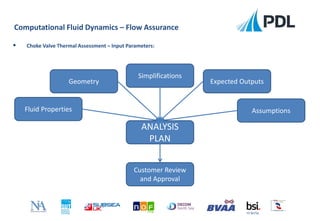
 Choke Valve Thermal Assessment – Input Parameters:
ANALYSIS
PLAN
Fluid Properties Assumptions
Simplifications
Expected OutputsGeometry
Customer Review
and Approval
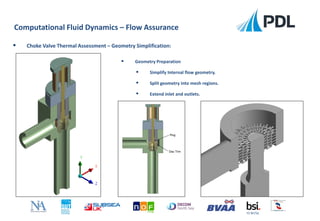
 Geometry Preparation
 Simplify Internal flow geometry.
 Split geometry into mesh regions.
 Extend inlet and outlets.
Computational Fluid Dynamics – Flow Assurance
FS 90756
 Choke Valve Thermal Assessment – Geometry Simplification:
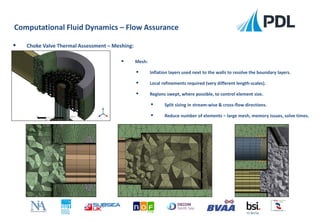
 Mesh:
 Inflation layers used next to the walls to resolve the boundary layers.
 Local refinements required (very different length-scales).
 Regions swept, where possible, to control element size.
 Split sizing in stream-wise & cross-flow directions.
 Reduce number of elements – large mesh, memory issues, solve times.
Computational Fluid Dynamics – Flow Assurance
FS 90756
 Choke Valve Thermal Assessment – Meshing:
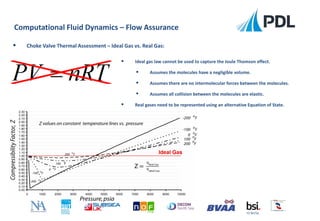
 Ideal gas law cannot be used to capture the Joule Thomson effect.
 Assumes the molecules have a negligible volume.
 Assumes there are no intermolecular forces between the molecules.
 Assumes all collision between the molecules are elastic.
 Real gases need to be represented using an alternative Equation of State.
Computational Fluid Dynamics – Flow Assurance
FS 90756
 Choke Valve Thermal Assessment – Ideal Gas vs. Real Gas:
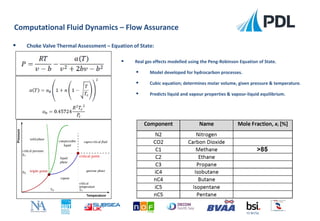
 Real gas effects modelled using the Peng-Robinson Equation of State.
 Model developed for hydrocarbon processes.
 Cubic equation; determines molar volume, given pressure & temperature.
 Predicts liquid and vapour properties & vapour-liquid equilibrium.
Computational Fluid Dynamics – Flow Assurance
FS 90756
 Choke Valve Thermal Assessment – Equation of State:
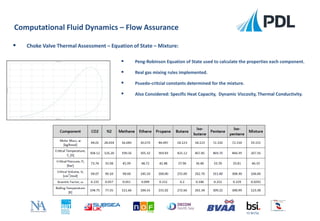
 Peng-Robinson Equation of State used to calculate the properties each component.
 Real gas mixing rules implemented.
 Psuedo-critcial constants determined for the mixture.
 Also Considered: Specific Heat Capacity, Dynamic Viscosity, Thermal Conductivity.
Computational Fluid Dynamics – Flow Assurance
FS 90756
 Choke Valve Thermal Assessment – Equation of State – Mixture:
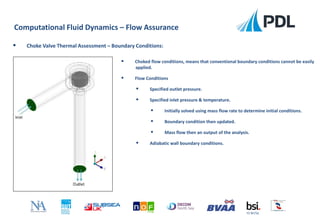
 Choked flow conditions, means that conventional boundary conditions cannot be easily
applied.
 Flow Conditions
 Specified outlet pressure.
 Specified inlet pressure & temperature.
 Initially solved using mass flow rate to determine initial conditions.
 Boundary condition then updated.
 Mass flow then an output of the analysis.
 Adiabatic wall boundary conditions.
Computational Fluid Dynamics – Flow Assurance
FS 90756
 Choke Valve Thermal Assessment – Boundary Conditions:
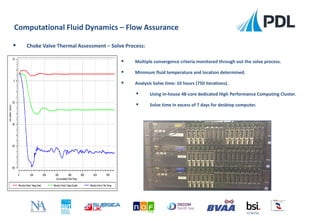
 Multiple convergence criteria monitored through out the solve process.
 Minimum fluid temperature and location determined.
 Analysis Solve time: 10 hours (750 iterations).
 Using in-house 48-core dedicated High Performance Computing Cluster.
 Solve time in excess of 7 days for desktop computer.
Computational Fluid Dynamics – Flow Assurance
FS 90756
 Choke Valve Thermal Assessment – Solve Process:
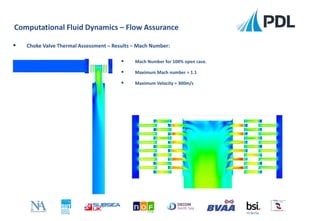
 Mach Number for 100% open case.
 Maximum Mach number ≈ 1.1
 Maximum Velocity ≈ 300m/s
Computational Fluid Dynamics – Flow Assurance
FS 90756
 Choke Valve Thermal Assessment – Results – Mach Number:
Computational Fluid Dynamics – Flow Assurance
FS 90756
 Choke Valve Thermal Assessment – Results – Streamlines:
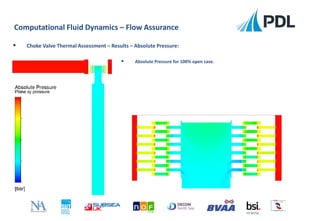
 Absolute Pressure for 100% open case.
Computational Fluid Dynamics – Flow Assurance
FS 90756
 Choke Valve Thermal Assessment – Results – Absolute Pressure:
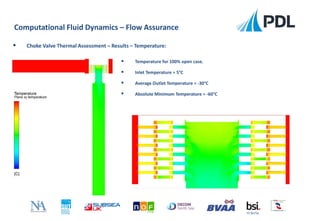
 Temperature for 100% open case.
 Inlet Temperature ≈ 5°C
 Average Outlet Temperature ≈ -30°C
 Absolute Minimum Temperature ≈ -60°C
Computational Fluid Dynamics – Flow Assurance
FS 90756
 Choke Valve Thermal Assessment – Results – Temperature:
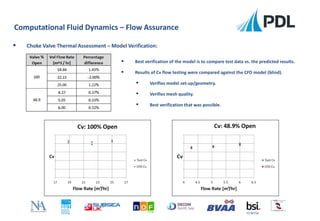
 Best verification of the model is to compare test data vs. the predicted results.
 Results of Cv flow testing were compared against the CFD model (blind).
 Verifies model set-up/geometry.
 Verifies mesh quality.
 Best verification that was possible.
Computational Fluid Dynamics – Flow Assurance
FS 90756
 Choke Valve Thermal Assessment – Model Verification:
 Comparison of calculated fluid properties with PVT data from 3rd party review.
 Comparison of results with simple flash calculations performed by others.
 Rigorous review of final reports by end customer:
 International Oil Company (Confidential)
 EPC Contractor (Confidential) – Flow Assurance
 DNV – 3rd Party Review
Computational Fluid Dynamics – Flow Assurance
FS 90756
 Choke Valve Thermal Assessment – Model Verification:
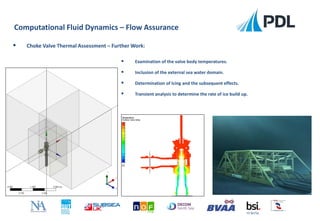
 Examination of the valve body temperatures.
 Inclusion of the external sea water domain.
 Determination of Icing and the subsequent effects.
 Transient analysis to determine the rate of ice build up.
Computational Fluid Dynamics – Flow Assurance
FS 90756
 Choke Valve Thermal Assessment – Further Work:
Simulation Trends
FS 90756
 More demand from end users for both CFD and FEA reports.
 The general complexity of analysis requested is increasing.
 More rigour applied to the depth and detail of the analysis requirements.
 The use of simulation to mitigate risk, shorten development timescales and reduce costs.
 Will become a mandatory requirements for some safety critical valves (API 17G (WD6)).
Questions?
FS 90756
PDL Solutions (Europe) Ltd PDL Solutions (North America) LLC PDL Solutions (Asia) Pte. Ltd
1 Tanners Yard Westheimer 10777 80 Raffles Place
Hexham Suite 1100 #32-01 UOB Plaza
Northumberland Houston Singapore
NE46 3NY TX 77042 048624
United Kingdom United States of America
T: + 44 1 434 609 473 T: + 1 713 260 9635 T: + 44 1 434 609 473
E: solutions@pdl-group.com E: solutions@pdl-group.com E: solutions @ pdl-group.com
W: www.pdl-group.com W: www.pdl-group.com W: www.pdl-group.com
FS 90756
Contact Details:

BVAA presentation 2015: The Use of CFD to assess valve performance and operation in extreme conditions

  • 1.
    FS 90756 “The useof CFD to assess valve performance and operation in extreme conditions” BVAA Conference Tuesday 12th May 2015 Alex Roff – Engineering Director
  • 2.
    Overview:  Introduction.  Theuse of CFD in the valve industry.  CFD case study – Joule Thomson effect in a valve.  Industry simulation trends.  Questions. FS 90756
  • 3.
    Introduction FS 90756  Simulationcan be used in the valve industry to gain confidence and verify the performance of equipment.  Representing operating conditions for valves and actuators can be challenging and in some cases an impossible task.  Where test facilities are available, testing can be expensive.  Gives you the ability to understand what is happening within the valve itself.  Ability to find the limit of operation of the components, as opposed to just verifying test conditions.  Gain confidence in a design before metal is cut.  Demonstrate an increased understanding to customers and compliance to the relevant design codes.
  • 4.
     Flow behaviour/ Cv calculation  Multi-phase flows  Valve closure analysis  Erosion / deposition analysis  Extreme flow conditions Computational Fluid Dynamics – Overview FS 90756  Computational Fluid Dynamics – Uses in Valve Industry:
  • 5.
     4” SubseaChoke  3 Stage Concentric Cage Trim  ΔP across choke ≈ 100 bar  Inlet Temp ≈ 5°C  Mass Flow Rate ≈ 25kg/s  What is the minimum temperature of the gas at the exit of the Choke Valve?  Demonstrate that the downstream pipe remains within design temperature limits. Computational Fluid Dynamics – Flow Assurance FS 90756  Choke Valve Thermal Assessment – Problem Statement:
  • 6.
    Computational Fluid Dynamics– Flow Assurance FS 90756  Choke Valve Thermal Assessment – Input Parameters: ANALYSIS PLAN Fluid Properties Assumptions Simplifications Expected OutputsGeometry Customer Review and Approval
  • 7.
     Geometry Preparation Simplify Internal flow geometry.  Split geometry into mesh regions.  Extend inlet and outlets. Computational Fluid Dynamics – Flow Assurance FS 90756  Choke Valve Thermal Assessment – Geometry Simplification:
  • 8.
     Mesh:  Inflationlayers used next to the walls to resolve the boundary layers.  Local refinements required (very different length-scales).  Regions swept, where possible, to control element size.  Split sizing in stream-wise & cross-flow directions.  Reduce number of elements – large mesh, memory issues, solve times. Computational Fluid Dynamics – Flow Assurance FS 90756  Choke Valve Thermal Assessment – Meshing:
  • 9.
     Ideal gaslaw cannot be used to capture the Joule Thomson effect.  Assumes the molecules have a negligible volume.  Assumes there are no intermolecular forces between the molecules.  Assumes all collision between the molecules are elastic.  Real gases need to be represented using an alternative Equation of State. Computational Fluid Dynamics – Flow Assurance FS 90756  Choke Valve Thermal Assessment – Ideal Gas vs. Real Gas:
  • 10.
     Real gaseffects modelled using the Peng-Robinson Equation of State.  Model developed for hydrocarbon processes.  Cubic equation; determines molar volume, given pressure & temperature.  Predicts liquid and vapour properties & vapour-liquid equilibrium. Computational Fluid Dynamics – Flow Assurance FS 90756  Choke Valve Thermal Assessment – Equation of State:
  • 11.
     Peng-Robinson Equationof State used to calculate the properties each component.  Real gas mixing rules implemented.  Psuedo-critcial constants determined for the mixture.  Also Considered: Specific Heat Capacity, Dynamic Viscosity, Thermal Conductivity. Computational Fluid Dynamics – Flow Assurance FS 90756  Choke Valve Thermal Assessment – Equation of State – Mixture:
  • 12.
     Choked flowconditions, means that conventional boundary conditions cannot be easily applied.  Flow Conditions  Specified outlet pressure.  Specified inlet pressure & temperature.  Initially solved using mass flow rate to determine initial conditions.  Boundary condition then updated.  Mass flow then an output of the analysis.  Adiabatic wall boundary conditions. Computational Fluid Dynamics – Flow Assurance FS 90756  Choke Valve Thermal Assessment – Boundary Conditions:
  • 13.
     Multiple convergencecriteria monitored through out the solve process.  Minimum fluid temperature and location determined.  Analysis Solve time: 10 hours (750 iterations).  Using in-house 48-core dedicated High Performance Computing Cluster.  Solve time in excess of 7 days for desktop computer. Computational Fluid Dynamics – Flow Assurance FS 90756  Choke Valve Thermal Assessment – Solve Process:
  • 14.
     Mach Numberfor 100% open case.  Maximum Mach number ≈ 1.1  Maximum Velocity ≈ 300m/s Computational Fluid Dynamics – Flow Assurance FS 90756  Choke Valve Thermal Assessment – Results – Mach Number:
  • 15.
    Computational Fluid Dynamics– Flow Assurance FS 90756  Choke Valve Thermal Assessment – Results – Streamlines:
  • 16.
     Absolute Pressurefor 100% open case. Computational Fluid Dynamics – Flow Assurance FS 90756  Choke Valve Thermal Assessment – Results – Absolute Pressure:
  • 17.
     Temperature for100% open case.  Inlet Temperature ≈ 5°C  Average Outlet Temperature ≈ -30°C  Absolute Minimum Temperature ≈ -60°C Computational Fluid Dynamics – Flow Assurance FS 90756  Choke Valve Thermal Assessment – Results – Temperature:
  • 18.
     Best verificationof the model is to compare test data vs. the predicted results.  Results of Cv flow testing were compared against the CFD model (blind).  Verifies model set-up/geometry.  Verifies mesh quality.  Best verification that was possible. Computational Fluid Dynamics – Flow Assurance FS 90756  Choke Valve Thermal Assessment – Model Verification:
  • 19.
     Comparison ofcalculated fluid properties with PVT data from 3rd party review.  Comparison of results with simple flash calculations performed by others.  Rigorous review of final reports by end customer:  International Oil Company (Confidential)  EPC Contractor (Confidential) – Flow Assurance  DNV – 3rd Party Review Computational Fluid Dynamics – Flow Assurance FS 90756  Choke Valve Thermal Assessment – Model Verification:
  • 20.
     Examination ofthe valve body temperatures.  Inclusion of the external sea water domain.  Determination of Icing and the subsequent effects.  Transient analysis to determine the rate of ice build up. Computational Fluid Dynamics – Flow Assurance FS 90756  Choke Valve Thermal Assessment – Further Work:
  • 21.
    Simulation Trends FS 90756 More demand from end users for both CFD and FEA reports.  The general complexity of analysis requested is increasing.  More rigour applied to the depth and detail of the analysis requirements.  The use of simulation to mitigate risk, shorten development timescales and reduce costs.  Will become a mandatory requirements for some safety critical valves (API 17G (WD6)).
  • 22.
  • 23.
    PDL Solutions (Europe)Ltd PDL Solutions (North America) LLC PDL Solutions (Asia) Pte. Ltd 1 Tanners Yard Westheimer 10777 80 Raffles Place Hexham Suite 1100 #32-01 UOB Plaza Northumberland Houston Singapore NE46 3NY TX 77042 048624 United Kingdom United States of America T: + 44 1 434 609 473 T: + 1 713 260 9635 T: + 44 1 434 609 473 E: solutions@pdl-group.com E: solutions@pdl-group.com E: solutions @ pdl-group.com W: www.pdl-group.com W: www.pdl-group.com W: www.pdl-group.com FS 90756 Contact Details: