Training Seminar
on
Solving Fluid Flow Problems Using CFD Softwares
Done At
Centre For Fire,Explosive & Environmental Saftey , DRDO
Content
 Organization Profile
 About vision and mission
 Keys area of CFES
 Introduction of CFD
 What is CFD
 Strategy Of CFD
 Objective1 : HYDRAULIC PIPE NETWORK SOLUTION USING
FLOWMASTER SOFTWARE
2: COMBUSTION GAS FLOW THROUGH THE EXHAUST DUCT
OF LAB SCALE IRSS FACILITY
ORGANIZATION PROFILE
DRDO functions as wing of the Department of
Defence Research and Development.
 Today, DRDO is a network of 52 laboratories
which are deeply engaged in developing Defence
technologies.
 It covers various disciplines, like aeronautics,
armaments, electronics, combat vehicles, engineering
systems, instrumentation, missiles, advanced
computing and simulation, special materials, naval
systems etc .
Presently, the Organization is backed by over 5000
DRDO -VISION & MISSION
Make India prosperous & self-reliant in Defence sector by
establishing world class science and technology base.
 Provide our Defence Services decisive edge by equipping
them with internationally competitive systems and solution.
Design, develop and lead to production state-of-the-art
sensors, weapon systems, platforms and allied equipment
for our Defence Services.
Provide technological solutions to the Services to
optimize combat effectiveness and to promote well-
being of the troops.
Key Areas of CFEES
Explosive Safety - CFEES helps in the Sitting of
explosive processing and storage dumps and the
design, testing and evaluation of safe explosive
storage houses.
Environment Safety - CFEES develops treatment
and disposal techniques for hazardous Heavy Metal
Wastes.
 As well as Photodegradable Polyethylene for use as
packaging material at high altitudes, which prevents
the pollution in mountainous areas where the Indian
Army operates, such as Kargil and Siachen.
Fire Safety - CFEES is involved in the development
of automatic fire and explosion detection and
suppression systems for armored vehicles.
water mist based fire protection Systems for various
applications.
It also develops lightweight fire protection clothing.
A smoke test tunnel for creating fire signatures
under various conditions has been installed.
Specialized Training for armed forces personnel in
fire protection, safety, prev.ention and firefighting is
also conducted by CFEES.
The lab has also developed a software package for
virtual firefighting and fire training simulation
Introduction to CFD
What is CFD?
–CFD: A methodology for obtaining a discrete solution
of real world fluid flow problems.
–Discrete Solution: Solution is obtained at a finite
collection of space points and at discrete time levels
For a reasonably accurate solution, the number of
space points that need to involved is of the order of
few millions. Solution is achievable only through
modern high speed computers
Approaches
STRATEGY OF CFD
Broadly, the strategy of CFD is to replace the
continuous problem domain with a discrete domain
using a grid.
N-S EQUATIONS (generally
P.D.E.)
DISCRETIZED ALGEBRAIC
FORM
B. C.
I. C.
OUTPUT IN FORM OF NUMBERS / PLOTS
Objective 1
HYDRAULIC PIPE NETWORK SOLUTION USING
FLOWMASTER SOFTWARE
Software used: FLOWMASTER
Solver modules:
 1. Incompresible flow balancing ( for water)
 2. Incompressible steady state (for water)
 3. Compressible flow balancing (for air)
 4. Compressible steady state (for air)
Main steps in Flowmaster Simulation
Components Used
Network 2 (Constant End Pressure : Without
Orifice)
Input Parameters For pipe
Component No. Diameter Length
2 18.00 mm 2.00 m
4 18.00 mm 2.00 m
6 18.00 mm 2.00 m
8 18.00 mm 2.00 m
10 18.00 mm 2.00 m
13 18.00 mm 2.00 m
15 18.00 mm 2.00 m
17 18.00 mm 2.00 m
20 18.00 mm 2.00 m
22 18.00 mm 2.00 m
Volumetric flow rate 12 Liters per min
Parameter Data
Deflection Angle 90 Degrees
Radius/Diameter 18 mm
Roughness 0.005 mm
Diameter 18.00 mm
Total Pressure 2 bar
Bends parameter
Pressure Source parameter
Results
Orifice Selected Diameter
(conical) Orifice 24 1.48112 mm
(conical) Orifice 25 1.48702 mm
(conical) Orifice 26 2.40008 mm
(conical) Orifice 27 1.79739 mm
(conical) Orifice 28 1.79738 mm
(conical) Orifice 29 2.78724 mm
COMBUSTION GAS FLOW THROUGH THE
EXHAUST DUCT OF LAB SCALE IRSS FACILITY
 Software Specification
Pre-Processor – GAMBIT 2.4.6
Solver & post-processor – FLUENT 6.3.26
 Steps Involved In Simulation
Step 1 :- Creating Geometry
Height 800mm
Radius 100mm
Axis used Along Positive X- axis
Height 400mm
Radius 100mm
Axis used Along Positive Y- axis
Radius 100mm
Axis used In X-Y- axis(Centre at Origin)
Height 250mm
Radius(R1) 100mm
Radius(R2) 130mm
Axis used Along Positive Y- axis
Height 7050mm
Radius 130mm
Axis used Along Positive Y- axis
Ware frame Model of creating Geometry
Type Of Computational Cell Mesh Size (in mm) No. Of Computational Cell
Tet/Hybrid 17 4,64,659
Tet/Hybrid 20 3,75,270
Tet/Hybrid 25 1,79,636
Step 2 :- Mashing Of The Duct
Mesh Input Data
Software Representation Of Mesh Data
Defining Boundary Type
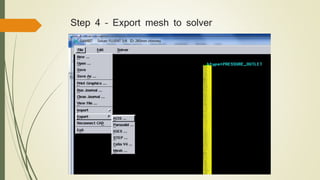
Step 4 – Export mesh to solver
 Fluent is a general purpose CFD solver to simulate the 2D, 3D fluid flow
and heat transfer problems.

Simple Steps Involved In Doing Simulation On Fluent.
 Reading case from Gambit.
 Checking the Grid.
 Scaling the Grid.
 Defining models.
 Assigning operating conditions.
 Assigning boundary conditions.
 Initializing simulation.
 Starting iterations
 Plotting residuals, histograms, vectors, and contours of velocity,
temperature etc.
Simulation steps of Fluent
Step 2 :- Scaling the Geometry.
This command is used so that we can correct our
Dimensions of the Geometry
Step 3 :- Defining Input parameters.
3.1 Input Data for Models
Type Of Fluid Air
Density 0.6 kg/m3
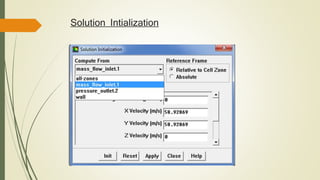
Solution Intialization
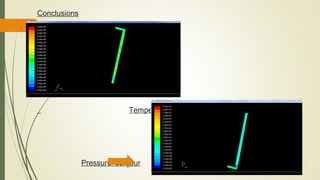
Conclusions
Temperature contour
Pressure contour
Velocity vectors
Thank you

Summer training PPT

  • 1.
    Training Seminar on Solving FluidFlow Problems Using CFD Softwares Done At Centre For Fire,Explosive & Environmental Saftey , DRDO
  • 2.
    Content  Organization Profile About vision and mission  Keys area of CFES  Introduction of CFD  What is CFD  Strategy Of CFD  Objective1 : HYDRAULIC PIPE NETWORK SOLUTION USING FLOWMASTER SOFTWARE 2: COMBUSTION GAS FLOW THROUGH THE EXHAUST DUCT OF LAB SCALE IRSS FACILITY
  • 3.
    ORGANIZATION PROFILE DRDO functionsas wing of the Department of Defence Research and Development.  Today, DRDO is a network of 52 laboratories which are deeply engaged in developing Defence technologies.  It covers various disciplines, like aeronautics, armaments, electronics, combat vehicles, engineering systems, instrumentation, missiles, advanced computing and simulation, special materials, naval systems etc . Presently, the Organization is backed by over 5000
  • 5.
    DRDO -VISION &MISSION Make India prosperous & self-reliant in Defence sector by establishing world class science and technology base.  Provide our Defence Services decisive edge by equipping them with internationally competitive systems and solution. Design, develop and lead to production state-of-the-art sensors, weapon systems, platforms and allied equipment for our Defence Services. Provide technological solutions to the Services to optimize combat effectiveness and to promote well- being of the troops.
  • 7.
    Key Areas ofCFEES Explosive Safety - CFEES helps in the Sitting of explosive processing and storage dumps and the design, testing and evaluation of safe explosive storage houses. Environment Safety - CFEES develops treatment and disposal techniques for hazardous Heavy Metal Wastes.  As well as Photodegradable Polyethylene for use as packaging material at high altitudes, which prevents the pollution in mountainous areas where the Indian Army operates, such as Kargil and Siachen.
  • 8.
    Fire Safety -CFEES is involved in the development of automatic fire and explosion detection and suppression systems for armored vehicles. water mist based fire protection Systems for various applications. It also develops lightweight fire protection clothing. A smoke test tunnel for creating fire signatures under various conditions has been installed. Specialized Training for armed forces personnel in fire protection, safety, prev.ention and firefighting is also conducted by CFEES. The lab has also developed a software package for virtual firefighting and fire training simulation
  • 9.
  • 10.
    What is CFD? –CFD:A methodology for obtaining a discrete solution of real world fluid flow problems. –Discrete Solution: Solution is obtained at a finite collection of space points and at discrete time levels For a reasonably accurate solution, the number of space points that need to involved is of the order of few millions. Solution is achievable only through modern high speed computers
  • 11.
  • 12.
    STRATEGY OF CFD Broadly,the strategy of CFD is to replace the continuous problem domain with a discrete domain using a grid.
  • 13.
    N-S EQUATIONS (generally P.D.E.) DISCRETIZEDALGEBRAIC FORM B. C. I. C. OUTPUT IN FORM OF NUMBERS / PLOTS
  • 14.
    Objective 1 HYDRAULIC PIPENETWORK SOLUTION USING FLOWMASTER SOFTWARE Software used: FLOWMASTER Solver modules:  1. Incompresible flow balancing ( for water)  2. Incompressible steady state (for water)  3. Compressible flow balancing (for air)  4. Compressible steady state (for air)
  • 15.
    Main steps inFlowmaster Simulation
  • 16.
  • 19.
    Network 2 (ConstantEnd Pressure : Without Orifice)
  • 21.
    Input Parameters Forpipe Component No. Diameter Length 2 18.00 mm 2.00 m 4 18.00 mm 2.00 m 6 18.00 mm 2.00 m 8 18.00 mm 2.00 m 10 18.00 mm 2.00 m 13 18.00 mm 2.00 m 15 18.00 mm 2.00 m 17 18.00 mm 2.00 m 20 18.00 mm 2.00 m 22 18.00 mm 2.00 m
  • 22.
    Volumetric flow rate12 Liters per min Parameter Data Deflection Angle 90 Degrees Radius/Diameter 18 mm Roughness 0.005 mm Diameter 18.00 mm Total Pressure 2 bar Bends parameter Pressure Source parameter
  • 23.
    Results Orifice Selected Diameter (conical)Orifice 24 1.48112 mm (conical) Orifice 25 1.48702 mm (conical) Orifice 26 2.40008 mm (conical) Orifice 27 1.79739 mm (conical) Orifice 28 1.79738 mm (conical) Orifice 29 2.78724 mm
  • 24.
    COMBUSTION GAS FLOWTHROUGH THE EXHAUST DUCT OF LAB SCALE IRSS FACILITY  Software Specification Pre-Processor – GAMBIT 2.4.6 Solver & post-processor – FLUENT 6.3.26  Steps Involved In Simulation Step 1 :- Creating Geometry
  • 26.
    Height 800mm Radius 100mm Axisused Along Positive X- axis Height 400mm Radius 100mm Axis used Along Positive Y- axis Radius 100mm Axis used In X-Y- axis(Centre at Origin)
  • 27.
    Height 250mm Radius(R1) 100mm Radius(R2)130mm Axis used Along Positive Y- axis Height 7050mm Radius 130mm Axis used Along Positive Y- axis
  • 28.
    Ware frame Modelof creating Geometry
  • 29.
    Type Of ComputationalCell Mesh Size (in mm) No. Of Computational Cell Tet/Hybrid 17 4,64,659 Tet/Hybrid 20 3,75,270 Tet/Hybrid 25 1,79,636 Step 2 :- Mashing Of The Duct Mesh Input Data
  • 30.
  • 32.
  • 33.
    Step 4 –Export mesh to solver
  • 34.
     Fluent isa general purpose CFD solver to simulate the 2D, 3D fluid flow and heat transfer problems. Simple Steps Involved In Doing Simulation On Fluent.  Reading case from Gambit.  Checking the Grid.  Scaling the Grid.  Defining models.  Assigning operating conditions.  Assigning boundary conditions.  Initializing simulation.  Starting iterations  Plotting residuals, histograms, vectors, and contours of velocity, temperature etc.
  • 35.
  • 36.
    Step 2 :-Scaling the Geometry. This command is used so that we can correct our Dimensions of the Geometry Step 3 :- Defining Input parameters. 3.1 Input Data for Models
  • 38.
    Type Of FluidAir Density 0.6 kg/m3
  • 39.
  • 40.
  • 41.
  • 42.