The students will be able to
 Define Research design
 Find out the Purposes of Research design
 Identify the elements of design construction
 Elaborate the Concepts to consider when designing a Research design
 enlist the Principles of Research design
 enumerate the Types of Research design
 explain the true-experimental research design in detail
 discuss the quasi experimental research design in detail
 Describe the quasi experimental research design in detail
DEFINITION
A blue print for the conduct of a study that
maximizes control over factors that could interfere
with the study’s desired outcomes .
Nancy .B
The arrangement of conditions for the collection and
analysis of data in a manner that aims to combine
relevance to the research purpose with economy in
procedure.
Kothari
Research design always gives the answers
of following questions: (Purpose of study)
 What is the study about ?
 Why is the study being made ?
 Where will the study be carried out ?
 What type of data is required ?
 Where can the required data be found ?
 What periods of time will the study include ?
 What will be the sample design ?
 How will the data be analyzed ?
Purposes of the research design
 It is established at the point of transition from asking the
question to attempting to find an answer to that question.
 It is the platform from which the researcher explores new
knowledge in an effort to better describe and understand
phenomena, clarify plausible explanations, and sometimes
identify potential causative factors.
 It provides the back bone structure of a study.
Purposes of the research design contd
 It determines how the study will be organized, when
data will be collected, and when interventions if any
are to be implemented.
 It maximizes objectivity in study protocol
implementation and data collection.
 It facilitates use of generally accepted methods of
inquiry that safeguard researchers from drawing
incorrect inferences and conclusions.
 Minimizes time and money
 Helps in advance planning
 Helps in selection of appropriate tools
 It eliminates bias and marginal error
Purposes of the research design contd
Design Construction
Basic Design Elements(4)
1.Time: From left to right in notation (reading Across time).
Elements that are listed on the left occur before elements that are
listed on the right.
2.Program(s) or Treatment (s)
The presumed cause, represented with symbol X. When multiple
programs are being studied using the same samples we can keep
the programs as X1, or X2 For comparison group which does not
receive the program under study no X is used.
Design Construction
 3. Observation (s) or Measures (s)
 The symbol used is “o”. If the same measurement or
observation is taken at every point in time in a design, then 0
is sufficient.
 4. Groups or Individuals: The final design elements consists
of the in act groups or the individuals who participate in
various conditions. In design notation each group is indicated
in a separate line
Design Constructions
(I) The Manner is which groups are assigned to the
conditions can be indicated by an appropriate symbols at
the beginning of each line.
“R” – Random Assignment
“N” – Non-Random Assignment
“C” –Assigned using a cut off score on a measurement.
 It should be flexible, appropriate, efficient, economical.
 It should give a smallest experimental error and high
reliability and validity.
 Good research design includes following five important
elements.
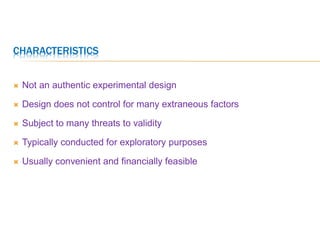
 Subjects
 Variables
 Time
 Setting
 Investigator’s role
Features of a good research design
Concepts to consider when Designing a
Research study
1. Manipulation
 Within the specification of given research design, the
researcher actively initiates, implements and terminates
procedures.
 It is linked to the independent variable.
 The researcher decides what is to be manipulated, to whom
the manipulation applies, when the manipulation is to occur
and how the manipulation is to be implemented.
Concepts to consider when Designing a
Research study
2. Control
 It must be exerted over extraneous sources that
might affect a study.
 It also adds precision, the ability to detect true
effects of smaller magnitude.
 Researcher must have control over processes to
determine who gets what at what time.
Concepts to consider when Designing a
Research study
 Methods of exerting Control
 Use of random methods to assign subjects to
treatments.
 Structuring the assignment process in such a way
that major, known extraneous forces are controlled.
 Blocking: Within each treatment group, there is
approximately even representation of these
extraneous variables in each of the treatment groups.
 Methods of exerting Control
 Matching:
 The researcher identifies one or more
extraneous variables to be controlled. As soon
as the subject is recruited for one of the
treatment group, the researcher tries to find a
subject for other group identical to the first
subject on the specific matching variables.
 Methods of exerting Control
Counterbalancing:
It is used in studies in which the researcher is
concerned that the order in which the treatments are
administered influence the results. Here, all subjects
receive all treatments, however the order of
administration of treatment is varied.
3.Randomization
 It provides a way to ensure that characteristics of
subjects are dispersed across samples in a non-
systematic fashion.
 Entails two separate processes:
 Random selection of subjects from the
population
 Random assignment of subjects to treatment
and control conditions.
Concepts to consider when Designing a Research study
Random selection
 Randomly drawing research subjects from the target
population about which the researcher wants to gain
knowledge and to whom the findings are to be generalized.
 It is the representativeness of the sample relative to the
characteristics of the population it is intended to exemplify.
Random Assignment
 Entails allocating sampling units to treatment and control
conditions in a nonsystematic way, using a decision method
that is known to be random (Eg: Coin toss, random drawing)
 It is intended to ensure that subjects in in one condition are
similar to those in other conditions.
4.Probability
 It is the language of certainty and uncertainty, accuracy and
error, trust and distrust, belief and disbelief in research data.
 In research, the aim is to pursue findings with a high
probability of certainty, accuracy, trust and belief.
 Because research is most often conducted under sub optimal
conditions there is a degree of uncertainty and thus error about
any findings that may come from it.
Concepts to consider when Designing a Research study
 This uncertainty and error are translated into likelihood or
probabilities.
 The likelihood that findings are unjustified and incorrect,
expressed as a probability between 1.00 (Completely
erroneous) and 0.00 (Completely exact finding)
 Nursing has taken a 5% error margin (0.05) as the maximum
error margin. However, often a 1%(0.01)or 0.1% (0.001) margin
might be more appropriate.
Concepts to consider when Designing a Research study
5.Bias
 It refers to the difference between what we observe about a
phenomenon and the phenomenon itself as it exists.
 Unfortunately the true is never known; research can only
give us the observations.
 All bias cannot be eliminated, but it can be minimized.
Concepts to consider when Designing a Research study
Strategies to minimize bias:
 Adequately conceptualizing constructs of interest and
appropriately turning them into variables.
 Selecting designs with minimal threats to validity.
 Using valid, reliable, and sensitive measurement methods.
 Applying statistical methods that maximize quantitative yield.
Concepts to consider when Designing a
Research study
Strategies to minimize bias:
 Blinding is one common technique that can minimize
bias. Here subjects are unaware of the study
hypothesis or the details of the treatment they receive
until the completion of the study.
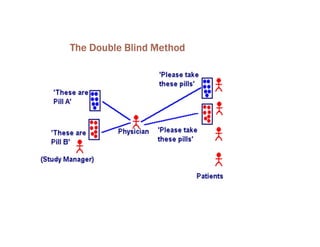
 Double blinding is used when both the subject as well
as the person collecting the data are blind to the study
hypothesis.
Concepts to consider when Designing a Research study
The Double Blind Method
6.Causality
 Causes lead to effects.
 Three conditions must be met to establish causality
 There must be a strong correlation between
the proposed cause and effect.
 The proposed cause must precede the effect in
time.
 The cause has to be present whenever the effect
occurs.
Concepts to consider when Designing a Research study
7.Selection factors
 It is reviewed with four types of validity.
 Statistical conclusion validity addresses the extent to
which at the statistical level, covariation is present
between independent and dependent variables ie, the
extent to which a relationship exists between the
independent and dependent variables.
 Internal validity refers to whether an observed
relationship between variables is indeed causal or in the
absence of a relationship there is no real causal link.
Concepts to consider when Designing a Research study
7.Selection factors
 Constructive validity asks whether the causal
relationship between the two variables is indeed “the
one” and tries to refute the possibility that a
confounding variable may explain the presumed causal
relationship.
 External validity refers to the generalizability of an
observed causal relationship across different persons,
settings and times.
Concepts to consider when Designing a Research study
PRINCIPLES OF RESEARCH DESIGN
Professor Fisher has enumerated three important
principles of research design.
 Principle of Replication
 Principle of randomization
 Principle of Local Control
PRINCIPLE OF REPLICATION
 According to this principle, the experiment
should be repeated more than once. Thus,
each treatment is applied in many
experimental units instead of one.
 By doing this method, the accuracy and
precision of the study are increased
significantly.
PRINCIPLE OF RANDOMIZATION
 This principle provides protection
 This principle indicates that the researcher
should design or plan the experiment in such
a way that the variations caused by
extraneous factors can all be combined
under the general heading of “Chance”.
PRINCIPLE OF LOCAL CONTROL
 The extraneous factors, the known source of
variability, is made to vary deliberately over
as wide a range as necessary and this needs
to be done in such a way that the variability
it causes can be measured and hence
eliminated from the experimental error.
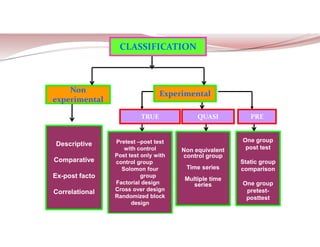
Non experimental Experimental
CLASSIFICATION
One group
post test
Static group
comparison
One group
pretest-
posttest
Non equivalent
control group
Time series
Multiple time
series
Descriptive
Comparative
Ex-post facto
Correlational
Non equivalent
control group
Time series
Multiple time
series
Descriptive
Comparative
Ex-post facto
Correlational
One group
post test
Static group
comparison
One group
pretest-
posttest
Non equivalent
control group
Time series
Multiple time
series
Descriptive
Comparative
Ex-post facto
Correlational
Pretest –post test
with control
Post test only with
control group
Solomon four
group
Factorial design
Cross over design
Randomized block
design
PRE
TRUE QUASI
TRUE QUASI
Non
experimental
Experimental
•
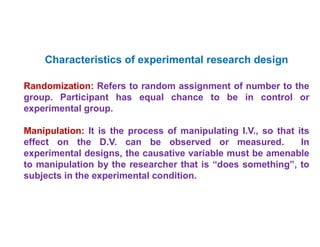
Characteristics of experimental research design
Randomization: Refers to random assignment of number to the
group. Participant has equal chance to be in control or
experimental group.
Manipulation: It is the process of manipulating I.V., so that its
effect on the D.V. can be observed or measured. In
experimental designs, the causative variable must be amenable
to manipulation by the researcher that is “does something”, to
subjects in the experimental condition.
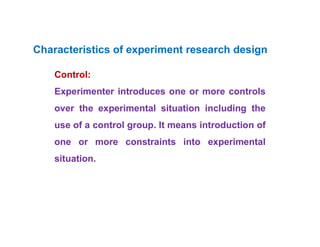
•
Control:
Experimenter introduces one or more controls
over the experimental situation including the
use of a control group. It means introduction of
one or more constraints into experimental
situation.
Characteristics of experiment research design
Essential Elements of Experimental Research
Random assignment of subjects to groups
Precisely defined independent variable
Manipulation of the independent variable
Researcher’s control of the experimental situation
and setting, including a control or comparison
group
Clearly identified sample criteria
Carefully measured dependent variables
Controlled environment for conduct of study
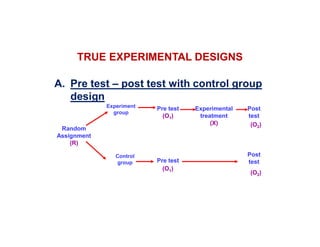
A. Pre test – post test with control group
design
TRUE EXPERIMENTAL DESIGNS
Random
Assignment
(R)
Experiment
group
Control
group
Pre test
(O1)
Pre test
Experimental
treatment
(X)
Post
test
Post
test
(O1)
(O2)
(O2)
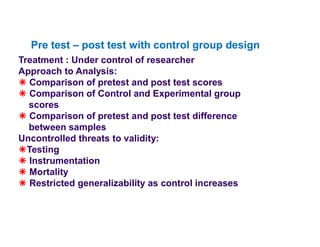
Pre test – post test with control group design
• pretest and post test
Treatment : Under control of researcher
Approach to Analysis:
 Comparison of pretest and post test scores
 Comparison of Control and Experimental group
scores
 Comparison of pretest and post test difference
between samples
Uncontrolled threats to validity:
Testing
 Instrumentation
 Mortality
 Restricted generalizability as control increases
PRE TEST – POST TEST CONTROL GROUP DESIGN
 In this design, subjects have been designed randomly to the
experimental or control group.
 The experimental treatment is given only to those in the
experimental group, and the pre tests and post tests are those
measurements of the dependent variables that are made before
and after the experimental treatment is performed.
 All true experimental designs have subjects randomly assigned
groups, have an experimental treatment introduced to some of
the subjects and have the effects of the treatment observed.
 The investigator is able to account for events
occurring between time 1 and time 2 through
observation of control group
 It also enables the investigator to control for
changes in the instrumentation, since
changes or drifts in measurement should
affect both groups equally
 Randomization decreases selection bias and
maturation.
ADVANTAGES
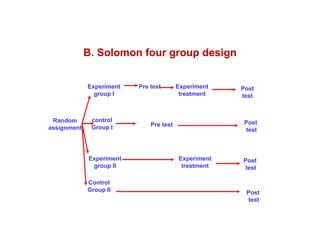
B. Solomon four group design
Random
assignment
Experiment
group I
Experiment
group II
Pre test
Post
test
control
Group I
Control
Group II
Experiment
treatment
Experiment
treatment
Post
test
Pre test
Post
test
Post
test
Pre test
SOLOMON FOUR GROUP DESIGN
 This design employs two experimental
groups and two control groups. Initially, the
investigator randomly assigns subjects to
the four groups. Those in the first
experimental treatment, and observed again
on occasion 2.
 Those in the experimental group 2 also
receive the treatment but are observed only
after the treatment, nor before.
Solomon four group design contd
Those in control group 1 are observed, on
occasion 1 and 2, but they are not given the
experimental treatment.
Those in control group 2 are observed only on
the second occasion without previous
observation or treatment.
ADVANTAGES
 It has great potential for generating information
about differential sources of effect on the
dependent variable, because all four groups are
studied at the same time, both the effects of
events occurring between time 1 and time 2 and
the maturation of subjects are controlled.
Advantages contd.
One can examine the score of the 2 control groups
for a measure of maturation without the influence of
treatment.
The investigator also can compare the difference in
the groups.
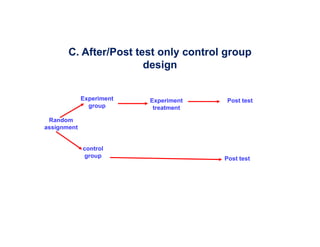
C. After/Post test only control group
design
Random
assignment
Experiment
group
control
group
Experiment
treatment
Post test
Post test
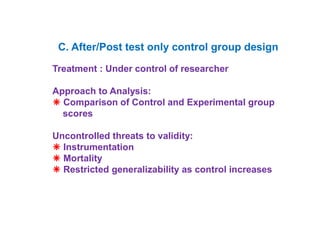
C. After/Post test only control group design
• pretest and post test
Treatment : Under control of researcher
Approach to Analysis:
 Comparison of Control and Experimental group
scores
Uncontrolled threats to validity:
 Instrumentation
 Mortality
 Restricted generalizability as control increases
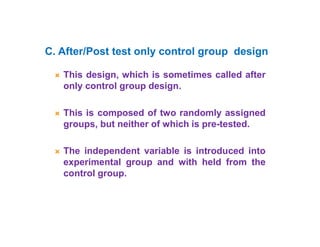
 This design, which is sometimes called after
only control group design.
 This is composed of two randomly assigned
groups, but neither of which is pre-tested.
 The independent variable is introduced into
experimental group and with held from the
control group.
C. After/Post test only control group design
ADVANTAGE
 This design can be useful in situation where it is
not possible to pretest the subjects or pretest is
not essential.
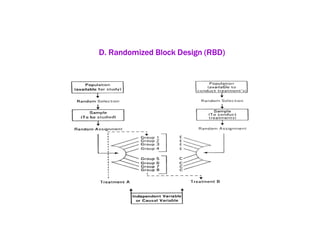
Uses the two group pretest-posttest pattern or
the two group post test pattern with one
addition: a blocking variable.
 The blocking variable if uncontrolled, is
expected to confound the findings of the study.
D. Randomized Block Design (RBD)
Randomized block design contd
To prevent the confusion subjects are rank
ordered in relation to the blocking variable.
 Random assignment of the samples to both the
groups based on the rank order of the variable is
done, so that both groups are equal in relation to
the confounding variable.
Ex: Effectiveness of a nursing intervention to relieve post
chemotherapy nausea among cancer patients.
IV: Nursing intervention to relieve post chemotherapy
nausea.
Confounding variable: Severity of nausea
Here subjects are ranked according to the severity of nausea. The
subjects with most severe nausea are identified and randomly
assigned with one to experimental group and one to control
group. Then the two subjects in the next rank are identified and
randomly assigned. This pattern is followed until the entire
sample are randomly assigned as matched pairs.
D. Randomized Block Design (RBD)
 Two or more different characteristics, treatments, or
events are independently varied within a single study.
 Two treatments or factors are involved and, within each factor,
two levels are manipulated.
 It examines multi causality.
 This is referred to as a 2x2 factorial design.
 Extension of the factorial design to more than two
levels of variables are referred to as MxN factorial
designs.
F. Factorial designs
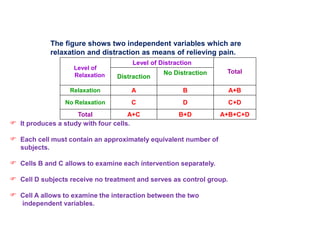
The figure shows two independent variables which are
relaxation and distraction as means of relieving pain.
Level of
Relaxation
Level of Distraction
Total
Distraction
No Distraction
Relaxation A B A+B
No Relaxation C D C+D
Total A+C B+D A+B+C+D
 It produces a study with four cells.
 Each cell must contain an approximately equivalent number of
subjects.
 Cells B and C allows to examine each intervention separately.
 Cell D subjects receive no treatment and serves as control group.
 Cell A allows to examine the interaction between the two
independent variables.
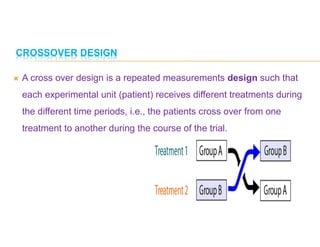
CROSSOVER DESIGN
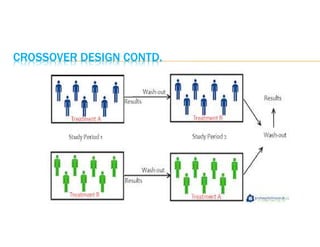
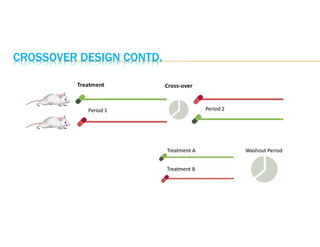
 A cross over design is a repeated measurements design such that
each experimental unit (patient) receives different treatments during
the different time periods, i.e., the patients cross over from one
treatment to another during the course of the trial.
CROSSOVER DESIGN CONTD.
QUASI EXPERIMENTAL DESIGN
DEFINITION
It is a research design in which the researcher initiates an
experimental treatment but some characteristics of true experiment
is lacking.
QUASI EXPERIMENTS
 It involve the Intervention but lack randomization
 Facilitate search for knowledge & examination of causality in
situations in which complete control is not possible
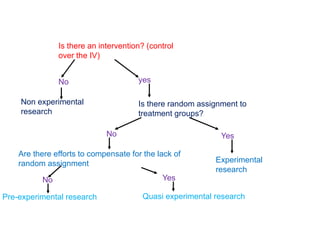
Is there an intervention? (control
over the IV)
No
Non experimental
research
yes
Is there random assignment to
treatment groups?
No Yes
Experimental
research
Are there efforts to compensate for the lack of
random assignment
No
Pre-experimental research
Yes
Quasi experimental research
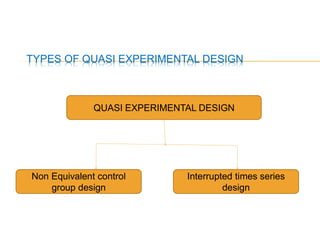
TYPES OF QUASI EXPERIMENTAL DESIGN
QUASI EXPERIMENTAL DESIGN
Non Equivalent control
group design
Interrupted times series
design
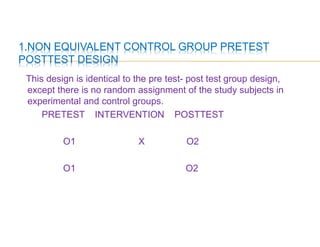
1.NON EQUIVALENT CONTROL GROUP PRETEST
POSTTEST DESIGN
This design is identical to the pre test- post test group design,
except there is no random assignment of the study subjects in
experimental and control groups.
PRETEST INTERVENTION POSTTEST
O1 X O2
O1 O2
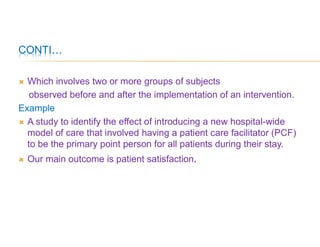
CONTI…
 Which involves two or more groups of subjects
observed before and after the implementation of an intervention.
Example
 A study to identify the effect of introducing a new hospital-wide
model of care that involved having a patient care facilitator (PCF)
to be the primary point person for all patients during their stay.
 Our main outcome is patient satisfaction.
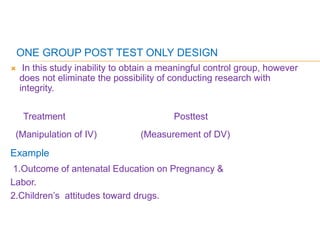
ONE GROUP POST TEST ONLY DESIGN
 In this study inability to obtain a meaningful control group, however
does not eliminate the possibility of conducting research with
integrity.
Treatment Posttest
(Manipulation of IV) (Measurement of DV)
Example
1.Outcome of antenatal Education on Pregnancy &
Labor.
2.Children’s attitudes toward drugs.
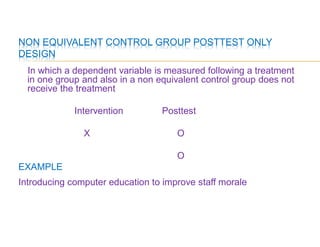
NON EQUIVALENT CONTROL GROUP POSTTEST ONLY
DESIGN
In which a dependent variable is measured following a treatment
in one group and also in a non equivalent control group does not
receive the treatment
Intervention Posttest
X O
O
EXAMPLE
Introducing computer education to improve staff morale
CONTI…
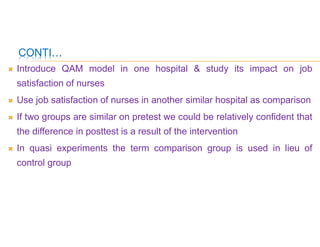
 Introduce QAM model in one hospital & study its impact on job
satisfaction of nurses
 Use job satisfaction of nurses in another similar hospital as comparison
 If two groups are similar on pretest we could be relatively confident that
the difference in posttest is a result of the intervention
 In quasi experiments the term comparison group is used in lieu of
control group
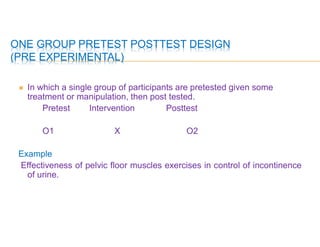
ONE GROUP PRETEST POSTTEST DESIGN
(PRE EXPERIMENTAL)
 In which a single group of participants are pretested given some
treatment or manipulation, then post tested.
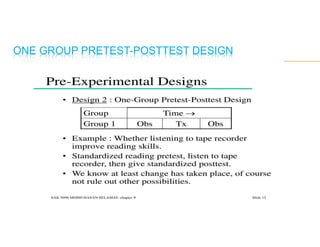
Pretest Intervention Posttest
O1 X O2
Example
Effectiveness of pelvic floor muscles exercises in control of incontinence
of urine.
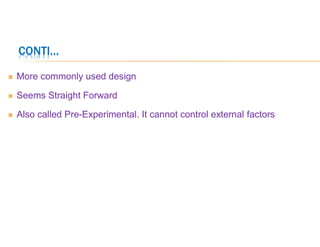
 More commonly used design
 Seems Straight Forward
 Also called Pre-Experimental. It cannot control external factors
CONTI…
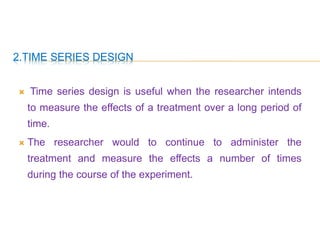
2.TIME SERIES DESIGN
 Time series design is useful when the researcher intends
to measure the effects of a treatment over a long period of
time.
 The researcher would to continue to administer the
treatment and measure the effects a number of times
during the course of the experiment.
TIME SERIES DESIGN
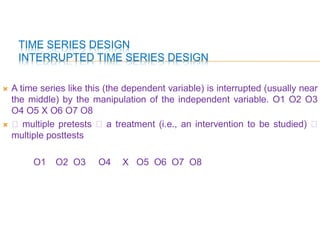
INTERRUPTED TIME SERIES DESIGN
 A time series like this (the dependent variable) is interrupted (usually near
the middle) by the manipulation of the independent variable. O1 O2 O3
O4 O5 X O6 O7 O8
  multiple pretests  a treatment (i.e., an intervention to be studied) 
multiple posttests
O1 O2 O3 O4 X O5 O6 O7 O8
CONTI…
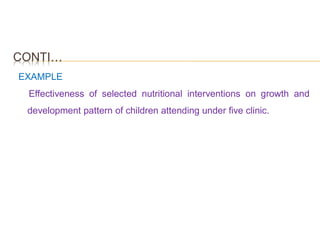
EXAMPLE
Effectiveness of selected nutritional interventions on growth and
development pattern of children attending under five clinic.
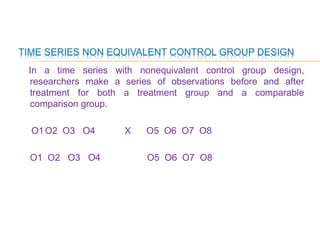
TIME SERIES NON EQUIVALENT CONTROL GROUP DESIGN
In a time series with nonequivalent control group design,
researchers make a series of observations before and after
treatment for both a treatment group and a comparable
comparison group.
O1O2 O3 O4 X O5 O6 O7 O8
O1 O2 O3 O4 O5 O6 O7 O8
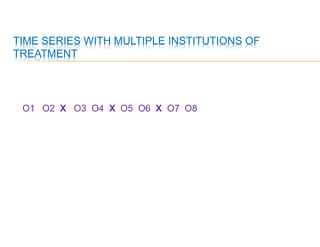
TIME SERIES WITH MULTIPLE INSTITUTIONS OF
TREATMENT
O1 O2 X O3 O4 X O5 O6 X O7 O8
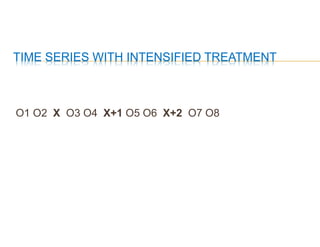
TIME SERIES WITH INTENSIFIED TREATMENT
O1 O2 X O3 O4 X+1 O5 O6 X+2 O7 O8
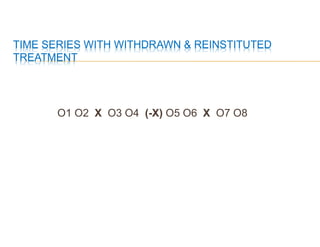
TIME SERIES WITH WITHDRAWN & REINSTITUTED
TREATMENT
O1 O2 X O3 O4 (-X) O5 O6 X O7 O8
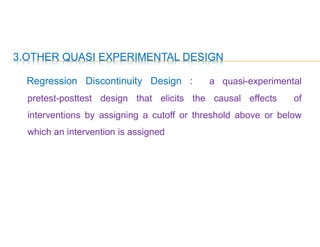
3.OTHER QUASI EXPERIMENTAL DESIGN
Regression Discontinuity Design : a quasi-experimental
pretest-posttest design that elicits the causal effects of
interventions by assigning a cutoff or threshold above or below
which an intervention is assigned
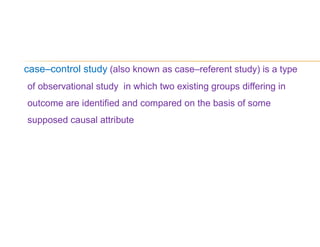
case–control study (also known as case–referent study) is a type
of observational study in which two existing groups differing in
outcome are identified and compared on the basis of some
supposed causal attribute
EXPERIMENTAL & COMPARISON CONDITIONS
 Develop a strong intervention protocols
 Careful in documenting the counterfactual
 In time series design, the counterfactual is the condition existing
before the intervention
STRENGTHS OF QUASI- EXPERIMENTS
 Practical
 Difficult to conduct true experiments in nursing research in real life
setting
 Introduce some research control when full experimental rigor is not
possible
 Several rival hypotheses competing with intervention as explanation
for the results
 Take the weaknesses into account in interpreting results
LIMITATIONS OF QUASI- EXPERIMENTS
 Several rival hypotheses competing with intervention as
explanation for the results
 Take the weaknesses into account in interpreting results
 Conclusion depend in part on human judgment rather than more
objective criteria, cause & effect inferences may be less
convincing
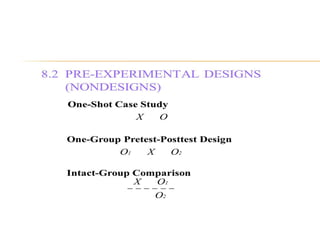
PRE EXPERIMENTAL RESEARCH DESIGN
DEFINITION
 It is a simplest type of design which does not include an adequate
control group.
TYPES
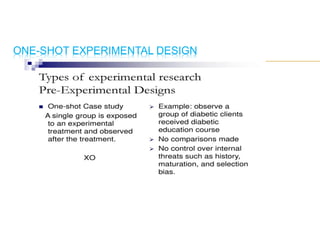
 One-shot experimental Design
 One Group Pretest-Posttest Design
 Intact group comparison
CHARACTERISTICS
 Not an authentic experimental design
 Design does not control for many extraneous factors
 Subject to many threats to validity
 Typically conducted for exploratory purposes
 Usually convenient and financially feasible
ONE-SHOT EXPERIMENTAL DESIGN
ONE GROUP PRETEST-POSTTEST DESIGN
PRE –EXPERIMENTAL DESIGN
ADVANTAGES
Convenient
More suitable design
Very simple
DISADVANTAGES
weak design
Very little control
Higher threat to internal validity
Selection bias

 EXPERIMENTAL DESIGN
 ADVANTAGES
 Most powerful design to demonstrate cause and effect
relationships between the Independent and dependent variable
 DISADVANTAGES
 Some variables can’t be manipulated
 Ethical constraints for experimenting on humans
 Hawthorne effect

REFERENCE
 Denise F.Polit & Cheryl Tatano Beck (2010) “Essentials Of
Nursing Research’’ Lippincott Williams Page 232-234
 Bernadette P.Hungler & Denise F.Polit (1999)“Nursing
research principles and methods’’ Lippincott Williams
Online reference
 web.csulb.edu
 wiki/quasi experiment
 study.com/academy
PPT-Experimental-research-design.pdf

PPT-Experimental-research-design.pdf

  • 2.
    The students willbe able to  Define Research design  Find out the Purposes of Research design  Identify the elements of design construction  Elaborate the Concepts to consider when designing a Research design
  • 3.
     enlist thePrinciples of Research design  enumerate the Types of Research design  explain the true-experimental research design in detail  discuss the quasi experimental research design in detail  Describe the quasi experimental research design in detail
  • 4.
    DEFINITION A blue printfor the conduct of a study that maximizes control over factors that could interfere with the study’s desired outcomes . Nancy .B The arrangement of conditions for the collection and analysis of data in a manner that aims to combine relevance to the research purpose with economy in procedure. Kothari
  • 5.
    Research design alwaysgives the answers of following questions: (Purpose of study)  What is the study about ?  Why is the study being made ?  Where will the study be carried out ?  What type of data is required ?  Where can the required data be found ?  What periods of time will the study include ?  What will be the sample design ?  How will the data be analyzed ?
  • 6.
    Purposes of theresearch design  It is established at the point of transition from asking the question to attempting to find an answer to that question.  It is the platform from which the researcher explores new knowledge in an effort to better describe and understand phenomena, clarify plausible explanations, and sometimes identify potential causative factors.  It provides the back bone structure of a study.
  • 7.
    Purposes of theresearch design contd  It determines how the study will be organized, when data will be collected, and when interventions if any are to be implemented.  It maximizes objectivity in study protocol implementation and data collection.  It facilitates use of generally accepted methods of inquiry that safeguard researchers from drawing incorrect inferences and conclusions.
  • 8.
     Minimizes timeand money  Helps in advance planning  Helps in selection of appropriate tools  It eliminates bias and marginal error Purposes of the research design contd
  • 9.
    Design Construction Basic DesignElements(4) 1.Time: From left to right in notation (reading Across time). Elements that are listed on the left occur before elements that are listed on the right. 2.Program(s) or Treatment (s) The presumed cause, represented with symbol X. When multiple programs are being studied using the same samples we can keep the programs as X1, or X2 For comparison group which does not receive the program under study no X is used.
  • 10.
    Design Construction  3.Observation (s) or Measures (s)  The symbol used is “o”. If the same measurement or observation is taken at every point in time in a design, then 0 is sufficient.  4. Groups or Individuals: The final design elements consists of the in act groups or the individuals who participate in various conditions. In design notation each group is indicated in a separate line
  • 11.
    Design Constructions (I) TheManner is which groups are assigned to the conditions can be indicated by an appropriate symbols at the beginning of each line. “R” – Random Assignment “N” – Non-Random Assignment “C” –Assigned using a cut off score on a measurement.
  • 12.
     It shouldbe flexible, appropriate, efficient, economical.  It should give a smallest experimental error and high reliability and validity.  Good research design includes following five important elements.  Subjects  Variables  Time  Setting  Investigator’s role Features of a good research design
  • 13.
    Concepts to considerwhen Designing a Research study 1. Manipulation  Within the specification of given research design, the researcher actively initiates, implements and terminates procedures.  It is linked to the independent variable.  The researcher decides what is to be manipulated, to whom the manipulation applies, when the manipulation is to occur and how the manipulation is to be implemented.
  • 14.
    Concepts to considerwhen Designing a Research study 2. Control  It must be exerted over extraneous sources that might affect a study.  It also adds precision, the ability to detect true effects of smaller magnitude.  Researcher must have control over processes to determine who gets what at what time.
  • 15.
    Concepts to considerwhen Designing a Research study  Methods of exerting Control  Use of random methods to assign subjects to treatments.  Structuring the assignment process in such a way that major, known extraneous forces are controlled.  Blocking: Within each treatment group, there is approximately even representation of these extraneous variables in each of the treatment groups.
  • 16.
     Methods ofexerting Control  Matching:  The researcher identifies one or more extraneous variables to be controlled. As soon as the subject is recruited for one of the treatment group, the researcher tries to find a subject for other group identical to the first subject on the specific matching variables.
  • 17.
     Methods ofexerting Control Counterbalancing: It is used in studies in which the researcher is concerned that the order in which the treatments are administered influence the results. Here, all subjects receive all treatments, however the order of administration of treatment is varied.
  • 18.
    3.Randomization  It providesa way to ensure that characteristics of subjects are dispersed across samples in a non- systematic fashion.  Entails two separate processes:  Random selection of subjects from the population  Random assignment of subjects to treatment and control conditions. Concepts to consider when Designing a Research study
  • 19.
    Random selection  Randomlydrawing research subjects from the target population about which the researcher wants to gain knowledge and to whom the findings are to be generalized.  It is the representativeness of the sample relative to the characteristics of the population it is intended to exemplify.
  • 20.
    Random Assignment  Entailsallocating sampling units to treatment and control conditions in a nonsystematic way, using a decision method that is known to be random (Eg: Coin toss, random drawing)  It is intended to ensure that subjects in in one condition are similar to those in other conditions.
  • 21.
    4.Probability  It isthe language of certainty and uncertainty, accuracy and error, trust and distrust, belief and disbelief in research data.  In research, the aim is to pursue findings with a high probability of certainty, accuracy, trust and belief.  Because research is most often conducted under sub optimal conditions there is a degree of uncertainty and thus error about any findings that may come from it. Concepts to consider when Designing a Research study
  • 22.
     This uncertaintyand error are translated into likelihood or probabilities.  The likelihood that findings are unjustified and incorrect, expressed as a probability between 1.00 (Completely erroneous) and 0.00 (Completely exact finding)  Nursing has taken a 5% error margin (0.05) as the maximum error margin. However, often a 1%(0.01)or 0.1% (0.001) margin might be more appropriate. Concepts to consider when Designing a Research study
  • 23.
    5.Bias  It refersto the difference between what we observe about a phenomenon and the phenomenon itself as it exists.  Unfortunately the true is never known; research can only give us the observations.  All bias cannot be eliminated, but it can be minimized. Concepts to consider when Designing a Research study
  • 24.
    Strategies to minimizebias:  Adequately conceptualizing constructs of interest and appropriately turning them into variables.  Selecting designs with minimal threats to validity.  Using valid, reliable, and sensitive measurement methods.  Applying statistical methods that maximize quantitative yield. Concepts to consider when Designing a Research study
  • 25.
    Strategies to minimizebias:  Blinding is one common technique that can minimize bias. Here subjects are unaware of the study hypothesis or the details of the treatment they receive until the completion of the study.  Double blinding is used when both the subject as well as the person collecting the data are blind to the study hypothesis. Concepts to consider when Designing a Research study
  • 26.
  • 27.
    6.Causality  Causes leadto effects.  Three conditions must be met to establish causality  There must be a strong correlation between the proposed cause and effect.  The proposed cause must precede the effect in time.  The cause has to be present whenever the effect occurs. Concepts to consider when Designing a Research study
  • 28.
    7.Selection factors  Itis reviewed with four types of validity.  Statistical conclusion validity addresses the extent to which at the statistical level, covariation is present between independent and dependent variables ie, the extent to which a relationship exists between the independent and dependent variables.  Internal validity refers to whether an observed relationship between variables is indeed causal or in the absence of a relationship there is no real causal link. Concepts to consider when Designing a Research study
  • 29.
    7.Selection factors  Constructivevalidity asks whether the causal relationship between the two variables is indeed “the one” and tries to refute the possibility that a confounding variable may explain the presumed causal relationship.  External validity refers to the generalizability of an observed causal relationship across different persons, settings and times. Concepts to consider when Designing a Research study
  • 30.
    PRINCIPLES OF RESEARCHDESIGN Professor Fisher has enumerated three important principles of research design.  Principle of Replication  Principle of randomization  Principle of Local Control
  • 31.
    PRINCIPLE OF REPLICATION According to this principle, the experiment should be repeated more than once. Thus, each treatment is applied in many experimental units instead of one.  By doing this method, the accuracy and precision of the study are increased significantly.
  • 32.
    PRINCIPLE OF RANDOMIZATION This principle provides protection  This principle indicates that the researcher should design or plan the experiment in such a way that the variations caused by extraneous factors can all be combined under the general heading of “Chance”.
  • 33.
    PRINCIPLE OF LOCALCONTROL  The extraneous factors, the known source of variability, is made to vary deliberately over as wide a range as necessary and this needs to be done in such a way that the variability it causes can be measured and hence eliminated from the experimental error.
  • 34.
    Non experimental Experimental CLASSIFICATION Onegroup post test Static group comparison One group pretest- posttest Non equivalent control group Time series Multiple time series Descriptive Comparative Ex-post facto Correlational Non equivalent control group Time series Multiple time series Descriptive Comparative Ex-post facto Correlational One group post test Static group comparison One group pretest- posttest Non equivalent control group Time series Multiple time series Descriptive Comparative Ex-post facto Correlational Pretest –post test with control Post test only with control group Solomon four group Factorial design Cross over design Randomized block design PRE TRUE QUASI TRUE QUASI Non experimental Experimental
  • 35.
    • Characteristics of experimentalresearch design Randomization: Refers to random assignment of number to the group. Participant has equal chance to be in control or experimental group. Manipulation: It is the process of manipulating I.V., so that its effect on the D.V. can be observed or measured. In experimental designs, the causative variable must be amenable to manipulation by the researcher that is “does something”, to subjects in the experimental condition.
  • 36.
    • Control: Experimenter introduces oneor more controls over the experimental situation including the use of a control group. It means introduction of one or more constraints into experimental situation. Characteristics of experiment research design
  • 37.
    Essential Elements ofExperimental Research Random assignment of subjects to groups Precisely defined independent variable Manipulation of the independent variable Researcher’s control of the experimental situation and setting, including a control or comparison group Clearly identified sample criteria Carefully measured dependent variables Controlled environment for conduct of study
  • 38.
    A. Pre test– post test with control group design TRUE EXPERIMENTAL DESIGNS Random Assignment (R) Experiment group Control group Pre test (O1) Pre test Experimental treatment (X) Post test Post test (O1) (O2) (O2)
  • 39.
    Pre test –post test with control group design • pretest and post test Treatment : Under control of researcher Approach to Analysis:  Comparison of pretest and post test scores  Comparison of Control and Experimental group scores  Comparison of pretest and post test difference between samples Uncontrolled threats to validity: Testing  Instrumentation  Mortality  Restricted generalizability as control increases
  • 40.
    PRE TEST –POST TEST CONTROL GROUP DESIGN  In this design, subjects have been designed randomly to the experimental or control group.  The experimental treatment is given only to those in the experimental group, and the pre tests and post tests are those measurements of the dependent variables that are made before and after the experimental treatment is performed.  All true experimental designs have subjects randomly assigned groups, have an experimental treatment introduced to some of the subjects and have the effects of the treatment observed.
  • 41.
     The investigatoris able to account for events occurring between time 1 and time 2 through observation of control group  It also enables the investigator to control for changes in the instrumentation, since changes or drifts in measurement should affect both groups equally  Randomization decreases selection bias and maturation. ADVANTAGES
  • 42.
    B. Solomon fourgroup design Random assignment Experiment group I Experiment group II Pre test Post test control Group I Control Group II Experiment treatment Experiment treatment Post test Pre test Post test Post test Pre test
  • 43.
    SOLOMON FOUR GROUPDESIGN  This design employs two experimental groups and two control groups. Initially, the investigator randomly assigns subjects to the four groups. Those in the first experimental treatment, and observed again on occasion 2.  Those in the experimental group 2 also receive the treatment but are observed only after the treatment, nor before.
  • 44.
    Solomon four groupdesign contd Those in control group 1 are observed, on occasion 1 and 2, but they are not given the experimental treatment. Those in control group 2 are observed only on the second occasion without previous observation or treatment.
  • 45.
    ADVANTAGES  It hasgreat potential for generating information about differential sources of effect on the dependent variable, because all four groups are studied at the same time, both the effects of events occurring between time 1 and time 2 and the maturation of subjects are controlled.
  • 46.
    Advantages contd. One canexamine the score of the 2 control groups for a measure of maturation without the influence of treatment. The investigator also can compare the difference in the groups.
  • 47.
    C. After/Post testonly control group design Random assignment Experiment group control group Experiment treatment Post test Post test
  • 48.
    C. After/Post testonly control group design • pretest and post test Treatment : Under control of researcher Approach to Analysis:  Comparison of Control and Experimental group scores Uncontrolled threats to validity:  Instrumentation  Mortality  Restricted generalizability as control increases
  • 49.
     This design,which is sometimes called after only control group design.  This is composed of two randomly assigned groups, but neither of which is pre-tested.  The independent variable is introduced into experimental group and with held from the control group. C. After/Post test only control group design
  • 50.
    ADVANTAGE  This designcan be useful in situation where it is not possible to pretest the subjects or pretest is not essential.
  • 51.
    Uses the twogroup pretest-posttest pattern or the two group post test pattern with one addition: a blocking variable.  The blocking variable if uncontrolled, is expected to confound the findings of the study. D. Randomized Block Design (RBD)
  • 52.
    Randomized block designcontd To prevent the confusion subjects are rank ordered in relation to the blocking variable.  Random assignment of the samples to both the groups based on the rank order of the variable is done, so that both groups are equal in relation to the confounding variable.
  • 53.
    Ex: Effectiveness ofa nursing intervention to relieve post chemotherapy nausea among cancer patients. IV: Nursing intervention to relieve post chemotherapy nausea. Confounding variable: Severity of nausea Here subjects are ranked according to the severity of nausea. The subjects with most severe nausea are identified and randomly assigned with one to experimental group and one to control group. Then the two subjects in the next rank are identified and randomly assigned. This pattern is followed until the entire sample are randomly assigned as matched pairs.
  • 54.
    D. Randomized BlockDesign (RBD)
  • 55.
     Two ormore different characteristics, treatments, or events are independently varied within a single study.  Two treatments or factors are involved and, within each factor, two levels are manipulated.  It examines multi causality.  This is referred to as a 2x2 factorial design.  Extension of the factorial design to more than two levels of variables are referred to as MxN factorial designs. F. Factorial designs
  • 56.
    The figure showstwo independent variables which are relaxation and distraction as means of relieving pain. Level of Relaxation Level of Distraction Total Distraction No Distraction Relaxation A B A+B No Relaxation C D C+D Total A+C B+D A+B+C+D  It produces a study with four cells.  Each cell must contain an approximately equivalent number of subjects.  Cells B and C allows to examine each intervention separately.  Cell D subjects receive no treatment and serves as control group.  Cell A allows to examine the interaction between the two independent variables.
  • 57.
    CROSSOVER DESIGN  Across over design is a repeated measurements design such that each experimental unit (patient) receives different treatments during the different time periods, i.e., the patients cross over from one treatment to another during the course of the trial.
  • 58.
  • 59.
  • 60.
    QUASI EXPERIMENTAL DESIGN DEFINITION Itis a research design in which the researcher initiates an experimental treatment but some characteristics of true experiment is lacking.
  • 61.
    QUASI EXPERIMENTS  Itinvolve the Intervention but lack randomization  Facilitate search for knowledge & examination of causality in situations in which complete control is not possible
  • 62.
    Is there anintervention? (control over the IV) No Non experimental research yes Is there random assignment to treatment groups? No Yes Experimental research Are there efforts to compensate for the lack of random assignment No Pre-experimental research Yes Quasi experimental research
  • 63.
    TYPES OF QUASIEXPERIMENTAL DESIGN QUASI EXPERIMENTAL DESIGN Non Equivalent control group design Interrupted times series design
  • 64.
    1.NON EQUIVALENT CONTROLGROUP PRETEST POSTTEST DESIGN This design is identical to the pre test- post test group design, except there is no random assignment of the study subjects in experimental and control groups. PRETEST INTERVENTION POSTTEST O1 X O2 O1 O2
  • 65.
    CONTI…  Which involvestwo or more groups of subjects observed before and after the implementation of an intervention. Example  A study to identify the effect of introducing a new hospital-wide model of care that involved having a patient care facilitator (PCF) to be the primary point person for all patients during their stay.  Our main outcome is patient satisfaction.
  • 66.
    ONE GROUP POSTTEST ONLY DESIGN  In this study inability to obtain a meaningful control group, however does not eliminate the possibility of conducting research with integrity. Treatment Posttest (Manipulation of IV) (Measurement of DV) Example 1.Outcome of antenatal Education on Pregnancy & Labor. 2.Children’s attitudes toward drugs.
  • 67.
    NON EQUIVALENT CONTROLGROUP POSTTEST ONLY DESIGN In which a dependent variable is measured following a treatment in one group and also in a non equivalent control group does not receive the treatment Intervention Posttest X O O EXAMPLE Introducing computer education to improve staff morale
  • 68.
    CONTI…  Introduce QAMmodel in one hospital & study its impact on job satisfaction of nurses  Use job satisfaction of nurses in another similar hospital as comparison  If two groups are similar on pretest we could be relatively confident that the difference in posttest is a result of the intervention  In quasi experiments the term comparison group is used in lieu of control group
  • 69.
    ONE GROUP PRETESTPOSTTEST DESIGN (PRE EXPERIMENTAL)  In which a single group of participants are pretested given some treatment or manipulation, then post tested. Pretest Intervention Posttest O1 X O2 Example Effectiveness of pelvic floor muscles exercises in control of incontinence of urine.
  • 70.
     More commonlyused design  Seems Straight Forward  Also called Pre-Experimental. It cannot control external factors CONTI…
  • 71.
    2.TIME SERIES DESIGN Time series design is useful when the researcher intends to measure the effects of a treatment over a long period of time.  The researcher would to continue to administer the treatment and measure the effects a number of times during the course of the experiment.
  • 72.
    TIME SERIES DESIGN INTERRUPTEDTIME SERIES DESIGN  A time series like this (the dependent variable) is interrupted (usually near the middle) by the manipulation of the independent variable. O1 O2 O3 O4 O5 X O6 O7 O8   multiple pretests  a treatment (i.e., an intervention to be studied)  multiple posttests O1 O2 O3 O4 X O5 O6 O7 O8
  • 73.
    CONTI… EXAMPLE Effectiveness of selectednutritional interventions on growth and development pattern of children attending under five clinic.
  • 74.
    TIME SERIES NONEQUIVALENT CONTROL GROUP DESIGN In a time series with nonequivalent control group design, researchers make a series of observations before and after treatment for both a treatment group and a comparable comparison group. O1O2 O3 O4 X O5 O6 O7 O8 O1 O2 O3 O4 O5 O6 O7 O8
  • 75.
    TIME SERIES WITHMULTIPLE INSTITUTIONS OF TREATMENT O1 O2 X O3 O4 X O5 O6 X O7 O8
  • 76.
    TIME SERIES WITHINTENSIFIED TREATMENT O1 O2 X O3 O4 X+1 O5 O6 X+2 O7 O8
  • 77.
    TIME SERIES WITHWITHDRAWN & REINSTITUTED TREATMENT O1 O2 X O3 O4 (-X) O5 O6 X O7 O8
  • 78.
    3.OTHER QUASI EXPERIMENTALDESIGN Regression Discontinuity Design : a quasi-experimental pretest-posttest design that elicits the causal effects of interventions by assigning a cutoff or threshold above or below which an intervention is assigned
  • 79.
    case–control study (alsoknown as case–referent study) is a type of observational study in which two existing groups differing in outcome are identified and compared on the basis of some supposed causal attribute
  • 80.
    EXPERIMENTAL & COMPARISONCONDITIONS  Develop a strong intervention protocols  Careful in documenting the counterfactual  In time series design, the counterfactual is the condition existing before the intervention
  • 81.
    STRENGTHS OF QUASI-EXPERIMENTS  Practical  Difficult to conduct true experiments in nursing research in real life setting  Introduce some research control when full experimental rigor is not possible  Several rival hypotheses competing with intervention as explanation for the results  Take the weaknesses into account in interpreting results
  • 82.
    LIMITATIONS OF QUASI-EXPERIMENTS  Several rival hypotheses competing with intervention as explanation for the results  Take the weaknesses into account in interpreting results  Conclusion depend in part on human judgment rather than more objective criteria, cause & effect inferences may be less convincing
  • 83.
    PRE EXPERIMENTAL RESEARCHDESIGN DEFINITION  It is a simplest type of design which does not include an adequate control group. TYPES  One-shot experimental Design  One Group Pretest-Posttest Design  Intact group comparison
  • 84.
    CHARACTERISTICS  Not anauthentic experimental design  Design does not control for many extraneous factors  Subject to many threats to validity  Typically conducted for exploratory purposes  Usually convenient and financially feasible
  • 86.
  • 87.
  • 88.
    PRE –EXPERIMENTAL DESIGN ADVANTAGES Convenient Moresuitable design Very simple DISADVANTAGES weak design Very little control Higher threat to internal validity Selection bias 
  • 89.
     EXPERIMENTAL DESIGN ADVANTAGES  Most powerful design to demonstrate cause and effect relationships between the Independent and dependent variable  DISADVANTAGES  Some variables can’t be manipulated  Ethical constraints for experimenting on humans  Hawthorne effect 
  • 90.
    REFERENCE  Denise F.Polit& Cheryl Tatano Beck (2010) “Essentials Of Nursing Research’’ Lippincott Williams Page 232-234  Bernadette P.Hungler & Denise F.Polit (1999)“Nursing research principles and methods’’ Lippincott Williams Online reference  web.csulb.edu  wiki/quasi experiment  study.com/academy