Business Process
Analysis
for Your Records
Management
Program
Geof Huth ● NYS Unified Court System
ARMA/AIIM Long Island ● 27 January 2016
Business
Process
Analysis
(BPA)
 Systematically documents a business
process
 Analyzes where the process can be
improved
 Designs improvements to the process
 Constructs a model of an improved process
BPA
Step
s
1. Identify the problem process
2. Secure support and commitment
3. Describe and map the process
4. Analyze performance
5. Design improved process
1.
Identify
Problem
 Processes with significant impact
 Processes you can change
 Issues people generally agree are problems
2.
Secure
Support
 Engage decisionmakers
 Assign or assume a leadership role
 Involve staff who can implement change
 Invite technical expertise
3.
Describ
e
Process
 Gather data from various sources and POVs
 Documentation
 Interviews
 Observation
 Facilitated group discussions
 Use logs
 Customer comments
 Laws, regulations, and policies
 Question assumptions anyone makes
Write
Narrative
 Assemble details on the process
 Develop a narrative description
Map
Process
 Visualize workflow (Visio or other products)
 Understand the process
 Identify who is responsible for each step
 Identify problems
 Bottlenecks
 Unnecessary steps
 Duplicative steps
 Steps more costly than their value
Process
Mapping
 Start with the big picture
 Walk through the process
 Write down the steps observed
 Arrange the sequence of steps
 Draw the flowchart
Process
Mapping
Symbols
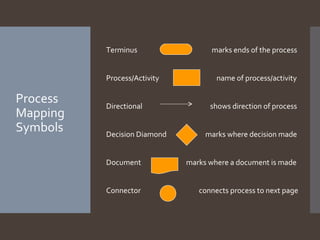
Terminus marks ends of the process
Process/Activity name of process/activity
Directional shows direction of process
Decision Diamond marks where decision made
Document marks where a document is made
Connector connects process to next page
4.
Analyze
Performanc
e
 Assess how well activity accomplishes goals
 Determine what improvements add value
 Identify ways to improve processes
 Faster
 Cheaper
 Better
Time
 Estimate cycle time per transaction
 Total time to complete transaction
 Includes time beyond an organization’s control
 Includes time when no useful activity is occurring
 Identify bottlenecks and other lost efficiency
Cost
 Estimate the true cost of inefficient systems
 Average time to complete task X hourly rate
 + Supplies and operating costs
 X Number of transactions per year
Quality
 Identify qualitative improvements
 Fewer mistakes
 Reduced risks
 Better access to information
 Improved system utility
Analyze
Improvement
s
 Best practices
 Historical analogy
 Expert opinion
 Prototypes and pilots
 Cost improvement estimates
5.
Design
Improved
Process
 Clarify the purpose of each activity
 Optimize steps that are valuable
 Reduce or eliminate those that aren’t
 Implement identified improvements
Report
Component
s
 Executive summary
 Description of existing business processes
 Evaluation of existing system
 Recommendations for improved processes
BPAs
 Require technical, managerial, political skills
 Never are really completed
 Involve some risk
 Can provide enormous benefits

Business Process Analysis for Your Records Management Program

Editor's Notes

  • #9 will be easily visible