Business Operating System (BOS)one team - one goal - one process
Leadership CriteriaLeaders need to show competence in the following aspects of these models:Ability to articulate all pieces of the Business Model (BOS)
Ability to establish clear vision
Ability to clearly communicate visionWhat is BOS?	The Business Operating System is the collection of global business processes which reflect best practices in the company.  The BOS documentation has been developed by teams from around the world and is applicable to all facilities.  Effective immediately, BOS replaces all existing operating procedures.
What is BOS?All BOS processes are:    Easy to understand and implement
    Value-added
    Interlinked
    Reflective of best practices
    Designed with a minimalist approach & documentation
ISO-9000 compliantThe objective is to create One Team, One Goal and OneBusiness Operating System.
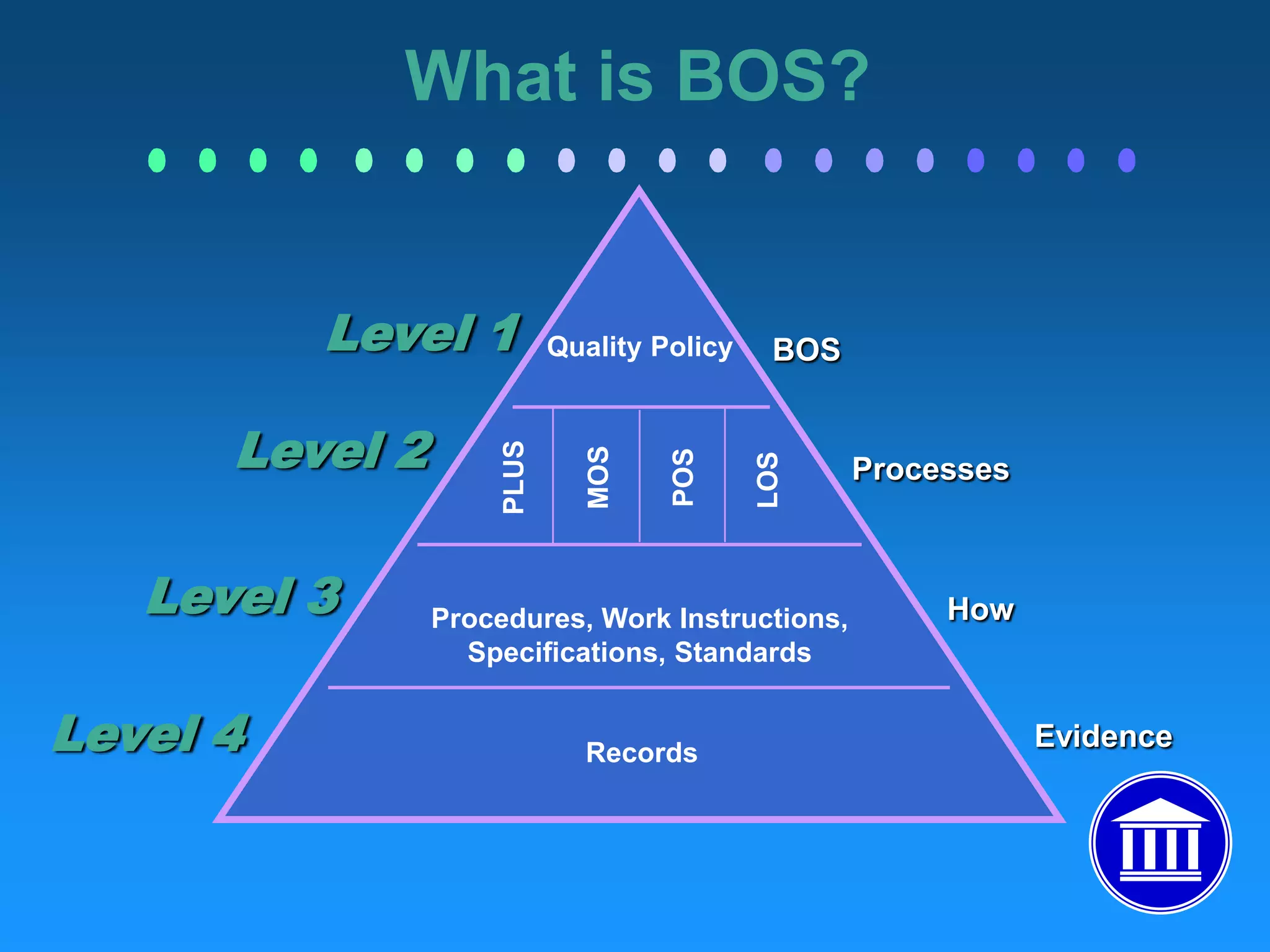
What is BOS?Level 1Quality PolicyBOSLevel 2ProcessesPLUSMOSPOSLOSLevel 3HowProcedures, Work Instructions, Specifications, StandardsLevel 4EvidenceRecords
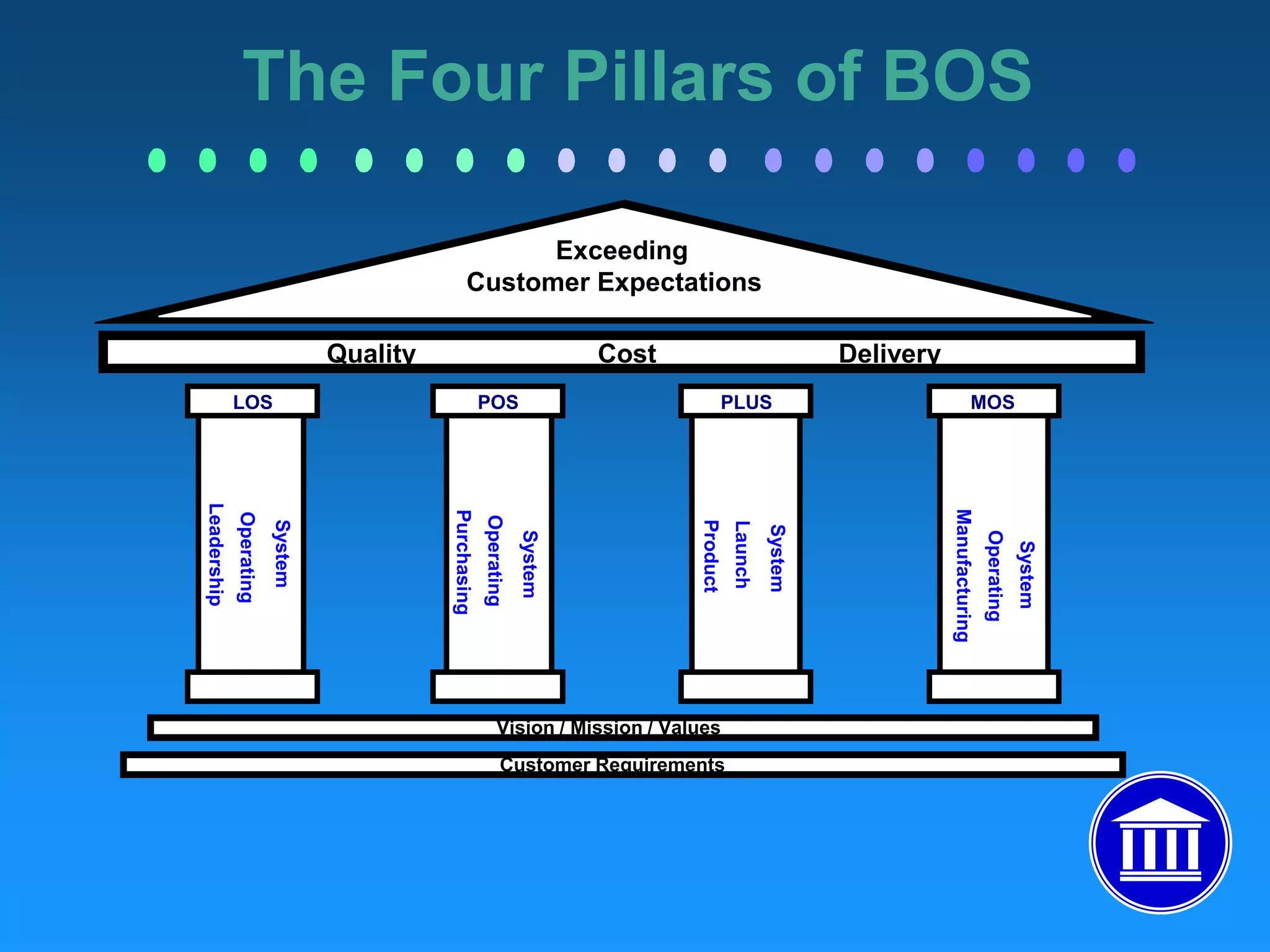
ExceedingCustomer ExpectationsQuality                         Cost                         DeliveryLOSPOSPLUSMOSSystemLeadershipLaunchOperatingSystemProduct OperatingPurchasingSystemSystemManufacturingOperatingVision / Mission / ValuesCustomer RequirementsThe Four Pillars of BOS
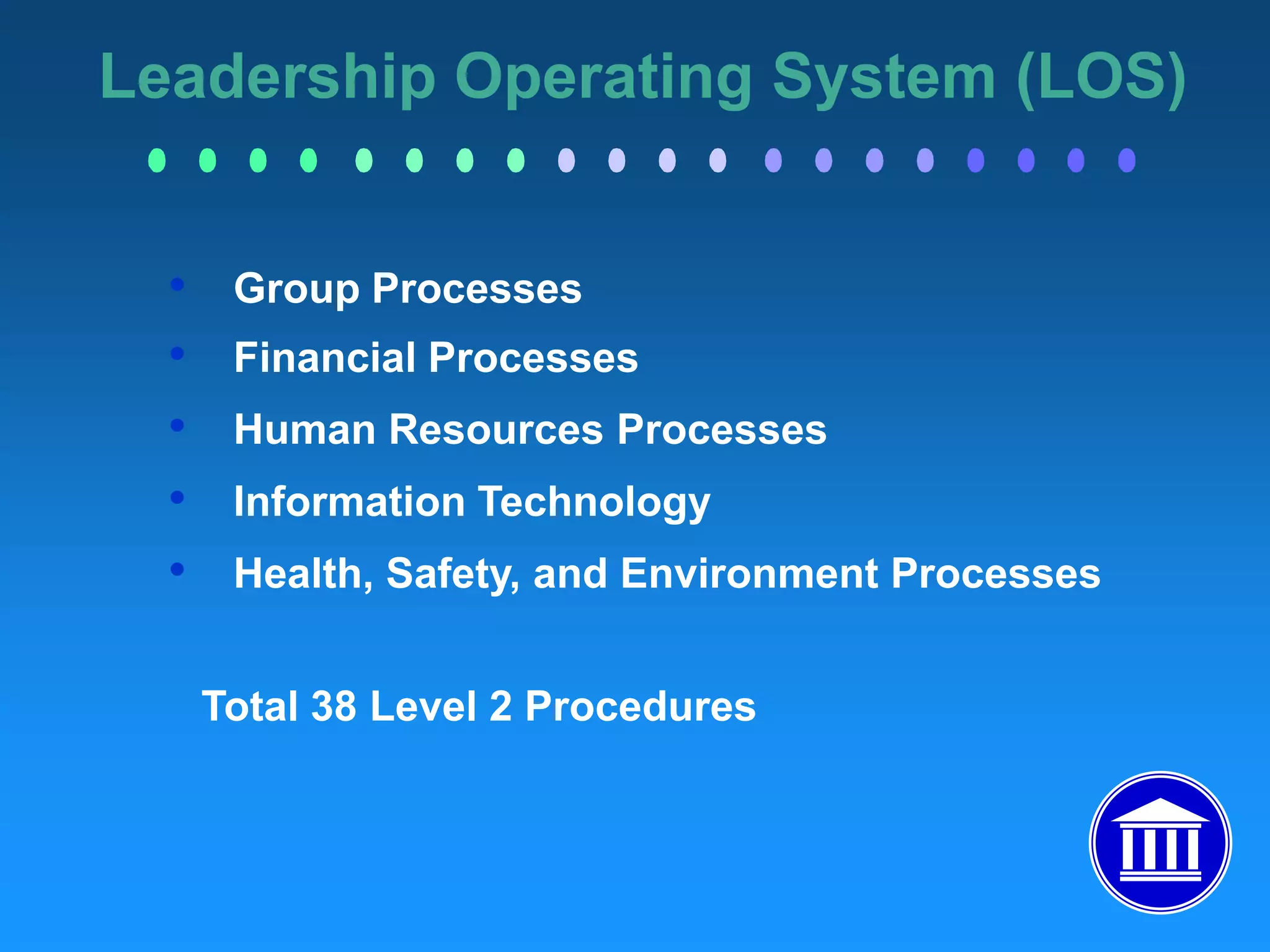
Leadership Operating System (LOS)    Group Processes
    Financial Processes
    Human Resources Processes
    Information Technology
    Health, Safety, and Environment ProcessesTotal 38 Level 2 Procedures
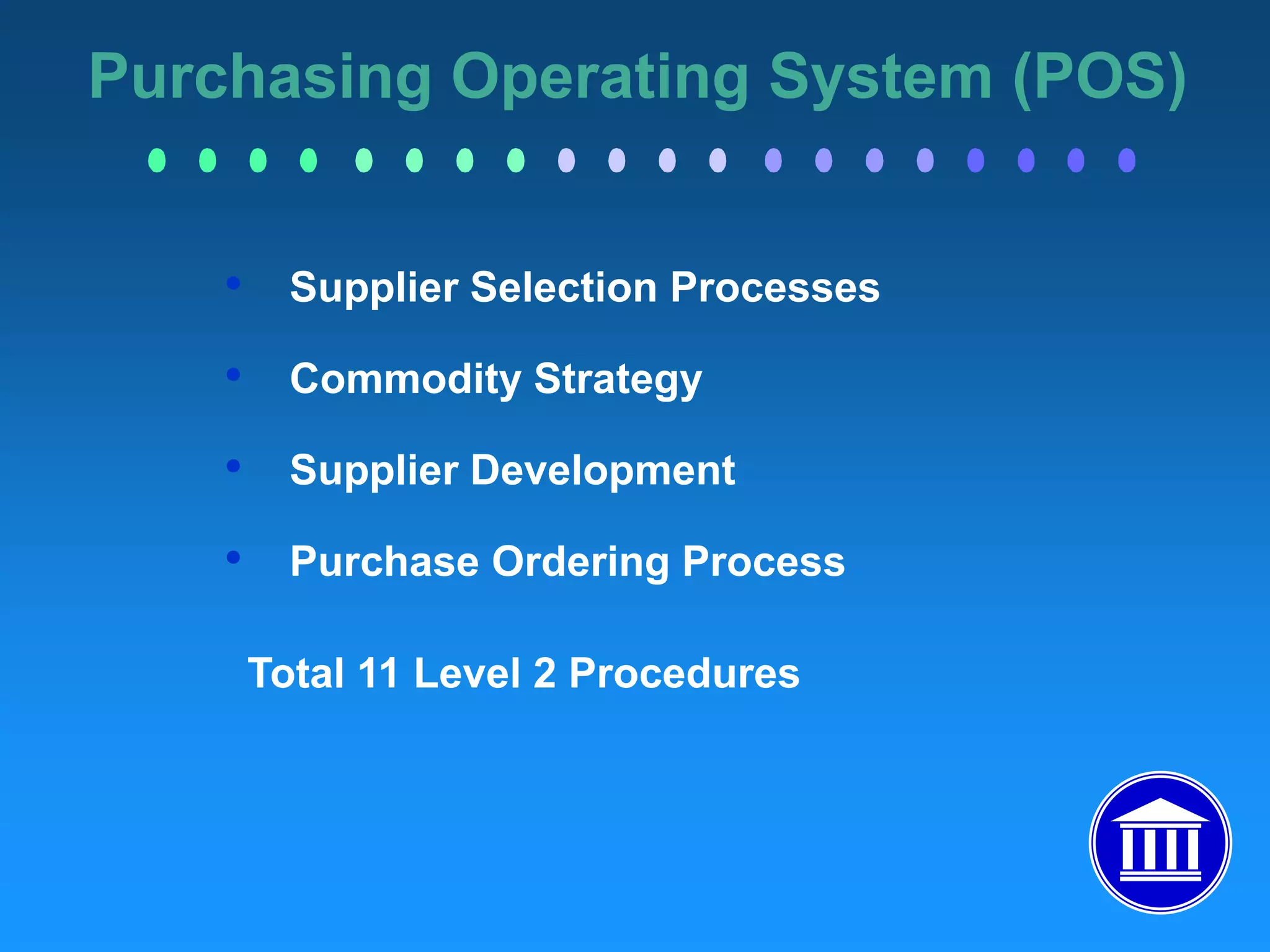
Purchasing Operating System (POS)    Supplier Selection Processes
    Commodity Strategy
    Supplier Development
    Purchase Ordering Process  Total 11 Level 2 Procedures
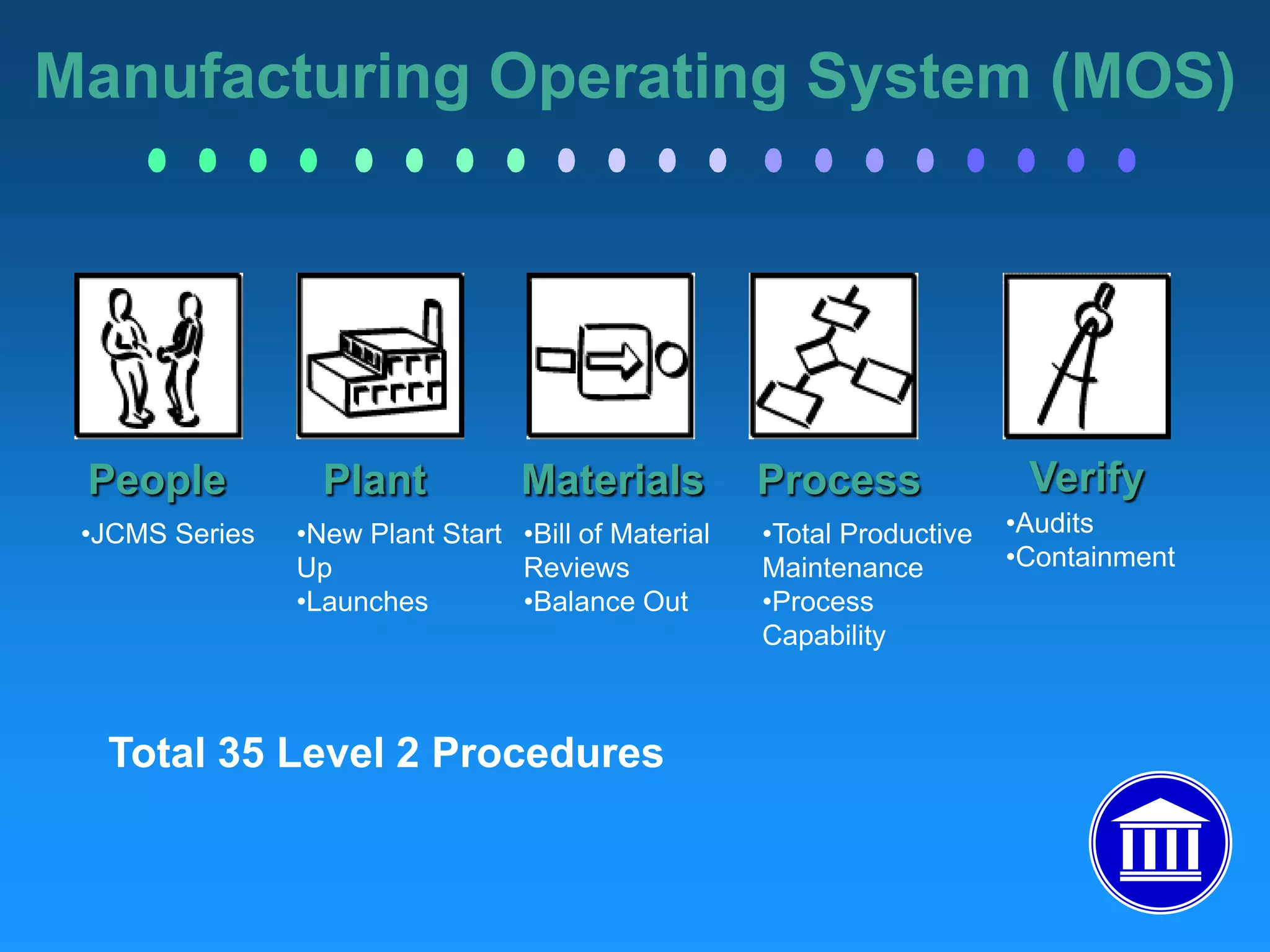
Manufacturing Operating System (MOS)VerifyPeoplePlantMaterialsProcessAudits
Containment
JCMS Series
New Plant Start Up
Launches
Bill of Material Reviews
Balance Out
Total Productive Maintenance
Process CapabilityTotal 35 Level 2 Procedures
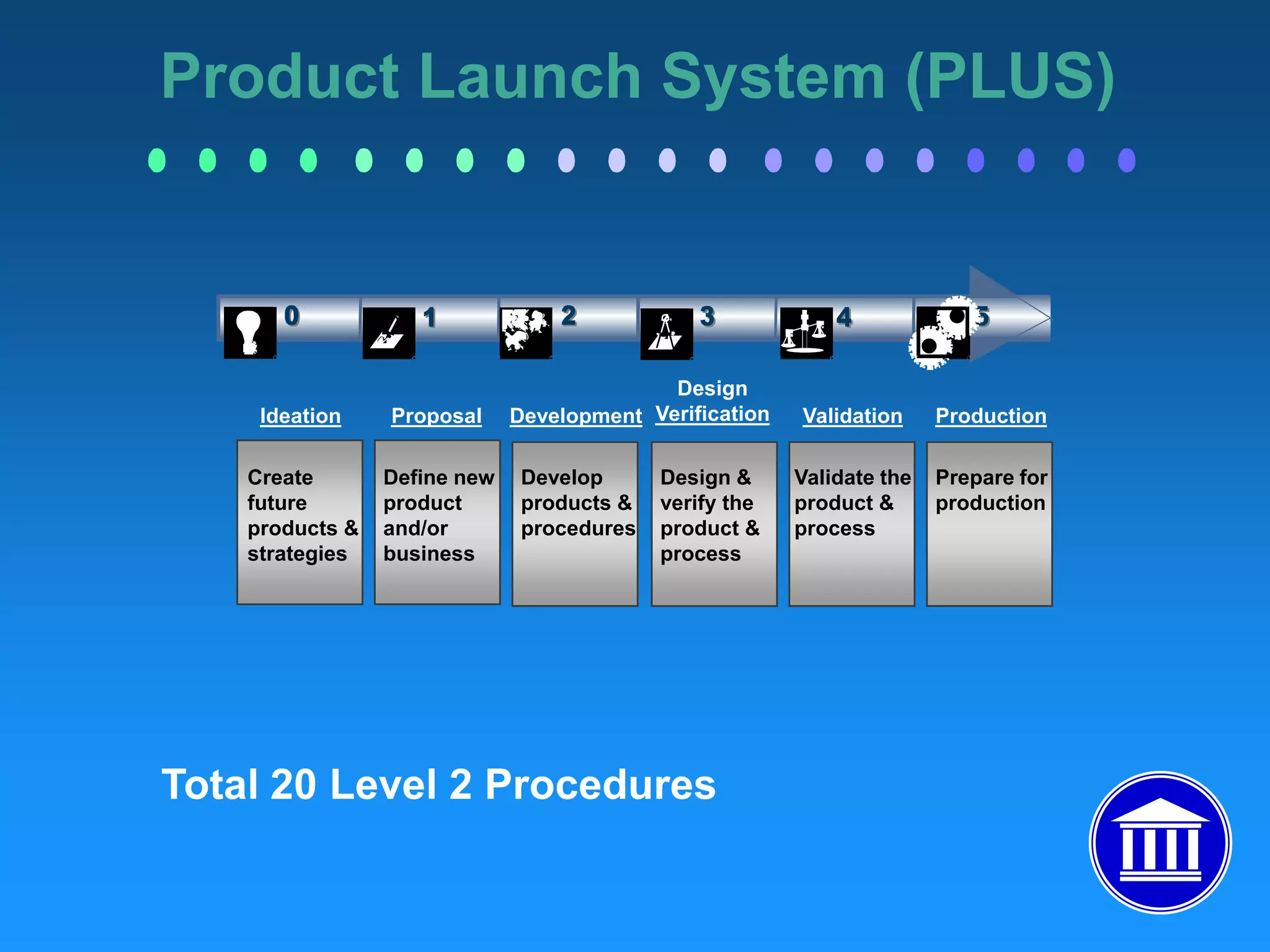
Product Launch System (PLUS)Design VerificationIdeationProposalDevelopmentValidationProductionCreate future products & strategiesDefine new product and/or businessDevelop products & proceduresDesign & verify the product & processValidate the product & processPrepare for productionTotal 20 Level 2 Procedures
“Most companies have good people. The companies that win over the long term have the best processes.” ---- Peter DruckerWhy Do We Need BOS?
Why Do We Want a Common Global Business Operating System (BOS)?Our goal is to be the finest supplier in the world.  This requires a common BOS.
Our customers are asking for a consistent  company around the world. This requires a common BOS.
A common BOS allows for easier growth as everyone has one system to learn.
One common company wide system allows for easier and more effective transfer of people.
A common operating system reduces variation.  Variation is waste.  Waste costs money.  Our customers do not want to pay for waste anymore than we do.   BOS allows us to solve a problem once and transfer the 	solution to all plants, not solve the same problem 	multiple times.
   Good processes, consistently applied, lead to 			outstanding products, best practices, superior 		quality and low cost.  Why Do We Need BOS?

Business operating system example

  • 1.
    Business Operating System(BOS)one team - one goal - one process
  • 2.
    Leadership CriteriaLeaders needto show competence in the following aspects of these models:Ability to articulate all pieces of the Business Model (BOS)
  • 3.
  • 4.
    Ability to clearlycommunicate visionWhat is BOS? The Business Operating System is the collection of global business processes which reflect best practices in the company. The BOS documentation has been developed by teams from around the world and is applicable to all facilities. Effective immediately, BOS replaces all existing operating procedures.
  • 5.
    What is BOS?AllBOS processes are: Easy to understand and implement
  • 6.
    Value-added
  • 7.
    Interlinked
  • 8.
    Reflective of best practices
  • 9.
    Designed with a minimalist approach & documentation
  • 10.
    ISO-9000 compliantThe objectiveis to create One Team, One Goal and OneBusiness Operating System.
  • 11.
    What is BOS?Level1Quality PolicyBOSLevel 2ProcessesPLUSMOSPOSLOSLevel 3HowProcedures, Work Instructions, Specifications, StandardsLevel 4EvidenceRecords
  • 12.
    ExceedingCustomer ExpectationsQuality Cost DeliveryLOSPOSPLUSMOSSystemLeadershipLaunchOperatingSystemProduct OperatingPurchasingSystemSystemManufacturingOperatingVision / Mission / ValuesCustomer RequirementsThe Four Pillars of BOS
  • 13.
    Leadership Operating System(LOS) Group Processes
  • 14.
    Financial Processes
  • 15.
    Human Resources Processes
  • 16.
    Information Technology
  • 17.
    Health, Safety, and Environment ProcessesTotal 38 Level 2 Procedures
  • 18.
    Purchasing Operating System(POS) Supplier Selection Processes
  • 19.
    Commodity Strategy
  • 20.
    Supplier Development
  • 21.
    Purchase Ordering Process Total 11 Level 2 Procedures
  • 22.
    Manufacturing Operating System(MOS)VerifyPeoplePlantMaterialsProcessAudits
  • 23.
  • 24.
  • 25.
  • 26.
  • 27.
  • 28.
  • 29.
  • 30.
    Process CapabilityTotal 35Level 2 Procedures
  • 31.
    Product Launch System(PLUS)Design VerificationIdeationProposalDevelopmentValidationProductionCreate future products & strategiesDefine new product and/or businessDevelop products & proceduresDesign & verify the product & processValidate the product & processPrepare for productionTotal 20 Level 2 Procedures
  • 32.
    “Most companies havegood people. The companies that win over the long term have the best processes.” ---- Peter DruckerWhy Do We Need BOS?
  • 33.
    Why Do WeWant a Common Global Business Operating System (BOS)?Our goal is to be the finest supplier in the world. This requires a common BOS.
  • 34.
    Our customers areasking for a consistent company around the world. This requires a common BOS.
  • 35.
    A common BOSallows for easier growth as everyone has one system to learn.
  • 36.
    One common companywide system allows for easier and more effective transfer of people.
  • 37.
    A common operatingsystem reduces variation. Variation is waste. Waste costs money. Our customers do not want to pay for waste anymore than we do. BOS allows us to solve a problem once and transfer the solution to all plants, not solve the same problem multiple times.
  • 38.
    Good processes, consistently applied, lead to outstanding products, best practices, superior quality and low cost. Why Do We Need BOS?
  • 39.
    "This year weare "raising the bar", and striving for greater process focus and discipline, innovation and continuous improvement. By doing this, we’ll be delivering higher levels of value to our customers, consumers and shareholders – and ensuring the long-term success of this organization. We all want our company be the premier supplier in the world, so please join me in making the roll-out of our new Business Operating System a great success."---, President and C.O.O.Why Do We Need BOS?
  • 40.
    Each employee in every location worldwide is affected by BOS.
  • 41.
    The development of a common set of global business processes affects the way in which we conduct business.
  • 42.
    Not everything has changed. BOS was constructed by reviewing all company procedures currently in place to identify the best practices for use globally.Who is Affected by BOS?
  • 43.
    BOS documentation willhave a direct affect on the following groups:Executive Leadership: The quality management and review processes have been established for the consistent evaluation of all facilities globally.
  • 44.
    Human Resources: Thehiring, training and evaluation processes for all employees have been established to ensure global consistency.
  • 45.
    Health, Safety &Environmental: The processes required to safeguard the people, facilities and communities in which we work have been established globally.
  • 46.
    Information Technology: Theconsistent usage of information technology has been developed for global application.Who is Affected by BOS?
  • 47.
    BOS documentation willhave a direct affect on the following groups: Finance: The accounting and commercial processes of the company have been established to support the needs of a global organization.
  • 48.
    Purchasing: The sourcing,procurement, and supplier development processes have been developed to integrate the needs of a global company with a global supply base.
  • 49.
    Engineering: A commonproduct and process development process has been developed to allow for a consistent approach in the launch of all products globally.
  • 50.
    Manufacturing: The processesrequired to establish common practices at each manufacturing facility have been established.Who is Affected by BOS?
  • 51.
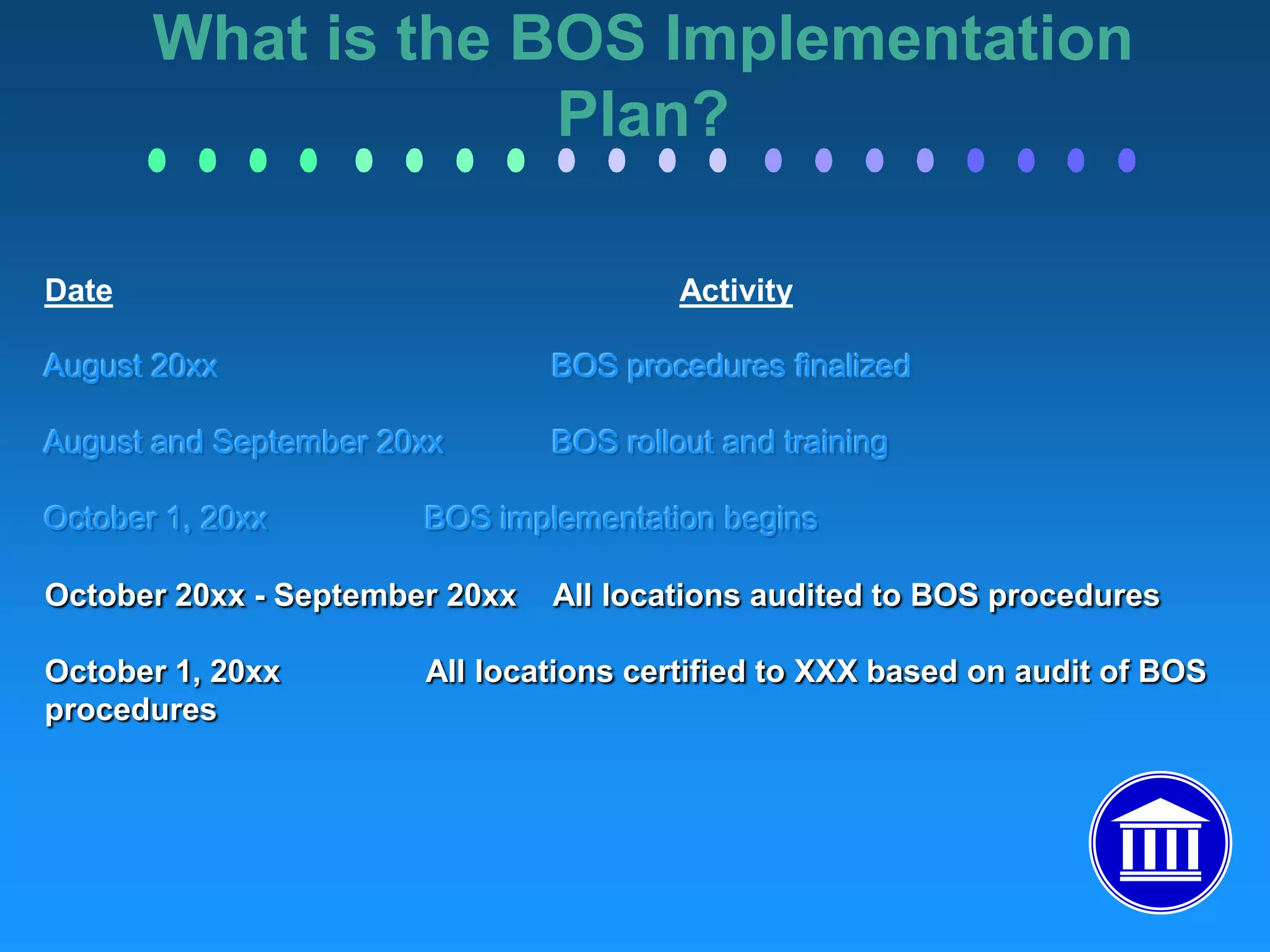
    What is theBOS Implementation Plan?DateActivityAugust 20xx BOS procedures finalizedAugust and September 20xx BOS rollout and trainingOctober 1, 20xx BOS implementation beginsOctober 20xx - September 20xx All locations audited to BOS proceduresOctober 1, 20xx All locations certified to XXX based on audit of BOS procedures
  • 52.
  • 53.
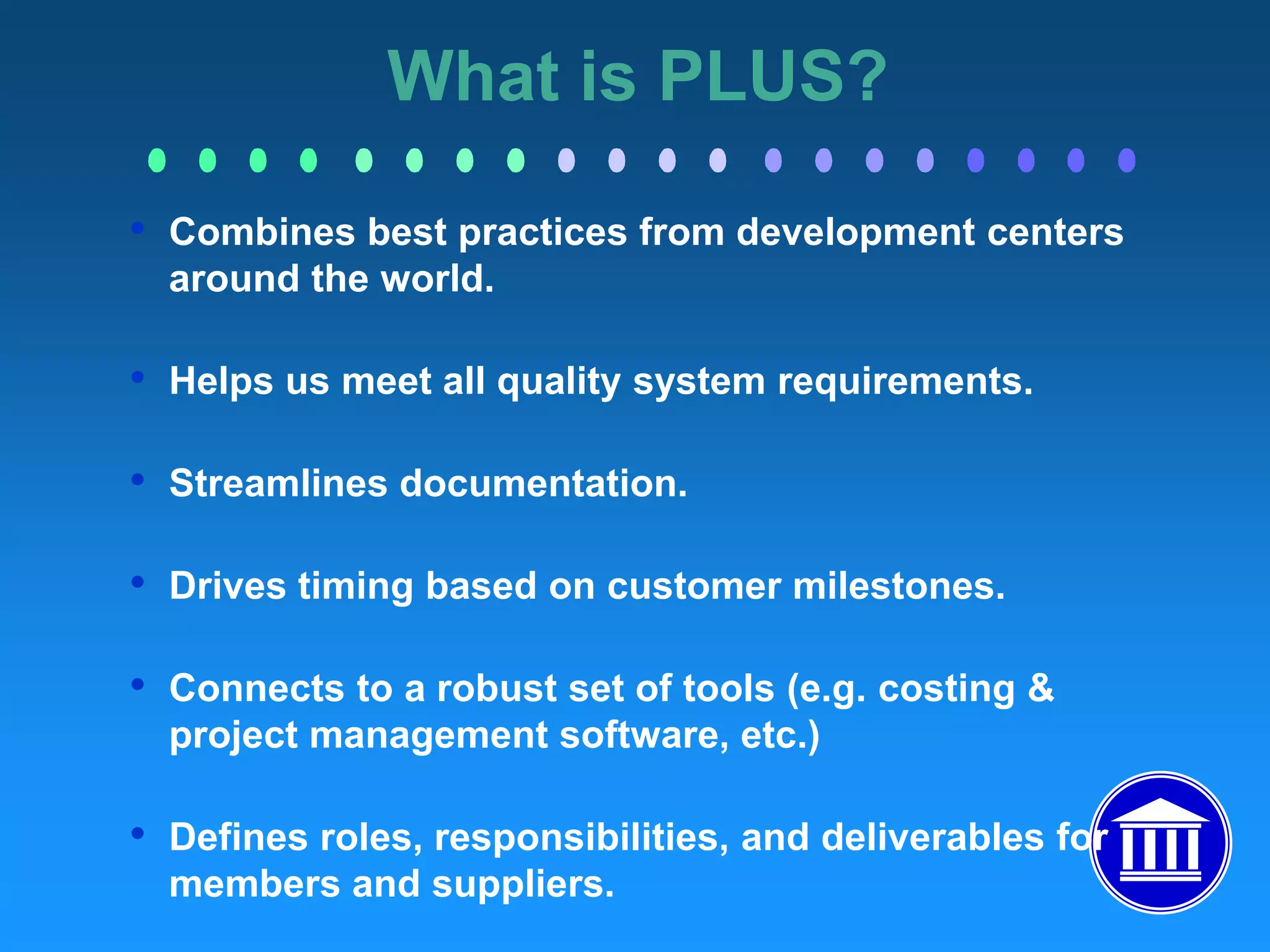
    What is PLUS?PLUSis the standard method for developing and launching new products.
  • 54.
    What is PLUS?Combinesbest practices from development centers around the world.
  • 55.
    Helps us meetall quality system requirements.
  • 56.
  • 57.
    Drives timing basedon customer milestones.
  • 58.
    Connects to arobust set of tools (e.g. costing & project management software, etc.)
  • 59.
    Defines roles, responsibilities,and deliverables for members and suppliers.Why Do We Need PLUS?As we have grown into new markets and products, we have outgrown our old systems. PLUS is a way of delivering new products of any type, to any customer.
  • 60.
    Help us achieveour 0 - 100 - 30 success criteria.Create synergy as we grow in customers, cultures and products.Help us manage complete interior programs.Open communication channels.Provide a flexibility for new products and types of programs we haven’t yet dreamed of.Why Do We Need PLUS?
  • 61.
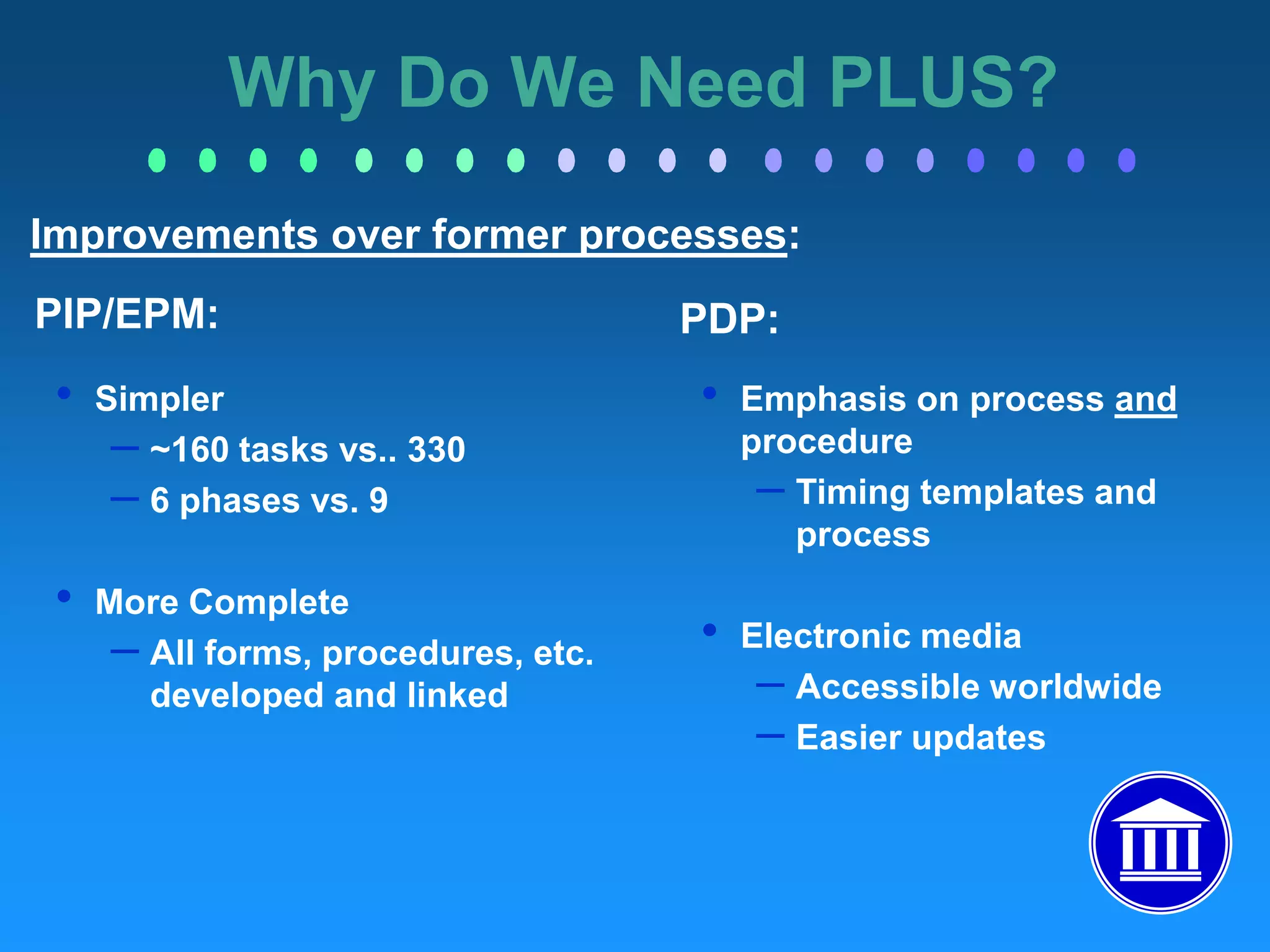
    Why Do WeNeed PLUS?Improvements over former processes:PIP/EPM:PDP:Simpler ~160 tasks vs.. 3306 phases vs. 9More CompleteAll forms, procedures, etc. developed and linkedEmphasis on process and procedure
  • 62.
  • 63.
  • 64.
  • 65.
  • 66.
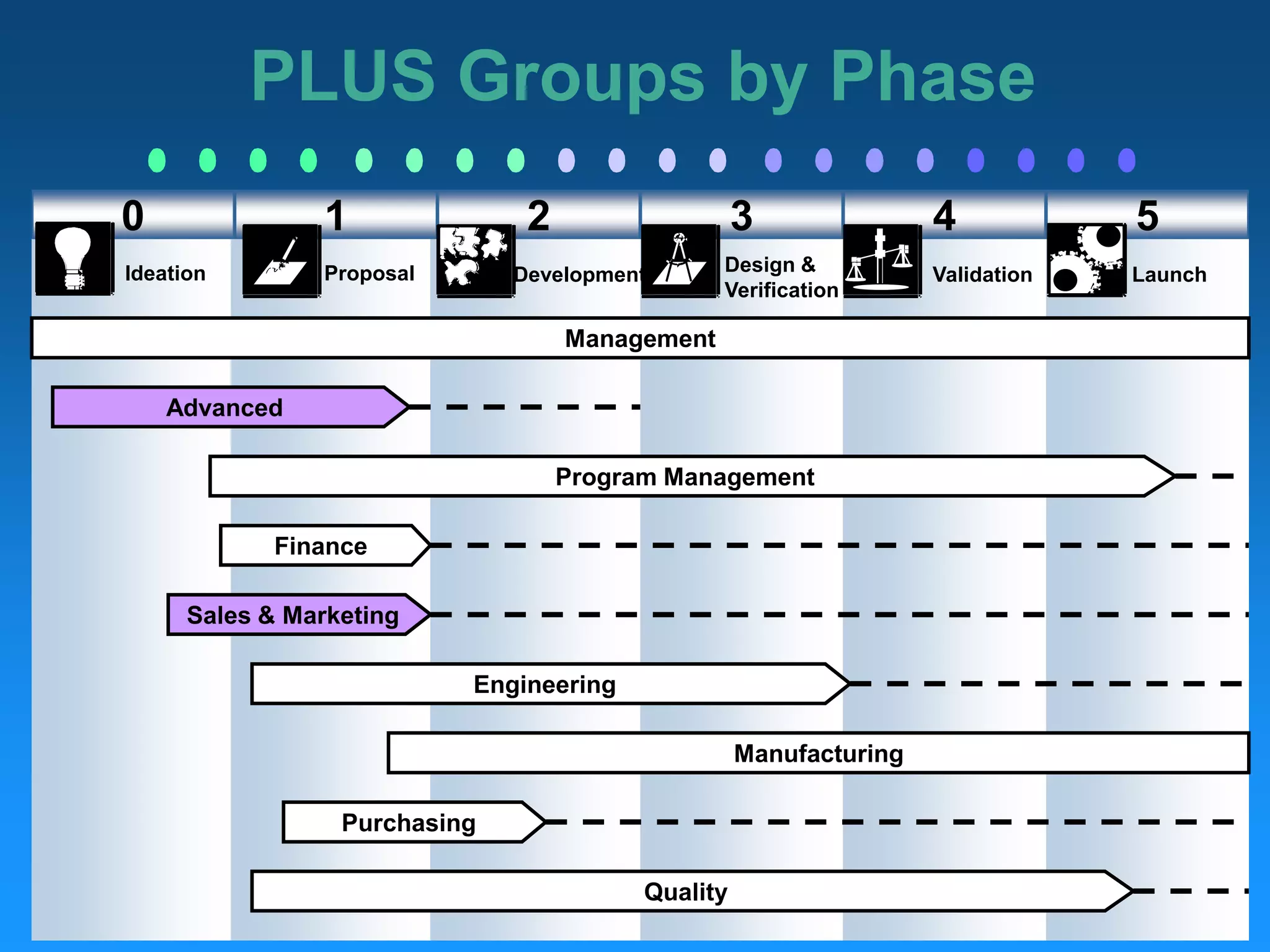
    PLUS Groups byPhaseProgram ManagementFinanceEngineeringPurchasingQuality012534Design & VerificationIdeationProposalDevelopmentValidationLaunchManagementAdvancedSales & MarketingManufacturing
  • 67.
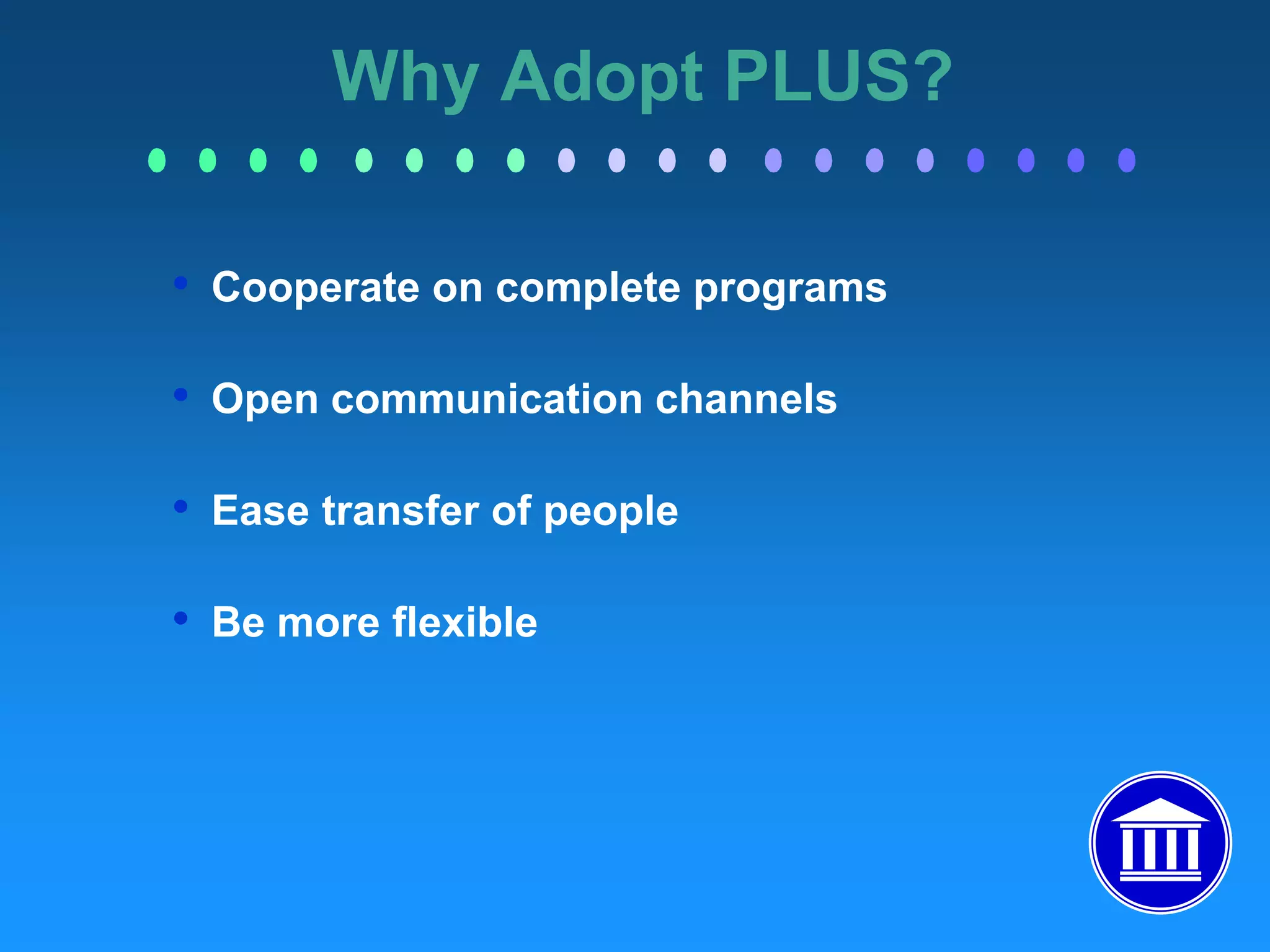
    Cooperate on completeprogramsOpen communication channelsEase transfer of people Be more flexible Why Adopt PLUS?
  • 68.
    Why Adopt PLUS?BestPractices:Emphasis on process and procedureRYG reportingSupplier Roles (Extended Enterprise) Procedure review teams for continuous improvementIntranet based training
  • 69.
    PLUS Development TeamPLUSwas created by a cross-functional team from most disciplines. Team members include:
  • 70.
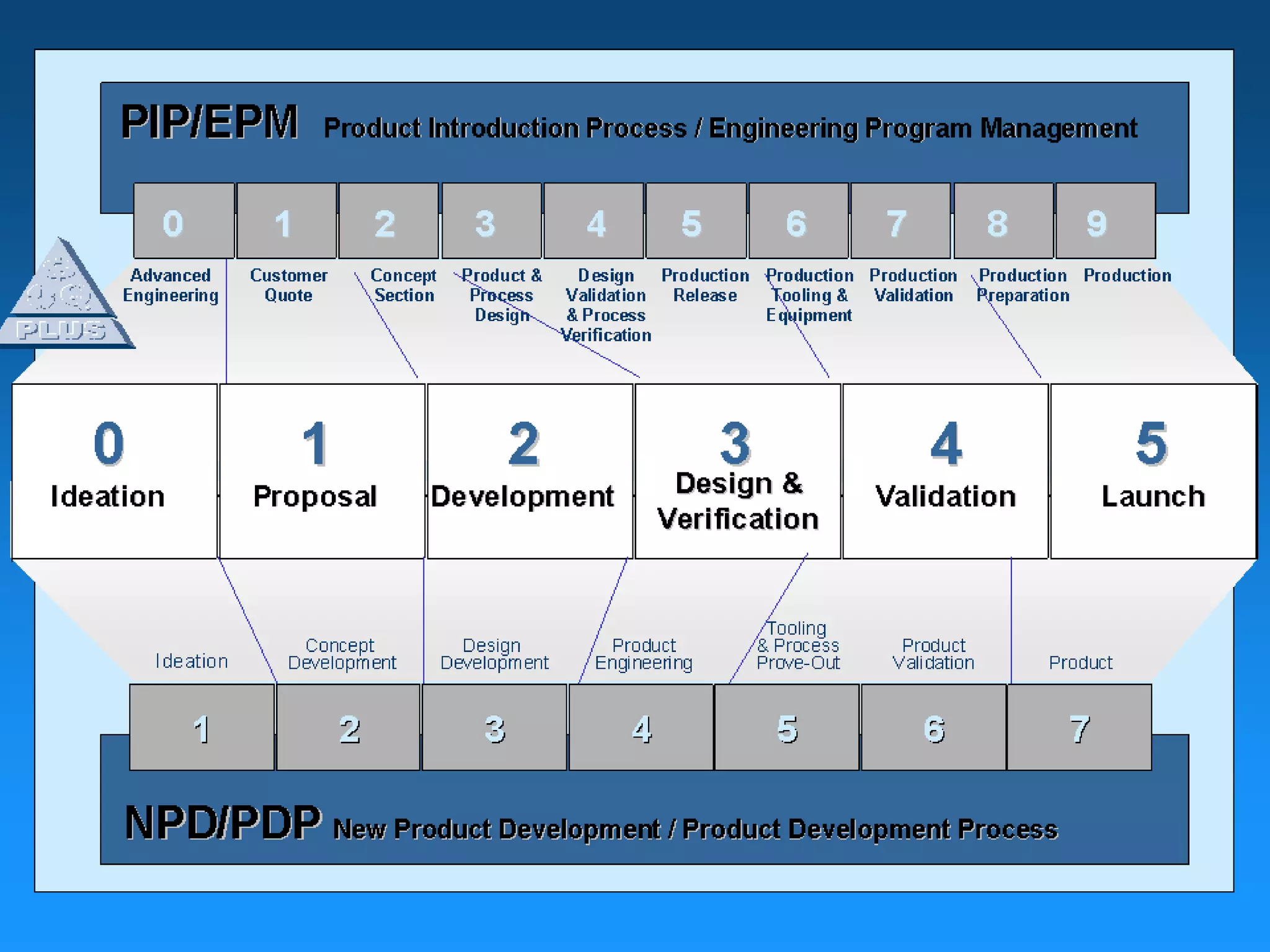
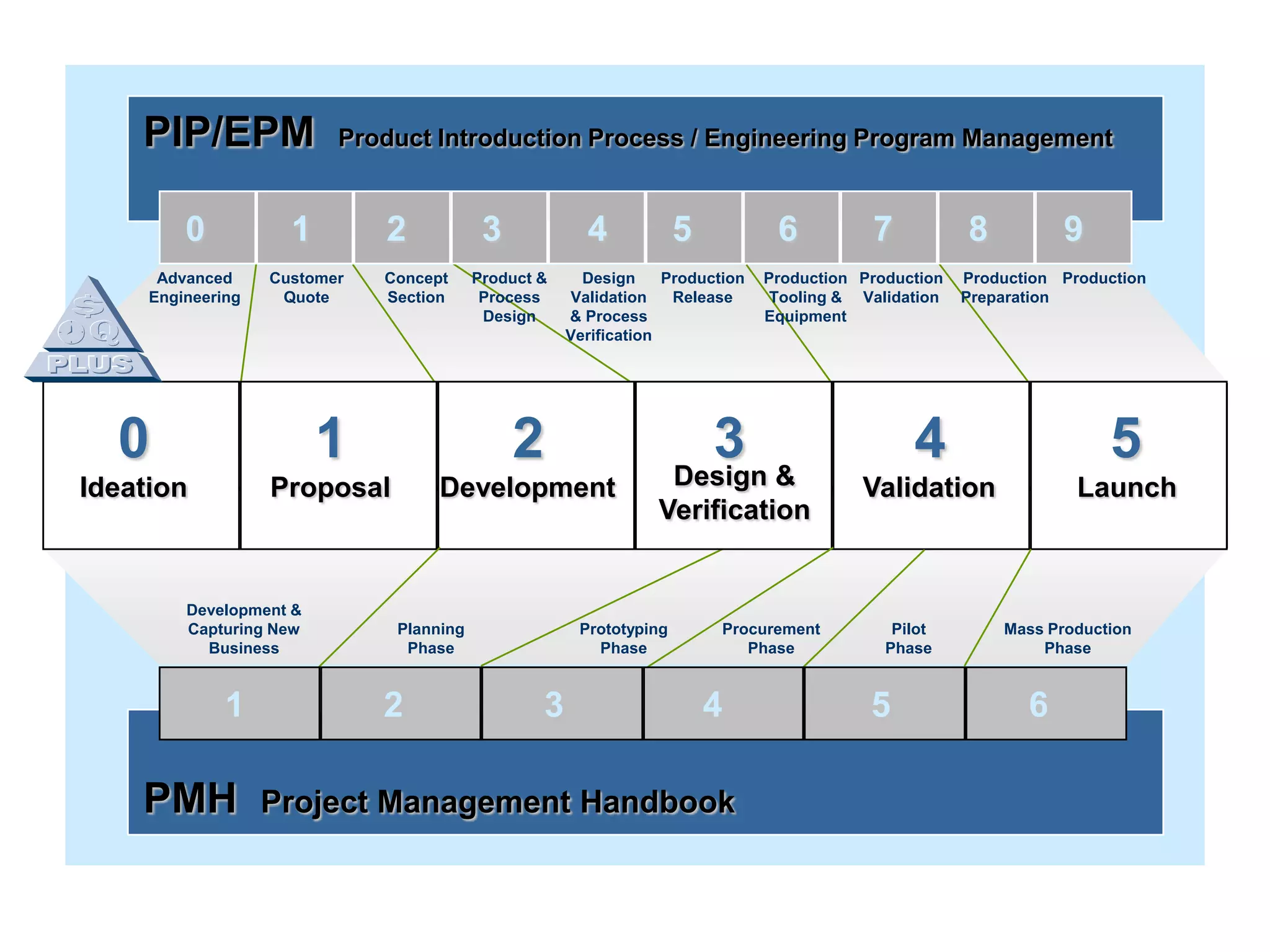
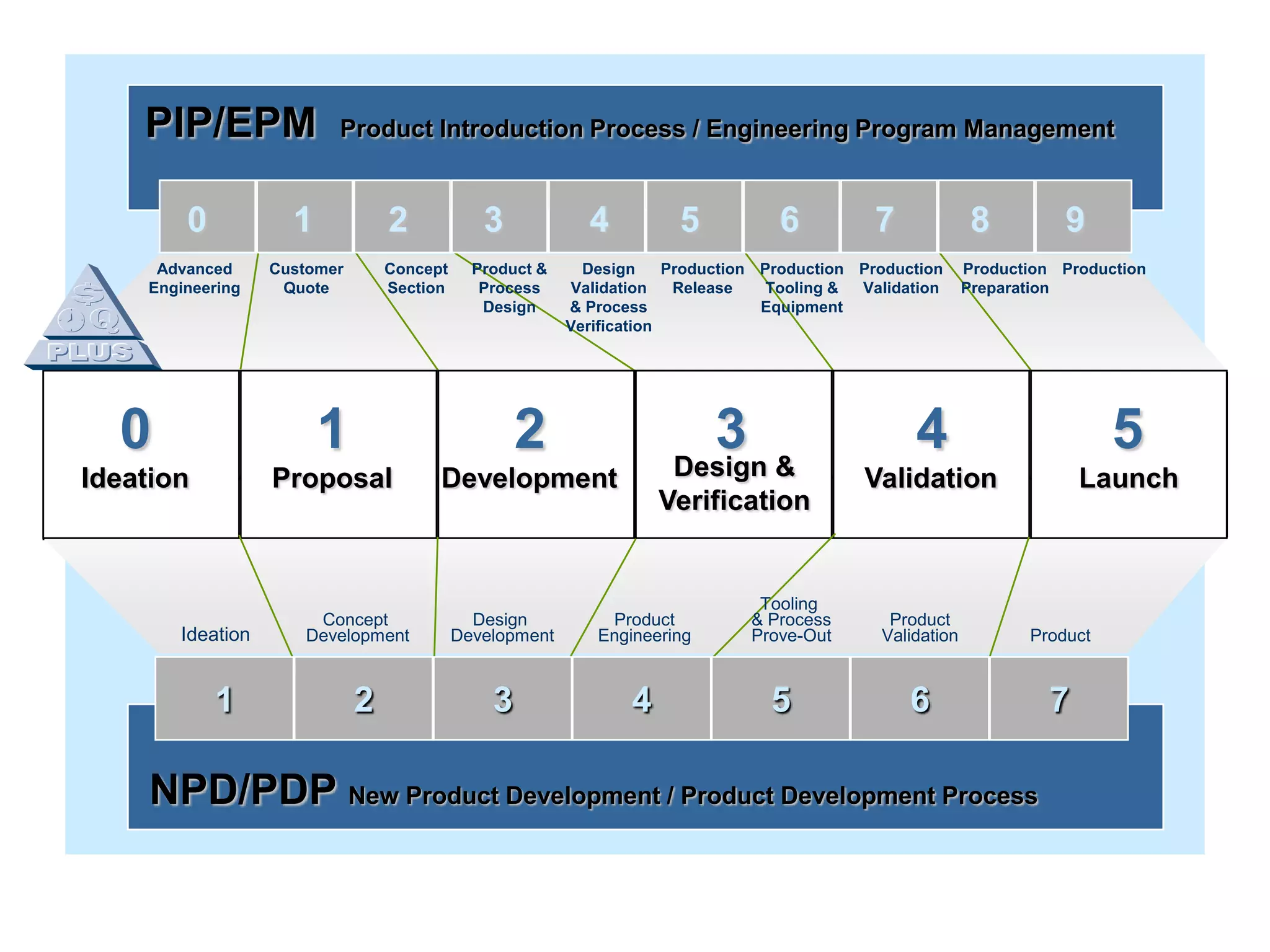
    021345Design & VerificationIdeationLaunchValidationDevelopmentProposalPIP/EPM Product Introduction Process / Engineering Program Management0213456789Advanced EngineeringProductionProductionPreparationCustomerQuoteProductionValidationProductionTooling &EquipmentConceptSectionProduct &ProcessDesignDesignValidation& ProcessVerificationProductionReleaseDevelopment &Capturing NewBusinessPilotPhasePlanningPhasePrototypingPhaseProcurementPhaseMass ProductionPhase213456PMH Project Management Handbook
  • 71.
    021345Design & VerificationIdeationLaunchValidationDevelopmentProposal1234567PIP/EPM Product Introduction Process / Engineering Program Management0213456789Advanced EngineeringProductionProductionPreparationCustomerQuoteProductionValidationProductionTooling &EquipmentConceptSectionProduct &ProcessDesignDesignValidation& ProcessVerificationProductionReleaseTooling & ProcessProve-OutConcept DevelopmentDesign DevelopmentProductEngineeringProductValidationIdeationProductNPD/PDP New Product Development / Product Development Process
  • 72.
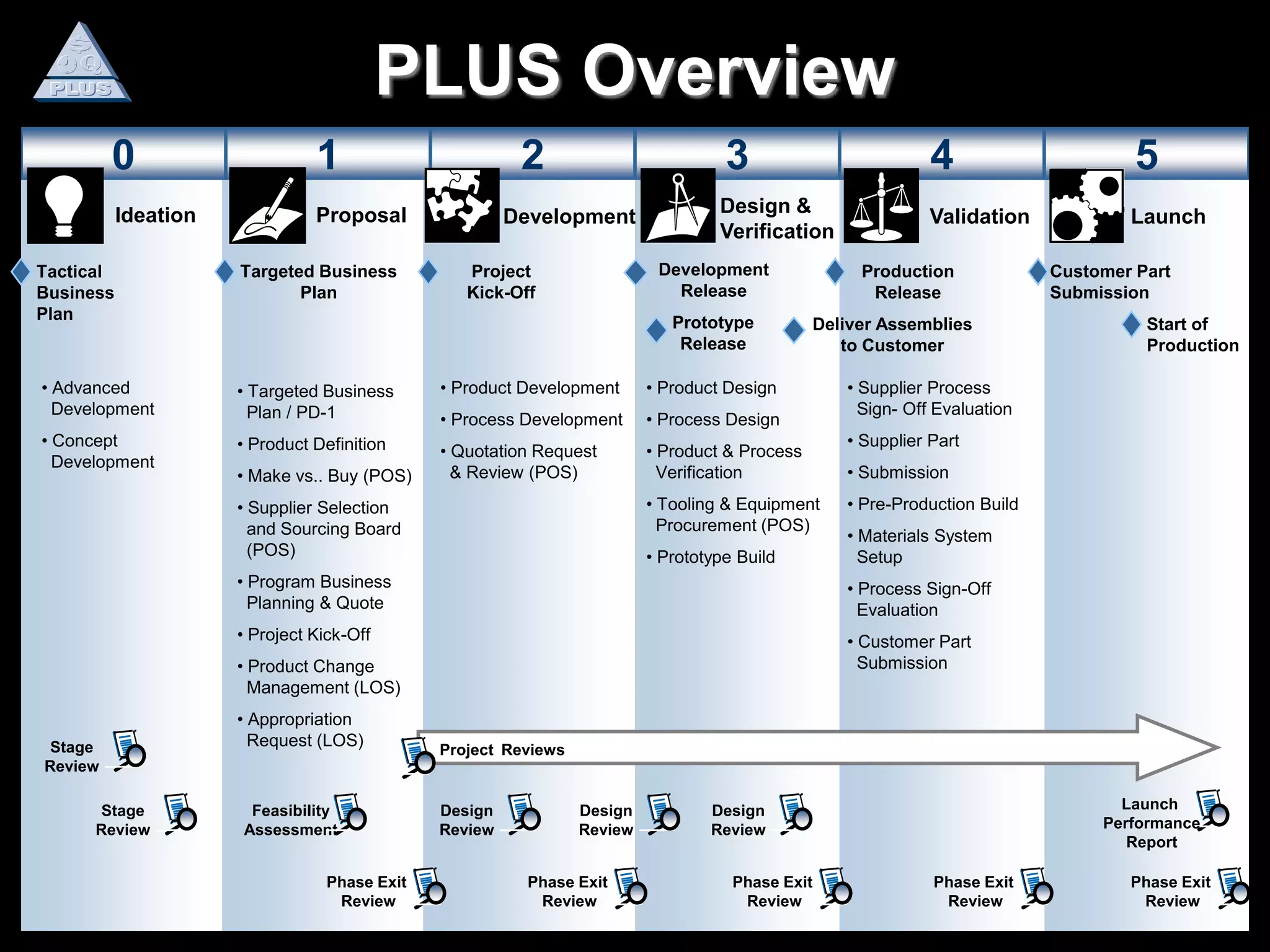
    Project Kick-OffProduction ReleaseTacticalBusiness PlanStageReviewFeasibility Assessment DesignReviewDesignReviewDesignReviewStageReviewPhase Exit ReviewPhase Exit ReviewPhase Exit ReviewPhase Exit ReviewPhase Exit ReviewLaunch PerformanceReportPLUS Overview 012534Design & VerificationIdeationProposalDevelopmentValidationLaunchDevelopment ReleaseCustomer Part SubmissionTargeted Business Plan PrototypeReleaseStart ofProductionDeliver Assemblies to Customer Advanced Development
  • 73.
    Concept Development
  • 74.
  • 75.
  • 76.
    Quotation Request & Review (POS)
  • 77.
  • 78.
  • 79.
    Product &Process Verification
  • 80.
    Tooling &Equipment Procurement (POS)
  • 81.
  • 82.
    Supplier Process Sign- Off Evaluation
  • 83.
  • 84.
  • 85.
  • 86.
  • 87.
  • 88.
    Customer Part Submission
  • 89.
    Targeted Business Plan / PD-1
  • 90.
  • 91.
    Make vs..Buy (POS)
  • 92.
    Supplier Selection and Sourcing Board (POS)
  • 93.
    Program Business Planning & Quote
  • 94.
  • 95.
    Product Change Management (LOS)
  • 96.
    Appropriation Request (LOS) ProjectReviews
  • 97.
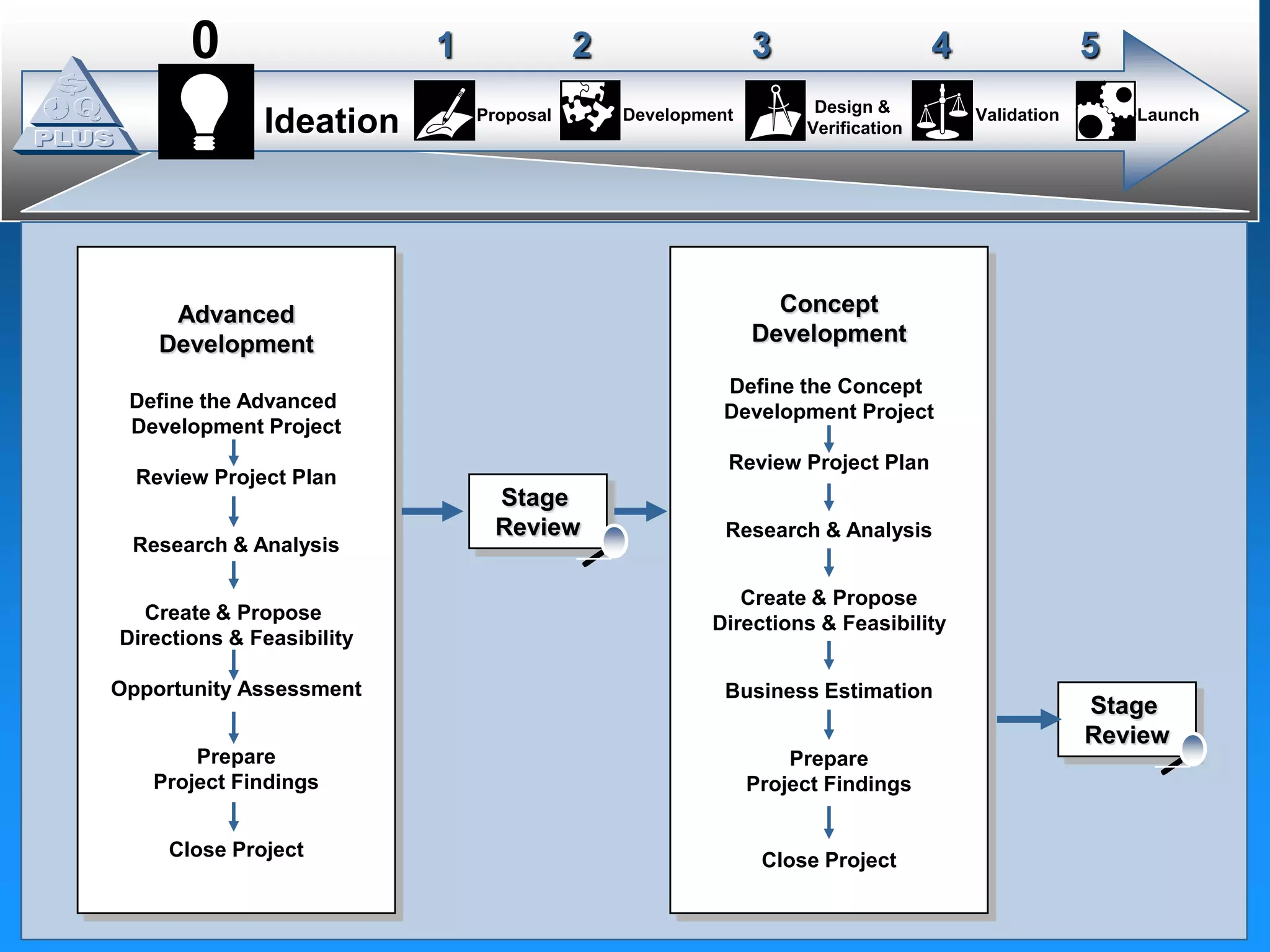
    023451Design & VerificationIdeationDevelopmentValidationLaunchProposalAdvancedDevelopmentDefinethe Advanced Development ProjectReview Project PlanResearch & AnalysisCreate & Propose Directions & FeasibilityOpportunity AssessmentPrepareProject FindingsClose ProjectConceptDevelopmentDefine the Concept Development ProjectReview Project PlanResearch & AnalysisCreate & ProposeDirections & FeasibilityBusiness EstimationPrepareProject FindingsClose ProjectStage ReviewStage Review
  • 98.
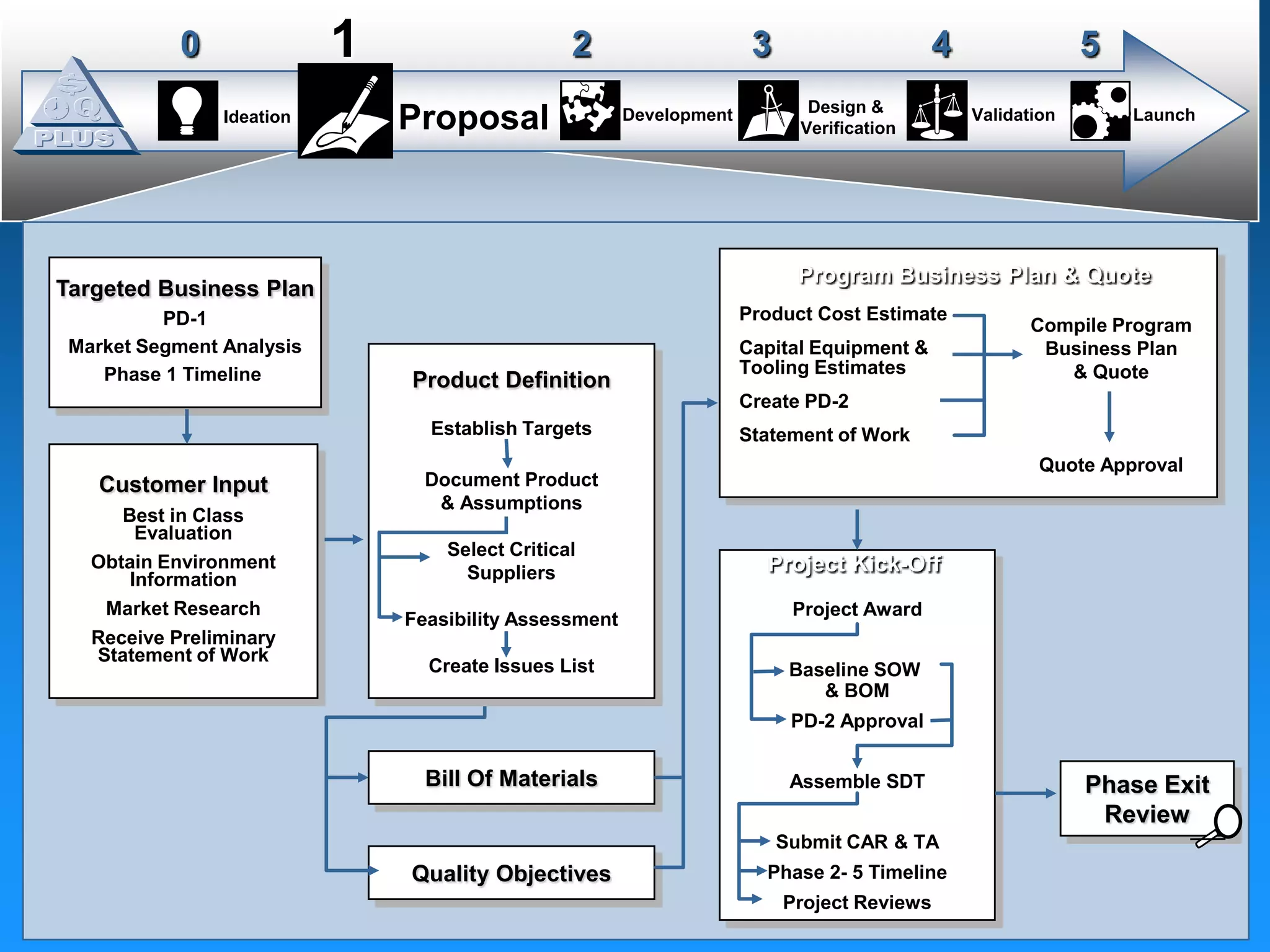
    1Phase ExitReview02345ProposalDesign &VerificationDevelopmentValidationLaunchIdeationProgram Business Plan & QuoteTargeted Business PlanPD-1Market Segment AnalysisPhase 1 Timeline Product Cost EstimateCapital Equipment &Tooling EstimatesCreate PD-2Statement of WorkCompile ProgramBusiness Plan & QuoteQuote ApprovalProduct DefinitionEstablish TargetsDocument Product& AssumptionsSelect CriticalSuppliersFeasibility AssessmentCreate Issues ListCustomer InputBest in ClassEvaluationObtain EnvironmentInformationMarket ResearchReceive PreliminaryStatement of WorkProject Kick-OffProject AwardBaseline SOW & BOMPD-2 ApprovalAssemble SDTSubmit CAR & TAPhase 2- 5 TimelineProject ReviewsBill Of MaterialsQuality Objectives
  • 99.
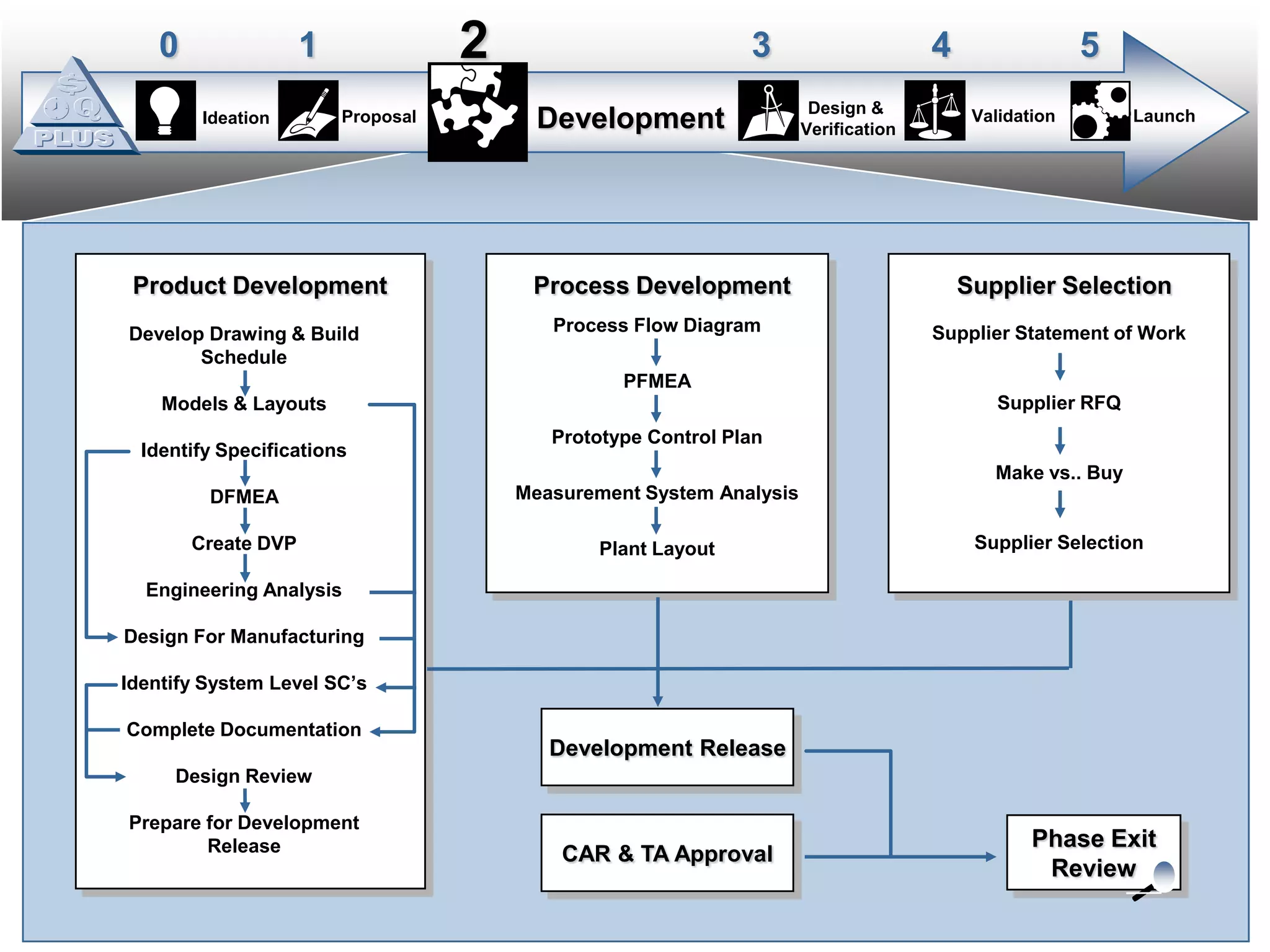
    203451Design & VerificationDevelopmentValidationLaunchProposalIdeationProductDevelopmentProcess DevelopmentSupplier SelectionProcess Flow DiagramPFMEAPrototype Control PlanMeasurement System AnalysisPlant LayoutSupplier Statement of WorkSupplier RFQMake vs.. BuySupplier SelectionDevelop Drawing & Build ScheduleModels & LayoutsIdentify SpecificationsDFMEACreate DVPEngineering AnalysisDesign For ManufacturingIdentify System Level SC’sComplete DocumentationDesign ReviewPrepare for Development ReleaseDevelopment ReleaseCAR & TA ApprovalPhase ExitReview
  • 100.
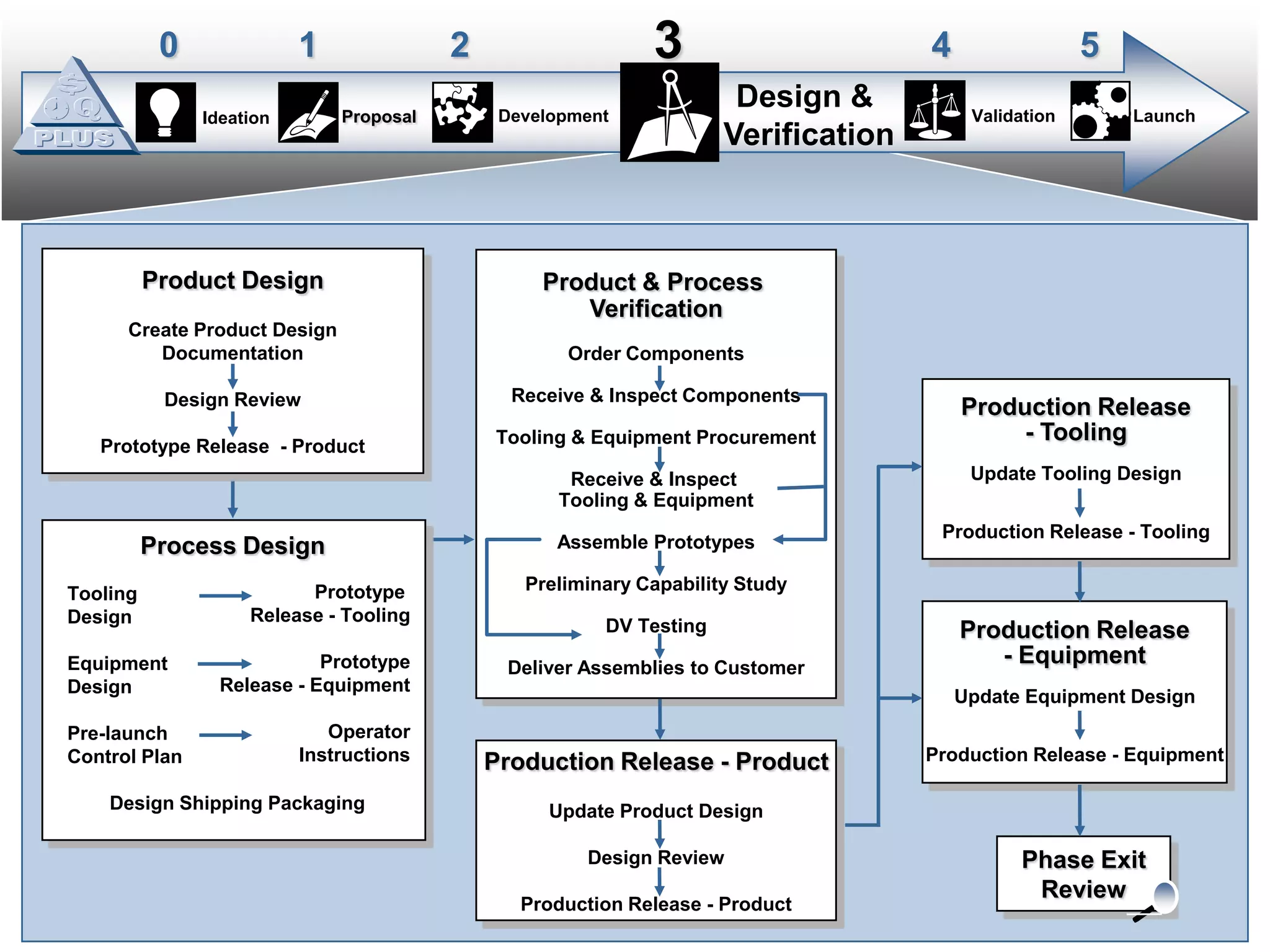
    302451Design & VerificationDevelopmentValidationLaunchProposalIdeationProductDesignCreate Product DesignDocumentationDesign ReviewPrototype Release - ProductProduct & Process VerificationOrder ComponentsReceive & Inspect ComponentsTooling & Equipment ProcurementReceive & Inspect Tooling & EquipmentAssemble PrototypesPreliminary Capability StudyDV TestingDeliver Assemblies to CustomerProduction Release- ToolingUpdate Tooling DesignProduction Release - ToolingProcess DesignTooling DesignEquipment DesignPre-launchControl Plan Design Shipping PackagingPrototype Release - ToolingPrototypeRelease - EquipmentOperatorInstructionsProduction Release- EquipmentUpdate Equipment DesignProduction Release - EquipmentProduction Release - ProductUpdate Product DesignDesign ReviewProduction Release - ProductPhase ExitReview
  • 101.
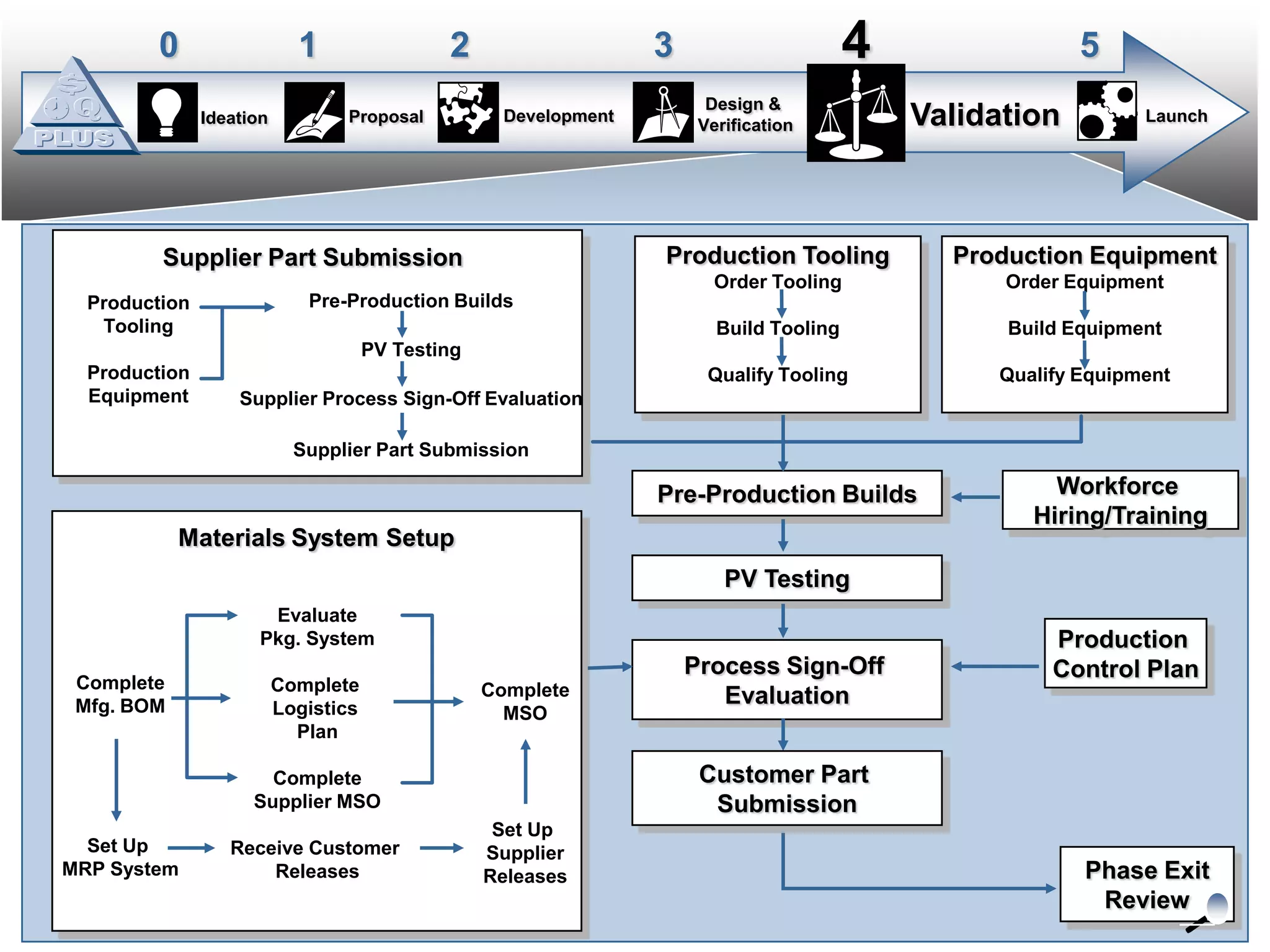
    402351Design & VerificationValidationDevelopmentLaunchProposalIdeationSupplierPart SubmissionProduction ToolingOrder ToolingBuild ToolingQualify ToolingProduction EquipmentOrder EquipmentBuild EquipmentQualify EquipmentPre-Production BuildsPV TestingSupplier Process Sign-Off EvaluationSupplier Part SubmissionProductionToolingProduction EquipmentPre-Production BuildsWorkforce Hiring/TrainingMaterials System SetupPV TestingEvaluatePkg. SystemComplete Logistics PlanCompleteSupplier MSOReceive Customer ReleasesProduction Control PlanProcess Sign-Off EvaluationCompleteMfg. BOMSet Up MRP SystemCompleteMSOSet Up SupplierReleasesCustomer Part SubmissionPhase ExitReview
  • 102.
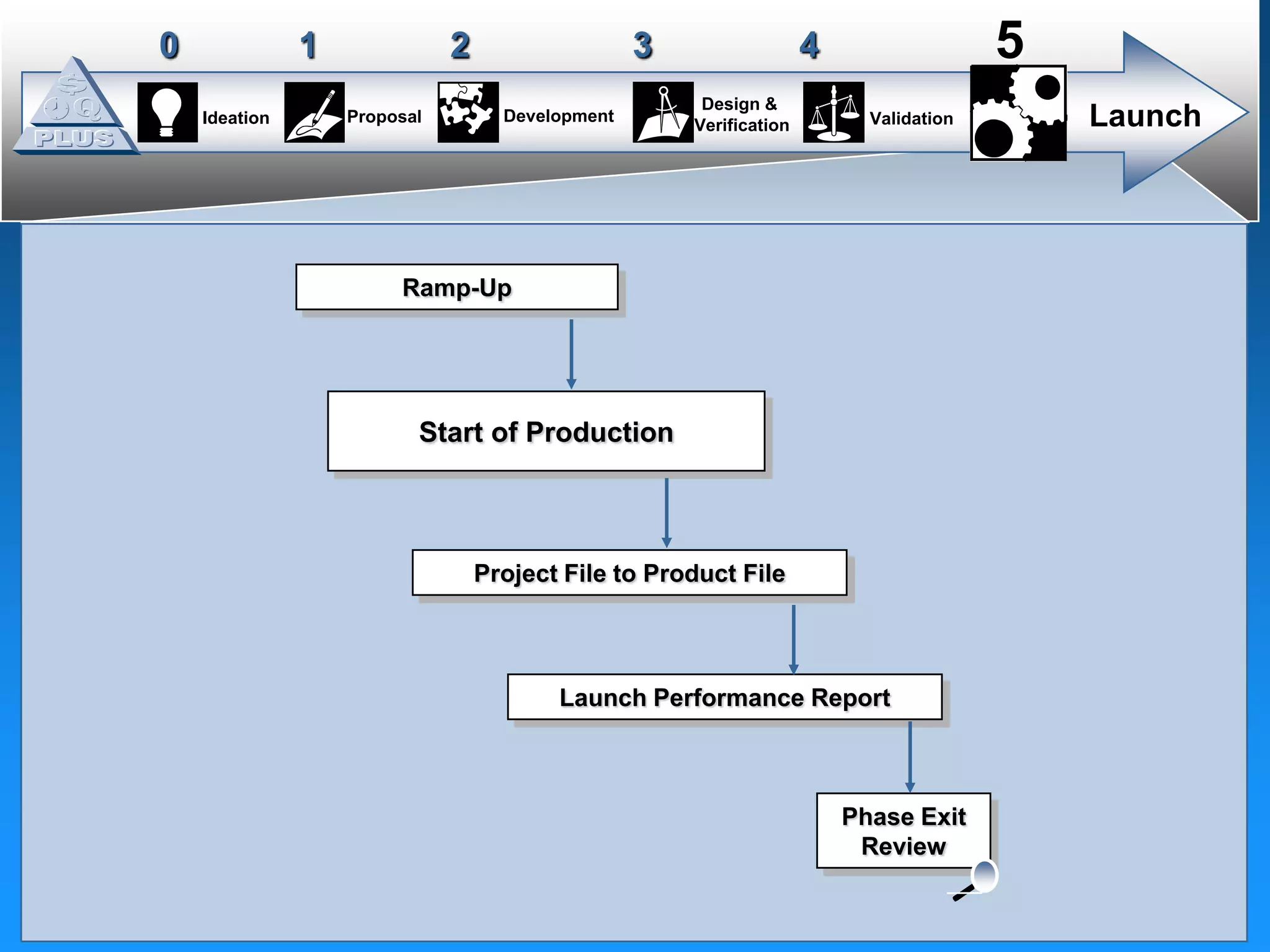
    502341Design & VerificationLaunchDevelopmentProposalIdeationValidationRamp-UpStartof ProductionProject File to Product FileLaunch Performance ReportPhase ExitReview