
Objectives
1.To recognise the importance of proper etiquette as it relates to interviewing and business situations
Title- Using Proper Etiquette
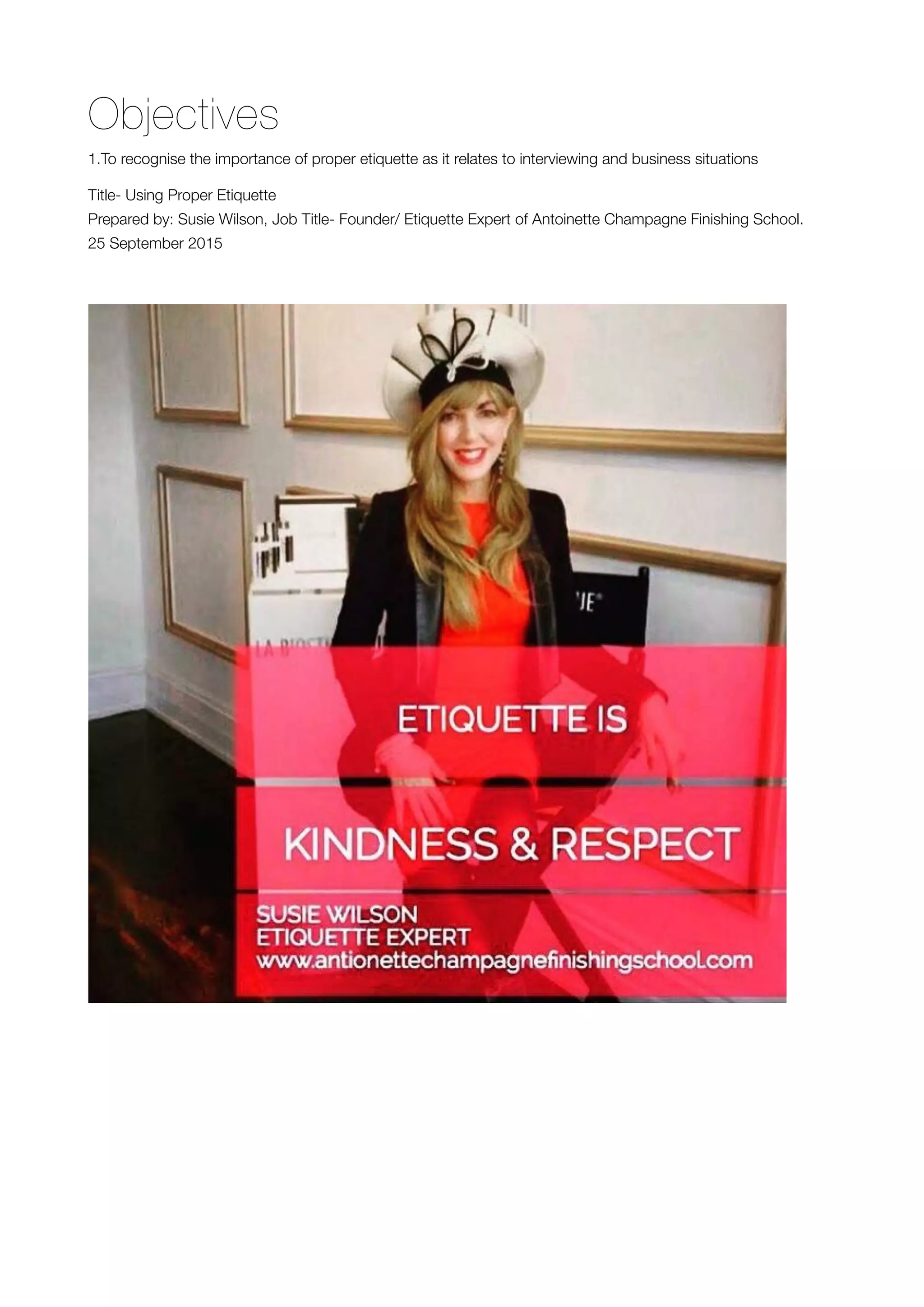
Prepared by: Susie Wilson, Job Title- Founder/ Etiquette Expert of Antoinette Champagne Finishing School.
25 September 2015
EXECUTIVE SUMMARY
Objective
1.To recognise the importance of proper etiquette as it relates to interviewing and business situations.
2.To understand the elements and characteristics of proper etiquette.
3.To understand proper dining etiquette.
Goals
1.This guide includes activities to help you achieve the stated objectives.
2. Read through this guide to understand proper etiquette guidelines.
3. Refer to the additional resources that are available.
4. Refer to the Writing Cover Letters guide..
5.Ask a Career Centre staff member about other workshops or courses that might be available on proper
etiquette
Solution
What is Etiquette?
Webster defines it as “the forms, manners and ceremonies established by convention as acceptable or required
in social relations, in a profession or in official life.”
Some business organisations have administrative manuals in which acceptable codes of behaviour are listed.
Etiquette is respect, good manners and good behaviour. It is not just each of these things, but it is all of these
things rolled into one.
For the purposes of this guide we will focus on five elements of business etiquette: work, social, telephone,
dining, and correspondence.
Project Outline
Work Etiquette
The following principles can be utilised by office employees to show proper etiquette; they include all aspects of
the work environment.
1. Be timely. Arrive to work and meetings on time. Complete work assignments on time.
2. Be polite, pleasant, and courteous.
3. Learn office politics. Utilise effective listening skills to discover appropriate office behaviour. Pay attention to
the way things are done.
4. Understand the four unwritten rules of business:
a.The Boss is the Boss: right or wrong, the boss always has the last word.
b. Keep the boss informed. Good or bad, you don’t want the boss to hear information mentioned from an
inappropriate source.
c. Never go over the boss’ head without telling him or her first.
d. Make your boss look good. Promotion and opportunities arise when you help the organisation reach its goals.
Using Proper Etiquette
5.Appearing professional and being well groomed are essential. Dress for your next promotion or job.
6.Adopt a can-do attitude. Those who accept challenges and display creativity are valuable.
7. Be flexible. By remaining flexible and implementing change you gain a reputation as a cooperative employee.
8. Give credit to everyone who made a contribution to a project or event.
9. Do not differentiate people by position or standing in a company.
Meeting People
Verbal and nonverbal behaviour help define your social skills when meeting people.You can demonstrate proper
etiquette by using effective handshakes, maintaining eye contact, and making the appropriate introductions.
1. Handshakes are vital in social situations.
a. Develop a comfortable handshake and keep it consistent.
b. Handshakes should not be too hard or too soft.
c. Make a solid connection of the web skin between the thumb and forefinger.
d.The host or person with the most authority usually initiates the handshake.
Using Proper Etiquette
2. Eye contact is another critical factor when meeting people.
a. Eye contact increases trust.
b. It shows confidence and good interpersonal skills.
c. Eye contact shows respect for the person and business situation.
3. Proper introductions help to establish rapport when meeting people.
a. Authority defines whose name is said first. Say the name of the most important person first and then the
name of the person being introduced.
b. Introduce people in the following order: younger to older, non-official to official, junior executive to senior
executive, colleague to customer.
c. Keep the introduction basic.
d. Remember names for future reference.
e. Provide some information about the people you are introducing to clarify your relationship with that person
f.Always carry business cards.
g. Keep written notes on people in order to follow-up both personally and professionally.
Using Proper Etiquette
Telephone Etiquette
When speaking on the telephone, proper etiquette is just as important as when you meet someone in person.
Like face- to-face interactions, how you behave on the telephone can demonstrate your character to others.
1.Always try to return calls on the same day.
2. Keep business conversations to the point.
3. Do not keep someone on hold more than 30 seconds.
4.Always leave your phone number if you ask for someone to call you back.
5. Maintain a phone log to refer back to for valuable information.
6. Listening is essential whether in person or on the phone. 7. Make sure your voice mail works properly.
Using Proper Etiquette
Dining Etiquette
In today’s world, much business is conducted at the dinner table.Whether at home or in a restaurant, it is
important to have a complete understanding of how to conduct yourself. You can reduce dining anxiety by
following these simple guidelines.
1.When possible let the host take the lead.
2.Ask for suggestions/recommendations.
3. Do not order the most or least expensive menu items. 4.Avoid foods that are sloppy or hard to eat.
5.Avoid alcohol even if others are drinking.
6. Choose the correct silverware. Knowing the formal table setting allows you to focus on the conversation
rather than which utensil to use.
Using Proper Etiquette
The BasicTable Setting
1. Eating utensils are used from the outside in. Dessert forks/spoons are placed at the top of the plate.
2. Everything to the right you drink, to the left you eat.
3.When you don’t know what do, watch your host.
4.When finished, leave your plate where it is. Do not push it away from you. Lay your fork and knife diagonally
across the plate and side-by-side, placing them as if pointing to the numbers 10 and 4 on a clock face. Place
the sharp edge of the knife facing you.
5. Practice proper table manners to increase your confidence and show your ability to handle social situations.
Using Proper Etiquette
Napkin Etiquette
1. Place the napkin in your lap immediately after seated.
2. Do not shake it open. Place the fold of a large napkin toward your waist.
3. If you must leave the table during the meal put the napkin on your chair or to the left of your plate.
4.When finished, place the napkin to the right of your plate.
5.Always pass to the right.
6. It is acceptable to pass to your immediate left if you are the closest to the item requested.
7.Always pass the salt and pepper together.
8.Ask the person nearest to you what you want “to please pass the item after they have used it themselves.”
Using Proper Etiquette
Eat properly.
1. Begin eating only after everyone has been served.
2. Bread and rolls should be broken into small pieces. Butter only one or two bites at a time. Butter should be
taken from the butter dish and placed on the bread plate, not directly on the bread.
3. Bring food to your mouth, not your mouth to the food.
4. Chew with your mouth closed.
5.Always scoop food away from you.
6. Do not leave a spoon in the cup, use the saucer or plate instead.
7.Taste before seasoning.
8. Cut food one piece at a time.
9. Do not smoke while dining out.
10. Do not use a toothpick or apply makeup at the table.
11. If food spills off your plate, pick it up with your silverware and place it on the edge of your plate.
12. Never spit a piece of food into your napkin. Remove the food from your mouth using the same utensil it
went in with. Place the offending piece of food on the edge of your plate. Fish bones or seeds may be removed
with your fingers.
13. Do not talk with your mouth full.
14.Take small bites so you can carry on a conversation without long delays for chewing and swallowing.
Using Proper Etiquette
Correspondence Etiquette
Whether you have just met someone or have known the person for some time, it is important to follow-up
meetings with written correspondence. Write a follow- up/thank you letter in 48 hours.
1.Whether a handwritten note or formal letter always follow guidelines for writing effective business letters.
a.Women should be addressed as “Ms.” no matter what their marital status.
b. Do not forget to sign your letter.
c.Always proof for typos and misspellings.
4. Letters usually contain the following elements:
a. Opener: the opener should be friendly and tells the reader why you are writing.
b. Justification: the second paragraph reinforces or justifies what you are looking for and why you should get it.
c. Closing: close the letter by seeking the person to act on your behalf or request.
Using Proper Etiquette
E-mail etiquette has some specific guidelines.
1. E-mail is appropriate to use, but never use all caps and watch for typos.
2.Always include a subject line in your message.
3. Make the subject line meaningful.
4. Use correct grammar and spelling.
5. Use a signature if you can. Make sure it identifies who you are and includes alternate means of contacting you
(phone and fax are useful).
6. Use active words instead of passive.
7. Do not ask to recall a message.
8. Use proper structure and layout.
9.Avoid long sentences.
10. Be concise and to the point.
More and more, proper business etiquette is viewed as an important part of making a good impression.These
visible signals are essential to your professional success.
SUSIE WILSON - ETIQUETTE EXPERT & PERSONAL
DEVELOPMENT TRAINER.
Founder & Director Antoinette Champagne Finishing School
@susiewilson

Using Proper Etiquette- Susie Wilson

  • 1.
    Objectives 1.To recognise theimportance of proper etiquette as it relates to interviewing and business situations Title- Using Proper Etiquette Prepared by: Susie Wilson, Job Title- Founder/ Etiquette Expert of Antoinette Champagne Finishing School. 25 September 2015
  • 2.
    EXECUTIVE SUMMARY Objective 1.To recognisethe importance of proper etiquette as it relates to interviewing and business situations. 2.To understand the elements and characteristics of proper etiquette. 3.To understand proper dining etiquette. Goals 1.This guide includes activities to help you achieve the stated objectives. 2. Read through this guide to understand proper etiquette guidelines. 3. Refer to the additional resources that are available. 4. Refer to the Writing Cover Letters guide.. 5.Ask a Career Centre staff member about other workshops or courses that might be available on proper etiquette Solution What is Etiquette? Webster defines it as “the forms, manners and ceremonies established by convention as acceptable or required in social relations, in a profession or in official life.” Some business organisations have administrative manuals in which acceptable codes of behaviour are listed. Etiquette is respect, good manners and good behaviour. It is not just each of these things, but it is all of these things rolled into one. For the purposes of this guide we will focus on five elements of business etiquette: work, social, telephone, dining, and correspondence. Project Outline Work Etiquette The following principles can be utilised by office employees to show proper etiquette; they include all aspects of the work environment. 1. Be timely. Arrive to work and meetings on time. Complete work assignments on time. 2. Be polite, pleasant, and courteous. 3. Learn office politics. Utilise effective listening skills to discover appropriate office behaviour. Pay attention to the way things are done. 4. Understand the four unwritten rules of business: a.The Boss is the Boss: right or wrong, the boss always has the last word. b. Keep the boss informed. Good or bad, you don’t want the boss to hear information mentioned from an inappropriate source. c. Never go over the boss’ head without telling him or her first. d. Make your boss look good. Promotion and opportunities arise when you help the organisation reach its goals. Using Proper Etiquette 5.Appearing professional and being well groomed are essential. Dress for your next promotion or job. 6.Adopt a can-do attitude. Those who accept challenges and display creativity are valuable. 7. Be flexible. By remaining flexible and implementing change you gain a reputation as a cooperative employee. 8. Give credit to everyone who made a contribution to a project or event. 9. Do not differentiate people by position or standing in a company.
  • 3.
    Meeting People Verbal andnonverbal behaviour help define your social skills when meeting people.You can demonstrate proper etiquette by using effective handshakes, maintaining eye contact, and making the appropriate introductions. 1. Handshakes are vital in social situations. a. Develop a comfortable handshake and keep it consistent. b. Handshakes should not be too hard or too soft. c. Make a solid connection of the web skin between the thumb and forefinger. d.The host or person with the most authority usually initiates the handshake. Using Proper Etiquette 2. Eye contact is another critical factor when meeting people. a. Eye contact increases trust. b. It shows confidence and good interpersonal skills. c. Eye contact shows respect for the person and business situation. 3. Proper introductions help to establish rapport when meeting people. a. Authority defines whose name is said first. Say the name of the most important person first and then the name of the person being introduced. b. Introduce people in the following order: younger to older, non-official to official, junior executive to senior executive, colleague to customer. c. Keep the introduction basic. d. Remember names for future reference. e. Provide some information about the people you are introducing to clarify your relationship with that person f.Always carry business cards. g. Keep written notes on people in order to follow-up both personally and professionally. Using Proper Etiquette Telephone Etiquette When speaking on the telephone, proper etiquette is just as important as when you meet someone in person. Like face- to-face interactions, how you behave on the telephone can demonstrate your character to others. 1.Always try to return calls on the same day. 2. Keep business conversations to the point. 3. Do not keep someone on hold more than 30 seconds. 4.Always leave your phone number if you ask for someone to call you back. 5. Maintain a phone log to refer back to for valuable information. 6. Listening is essential whether in person or on the phone. 7. Make sure your voice mail works properly. Using Proper Etiquette Dining Etiquette In today’s world, much business is conducted at the dinner table.Whether at home or in a restaurant, it is important to have a complete understanding of how to conduct yourself. You can reduce dining anxiety by following these simple guidelines. 1.When possible let the host take the lead. 2.Ask for suggestions/recommendations. 3. Do not order the most or least expensive menu items. 4.Avoid foods that are sloppy or hard to eat. 5.Avoid alcohol even if others are drinking. 6. Choose the correct silverware. Knowing the formal table setting allows you to focus on the conversation rather than which utensil to use.
  • 4.
    Using Proper Etiquette TheBasicTable Setting 1. Eating utensils are used from the outside in. Dessert forks/spoons are placed at the top of the plate. 2. Everything to the right you drink, to the left you eat. 3.When you don’t know what do, watch your host. 4.When finished, leave your plate where it is. Do not push it away from you. Lay your fork and knife diagonally across the plate and side-by-side, placing them as if pointing to the numbers 10 and 4 on a clock face. Place the sharp edge of the knife facing you. 5. Practice proper table manners to increase your confidence and show your ability to handle social situations. Using Proper Etiquette Napkin Etiquette 1. Place the napkin in your lap immediately after seated. 2. Do not shake it open. Place the fold of a large napkin toward your waist. 3. If you must leave the table during the meal put the napkin on your chair or to the left of your plate. 4.When finished, place the napkin to the right of your plate. 5.Always pass to the right. 6. It is acceptable to pass to your immediate left if you are the closest to the item requested. 7.Always pass the salt and pepper together. 8.Ask the person nearest to you what you want “to please pass the item after they have used it themselves.”
  • 5.
    Using Proper Etiquette Eatproperly. 1. Begin eating only after everyone has been served. 2. Bread and rolls should be broken into small pieces. Butter only one or two bites at a time. Butter should be taken from the butter dish and placed on the bread plate, not directly on the bread. 3. Bring food to your mouth, not your mouth to the food. 4. Chew with your mouth closed. 5.Always scoop food away from you. 6. Do not leave a spoon in the cup, use the saucer or plate instead. 7.Taste before seasoning. 8. Cut food one piece at a time. 9. Do not smoke while dining out. 10. Do not use a toothpick or apply makeup at the table. 11. If food spills off your plate, pick it up with your silverware and place it on the edge of your plate. 12. Never spit a piece of food into your napkin. Remove the food from your mouth using the same utensil it went in with. Place the offending piece of food on the edge of your plate. Fish bones or seeds may be removed with your fingers. 13. Do not talk with your mouth full. 14.Take small bites so you can carry on a conversation without long delays for chewing and swallowing.
  • 6.
    Using Proper Etiquette CorrespondenceEtiquette Whether you have just met someone or have known the person for some time, it is important to follow-up meetings with written correspondence. Write a follow- up/thank you letter in 48 hours. 1.Whether a handwritten note or formal letter always follow guidelines for writing effective business letters. a.Women should be addressed as “Ms.” no matter what their marital status. b. Do not forget to sign your letter. c.Always proof for typos and misspellings. 4. Letters usually contain the following elements: a. Opener: the opener should be friendly and tells the reader why you are writing. b. Justification: the second paragraph reinforces or justifies what you are looking for and why you should get it. c. Closing: close the letter by seeking the person to act on your behalf or request. Using Proper Etiquette E-mail etiquette has some specific guidelines. 1. E-mail is appropriate to use, but never use all caps and watch for typos. 2.Always include a subject line in your message. 3. Make the subject line meaningful. 4. Use correct grammar and spelling. 5. Use a signature if you can. Make sure it identifies who you are and includes alternate means of contacting you (phone and fax are useful). 6. Use active words instead of passive. 7. Do not ask to recall a message. 8. Use proper structure and layout. 9.Avoid long sentences. 10. Be concise and to the point. More and more, proper business etiquette is viewed as an important part of making a good impression.These visible signals are essential to your professional success.
  • 7.
    SUSIE WILSON -ETIQUETTE EXPERT & PERSONAL DEVELOPMENT TRAINER. Founder & Director Antoinette Champagne Finishing School @susiewilson