OE PM - Business Case
Presentation Template
Month, Day, Year
Enter Project Name
1PM-COP Artifact ID: I02.00
Purpose
The Business Case Presentation is an optional template that can be used if it is
deemed appropriate to present the results of the business case in a PowerPoint
format.
2PM-COP Artifact ID: I02.00
Investment Description
• Business Project Objective: A one or two sentence describing the successful
outcome of this project.
• Problem/Opportunity Statement: Problem/Opportunity Table from the Project
Charter.
3PM-COP Artifact ID: I02.00
Investment Description
• Solution Strategy: Summarize the proposed project, including major activities, and
key attributes of the solution. Explain how the proposed project addresses the
specific business issues or opportunities identified in the previous section.
• Strategic Fit: Identify which of the company’s strategic objectives this proposed
project supports, and explain how (i.e. increases customer retention/acquisition, etc.).
List project characteristics (e.g. regulatory requirement, corporate mandate, contract
expiration, etc.)
4PM-COP Artifact ID: I02.00
Assumptions and Dependencies
5PM-COP Artifact ID: I02.00
• Key Assumptions: Specify any assumptions that are driving the project approach.
Information should come from the Project Charter.
• Strategic Fit: List all efforts that this project is dependent on, as well as efforts that
will depend on this project. Explain coordination efforts planned or underway.
Competitive Benchmarking
6PM-COP Artifact ID: I02.00
Discuss competitor’s practices in the solution space.
Document each alternative solution considered. Discuss the “Do Nothing” alternative only if it is
a viable alternative. Discuss the advantages and disadvantages of each alternative and why
each was rejected.
Alternatives and Comparisons
7PM-COP Artifact ID: I02.00
Document the recommended solution with a summary of the reasons why this solution is
being recommended.
Solution Recommendation
8PM-COP Artifact ID: I02.00
Benefits
9PM-COP Artifact ID: I02.00
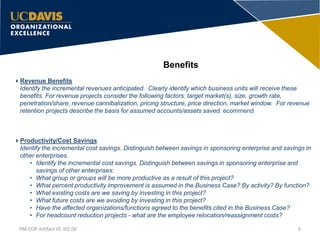
Revenue Benefits
Identify the incremental revenues anticipated. Clearly identify which business units will receive these
benefits. For revenue projects consider the following factors: target market(s), size, growth rate,
penetration/share, revenue cannibalization, pricing structure, price direction, market window. For revenue
retention projects describe the basis for assumed accounts/assets saved. ecommend
Productivity/Cost Savings
Identify the incremental cost savings. Distinguish between savings in sponsoring enterprise and savings in
other enterprises.
• Identify the incremental cost savings. Distinguish between savings in sponsoring enterprise and
savings of other enterprises:
• What group or groups will be more productive as a result of this project?
• What percent productivity improvement is assumed in the Business Case? By activity? By function?
• What existing costs are we saving by investing in this project?
• What future costs are we avoiding by investing in this project?
• Have the affected organizations/functions agreed to the benefits cited in the Business Case?
• For headcount reduction projects - what are the employee relocation/reassignment costs?
Benefits
10PM-COP Artifact ID: I02.00
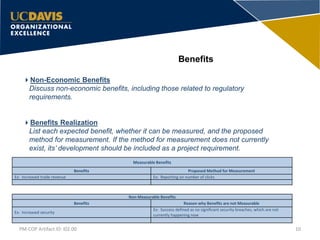
Non-Economic Benefits
Discuss non-economic benefits, including those related to regulatory
requirements.
Benefits Realization
List each expected benefit, whether it can be measured, and the proposed
method for measurement. If the method for measurement does not currently
exist, its’ development should be included as a project requirement.
Measurable Benefits
Benefits Proposed Method for Measurement
Ex: Increased trade revenue Ex: Reporting on number of clicks
Non-Measurable Benefits
Benefits Reason why Benefits are not Measurable
Ex: Increased security
Ex: Success defined as no significant security breaches, which are not
currently happening now
Cost Overview
11PM-COP Artifact ID: I02.00
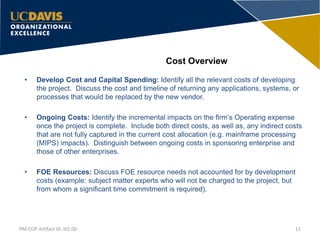
• Develop Cost and Capital Spending: Identify all the relevant costs of developing
the project. Discuss the cost and timeline of returning any applications, systems, or
processes that would be replaced by the new vendor.
• Ongoing Costs: Identify the incremental impacts on the firm’s Operating expense
once the project is complete. Include both direct costs, as well as, any indirect costs
that are not fully captured in the current cost allocation (e.g. mainframe processing
(MIPS) impacts). Distinguish between ongoing costs in sponsoring enterprise and
those of other enterprises.
• FOE Resources: Discuss FOE resource needs not accounted for by development
costs (example: subject matter experts who will not be charged to the project, but
from whom a significant time commitment is required).
Financial Summary
12PM-COP Artifact ID: I02.00
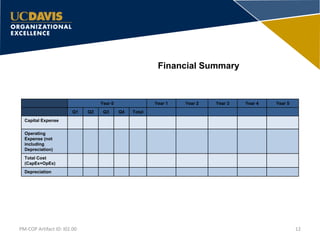
Year 0 Year 1 Year 2 Year 3 Year 4 Year 5
Q1 Q2 Q3 Q4 Total
Capital Expense
Operating
Expense (not
including
Depreciation)
Total Cost
(CapEx+OpEx)
Depreciation

Business case presentation

  • 1.
    OE PM -Business Case Presentation Template Month, Day, Year Enter Project Name 1PM-COP Artifact ID: I02.00
  • 2.
    Purpose The Business CasePresentation is an optional template that can be used if it is deemed appropriate to present the results of the business case in a PowerPoint format. 2PM-COP Artifact ID: I02.00
  • 3.
    Investment Description • BusinessProject Objective: A one or two sentence describing the successful outcome of this project. • Problem/Opportunity Statement: Problem/Opportunity Table from the Project Charter. 3PM-COP Artifact ID: I02.00
  • 4.
    Investment Description • SolutionStrategy: Summarize the proposed project, including major activities, and key attributes of the solution. Explain how the proposed project addresses the specific business issues or opportunities identified in the previous section. • Strategic Fit: Identify which of the company’s strategic objectives this proposed project supports, and explain how (i.e. increases customer retention/acquisition, etc.). List project characteristics (e.g. regulatory requirement, corporate mandate, contract expiration, etc.) 4PM-COP Artifact ID: I02.00
  • 5.
    Assumptions and Dependencies 5PM-COPArtifact ID: I02.00 • Key Assumptions: Specify any assumptions that are driving the project approach. Information should come from the Project Charter. • Strategic Fit: List all efforts that this project is dependent on, as well as efforts that will depend on this project. Explain coordination efforts planned or underway.
  • 6.
    Competitive Benchmarking 6PM-COP ArtifactID: I02.00 Discuss competitor’s practices in the solution space.
  • 7.
    Document each alternativesolution considered. Discuss the “Do Nothing” alternative only if it is a viable alternative. Discuss the advantages and disadvantages of each alternative and why each was rejected. Alternatives and Comparisons 7PM-COP Artifact ID: I02.00
  • 8.
    Document the recommendedsolution with a summary of the reasons why this solution is being recommended. Solution Recommendation 8PM-COP Artifact ID: I02.00
  • 9.
    Benefits 9PM-COP Artifact ID:I02.00 Revenue Benefits Identify the incremental revenues anticipated. Clearly identify which business units will receive these benefits. For revenue projects consider the following factors: target market(s), size, growth rate, penetration/share, revenue cannibalization, pricing structure, price direction, market window. For revenue retention projects describe the basis for assumed accounts/assets saved. ecommend Productivity/Cost Savings Identify the incremental cost savings. Distinguish between savings in sponsoring enterprise and savings in other enterprises. • Identify the incremental cost savings. Distinguish between savings in sponsoring enterprise and savings of other enterprises: • What group or groups will be more productive as a result of this project? • What percent productivity improvement is assumed in the Business Case? By activity? By function? • What existing costs are we saving by investing in this project? • What future costs are we avoiding by investing in this project? • Have the affected organizations/functions agreed to the benefits cited in the Business Case? • For headcount reduction projects - what are the employee relocation/reassignment costs?
  • 10.
    Benefits 10PM-COP Artifact ID:I02.00 Non-Economic Benefits Discuss non-economic benefits, including those related to regulatory requirements. Benefits Realization List each expected benefit, whether it can be measured, and the proposed method for measurement. If the method for measurement does not currently exist, its’ development should be included as a project requirement. Measurable Benefits Benefits Proposed Method for Measurement Ex: Increased trade revenue Ex: Reporting on number of clicks Non-Measurable Benefits Benefits Reason why Benefits are not Measurable Ex: Increased security Ex: Success defined as no significant security breaches, which are not currently happening now
  • 11.
    Cost Overview 11PM-COP ArtifactID: I02.00 • Develop Cost and Capital Spending: Identify all the relevant costs of developing the project. Discuss the cost and timeline of returning any applications, systems, or processes that would be replaced by the new vendor. • Ongoing Costs: Identify the incremental impacts on the firm’s Operating expense once the project is complete. Include both direct costs, as well as, any indirect costs that are not fully captured in the current cost allocation (e.g. mainframe processing (MIPS) impacts). Distinguish between ongoing costs in sponsoring enterprise and those of other enterprises. • FOE Resources: Discuss FOE resource needs not accounted for by development costs (example: subject matter experts who will not be charged to the project, but from whom a significant time commitment is required).
  • 12.
    Financial Summary 12PM-COP ArtifactID: I02.00 Year 0 Year 1 Year 2 Year 3 Year 4 Year 5 Q1 Q2 Q3 Q4 Total Capital Expense Operating Expense (not including Depreciation) Total Cost (CapEx+OpEx) Depreciation