Product Business Case Template
Purpose

The purpose of this tool is to help you design a Business Case for any corporate product
investment. Business cases are developed for many reasons, such as acquiring a company,
developing a new market or to capitalize on a high-growth opportunity. This business
case template is designed to help prepare a request for significant funding outside your
normal annual operating budget to invest in product development.


How to Use this Template

Complete the following sections with your project team and/or stakeholders. Cut & paste
information into a document that reflects your corporate image, and deliver your Business
Case to senior executives interested in sponsoring the project.


Title Page

                        [Insert Company Name or Logo]


                      Business Case – (insert project title)


                             [Insert Completion Date]


                       Completed By: [Insert Project Manager Name]
                      Completed For: [Insert Project Sponsor Name]
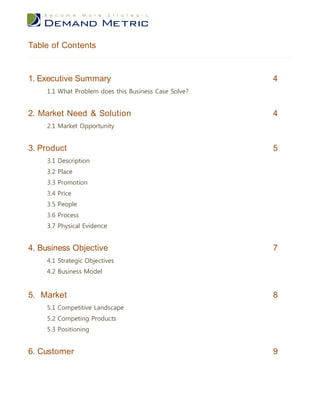
Table of Contents


1. Executive Summary                                  4
    1.1 What Problem does this Business Case Solve?


2. Market Need & Solution                             4
    2.1 Market Opportunity


3. Product                                            5
    3.1 Description
    3.2 Place
    3.3 Promotion
    3.4 Price
    3.5 People
    3.6 Process
    3.7 Physical Evidence


4. Business Objective                                 7
    4.1 Strategic Objectives
    4.2 Business Model


5. Market                                             8
    5.1 Competitive Landscape
    5.2 Competing Products
    5.3 Positioning


6. Customer                                           9
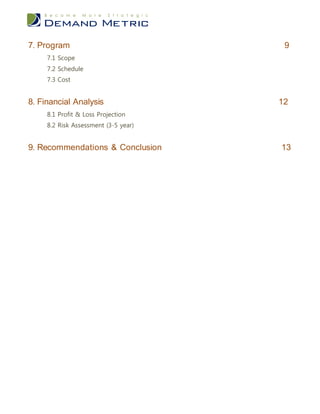
7. Program                             9
     7.1 Scope
     7.2 Schedule
     7.3 Cost


8. Financial Analysis                 12
     8.1 Profit & Loss Projection
     8.2 Risk Assessment (3-5 year)


9. Recommendations & Conclusion       13
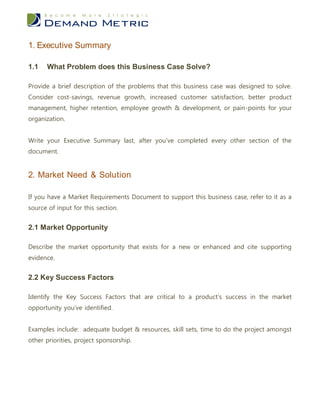
1. Executive Summary

1.1   What Problem does this Business Case Solve?

Provide a brief description of the problems that this business case was designed to solve.
Consider cost-savings, revenue growth, increased customer satisfaction, better product
management, higher retention, employee growth & development, or pain-points for your
organization.


Write your Executive Summary last, after you’ve completed every other section of the
document.


2. Market Need & Solution

If you have a Market Requirements Document to support this business case, refer to it as a
source of input for this section.


2.1 Market Opportunity

Describe the market opportunity that exists for a new or enhanced and cite supporting
evidence.


2.2 Key Success Factors

Identify the Key Success Factors that are critical to a product’s success in the market
opportunity you’ve identified.


Examples include: adequate budget & resources, skill sets, time to do the project amongst
other priorities, project sponsorship.
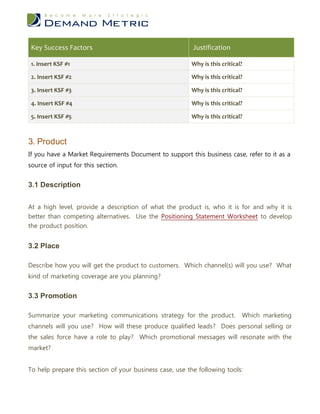
Key Success Factors                                      Justification

 1. Insert KSF #1                                        Why is this critical?

 2. Insert KSF #2                                        Why is this critical?

 3. Insert KSF #3                                        Why is this critical?

 4. Insert KSF #4                                        Why is this critical?

 5. Insert KSF #5                                        Why is this critical?


3. Product
If you have a Market Requirements Document to support this business case, refer to it as a
source of input for this section.


3.1 Description


At a high level, provide a description of what the product is, who it is for and why it is
better than competing alternatives. Use the Positioning Statement Worksheet to develop
the product position.


3.2 Place

Describe how you will get the product to customers. Which channel(s) will you use? What
kind of marketing coverage are you planning?


3.3 Promotion

Summarize your marketing communications strategy for the product.            Which marketing
channels will you use? How will these produce qualified leads? Does personal selling or
the sales force have a role to play? Which promotional messages will resonate with the
market?


To help prepare this section of your business case, use the following tools:
1. Marketing Channel Ranking Tool
       2. Message Mapping Tool


3.4 Price

Discuss your pricing strategy and the objectives you have for it. Use the Pricing Strategy
Template to help determine a pricing strategy.


3.5 People

Describe the human actors who are involved in achieving success in the market with this
product:


   1. Employees: what kind of recruiting, training, motivation, rewards and teamwork are
       required?
   2. Customers: what sort of education and training will customers need to adopt and
       use this product?


3.6 Process

Provide detail on the actual procedures, flow of activities and supporting systems by which
the product is delivered to customers in the market. For example, you may wish to use the
Purchase Process Diagram Tool to describe the sequence of activities leading to the
purchase of this product.


3.7 Physical Evidence

List all tangible representations of the product beginning with the product itself and
including: business cards, brochures, packaging, documentation, signage, equipment and
physical facilities.   Emphasize how each tangible component will communicate the
product’s purpose, quality, intended use, target market and benefits.
4. Business Objective

This section outlines the objectives the product will achieve when launched.


4.1 Strategic Objectives

List the specific objectives identified for this product. For each objective, describe how it is:


      1. Consistent with corporate strategy and vision.
      2. Appropriate for where the product is in its lifecycle.
      3. Complementary to the positioning strategy for this product.


4.2 Business Model

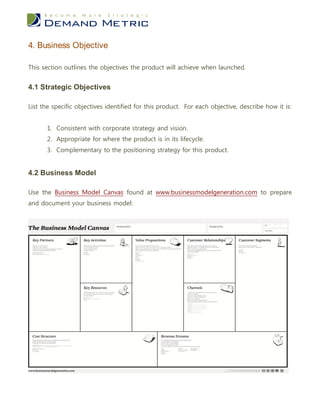
Use the Business Model Canvas found at www.businessmodelgeneration.com to prepare
and document your business model:
Your business model will provide detail about:


   Key Partners                    Value Propositions              Customer Relationships
   Key Activities                  Cost Structure                  Customer Segments
   Key Resources                   Revenue Streams                 Channels


5. Market

In this section you will discuss the market factors that will impact or facilitate the product’s
success: competition and market position.


5.1 Competitive Landscape

Assess the competition at the corporate level. Use the Competitor Analysis Tool to help
complete your assessment. Your assessment should include:


          Each direct competitor or substitute product
          Their strategy
          Strengths and weaknesses
          Financials
          Estimated capabilities, resources and ability to execute
          Predicted response to your actions


5.2 Competing Products

Assess competing products, using the Competitive Products Sales Reference Tool.
Compare competing solutions at the feature level to determine where you have a
competitive advantage and which product is the market leader.
5.3 Positioning

Positioning is the process of defining a market position for your product. Once defined, that
market position is expressed as a Positioning Statement that describes your product, defines its
differentiation and expresses how you will create value.     A Positioning Statement is a succinct
expression of your market position that is externally focused, describes the target customer,
primary benefit, references the competition and answers the question: why should I buy from
you?


Use the Positioning Statement Worksheet to articulate a market position for this product.


6. Customer

To have sales success, you will need to tailor your sales pitch to your target customer, so in
this section, you will define your target customer segments and provide profiles of
representative customers. Use the Customer Profile Template to create a persona for each
type of customer represented in the buying process. Keep in mind that for B2B segments,
you may have several personas involved in the process of making a single sale, such as
executives, managers and the actual users.


7. Program

This section will outline the key risks that need to be mitigated and provide contingency
plans for each identified risk.   Risks include:   lack of end-user adoption, project over-
time/over-budget, technical risk, and senior management commitment.


7.1 Scope

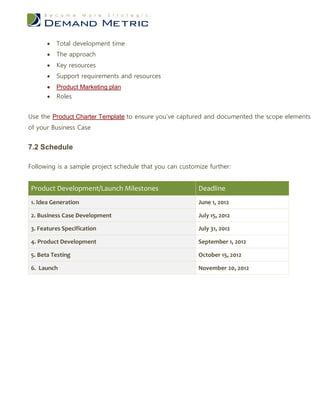
Describe the scope of this project, broken into phases, including:


          How to accomplish the project successfully
   Total development time
         The approach
         Key resources
         Support requirements and resources
         Product Marketing plan
         Roles


Use the Product Charter Template to ensure you’ve captured and documented the scope elements
of your Business Case


7.2 Schedule

Following is a sample project schedule that you can customize further:


Product Development/Launch Milestones                     Deadline
1. Idea Generation                                        June 1, 2012

2. Business Case Development                              July 15, 2012

3. Features Specification                                 July 31, 2012

4. Product Development                                    September 1, 2012

5. Beta Testing                                           October 15, 2012

6. Launch                                                 November 20, 2012
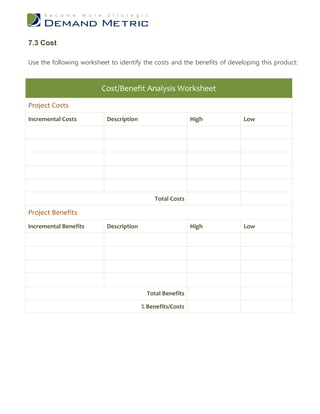
7.3 Cost

Use the following worksheet to identify the costs and the benefits of developing this product:


                         Cost/Benefit Analysis Worksheet
Project Costs
Incremental Costs          Description                      High           Low


                                             Total Costs

Project Benefits
Incremental Benefits       Description                      High           Low


                                           Total Benefits

                                         % Benefits/Costs
8. Financial Analysis

The purpose of the financial analysis is to indicate the product’s potential and provide a
timetable for financial viability.


8.1 Profit & Loss Projection

Provide a detailed analysis of how many units you must sell in order to break even. Use the
Break Even Analysis Tool to help complete this projection.


8.2 Risk Assessment

Provide an assessment of risk over a three to five year horizon for developing this product.
Consider the following dimensions of risk:


          Investment Risk: what are the risk factors that would lead to not getting a return
           for investing in the development of this product?     Example risk factors could
           include: lack of end-user adoption, project over-time/over-budget, technical risk
           and senior management commitment.


          Opportunity Risk:     what are the lost opportunity risks of not developing this
           product or not delivering it to the market at the right time? This part of your
           analysis should predict what might happen if you don’t proceed with product
           development.     Examples include loss of market share, loss of perception as a
           market leader and loss of revenue to competitors who do have products in this
           niche.


Use the Risk Assessment Tool to help identify the risks and predict their impact and
probability.
9. Recommendations & Conclusion

Conclude your Business Case with specific recommendations: what should the company
do?

Product Business Case Template

  • 1.
    Product Business CaseTemplate Purpose The purpose of this tool is to help you design a Business Case for any corporate product investment. Business cases are developed for many reasons, such as acquiring a company, developing a new market or to capitalize on a high-growth opportunity. This business case template is designed to help prepare a request for significant funding outside your normal annual operating budget to invest in product development. How to Use this Template Complete the following sections with your project team and/or stakeholders. Cut & paste information into a document that reflects your corporate image, and deliver your Business Case to senior executives interested in sponsoring the project. Title Page [Insert Company Name or Logo] Business Case – (insert project title) [Insert Completion Date] Completed By: [Insert Project Manager Name] Completed For: [Insert Project Sponsor Name]
  • 2.
    Table of Contents 1.Executive Summary 4 1.1 What Problem does this Business Case Solve? 2. Market Need & Solution 4 2.1 Market Opportunity 3. Product 5 3.1 Description 3.2 Place 3.3 Promotion 3.4 Price 3.5 People 3.6 Process 3.7 Physical Evidence 4. Business Objective 7 4.1 Strategic Objectives 4.2 Business Model 5. Market 8 5.1 Competitive Landscape 5.2 Competing Products 5.3 Positioning 6. Customer 9
  • 3.
    7. Program 9 7.1 Scope 7.2 Schedule 7.3 Cost 8. Financial Analysis 12 8.1 Profit & Loss Projection 8.2 Risk Assessment (3-5 year) 9. Recommendations & Conclusion 13
  • 4.
    1. Executive Summary 1.1 What Problem does this Business Case Solve? Provide a brief description of the problems that this business case was designed to solve. Consider cost-savings, revenue growth, increased customer satisfaction, better product management, higher retention, employee growth & development, or pain-points for your organization. Write your Executive Summary last, after you’ve completed every other section of the document. 2. Market Need & Solution If you have a Market Requirements Document to support this business case, refer to it as a source of input for this section. 2.1 Market Opportunity Describe the market opportunity that exists for a new or enhanced and cite supporting evidence. 2.2 Key Success Factors Identify the Key Success Factors that are critical to a product’s success in the market opportunity you’ve identified. Examples include: adequate budget & resources, skill sets, time to do the project amongst other priorities, project sponsorship.
  • 5.
    Key Success Factors Justification 1. Insert KSF #1 Why is this critical? 2. Insert KSF #2 Why is this critical? 3. Insert KSF #3 Why is this critical? 4. Insert KSF #4 Why is this critical? 5. Insert KSF #5 Why is this critical? 3. Product If you have a Market Requirements Document to support this business case, refer to it as a source of input for this section. 3.1 Description At a high level, provide a description of what the product is, who it is for and why it is better than competing alternatives. Use the Positioning Statement Worksheet to develop the product position. 3.2 Place Describe how you will get the product to customers. Which channel(s) will you use? What kind of marketing coverage are you planning? 3.3 Promotion Summarize your marketing communications strategy for the product. Which marketing channels will you use? How will these produce qualified leads? Does personal selling or the sales force have a role to play? Which promotional messages will resonate with the market? To help prepare this section of your business case, use the following tools:
  • 6.
    1. Marketing ChannelRanking Tool 2. Message Mapping Tool 3.4 Price Discuss your pricing strategy and the objectives you have for it. Use the Pricing Strategy Template to help determine a pricing strategy. 3.5 People Describe the human actors who are involved in achieving success in the market with this product: 1. Employees: what kind of recruiting, training, motivation, rewards and teamwork are required? 2. Customers: what sort of education and training will customers need to adopt and use this product? 3.6 Process Provide detail on the actual procedures, flow of activities and supporting systems by which the product is delivered to customers in the market. For example, you may wish to use the Purchase Process Diagram Tool to describe the sequence of activities leading to the purchase of this product. 3.7 Physical Evidence List all tangible representations of the product beginning with the product itself and including: business cards, brochures, packaging, documentation, signage, equipment and physical facilities. Emphasize how each tangible component will communicate the product’s purpose, quality, intended use, target market and benefits.
  • 7.
    4. Business Objective Thissection outlines the objectives the product will achieve when launched. 4.1 Strategic Objectives List the specific objectives identified for this product. For each objective, describe how it is: 1. Consistent with corporate strategy and vision. 2. Appropriate for where the product is in its lifecycle. 3. Complementary to the positioning strategy for this product. 4.2 Business Model Use the Business Model Canvas found at www.businessmodelgeneration.com to prepare and document your business model:
  • 8.
    Your business modelwill provide detail about:  Key Partners  Value Propositions  Customer Relationships  Key Activities  Cost Structure  Customer Segments  Key Resources  Revenue Streams  Channels 5. Market In this section you will discuss the market factors that will impact or facilitate the product’s success: competition and market position. 5.1 Competitive Landscape Assess the competition at the corporate level. Use the Competitor Analysis Tool to help complete your assessment. Your assessment should include:  Each direct competitor or substitute product  Their strategy  Strengths and weaknesses  Financials  Estimated capabilities, resources and ability to execute  Predicted response to your actions 5.2 Competing Products Assess competing products, using the Competitive Products Sales Reference Tool. Compare competing solutions at the feature level to determine where you have a competitive advantage and which product is the market leader.
  • 9.
    5.3 Positioning Positioning isthe process of defining a market position for your product. Once defined, that market position is expressed as a Positioning Statement that describes your product, defines its differentiation and expresses how you will create value. A Positioning Statement is a succinct expression of your market position that is externally focused, describes the target customer, primary benefit, references the competition and answers the question: why should I buy from you? Use the Positioning Statement Worksheet to articulate a market position for this product. 6. Customer To have sales success, you will need to tailor your sales pitch to your target customer, so in this section, you will define your target customer segments and provide profiles of representative customers. Use the Customer Profile Template to create a persona for each type of customer represented in the buying process. Keep in mind that for B2B segments, you may have several personas involved in the process of making a single sale, such as executives, managers and the actual users. 7. Program This section will outline the key risks that need to be mitigated and provide contingency plans for each identified risk. Risks include: lack of end-user adoption, project over- time/over-budget, technical risk, and senior management commitment. 7.1 Scope Describe the scope of this project, broken into phases, including:  How to accomplish the project successfully
  • 10.
    Total development time  The approach  Key resources  Support requirements and resources  Product Marketing plan  Roles Use the Product Charter Template to ensure you’ve captured and documented the scope elements of your Business Case 7.2 Schedule Following is a sample project schedule that you can customize further: Product Development/Launch Milestones Deadline 1. Idea Generation June 1, 2012 2. Business Case Development July 15, 2012 3. Features Specification July 31, 2012 4. Product Development September 1, 2012 5. Beta Testing October 15, 2012 6. Launch November 20, 2012
  • 11.
    7.3 Cost Use thefollowing worksheet to identify the costs and the benefits of developing this product: Cost/Benefit Analysis Worksheet Project Costs Incremental Costs Description High Low Total Costs Project Benefits Incremental Benefits Description High Low Total Benefits % Benefits/Costs
  • 12.
    8. Financial Analysis Thepurpose of the financial analysis is to indicate the product’s potential and provide a timetable for financial viability. 8.1 Profit & Loss Projection Provide a detailed analysis of how many units you must sell in order to break even. Use the Break Even Analysis Tool to help complete this projection. 8.2 Risk Assessment Provide an assessment of risk over a three to five year horizon for developing this product. Consider the following dimensions of risk:  Investment Risk: what are the risk factors that would lead to not getting a return for investing in the development of this product? Example risk factors could include: lack of end-user adoption, project over-time/over-budget, technical risk and senior management commitment.  Opportunity Risk: what are the lost opportunity risks of not developing this product or not delivering it to the market at the right time? This part of your analysis should predict what might happen if you don’t proceed with product development. Examples include loss of market share, loss of perception as a market leader and loss of revenue to competitors who do have products in this niche. Use the Risk Assessment Tool to help identify the risks and predict their impact and probability.
  • 13.
    9. Recommendations &Conclusion Conclude your Business Case with specific recommendations: what should the company do?