CARDIFF METROPOLITAN UNIVERSITY
UNIVERSAL BUSINESS SCHOOL
Name: Priyakshi Nandrajog
Course: BABM5 Level 5
Student ID: st20112439
Subject: Business in Action
Module Leader: Prof. Vipul Mehta
Topic: Strategic Analysis of Paytm (Patchwork 3)
1 The Success Story of Paytm
2 Critical Evaluation of Marketing Strategies adopted by
Paytm
3 Critical Evaluation of IT Strategies adopted by Paytm
4 Critical Evaluation of HR Strategies adopted by Paytm
5 Critical Evaluation of Finance Strategies adopted by
Paytm
6 Critical Evaluation of Operational Strategies adopted
by Paytm
7 Conclusion
Mr. Vijay Shekhar Sharma, is the founder of Paytm He was born in the Indian state of Uttar-
Pradesh in a middle-class family. While he was studying in Delhi College of Engineering he
went through difficulties in comprehending English, besides the difficulties he started a
website called indiasite.net and sold the website later for $ 1 million. He then came up with a
content platform known as “One97 Communications” which is now the Parent company of
Paytm.
Paytm i.e. Pay through Mobile, is one of the largest E-wallet and E-commerce companies,
with its headquarters in the National Capital Region, India. The company was founded in
2010, and is a subsidiary of one of the leading mobile internet companies of India known as
One97 Communications (The Ingenious Scribblers, 2018).
In 2014, Paytm launched its E-wallet services, last year the company earned a license from
RBI to launch the first payment bank of India. The objective of the company is to convert
India into a cashless economy
After the government decision, Demonitisation came into action. It served as a huge
opportunity for Vijay Sharma. Paytm was then aggressively promoted to help the citizens to
deal with cash crunch in the economy. Now Paytm has spread its presence all over the country
and is an accepted mode of payment from tea stalls to huge supermarkets. The brand Paytm
started with online recharge services and has set its own marketplace in the recent years.
“Looking forward to a cashless India, Vijay’s dream is to bring half a billion Indians to the
mainstream economy. His dream is to build India’s first $100 Bn firm,a company that would make
the nation proud.”
(Paytm Blog, 2018)
Paytm: The Success Story
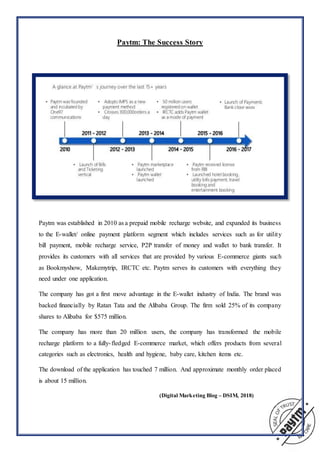
Paytm was established in 2010 as a prepaid mobile recharge website, and expanded its business
to the E-wallet/ online payment platform segment which includes services such as for utility
bill payment, mobile recharge service, P2P transfer of money and wallet to bank transfer. It
provides its customers with all services that are provided by various E-commerce giants such
as Bookmyshow, Makemytrip, IRCTC etc. Paytm serves its customers with everything they
need under one application.
The company has got a first move advantage in the E-wallet industry of India. The brand was
backed financially by Ratan Tata and the Alibaba Group. The firm sold 25% of its company
shares to Alibaba for $575 million.
The company has more than 20 million users, the company has transformed the mobile
recharge platform to a fully-fledged E-commerce market, which offers products from several
categories such as electronics, health and hygiene, baby care, kitchen items etc.
The download of the application has touched 7 million. And approximate monthly order placed
is about 15 million.
(Digital Marketing Blog – DSIM, 2018)
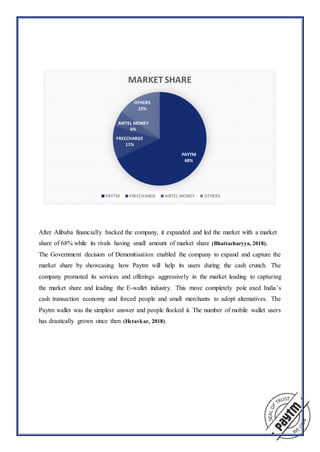
After Alibaba financially backed the company, it expanded and led the market with a market
share of 68% while its rivals having small amount of market share (Bhattacharyya, 2018).
The Government decision of Demonitisation enabled the company to expand and capture the
market share by showcasing how Paytm will help its users during the cash crunch. The
company promoted its services and offerings aggressively in the market leading to capturing
the market share and leading the E-wallet industry. This move completely pole axed India’s
cash transaction economy and forced people and small merchants to adopt alternatives. The
Paytm wallet was the simplest answer and people flocked it. The number of mobile wallet users
has drastically grown since then (Hetavkar, 2018).
PAYTM
68%
FREECHARGE
11%
AIRTEL MONEY
6%
OTHERS
15%
MARKET SHARE
PAYTM FREECHARGE AIRTEL MONEY OTHERS
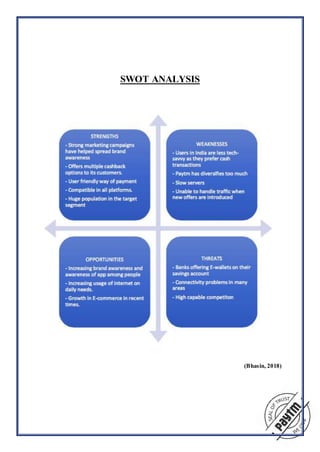
SWOT ANALYSIS
(Bhasin, 2018)
Critical Evaluation of Marketing Strategies adopted by Paytm
Paytm follows the undifferentiated targeting since the beginning. The target the entire audience
irrespective of income, gender, age or status. By following this strategy, the company was able
to capture the E-wallet market of India. With the recent decision of demonetization taken by
the government of India, Paytm served as an alternative for hard cash and helped the citizen to
get away with the phase of demonetization.
Marketing Mix
Product
Paytm is the largest online payment portal in India, it provides its customers with various
services such as online shopping, E-wallet services etc. As the name suggests “Pay through
mobile”, it is accessible on smartphones and on computers inorder to avail services such as
making bill payments, mobile recharges, pay at the restaurant, book air tickets etc. the company
has positioned itself as an alternative for hard cash in the economy. Paytm also enables its users
with banking services, which allow its users to have saving account and access to a debit card.
Price
Hard to believe, but Paytm provides free service to its customers, as it serves as a medium to
make payments to avail other services or to purchase other products. The company was founded
due to huge amount of investments it received by various companies. The company received
an investment of $575 million from the leading E-commerce giant Alibaba and many others.
The company is able to give huge discounts and offers on its services due to the huge
investments. They also give discount on their E-commerce portal, to keep their customers on
board. This provides an over view of its pricing strategy. Paytm has various other competitors
in the industry, but no other E-wallet company has been able to capture a market share
equivalent to or higher than Paytm. Paytm charges a minimum transaction fee on transfer of
money to the bank account. They have their earnings from the transactional fee and commission
charged on the transactions, money that is stored in the wallet of the users Paytm creates income
through interest.
Place:
Paytm like other websites and apps, can be accessed through smartphones and on its website
with active internet connection. The company is headquartered in Delhi, India. The company
has spread its services such as online payment and shopping throughout the country in a short
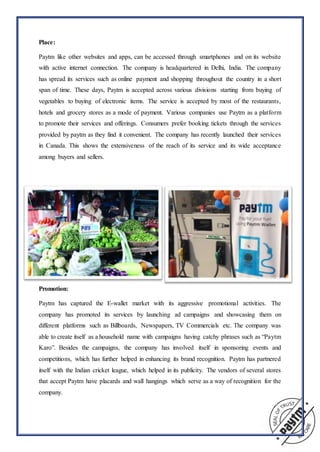
span of time. These days, Paytm is accepted across various divisions starting from buying of
vegetables to buying of electronic items. The service is accepted by most of the restaurants,
hotels and grocery stores as a mode of payment. Various companies use Paytm as a platform
to promote their services and offerings. Consumers prefer booking tickets through the services
provided by paytm as they find it convenient. The company has recently launched their services
in Canada. This shows the extensiveness of the reach of its service and its wide acceptance
among buyers and sellers.
Promotion:
Paytm has captured the E-wallet market with its aggressive promotional activities. The
company has promoted its services by launching ad campaigns and showcasing them on
different platforms such as Billboards, Newspapers, TV Commercials etc. The company was
able to create itself as a household name with campaigns having catchy phrases such as “Paytm
Karo”. Besides the campaigns, the company has involved itself in sponsoring events and
competitions, which has further helped in enhancing its brand recognition. Paytm has partnered
itself with the Indian cricket league, which helped in its publicity. The vendors of several stores
that accept Paytm have placards and wall hangings which serve as a way of recognition for the
company.
People:
Paytm is a service brand, and they believe people are their most important asset, be it their
customers or their employees. The company provides employment to more than 13,000 people,
besides its employees it has about 3 million suppliers accepting the mode of payment offered
by Paytm. The company has over 150 million subscribers that use Paytm services for their daily
transactions. The internal workforce of the company is also provided with several health
benefits.
Process:
“Process
The main objective of the company was to initiate hassle free transactions with a
user-friendly interface. A person needs to login to paytm and load money into their wallet
through their credit/debit card, and later make use of that money for various services by
entering the mobile number or by scanning the QR code.”
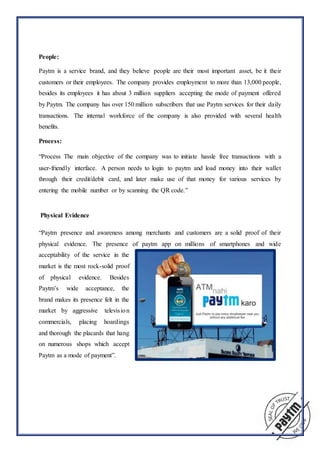
Physical Evidence
“Paytm presence and awareness among merchants and customers are a solid proof of their
physical evidence. The presence of paytm app on millions of smartphones and wide
acceptability of the service in the
market is the most rock-solid proof
of physical evidence. Besides
Paytm’s wide acceptance, the
brand makes its presence felt in the
market by aggressive television
commercials, placing hoardings
and thorough the placards that hang
on numerous shops which accept
Paytm as a mode of payment”.
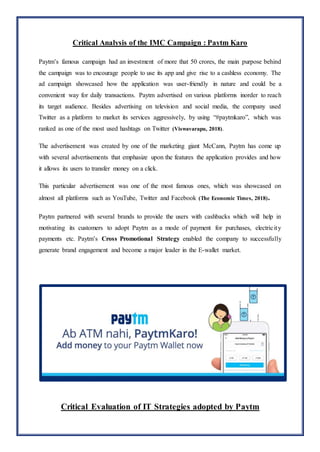
Critical Analysis of the IMC Campaign : Paytm Karo
Paytm’s famous campaign had an investment of more that 50 crores, the main purpose behind
the campaign was to encourage people to use its app and give rise to a cashless economy. The
ad campaign showcased how the application was user-friendly in nature and could be a
convenient way for daily transactions. Paytm advertised on various platforms inorder to reach
its target audience. Besides advertising on television and social media, the company used
Twitter as a platform to market its services aggressively, by using “#paytmkaro”, which was
ranked as one of the most used hashtags on Twitter (Viswavarapu, 2018).
The advertisement was created by one of the marketing giant McCann, Paytm has come up
with several advertisements that emphasize upon the features the application provides and how
it allows its users to transfer money on a click.
This particular advertisement was one of the most famous ones, which was showcased on
almost all platforms such as YouTube, Twitter and Facebook (The Economic Times, 2018).
Paytm partnered with several brands to provide the users with cashbacks which will help in
motivating its customers to adopt Paytm as a mode of payment for purchases, electricity
payments etc. Paytm’s Cross Promotional Strategy enabled the company to successfully
generate brand engagement and become a major leader in the E-wallet market.
Critical Evaluation of IT Strategies adopted by Paytm
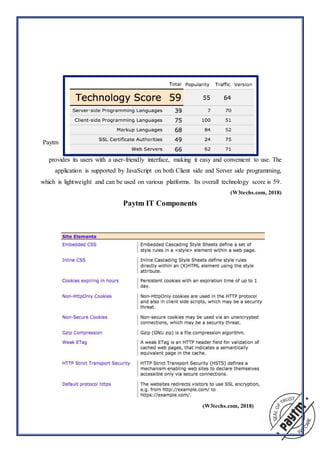
Paytm
provides its users with a user-friendly interface, making it easy and convenient to use. The
application is supported by JavaScript on both Client side and Server side programming,
which is lightweight and can be used on various platforms. Its overall technology score is 59.
(W3techs.com, 2018)
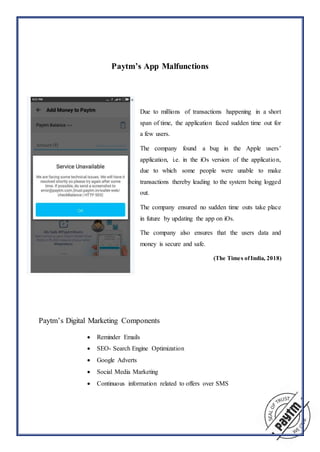
Paytm IT Components
(W3techs.com, 2018)
Paytm’s App Malfunctions
Due to millions of transactions happening in a short
span of time, the application faced sudden time out for
a few users.
The company found a bug in the Apple users’
application, i.e. in the iOs version of the application,
due to which some people were unable to make
transactions thereby leading to the system being logged
out.
The company ensured no sudden time outs take place
in future by updating the app on iOs.
The company also ensures that the users data and
money is secure and safe.
(The Times ofIndia, 2018)
Paytm’s Digital Marketing Components
 Reminder Emails
 SEO- Search Engine Optimization
 Google Adverts
 Social Media Marketing
 Continuous information related to offers over SMS
Critical Evaluation of HR Strategies adopted by Paytm
Companies like Paytm, that are tech savvy and work in the E-commerce industry, find it
extremely difficult catch upon a fully trained and employable workforce, such companies
believe in hiring and providing training according to the company’s requirements and provide
them with a comfortable work place so that they retain for a longer period. The company does
not believe in having boundaries within its work force and encourages its employees to think
alike.
Core Values:
“Paytm is a transparent and ethical company and expects that its ethics and values are intentiona lly
upheld all across. Paytm is bound by the relevant law of the land.”
“We do what we love and love what we do. We are a team of young enthusiastic crazies, driven
by a strong yearning and passion to change the way payments are made in India. We are
determined to revolutionize face of mobile commerce in India.”
Human Resource policies of Paytm are flexible, the company does not believe in having an
unbendable policy, as they look for a highly energetic and motivated workforce which is
important for the growth of the company. The company provides its employees with an open
culture that enables the employees to contribute by sharing their opinions and ideas. The HR
department ensures there is a motivated workforce by providing cross-training courses and
making their roles interesting.
The recent initiative by the HR department enables its employees to share their feedback and
their experience at work, which will help the company to keep its employees satisfied and
motivated. Employees are allowed to take an unpaid leave of upto six months, incase of any
serious commitment. The company allows the employee to re-join in case he has to leave for
any personal reason. In order to stay obliged, committed and motivated at work, the company
provides perks such as tickets to various shows, Medical Insurance, Team outings and get
togethers.
The company also expects certain responsibilities to be fulfilled by its employees. They expect
an ethical and professional behavior while representing the brand at any point. The employees
must meet the job requirements and standards of working in the organisation by completing all
job trainings. They expect their subordinates to report in case of any violation of laws. The
company believes in customer confidentiality and expects the employees to believe in the same.
Global Recruitment Program:
With the increase in the number of individuals accessing internet on their smartphones, it can
be observed that there is a drastic change in the way people shop and pay. Paytm moves ahead
with its mission of simplifying day-to-day transactions for the economy.
Paytm is a brand which celebrates its employees, the top management believes that their
numerous achievements have been possible only because of their smart workforce. The
working environment at Paytm encourages innovation and drives employees towards going the
extra mile. Each Paytm employee strives towards enhancing the product service to ensure they
delight their consumer. The brand with global aspirations is now planning to recruit talent from
across the globe (Paytm.com, 2018).
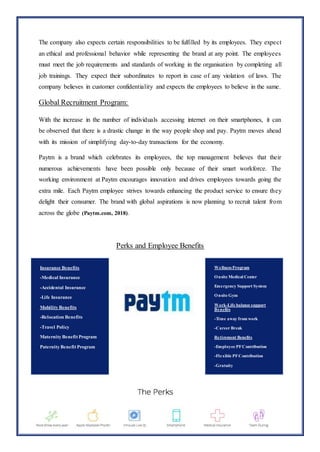
Perks and Employee Benefits
Insurance Benefits
-Medical Insurance
-Accidental Insurance
-Life Insurance
Mobility Benefits
-Relocation Benefits
-Travel Policy
Maternity Benefit Program
Paternity Benefit Program
Wellness Program
Onsite Medical Center
Emergency Support System
Onsite Gym
Work-Life balance support
Benefits
-Time away from work
-Career Break
Retirement Benefits
-Employee PFContribution
-Flexible PFContribution
-Gratuity
Paytm Human Components:
Paytm has unified its HR and IT activities to create a joint database using an enterprise resource
planning software, this helped the organization to reduce its operational costs and increase its
operational efficiency
Payrolls: Paytm accounts the presence of the employee at work and calculates the remuneration
accordingly.
Employee Productivity: output produced by the employee at Paytm is then compared with the
pre-decided standards
HR Metrics: Paytm conducts several feedback sessions, where the employees tell how they feel
about the workplace.
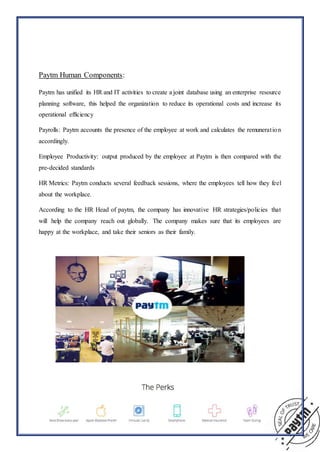
According to the HR Head of paytm, the company has innovative HR strategies/policies that
will help the company reach out globally. The company makes sure that its employees are
happy at the workplace, and take their seniors as their family.
Critical Evaluation of the Financial Strategy adopted by Paytm
Inorder to keep the parent company afloat, the founder of Paytm was struggling for cash flow.
The strategy behind Paytm earning even after providing its users with 50% to 100% cashback.
The company has converted itself into one of the India companies dealing in mobile payments,
marketplace, bill payments etc. which serves more than 100 million users.
How Paytm earns profit?
In the year 2017, the company was valued at $7 billion, which included a huge stake of a global
E-commerce giant, Alibaba.
The revenue model of Paytm, can be categorized as:
1. Bill Payments
2. Recharge Services
3. Payment Solutions
4. Wallet Services etc.
Paytm Mall (Paytm Marketplace)
The company was the first ever to come up with a mobile only marketplace, with over 120
million buyers and 2 million daily transactions that are mostly prepaid.
Revenue is generated through commissions and fees through sellers, which according to the
category of the product (Feedough, 2018).
Paytm Wallet
“The money deposited by users in Paytm wallet is deposited by Paytm in an Escrow
Account, as per RBI Guidelines, with a partner bank. This escrow account deposit fetch Paytm
certain interest which is decided as per the contract between the bank and Paytm.”
Recharge and Bill Payments
Company charges commission from the mobile operators/ and other service providers.
Payment Solutions
Online businesses have an edge as Payments solutions allow them to accept several payments
through paytm. The setup comes with no fee, on the other hand the Company charges about
1.99% commission on each transaction.
Acquisitions, Sponsorships and Other Expenditures
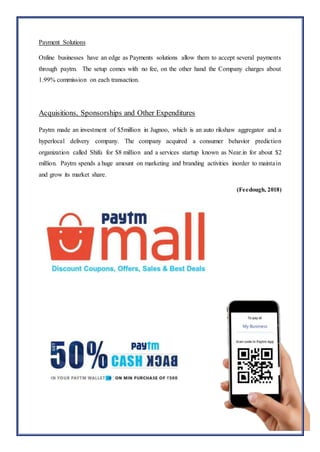
Paytm made an investment of $5million in Jugnoo, which is an auto rikshaw aggregator and a
hyperlocal delivery company. The company acquired a consumer behavior prediction
organization called Shifu for $8 million and a services startup known as Near.in for about $2
million. Paytm spends a huge amount on marketing and branding activities inorder to maintain
and grow its market share.
(Feedough, 2018)
Critical Evaluation of Operational Strategies adopted by Paytm
Supply Chain Management
(@businessline, 2018)
“The company has its operations directly from the suppliers, Paytm has 100 brand stores and
about 15000 brand authorized retailers. The company is different from any other E-commerce
company in terms of operations, as their model aims towards becoming technology assistants
for offline retailers and provide them with the required marketing needs and the know-how to
fight against the large monolithic E-commerce retailers. The company has forged partnership
with several brands. The task looks steep as Paytm Mall is up against rivals sitting
on a cash war-chest (Choudhury, 2018).”
“Paytm Mall is firming up its effort to take on the e-commerce market at a time when
incumbents Flipkart and Amazon India have taken over bulk of online sales due to their first
movers’ advantage.”
“In the run-up to the Diwali season, a period characterized by major discounting by brands and
retailers and where e-commerce firms reap their highest monthly sales, Paytm Mall is banking
on categories such as electronics, fashion and daily essentials to drive up sales. Flipkart recently
raised a mammoth $2.5 billion round from Softbank Corp., while Amazon Inc. has committed
to spend $5 billion on India operations, one-third of which has already been invested (Malik,
2018).”
Conclusion
“E-commerce has been a major game-changer in the Indian economy and its evolution seems
infinite as newer technologies sprout. Due to this, various basic elements of business have
evolved over the years and Paytm seems to be the one, which has an authentic blend of the
conventional business values with modern techniques. Paytm has been leading the torch of
innovation by introducing new methods and functions for payment and shopping in this
advancing Indian economy. The motive of the company was to serve as an alternative during
cash crunch in the economy.” The analysis conducted in this report indicates that the company
treats its employee’s like family because of which people at Paytm work selflessly because
they feel it’s their organisation. “Besides the company’s strategic moves and innovative HR
policies, Paytm is also a wonderful marketer their marketing strategies are innovative, creative
and have captured the highest market share in the E-wallet segment.” Paytm has played an
instrumental role, while the economy was facing issues with hard crunch and has successfully
created its stand in the market. “Today the makers of India’s biggest e-commerce player
continue to innovate and provide an enriching experience to its users. Paytm brought with itself
a revolution a “start-up revolution” and now it continues its journey towards going global.”
Bibliography
Journals and Articles:
 @businessline. (2018). Paytm to replicate Alibaba’s logistics strategy with LogiNext. [online]
Available at: https://www.thehindubusinessline.com/info-tech/paytm-to-replicate-alibabas-
logistics-strategy-with-loginext/article9272248.ece [Accessed 9 Apr. 2018].
 Ghuman, D. (2016). “Recharging: the Right Way??” A case study on e-payment giants:
Freecharge & PayTM. IOSR Journal of Business and Management, 01(01), pp.87-92.
 Gupta, O. and Singh, A. (2017). Impact of Relationship Management on Customer Loyalty of
e-Wallet Users: A Study of Paytm Enterprise. SMS Journal of Enterpreneurship and
Innovation, 3(02).
 Lee, S. and Kim, B. (2015). Mobile Wallet Service Development to Vitalize Smartphone
Banking - Focusing on Hana Bank’ N Wallet. Korea Business Review, 19(1), p.157.
 Mahapatra, D. and Patra, S. (2017). Plight of Digital Disruption: A Study of Paytm Payment
Bank in India. Siddhant- A Journal of Decision Making, 17(4), p.323.
 Pranjal Dixit, Ashu Prakash and Tushar Tiwari (2017). Heuristic Analysis of "Growth of
PayTM." International Journal of Engineering Research and, V6(04).
 진동수and JaewookLim (2012). Impactsof Social Commerce in E-commerce : In perspective
of Social Commerce Analysis Model. International Commerce and Information Review,14(1),
pp.389-410.
Websites
 Anon, (2018). [online] Available at: https://www.quora.com/What-is-the-growth-rate-of-
Paytm-and-its-penetration-in-India [Accessed 8 Apr. 2018].
 Aulakh, G. (2018). Alibaba,AntFinancialinvestabout$680 million in Paytm,up staketo 40%.
[online] The Economic Times. Available at:
https://economictimes.indiatimes.com/industry/banking/finance/banking/alibaba-ant-
financial-invest-about-680-million-in-paytm-up-stake-to-40/articleshow/49148651.cms
[Accessed 8 Apr. 2018].
 Bhasin, H. (2018). SWOT analysis of Paytm - paytm SWOT analysis explain. [online]
Marketing91. Available at: https://www.marketing91.com/swot-analysis-paytm/ [Accessed 8
Apr. 2018].
 Bhattacharyya, A. (2018). Paytm hogs market share at 68% vs rival Freecharge at 11.4%,
Airtel Money at 5.4%. [online] The Financial Express. Available at:
http://www.financialexpress.com/industry/paytm-hogs-market-share-at-68-vs-rival-
freecharge-at-11-4-airtel-money-at-5-4/726968/ [Accessed 8 Apr. 2018].
 Business Insider. (2018). Paytm Founder, Vijay Shekhar Sharma’s incredible life story!.
[online] Available at: https://www.businessinsider.in/Paytm-Founder-Vijay-Shekhar-Sharmas-
incredible-life-story/articleshow/50497089.cms [Accessed 8 Apr. 2018].
 CB Insights Research. (2018). How The OwnerOf India’s Massively Successful PaytmMobile
App Wants To Take Over Banking, Insurance, Loans, Credit Cards, And More. [online]
Available at: https://www.cbinsights.com/research/one97-communications-paytm-fintech-
strategy-expert-intelligence/ [Accessed 8 Apr. 2018].
 CEO, F. (2018). Flipkart and Paytmhold majority market share in India, says Masayoshi Son.
[online] YourStory.com. Available at: https://yourstory.com/2017/11/flipkart-paytm-holds-
majority-market-share-says-softbank-ceo/ [Accessed 8 Apr. 2018].
 Digital Marketing Blog - DSIM. (2018). DSIM- Digital Marketing Blog. [online] Available at:
http://dsim.in/blog/2015/05/08/case-study-paytm-journey-from-mobile-recharge-to-e-
commerce-market/ [Accessed 8 Apr. 2018].
 Entrackr. (2018). Flipkart and Paytm are leaders with 60% market share: Masayoshi Son.
[online] Available at: https://entrackr.com/2017/11/flipkart-paytm-market-leaders/ [Accessed
8 Apr. 2018].
 Euromoney. (2018). How Paytm went big on Indian demonetization. [online] Available at:
https://www.euromoney.com/article/b15ts6qpxvj51d/how-paytm-went-big-on-indian-
demonetization [Accessed 8 Apr. 2018].
 Feedough. (2018). Paytm Business Model – How does Paytm Make Money? | Feedough.
[online] Available at: https://www.feedough.com/paytm-business-model-how-paytm-makes-
money/ [Accessed 8 Apr. 2018].
 Hetavkar, N. (2018). BHIM app market share falls to 6% as Tez, PhonePe and
Paytm make gains. [online] Business-standard.com. Available at:
http://www.business-standard.com/article/economy-policy/bhim-app-market-
share-falls-to-6-as-tez-phonepe-and-paytm-make-gains-118010500063_1.html [Accessed 8
Apr. 2018].
 MBA Skool-Study.Learn.Share. (2018). Paytm SWOT Analysis | USP & Competitors |
BrandGuide | MBA Skool-Study.Learn.Share.. [online] Available at:
https://www.mbaskool.com/brandguide/it-technology/16943-paytm.html [Accessed 8 Apr.
2018].
 Paytm Blog. (2018). The inspiring journey of PaytmFounderVijay ShekharSharma. [online]
Available at: https://blog.paytm.com/the-inspiring-journey-of-paytm-founder-vijay-shekhar-
sharma-2f9707c9e8c7 [Accessed 8 Apr. 2018].
 Paytm.com. (2018). Paytm Business | Free Payments Gateway | Payment Solution For Every
Business | India. [online] Available at: https://paytm.com/business/payments/about [Accessed
8 Apr. 2018].
 Peoplematters.in. (2018). People Matters - Interstitial Site. [online] Available at:
https://www.peoplematters.in/article/hr-ready/hr-strategies-in-e-commerce-industry-
14591?utm_source=peoplematters&utm_medium=interstitial&utm_campaign=learnings-of-
the-day&media_type=article&subcat=strategic-hr&title=hr-strategies-in-e-commerce-
industry&id=14591 [Accessed 8 Apr. 2018].
 The Ingenious Scribblers. (2018). Success story of Paytm - Vijay Shekhar Sharma! - The
Ingenious Scribblers. [online] Available at: https://ingeniousscribblers.in/success-story-of-
paytm-vijay-shekhar-sharma/ [Accessed 8 Apr. 2018].
 The Times of India. (2018). Transaction issueson Paytm continue - Times of India. [online]
Available at: https://timesofindia.indiatimes.com/companies/transaction-issues-on-paytm-
continue/articleshow/56141117.cms [Accessed 8 Apr. 2018].
 VCCircle. (2018). What gives Paytm an edge over others in payments bank game?. [online]
Available at: https://www.vccircle.com/sneak-peek-at-paytms-game-plan-to-win-the-
payments-bank-race/ [Accessed 8 Apr. 2018].
 W3techs.com. (2018). Web Technologies used by Paytm.com. [online] Available at:
https://w3techs.com/sites/info/paytm.com [Accessed 8 Apr. 2018].
 Choudhury, K. (2018). Paytm Mall gets a new Chief Operating Officer. [online] Business-
standard.com. Available at: http://www.business-
standard.com/article/companies/paytm-mall-gets-a-new-chief-operating-officer-
117061200060_1.html [Accessed 9 Apr. 2018].
 India, P. (2018). Paytm launches online marketplace app - Paytm Mall. [online] Business-
standard.com. Available at: http://www.business-standard.com/article/pti-stories/paytm-e-
commerce-launches-online-marketplace-app-paytm-mall-117022700458_1.html [Accessed 9
Apr. 2018].
 Malik, Y. (2018). PaytmMall ramps up operationsahead of festive season, targets $4 billion
sales. [online] https://www.livemint.com/. Available at:
https://www.livemint.com/Companies/4WyfvC8gfibiMzVo4duVYN/Paytm-Mall-ramps-up-
operations-ahead-of-festive-season-targ.html [Accessed 9 Apr. 2018].

Business Analysis of Paytm

  • 1.
    CARDIFF METROPOLITAN UNIVERSITY UNIVERSALBUSINESS SCHOOL Name: Priyakshi Nandrajog Course: BABM5 Level 5 Student ID: st20112439 Subject: Business in Action Module Leader: Prof. Vipul Mehta Topic: Strategic Analysis of Paytm (Patchwork 3)
  • 2.
    1 The SuccessStory of Paytm 2 Critical Evaluation of Marketing Strategies adopted by Paytm 3 Critical Evaluation of IT Strategies adopted by Paytm 4 Critical Evaluation of HR Strategies adopted by Paytm 5 Critical Evaluation of Finance Strategies adopted by Paytm 6 Critical Evaluation of Operational Strategies adopted by Paytm 7 Conclusion
  • 3.
    Mr. Vijay ShekharSharma, is the founder of Paytm He was born in the Indian state of Uttar- Pradesh in a middle-class family. While he was studying in Delhi College of Engineering he went through difficulties in comprehending English, besides the difficulties he started a website called indiasite.net and sold the website later for $ 1 million. He then came up with a content platform known as “One97 Communications” which is now the Parent company of Paytm. Paytm i.e. Pay through Mobile, is one of the largest E-wallet and E-commerce companies, with its headquarters in the National Capital Region, India. The company was founded in 2010, and is a subsidiary of one of the leading mobile internet companies of India known as One97 Communications (The Ingenious Scribblers, 2018). In 2014, Paytm launched its E-wallet services, last year the company earned a license from RBI to launch the first payment bank of India. The objective of the company is to convert India into a cashless economy After the government decision, Demonitisation came into action. It served as a huge opportunity for Vijay Sharma. Paytm was then aggressively promoted to help the citizens to deal with cash crunch in the economy. Now Paytm has spread its presence all over the country and is an accepted mode of payment from tea stalls to huge supermarkets. The brand Paytm started with online recharge services and has set its own marketplace in the recent years. “Looking forward to a cashless India, Vijay’s dream is to bring half a billion Indians to the mainstream economy. His dream is to build India’s first $100 Bn firm,a company that would make the nation proud.” (Paytm Blog, 2018)
  • 4.
    Paytm: The SuccessStory Paytm was established in 2010 as a prepaid mobile recharge website, and expanded its business to the E-wallet/ online payment platform segment which includes services such as for utility bill payment, mobile recharge service, P2P transfer of money and wallet to bank transfer. It provides its customers with all services that are provided by various E-commerce giants such as Bookmyshow, Makemytrip, IRCTC etc. Paytm serves its customers with everything they need under one application. The company has got a first move advantage in the E-wallet industry of India. The brand was backed financially by Ratan Tata and the Alibaba Group. The firm sold 25% of its company shares to Alibaba for $575 million. The company has more than 20 million users, the company has transformed the mobile recharge platform to a fully-fledged E-commerce market, which offers products from several categories such as electronics, health and hygiene, baby care, kitchen items etc. The download of the application has touched 7 million. And approximate monthly order placed is about 15 million. (Digital Marketing Blog – DSIM, 2018)
  • 5.
    After Alibaba financiallybacked the company, it expanded and led the market with a market share of 68% while its rivals having small amount of market share (Bhattacharyya, 2018). The Government decision of Demonitisation enabled the company to expand and capture the market share by showcasing how Paytm will help its users during the cash crunch. The company promoted its services and offerings aggressively in the market leading to capturing the market share and leading the E-wallet industry. This move completely pole axed India’s cash transaction economy and forced people and small merchants to adopt alternatives. The Paytm wallet was the simplest answer and people flocked it. The number of mobile wallet users has drastically grown since then (Hetavkar, 2018). PAYTM 68% FREECHARGE 11% AIRTEL MONEY 6% OTHERS 15% MARKET SHARE PAYTM FREECHARGE AIRTEL MONEY OTHERS
  • 6.
  • 7.
    Critical Evaluation ofMarketing Strategies adopted by Paytm Paytm follows the undifferentiated targeting since the beginning. The target the entire audience irrespective of income, gender, age or status. By following this strategy, the company was able to capture the E-wallet market of India. With the recent decision of demonetization taken by the government of India, Paytm served as an alternative for hard cash and helped the citizen to get away with the phase of demonetization. Marketing Mix Product Paytm is the largest online payment portal in India, it provides its customers with various services such as online shopping, E-wallet services etc. As the name suggests “Pay through mobile”, it is accessible on smartphones and on computers inorder to avail services such as making bill payments, mobile recharges, pay at the restaurant, book air tickets etc. the company has positioned itself as an alternative for hard cash in the economy. Paytm also enables its users with banking services, which allow its users to have saving account and access to a debit card. Price Hard to believe, but Paytm provides free service to its customers, as it serves as a medium to make payments to avail other services or to purchase other products. The company was founded due to huge amount of investments it received by various companies. The company received an investment of $575 million from the leading E-commerce giant Alibaba and many others. The company is able to give huge discounts and offers on its services due to the huge investments. They also give discount on their E-commerce portal, to keep their customers on board. This provides an over view of its pricing strategy. Paytm has various other competitors in the industry, but no other E-wallet company has been able to capture a market share equivalent to or higher than Paytm. Paytm charges a minimum transaction fee on transfer of money to the bank account. They have their earnings from the transactional fee and commission charged on the transactions, money that is stored in the wallet of the users Paytm creates income through interest.
  • 8.
    Place: Paytm like otherwebsites and apps, can be accessed through smartphones and on its website with active internet connection. The company is headquartered in Delhi, India. The company has spread its services such as online payment and shopping throughout the country in a short span of time. These days, Paytm is accepted across various divisions starting from buying of vegetables to buying of electronic items. The service is accepted by most of the restaurants, hotels and grocery stores as a mode of payment. Various companies use Paytm as a platform to promote their services and offerings. Consumers prefer booking tickets through the services provided by paytm as they find it convenient. The company has recently launched their services in Canada. This shows the extensiveness of the reach of its service and its wide acceptance among buyers and sellers. Promotion: Paytm has captured the E-wallet market with its aggressive promotional activities. The company has promoted its services by launching ad campaigns and showcasing them on different platforms such as Billboards, Newspapers, TV Commercials etc. The company was able to create itself as a household name with campaigns having catchy phrases such as “Paytm Karo”. Besides the campaigns, the company has involved itself in sponsoring events and competitions, which has further helped in enhancing its brand recognition. Paytm has partnered itself with the Indian cricket league, which helped in its publicity. The vendors of several stores that accept Paytm have placards and wall hangings which serve as a way of recognition for the company.
  • 9.
    People: Paytm is aservice brand, and they believe people are their most important asset, be it their customers or their employees. The company provides employment to more than 13,000 people, besides its employees it has about 3 million suppliers accepting the mode of payment offered by Paytm. The company has over 150 million subscribers that use Paytm services for their daily transactions. The internal workforce of the company is also provided with several health benefits. Process: “Process
The main objective of the company was to initiate hassle free transactions with a user-friendly interface. A person needs to login to paytm and load money into their wallet through their credit/debit card, and later make use of that money for various services by entering the mobile number or by scanning the QR code.” Physical Evidence “Paytm presence and awareness among merchants and customers are a solid proof of their physical evidence. The presence of paytm app on millions of smartphones and wide acceptability of the service in the market is the most rock-solid proof of physical evidence. Besides Paytm’s wide acceptance, the brand makes its presence felt in the market by aggressive television commercials, placing hoardings and thorough the placards that hang on numerous shops which accept Paytm as a mode of payment”.
  • 10.
    Critical Analysis ofthe IMC Campaign : Paytm Karo Paytm’s famous campaign had an investment of more that 50 crores, the main purpose behind the campaign was to encourage people to use its app and give rise to a cashless economy. The ad campaign showcased how the application was user-friendly in nature and could be a convenient way for daily transactions. Paytm advertised on various platforms inorder to reach its target audience. Besides advertising on television and social media, the company used Twitter as a platform to market its services aggressively, by using “#paytmkaro”, which was ranked as one of the most used hashtags on Twitter (Viswavarapu, 2018). The advertisement was created by one of the marketing giant McCann, Paytm has come up with several advertisements that emphasize upon the features the application provides and how it allows its users to transfer money on a click. This particular advertisement was one of the most famous ones, which was showcased on almost all platforms such as YouTube, Twitter and Facebook (The Economic Times, 2018). Paytm partnered with several brands to provide the users with cashbacks which will help in motivating its customers to adopt Paytm as a mode of payment for purchases, electricity payments etc. Paytm’s Cross Promotional Strategy enabled the company to successfully generate brand engagement and become a major leader in the E-wallet market. Critical Evaluation of IT Strategies adopted by Paytm
  • 11.
    Paytm provides its userswith a user-friendly interface, making it easy and convenient to use. The application is supported by JavaScript on both Client side and Server side programming, which is lightweight and can be used on various platforms. Its overall technology score is 59. (W3techs.com, 2018) Paytm IT Components (W3techs.com, 2018)
  • 12.
    Paytm’s App Malfunctions Dueto millions of transactions happening in a short span of time, the application faced sudden time out for a few users. The company found a bug in the Apple users’ application, i.e. in the iOs version of the application, due to which some people were unable to make transactions thereby leading to the system being logged out. The company ensured no sudden time outs take place in future by updating the app on iOs. The company also ensures that the users data and money is secure and safe. (The Times ofIndia, 2018) Paytm’s Digital Marketing Components  Reminder Emails  SEO- Search Engine Optimization  Google Adverts  Social Media Marketing  Continuous information related to offers over SMS
  • 13.
    Critical Evaluation ofHR Strategies adopted by Paytm Companies like Paytm, that are tech savvy and work in the E-commerce industry, find it extremely difficult catch upon a fully trained and employable workforce, such companies believe in hiring and providing training according to the company’s requirements and provide them with a comfortable work place so that they retain for a longer period. The company does not believe in having boundaries within its work force and encourages its employees to think alike. Core Values: “Paytm is a transparent and ethical company and expects that its ethics and values are intentiona lly upheld all across. Paytm is bound by the relevant law of the land.” “We do what we love and love what we do. We are a team of young enthusiastic crazies, driven by a strong yearning and passion to change the way payments are made in India. We are determined to revolutionize face of mobile commerce in India.” Human Resource policies of Paytm are flexible, the company does not believe in having an unbendable policy, as they look for a highly energetic and motivated workforce which is important for the growth of the company. The company provides its employees with an open culture that enables the employees to contribute by sharing their opinions and ideas. The HR department ensures there is a motivated workforce by providing cross-training courses and making their roles interesting. The recent initiative by the HR department enables its employees to share their feedback and their experience at work, which will help the company to keep its employees satisfied and motivated. Employees are allowed to take an unpaid leave of upto six months, incase of any serious commitment. The company allows the employee to re-join in case he has to leave for any personal reason. In order to stay obliged, committed and motivated at work, the company provides perks such as tickets to various shows, Medical Insurance, Team outings and get togethers.
  • 14.
    The company alsoexpects certain responsibilities to be fulfilled by its employees. They expect an ethical and professional behavior while representing the brand at any point. The employees must meet the job requirements and standards of working in the organisation by completing all job trainings. They expect their subordinates to report in case of any violation of laws. The company believes in customer confidentiality and expects the employees to believe in the same. Global Recruitment Program: With the increase in the number of individuals accessing internet on their smartphones, it can be observed that there is a drastic change in the way people shop and pay. Paytm moves ahead with its mission of simplifying day-to-day transactions for the economy. Paytm is a brand which celebrates its employees, the top management believes that their numerous achievements have been possible only because of their smart workforce. The working environment at Paytm encourages innovation and drives employees towards going the extra mile. Each Paytm employee strives towards enhancing the product service to ensure they delight their consumer. The brand with global aspirations is now planning to recruit talent from across the globe (Paytm.com, 2018). Perks and Employee Benefits Insurance Benefits -Medical Insurance -Accidental Insurance -Life Insurance Mobility Benefits -Relocation Benefits -Travel Policy Maternity Benefit Program Paternity Benefit Program Wellness Program Onsite Medical Center Emergency Support System Onsite Gym Work-Life balance support Benefits -Time away from work -Career Break Retirement Benefits -Employee PFContribution -Flexible PFContribution -Gratuity
  • 15.
    Paytm Human Components: Paytmhas unified its HR and IT activities to create a joint database using an enterprise resource planning software, this helped the organization to reduce its operational costs and increase its operational efficiency Payrolls: Paytm accounts the presence of the employee at work and calculates the remuneration accordingly. Employee Productivity: output produced by the employee at Paytm is then compared with the pre-decided standards HR Metrics: Paytm conducts several feedback sessions, where the employees tell how they feel about the workplace. According to the HR Head of paytm, the company has innovative HR strategies/policies that will help the company reach out globally. The company makes sure that its employees are happy at the workplace, and take their seniors as their family.
  • 16.
    Critical Evaluation ofthe Financial Strategy adopted by Paytm Inorder to keep the parent company afloat, the founder of Paytm was struggling for cash flow. The strategy behind Paytm earning even after providing its users with 50% to 100% cashback. The company has converted itself into one of the India companies dealing in mobile payments, marketplace, bill payments etc. which serves more than 100 million users. How Paytm earns profit? In the year 2017, the company was valued at $7 billion, which included a huge stake of a global E-commerce giant, Alibaba. The revenue model of Paytm, can be categorized as: 1. Bill Payments 2. Recharge Services 3. Payment Solutions 4. Wallet Services etc. Paytm Mall (Paytm Marketplace) The company was the first ever to come up with a mobile only marketplace, with over 120 million buyers and 2 million daily transactions that are mostly prepaid. Revenue is generated through commissions and fees through sellers, which according to the category of the product (Feedough, 2018). Paytm Wallet “The money deposited by users in Paytm wallet is deposited by Paytm in an Escrow Account, as per RBI Guidelines, with a partner bank. This escrow account deposit fetch Paytm certain interest which is decided as per the contract between the bank and Paytm.” Recharge and Bill Payments Company charges commission from the mobile operators/ and other service providers.
  • 17.
    Payment Solutions Online businesseshave an edge as Payments solutions allow them to accept several payments through paytm. The setup comes with no fee, on the other hand the Company charges about 1.99% commission on each transaction. Acquisitions, Sponsorships and Other Expenditures Paytm made an investment of $5million in Jugnoo, which is an auto rikshaw aggregator and a hyperlocal delivery company. The company acquired a consumer behavior prediction organization called Shifu for $8 million and a services startup known as Near.in for about $2 million. Paytm spends a huge amount on marketing and branding activities inorder to maintain and grow its market share. (Feedough, 2018)
  • 18.
    Critical Evaluation ofOperational Strategies adopted by Paytm Supply Chain Management (@businessline, 2018) “The company has its operations directly from the suppliers, Paytm has 100 brand stores and about 15000 brand authorized retailers. The company is different from any other E-commerce company in terms of operations, as their model aims towards becoming technology assistants for offline retailers and provide them with the required marketing needs and the know-how to fight against the large monolithic E-commerce retailers. The company has forged partnership with several brands. The task looks steep as Paytm Mall is up against rivals sitting on a cash war-chest (Choudhury, 2018).”
  • 19.
    “Paytm Mall isfirming up its effort to take on the e-commerce market at a time when incumbents Flipkart and Amazon India have taken over bulk of online sales due to their first movers’ advantage.” “In the run-up to the Diwali season, a period characterized by major discounting by brands and retailers and where e-commerce firms reap their highest monthly sales, Paytm Mall is banking on categories such as electronics, fashion and daily essentials to drive up sales. Flipkart recently raised a mammoth $2.5 billion round from Softbank Corp., while Amazon Inc. has committed to spend $5 billion on India operations, one-third of which has already been invested (Malik, 2018).” Conclusion “E-commerce has been a major game-changer in the Indian economy and its evolution seems infinite as newer technologies sprout. Due to this, various basic elements of business have evolved over the years and Paytm seems to be the one, which has an authentic blend of the conventional business values with modern techniques. Paytm has been leading the torch of innovation by introducing new methods and functions for payment and shopping in this advancing Indian economy. The motive of the company was to serve as an alternative during cash crunch in the economy.” The analysis conducted in this report indicates that the company treats its employee’s like family because of which people at Paytm work selflessly because they feel it’s their organisation. “Besides the company’s strategic moves and innovative HR policies, Paytm is also a wonderful marketer their marketing strategies are innovative, creative and have captured the highest market share in the E-wallet segment.” Paytm has played an instrumental role, while the economy was facing issues with hard crunch and has successfully created its stand in the market. “Today the makers of India’s biggest e-commerce player continue to innovate and provide an enriching experience to its users. Paytm brought with itself a revolution a “start-up revolution” and now it continues its journey towards going global.”
  • 20.
    Bibliography Journals and Articles: @businessline. (2018). Paytm to replicate Alibaba’s logistics strategy with LogiNext. [online] Available at: https://www.thehindubusinessline.com/info-tech/paytm-to-replicate-alibabas- logistics-strategy-with-loginext/article9272248.ece [Accessed 9 Apr. 2018].  Ghuman, D. (2016). “Recharging: the Right Way??” A case study on e-payment giants: Freecharge & PayTM. IOSR Journal of Business and Management, 01(01), pp.87-92.  Gupta, O. and Singh, A. (2017). Impact of Relationship Management on Customer Loyalty of e-Wallet Users: A Study of Paytm Enterprise. SMS Journal of Enterpreneurship and Innovation, 3(02).  Lee, S. and Kim, B. (2015). Mobile Wallet Service Development to Vitalize Smartphone Banking - Focusing on Hana Bank’ N Wallet. Korea Business Review, 19(1), p.157.  Mahapatra, D. and Patra, S. (2017). Plight of Digital Disruption: A Study of Paytm Payment Bank in India. Siddhant- A Journal of Decision Making, 17(4), p.323.  Pranjal Dixit, Ashu Prakash and Tushar Tiwari (2017). Heuristic Analysis of "Growth of PayTM." International Journal of Engineering Research and, V6(04).  진동수and JaewookLim (2012). Impactsof Social Commerce in E-commerce : In perspective of Social Commerce Analysis Model. International Commerce and Information Review,14(1), pp.389-410. Websites  Anon, (2018). [online] Available at: https://www.quora.com/What-is-the-growth-rate-of- Paytm-and-its-penetration-in-India [Accessed 8 Apr. 2018].  Aulakh, G. (2018). Alibaba,AntFinancialinvestabout$680 million in Paytm,up staketo 40%. [online] The Economic Times. Available at: https://economictimes.indiatimes.com/industry/banking/finance/banking/alibaba-ant- financial-invest-about-680-million-in-paytm-up-stake-to-40/articleshow/49148651.cms [Accessed 8 Apr. 2018].
  • 21.
     Bhasin, H.(2018). SWOT analysis of Paytm - paytm SWOT analysis explain. [online] Marketing91. Available at: https://www.marketing91.com/swot-analysis-paytm/ [Accessed 8 Apr. 2018].  Bhattacharyya, A. (2018). Paytm hogs market share at 68% vs rival Freecharge at 11.4%, Airtel Money at 5.4%. [online] The Financial Express. Available at: http://www.financialexpress.com/industry/paytm-hogs-market-share-at-68-vs-rival- freecharge-at-11-4-airtel-money-at-5-4/726968/ [Accessed 8 Apr. 2018].  Business Insider. (2018). Paytm Founder, Vijay Shekhar Sharma’s incredible life story!. [online] Available at: https://www.businessinsider.in/Paytm-Founder-Vijay-Shekhar-Sharmas- incredible-life-story/articleshow/50497089.cms [Accessed 8 Apr. 2018].  CB Insights Research. (2018). How The OwnerOf India’s Massively Successful PaytmMobile App Wants To Take Over Banking, Insurance, Loans, Credit Cards, And More. [online] Available at: https://www.cbinsights.com/research/one97-communications-paytm-fintech- strategy-expert-intelligence/ [Accessed 8 Apr. 2018].  CEO, F. (2018). Flipkart and Paytmhold majority market share in India, says Masayoshi Son. [online] YourStory.com. Available at: https://yourstory.com/2017/11/flipkart-paytm-holds- majority-market-share-says-softbank-ceo/ [Accessed 8 Apr. 2018].  Digital Marketing Blog - DSIM. (2018). DSIM- Digital Marketing Blog. [online] Available at: http://dsim.in/blog/2015/05/08/case-study-paytm-journey-from-mobile-recharge-to-e- commerce-market/ [Accessed 8 Apr. 2018].  Entrackr. (2018). Flipkart and Paytm are leaders with 60% market share: Masayoshi Son. [online] Available at: https://entrackr.com/2017/11/flipkart-paytm-market-leaders/ [Accessed 8 Apr. 2018].  Euromoney. (2018). How Paytm went big on Indian demonetization. [online] Available at: https://www.euromoney.com/article/b15ts6qpxvj51d/how-paytm-went-big-on-indian- demonetization [Accessed 8 Apr. 2018].  Feedough. (2018). Paytm Business Model – How does Paytm Make Money? | Feedough. [online] Available at: https://www.feedough.com/paytm-business-model-how-paytm-makes- money/ [Accessed 8 Apr. 2018].  Hetavkar, N. (2018). BHIM app market share falls to 6% as Tez, PhonePe and Paytm make gains. [online] Business-standard.com. Available at: http://www.business-standard.com/article/economy-policy/bhim-app-market-
  • 22.
    share-falls-to-6-as-tez-phonepe-and-paytm-make-gains-118010500063_1.html [Accessed 8 Apr.2018].  MBA Skool-Study.Learn.Share. (2018). Paytm SWOT Analysis | USP & Competitors | BrandGuide | MBA Skool-Study.Learn.Share.. [online] Available at: https://www.mbaskool.com/brandguide/it-technology/16943-paytm.html [Accessed 8 Apr. 2018].  Paytm Blog. (2018). The inspiring journey of PaytmFounderVijay ShekharSharma. [online] Available at: https://blog.paytm.com/the-inspiring-journey-of-paytm-founder-vijay-shekhar- sharma-2f9707c9e8c7 [Accessed 8 Apr. 2018].  Paytm.com. (2018). Paytm Business | Free Payments Gateway | Payment Solution For Every Business | India. [online] Available at: https://paytm.com/business/payments/about [Accessed 8 Apr. 2018].  Peoplematters.in. (2018). People Matters - Interstitial Site. [online] Available at: https://www.peoplematters.in/article/hr-ready/hr-strategies-in-e-commerce-industry- 14591?utm_source=peoplematters&utm_medium=interstitial&utm_campaign=learnings-of- the-day&media_type=article&subcat=strategic-hr&title=hr-strategies-in-e-commerce- industry&id=14591 [Accessed 8 Apr. 2018].  The Ingenious Scribblers. (2018). Success story of Paytm - Vijay Shekhar Sharma! - The Ingenious Scribblers. [online] Available at: https://ingeniousscribblers.in/success-story-of- paytm-vijay-shekhar-sharma/ [Accessed 8 Apr. 2018].  The Times of India. (2018). Transaction issueson Paytm continue - Times of India. [online] Available at: https://timesofindia.indiatimes.com/companies/transaction-issues-on-paytm- continue/articleshow/56141117.cms [Accessed 8 Apr. 2018].  VCCircle. (2018). What gives Paytm an edge over others in payments bank game?. [online] Available at: https://www.vccircle.com/sneak-peek-at-paytms-game-plan-to-win-the- payments-bank-race/ [Accessed 8 Apr. 2018].  W3techs.com. (2018). Web Technologies used by Paytm.com. [online] Available at: https://w3techs.com/sites/info/paytm.com [Accessed 8 Apr. 2018].  Choudhury, K. (2018). Paytm Mall gets a new Chief Operating Officer. [online] Business- standard.com. Available at: http://www.business- standard.com/article/companies/paytm-mall-gets-a-new-chief-operating-officer- 117061200060_1.html [Accessed 9 Apr. 2018].
  • 23.
     India, P.(2018). Paytm launches online marketplace app - Paytm Mall. [online] Business- standard.com. Available at: http://www.business-standard.com/article/pti-stories/paytm-e- commerce-launches-online-marketplace-app-paytm-mall-117022700458_1.html [Accessed 9 Apr. 2018].  Malik, Y. (2018). PaytmMall ramps up operationsahead of festive season, targets $4 billion sales. [online] https://www.livemint.com/. Available at: https://www.livemint.com/Companies/4WyfvC8gfibiMzVo4duVYN/Paytm-Mall-ramps-up- operations-ahead-of-festive-season-targ.html [Accessed 9 Apr. 2018].