Business 2.0 Business and IT fusion Lecture 3: Communication (with Geeks)Dr Raymond Young (MBA, GAICD) Raymond.young@canberra.edu.au
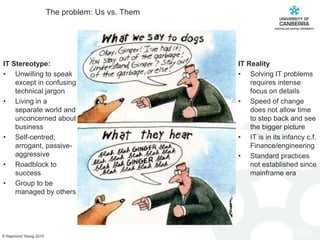
The problem: Us vs. ThemIT Stereotype:Unwilling to speak except in confusing technical jargonLiving in a separate worldand unconcerned about businessSelf-centred, arrogant, passive-aggressiveRoadblock to successGroup to be managed by othersIT RealitySolving IT problems  requires intense focus on detailsSpeed of change does not allow time to step back and see the bigger pictureIT is in its infancy c.f. Finance/engineering Standard practices not established since mainframe era
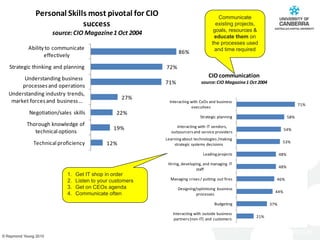
Communicate existing projects, goals, resources & educate them on the processes used and time requiredGet IT shop in orderListen to your customersGet on CEOs agendaCommunicate often
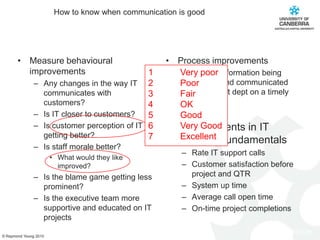
How to know when communication is goodMeasure behavioural improvementsAny changes in the way IT communicates with customers?Is IT closer to customers?Is customer perception of IT getting better?Is staff morale better?What would they like improved?Is the blame game getting less prominent?Is the executive team more supportive and educated on IT projectsProcess improvementsIs good information being created and communicated throughout dept on a timely basisImprovements in IT business fundamentalsRate IT support callsCustomer satisfaction before project and QTRSystem up timeAverage call open timeOn-time project completions
How to know when communication is goodMeasure behavioural improvementsAny changes in the way IT communicates with customers?Is IT closer to customers?Is customer perception of IT getting better?Is staff morale better?What would they like improved?Is the blame game getting less prominent?Is the executive team more supportive and educated on IT projectsProcess improvementsIs good information being created and communicated throughout dept on a timely basisImprovements in IT business fundamentalsRate IT support callsCustomer satisfaction before project and QTRSystem up timeAverage call open timeOn-time project completions1	Very poor2	Poor3	Fair4	OK5	Good6	Very Good7	Excellent
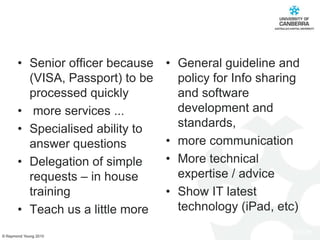
Senior officer because (VISA, Passport) to be processed quickly more services ...Specialised ability to answer questionsDelegation of simple requests – in house trainingTeach us a little moreGeneral guideline and policy for Info sharing and software development and standards, more communicationMore technical expertise / adviceShow IT latest technology (iPad, etc)
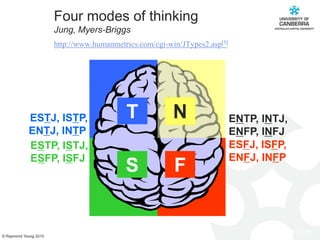
Four modes of thinkingJung, Myers-Briggs http://www.humanmetrics.com/cgi-win/JTypes2.asp[1]TNENTP, INTJ,ENFP, INFJESTJ, ISTP,ENTJ, INTPESFJ, ISFP,ENFJ, INFP ESTP, ISTJ,ESFP, ISFJ FS
Four modes of thinkingBenzigerLogic, ResultsManagementValue: General principlesAttention: operating principles (a) efficient use of resources(b) Decision making(c) Technical problem solvingStructure: ‘sign’ language, analytical, logicalPrefer: half-page summary, verbal debate, verbal fencingVision, CreativityGrowth and AdaptationValue: innovation, amusementAttention: new ideas, abstract patterns, big trendsStructure: internal images, non-verbal, spatial, dynamicPrefer: metaphors or symbolic images or word phrasesIntuition, EmpathyPeace and HarmonyValue: sensitive, nurturingAttention: people,relationships Structure: rhythmical, nonverbal, feelingPrefer: singing, dancing, speaking with eyes and touchingProcess, RoutineBuilding & Maintaining orderly foundationsValue: dependability, timeAttentive to: proceduresStructure: sequential, detailed, proceduralPrefer: forms, check lists
Tips for communicating with your bossFRONTAL  LEFT BOSSESCommunication Don’t take the tone of voice or his order giving personallyRealise he actively dislikes incompetence, inefficiency, redundancy and emotionality. Also keep your personal life out of the workplace.Be brief. Know what you’re going to say before you say it. Stress the key points When requesting something, be specific and state logically its functional valuePrepare handoutsProvide half-page written summaries.Be precise, concise, black and whitePresent material as critical analysis restricting data to key pointsUse precise numbers, percentages and dollar amounts whenever possibleMake sure charts and diagrams are precisely drawnEnsure technical aspects come off without a hitchCite research when making your caseShow how your policy/project will give the organisation or a key person leverage or leverage or surer ROIFRONTAL  RIGHT BOSSESCommunicate ideas in informal, personal conversations (don’t expect him to sit through meetings)Talk more rapidly than you usually doShow how your ideas relate to the cutting edge, the latest research, etc.Show how your ideas parallels theories in other non-related fieldsCreate word pictures when presenting information (remember he’s a highly spatial, visual, pattern-sensitive thinker)Use metaphorsDraw pictures emphasising symbols and shapesBe amused (it will endear you to your boss)In preparing handoutsCite references to link to concepts and ideasHandle all the details and paperwork yourselfWatch to make sure he signs important documentsHelp by:If you are not a strong Frontal left, find a strong Frontal Left to help your boss lobby or negotiate support for your project with managementHandle all personal disputes yourselfDon’t move his stacks or clean up his workspace

Bus2.0 - communication

  • 1.
    Business 2.0 Businessand IT fusion Lecture 3: Communication (with Geeks)Dr Raymond Young (MBA, GAICD) Raymond.young@canberra.edu.au
  • 2.
    The problem: Usvs. ThemIT Stereotype:Unwilling to speak except in confusing technical jargonLiving in a separate worldand unconcerned about businessSelf-centred, arrogant, passive-aggressiveRoadblock to successGroup to be managed by othersIT RealitySolving IT problems requires intense focus on detailsSpeed of change does not allow time to step back and see the bigger pictureIT is in its infancy c.f. Finance/engineering Standard practices not established since mainframe era
  • 3.
    Communicate existing projects,goals, resources & educate them on the processes used and time requiredGet IT shop in orderListen to your customersGet on CEOs agendaCommunicate often
  • 4.
    How to knowwhen communication is goodMeasure behavioural improvementsAny changes in the way IT communicates with customers?Is IT closer to customers?Is customer perception of IT getting better?Is staff morale better?What would they like improved?Is the blame game getting less prominent?Is the executive team more supportive and educated on IT projectsProcess improvementsIs good information being created and communicated throughout dept on a timely basisImprovements in IT business fundamentalsRate IT support callsCustomer satisfaction before project and QTRSystem up timeAverage call open timeOn-time project completions
  • 5.
    How to knowwhen communication is goodMeasure behavioural improvementsAny changes in the way IT communicates with customers?Is IT closer to customers?Is customer perception of IT getting better?Is staff morale better?What would they like improved?Is the blame game getting less prominent?Is the executive team more supportive and educated on IT projectsProcess improvementsIs good information being created and communicated throughout dept on a timely basisImprovements in IT business fundamentalsRate IT support callsCustomer satisfaction before project and QTRSystem up timeAverage call open timeOn-time project completions1 Very poor2 Poor3 Fair4 OK5 Good6 Very Good7 Excellent
  • 6.
    Senior officer because(VISA, Passport) to be processed quickly more services ...Specialised ability to answer questionsDelegation of simple requests – in house trainingTeach us a little moreGeneral guideline and policy for Info sharing and software development and standards, more communicationMore technical expertise / adviceShow IT latest technology (iPad, etc)
  • 7.
    Four modes ofthinkingJung, Myers-Briggs http://www.humanmetrics.com/cgi-win/JTypes2.asp[1]TNENTP, INTJ,ENFP, INFJESTJ, ISTP,ENTJ, INTPESFJ, ISFP,ENFJ, INFP ESTP, ISTJ,ESFP, ISFJ FS
  • 8.
    Four modes ofthinkingBenzigerLogic, ResultsManagementValue: General principlesAttention: operating principles (a) efficient use of resources(b) Decision making(c) Technical problem solvingStructure: ‘sign’ language, analytical, logicalPrefer: half-page summary, verbal debate, verbal fencingVision, CreativityGrowth and AdaptationValue: innovation, amusementAttention: new ideas, abstract patterns, big trendsStructure: internal images, non-verbal, spatial, dynamicPrefer: metaphors or symbolic images or word phrasesIntuition, EmpathyPeace and HarmonyValue: sensitive, nurturingAttention: people,relationships Structure: rhythmical, nonverbal, feelingPrefer: singing, dancing, speaking with eyes and touchingProcess, RoutineBuilding & Maintaining orderly foundationsValue: dependability, timeAttentive to: proceduresStructure: sequential, detailed, proceduralPrefer: forms, check lists
  • 9.
    Tips for communicatingwith your bossFRONTAL LEFT BOSSESCommunication Don’t take the tone of voice or his order giving personallyRealise he actively dislikes incompetence, inefficiency, redundancy and emotionality. Also keep your personal life out of the workplace.Be brief. Know what you’re going to say before you say it. Stress the key points When requesting something, be specific and state logically its functional valuePrepare handoutsProvide half-page written summaries.Be precise, concise, black and whitePresent material as critical analysis restricting data to key pointsUse precise numbers, percentages and dollar amounts whenever possibleMake sure charts and diagrams are precisely drawnEnsure technical aspects come off without a hitchCite research when making your caseShow how your policy/project will give the organisation or a key person leverage or leverage or surer ROIFRONTAL RIGHT BOSSESCommunicate ideas in informal, personal conversations (don’t expect him to sit through meetings)Talk more rapidly than you usually doShow how your ideas relate to the cutting edge, the latest research, etc.Show how your ideas parallels theories in other non-related fieldsCreate word pictures when presenting information (remember he’s a highly spatial, visual, pattern-sensitive thinker)Use metaphorsDraw pictures emphasising symbols and shapesBe amused (it will endear you to your boss)In preparing handoutsCite references to link to concepts and ideasHandle all the details and paperwork yourselfWatch to make sure he signs important documentsHelp by:If you are not a strong Frontal left, find a strong Frontal Left to help your boss lobby or negotiate support for your project with managementHandle all personal disputes yourselfDon’t move his stacks or clean up his workspace