COMPUTER SYSTEM
SERVICING NCII
TESDA- TECHNICAL EDUCATION AND
SKILLS DEVELOPMENT AUTHORITY
MMTSI-Marinduque Manpower
and Trade Skills Institute Inc.
What to Bring:
1. Facemask/
2. Notebook/paper
3. Pen
4. Computer(optional)
PROPER ONLINE ETIQUETTE
1. Be respectful
2. Be on time
3. Mute your microphone when you are not speaking
4. Listen attentively
5. Avoid sending irrelevant messages
6. Be aware of strong language, exclamation points
and capslock
7. Don’t post or share inappropriate material
8. Be forgiving
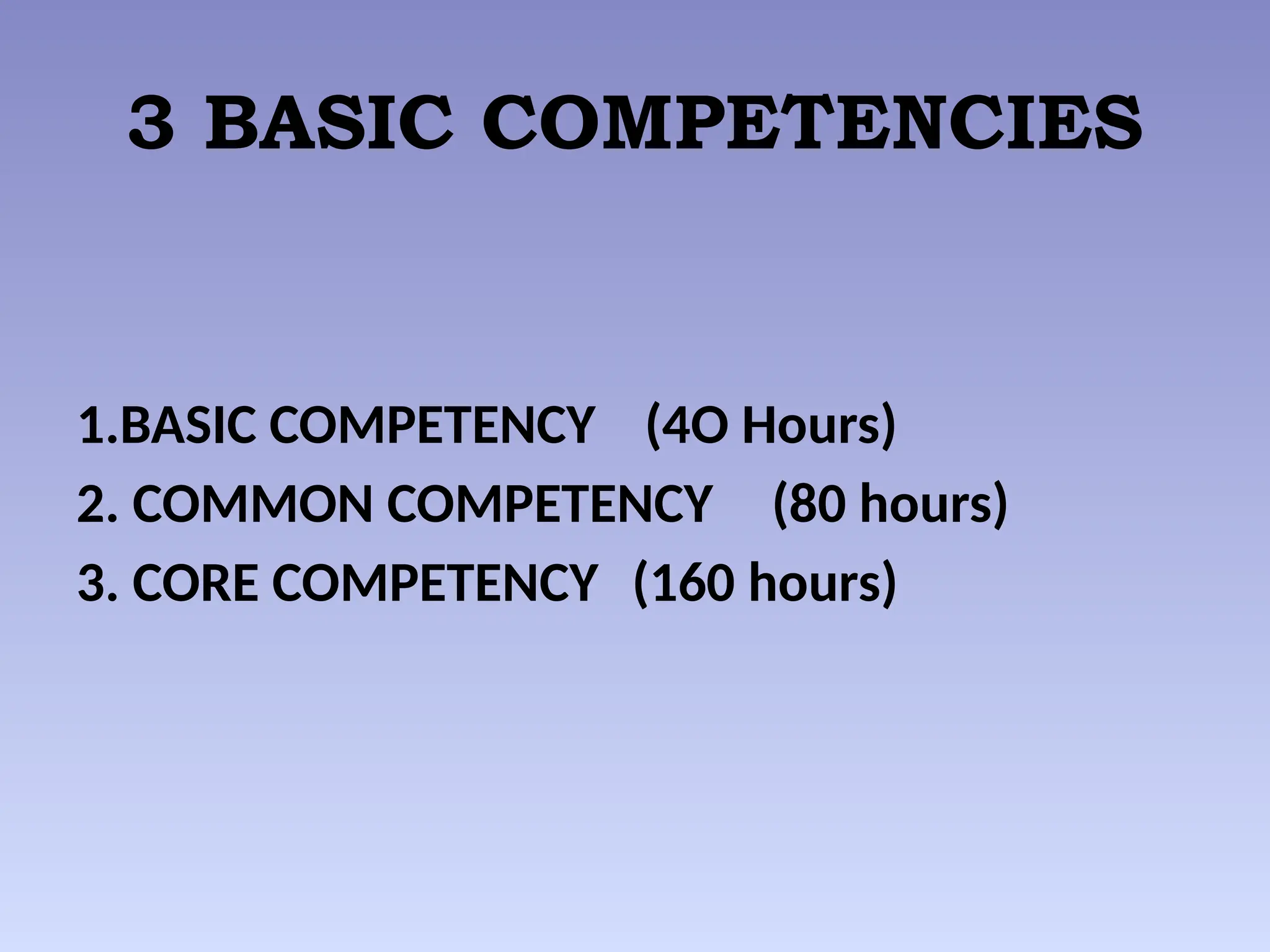
3 BASIC COMPETENCIES
1.BASIC COMPETENCY (4O Hours)
2. COMMON COMPETENCY (80 hours)
3. CORE COMPETENCY (160 hours)
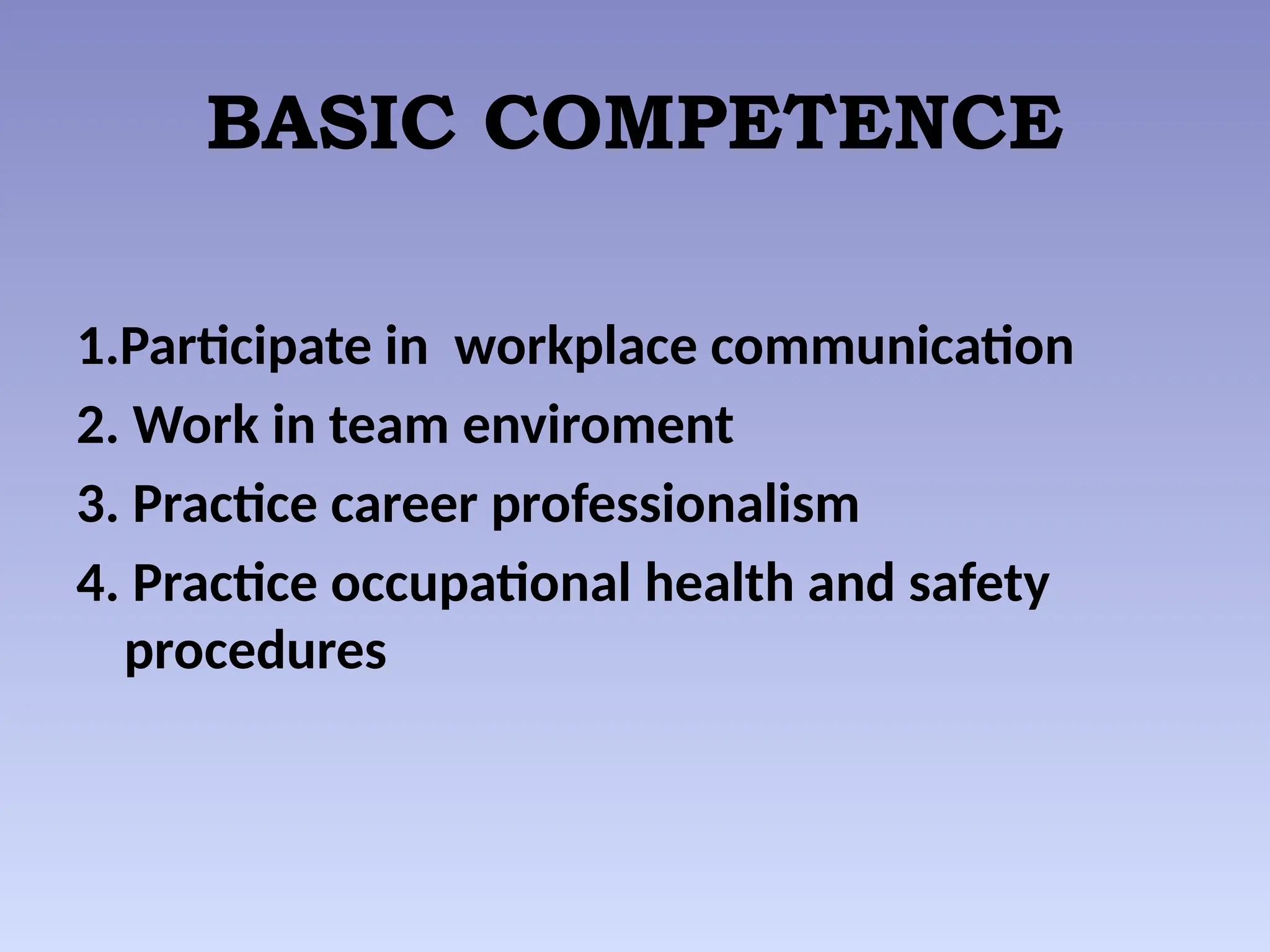
BASIC COMPETENCE
1.Participate in workplace communication
2. Work in team enviroment
3. Practice career professionalism
4. Practice occupational health and safety
procedures
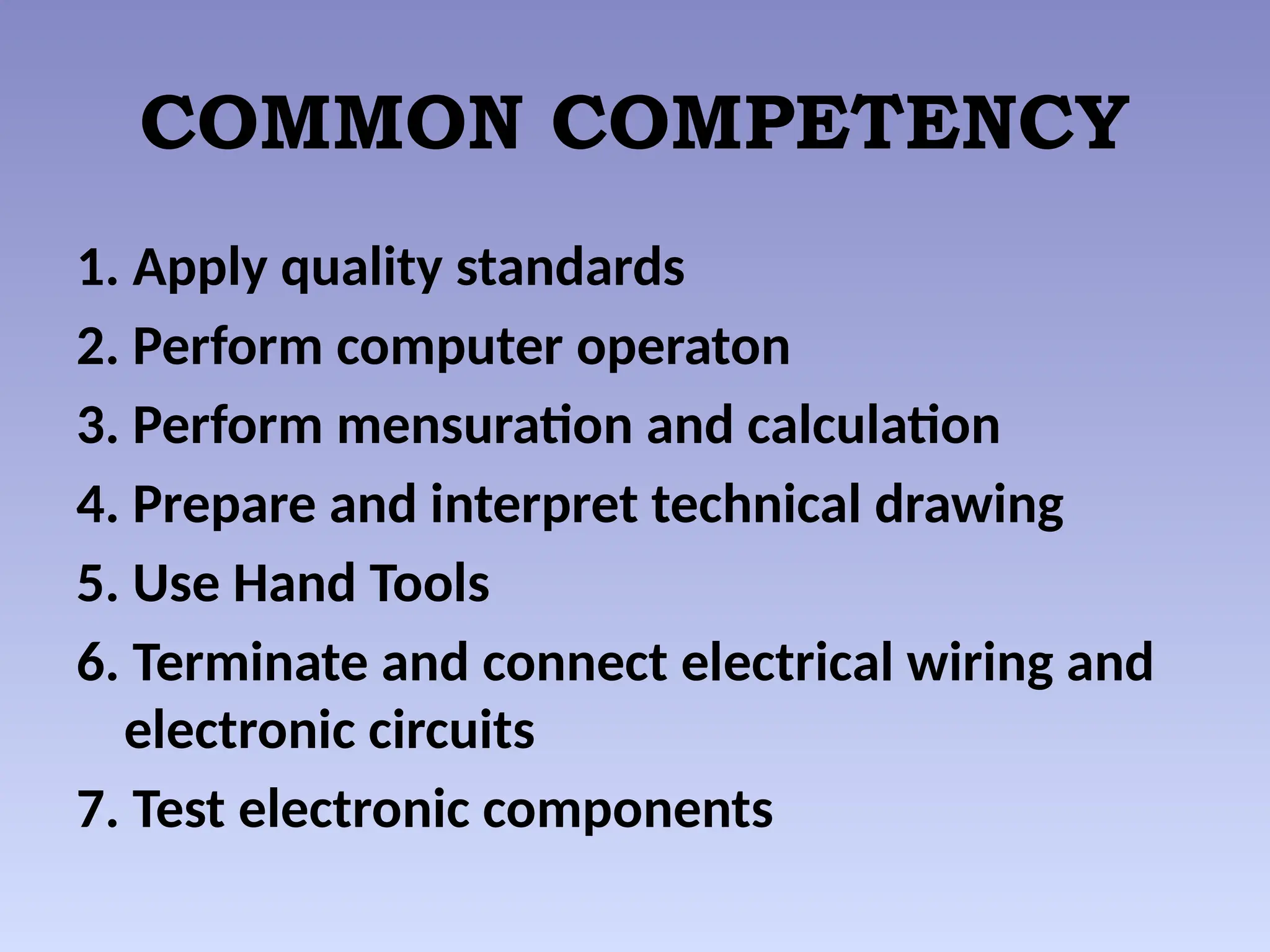
COMMON COMPETENCY
1. Apply quality standards
2. Perform computer operaton
3. Perform mensuration and calculation
4. Prepare and interpret technical drawing
5. Use Hand Tools
6. Terminate and connect electrical wiring and
electronic circuits
7. Test electronic components
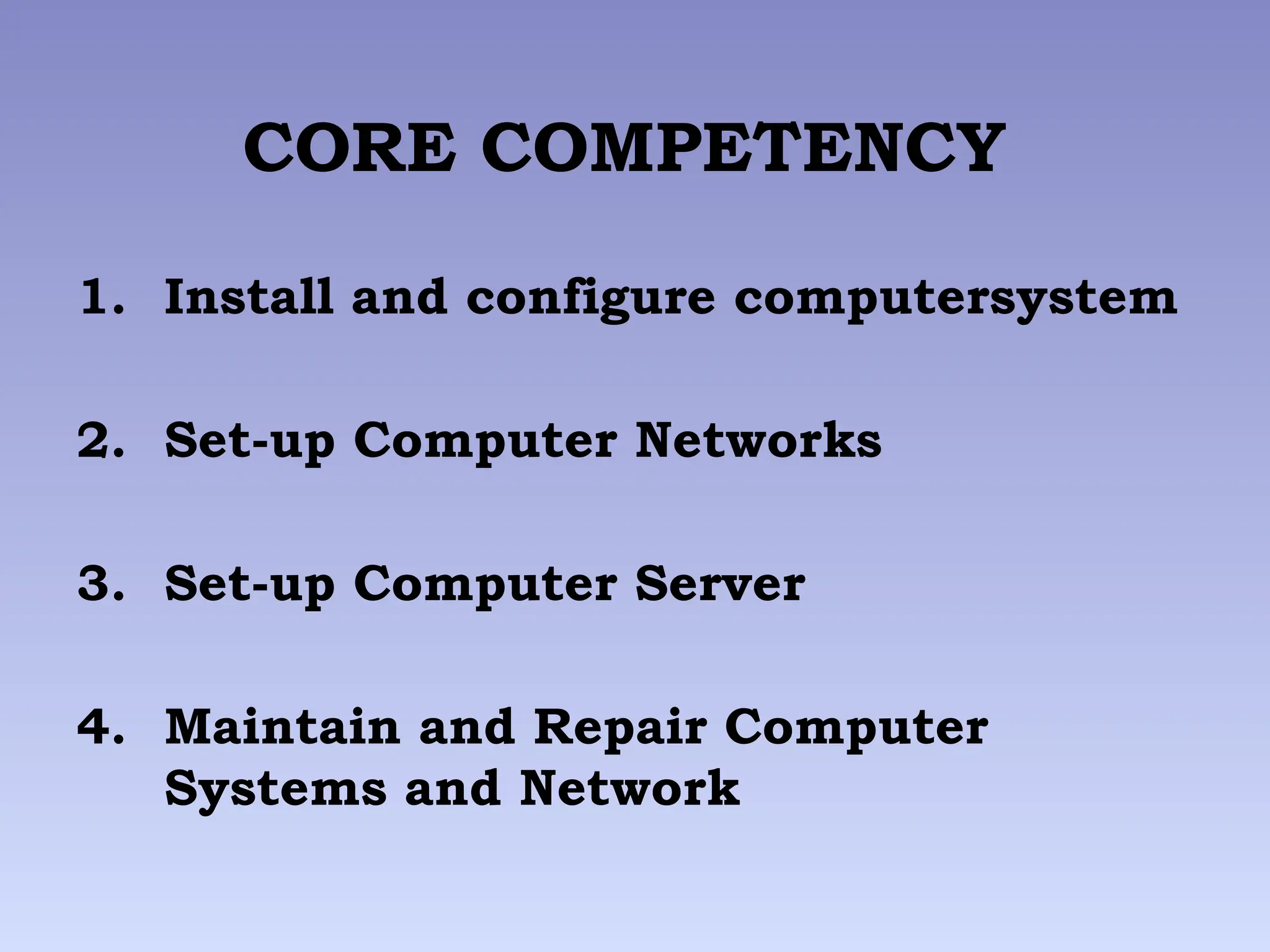
CORE COMPETENCY
1. Install and configure computersystem
2. Set-up Computer Networks
3. Set-up Computer Server
4. Maintain and Repair Computer
Systems and Network
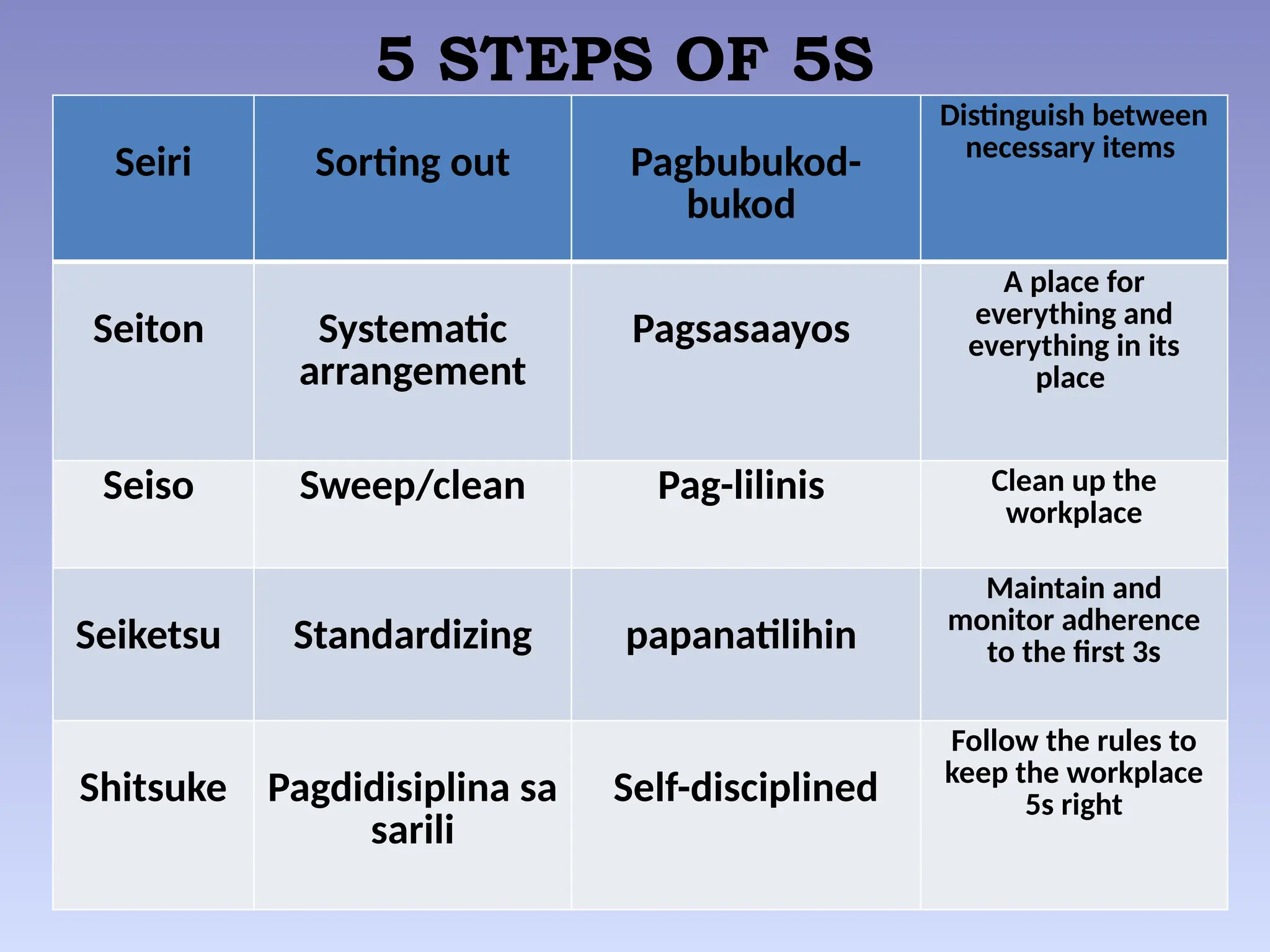
5 STEPS OF 5S
Seiri Sorting out Pagbubukod-
bukod
Distinguish between
necessary items
Seiton Systematic
arrangement
Pagsasaayos
A place for
everything and
everything in its
place
Seiso Sweep/clean Pag-lilinis Clean up the
workplace
Seiketsu Standardizing papanatilihin
Maintain and
monitor adherence
to the first 3s
Shitsuke Pagdidisiplina sa
sarili
Self-disciplined
Follow the rules to
keep the workplace
5s right
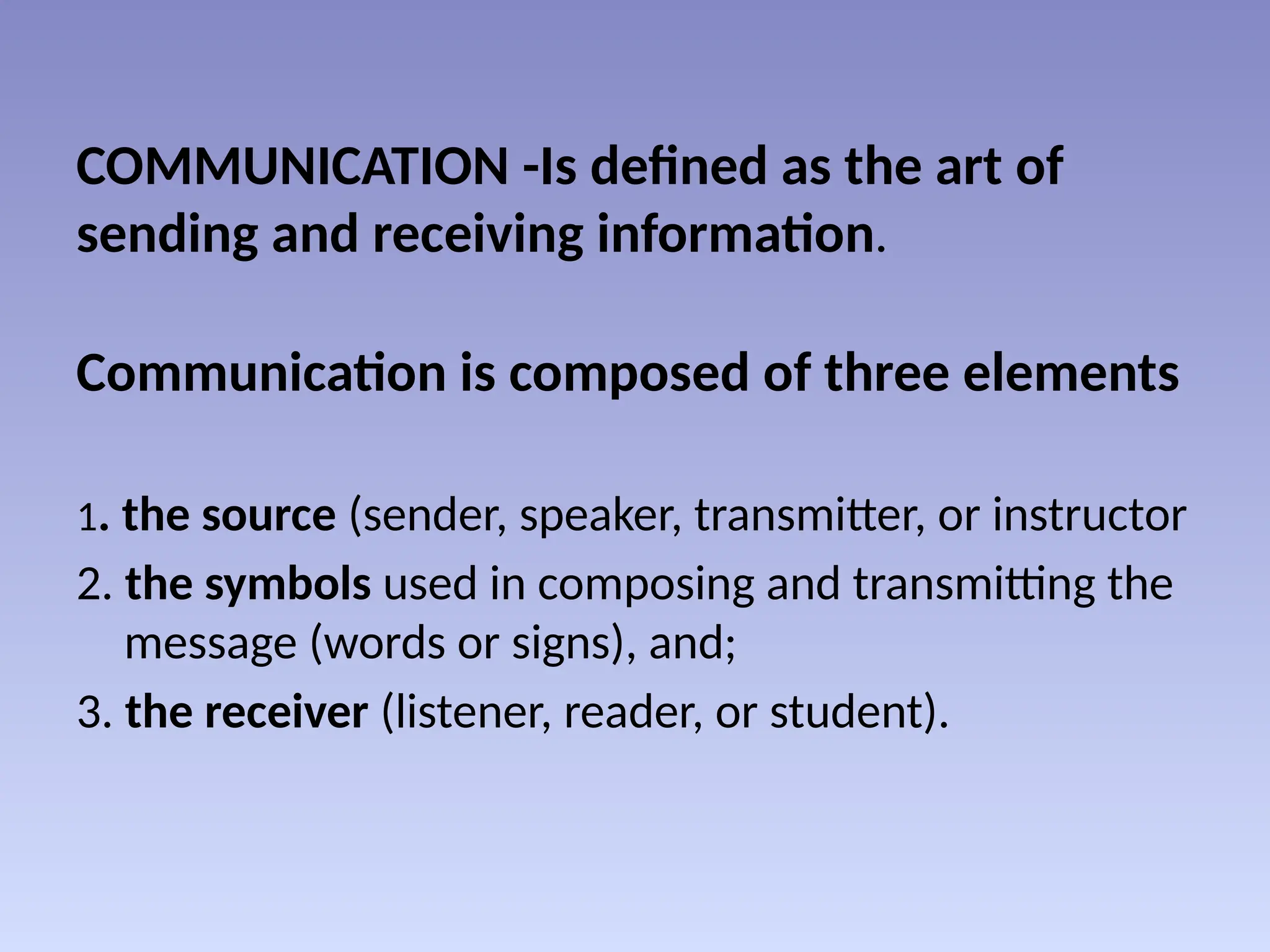
COMMUNICATION -Is defined as the art of
sending and receiving information.
Communication is composed of three elements
1. the source (sender, speaker, transmitter, or instructor
2. the symbols used in composing and transmitting the
message (words or signs), and;
3. the receiver (listener, reader, or student).
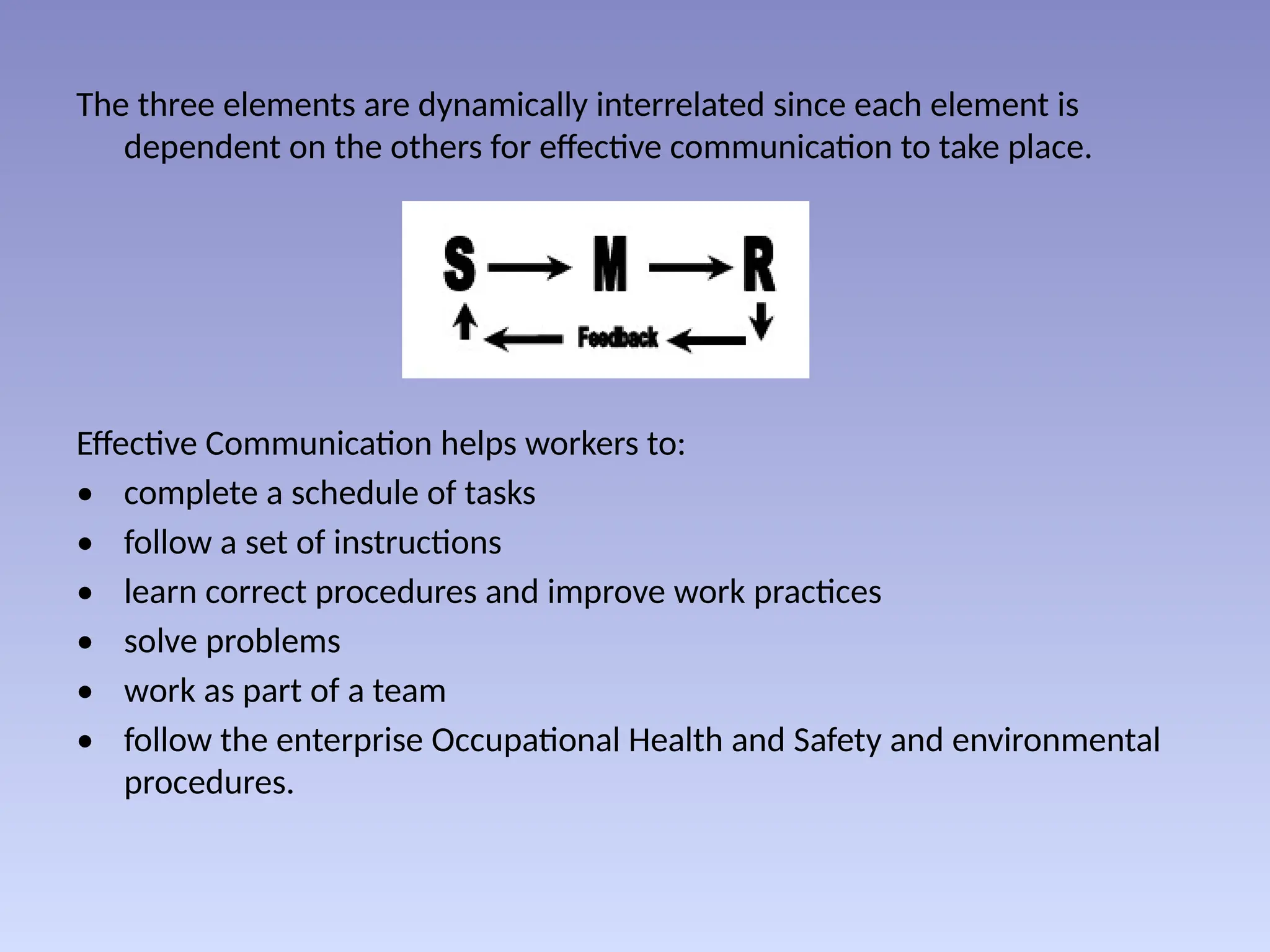
The three elements are dynamically interrelated since each element is
dependent on the others for effective communication to take place.
Effective Communication helps workers to:
• complete a schedule of tasks
• follow a set of instructions
• learn correct procedures and improve work practices
• solve problems
• work as part of a team
• follow the enterprise Occupational Health and Safety and environmental
procedures.
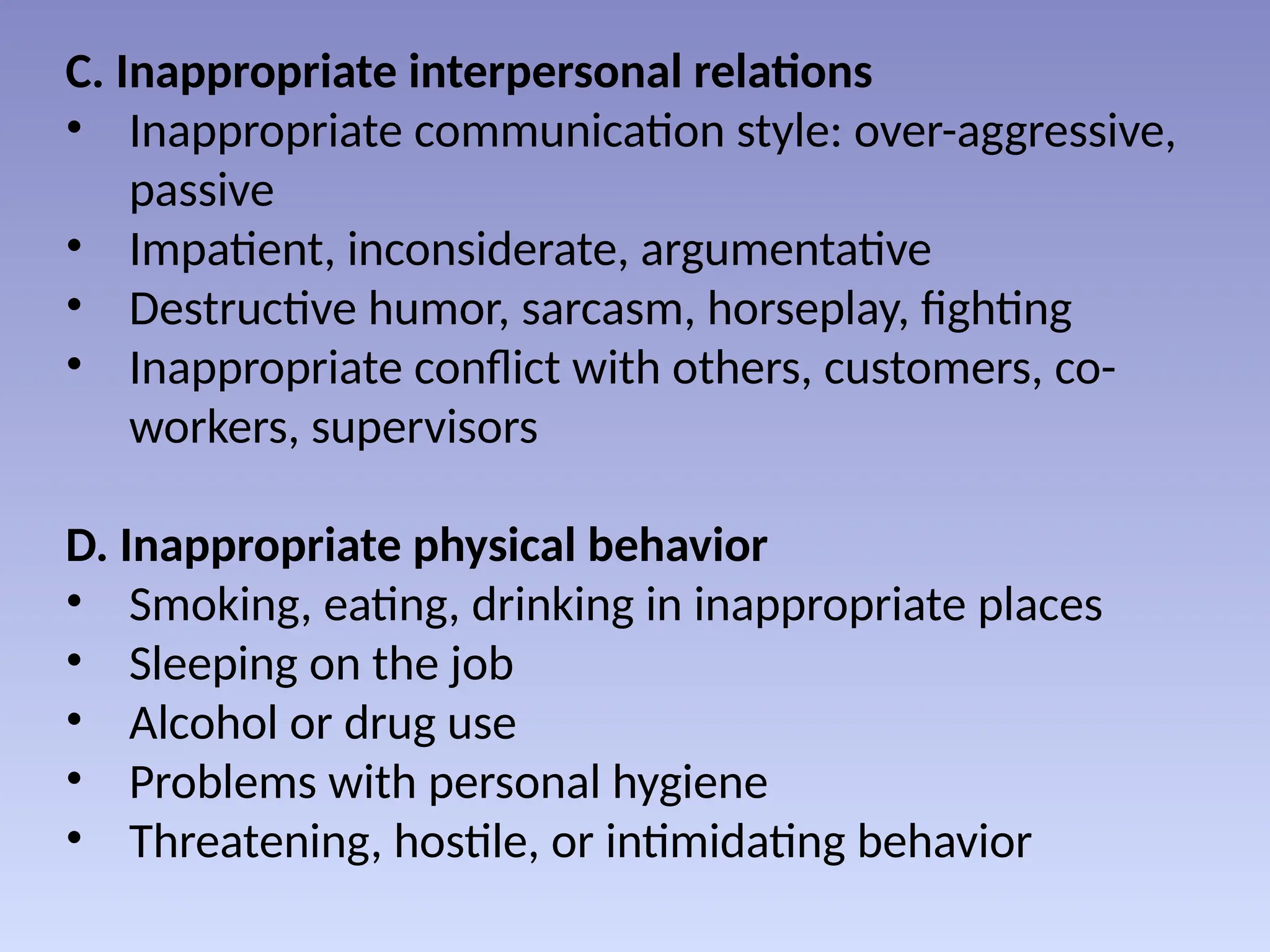
C. Inappropriate interpersonal relations
• Inappropriate communication style: over-aggressive,
passive
• Impatient, inconsiderate, argumentative
• Destructive humor, sarcasm, horseplay, fighting
• Inappropriate conflict with others, customers, co-
workers, supervisors
D. Inappropriate physical behavior
• Smoking, eating, drinking in inappropriate places
• Sleeping on the job
• Alcohol or drug use
• Problems with personal hygiene
• Threatening, hostile, or intimidating behavior
Effective Communication helps workers to:
• complete a schedule of tasks
• follow a set of instructions
• learn correct procedures and improve
work practices
• solve problems
• work as part of a team
• follow the enterprise Occupational Health
and Safety and environmental procedures.
There are three main modes of
communication:
1. Verbal communication
2. Non-verbal communication
3. Written communication
Verbal Communication
In industries a large proportion of
communication is verbal or spoken. This may
occur face-to-face or via telephones or two-way
radios. For verbal communication to be effective
both the speaker and the listener need to be
actively engaged in the conversation.
The speaker should be clear, concise,
and courteous and use a style of language that is
appropriate to the situation and the audience
The listener should give the
speaker their full attention and be sure that
they clearly understand the message being
conveyed.
Questions should be asked by the
listener to clarify the meaning and by the
speaker to ensure that the information has
been fully understood. There are three types
of questions:
• Closed questions are used to obtain a particular piece of
information. They are usually answered with a yes or no or with
a limited response. For example:
– Have you driven a four-wheel drive tractor before?
• Open questions encourage people to discuss a situation and
share information. They often require longer answers and begin
with how, where, when, which, who, why or what. For example:
– What types of tractors have you driven?
• Reflective questions, also called mirror questions, are used to
show the speaker that you have been actively listening to them.
They are also helpful when encouraging a person to express
their opinions clearly. For example:
– So, you’ve driven this type of tractor before?
– You’ve found this type of tractor to run reliably, haven’t you?
There are a number of barriers that reduce the
effectiveness of verbal communication. These
include:
– inappropriate choice of language style
– inappropriate body language
– disruptions
– noise in the proximity and/or a poor signal
– relevance of the topic to the listener
– Assumptions made by both the speaker and
listener.
Non-verbal communication
A significant aspect of face-to-face
communication is non-verbal body language. This
includes body posture, arm and hand positions, facial
expressions, and eye-contact and hand gestures.
Sometimes a conflicting message may be given because
the words spoken do not match a speaker’s body
language.
WRITTEN COMMUNICATION
Companies/ enterprises often require workers to use written forms of
communication. This may involve reading workplace notices and instruction
such as:
• signs and labels
• notes, messages and memos
• rosters and work schedules
• safety material and notices
• invoices and dockets with customer information
• tables and simple graphs.
Thank you
WORK IN A TEAM ENVIRONMENT
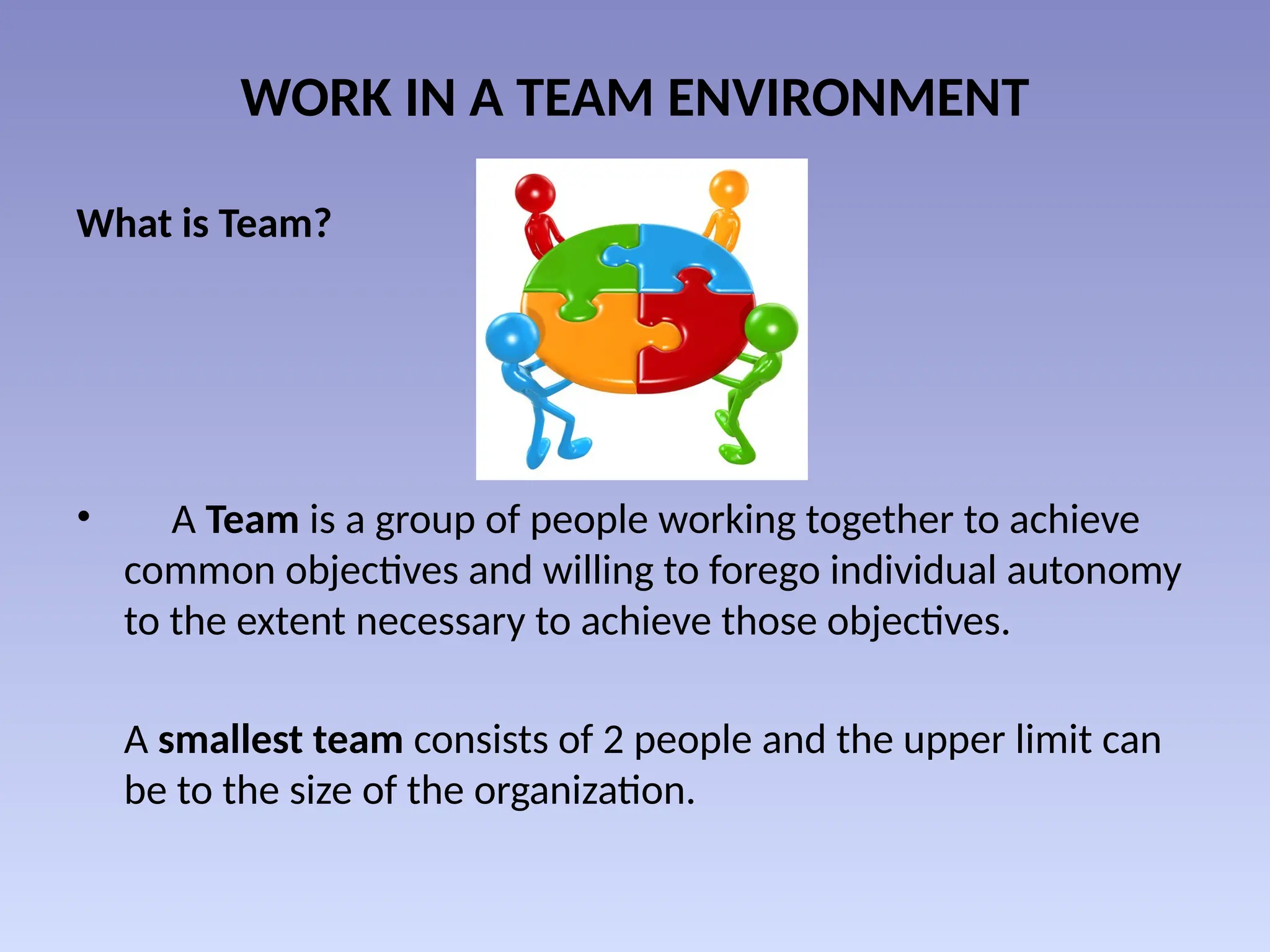
What is Team?
• A Team is a group of people working together to achieve
common objectives and willing to forego individual autonomy
to the extent necessary to achieve those objectives.
A smallest team consists of 2 people and the upper limit can
be to the size of the organization.
Skills needed for teamwork
Aside from any required technical proficiency, a wide variety of social skills are desirable for
successful teamwork, including:
• Listening - it is important to listen to other people's ideas. When people are allowed to
freely express their ideas, these initial ideas will produce other ideas.
• Questioning - it is important to ask questions, interact, and discuss the objectives of the
team.
• Persuading - individuals are encouraged to exchange, defend, and then to ultimately
rethink their ideas.
• Respecting - it is important to treat others with respect and to support their ideas.
• Helping - it is crucial to help one's coworkers, which is the general theme of teamwork.
• Sharing - it is important to share with the team to create an environment of teamwork.
• Participating - all members of the team are encouraged to participate in the team.
• Communication - For a team to work effectively it is essential team members acquire
communication skills and use effective communication channels between one another
e.g. using email, viral communication, group meetings and so on. This will enable team
members of the group to work together and achieve the teams purpose and goals.
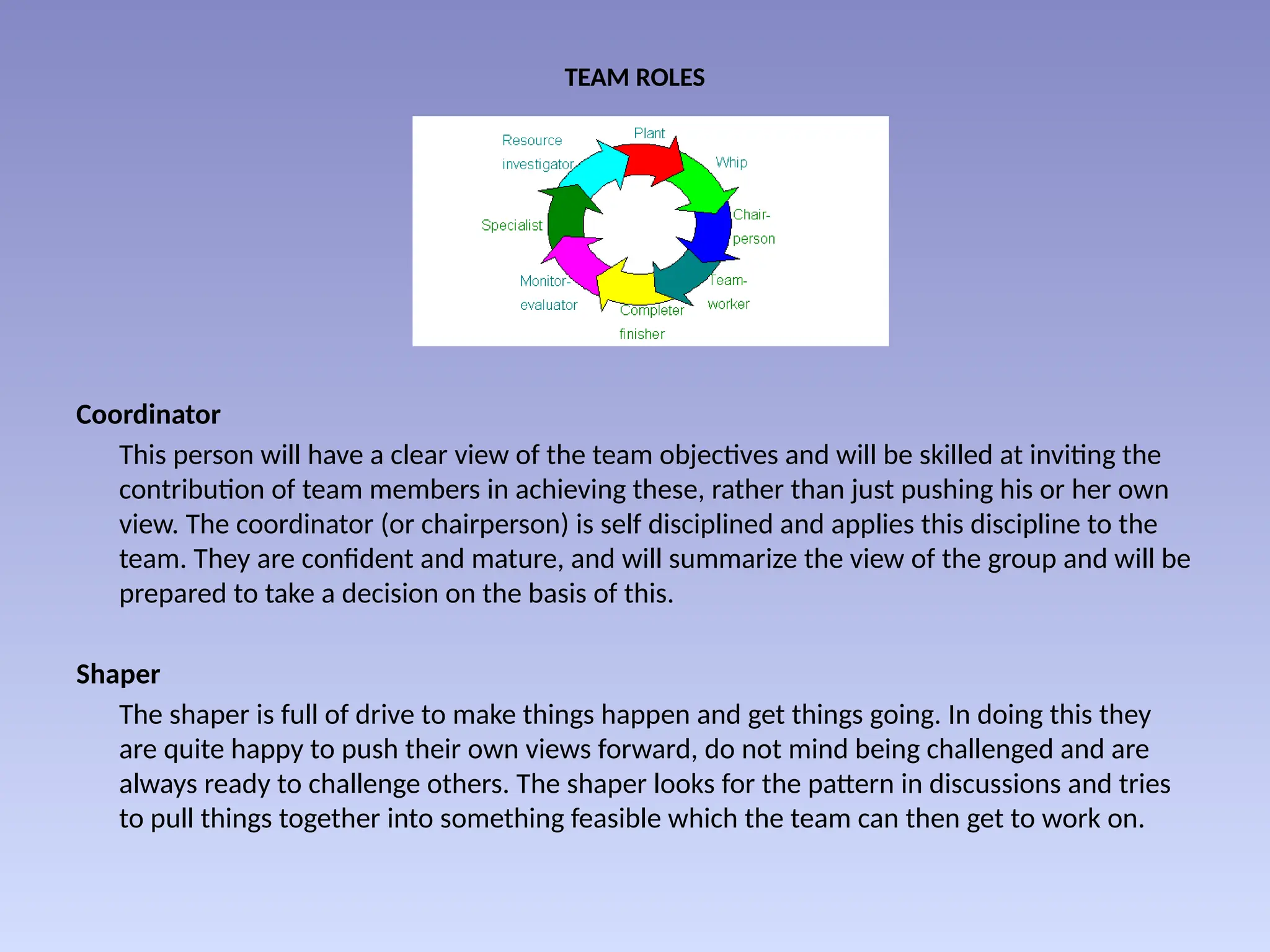
TEAM ROLES
Coordinator
This person will have a clear view of the team objectives and will be skilled at inviting the
contribution of team members in achieving these, rather than just pushing his or her own
view. The coordinator (or chairperson) is self disciplined and applies this discipline to the
team. They are confident and mature, and will summarize the view of the group and will be
prepared to take a decision on the basis of this.
Shaper
The shaper is full of drive to make things happen and get things going. In doing this they
are quite happy to push their own views forward, do not mind being challenged and are
always ready to challenge others. The shaper looks for the pattern in discussions and tries
to pull things together into something feasible which the team can then get to work on.
Plant
• This member is the one who is most likely to come out with original ideas and challenge
the traditional way of thinking about things. Sometimes they become so imaginative and
creative that the team cannot see the relevance of what they are saying. However,
without the plant to scatter the seeds of new ideas the team will often find it difficult to
make any headway. The plant’s strength is in providing major new insights and ideas for
changes in direction and not in contributing to the detail of what needs to be done.
Resource investigator
• The resource investigator is the group member with the strongest contacts and
networks, and is excellent at bringing in information and support from the outside. This
member can be very enthusiastic in pursuit of the team’s goals, but cannot always
sustain this enthusiasm.
Implementer
• The individual who is a company worker is well organised and effective at turning big
ideas into manageable tasks and plans that can be achieved. Such individuals are both
logical and disciplined in their approach. They are hardworking and methodical but may
have some difficulty in being flexible.
Team worker
• The team worker is the one who is most aware of the others in the team, their
needs and their concerns. They are sensitive and supportive of other people’s
efforts, and try to promote harmony and reduce conflict. Team workers are
particularly important when the team is experiencing a stressful or difficult
period.
Completer
• As the title suggests, the completer is the one who drives the deadlines and
makes sure they are achieved. The completer usually communicates a sense of
urgency which galvanises other team members into action. They are
conscientious and effective at checking the details, which is a vital contribution,
but sometimes get ‘bogged down’ in them.
Monitor evaluator
• The monitor evaluator is good at seeing all the options. They have a strategic
perspective and can judge situations accurately. The monitor evaluator can be
overcritical and is not usually good at inspiring and encouraging others.
Specialist
• This person provides specialist skills and
knowledge and has a dedicated and single-
minded approach. They can adopt a very
narrow perspective and sometimes fail to see
the whole picture.
Finisher
• A person who sticks to deadline and likes to
get on with things, Will probably be irritated
by the more relaxed member of the team.
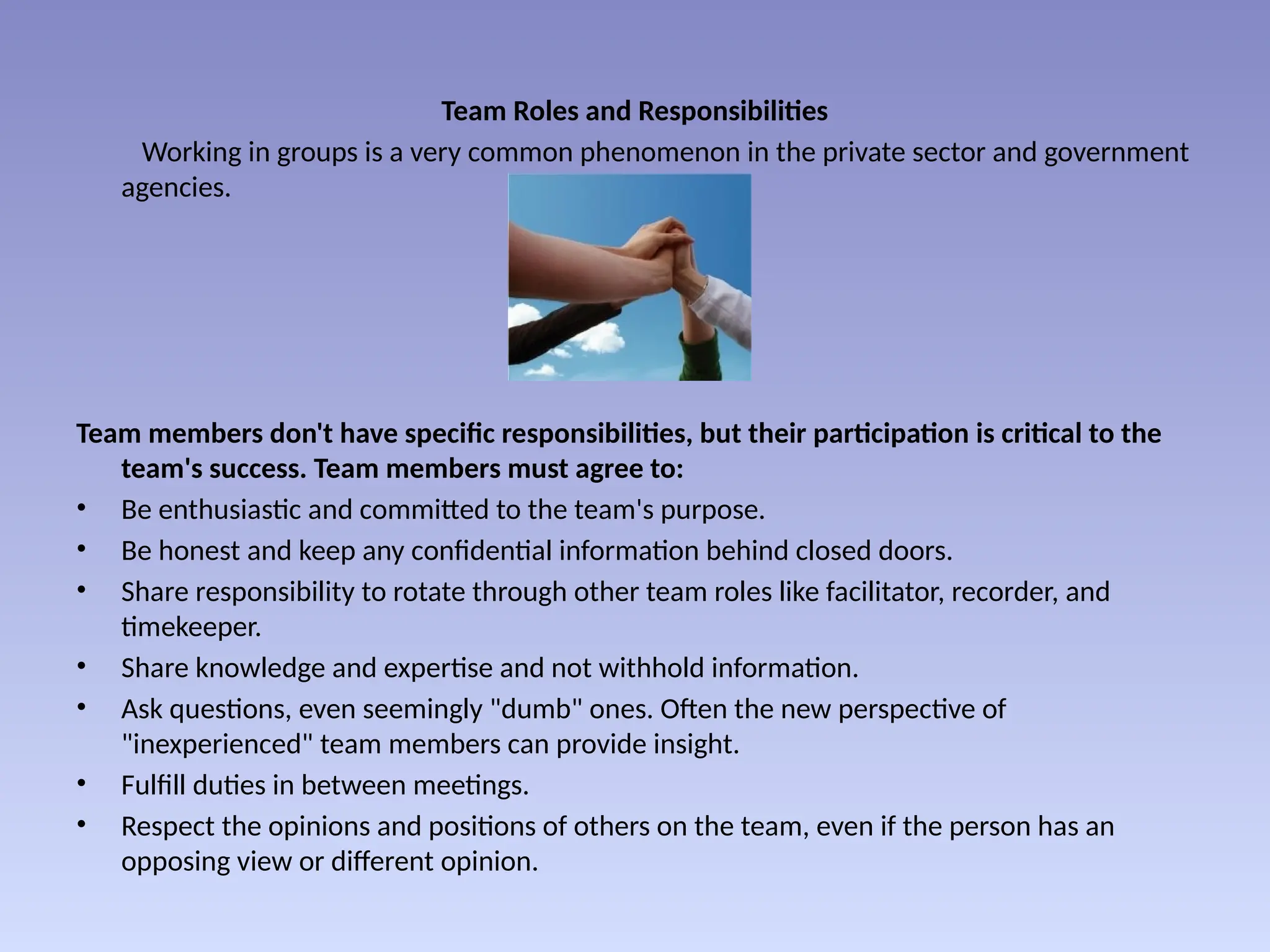
Team Roles and Responsibilities
Working in groups is a very common phenomenon in the private sector and government
agencies.
Team members don't have specific responsibilities, but their participation is critical to the
team's success. Team members must agree to:
• Be enthusiastic and committed to the team's purpose.
• Be honest and keep any confidential information behind closed doors.
• Share responsibility to rotate through other team roles like facilitator, recorder, and
timekeeper.
• Share knowledge and expertise and not withhold information.
• Ask questions, even seemingly "dumb" ones. Often the new perspective of
"inexperienced" team members can provide insight.
• Fulfill duties in between meetings.
• Respect the opinions and positions of others on the team, even if the person has an
opposing view or different opinion.
Being a professional does not only require mastery of knowledge and skills with
respect to a certain profession, or of passing a professional or career exams or
earning degree. It is a character that demonstrates certain qualities and attitudes
and a commitment to professional ethics.
The three Dimensions of Professionalism
A. Physical projection – this includes:
Proper Grooming – clean cut, no body odor, clean fingernails, well pressed
uniform etc.
Good posture – straight body, no hands on pocket, relaxed
Natural smile
Eye contact but not an sneering look
Absence of unpleasant mannerism like scratching hair, biting nails, etc.
Pleasant disposition
Oral hygiene, no bad breadth
Appropriate make up for women
B. Verbal projection
Being careful with tone, pitch and body language tone must be warm
Well-modulated voice Speaking with authority- ability to explain and
justify ideas, readiness to answer questions. This gives an impression
that one knows what he is talking about. Tactfulness- saying the right
things on the right time and in the right place. Assertiveness in
expressing oneself- sensitivity to the feelings of others
C. Behavior and Performance
Adherence to professional/industry standards of service
Compliance to standard operating procedure
Assertive behavior
Adherence to work ethics and respect for protocol
Being discreet with confidential matters
Practice of social graces, proper table manners, telephone courtesy
Appropriate behavior in public
Employees may also be required to write down information, messages and material
and tool requirements. They will need to fill out a variety of workplace forms.
To be effective, written workplace information must be:
1. Clear – the handwriting must be legible and the information written in a manner
that will not be confusing.
2. Concise – the message should be written in simple language using short sentences
or point form. Unnecessary information and repetition should be avoided.
3. Correct – accuracy is very important when writing down information. If taking a
phone message, read the details back to the caller, especially names, addresses and
phone numbers. Use correct terminology where appropriate.
4. Courteous – as with verbal communication, the style of the language chosen should
be appropriate to the situation and the reader.
Demonstrate work values
Being a professional does not only require mastery of knowledge and skills with
respect to a certain profession, or of passing a professional or career exams or earning
degree. It is a character that demonstrates certain qualities and attitudes and a commitment
to professional ethics.
The three Dimensions of Professionalism
A. Physical projection – this includes:
Proper Grooming – clean cut, no body odor, clean fingernails, well pressed
uniform etc.
Good posture – straight body, no hands on pocket, relaxed
Natural smile
Eye contact but not an sneering look
Absence of unpleasant mannerism like scratching hair, biting nails, etc.
Pleasant disposition
Oral hygiene, no bad breadth
Appropriate make up for women
B. Verbal projection
Being careful with tone, pitch and body language tone must be warm Well-
modulated voice
Speaking with authority- ability to explain and justify ideas,
readiness to answer questions. This gives an impression that one
knows what he is talking about. Tactfulness- saying the right things
on the right time and in the right place. Assertiveness in
expressing oneself- sensitivity to the feelings of others
C. Behavior and Performance
Adherence to professional/industry standards of service
Compliance to standard operating procedure
Assertive behavior
Adherence to work ethics and respect for protocol
Being discreet with confidential matters
Practice of social graces, proper table manners, telephone courtesy
Appropriate behavior in public
Professionalism means avoiding bad habits at work like:
• Yawning
• Grouping together with other staff for a chat while on duty
• Shouting, giggling, loud conversation
• Daydreaming, eavesdropping
• Indulging in customer’s private conversations
• Putting hands on pocket and playing with pocket coin
• Leaning on walls, tables and chairs
• Sneering or staring look
• Chewing gum while on duty or while talking to customers • Suggesting or demanding for a
tip
• Counting tips in view of customers
• Too much familiarity with the customers
• Bluffing customers
• Reading newspapers/ magazines while on duty
• Use of rude and insulting language
• Pointing at something or someone with a finger
• Interrupting customers conversation unless for valid reasons
• Leaving one’s station longer than necessary
Thank You
Practice Career Professionalism
What is personality?
Personality is the sum total of the biological, psychological, socio cultural and other
traits of a person, manifested in the way he thinks, feels, acts and relates with others.
Determinants of Personality
Behavioral experts agree that personality is a product of nature and nurture, an
integration of his biological and social heritage. What a person thinks does and feels
as a child, adolescent or adult results from the inter relationship that exist between
biologically inherited factors and environmental influences.
Heredity
Genes transmitted by parents determine a person physical and biological
characteristic such as physical stature, color of the skin and hair.Some individuals excel
in physical qualities, others are physically handicapped like the dumb, blind, deaf and
austistic persons. However, it does not follow that a person with biological or physical
deficiency is also handicapped from developing a good or pleasing personality.
The Social Environment
The social environment consists of individuals, groups and institutions
with whom the person interacts with from childhood to adulthood.
Socialization is a process where a person acquires, learns and internalizes a
set of beliefs, ideas, values, attitudes and other socio-cultural characteristic.
Personal growth and Stages of Development:
The process of development takes place in four stages:
Stage 1 – Understanding an Ideal
At this stage, the person is exposed to learning situations where he
discovers an ideal- the ideal personality, qualities of a winning personality,
the elements and conditions for growth and development . He is also able to
differentiate functional vs. dysfunctional behavior and their damage
consequences. These knowledge provide the framework for understanding
his behavior and personality.
Stage 2 – Self awareness
After discovering the ideal, the person goes into self mirroring.
He looks into his personal qualities, behavior and compares this
against the ideal. He discovers his dysfunctional behavior and how
it has affected his success, happiness and relationships with others.
Stage 3 - Self Realization
As the individual becomes aware of his behavior, he is guided on
how to understand himself by bringing into his consciousness the
things in the past and other realities that have directly or indirectly
conditioned his present behavior or maladjustment. Among these
are the distorted beliefs and values that he may have internalized.
He is also made to realize how his behavior has hampered his
growth and development as well as his happiness.
Stage 4 – Decision to change
With self realization the individual makes a decision
to change. If one is determined to grow as a person, he
has to decide to change.
Stage 5- Actualizing the change
In his decision to grow and develop, the individual
now puts into action the necessary changes in his life
including a change in attitude, re- alignment of his
value system and behavioral change.
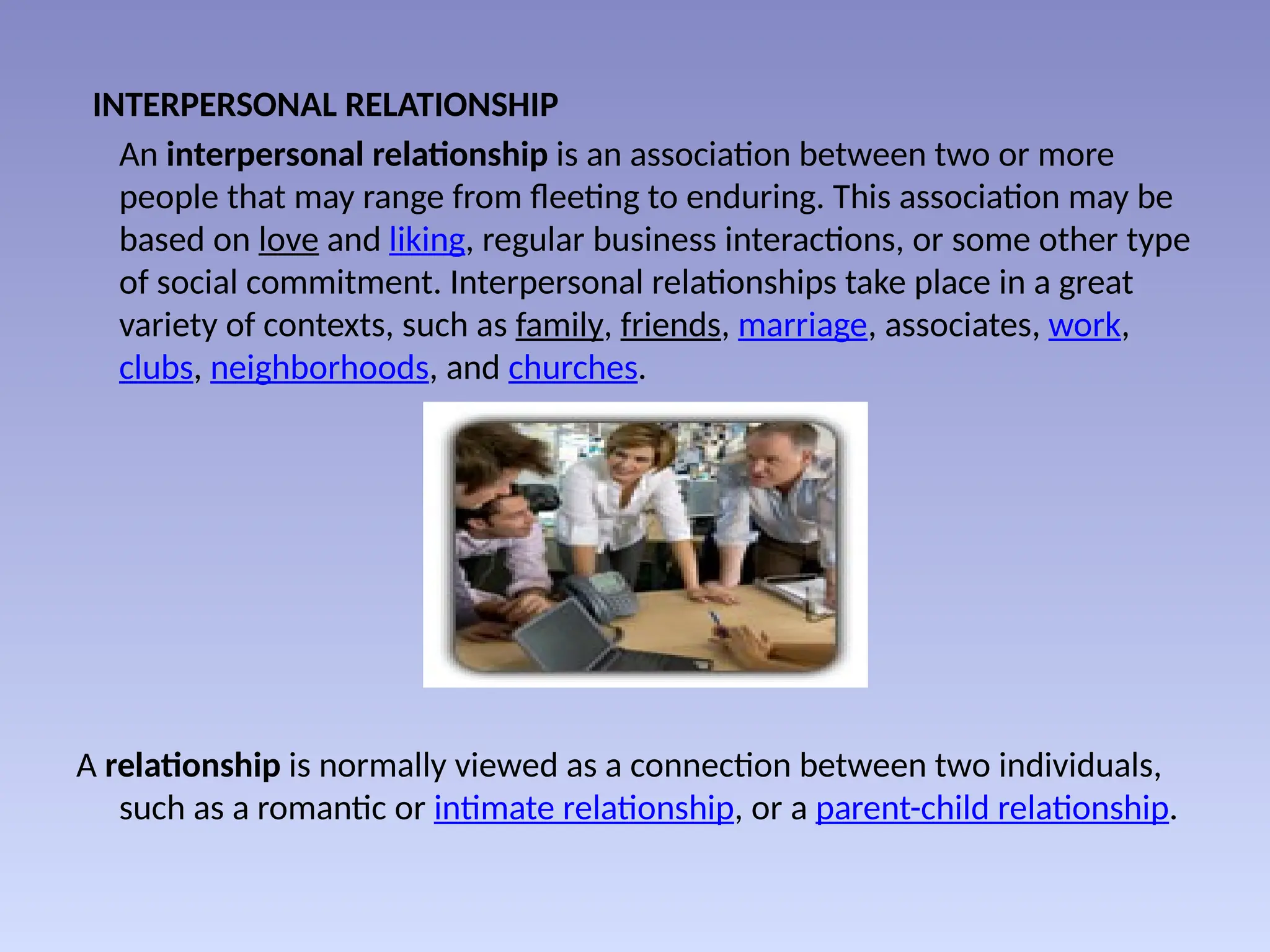
INTERPERSONAL RELATIONSHIP
An interpersonal relationship is an association between two or more
people that may range from fleeting to enduring. This association may be
based on love and liking, regular business interactions, or some other type
of social commitment. Interpersonal relationships take place in a great
variety of contexts, such as family, friends, marriage, associates, work,
clubs, neighborhoods, and churches.
A relationship is normally viewed as a connection between two individuals,
such as a romantic or intimate relationship, or a parent-child relationship.
Types of Interpersonal Relationships
relationships are important for emotional wellbeing throughout the
lifespan.
• The natural development of a relationship follows five stages:
Acquaintance - Becoming acquainted depends on previous
relationships, physical proximity, first impressions, and a variety of
other factors. If two people begin to like each other, continued
interactions may lead to the next stage, but acquaintance can
continue indefinitely.
Buildup - During this stage, people begin to trust and care about
each other. The need for compatibility and such filtering agents as
common background and goals will influence whether or not
interaction continues.
Continuation - This stage follows a mutual commitment to a
long term friendship, romantic relationship, or marriage. It is
generally a long, relative stable period. Nevertheless,
continued growth and development will occur during this
time. Mutual trust is important for sustaining the relationship.
Deterioration - Not all relationships deteriorate, but those
that do, tend to show signs of trouble. Boredom, resentment,
and dissatisfaction may occur, and individuals may
communicate less and avoid self-disclosure. Loss of trust and
betrayals may take place as the downward spiral continues.
Termination - The final stage marks the end of the
relationship, either by death in the case of a healthy
relationship, or by separation.
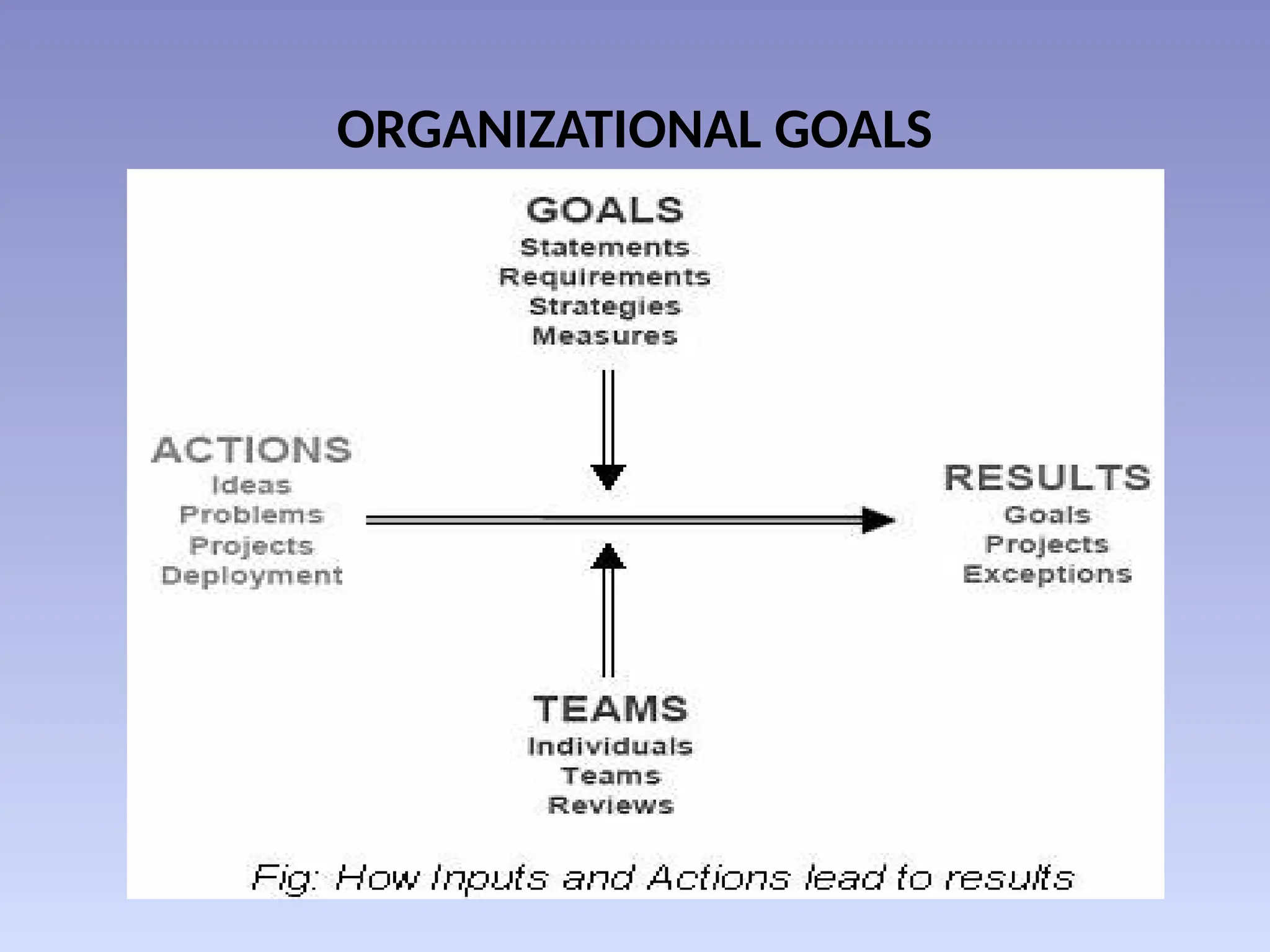
ORGANIZATIONAL GOALS
TYPES OF GOALS:
Part of the reason why goal setting fails is that people don’t understand the different
types of goals and how to treat them. Goals may involve:
• Developing a new skill or improving current skills.
• Beating old habits, or developing better ones.
• Producing an outcome, achieving a dream.
The way each of these types of goals are treated is different – some are short term,
others are medium to long term, some have a clear direction to achieve them, others
may have a more torturous path, and some are naturally easier than others to achieve.
Goals can also be:
Big-picture goals – your end destination as defined by the ‘Big-Picture 'Statements for
your various life aspects. These goals are typically not achievable in one simple step –
there is a journey to be taken to get there.
Milestone Goals – these are the series of goals that will take you to your destination.
Mini Goals – milestone goals may need to be broken down into bite-size chunks to make
them more manageable.
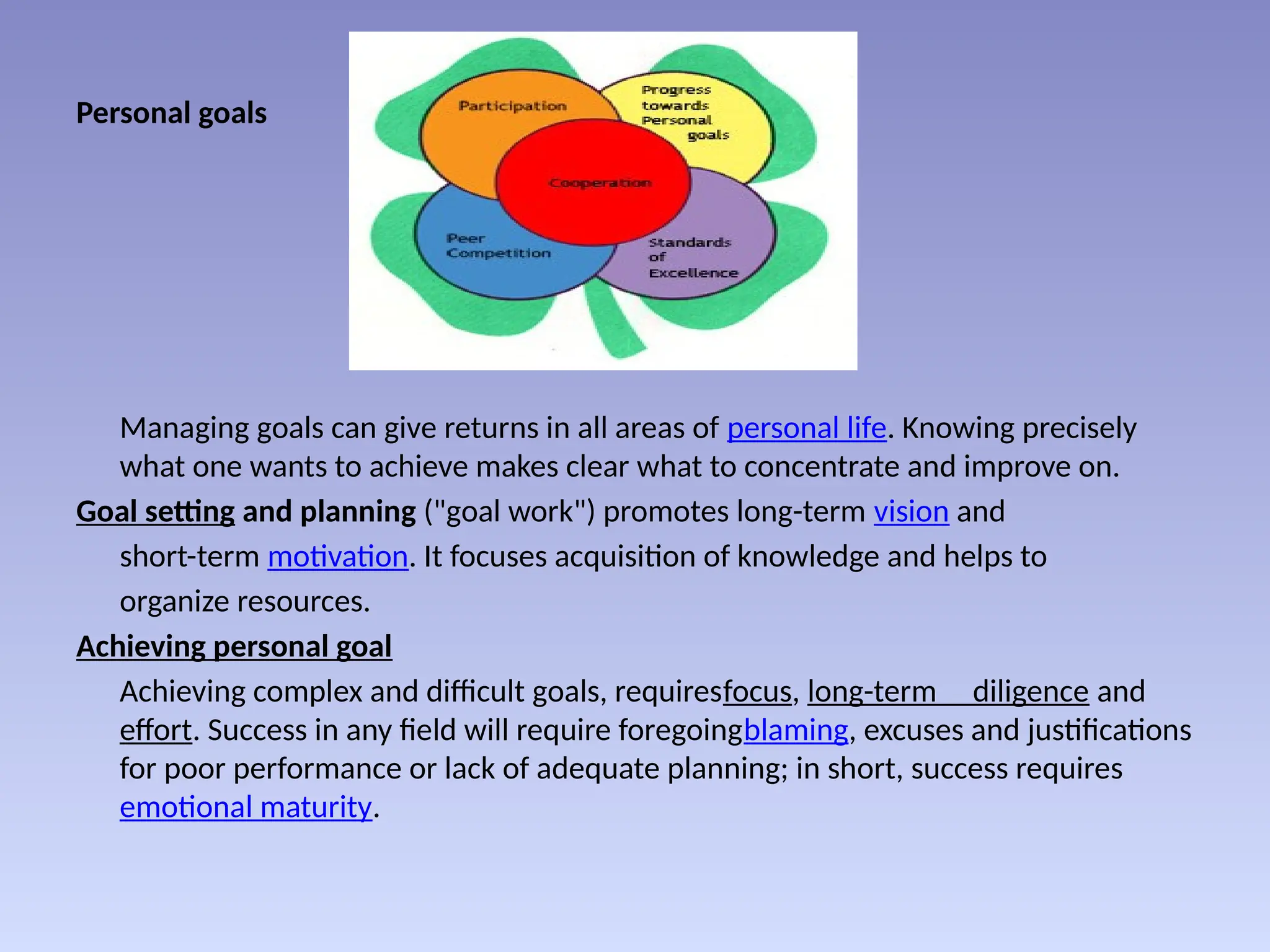
Personal goals
Managing goals can give returns in all areas of personal life. Knowing precisely
what one wants to achieve makes clear what to concentrate and improve on.
Goal setting and planning ("goal work") promotes long-term vision and
short-term motivation. It focuses acquisition of knowledge and helps to
organize resources.
Achieving personal goal
Achieving complex and difficult goals, requiresfocus, long-term diligence and
effort. Success in any field will require foregoingblaming, excuses and justifications
for poor performance or lack of adequate planning; in short, success requires
emotional maturity.
Goal-management
Goal management consists of the process of recognizing or inferring goals
of individual or team-members, abandoning no longer relevant goals,
identifying and resolving conflicts among goals, and prioritizing goals
consistently for optimal team-collaboration and effective operations.
GOAL MANAGEMENT INCLUDE
assessment and dissolution of non-rational blocks to success
time-management
• frequent reconsideration (consistency checks)
• feasibility checks
• adjusting milestones and main-goal targets
•
EFFECTIVE TIME MANAGEMENT
Planning – the simplest way to plan your work is to write a list of things
you need to accomplish during the day
Organizing – number the tasks on the list in the order of the
importance, then do the most important first. Also have a
place for everything so that you waste as little time as
possible looking for things you will be using to perform
certain tasks.
Implementing – Use “Dovetailing “to save time and meet your
schedules. This means that while your hands are involved in
other activities, your mind can be sorting out problems and
mentally planning related tasks that shall follow.
Controlling – to evaluate whether your time for doing your
work is properly manage or not, compare them with your “
Work to do List “. Examine your list for possible refinement
or streamlining.
PERSONAL HYGIENE AND PRACTICES
GROOMING ROUTINES
Hair
• Wash your hair every other day using soap or mild shampoo. Avoid shampoos with borax
or alkalis. Rinse well.
• Ladies hair should be clipped on both sides or breaded (if it is long).
• Length of men’s hair should not go beyond collar and the side hair must not cover the ear.
• Dry your hair after a wash.
• Oil the scalp, once a week, preferably an hour before hair wash.
• Bangs should be avoided.
Skin
• Soap and water are essential for keeping the skin clean.
• A good bath once or twice a day is recommended.
• Those who are involved in active sports or work out to a sweat would do well to take a
bath after the activity.
• Germicidal or antiseptic soaps are not essential for the daily bath. You can use a bath
sponge for scrubbing.
Teeth
• Brush your teeth twice a day and rinse well after every meal. Brushing before going to bed is
important. (This is especially recommended for people with a sweet tooth).
• While brushing, pay attention to the fact that you are getting rid of the food particles stuck in
between the teeth and in the crevices of the flatter teeth at the back, the molars and pre
molars.
• Brush down on the upper teeth and brush up on the lower teeth. Use a circular motion. Pay
attention to the tongue and the inner surface of teeth as well.
• No tooth decay to avoid bad breath.
•
Hands
• Wash hands thoroughly with soap and water before and after every meal and after visiting
the toilet.
• Soaping and rinsing should cover the areas between fingers, nails and back of the hand.
Hands should be dried with a clean towel after wash.
• The towel at the wash stand has to be washed and changed every day.
• While cooking, especially when packing lunches, you can prevent food from spoilage and
minimize contamination by keeping your hands clean.
• While handling food avoid scratching, or touching the ears, nose, mouth or other body
orifices.
Nails
• Keep your nails short.
• Do not keep your nails painted continuously. It causes the keratin, of
which nails are made, to split.
• Pamper your hands and nails once every three weeks with a manicure.
This requires soaking your hands in warm water for ten minutes,
massaging of hands, thorough cleaning and shaping of nails.
• Choose your manicure kit with care. In some kits, the instruments are
crudely made and they will do more harm than good.
Feet
• Give your feet a good scrub with a sponge, pumice stone or foot scrubber
that is not made of very abrasive material when having a bath.
• Dry after bath between toes. Keep toenails clipped.
Shoes and socks
• Those who use shoes constantly need to slip them off now and then. This airs the socks a
bit and makes them less smelly.
• Wear cotton socks. Wear a clean pair every day.
• Powder your feet before wearing socks. Many people have sweaty feet, and socks and
shoes can get quite smelly.
• Go for a pedicure once in three weeks.
• Shoes should be clean and well polished, heels in good condition.
• Black socks for men should changed daily with fresh ones
• Ladies should wear stockings but must ensure it has no “run” or damage
• Menstrual Hygiene
• Technology offers sanitary pads, tampons or menstrual cups or caps to deal with the
flow.
• Absorbent pads may be noticeable in form fitting clothes. They cause some soreness on
the inner thighs.
• Some women prefer tampon to external pads. A plug of absorbent cotton or gauze is
inserted inside. But these should not be left unchanged beyond six hours. The cleaned
and re used.
Uniforms
• Must be comfortably fit, no sagging hemline
• Properly buttoned, sleeves should never be folded nor
rolled
• Clean and well pressed, free from stains nor wrinkle
Ear
• Clean and free from visible dirt inside and outside
• Earrings are never appropriate for men; ladies in uniform
should never wear dangling earrings
NORMS OF CONDUCT OF OFFICIALS AND EMPLOYEES
At all times, the Agency and the human resource shall exemplify and
operate on the core values of absolute honesty, maximum efficiency
and total solidarity. As such, they are expected to conduct themselves
in a manner reflective of the following behaviors:
Commitment to Public Interest - To uphold the public interest over
personal interest. All government resources and powers must be
employed and used efficiently, effectively, honestly and economically,
particularly to avoid wastage in public funds and revenues.
Professionalism - To perform and discharge their duties with the
highest degree of excellence, professionalism, intelligence and skill.
They shall serve with utmost devotion and dedication to duty.
• Justness and Sincerity - To remain true to the people at all times. They must act with
justness and sincerity and shall not discriminate against anyone, especially the poor and
underprivileged.
• Political Neutrality - To provide service to everyone without unfair discrimination
regardless of party affiliation or preference.
• Responsiveness to the Public - To extend prompt, courteous and adequate service to the
public.
• Nationalism and Patriotism - To be loyal to the Republic and the Filipino people, promote
the use of locally produced goods, resources and technology and encourage appreciation
and pride of country and people.
• Commitment to Democracy - To commit themselves to the democratic way of life and
values, maintain the principles of public accountability and manifest by deeds the
supremacy of civilian authority over the military. They shall at all times uphold the
Constitution and put loyalty to country above loyalty to persons and party.
• Simple Living - means maintaining a standard of living within the public official or
employee's visible means of income as correctly disclosed in his income tax returns,
annual statement of assets, liabilities and net worth, and other documents relating to
financial and business interests and connections.
Rights and Duties of a Worker
When starting a new job, it is always important to ask about the terms and
conditions of employment.
Worker Rights
Every worker has a right to:
•  Work in a safe environment that does not threaten his health.
•  Know about any potential hazards at the workplace.
•  Take sick/medical leave when it is required and produce certification for it.
•  Take the number of leave days (after consultations with the employer) as
set by the state.
•  Get paid at least the minimum wage as set by each state.
•  Be treated with the respect and dignity of a human being.
•  Be free to join any Union of his choice.
Worker Duties
Every worker has the duty to:
•  Give his employer a good days work.
•  Help and respect his colleagues.
•  Inform his employer when he is ill and unable to go to work.
•  Makes good use of company resources without wasting.
•  Use any equipment, protective devices or clothing required
by the employer; and doesn't remove or make ineffective any
protective device.
•  Inform the employer about any known missing or defective
equipment or protective device that may be dangerous.
Thank You
Practice Occupational
Health and Safety
Procedures
Hazards and Risks Identification and Control
Hazards Defined
A hazard is a source or potential source of human injury, ill health
or disease. Anything which might cause injury or ill health to
anyone at or near a workplace is a hazard. While some hazards
are fairly obvious and easy to identify, others are not - for
example exposure to noise, chemicals or radiation.
• Types of Hazards
Hazards are classified into five different types:
• • physical - includes floors, stairs, work platforms, steps, ladders,
fire, falling objects, slippery surfaces, manual handling (lifting,
pushing, pulling), excessively loud and prolonged noise, vibration,
heat and cold, radiation, poor lighting, ventilation, air quality
• mechanical and/or electrical - includes
electricity, machinery, equipment, pressure
vessels, dangerous goods, fork lifts, cranes, hoists
• chemical - includes chemical substances such as
acids or poisons and those that could lead to fire
or explosion, cleaning agents, dusts and fumes
from various processes such as welding
• biological - includes bacteria, viruses, mould,
mildew, insects, vermin, animals
• psychosocial environment - includes workplace
stressors arising from a variety of sources.
• doing walk-through surveys, inspections or safety audits in
the workplace to evaluate the organization’s health and
safety system
• considering OHS implications when analyzing work processes
• investigating workplace incidents and `near hits' reports - in
some cases there may be more than one hazard contributing
to an incident
• getting feedback from employees can often provide valuable
information about hazards, because they have hands-on
experience in their work area
• consulting with employees, health and safety representatives
and OHS Committee members
• benchmarking against or liaising with similar workplaces.
• doing walk-through surveys, inspections or safety audits in
the workplace to evaluate the organization’s health and
safety system
• considering OHS implications when analyzing work processes
• investigating workplace incidents and `near hits' reports - in
some cases there may be more than one hazard contributing
to an incident
• getting feedback from employees can often provide valuable
information about hazards, because they have hands-on
experience in their work area
• consulting with employees, health and safety representatives
and OHS Committee members
• benchmarking against or liaising with similar workplaces.
Organizational safety and Health Protocols
The administration of an organization can pose health and
safety risks if the internal environment is not maintained
and monitored appropriately by a company.
Internal Factors
The attitude a business has towards maintaining the health
and safety of its employees is an internal factor that
employees rely on to be protected from dangers and
threats in the workplace.
• Safety Councils
Businesses can demonstrate their commitment to ensuring
health and safety measures by creating safety
management councils.
• Safety Protocols
Developing safety protocols allows companies to keep
written policies and procedures about how to prevent
hazards from occurring in the workplace, as well as provide
instructions on how to respond if employees' health or
safety are threatened. Safety protocols should be easily
accessible for anyone in the company to review
• Education
Education is an effective way for businesses to maintain
their commitment to safety.
• Conducting Safety Drills
Disaster drills are valuable because they teach people how
to respond in a time of urgency
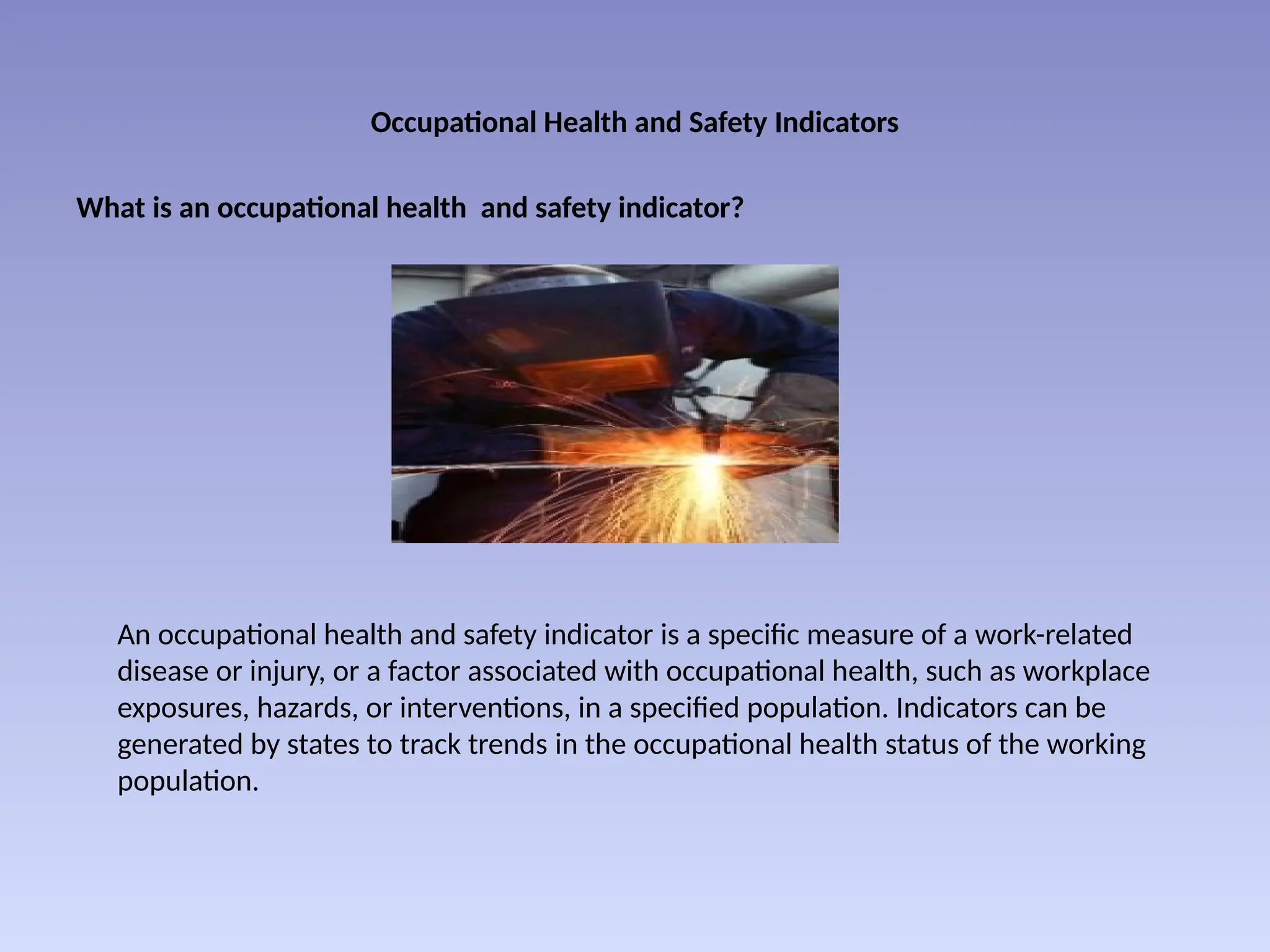
Occupational Health and Safety Indicators
What is an occupational health and safety indicator?
An occupational health and safety indicator is a specific measure of a work-related
disease or injury, or a factor associated with occupational health, such as workplace
exposures, hazards, or interventions, in a specified population. Indicators can be
generated by states to track trends in the occupational health status of the working
population.
Why use occupational health and safety indicators?
• Measure baseline health of worker populations
• Identify trends and patterns of work-related injury, illness, and death
• Anticipate early problem areas that deserve attention
• Reduce preventable workplace injuries
• Increase consistency and availability of occupational disease and injury
surveillance data
What occupational health indicators are generated?
Most state public health or labor departments calculate the 19
occupational health indicators listed below. Depending on the type of
industries and jobs in a state and the availability of data, some states
have developed additional indicators to better measure worker health
in their state. At the current time,
Thank You

Computer-System-Servicing-NCII-basic.pptx

  • 1.
  • 2.
    TESDA- TECHNICAL EDUCATIONAND SKILLS DEVELOPMENT AUTHORITY MMTSI-Marinduque Manpower and Trade Skills Institute Inc.
  • 3.
    What to Bring: 1.Facemask/ 2. Notebook/paper 3. Pen 4. Computer(optional)
  • 4.
    PROPER ONLINE ETIQUETTE 1.Be respectful 2. Be on time 3. Mute your microphone when you are not speaking 4. Listen attentively 5. Avoid sending irrelevant messages 6. Be aware of strong language, exclamation points and capslock 7. Don’t post or share inappropriate material 8. Be forgiving
  • 5.
    3 BASIC COMPETENCIES 1.BASICCOMPETENCY (4O Hours) 2. COMMON COMPETENCY (80 hours) 3. CORE COMPETENCY (160 hours)
  • 6.
    BASIC COMPETENCE 1.Participate inworkplace communication 2. Work in team enviroment 3. Practice career professionalism 4. Practice occupational health and safety procedures
  • 7.
    COMMON COMPETENCY 1. Applyquality standards 2. Perform computer operaton 3. Perform mensuration and calculation 4. Prepare and interpret technical drawing 5. Use Hand Tools 6. Terminate and connect electrical wiring and electronic circuits 7. Test electronic components
  • 8.
    CORE COMPETENCY 1. Installand configure computersystem 2. Set-up Computer Networks 3. Set-up Computer Server 4. Maintain and Repair Computer Systems and Network
  • 9.
    5 STEPS OF5S Seiri Sorting out Pagbubukod- bukod Distinguish between necessary items Seiton Systematic arrangement Pagsasaayos A place for everything and everything in its place Seiso Sweep/clean Pag-lilinis Clean up the workplace Seiketsu Standardizing papanatilihin Maintain and monitor adherence to the first 3s Shitsuke Pagdidisiplina sa sarili Self-disciplined Follow the rules to keep the workplace 5s right
  • 10.
    COMMUNICATION -Is definedas the art of sending and receiving information. Communication is composed of three elements 1. the source (sender, speaker, transmitter, or instructor 2. the symbols used in composing and transmitting the message (words or signs), and; 3. the receiver (listener, reader, or student).
  • 11.
    The three elementsare dynamically interrelated since each element is dependent on the others for effective communication to take place. Effective Communication helps workers to: • complete a schedule of tasks • follow a set of instructions • learn correct procedures and improve work practices • solve problems • work as part of a team • follow the enterprise Occupational Health and Safety and environmental procedures.
  • 12.
    C. Inappropriate interpersonalrelations • Inappropriate communication style: over-aggressive, passive • Impatient, inconsiderate, argumentative • Destructive humor, sarcasm, horseplay, fighting • Inappropriate conflict with others, customers, co- workers, supervisors D. Inappropriate physical behavior • Smoking, eating, drinking in inappropriate places • Sleeping on the job • Alcohol or drug use • Problems with personal hygiene • Threatening, hostile, or intimidating behavior
  • 13.
    Effective Communication helpsworkers to: • complete a schedule of tasks • follow a set of instructions • learn correct procedures and improve work practices • solve problems • work as part of a team • follow the enterprise Occupational Health and Safety and environmental procedures.
  • 14.
    There are threemain modes of communication: 1. Verbal communication 2. Non-verbal communication 3. Written communication
  • 15.
    Verbal Communication In industriesa large proportion of communication is verbal or spoken. This may occur face-to-face or via telephones or two-way radios. For verbal communication to be effective both the speaker and the listener need to be actively engaged in the conversation. The speaker should be clear, concise, and courteous and use a style of language that is appropriate to the situation and the audience
  • 16.
    The listener shouldgive the speaker their full attention and be sure that they clearly understand the message being conveyed. Questions should be asked by the listener to clarify the meaning and by the speaker to ensure that the information has been fully understood. There are three types of questions:
  • 17.
    • Closed questionsare used to obtain a particular piece of information. They are usually answered with a yes or no or with a limited response. For example: – Have you driven a four-wheel drive tractor before? • Open questions encourage people to discuss a situation and share information. They often require longer answers and begin with how, where, when, which, who, why or what. For example: – What types of tractors have you driven? • Reflective questions, also called mirror questions, are used to show the speaker that you have been actively listening to them. They are also helpful when encouraging a person to express their opinions clearly. For example: – So, you’ve driven this type of tractor before? – You’ve found this type of tractor to run reliably, haven’t you?
  • 18.
    There are anumber of barriers that reduce the effectiveness of verbal communication. These include: – inappropriate choice of language style – inappropriate body language – disruptions – noise in the proximity and/or a poor signal – relevance of the topic to the listener – Assumptions made by both the speaker and listener.
  • 19.
    Non-verbal communication A significantaspect of face-to-face communication is non-verbal body language. This includes body posture, arm and hand positions, facial expressions, and eye-contact and hand gestures. Sometimes a conflicting message may be given because the words spoken do not match a speaker’s body language.
  • 20.
    WRITTEN COMMUNICATION Companies/ enterprisesoften require workers to use written forms of communication. This may involve reading workplace notices and instruction such as: • signs and labels • notes, messages and memos • rosters and work schedules • safety material and notices • invoices and dockets with customer information • tables and simple graphs.
  • 21.
  • 22.
    WORK IN ATEAM ENVIRONMENT
  • 23.
    WORK IN ATEAM ENVIRONMENT What is Team? • A Team is a group of people working together to achieve common objectives and willing to forego individual autonomy to the extent necessary to achieve those objectives. A smallest team consists of 2 people and the upper limit can be to the size of the organization.
  • 24.
    Skills needed forteamwork Aside from any required technical proficiency, a wide variety of social skills are desirable for successful teamwork, including: • Listening - it is important to listen to other people's ideas. When people are allowed to freely express their ideas, these initial ideas will produce other ideas. • Questioning - it is important to ask questions, interact, and discuss the objectives of the team. • Persuading - individuals are encouraged to exchange, defend, and then to ultimately rethink their ideas. • Respecting - it is important to treat others with respect and to support their ideas. • Helping - it is crucial to help one's coworkers, which is the general theme of teamwork. • Sharing - it is important to share with the team to create an environment of teamwork. • Participating - all members of the team are encouraged to participate in the team. • Communication - For a team to work effectively it is essential team members acquire communication skills and use effective communication channels between one another e.g. using email, viral communication, group meetings and so on. This will enable team members of the group to work together and achieve the teams purpose and goals.
  • 25.
    TEAM ROLES Coordinator This personwill have a clear view of the team objectives and will be skilled at inviting the contribution of team members in achieving these, rather than just pushing his or her own view. The coordinator (or chairperson) is self disciplined and applies this discipline to the team. They are confident and mature, and will summarize the view of the group and will be prepared to take a decision on the basis of this. Shaper The shaper is full of drive to make things happen and get things going. In doing this they are quite happy to push their own views forward, do not mind being challenged and are always ready to challenge others. The shaper looks for the pattern in discussions and tries to pull things together into something feasible which the team can then get to work on.
  • 26.
    Plant • This memberis the one who is most likely to come out with original ideas and challenge the traditional way of thinking about things. Sometimes they become so imaginative and creative that the team cannot see the relevance of what they are saying. However, without the plant to scatter the seeds of new ideas the team will often find it difficult to make any headway. The plant’s strength is in providing major new insights and ideas for changes in direction and not in contributing to the detail of what needs to be done. Resource investigator • The resource investigator is the group member with the strongest contacts and networks, and is excellent at bringing in information and support from the outside. This member can be very enthusiastic in pursuit of the team’s goals, but cannot always sustain this enthusiasm. Implementer • The individual who is a company worker is well organised and effective at turning big ideas into manageable tasks and plans that can be achieved. Such individuals are both logical and disciplined in their approach. They are hardworking and methodical but may have some difficulty in being flexible.
  • 27.
    Team worker • Theteam worker is the one who is most aware of the others in the team, their needs and their concerns. They are sensitive and supportive of other people’s efforts, and try to promote harmony and reduce conflict. Team workers are particularly important when the team is experiencing a stressful or difficult period. Completer • As the title suggests, the completer is the one who drives the deadlines and makes sure they are achieved. The completer usually communicates a sense of urgency which galvanises other team members into action. They are conscientious and effective at checking the details, which is a vital contribution, but sometimes get ‘bogged down’ in them. Monitor evaluator • The monitor evaluator is good at seeing all the options. They have a strategic perspective and can judge situations accurately. The monitor evaluator can be overcritical and is not usually good at inspiring and encouraging others.
  • 28.
    Specialist • This personprovides specialist skills and knowledge and has a dedicated and single- minded approach. They can adopt a very narrow perspective and sometimes fail to see the whole picture. Finisher • A person who sticks to deadline and likes to get on with things, Will probably be irritated by the more relaxed member of the team.
  • 29.
    Team Roles andResponsibilities Working in groups is a very common phenomenon in the private sector and government agencies. Team members don't have specific responsibilities, but their participation is critical to the team's success. Team members must agree to: • Be enthusiastic and committed to the team's purpose. • Be honest and keep any confidential information behind closed doors. • Share responsibility to rotate through other team roles like facilitator, recorder, and timekeeper. • Share knowledge and expertise and not withhold information. • Ask questions, even seemingly "dumb" ones. Often the new perspective of "inexperienced" team members can provide insight. • Fulfill duties in between meetings. • Respect the opinions and positions of others on the team, even if the person has an opposing view or different opinion.
  • 30.
    Being a professionaldoes not only require mastery of knowledge and skills with respect to a certain profession, or of passing a professional or career exams or earning degree. It is a character that demonstrates certain qualities and attitudes and a commitment to professional ethics. The three Dimensions of Professionalism A. Physical projection – this includes: Proper Grooming – clean cut, no body odor, clean fingernails, well pressed uniform etc. Good posture – straight body, no hands on pocket, relaxed Natural smile Eye contact but not an sneering look Absence of unpleasant mannerism like scratching hair, biting nails, etc. Pleasant disposition Oral hygiene, no bad breadth Appropriate make up for women
  • 31.
    B. Verbal projection Beingcareful with tone, pitch and body language tone must be warm Well-modulated voice Speaking with authority- ability to explain and justify ideas, readiness to answer questions. This gives an impression that one knows what he is talking about. Tactfulness- saying the right things on the right time and in the right place. Assertiveness in expressing oneself- sensitivity to the feelings of others C. Behavior and Performance Adherence to professional/industry standards of service Compliance to standard operating procedure Assertive behavior Adherence to work ethics and respect for protocol Being discreet with confidential matters Practice of social graces, proper table manners, telephone courtesy Appropriate behavior in public
  • 32.
    Employees may alsobe required to write down information, messages and material and tool requirements. They will need to fill out a variety of workplace forms. To be effective, written workplace information must be: 1. Clear – the handwriting must be legible and the information written in a manner that will not be confusing. 2. Concise – the message should be written in simple language using short sentences or point form. Unnecessary information and repetition should be avoided. 3. Correct – accuracy is very important when writing down information. If taking a phone message, read the details back to the caller, especially names, addresses and phone numbers. Use correct terminology where appropriate. 4. Courteous – as with verbal communication, the style of the language chosen should be appropriate to the situation and the reader.
  • 33.
    Demonstrate work values Beinga professional does not only require mastery of knowledge and skills with respect to a certain profession, or of passing a professional or career exams or earning degree. It is a character that demonstrates certain qualities and attitudes and a commitment to professional ethics. The three Dimensions of Professionalism A. Physical projection – this includes: Proper Grooming – clean cut, no body odor, clean fingernails, well pressed uniform etc. Good posture – straight body, no hands on pocket, relaxed Natural smile Eye contact but not an sneering look Absence of unpleasant mannerism like scratching hair, biting nails, etc. Pleasant disposition Oral hygiene, no bad breadth Appropriate make up for women
  • 34.
    B. Verbal projection Beingcareful with tone, pitch and body language tone must be warm Well- modulated voice Speaking with authority- ability to explain and justify ideas, readiness to answer questions. This gives an impression that one knows what he is talking about. Tactfulness- saying the right things on the right time and in the right place. Assertiveness in expressing oneself- sensitivity to the feelings of others C. Behavior and Performance Adherence to professional/industry standards of service Compliance to standard operating procedure Assertive behavior Adherence to work ethics and respect for protocol Being discreet with confidential matters Practice of social graces, proper table manners, telephone courtesy Appropriate behavior in public
  • 35.
    Professionalism means avoidingbad habits at work like: • Yawning • Grouping together with other staff for a chat while on duty • Shouting, giggling, loud conversation • Daydreaming, eavesdropping • Indulging in customer’s private conversations • Putting hands on pocket and playing with pocket coin • Leaning on walls, tables and chairs • Sneering or staring look • Chewing gum while on duty or while talking to customers • Suggesting or demanding for a tip • Counting tips in view of customers • Too much familiarity with the customers • Bluffing customers • Reading newspapers/ magazines while on duty • Use of rude and insulting language • Pointing at something or someone with a finger • Interrupting customers conversation unless for valid reasons • Leaving one’s station longer than necessary
  • 36.
  • 37.
  • 38.
    What is personality? Personalityis the sum total of the biological, psychological, socio cultural and other traits of a person, manifested in the way he thinks, feels, acts and relates with others. Determinants of Personality Behavioral experts agree that personality is a product of nature and nurture, an integration of his biological and social heritage. What a person thinks does and feels as a child, adolescent or adult results from the inter relationship that exist between biologically inherited factors and environmental influences. Heredity Genes transmitted by parents determine a person physical and biological characteristic such as physical stature, color of the skin and hair.Some individuals excel in physical qualities, others are physically handicapped like the dumb, blind, deaf and austistic persons. However, it does not follow that a person with biological or physical deficiency is also handicapped from developing a good or pleasing personality.
  • 39.
    The Social Environment Thesocial environment consists of individuals, groups and institutions with whom the person interacts with from childhood to adulthood. Socialization is a process where a person acquires, learns and internalizes a set of beliefs, ideas, values, attitudes and other socio-cultural characteristic. Personal growth and Stages of Development: The process of development takes place in four stages: Stage 1 – Understanding an Ideal At this stage, the person is exposed to learning situations where he discovers an ideal- the ideal personality, qualities of a winning personality, the elements and conditions for growth and development . He is also able to differentiate functional vs. dysfunctional behavior and their damage consequences. These knowledge provide the framework for understanding his behavior and personality.
  • 40.
    Stage 2 –Self awareness After discovering the ideal, the person goes into self mirroring. He looks into his personal qualities, behavior and compares this against the ideal. He discovers his dysfunctional behavior and how it has affected his success, happiness and relationships with others. Stage 3 - Self Realization As the individual becomes aware of his behavior, he is guided on how to understand himself by bringing into his consciousness the things in the past and other realities that have directly or indirectly conditioned his present behavior or maladjustment. Among these are the distorted beliefs and values that he may have internalized. He is also made to realize how his behavior has hampered his growth and development as well as his happiness.
  • 41.
    Stage 4 –Decision to change With self realization the individual makes a decision to change. If one is determined to grow as a person, he has to decide to change. Stage 5- Actualizing the change In his decision to grow and develop, the individual now puts into action the necessary changes in his life including a change in attitude, re- alignment of his value system and behavioral change.
  • 42.
    INTERPERSONAL RELATIONSHIP An interpersonalrelationship is an association between two or more people that may range from fleeting to enduring. This association may be based on love and liking, regular business interactions, or some other type of social commitment. Interpersonal relationships take place in a great variety of contexts, such as family, friends, marriage, associates, work, clubs, neighborhoods, and churches. A relationship is normally viewed as a connection between two individuals, such as a romantic or intimate relationship, or a parent-child relationship.
  • 43.
    Types of InterpersonalRelationships relationships are important for emotional wellbeing throughout the lifespan. • The natural development of a relationship follows five stages: Acquaintance - Becoming acquainted depends on previous relationships, physical proximity, first impressions, and a variety of other factors. If two people begin to like each other, continued interactions may lead to the next stage, but acquaintance can continue indefinitely. Buildup - During this stage, people begin to trust and care about each other. The need for compatibility and such filtering agents as common background and goals will influence whether or not interaction continues.
  • 44.
    Continuation - Thisstage follows a mutual commitment to a long term friendship, romantic relationship, or marriage. It is generally a long, relative stable period. Nevertheless, continued growth and development will occur during this time. Mutual trust is important for sustaining the relationship. Deterioration - Not all relationships deteriorate, but those that do, tend to show signs of trouble. Boredom, resentment, and dissatisfaction may occur, and individuals may communicate less and avoid self-disclosure. Loss of trust and betrayals may take place as the downward spiral continues. Termination - The final stage marks the end of the relationship, either by death in the case of a healthy relationship, or by separation.
  • 45.
  • 46.
    TYPES OF GOALS: Partof the reason why goal setting fails is that people don’t understand the different types of goals and how to treat them. Goals may involve: • Developing a new skill or improving current skills. • Beating old habits, or developing better ones. • Producing an outcome, achieving a dream. The way each of these types of goals are treated is different – some are short term, others are medium to long term, some have a clear direction to achieve them, others may have a more torturous path, and some are naturally easier than others to achieve. Goals can also be: Big-picture goals – your end destination as defined by the ‘Big-Picture 'Statements for your various life aspects. These goals are typically not achievable in one simple step – there is a journey to be taken to get there. Milestone Goals – these are the series of goals that will take you to your destination. Mini Goals – milestone goals may need to be broken down into bite-size chunks to make them more manageable.
  • 47.
    Personal goals Managing goalscan give returns in all areas of personal life. Knowing precisely what one wants to achieve makes clear what to concentrate and improve on. Goal setting and planning ("goal work") promotes long-term vision and short-term motivation. It focuses acquisition of knowledge and helps to organize resources. Achieving personal goal Achieving complex and difficult goals, requiresfocus, long-term diligence and effort. Success in any field will require foregoingblaming, excuses and justifications for poor performance or lack of adequate planning; in short, success requires emotional maturity.
  • 48.
    Goal-management Goal management consistsof the process of recognizing or inferring goals of individual or team-members, abandoning no longer relevant goals, identifying and resolving conflicts among goals, and prioritizing goals consistently for optimal team-collaboration and effective operations. GOAL MANAGEMENT INCLUDE assessment and dissolution of non-rational blocks to success time-management • frequent reconsideration (consistency checks) • feasibility checks • adjusting milestones and main-goal targets • EFFECTIVE TIME MANAGEMENT Planning – the simplest way to plan your work is to write a list of things you need to accomplish during the day
  • 49.
    Organizing – numberthe tasks on the list in the order of the importance, then do the most important first. Also have a place for everything so that you waste as little time as possible looking for things you will be using to perform certain tasks. Implementing – Use “Dovetailing “to save time and meet your schedules. This means that while your hands are involved in other activities, your mind can be sorting out problems and mentally planning related tasks that shall follow. Controlling – to evaluate whether your time for doing your work is properly manage or not, compare them with your “ Work to do List “. Examine your list for possible refinement or streamlining.
  • 50.
    PERSONAL HYGIENE ANDPRACTICES GROOMING ROUTINES Hair • Wash your hair every other day using soap or mild shampoo. Avoid shampoos with borax or alkalis. Rinse well. • Ladies hair should be clipped on both sides or breaded (if it is long). • Length of men’s hair should not go beyond collar and the side hair must not cover the ear. • Dry your hair after a wash. • Oil the scalp, once a week, preferably an hour before hair wash. • Bangs should be avoided. Skin • Soap and water are essential for keeping the skin clean. • A good bath once or twice a day is recommended. • Those who are involved in active sports or work out to a sweat would do well to take a bath after the activity. • Germicidal or antiseptic soaps are not essential for the daily bath. You can use a bath sponge for scrubbing.
  • 51.
    Teeth • Brush yourteeth twice a day and rinse well after every meal. Brushing before going to bed is important. (This is especially recommended for people with a sweet tooth). • While brushing, pay attention to the fact that you are getting rid of the food particles stuck in between the teeth and in the crevices of the flatter teeth at the back, the molars and pre molars. • Brush down on the upper teeth and brush up on the lower teeth. Use a circular motion. Pay attention to the tongue and the inner surface of teeth as well. • No tooth decay to avoid bad breath. • Hands • Wash hands thoroughly with soap and water before and after every meal and after visiting the toilet. • Soaping and rinsing should cover the areas between fingers, nails and back of the hand. Hands should be dried with a clean towel after wash. • The towel at the wash stand has to be washed and changed every day. • While cooking, especially when packing lunches, you can prevent food from spoilage and minimize contamination by keeping your hands clean. • While handling food avoid scratching, or touching the ears, nose, mouth or other body orifices.
  • 52.
    Nails • Keep yournails short. • Do not keep your nails painted continuously. It causes the keratin, of which nails are made, to split. • Pamper your hands and nails once every three weeks with a manicure. This requires soaking your hands in warm water for ten minutes, massaging of hands, thorough cleaning and shaping of nails. • Choose your manicure kit with care. In some kits, the instruments are crudely made and they will do more harm than good. Feet • Give your feet a good scrub with a sponge, pumice stone or foot scrubber that is not made of very abrasive material when having a bath. • Dry after bath between toes. Keep toenails clipped.
  • 53.
    Shoes and socks •Those who use shoes constantly need to slip them off now and then. This airs the socks a bit and makes them less smelly. • Wear cotton socks. Wear a clean pair every day. • Powder your feet before wearing socks. Many people have sweaty feet, and socks and shoes can get quite smelly. • Go for a pedicure once in three weeks. • Shoes should be clean and well polished, heels in good condition. • Black socks for men should changed daily with fresh ones • Ladies should wear stockings but must ensure it has no “run” or damage • Menstrual Hygiene • Technology offers sanitary pads, tampons or menstrual cups or caps to deal with the flow. • Absorbent pads may be noticeable in form fitting clothes. They cause some soreness on the inner thighs. • Some women prefer tampon to external pads. A plug of absorbent cotton or gauze is inserted inside. But these should not be left unchanged beyond six hours. The cleaned and re used.
  • 54.
    Uniforms • Must becomfortably fit, no sagging hemline • Properly buttoned, sleeves should never be folded nor rolled • Clean and well pressed, free from stains nor wrinkle Ear • Clean and free from visible dirt inside and outside • Earrings are never appropriate for men; ladies in uniform should never wear dangling earrings
  • 55.
    NORMS OF CONDUCTOF OFFICIALS AND EMPLOYEES At all times, the Agency and the human resource shall exemplify and operate on the core values of absolute honesty, maximum efficiency and total solidarity. As such, they are expected to conduct themselves in a manner reflective of the following behaviors: Commitment to Public Interest - To uphold the public interest over personal interest. All government resources and powers must be employed and used efficiently, effectively, honestly and economically, particularly to avoid wastage in public funds and revenues. Professionalism - To perform and discharge their duties with the highest degree of excellence, professionalism, intelligence and skill. They shall serve with utmost devotion and dedication to duty.

  • 56.
    • Justness andSincerity - To remain true to the people at all times. They must act with justness and sincerity and shall not discriminate against anyone, especially the poor and underprivileged. • Political Neutrality - To provide service to everyone without unfair discrimination regardless of party affiliation or preference. • Responsiveness to the Public - To extend prompt, courteous and adequate service to the public. • Nationalism and Patriotism - To be loyal to the Republic and the Filipino people, promote the use of locally produced goods, resources and technology and encourage appreciation and pride of country and people. • Commitment to Democracy - To commit themselves to the democratic way of life and values, maintain the principles of public accountability and manifest by deeds the supremacy of civilian authority over the military. They shall at all times uphold the Constitution and put loyalty to country above loyalty to persons and party. • Simple Living - means maintaining a standard of living within the public official or employee's visible means of income as correctly disclosed in his income tax returns, annual statement of assets, liabilities and net worth, and other documents relating to financial and business interests and connections.
  • 57.
    Rights and Dutiesof a Worker When starting a new job, it is always important to ask about the terms and conditions of employment. Worker Rights Every worker has a right to: •  Work in a safe environment that does not threaten his health. •  Know about any potential hazards at the workplace. •  Take sick/medical leave when it is required and produce certification for it. •  Take the number of leave days (after consultations with the employer) as set by the state. •  Get paid at least the minimum wage as set by each state. •  Be treated with the respect and dignity of a human being. •  Be free to join any Union of his choice.
  • 58.
    Worker Duties Every workerhas the duty to: •  Give his employer a good days work. •  Help and respect his colleagues. •  Inform his employer when he is ill and unable to go to work. •  Makes good use of company resources without wasting. •  Use any equipment, protective devices or clothing required by the employer; and doesn't remove or make ineffective any protective device. •  Inform the employer about any known missing or defective equipment or protective device that may be dangerous.
  • 59.
  • 60.
  • 61.
    Hazards and RisksIdentification and Control Hazards Defined A hazard is a source or potential source of human injury, ill health or disease. Anything which might cause injury or ill health to anyone at or near a workplace is a hazard. While some hazards are fairly obvious and easy to identify, others are not - for example exposure to noise, chemicals or radiation. • Types of Hazards Hazards are classified into five different types: • • physical - includes floors, stairs, work platforms, steps, ladders, fire, falling objects, slippery surfaces, manual handling (lifting, pushing, pulling), excessively loud and prolonged noise, vibration, heat and cold, radiation, poor lighting, ventilation, air quality
  • 62.
    • mechanical and/orelectrical - includes electricity, machinery, equipment, pressure vessels, dangerous goods, fork lifts, cranes, hoists • chemical - includes chemical substances such as acids or poisons and those that could lead to fire or explosion, cleaning agents, dusts and fumes from various processes such as welding • biological - includes bacteria, viruses, mould, mildew, insects, vermin, animals • psychosocial environment - includes workplace stressors arising from a variety of sources.
  • 63.
    • doing walk-throughsurveys, inspections or safety audits in the workplace to evaluate the organization’s health and safety system • considering OHS implications when analyzing work processes • investigating workplace incidents and `near hits' reports - in some cases there may be more than one hazard contributing to an incident • getting feedback from employees can often provide valuable information about hazards, because they have hands-on experience in their work area • consulting with employees, health and safety representatives and OHS Committee members • benchmarking against or liaising with similar workplaces.
  • 64.
    • doing walk-throughsurveys, inspections or safety audits in the workplace to evaluate the organization’s health and safety system • considering OHS implications when analyzing work processes • investigating workplace incidents and `near hits' reports - in some cases there may be more than one hazard contributing to an incident • getting feedback from employees can often provide valuable information about hazards, because they have hands-on experience in their work area • consulting with employees, health and safety representatives and OHS Committee members • benchmarking against or liaising with similar workplaces.
  • 65.
    Organizational safety andHealth Protocols The administration of an organization can pose health and safety risks if the internal environment is not maintained and monitored appropriately by a company. Internal Factors The attitude a business has towards maintaining the health and safety of its employees is an internal factor that employees rely on to be protected from dangers and threats in the workplace. • Safety Councils Businesses can demonstrate their commitment to ensuring health and safety measures by creating safety management councils.
  • 66.
    • Safety Protocols Developingsafety protocols allows companies to keep written policies and procedures about how to prevent hazards from occurring in the workplace, as well as provide instructions on how to respond if employees' health or safety are threatened. Safety protocols should be easily accessible for anyone in the company to review • Education Education is an effective way for businesses to maintain their commitment to safety. • Conducting Safety Drills Disaster drills are valuable because they teach people how to respond in a time of urgency
  • 67.
    Occupational Health andSafety Indicators What is an occupational health and safety indicator? An occupational health and safety indicator is a specific measure of a work-related disease or injury, or a factor associated with occupational health, such as workplace exposures, hazards, or interventions, in a specified population. Indicators can be generated by states to track trends in the occupational health status of the working population.
  • 68.
    Why use occupationalhealth and safety indicators? • Measure baseline health of worker populations • Identify trends and patterns of work-related injury, illness, and death • Anticipate early problem areas that deserve attention • Reduce preventable workplace injuries • Increase consistency and availability of occupational disease and injury surveillance data What occupational health indicators are generated? Most state public health or labor departments calculate the 19 occupational health indicators listed below. Depending on the type of industries and jobs in a state and the availability of data, some states have developed additional indicators to better measure worker health in their state. At the current time,
  • 69.