Downloaded 57 times


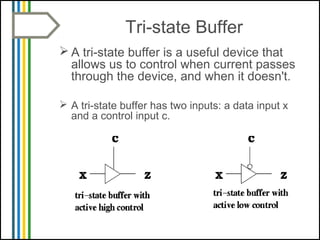
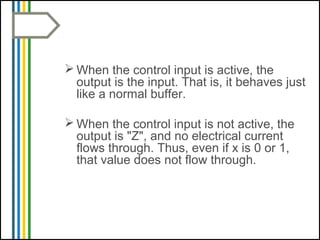
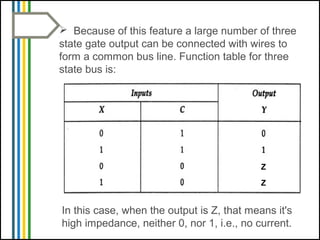


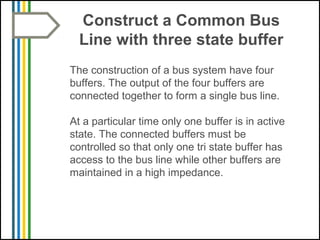
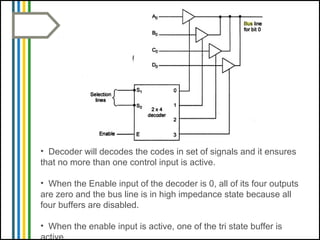
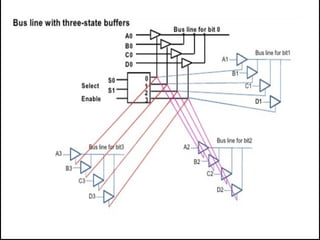

This document discusses tri-state buffers and how they can be used to construct a common bus line. It explains that a tri-state buffer has two inputs - a data input and a control input. When the control input is active, the output is the input behaving like a normal buffer, but when inactive the output is high impedance. This allows multiple device outputs to be connected to a single bus line while only allowing one device to actively drive the bus at a time. It provides an example of using tri-state buffers and a decoder to construct a common 32-bit bus line from the outputs of three devices, with only one being active on the bus at any given time.


![Getting Started with Apache Spark: Big Data Made Simple [Free Meetup]](https://cdn.slidesharecdn.com/ss_thumbnails/apachesparkgettingstarted-260203175547-8361bcc3-thumbnail.jpg?width=640&height=640&fit=bounds)


