Burns Classifications
1
Types Of Burns
• Heat-related burns : is a burn that we get from direct contact with flame, water hot steam
or even from hot cooking pan.
• A temperature of 44° C is enough to cause burns to the skin, higher temperatures 80° C
can cause sever burns.
• And there are actually four types of this kind, will be discussed next.
• Chemical burns : burns that happen as a result to exposure of chemical hazards.
• They happen more often than you think and are actually considered a fairly common
household injury; it is actually surprising to people to know that almost every room in
your house contains a hazardous chemical-especially the ordinary cleaning products.
2
Burns Classifications
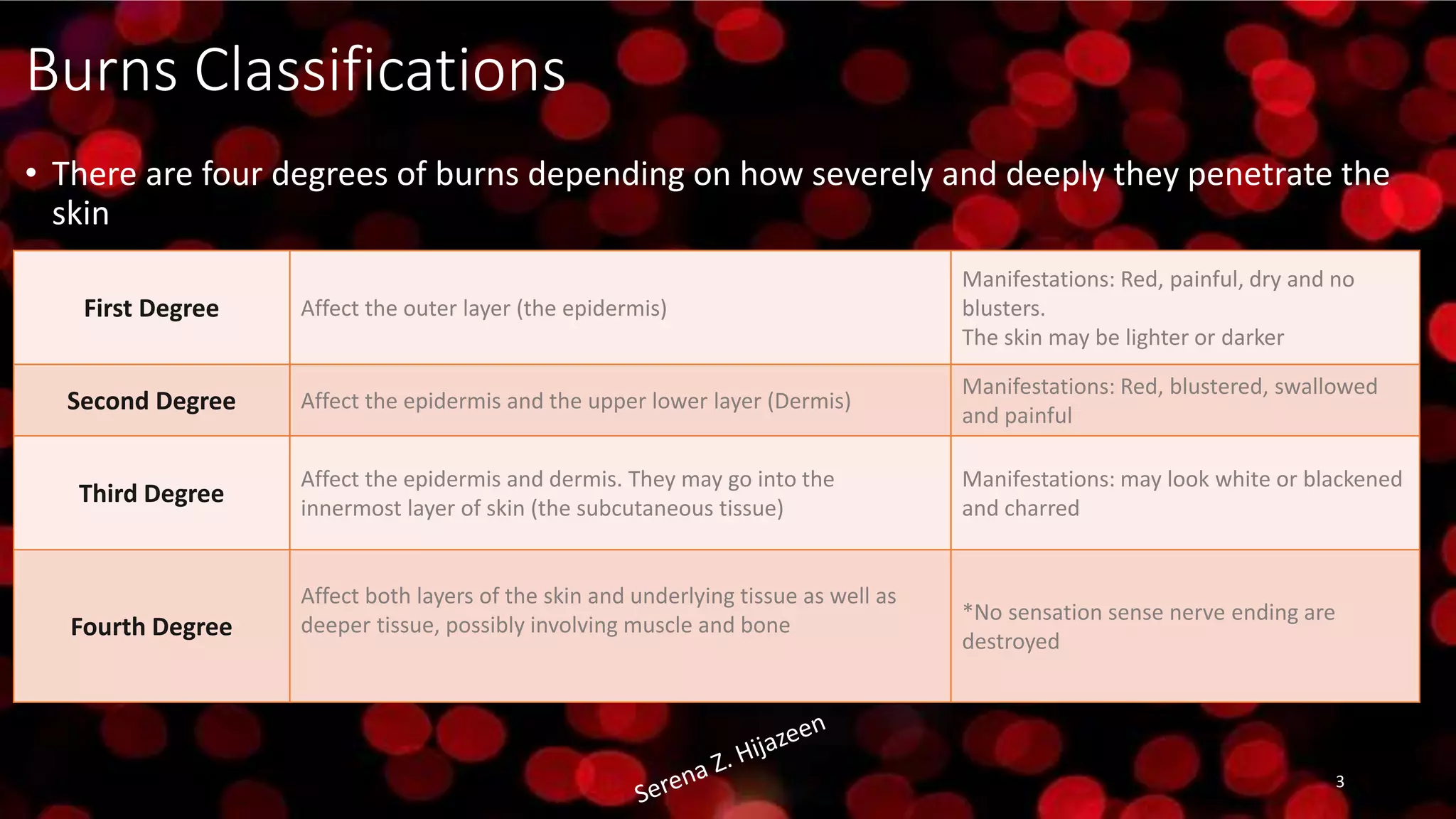
• There are four degrees of burns depending on how severely and deeply they penetrate the
skin
First Degree Affect the outer layer (the epidermis)
Manifestations: Red, painful, dry and no
blusters.
The skin may be lighter or darker
Second Degree Affect the epidermis and the upper lower layer (Dermis)
Manifestations: Red, blustered, swallowed
and painful
Third Degree
Affect the epidermis and dermis. They may go into the
innermost layer of skin (the subcutaneous tissue)
Manifestations: may look white or blackened
and charred
Fourth Degree
Affect both layers of the skin and underlying tissue as well as
deeper tissue, possibly involving muscle and bone
*No sensation sense nerve ending are
destroyed
3
Burns Classifications
1st degree
2nd degree
3rd degree
4th degree
4
Chemical Burns
• We will discuss briefly different households that cause burns.
5
Chemical Burns
1. Bleach; which is found in every house and a normal housewives would use
it at least 3-4 times a day.
It causes serious burns to the skin, eyes and lungs.
6
Chemical Burns
2. Ammonia; It is known to be an excellent glass cleaner, also it is
found in toilet bowl cleaners, oven and drain cleaners.
It leads to dangerous chemical burns.
3. Hydrogen peroxide; this chemical compound is found as an
oxidizer, bleaching agent and antiseptic.
7
Chemical Burns
4. Sodium or Calcium hypochlorite; found in laundry detergents,
it can cause burns to the skin and eyes.
5. Sulfuric acid; most people do not know this but old batteries
may leak the battery acid (Sulfuric acid), which is extremely
corrosive and can cause damage to the exposed skin area.
8
What To Do In The Case Of Burns
• First-degree burns  since this kind of burns only effect the outer layer of the skin, it will
heal as the cells shed.
• These burns are only treated by house care.
• You can do the following :
• Soaking the wound in cool water for five minutes or longer.
• Take pain reliefs like Acetaminophen or Ibuprofen.
• Apply an anesthetic with Aloe Vera gel or cream to sooth the skin.
• Use an antibiotic ointment and loose gauze to protect the affected area.
• Make sure you don’t use ice, as this may make the damage worse. And prolong the healing
process.
9
• Second-degree burns  this kind of burns is manifested by blisters on the affected area,
and as the blister is bigger and worse the more time treatment will take.
• In this case you may :
• Wash the skin under cool water for 15 minutes or longer.
• Taking pain reliefs.
• Applying antibiotic cream to the blisters.
• As for the Third- and Fourth-degrees  Call immediately 911 and avoid.
• While you’re waiting for medical treatment, raise the injury above the heart.
• Don’t remove clothes, but make sure no clothing is stuck to the burn.
What To Do In The Case Of Burns
10
• Never apply cotton balls to a burn because the small fibers can stick to the injury and
increase the risk of infection.
• Never apply toothpaste, butter and eggs as these are not proven to be effective. And may
worsen the burn by causing infections.
• Do not use creams, lotion, oils or cortisone. Only ointments.
• Never pop a blister as it leads to infections.
What To Do In The Case Of Burns
11
Complications Associated With Burns
• The following complications are not associated with first or second- degrees burns but with
more serious ones.
• Researches have shown that burns cause increase sugar production and insulin resistance.
It is not preferable to test blood sugar after burns.
• And the increased sugar levels make a good environment for microbial growth which leads
to infections and may cause sepsis1 or tetanus2.
• Burns are also associated with decreasing body
temperature.
1: Severe decrease in blood pressure caused by infections, it
may lead to death
2: Same as sepsis
12
Pharmaceutical Products For Treating Burns
• There are some products that are used for first aid in the case of burns:
• Ointments that have aloe vera or petroleum jelly may be used as well, the ointment does
not have to contain antibiotic in it as it may cause allergic reactions.
13
References
• https://www.healthline.com/health/burns#outlook
• https://www.californiaburninjurylawyer.net/top-10-common-household-items-
can-cause-chemical-burns/
• https://www.pharmaceutical-journal.com/files/rps-
pjonline/pdf/cp201007_burns_management-249.pdf
14

Burns; Types, Management, Treatment and Causes

  • 1.
  • 2.
    Types Of Burns •Heat-related burns : is a burn that we get from direct contact with flame, water hot steam or even from hot cooking pan. • A temperature of 44° C is enough to cause burns to the skin, higher temperatures 80° C can cause sever burns. • And there are actually four types of this kind, will be discussed next. • Chemical burns : burns that happen as a result to exposure of chemical hazards. • They happen more often than you think and are actually considered a fairly common household injury; it is actually surprising to people to know that almost every room in your house contains a hazardous chemical-especially the ordinary cleaning products. 2
  • 3.
    Burns Classifications • Thereare four degrees of burns depending on how severely and deeply they penetrate the skin First Degree Affect the outer layer (the epidermis) Manifestations: Red, painful, dry and no blusters. The skin may be lighter or darker Second Degree Affect the epidermis and the upper lower layer (Dermis) Manifestations: Red, blustered, swallowed and painful Third Degree Affect the epidermis and dermis. They may go into the innermost layer of skin (the subcutaneous tissue) Manifestations: may look white or blackened and charred Fourth Degree Affect both layers of the skin and underlying tissue as well as deeper tissue, possibly involving muscle and bone *No sensation sense nerve ending are destroyed 3
  • 4.
    Burns Classifications 1st degree 2nddegree 3rd degree 4th degree 4
  • 5.
    Chemical Burns • Wewill discuss briefly different households that cause burns. 5
  • 6.
    Chemical Burns 1. Bleach;which is found in every house and a normal housewives would use it at least 3-4 times a day. It causes serious burns to the skin, eyes and lungs. 6
  • 7.
    Chemical Burns 2. Ammonia;It is known to be an excellent glass cleaner, also it is found in toilet bowl cleaners, oven and drain cleaners. It leads to dangerous chemical burns. 3. Hydrogen peroxide; this chemical compound is found as an oxidizer, bleaching agent and antiseptic. 7
  • 8.
    Chemical Burns 4. Sodiumor Calcium hypochlorite; found in laundry detergents, it can cause burns to the skin and eyes. 5. Sulfuric acid; most people do not know this but old batteries may leak the battery acid (Sulfuric acid), which is extremely corrosive and can cause damage to the exposed skin area. 8
  • 9.
    What To DoIn The Case Of Burns • First-degree burns  since this kind of burns only effect the outer layer of the skin, it will heal as the cells shed. • These burns are only treated by house care. • You can do the following : • Soaking the wound in cool water for five minutes or longer. • Take pain reliefs like Acetaminophen or Ibuprofen. • Apply an anesthetic with Aloe Vera gel or cream to sooth the skin. • Use an antibiotic ointment and loose gauze to protect the affected area. • Make sure you don’t use ice, as this may make the damage worse. And prolong the healing process. 9
  • 10.
    • Second-degree burns this kind of burns is manifested by blisters on the affected area, and as the blister is bigger and worse the more time treatment will take. • In this case you may : • Wash the skin under cool water for 15 minutes or longer. • Taking pain reliefs. • Applying antibiotic cream to the blisters. • As for the Third- and Fourth-degrees  Call immediately 911 and avoid. • While you’re waiting for medical treatment, raise the injury above the heart. • Don’t remove clothes, but make sure no clothing is stuck to the burn. What To Do In The Case Of Burns 10
  • 11.
    • Never applycotton balls to a burn because the small fibers can stick to the injury and increase the risk of infection. • Never apply toothpaste, butter and eggs as these are not proven to be effective. And may worsen the burn by causing infections. • Do not use creams, lotion, oils or cortisone. Only ointments. • Never pop a blister as it leads to infections. What To Do In The Case Of Burns 11
  • 12.
    Complications Associated WithBurns • The following complications are not associated with first or second- degrees burns but with more serious ones. • Researches have shown that burns cause increase sugar production and insulin resistance. It is not preferable to test blood sugar after burns. • And the increased sugar levels make a good environment for microbial growth which leads to infections and may cause sepsis1 or tetanus2. • Burns are also associated with decreasing body temperature. 1: Severe decrease in blood pressure caused by infections, it may lead to death 2: Same as sepsis 12
  • 13.
    Pharmaceutical Products ForTreating Burns • There are some products that are used for first aid in the case of burns: • Ointments that have aloe vera or petroleum jelly may be used as well, the ointment does not have to contain antibiotic in it as it may cause allergic reactions. 13
  • 14.