Bullying 
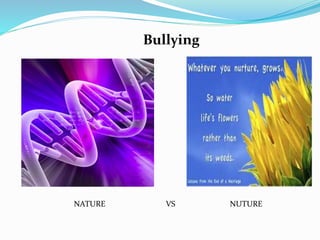
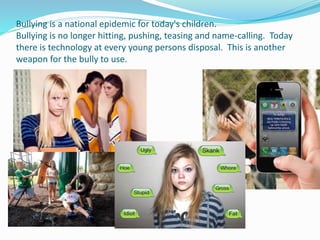
NATURE VS NUTURE
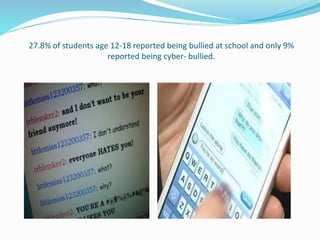
Bullying is a national epidemic for today's children. 
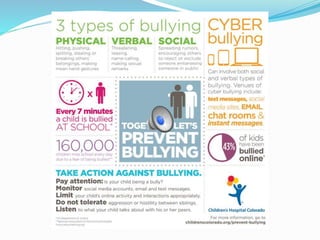
Bullying is no longer hitting, pushing, teasing and name-calling. Today 
there is technology at every young persons disposal. This is another 
weapon for the bully to use.
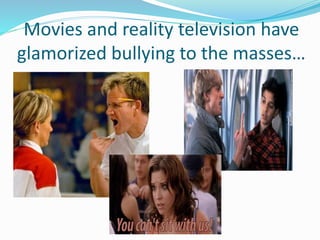
27.8% of students age 12-18 reported being bullied at school and only 9% 
reported being cyber- bullied.
About 1 in 3 students report being bullied during the 
2013 school year. 
(National Centre for Educational Statistics,2013)
Movies and reality television have 
glamorized bullying to the masses…
“Heavy exposure to media 
alters the viewers perception of 
social reality in a way that 
matches the media world.” 
-Levi and Kilbourne
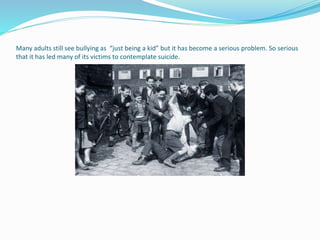
Many adults still see bullying as “just being a kid” but it has become a serious problem. So serious 
that it has led many of its victims to contemplate suicide.
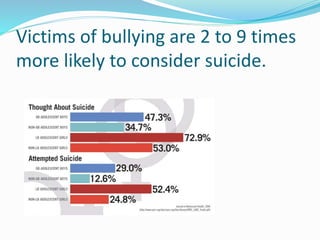
Victims of bullying are 2 to 9 times 
more likely to consider suicide.
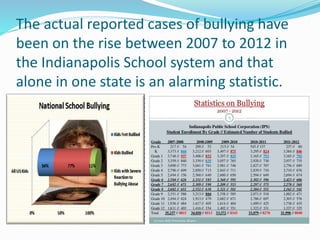
The actual reported cases of bullying have 
been on the rise between 2007 to 2012 in 
the Indianapolis School system and that 
alone in one state is an alarming statistic.
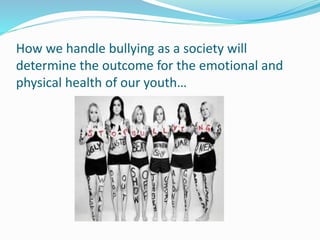
How we handle bullying as a society will 
determine the outcome for the emotional and 
physical health of our youth…
What are we doing as a society 
that is perpetuating the cycle of 
bullying?
Adults continue to tolerate 
bullying because they believe 
this is a normal part of child 
development, they feel 
students should learn to solve 
problems on their own…
Teachers and staff members do 
not intervene for various 
reasons.. 
They hope it will go away, 
they lack the skills to intervene, 
lack of administrative support is 
often a big one!!!
Are we helping to Create Bullies 
as a society?
By tolerating the bullying behavior 
what are we saying to the 
“victim”? 
Victims of bullying get the 
“implied” message that adults have 
discounted their worth as 
individuals.
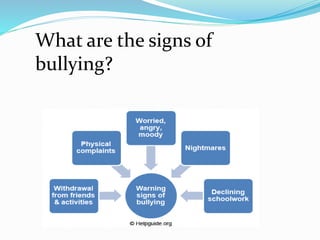
What are the signs of 
bullying?
What are we doing to stop the 
cycle?
There are foundations out 
there to speak to school age 
children about bullying
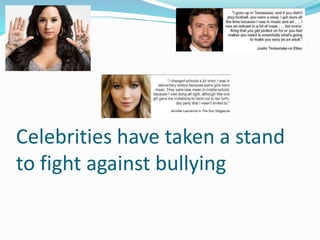
Celebrities have taken a stand 
to fight against bullying
REFERENCES 
Baldry A.C. and Farrington D.P. published in the Journal of Legal and Criminological Psychology (September 1998) 
Bandura, Albert; Ross, D; Ross, S.A (1961). "Transmission of aggression through imitation of aggressive models". Journal of Abnormal and Social Psychology 63 
(3): 575–582 
Donnellan, M. B., Trzesniewski, K. H., Robins, R. W., Moffitt, T. E., & Caspi, A. (2005). Low self-esteem is related to aggression, antisocial behavior, and 
delinquency. Psychological science, 16(4), 328-335. 
Gini, Gianluca, and Tiziana Pozzoli. "Association between bullying and psychosomatic problems: A meta-analysis." Pediatrics 123.3 (2009): 1059-1065. 
Graham, S. (2010). What educators need to know about bullying behaviors. Phi Delta Kappan, 92(1), 66-69 
Grohol, J. (2012). Bullies More Likely to Have Mental Disorder. Psych Central. Retrieved on December 13, 2014, from 
http://psychcentral.com/blog/archives/2012/10/22/bullies-more-likely-to-have-mental-disorder 
Merrell, K. W., Gueldner, B. A., Ross, S. W., & Isava, D. M. (2008). How effective are school bullying intervention programs? A meta-analysis of intervention 
research. School Psychology Quarterly, 23(1), 26. 
Juvonen, J., Graham, S., & Schuster, M. A. (2003). Bullying among young adolescents: The strong, the weak, and the troubled. Pediatrics, 112(6), 1231-1237. 
O'CONNELL, P. A. U. L., Pepler, D., & Craig, W. (1999). Peer involvement in bullying: Insights and challenges for intervention. Journal of adolescence, 22(4), 437- 
452 
. 
Stein, J. A., Dukes, R. L., & Warren, J. I. (2007). Adolescent male bullies, victims, and bully-victims: A comparison of psychosocial and behavioral characteristics. 
Journal of pediatric psychology, 32(3), 273-282.

BULLYING: PSY49201 Capstone Project

  • 1.
  • 2.
    Bullying is anational epidemic for today's children. Bullying is no longer hitting, pushing, teasing and name-calling. Today there is technology at every young persons disposal. This is another weapon for the bully to use.
  • 3.
    27.8% of studentsage 12-18 reported being bullied at school and only 9% reported being cyber- bullied.
  • 4.
    About 1 in3 students report being bullied during the 2013 school year. (National Centre for Educational Statistics,2013)
  • 5.
    Movies and realitytelevision have glamorized bullying to the masses…
  • 6.
    “Heavy exposure tomedia alters the viewers perception of social reality in a way that matches the media world.” -Levi and Kilbourne
  • 7.
    Many adults stillsee bullying as “just being a kid” but it has become a serious problem. So serious that it has led many of its victims to contemplate suicide.
  • 8.
    Victims of bullyingare 2 to 9 times more likely to consider suicide.
  • 9.
    The actual reportedcases of bullying have been on the rise between 2007 to 2012 in the Indianapolis School system and that alone in one state is an alarming statistic.
  • 10.
    How we handlebullying as a society will determine the outcome for the emotional and physical health of our youth…
  • 13.
    What are wedoing as a society that is perpetuating the cycle of bullying?
  • 14.
    Adults continue totolerate bullying because they believe this is a normal part of child development, they feel students should learn to solve problems on their own…
  • 15.
    Teachers and staffmembers do not intervene for various reasons.. They hope it will go away, they lack the skills to intervene, lack of administrative support is often a big one!!!
  • 17.
    Are we helpingto Create Bullies as a society?
  • 18.
    By tolerating thebullying behavior what are we saying to the “victim”? Victims of bullying get the “implied” message that adults have discounted their worth as individuals.
  • 19.
    What are thesigns of bullying?
  • 20.
    What are wedoing to stop the cycle?
  • 21.
    There are foundationsout there to speak to school age children about bullying
  • 24.
    Celebrities have takena stand to fight against bullying
  • 26.
    REFERENCES Baldry A.C.and Farrington D.P. published in the Journal of Legal and Criminological Psychology (September 1998) Bandura, Albert; Ross, D; Ross, S.A (1961). "Transmission of aggression through imitation of aggressive models". Journal of Abnormal and Social Psychology 63 (3): 575–582 Donnellan, M. B., Trzesniewski, K. H., Robins, R. W., Moffitt, T. E., & Caspi, A. (2005). Low self-esteem is related to aggression, antisocial behavior, and delinquency. Psychological science, 16(4), 328-335. Gini, Gianluca, and Tiziana Pozzoli. "Association between bullying and psychosomatic problems: A meta-analysis." Pediatrics 123.3 (2009): 1059-1065. Graham, S. (2010). What educators need to know about bullying behaviors. Phi Delta Kappan, 92(1), 66-69 Grohol, J. (2012). Bullies More Likely to Have Mental Disorder. Psych Central. Retrieved on December 13, 2014, from http://psychcentral.com/blog/archives/2012/10/22/bullies-more-likely-to-have-mental-disorder Merrell, K. W., Gueldner, B. A., Ross, S. W., & Isava, D. M. (2008). How effective are school bullying intervention programs? A meta-analysis of intervention research. School Psychology Quarterly, 23(1), 26. Juvonen, J., Graham, S., & Schuster, M. A. (2003). Bullying among young adolescents: The strong, the weak, and the troubled. Pediatrics, 112(6), 1231-1237. O'CONNELL, P. A. U. L., Pepler, D., & Craig, W. (1999). Peer involvement in bullying: Insights and challenges for intervention. Journal of adolescence, 22(4), 437- 452 . Stein, J. A., Dukes, R. L., & Warren, J. I. (2007). Adolescent male bullies, victims, and bully-victims: A comparison of psychosocial and behavioral characteristics. Journal of pediatric psychology, 32(3), 273-282.
Editor's Notes

  • #2 There are two sides to this coin one study believes in their theory that one cannot be born a bully. This school of thought is “Nurture” Research has shown that bullying has little to do with particular victims, but bullying is a product of the bully’s own personal difficulties. This stems from “personality problems, self-esteem issues, poor emotional control, and learned tendencies”. Unfortunately for the victim, a lot of times they are just in the wrong place at the wrong time. The other That we have DNA or a genetic makeup that contributes to this behavior. Originally, epigenetic changes were assumed to happen only during fetal development. But Scientists wanted to probe further Could grandad’s experience as a POW during Vietnam affect a grandson’s DNA? “According to the new insights of behavioral epigenetics, traumatic experiences in our past, or in our recent ancestors’ past, leave molecular scars adhering to our DNA. Jews whose great-grandparents were chased from their Russian shtetls; Chinese whose grandparents lived through the ravages of the Cultural Revolution; young immigrants from Africa whose parents survived massacres; adults of every ethnicity who grew up with alcoholic or abusive parents — all carry with them more than just memories.” (Discover, Hurley) So we can carry the gene but it doesn’t manifest itself unless we as a society allow the behavior to happen.
  • #3 According to the U.S. Department of Health and Human Services’ (DHHS) anti-bullying website, Stopbullying.gov, bullying is defined as “intentionally aggressive, usually repeated” verbal, social, or physical behavior aimed at a specific person or group of people. Some bullying actions are considered criminal, such as harassment or hazing; but “bullying” alone is not illegal. And recent news stories abound with tales of cyberbullying – where the target is harassed through social media or other technology – that have unfortunately resulted in victims’ suicides. The majority of bullying still takes place at school; 1 in 3 U.S. students say they have been bullied at school.
  • #4 Bullying boosts the social status and popularity of middle school students. It seems the ones that are deemed “cool” bully more and this continues the cycle of perpetuating their so called “coolness”. 20 percent of U.S. students in grades 9-12 reportedly have experienced bullying or are feeling bullied, while 28 percent of students in grades 6-12 report the same. Experts agree that most incidences of bullying occur during middle school. I have three children and have found that two of my three children have already been bullied before high school.
  • #6 We all enjoy reality T.V. and shows that portray the cool ones but in reality what are we projecting to society? The show Hells Kitchen was a show I watched until I tired of the constant bullying. My daughter loves the movie mean girls but that isn’t any better and what about the classic Karate kid? The rich, cool aggressive kid takes on the poor less fortunate kid. The only saving grace is that he prevails in the end.
  • #8 Our society is composed of many different schools of thought on Bullying, what bullying means to them and when it is taken to far. What is bullying to you? Is there a fine line? Do we wait until a child has had enough and will take their life and then punish the bully? Do we look the other way?
  • #9 2 to 9 times more likely to consider suicide?! REALLY when are we going to wake up and notice. That’s alarming.
  • #10 In cities where there is a larger and more diverse population the percentage of bullying will be higher than in smaller areas. Tis doesn’t make it any less real or devastating for all involved.
  • #12 Most of us cannot even begin to understand the bullying children deal with today. There are so many more ways to hurt them than before. The following video shows us just what it is like. It is hard to watch but it needs to be to get the message across.
  • #13 Today our children not only deal with physical bullying, such as hitting, pushing, even breaking ones belongings to name a few. They deal with the verbal bullying of threatening, teasing, and even name calling. There is the ever dreaded Social bullying of spreading rumors, encouraging others to reject that person or exclude them and even embarrass them in public. The youngest form of bullying and most frequent form is cyberbullying. This is a venue that includes both social a verbal bullying.
  • #14 This question is cut and dried. What are we doing?
  • #15 We are tolerating the behavior and we are ignoring the victim and allowing the cycle to continue.
  • #17 Theses three beautiful children represent my three and two of them have already been bullied. My oldest daughter was bullied in verbally and socially bullied in the sixth grade and my son was physically bullied in the third grade. Both instances were swept under the rug by administration. My sons third grade teacher was amazing and stood up for him and helped us to put an end to this. This bullying changed my son and his personality and I am saddened by this. We need to stop this now.
  • #18 Are we creating bullies? DO we allow this behavior so in turn more and more children become them? Or are some just born “MEAN” .This is an interesting theory. By looking the other way we are giving the bully the right to continue with their behavior. That there are no consequences for their actions and the cycle will continue. Bullying is best understood as an adaptive behavior that makes sense within certain family environments. A study by Baldry A.C. and Farrington D.P. published in the Journal of Legal and Criminological Psychology (September 1998) examined 11-14 year old school children who reported being bullies and/or victims. Both types of children were found to come from homes where "authoritarian" styles of parenting were employed. In other words: "you'll do as you're told, or else, no questions asked!". Authoritarian parenting is characterized by punitiveness, an immutable power imbalance which favors the parents, and an absence of explanation, negotiation, or consultation.
  • #20 As you can see some of this would be hard to interpret as being bullied especially in that of a teen. When there are these signs no matter what you may think, talk to your child, really talk to them and :LISTEN!! They need you.
  • #21 Research has shown that when adults step in and take control of a bullying situation it “stops within 10 seconds about 57 percent of the time”. Addressing the problem is important and cuts down on the incidents of bullying.
  • #22 So many lives have been altered and lost due to bullying. The only positive to come from any of it is that it has helped to create many foundations that help victims of bullying and try to prevent bullying all together.
  • #23 Megan Meier was a young eighth grade student with a bright future ahead of her. She had trouble with her weight and finally thought she had met a nice boy “ online” They chatted in the online world for six weeks. He told her about himself opened up etc.. Megan in turn did the same. This in reality was a game being played by a former friend and her former friends mother to try and get Megan to talk bad about kids at school so they could use it against her. The mom and her daughter created a fake account on “MYSPACE” and went from there. Megan was a target to be bullied. The cyber relationship took a turn one day and the last message from the “boy” was” Everybody in O'Fallon knows how you are. You are a bad person and everybody hates you. Have a shitty rest of your life. The world would be a better place without you."  Sadly Megan took her own life right after that. Megans mom founded the Megan Meier foundation “to bring awareness, education and promote positive change to children, parents and educators in response to the issues surrounding bullying and cyberbullying in our children's daily environment.”
  • #25 The following Video is the part of Hollywood that was bullied and LOOK AT THEM NOW!!! They do not stand for bullying and neither should you. It doesn’t make you big, doesn’t make you cool and it doesn’t make whatever bad that is going on in your life seem better.
  • #26 In the end it is up to each and every one of us to take a stand and help bot the victim and the bully so that we end this vicious cycle of bullying.