What is
Bullying???
  Aggressive behavior may be bullying
  depending on what happened, how
  often it happens and who it happens
  to.
Bullying
Definition
   Bullying is unwanted, aggressive behavior among school aged children that involves a
   real or perceived power imbalance. The behavior is repeated, or has the potential to be
   repeated, over time. Both kids who are bullied and who bully others may have
   serious, lasting problems.

   In order to be considered bullying, the behavior must be aggressive and include:
   ~An Imbalance of Power: Kids who bully use their power—such as physical
   strength, access to embarrassing information, or popularity—to control or harm others.
   Power imbalances can change over time and in different situations, even if they
   involve the same people.

   ~Repetition: Bullying behaviors happen more than once or have the potential to
   happen more than once.

   ~Bullying includes actions such as making threats, spreading rumors, attacking
   someone physically or verbally, and excluding someone from a group on purpose.
Types of Bullying

      There are three types of bullying:

      ~Verbal bullying is saying or writing mean things. Verbal bullying includes:
            ~Teasing
            ~Name-calling
            ~Inappropriate sexual comments
            ~Taunting
            ~Threatening to cause harm
      ~Social bullying, sometimes referred to as relational bullying, involves hurting
      someone’s reputation or relationships. Social bullying includes:
            ~Leaving someone out on purpose
            ~Telling other children not to be friends with someone
            ~Spreading rumors about someone
            ~Embarrassing someone in public
      ~Physical bullying involves hurting a person’s body or possessions. Physical
      bullying includes:
            ~Hitting/kicking/pinching
            ~Spitting
            ~Tripping/pushing
            ~Taking or breaking someone’s things
            ~Making mean or rude hand gestures
Where and When Bullying Happens


      Bullying can occur during or after school hours. While most reported
      bullying happens in the school building, a significant percentage also
      happens in places like on the playground or the bus. It can also happen
      travelling to or from school, in the youth’s neighborhood, or on the
      Internet.
Frequency of Bullying


       There are two sources of federally collected data on youth bullying:

       ~The 2011 Youth Risk Behavior Surveillance System (Centers for
       Disease Control and Prevention) indicates that, nationwide, 20% of
       students in grades 9–12 experienced bullying.

       ~The 2008–2009 School Crime Supplement (National Center for
       Education Statistics and Bureau of Justice Statistics) indicates
       that, nationwide, 28% of students in grades 6–12 experienced bullying.
Who is at
Risk
  Bullying can happen anywhere, but depending on the
  environment, some groups may be at an increased risk. Learn
  what factors increase the risk of children being bullied or
  children more likely to bully others and what warning signs can
  indicate that bullying may be happening.
Risk Factors

     No single factor puts a child at risk of being bullied or bullying
     others. Bullying can happen anywhere—cities, suburbs, or rural
     towns. Depending on the environment, some groups—such as
     lesbian, gay, bisexual, or transgendered (LGBT) youth, youth with
     disabilities, and socially isolated youth—may be at an increased
     risk of being bullied.
Children at Risk of Being Bullied

      Generally, children who are bullied have one or more of the following
      risk factors:

      ~Are perceived as different from their peers, such as being overweight
      or underweight, wearing glasses or different clothing, being new to a
      school, or being unable to afford what kids consider ―cool‖
      ~Are perceived as weak or unable to defend themselves
      ~Are depressed, anxious, or have low self esteem
      ~Are less popular than others and have few friends
      ~Do not get along well with others, seen as annoying or provoking, or
      antagonize others for attention

      However, even if a child has these risk factors, it doesn’t mean that they
      will be bullied.
Children More Likely to Bully Others

      There are two types of kids who are more likely to bully others:

      ~Some are well-connected to their peers, have social power, are overly concerned
      about their popularity, and like to dominate or be in charge of others.
      ~Others are more isolated from their peers and may be depressed or anxious, have
      low self esteem, be less involved in school, be easily pressured by peers, or not
      identify with the emotions or feelings of others.

      Children who have these factors are also more likely to bully others;

      ~Are aggressive or easily frustrated
      ~Have less parental involvement or having issues at home
      ~Think badly of others
      ~Have difficulty following rules
      ~View violence in a positive way
      ~Have friends who bully others

      Remember, those who bully others do not need to be stronger or bigger than those
      they bully. The power imbalance can come from a number of sources—
      popularity, strength, cognitive ability—and children who bully may have more
      than one of these characteristics.
Effects of Bullying


       Bullying can affect everyone—those who are bullied, those
       who bully, and those who witness bullying. Bullying is linked
       to many negative outcomes including impacts on mental
       health, substance use, and suicide. It is important to talk to kids
       to determine whether bullying—or something else—is a
       concern
Kids Who are Bullied


      Kids who are bullied can experience negative physical, school, and mental
      health issues. Kids who are bullied are more likely to experience:

      ~Depression and anxiety, increased feelings of sadness and
      loneliness, changes in sleep and eating patterns, and loss of interest in
      activities they used to enjoy. These issues may persist into adulthood.
      ~Health complaints
      ~Decreased academic achievement—GPA and standardized test scores—
      and school participation. They are more likely to miss, skip, or drop out of
      school.

      A very small number of bullied children might retaliate through extremely
      violent measures. In 12 of 15 school shooting cases in the 1990s, the
      shooters had a history of being bullied.
Kids Who Bully Others


      Kids who bully others can also engage in violent and other risky
      behaviors into adulthood. Kids who bully are more likely to:

      ~Abuse alcohol and other drugs in adolescence and as adults
      ~Get into fights, vandalize property, and drop out of school
      ~Engage in early sexual activity
      ~Have criminal convictions and traffic citations as adults
      ~Be abusive toward their romantic partners, spouses, or children as
      adults
Bystanders


      Kids who witness bullying are more likely to:

      ~Have increased use of tobacco, alcohol, or other drugs
      ~Have increased mental health problems, including depression
      and anxiety
      ~Miss or skip school
The Relationship between
Bullying and Suicide

     Media reports often link bullying with suicide. However, most youth who
     are bullied do not have thoughts of suicide or engage in suicidal behaviors.

     Although kids who are bullied are at risk of suicide, bullying alone is not
     the cause. Many issues contribute to suicide risk, including
     depression, problems at home, and trauma history. Additionally, specific
     groups have an increased risk of suicide, including American Indian and
     Alaskan Native, Asian American, lesbian, gay, bisexual, and transgender
     youth. This risk can be increased further when these kids are not supported
     by parents, peers, and schools. Bullying can make an unsupportive situation
     worse
Respond to
Bullying
   How you respond can make an impact on bullying
   over time.
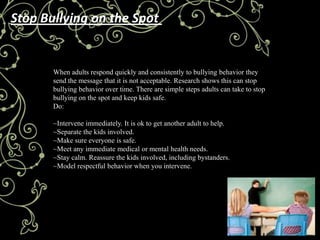
Stop Bullying on the Spot


       When adults respond quickly and consistently to bullying behavior they
       send the message that it is not acceptable. Research shows this can stop
       bullying behavior over time. There are simple steps adults can take to stop
       bullying on the spot and keep kids safe.
       Do:

       ~Intervene immediately. It is ok to get another adult to help.
       ~Separate the kids involved.
       ~Make sure everyone is safe.
       ~Meet any immediate medical or mental health needs.
       ~Stay calm. Reassure the kids involved, including bystanders.
       ~Model respectful behavior when you intervene.
Avoid these common mistakes:

~Don’t ignore it. Don’t think kids can work it out without adult help.
~Don’t immediately try to sort out the facts.
~Don’t force other kids to say publicly what they saw.
~Don’t question the children involved in front of other kids.
~Don’t talk to the kids involved together, only separately.
~Don’t make the kids involved apologize or patch up relations on the spot.
Get police help or medical attention immediately if:

~A weapon is involved.
~There are threats of serious physical injury.
~There are threats of hate-motivated violence, such as racism or homophobia.
~There is serious bodily harm.
~There is sexual abuse.
~Anyone is accused of an illegal act, such as robbery or extortion—using force to
get money, property, or services.
Find Out What Happened


     Get the Facts

     ~Keep all the involved children separate.
     ~Get the story from several sources, both adults and kids.
     ~Listen without blaming.
     ~Don’t call the act ―bullying‖ while you are trying to understand what happened.

     It may be difficult to get the whole story, especially if multiple students are involved or
     the bullying involves social bullying or cyberbullying. Collect all available information.
Determine if it's Bullying

There are many behaviors that look like bullying but require different approaches. It is
important to determine whether the situation is bullying or something else.

Review the definition of bullying. State law and school policy may have additional
guidelines for defining bullying behavior.
To determine if this is bullying or something else, consider the following questions:

~What is the history between the kids involved? Have there been past conflicts?
~Is there a power imbalance? Remember that a power imbalance is not limited to
physical strength. It is sometimes not easily recognized. If the targeted child feels like
there is a power imbalance, there probably is.
~Has this happened before? Is the child worried it will happen again?
~Have the kids dated? There are special responses for teen dating violence.
~Are any of the kids involved with a gang? Gang violence has different interventions.

Remember that it may not matter ―who started it.‖ Some kids who are bullied may be
seen as annoying or provoking, but this does not excuse the bullying behavior
Bullying
Bullying

Bullying

  • 2.
    What is Bullying??? Aggressive behavior may be bullying depending on what happened, how often it happens and who it happens to.
  • 3.
    Bullying Definition Bullying is unwanted, aggressive behavior among school aged children that involves a real or perceived power imbalance. The behavior is repeated, or has the potential to be repeated, over time. Both kids who are bullied and who bully others may have serious, lasting problems. In order to be considered bullying, the behavior must be aggressive and include: ~An Imbalance of Power: Kids who bully use their power—such as physical strength, access to embarrassing information, or popularity—to control or harm others. Power imbalances can change over time and in different situations, even if they involve the same people. ~Repetition: Bullying behaviors happen more than once or have the potential to happen more than once. ~Bullying includes actions such as making threats, spreading rumors, attacking someone physically or verbally, and excluding someone from a group on purpose.
  • 4.
    Types of Bullying There are three types of bullying: ~Verbal bullying is saying or writing mean things. Verbal bullying includes: ~Teasing ~Name-calling ~Inappropriate sexual comments ~Taunting ~Threatening to cause harm ~Social bullying, sometimes referred to as relational bullying, involves hurting someone’s reputation or relationships. Social bullying includes: ~Leaving someone out on purpose ~Telling other children not to be friends with someone ~Spreading rumors about someone ~Embarrassing someone in public ~Physical bullying involves hurting a person’s body or possessions. Physical bullying includes: ~Hitting/kicking/pinching ~Spitting ~Tripping/pushing ~Taking or breaking someone’s things ~Making mean or rude hand gestures
  • 5.
    Where and WhenBullying Happens Bullying can occur during or after school hours. While most reported bullying happens in the school building, a significant percentage also happens in places like on the playground or the bus. It can also happen travelling to or from school, in the youth’s neighborhood, or on the Internet.
  • 6.
    Frequency of Bullying There are two sources of federally collected data on youth bullying: ~The 2011 Youth Risk Behavior Surveillance System (Centers for Disease Control and Prevention) indicates that, nationwide, 20% of students in grades 9–12 experienced bullying. ~The 2008–2009 School Crime Supplement (National Center for Education Statistics and Bureau of Justice Statistics) indicates that, nationwide, 28% of students in grades 6–12 experienced bullying.
  • 7.
    Who is at Risk Bullying can happen anywhere, but depending on the environment, some groups may be at an increased risk. Learn what factors increase the risk of children being bullied or children more likely to bully others and what warning signs can indicate that bullying may be happening.
  • 8.
    Risk Factors No single factor puts a child at risk of being bullied or bullying others. Bullying can happen anywhere—cities, suburbs, or rural towns. Depending on the environment, some groups—such as lesbian, gay, bisexual, or transgendered (LGBT) youth, youth with disabilities, and socially isolated youth—may be at an increased risk of being bullied.
  • 9.
    Children at Riskof Being Bullied Generally, children who are bullied have one or more of the following risk factors: ~Are perceived as different from their peers, such as being overweight or underweight, wearing glasses or different clothing, being new to a school, or being unable to afford what kids consider ―cool‖ ~Are perceived as weak or unable to defend themselves ~Are depressed, anxious, or have low self esteem ~Are less popular than others and have few friends ~Do not get along well with others, seen as annoying or provoking, or antagonize others for attention However, even if a child has these risk factors, it doesn’t mean that they will be bullied.
  • 10.
    Children More Likelyto Bully Others There are two types of kids who are more likely to bully others: ~Some are well-connected to their peers, have social power, are overly concerned about their popularity, and like to dominate or be in charge of others. ~Others are more isolated from their peers and may be depressed or anxious, have low self esteem, be less involved in school, be easily pressured by peers, or not identify with the emotions or feelings of others. Children who have these factors are also more likely to bully others; ~Are aggressive or easily frustrated ~Have less parental involvement or having issues at home ~Think badly of others ~Have difficulty following rules ~View violence in a positive way ~Have friends who bully others Remember, those who bully others do not need to be stronger or bigger than those they bully. The power imbalance can come from a number of sources— popularity, strength, cognitive ability—and children who bully may have more than one of these characteristics.
  • 11.
    Effects of Bullying Bullying can affect everyone—those who are bullied, those who bully, and those who witness bullying. Bullying is linked to many negative outcomes including impacts on mental health, substance use, and suicide. It is important to talk to kids to determine whether bullying—or something else—is a concern
  • 12.
    Kids Who areBullied Kids who are bullied can experience negative physical, school, and mental health issues. Kids who are bullied are more likely to experience: ~Depression and anxiety, increased feelings of sadness and loneliness, changes in sleep and eating patterns, and loss of interest in activities they used to enjoy. These issues may persist into adulthood. ~Health complaints ~Decreased academic achievement—GPA and standardized test scores— and school participation. They are more likely to miss, skip, or drop out of school. A very small number of bullied children might retaliate through extremely violent measures. In 12 of 15 school shooting cases in the 1990s, the shooters had a history of being bullied.
  • 13.
    Kids Who BullyOthers Kids who bully others can also engage in violent and other risky behaviors into adulthood. Kids who bully are more likely to: ~Abuse alcohol and other drugs in adolescence and as adults ~Get into fights, vandalize property, and drop out of school ~Engage in early sexual activity ~Have criminal convictions and traffic citations as adults ~Be abusive toward their romantic partners, spouses, or children as adults
  • 14.
    Bystanders Kids who witness bullying are more likely to: ~Have increased use of tobacco, alcohol, or other drugs ~Have increased mental health problems, including depression and anxiety ~Miss or skip school
  • 15.
    The Relationship between Bullyingand Suicide Media reports often link bullying with suicide. However, most youth who are bullied do not have thoughts of suicide or engage in suicidal behaviors. Although kids who are bullied are at risk of suicide, bullying alone is not the cause. Many issues contribute to suicide risk, including depression, problems at home, and trauma history. Additionally, specific groups have an increased risk of suicide, including American Indian and Alaskan Native, Asian American, lesbian, gay, bisexual, and transgender youth. This risk can be increased further when these kids are not supported by parents, peers, and schools. Bullying can make an unsupportive situation worse
  • 16.
    Respond to Bullying How you respond can make an impact on bullying over time.
  • 17.
    Stop Bullying onthe Spot When adults respond quickly and consistently to bullying behavior they send the message that it is not acceptable. Research shows this can stop bullying behavior over time. There are simple steps adults can take to stop bullying on the spot and keep kids safe. Do: ~Intervene immediately. It is ok to get another adult to help. ~Separate the kids involved. ~Make sure everyone is safe. ~Meet any immediate medical or mental health needs. ~Stay calm. Reassure the kids involved, including bystanders. ~Model respectful behavior when you intervene.
  • 18.
    Avoid these commonmistakes: ~Don’t ignore it. Don’t think kids can work it out without adult help. ~Don’t immediately try to sort out the facts. ~Don’t force other kids to say publicly what they saw. ~Don’t question the children involved in front of other kids. ~Don’t talk to the kids involved together, only separately. ~Don’t make the kids involved apologize or patch up relations on the spot. Get police help or medical attention immediately if: ~A weapon is involved. ~There are threats of serious physical injury. ~There are threats of hate-motivated violence, such as racism or homophobia. ~There is serious bodily harm. ~There is sexual abuse. ~Anyone is accused of an illegal act, such as robbery or extortion—using force to get money, property, or services.
  • 19.
    Find Out WhatHappened Get the Facts ~Keep all the involved children separate. ~Get the story from several sources, both adults and kids. ~Listen without blaming. ~Don’t call the act ―bullying‖ while you are trying to understand what happened. It may be difficult to get the whole story, especially if multiple students are involved or the bullying involves social bullying or cyberbullying. Collect all available information.
  • 20.
    Determine if it'sBullying There are many behaviors that look like bullying but require different approaches. It is important to determine whether the situation is bullying or something else. Review the definition of bullying. State law and school policy may have additional guidelines for defining bullying behavior. To determine if this is bullying or something else, consider the following questions: ~What is the history between the kids involved? Have there been past conflicts? ~Is there a power imbalance? Remember that a power imbalance is not limited to physical strength. It is sometimes not easily recognized. If the targeted child feels like there is a power imbalance, there probably is. ~Has this happened before? Is the child worried it will happen again? ~Have the kids dated? There are special responses for teen dating violence. ~Are any of the kids involved with a gang? Gang violence has different interventions. Remember that it may not matter ―who started it.‖ Some kids who are bullied may be seen as annoying or provoking, but this does not excuse the bullying behavior