Chapter 4 Lecture
Health: The Basics
Tenth Edition
Preventing Violence
and Injury
© 2013 Pearson Education, Inc.
Preventing Violence and Injury
• Violence is the intentional use of physical force
or power, threatened or actual, against
oneself, another person, or against a group or
community that either results in
injury, death, psychological
harm, maldevelopment, or deprivation
(WHO, 2002).
• Intentional injuries include injury, death, or
psychological harm caused by violence with the
intent to harm vs. Unintentional injuries include
injury, death, or psychological harm caused
unintentionally, often as a result of circumstance.
© 2013 Pearson Education, Inc.
Violence in the United States
• Unintentional injuries, particularly from
motor vehicle crashes, are the number
one cause of death among 15–24-year-
olds in the United States.
• After steadily increasing from 1973 to
2006, the rates of overall crime have been
decreasing recently.
• Violent crimes involve force or threat of
force, and include murder, non-negligent
manslaughter, forcible rape, robbery, and
aggravated assault.
© 2013 Pearson Education, Inc.
Declining Crime Rates
© 2013 Pearson Education, Inc.
Violence in the United States (cont.)
• Most violence is underreported.
• Disparities in crime rates exist based on
race, sex, age, socioeconomic
status, geography, and other factors.
• Last year, there were an estimated 4.3
million crimes against U.S. residents aged
12 and older.
© 2013 Pearson Education, Inc.
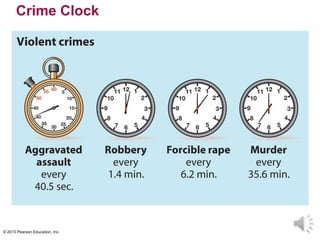
Crime Clock
© 2013 Pearson Education, Inc.
Violence on U.S. Campuses
• The most deadly mass shooting in U.S.
history took place at Virginia Tech on April
16, 2007.
– Today it would be hard to find a campus
without a safety plan in place.
• Ninety-three percent of crimes against
college students occur at off-campus
locations.
• Almost 8% of women and 3.8% of men
report being stalked.
© 2013 Pearson Education, Inc.
• Political differences
• Breakdowns in the
criminal justice
system
• Stress
• Heavy substance
use
Factors Contributing to Violence
• Poverty
• Unemployment
• Parental influence
• Cultural beliefs
• Discrimination or
oppression
• Religious beliefs and
differences
© 2013 Pearson Education, Inc.
What Makes Some People Prone to
Violence?
• Personal factors can also increase risks
for violence.
• Emerging evidence suggests that the
family and home environment may be the
greatest contributor to eventual violent
behavior.
© 2013 Pearson Education, Inc.
Predictors of Violence
• People who anger quickly often have low
tolerance for frustration.
– Aggressive behavior may be primary
aggression that is goal-directed, hostile self-
assertion that is destructive in nature.
– Reactive aggression is part of an emotional
reaction brought about by frustrating life
experiences.
• Substance abuse is closely linked to
violence, even though research has failed
to show it causes violence.
© 2013 Pearson Education, Inc.
How Much Impact Do the Media Have?
• Although early studies supported a link
between the violent media and
subsequent violent behavior, recent work
fails to support this association.
• Today, young people are exposed to more
violence through media than at any other
time, without a corresponding increase in
violent behavior.
© 2013 Pearson Education, Inc.
Intentional Injuries
• Intentional injuries cause pain and
suffering at the very least, and death and
disability at the worst.
• Homicide is the 15th leading cause of
death overall and the 2nd cause of death
for people age 15–24.
– Most homicides are not random acts of
violence—more than half of all homicides
occur among people who know one another.
© 2013 Pearson Education, Inc.
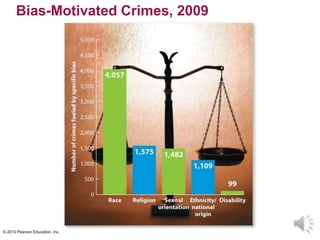
Bias-Motivated Crimes, 2009
© 2013 Pearson Education, Inc.
Hate and Bias Crimes
• A hate crime is committed against a
person, property, or group of people with
the motivation fueled by the offender's bias
against race, religion, disability, sexual
orientation, or ethnicity.
• Bias-related crime, or
ethnoviolence, describes violence against
ethnic groups in the larger society that is
based on prejudice and discrimination.
© 2013 Pearson Education, Inc.
Reasons for Hate and Bias Crimes
• Common reasons given to explain these
crimes include
– Thrill seeking
– Feeling threatened
– Retaliation
– Fearing the unknown
• For some, hate crimes are a part of their
mission in life due to religious zeal or
distorted moral beliefs.
© 2013 Pearson Education, Inc.
Gang Violence
• Gang violence includes drug and sex
trafficking, shootings, beatings, thefts, carjacking
s, and the killing of innocent victims caught in
the cross fire.
• Gang members are usually 12–22 years old.
• Risk factors for gang membership include low
self-esteem, academic problems, low
socioeconomic status, alienation from family and
society, family violence, and living in gang-
controlled neighborhoods.
© 2013 Pearson Education, Inc.
Terrorism
• Terrorism is the unlawful use of force or
violence against persons or property to
intimidate or coerce a government, the
civilian population, or any segment
thereof, in furtherance of political or social
objectives.
• Effects on the economy include costs of
food and fuel, travel restrictions, additional
security measures, and military buildups.

Ch4pt1 violence injury_p_pwaudio

  • 2.
    Chapter 4 Lecture Health:The Basics Tenth Edition Preventing Violence and Injury
  • 3.
    © 2013 PearsonEducation, Inc. Preventing Violence and Injury • Violence is the intentional use of physical force or power, threatened or actual, against oneself, another person, or against a group or community that either results in injury, death, psychological harm, maldevelopment, or deprivation (WHO, 2002). • Intentional injuries include injury, death, or psychological harm caused by violence with the intent to harm vs. Unintentional injuries include injury, death, or psychological harm caused unintentionally, often as a result of circumstance.
  • 4.
    © 2013 PearsonEducation, Inc. Violence in the United States • Unintentional injuries, particularly from motor vehicle crashes, are the number one cause of death among 15–24-year- olds in the United States. • After steadily increasing from 1973 to 2006, the rates of overall crime have been decreasing recently. • Violent crimes involve force or threat of force, and include murder, non-negligent manslaughter, forcible rape, robbery, and aggravated assault.
  • 5.
    © 2013 PearsonEducation, Inc. Declining Crime Rates
  • 6.
    © 2013 PearsonEducation, Inc. Violence in the United States (cont.) • Most violence is underreported. • Disparities in crime rates exist based on race, sex, age, socioeconomic status, geography, and other factors. • Last year, there were an estimated 4.3 million crimes against U.S. residents aged 12 and older.
  • 7.
    © 2013 PearsonEducation, Inc. Crime Clock
  • 8.
    © 2013 PearsonEducation, Inc. Violence on U.S. Campuses • The most deadly mass shooting in U.S. history took place at Virginia Tech on April 16, 2007. – Today it would be hard to find a campus without a safety plan in place. • Ninety-three percent of crimes against college students occur at off-campus locations. • Almost 8% of women and 3.8% of men report being stalked.
  • 9.
    © 2013 PearsonEducation, Inc. • Political differences • Breakdowns in the criminal justice system • Stress • Heavy substance use Factors Contributing to Violence • Poverty • Unemployment • Parental influence • Cultural beliefs • Discrimination or oppression • Religious beliefs and differences
  • 10.
    © 2013 PearsonEducation, Inc. What Makes Some People Prone to Violence? • Personal factors can also increase risks for violence. • Emerging evidence suggests that the family and home environment may be the greatest contributor to eventual violent behavior.
  • 11.
    © 2013 PearsonEducation, Inc. Predictors of Violence • People who anger quickly often have low tolerance for frustration. – Aggressive behavior may be primary aggression that is goal-directed, hostile self- assertion that is destructive in nature. – Reactive aggression is part of an emotional reaction brought about by frustrating life experiences. • Substance abuse is closely linked to violence, even though research has failed to show it causes violence.
  • 12.
    © 2013 PearsonEducation, Inc. How Much Impact Do the Media Have? • Although early studies supported a link between the violent media and subsequent violent behavior, recent work fails to support this association. • Today, young people are exposed to more violence through media than at any other time, without a corresponding increase in violent behavior.
  • 13.
    © 2013 PearsonEducation, Inc. Intentional Injuries • Intentional injuries cause pain and suffering at the very least, and death and disability at the worst. • Homicide is the 15th leading cause of death overall and the 2nd cause of death for people age 15–24. – Most homicides are not random acts of violence—more than half of all homicides occur among people who know one another.
  • 14.
    © 2013 PearsonEducation, Inc. Bias-Motivated Crimes, 2009
  • 15.
    © 2013 PearsonEducation, Inc. Hate and Bias Crimes • A hate crime is committed against a person, property, or group of people with the motivation fueled by the offender's bias against race, religion, disability, sexual orientation, or ethnicity. • Bias-related crime, or ethnoviolence, describes violence against ethnic groups in the larger society that is based on prejudice and discrimination.
  • 16.
    © 2013 PearsonEducation, Inc. Reasons for Hate and Bias Crimes • Common reasons given to explain these crimes include – Thrill seeking – Feeling threatened – Retaliation – Fearing the unknown • For some, hate crimes are a part of their mission in life due to religious zeal or distorted moral beliefs.
  • 17.
    © 2013 PearsonEducation, Inc. Gang Violence • Gang violence includes drug and sex trafficking, shootings, beatings, thefts, carjacking s, and the killing of innocent victims caught in the cross fire. • Gang members are usually 12–22 years old. • Risk factors for gang membership include low self-esteem, academic problems, low socioeconomic status, alienation from family and society, family violence, and living in gang- controlled neighborhoods.
  • 18.
    © 2013 PearsonEducation, Inc. Terrorism • Terrorism is the unlawful use of force or violence against persons or property to intimidate or coerce a government, the civilian population, or any segment thereof, in furtherance of political or social objectives. • Effects on the economy include costs of food and fuel, travel restrictions, additional security measures, and military buildups.