Rana Ali Haider
14-NTU-0140
National Textile University
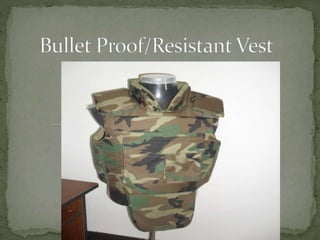
 A ballistic vest or bullet-resistant vest, often called
a bulletproof vest, is an item of personal armor that
helps absorb the impact and reduce or prohibit
penetration to the body from firearm-
fired projectiles and shrapnel from explosions. Soft
vests are made from many layers of woven or
laminated fibers and can be capable of protecting the
wearer from small-caliber handgun and
shotgun projectiles, and small fragments from
explosives such as hand grenades.
 Metal or ceramic plates can be used with a soft vest,
providing additional protection from rifle rounds, and
metallic components or tightly woven fiber layers can
give soft armor resistance to stab and slash attacks
from knives and similar close-quarter weapons. Soft
vests are commonly worn by police forces, private
citizens who are at risk of being shot (e.g., national
leaders), security guards, and bodyguards, whereas
hard-plate reinforced vests are mainly worn by combat
soldiers, police tactical units, and hostage rescue
teams.
 In 1538, Francesco Maria Della
Rovere commissioned Filippo Negroli to create a
bulletproof vest. In 1561, Maximilian II, Holy Roman
Emperor is recorded as testing his armor against gun-
fire.
 One of the first commercially sold bulletproof armor
was produced by a tailor in Dublin, Ireland in the
1840s. The Cork Examiner reported on his line of
business in December 1847.
 Commercially used synthetic fibers include Kevlar,
Spectra, Twaron, Ballistic Nylon and Zylon.
 Mostly used material for bulletproof vest is Kevlar.
 Kevlar is not used in pure form because it has some
drawbacks.
 Use of Spectra for vests is also increasing now a days.
 It is degraded by the UV Rays.
 Low stability under wet conditions because Kevlar has
low strength under wet conditions.
 Therefore, Kevlar is blended with a natural fiber which
is mostly Wool.
 Advantages:
 Better tear strength even under wet conditions.
 Better energy absorbing capacity and reduced number
of layers in a vest.
 Better breathability and feels good on skin.
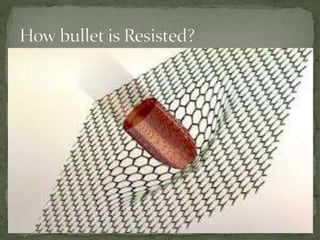
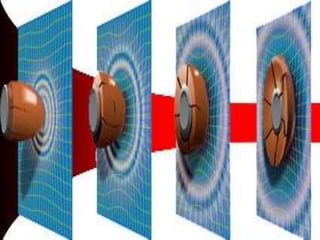
 Restricts the displacement of Kevlar yarns under the
impact of bullet.
 Increases the friction at yarn intersections and
penetrating bullet comes across a stronger resisting
force.
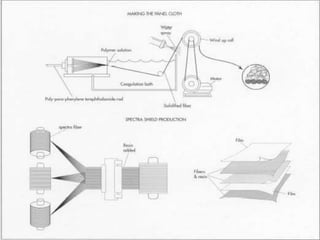
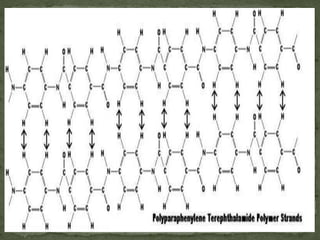
 To make Kevlar, the polymer poly-para-phenylene
terephthalamide is first produced in the laboratory.
This is done through a process known as
polymerization, which involves combining molecules
into long chains. The resultant crystalline liquid is
then extruded through a spinneret to form Kevlar
yarn. The Kevlar yarn then passes through a
coagulation bath to help it harden.
 The Kevlar yarn is then twisted to make it suitable for
weaving. To make Kevlar cloth, the yarns are woven in
the simplest pattern, plain weave, which is merely the
over and under pattern of threads that interlace
alternatively.
 Spectra used in bulletproof vests is usually non
woven. Resin is used to coat the fibers, sealing them
together to form a sheet of Spectra cloth. Two sheets of
this cloth are then placed at right angles to one
another and again bonded, forming a nonwoven fabric
that is next sandwiched between two sheets of
polyethylene film.
 The cloth is then laid out on the cutting table.
 Layers of fabric depends on the protection needed.
 Minimum 8 layers are used and maximum 25.
 Layers are cut with a cutting machine according to the
shape required.
 Panels are stitched by Standard Industrial Sewing
machines using the Kevlar thread for sewing.
 These panels are then placed in the shells of Polyester-
Cotton blended fabric which gives extra comfort to the
wearer.
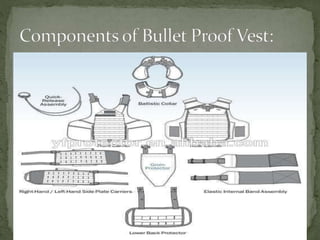
 These panels are then placed in a Garment which is of
shape of a garment.
 Number of layers of fabric define the strength of vest
against bullet.
 Accessories are sewn on the vest such as Straps etc.
 A size tag is also attached on the vest.
 The finished vest is then boxed to the customer.
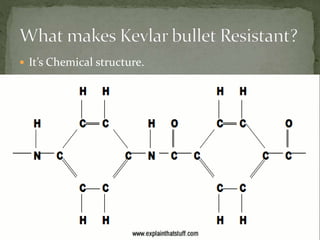
 It’s Chemical structure.
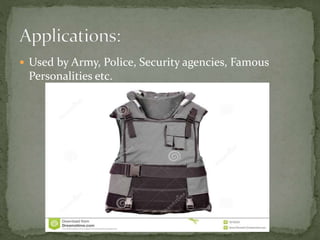
 Used by Army, Police, Security agencies, Famous
Personalities etc.

Bullet Proof Jacket or Bullet Proof/Resistant Vest

  • 2.
  • 3.
     A ballisticvest or bullet-resistant vest, often called a bulletproof vest, is an item of personal armor that helps absorb the impact and reduce or prohibit penetration to the body from firearm- fired projectiles and shrapnel from explosions. Soft vests are made from many layers of woven or laminated fibers and can be capable of protecting the wearer from small-caliber handgun and shotgun projectiles, and small fragments from explosives such as hand grenades.
  • 4.
     Metal orceramic plates can be used with a soft vest, providing additional protection from rifle rounds, and metallic components or tightly woven fiber layers can give soft armor resistance to stab and slash attacks from knives and similar close-quarter weapons. Soft vests are commonly worn by police forces, private citizens who are at risk of being shot (e.g., national leaders), security guards, and bodyguards, whereas hard-plate reinforced vests are mainly worn by combat soldiers, police tactical units, and hostage rescue teams.
  • 5.
     In 1538,Francesco Maria Della Rovere commissioned Filippo Negroli to create a bulletproof vest. In 1561, Maximilian II, Holy Roman Emperor is recorded as testing his armor against gun- fire.  One of the first commercially sold bulletproof armor was produced by a tailor in Dublin, Ireland in the 1840s. The Cork Examiner reported on his line of business in December 1847.
  • 6.
     Commercially usedsynthetic fibers include Kevlar, Spectra, Twaron, Ballistic Nylon and Zylon.  Mostly used material for bulletproof vest is Kevlar.  Kevlar is not used in pure form because it has some drawbacks.  Use of Spectra for vests is also increasing now a days.
  • 7.
     It isdegraded by the UV Rays.  Low stability under wet conditions because Kevlar has low strength under wet conditions.  Therefore, Kevlar is blended with a natural fiber which is mostly Wool.
  • 8.
     Advantages:  Bettertear strength even under wet conditions.  Better energy absorbing capacity and reduced number of layers in a vest.  Better breathability and feels good on skin.  Restricts the displacement of Kevlar yarns under the impact of bullet.  Increases the friction at yarn intersections and penetrating bullet comes across a stronger resisting force.
  • 9.
     To makeKevlar, the polymer poly-para-phenylene terephthalamide is first produced in the laboratory. This is done through a process known as polymerization, which involves combining molecules into long chains. The resultant crystalline liquid is then extruded through a spinneret to form Kevlar yarn. The Kevlar yarn then passes through a coagulation bath to help it harden.
  • 10.
     The Kevlaryarn is then twisted to make it suitable for weaving. To make Kevlar cloth, the yarns are woven in the simplest pattern, plain weave, which is merely the over and under pattern of threads that interlace alternatively.
  • 11.
     Spectra usedin bulletproof vests is usually non woven. Resin is used to coat the fibers, sealing them together to form a sheet of Spectra cloth. Two sheets of this cloth are then placed at right angles to one another and again bonded, forming a nonwoven fabric that is next sandwiched between two sheets of polyethylene film.
  • 13.
     The clothis then laid out on the cutting table.  Layers of fabric depends on the protection needed.  Minimum 8 layers are used and maximum 25.  Layers are cut with a cutting machine according to the shape required.
  • 14.
     Panels arestitched by Standard Industrial Sewing machines using the Kevlar thread for sewing.  These panels are then placed in the shells of Polyester- Cotton blended fabric which gives extra comfort to the wearer.  These panels are then placed in a Garment which is of shape of a garment.  Number of layers of fabric define the strength of vest against bullet.
  • 15.
     Accessories aresewn on the vest such as Straps etc.  A size tag is also attached on the vest.  The finished vest is then boxed to the customer.
  • 16.
  • 21.
     Used byArmy, Police, Security agencies, Famous Personalities etc.