Bridge designs, Vectors, and Forces!
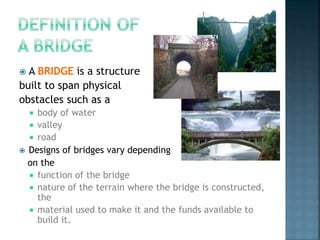
 A BRIDGE is a structure
built to span physical
obstacles such as a
 body of water
 valley
 road
 Designs of bridges vary depending
on the
 function of the bridge
 nature of the terrain where the bridge is constructed,
the
 material used to make it and the funds available to
build it.
 Famous Bridges Exploration
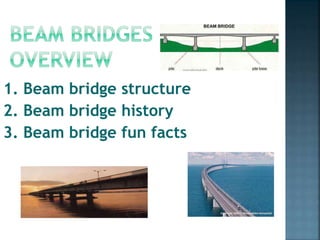
1. Beam bridge structure
2. Beam bridge history
3. Beam bridge fun facts
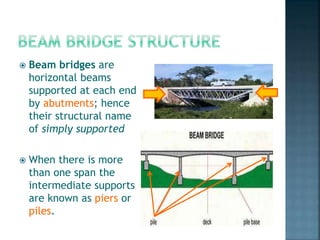
 Beam bridges are
horizontal beams
supported at each end
by abutments; hence
their structural name
of simply supported
 When there is more
than one span the
intermediate supports
are known as piers or
piles.
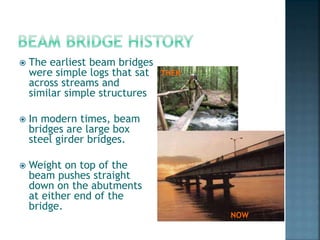
 The earliest beam bridges
were simple logs that sat
across streams and
similar simple structures
 In modern times, beam
bridges are large box
steel girder bridges.
 Weight on top of the
beam pushes straight
down on the abutments
at either end of the
bridge.
THEN
NOW
 Beam bridge spans typically do
not exceed 250 feet (76 m)
long, as the strength of a span
decreases with increased
length.
 However, the main span of the
Rio-Niteroi Bridge, a box
girder bridge, is 300 meters
(980 ft.).
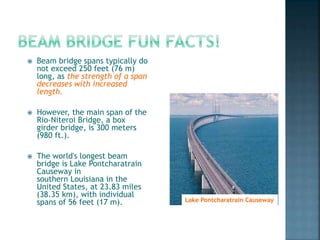
 The world's longest beam
bridge is Lake Pontcharatrain
Causeway in
southern Louisiana in the
United States, at 23.83 miles
(38.35 km), with individual
spans of 56 feet (17 m). Lake Pontcharatrain Causeway
1. Truss bridge structure
2. Truss bridge history
3. Truss bridge fun facts!
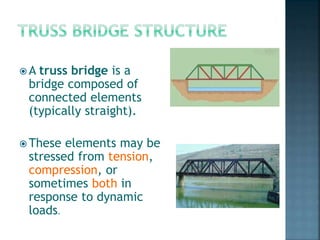
 A truss bridge is a
bridge composed of
connected elements
(typically straight).
 These elements may be
stressed from tension,
compression, or
sometimes both in
response to dynamic
loads.
 Truss bridges are one of
the oldest types of modern
bridges.
 The basic types of
truss bridges have simple
designs which could be
easily analyzed by
nineteenth and early
twentieth century
engineers.
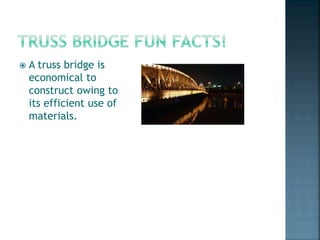
 A truss bridge is
economical to
construct owing to
its efficient use of
materials.
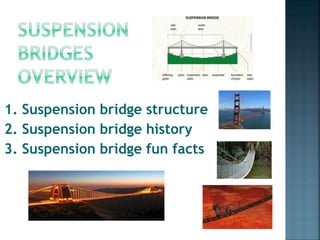
1. Suspension bridge structure
2. Suspension bridge history
3. Suspension bridge fun facts
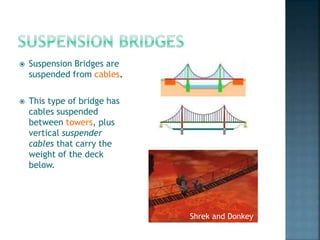
 Suspension Bridges are
suspended from cables.
 This type of bridge has
cables suspended
between towers, plus
vertical suspender
cables that carry the
weight of the deck
below.
Shrek and Donkey
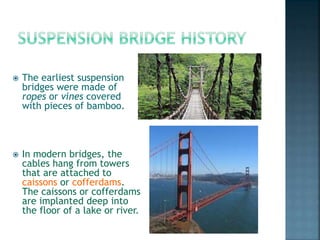
 The earliest suspension
bridges were made of
ropes or vines covered
with pieces of bamboo.
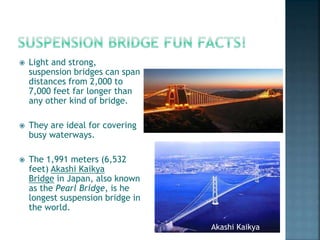
 In modern bridges, the
cables hang from towers
that are attached to
caissons or cofferdams.
The caissons or cofferdams
are implanted deep into
the floor of a lake or river.
 Light and strong,
suspension bridges can span
distances from 2,000 to
7,000 feet far longer than
any other kind of bridge.
 They are ideal for covering
busy waterways.
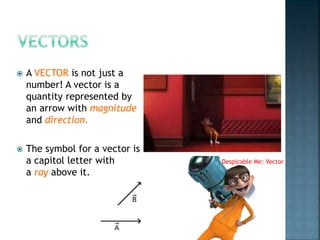
 The 1,991 meters (6,532
feet) Akashi Kaikya
Bridge in Japan, also known
as the Pearl Bridge, is he
longest suspension bridge in
the world.
Akashi Kaikya
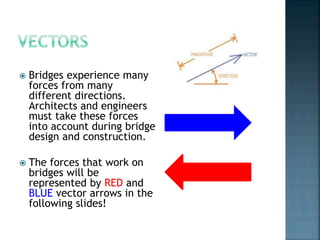
 A VECTOR is not just a
number! A vector is a
quantity represented by
an arrow with magnitude
and direction.
 The symbol for a vector is
a capitol letter with
a ray above it.
Despicable Me: Vector
 Bridges experience many
forces from many
different directions.
Architects and engineers
must take these forces
into account during bridge
design and construction.
 The forces that work on
bridges will be
represented by RED and
BLUE vector arrows in the
following slides!
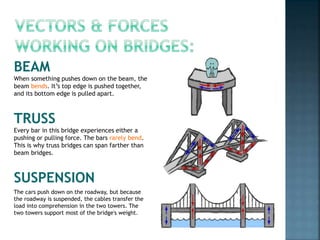
BEAM
When something pushes down on the beam, the
beam bends. It’s top edge is pushed together,
and its bottom edge is pulled apart.
TRUSS
Every bar in this bridge experiences either a
pushing or pulling force. The bars rarely bend.
This is why truss bridges can span farther than
beam bridges.
SUSPENSION
The cars push down on the roadway, but because
the roadway is suspended, the cables transfer the
load into comprehension in the two towers. The
two towers support most of the bridge's weight.
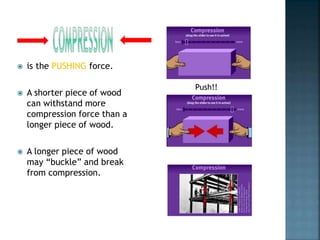
 is the PUSHING force.
 A shorter piece of wood
can withstand more
compression force than a
longer piece of wood.
 A longer piece of wood
may “buckle” and break
from compression.
Push!!
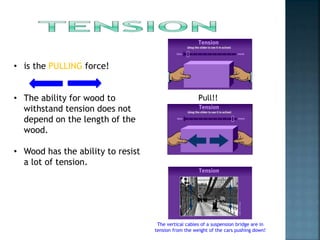
• is the PULLING force!
• The ability for wood to
withstand tension does not
depend on the length of the
wood.
• Wood has the ability to resist
a lot of tension.
Pull!!
The vertical cables of a suspension bridge are in
tension from the weight of the cars pushing down!
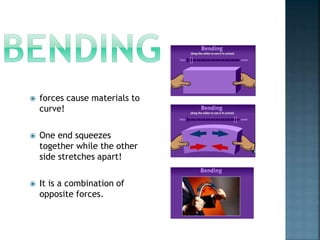
 forces cause materials to
curve!
 One end squeezes
together while the other
side stretches apart!
 It is a combination of
opposite forces.
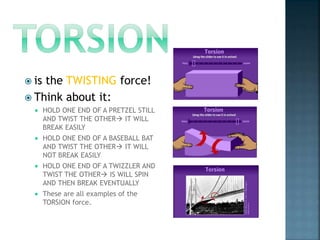
 is the TWISTING force!
 Think about it:
 HOLD ONE END OF A PRETZEL STILL
AND TWIST THE OTHER IT WILL
BREAK EASILY
 HOLD ONE END OF A BASEBALL BAT
AND TWIST THE OTHER IT WILL
NOT BREAK EASILY
 HOLD ONE END OF A TWIZZLER AND
TWIST THE OTHER IS WILL SPIN
AND THEN BREAK EVENTUALLY
 These are all examples of the
TORSION force.
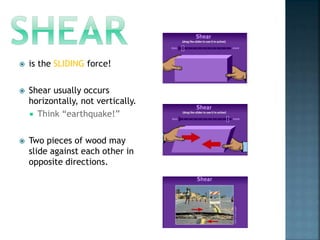
 is the SLIDING force!
 Shear usually occurs
horizontally, not vertically.
 Think “earthquake!”
 Two pieces of wood may
slide against each other in
opposite directions.
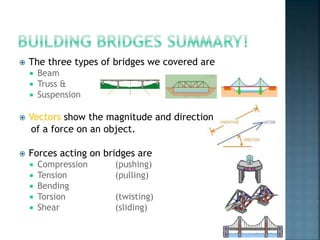
 The three types of bridges we covered are
 Beam
 Truss &
 Suspension
 Vectors show the magnitude and direction
of a force on an object.
 Forces acting on bridges are
 Compression (pushing)
 Tension (pulling)
 Bending
 Torsion (twisting)
 Shear (sliding)

Building-Bridges-PowerPoint-NXPowerLite.pptx

  • 1.
  • 2.
     A BRIDGEis a structure built to span physical obstacles such as a  body of water  valley  road  Designs of bridges vary depending on the  function of the bridge  nature of the terrain where the bridge is constructed, the  material used to make it and the funds available to build it.
  • 3.
     Famous BridgesExploration
  • 4.
    1. Beam bridgestructure 2. Beam bridge history 3. Beam bridge fun facts
  • 5.
     Beam bridgesare horizontal beams supported at each end by abutments; hence their structural name of simply supported  When there is more than one span the intermediate supports are known as piers or piles.
  • 6.
     The earliestbeam bridges were simple logs that sat across streams and similar simple structures  In modern times, beam bridges are large box steel girder bridges.  Weight on top of the beam pushes straight down on the abutments at either end of the bridge. THEN NOW
  • 7.
     Beam bridgespans typically do not exceed 250 feet (76 m) long, as the strength of a span decreases with increased length.  However, the main span of the Rio-Niteroi Bridge, a box girder bridge, is 300 meters (980 ft.).  The world's longest beam bridge is Lake Pontcharatrain Causeway in southern Louisiana in the United States, at 23.83 miles (38.35 km), with individual spans of 56 feet (17 m). Lake Pontcharatrain Causeway
  • 8.
    1. Truss bridgestructure 2. Truss bridge history 3. Truss bridge fun facts!
  • 9.
     A trussbridge is a bridge composed of connected elements (typically straight).  These elements may be stressed from tension, compression, or sometimes both in response to dynamic loads.
  • 10.
     Truss bridgesare one of the oldest types of modern bridges.  The basic types of truss bridges have simple designs which could be easily analyzed by nineteenth and early twentieth century engineers.
  • 11.
     A trussbridge is economical to construct owing to its efficient use of materials.
  • 12.
    1. Suspension bridgestructure 2. Suspension bridge history 3. Suspension bridge fun facts
  • 13.
     Suspension Bridgesare suspended from cables.  This type of bridge has cables suspended between towers, plus vertical suspender cables that carry the weight of the deck below. Shrek and Donkey
  • 14.
     The earliestsuspension bridges were made of ropes or vines covered with pieces of bamboo.  In modern bridges, the cables hang from towers that are attached to caissons or cofferdams. The caissons or cofferdams are implanted deep into the floor of a lake or river.
  • 15.
     Light andstrong, suspension bridges can span distances from 2,000 to 7,000 feet far longer than any other kind of bridge.  They are ideal for covering busy waterways.  The 1,991 meters (6,532 feet) Akashi Kaikya Bridge in Japan, also known as the Pearl Bridge, is he longest suspension bridge in the world. Akashi Kaikya
  • 16.
     A VECTORis not just a number! A vector is a quantity represented by an arrow with magnitude and direction.  The symbol for a vector is a capitol letter with a ray above it. Despicable Me: Vector
  • 17.
     Bridges experiencemany forces from many different directions. Architects and engineers must take these forces into account during bridge design and construction.  The forces that work on bridges will be represented by RED and BLUE vector arrows in the following slides!
  • 18.
    BEAM When something pushesdown on the beam, the beam bends. It’s top edge is pushed together, and its bottom edge is pulled apart. TRUSS Every bar in this bridge experiences either a pushing or pulling force. The bars rarely bend. This is why truss bridges can span farther than beam bridges. SUSPENSION The cars push down on the roadway, but because the roadway is suspended, the cables transfer the load into comprehension in the two towers. The two towers support most of the bridge's weight.
  • 19.
     is thePUSHING force.  A shorter piece of wood can withstand more compression force than a longer piece of wood.  A longer piece of wood may “buckle” and break from compression. Push!!
  • 20.
    • is thePULLING force! • The ability for wood to withstand tension does not depend on the length of the wood. • Wood has the ability to resist a lot of tension. Pull!! The vertical cables of a suspension bridge are in tension from the weight of the cars pushing down!
  • 21.
     forces causematerials to curve!  One end squeezes together while the other side stretches apart!  It is a combination of opposite forces.
  • 22.
     is theTWISTING force!  Think about it:  HOLD ONE END OF A PRETZEL STILL AND TWIST THE OTHER IT WILL BREAK EASILY  HOLD ONE END OF A BASEBALL BAT AND TWIST THE OTHER IT WILL NOT BREAK EASILY  HOLD ONE END OF A TWIZZLER AND TWIST THE OTHER IS WILL SPIN AND THEN BREAK EVENTUALLY  These are all examples of the TORSION force.
  • 23.
     is theSLIDING force!  Shear usually occurs horizontally, not vertically.  Think “earthquake!”  Two pieces of wood may slide against each other in opposite directions.
  • 24.
     The threetypes of bridges we covered are  Beam  Truss &  Suspension  Vectors show the magnitude and direction of a force on an object.  Forces acting on bridges are  Compression (pushing)  Tension (pulling)  Bending  Torsion (twisting)  Shear (sliding)

Editor's Notes

  • #2 Update some of the photos – grainy Add some animation to make information seem less cluttered and all at once More examples of history of bridges ---
  • #4 Note: Top link takes you to a list of famous bridges all over the world. Click on the thumbnail photos next to the description to see a larger picture. Point out the differing architecture styles of the various bridges. Even though bridges all have the same function they look drastically different from each other depending on which country they are in. Here’s a link to a second, shorter list of famous bridges. http://www.touropia.com/most-famous-bridges-in-the-world/