How To Be A

Secret Agent
^
change

Chris Farrell

Shawn Button

Agile Tour Toronto 2013
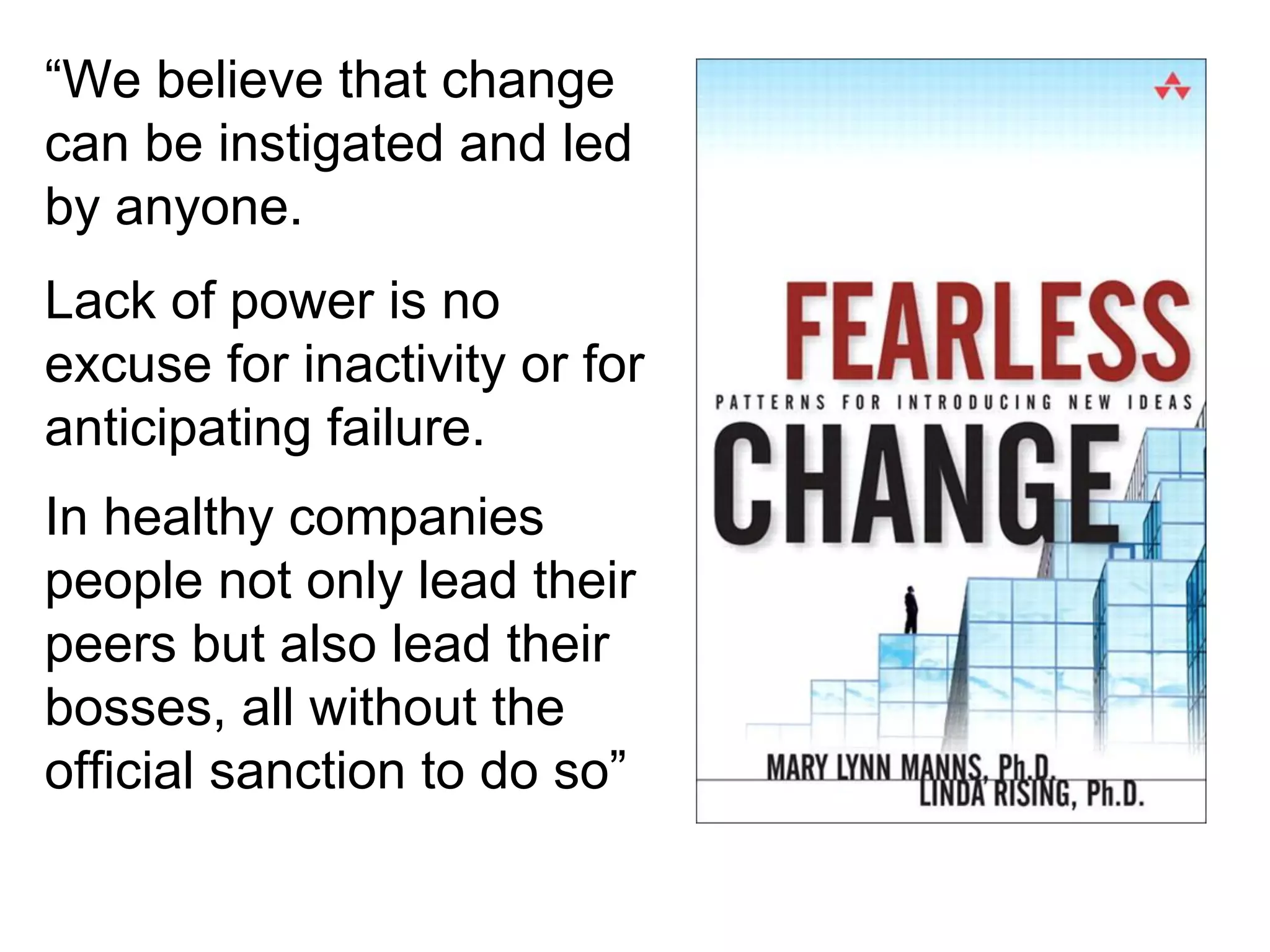
“We believe that change
can be instigated and led
by anyone.
Lack of power is no
excuse for inactivity or for
anticipating failure.
In healthy companies
people not only lead their
peers but also lead their
bosses, all without the
official sanction to do so”
Tools

•  We are going to introduce you to a lot
of tools that you can use to help
effect change.

•  We are not going to tell you what
changes you should make.

•  For more information on these tools

see the links section at the end of this
presentation or come speak to us.
Agenda

•  Introduction (you are here)

•  Fill in problem worksheets
•  Working With Your Company
•  Working With Others
•  Working On Yourself
•  References
Change Agent Worksheets
Think of three problems that you see in your
organization on a daily basis.
Examples:
Ineffective practices
Micromanaging boss
Introducing Scrum
Improving Collaboration
Making people aware of quality issues

• 
• 
• 
• 
• 
Working With
Your Company
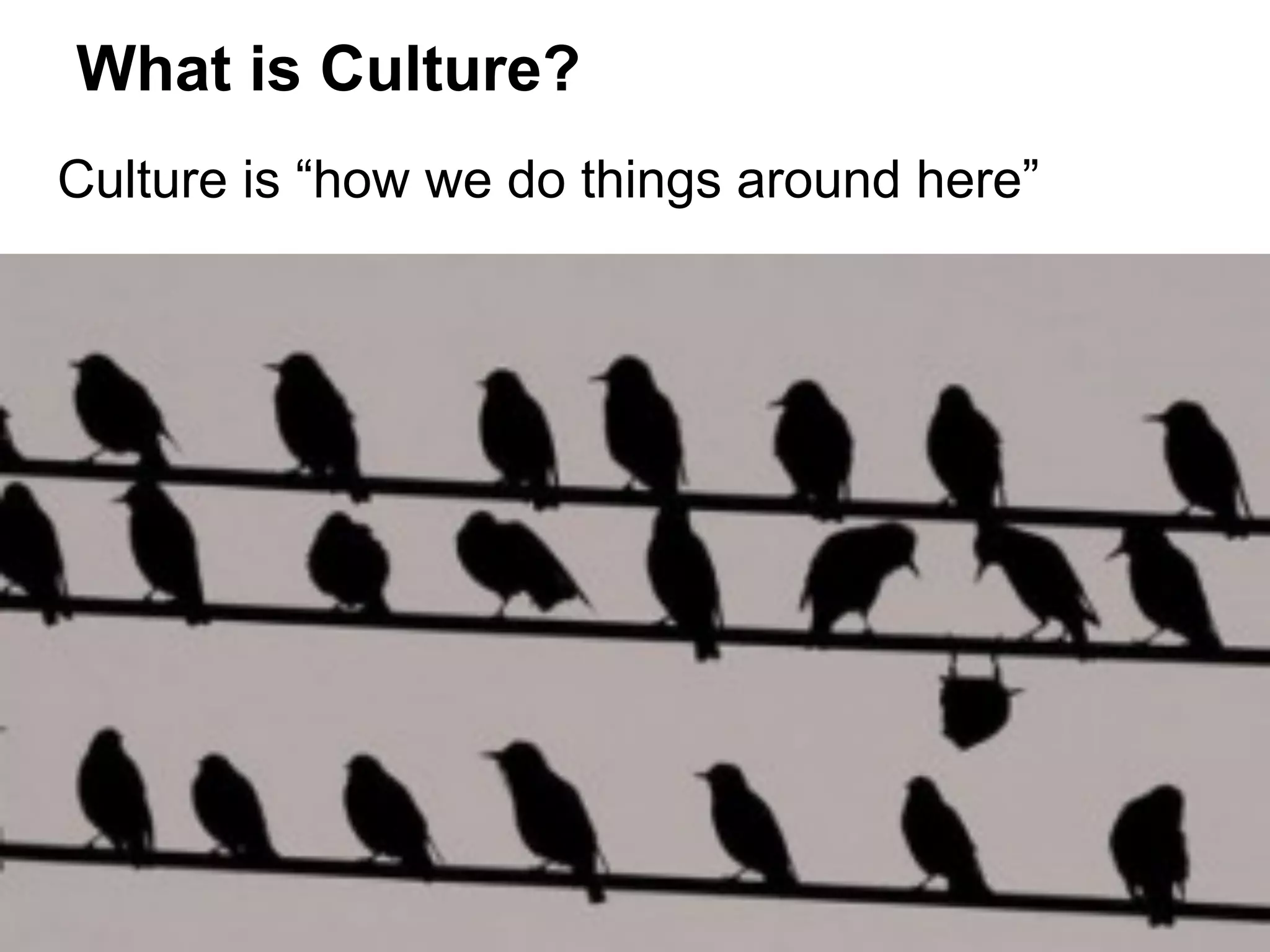
What is Culture?
Culture is “how we do things around here”
Culture is HARD
to Change

• “What these

[business] needs
require are changes
in behavior. But
“changing culture” is
not going to produce
them. Culture … is
singularly persistent.”
– Peter Drucker 1991
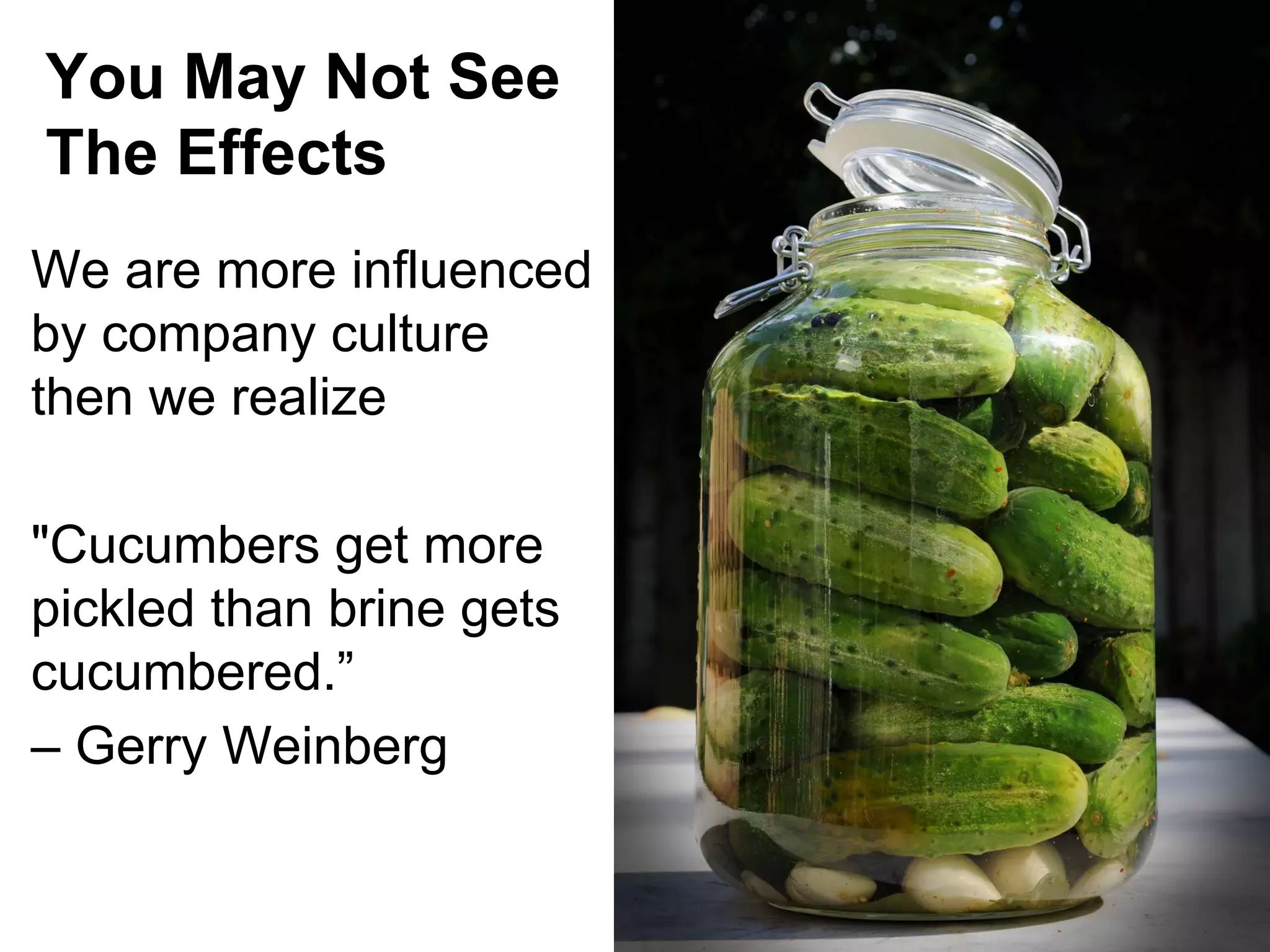
You May Not See
The Effects
We are more influenced
by company culture
then we realize
"Cucumbers get more
pickled than brine gets
cucumbered.”
– Gerry Weinberg
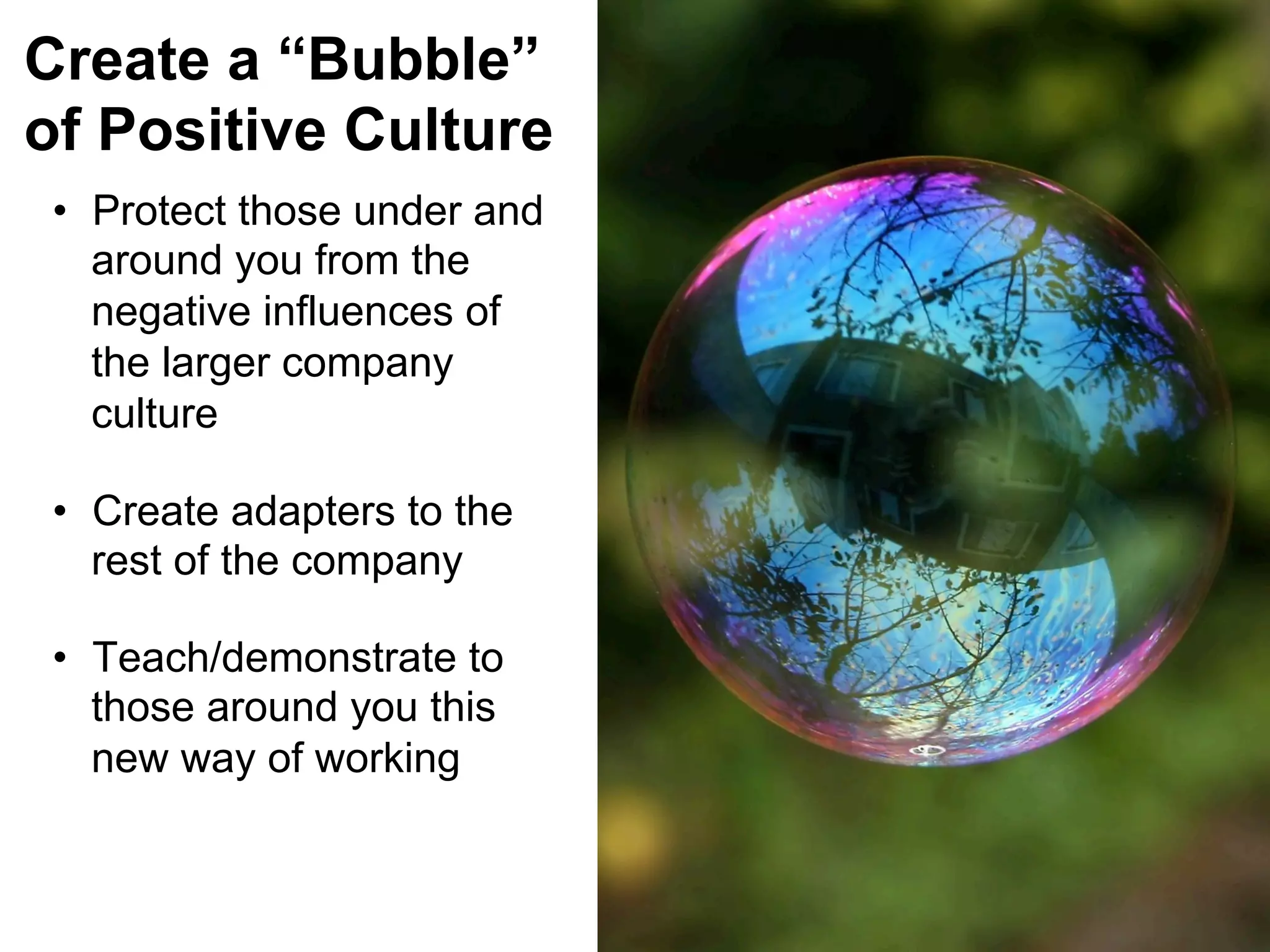
Create a “Bubble”
of Positive Culture
•  Protect those under and
around you from the
negative influences of
the larger company
culture
•  Create adapters to the
rest of the company
•  Teach/demonstrate to
those around you this
new way of working
Be aware that your culture bubble is fragile.
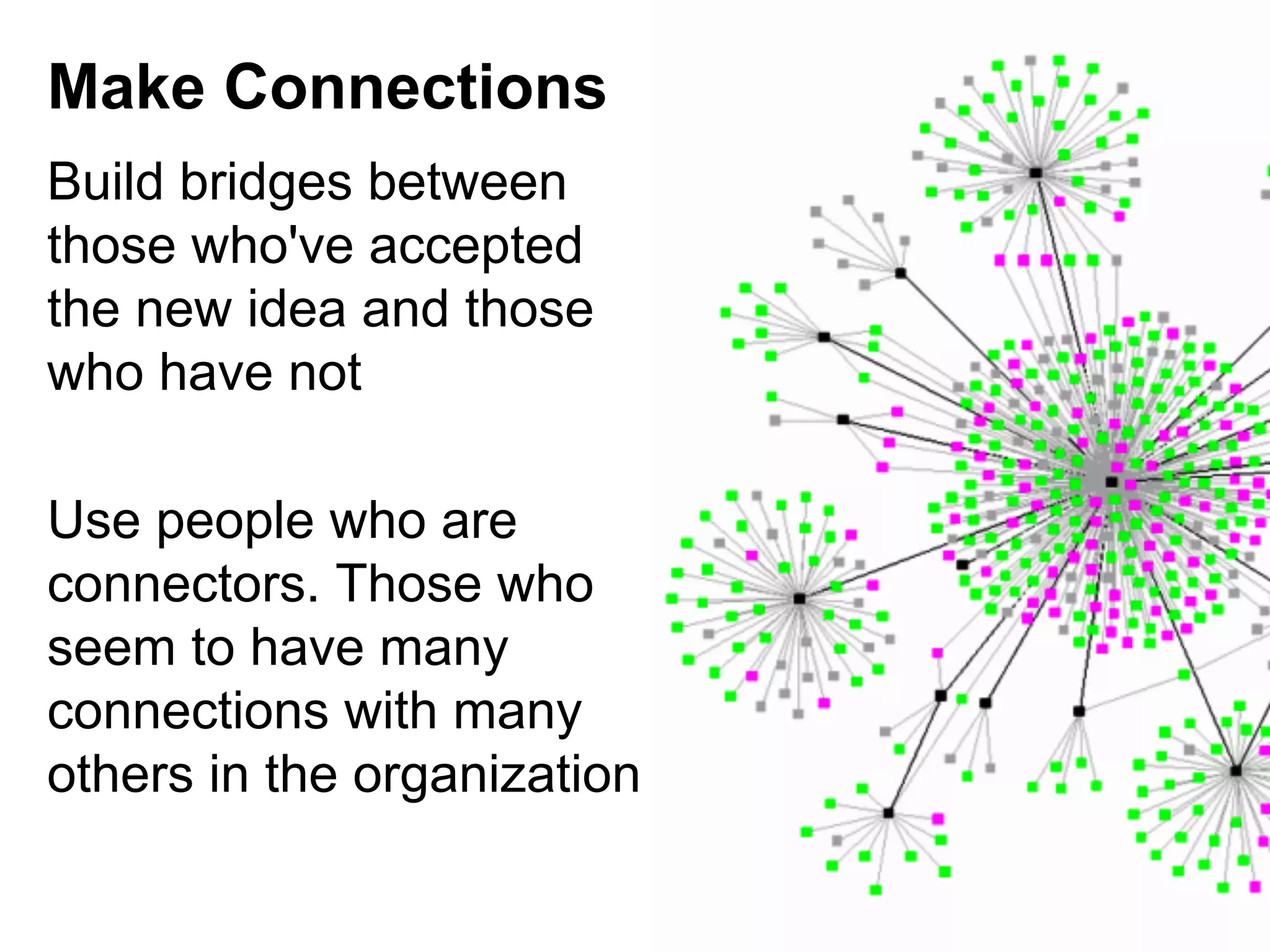
Make Connections
Build bridges between
those who've accepted
the new idea and those
who have not
Use people who are
connectors. Those who
seem to have many
connections with many
others in the organization
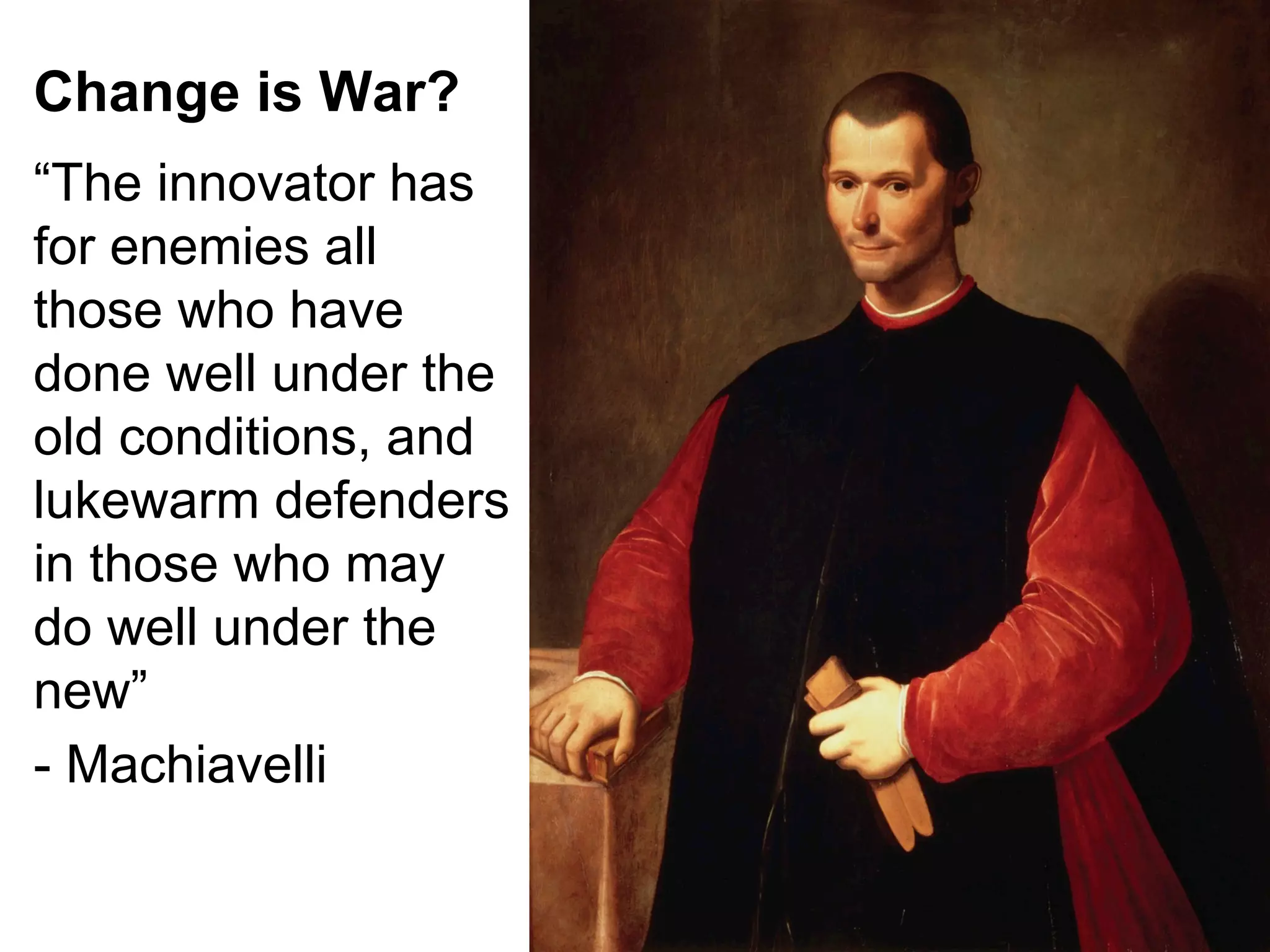
Change is War?
“The innovator has
for enemies all
those who have
done well under the
old conditions, and
lukewarm defenders
in those who may
do well under the
new”
- Machiavelli
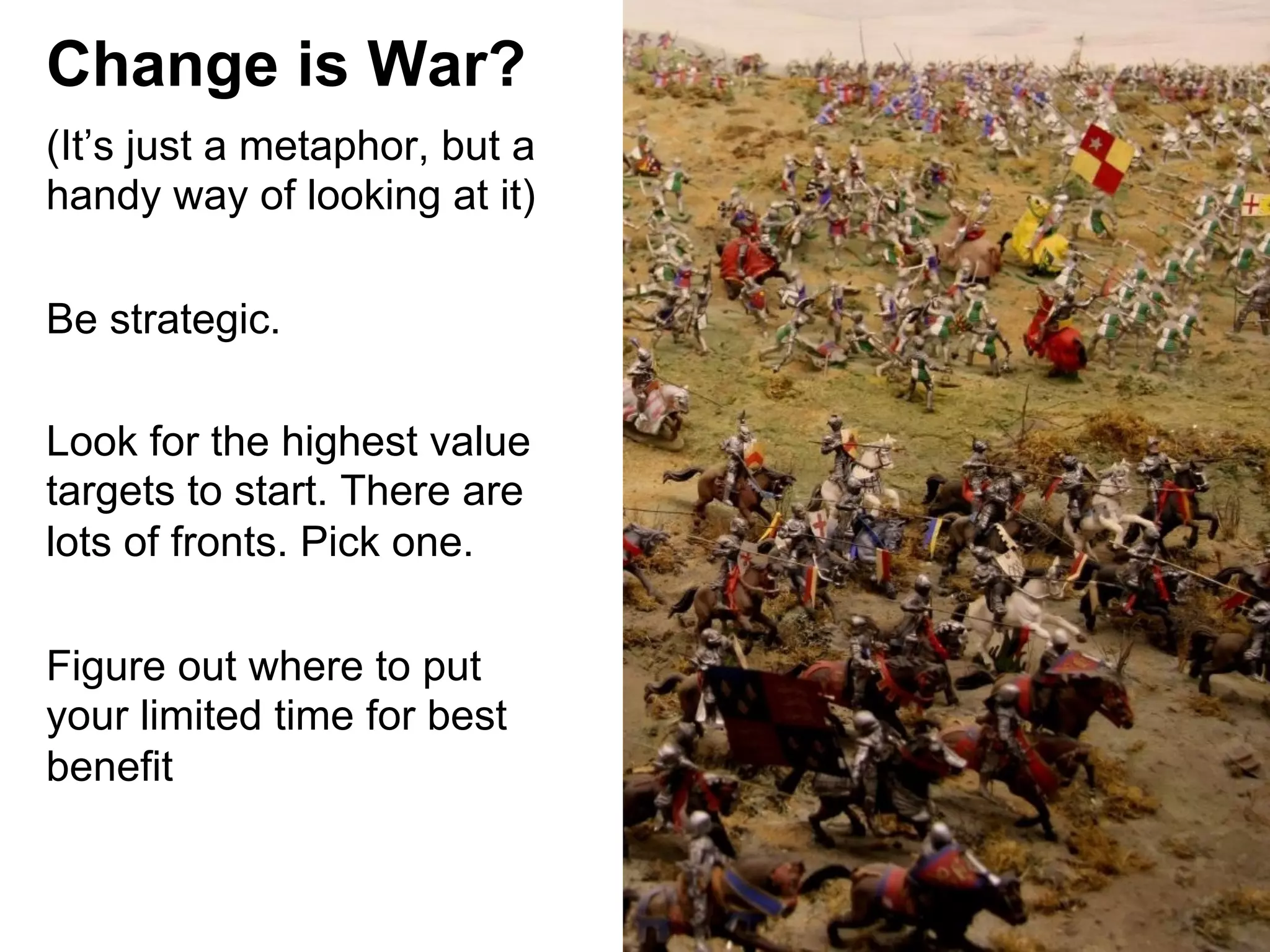
Change is War?
(It’s just a metaphor, but a
handy way of looking at it)
Be strategic.
Look for the highest value
targets to start. There are
lots of fronts. Pick one.
Figure out where to put
your limited time for best
benefit
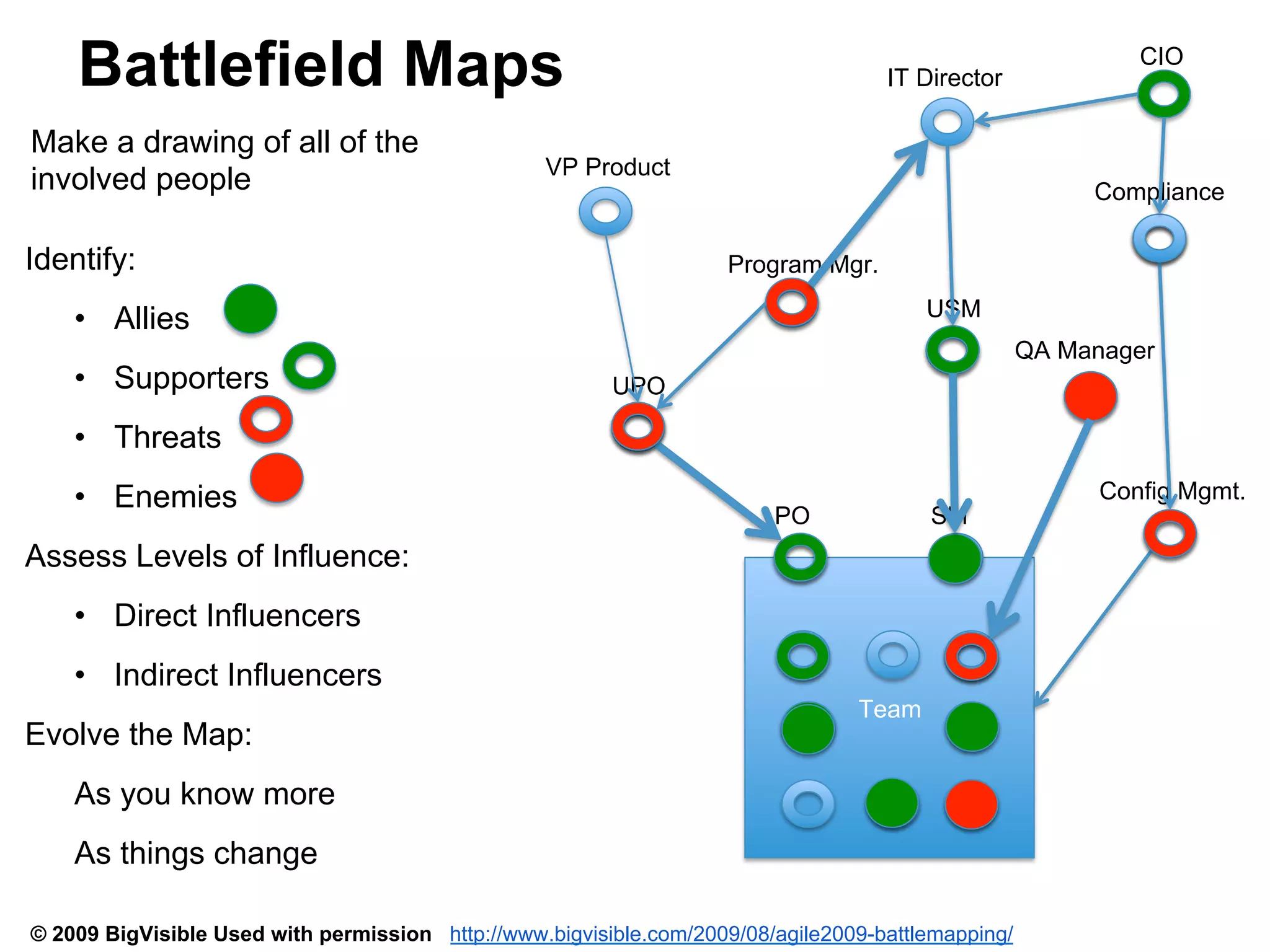
Battlefield Maps
Make a drawing of all of the
involved people

IT Director

VP Product

Identify:

Compliance
Program Mgr.
USM

•  Allies
•  Supporters

CIO

QA Manager
UPO

•  Threats
•  Enemies

PO

SM

Assess Levels of Influence:
•  Direct Influencers
•  Indirect Influencers
Evolve the Map:

Team

As you know more
As things change
© 2009 BigVisible Used with permission http://www.bigvisible.com/2009/08/agile2009-battlemapping/

Config Mgmt.
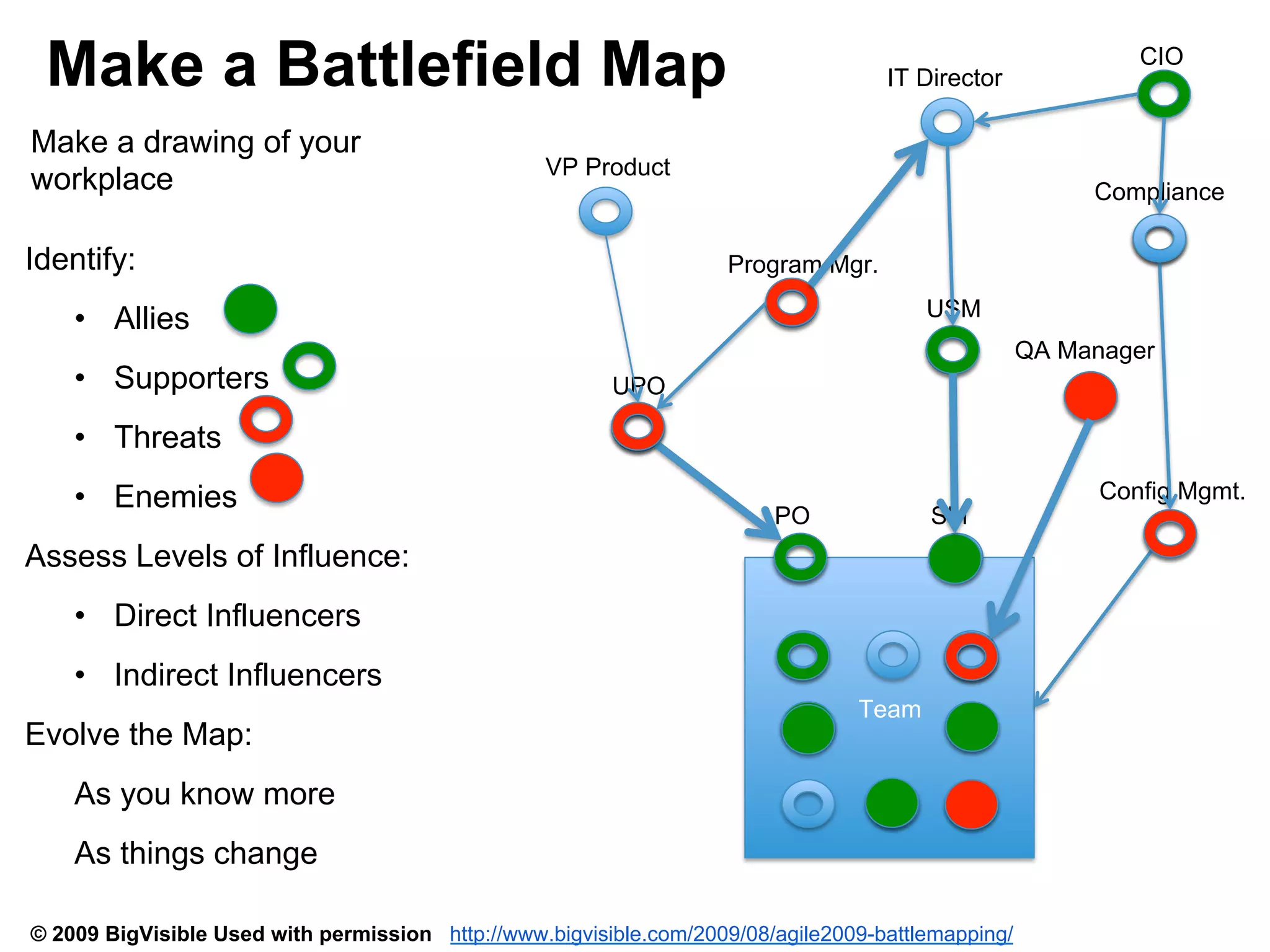
Make a Battlefield Map
Make a drawing of your
workplace

IT Director

VP Product

Identify:

Compliance
Program Mgr.
USM

•  Allies
•  Supporters

CIO

QA Manager
UPO

•  Threats
•  Enemies

PO

SM

Assess Levels of Influence:
•  Direct Influencers
•  Indirect Influencers
Evolve the Map:

Team

As you know more
As things change
© 2009 BigVisible Used with permission http://www.bigvisible.com/2009/08/agile2009-battlemapping/

Config Mgmt.
Working
With
Others
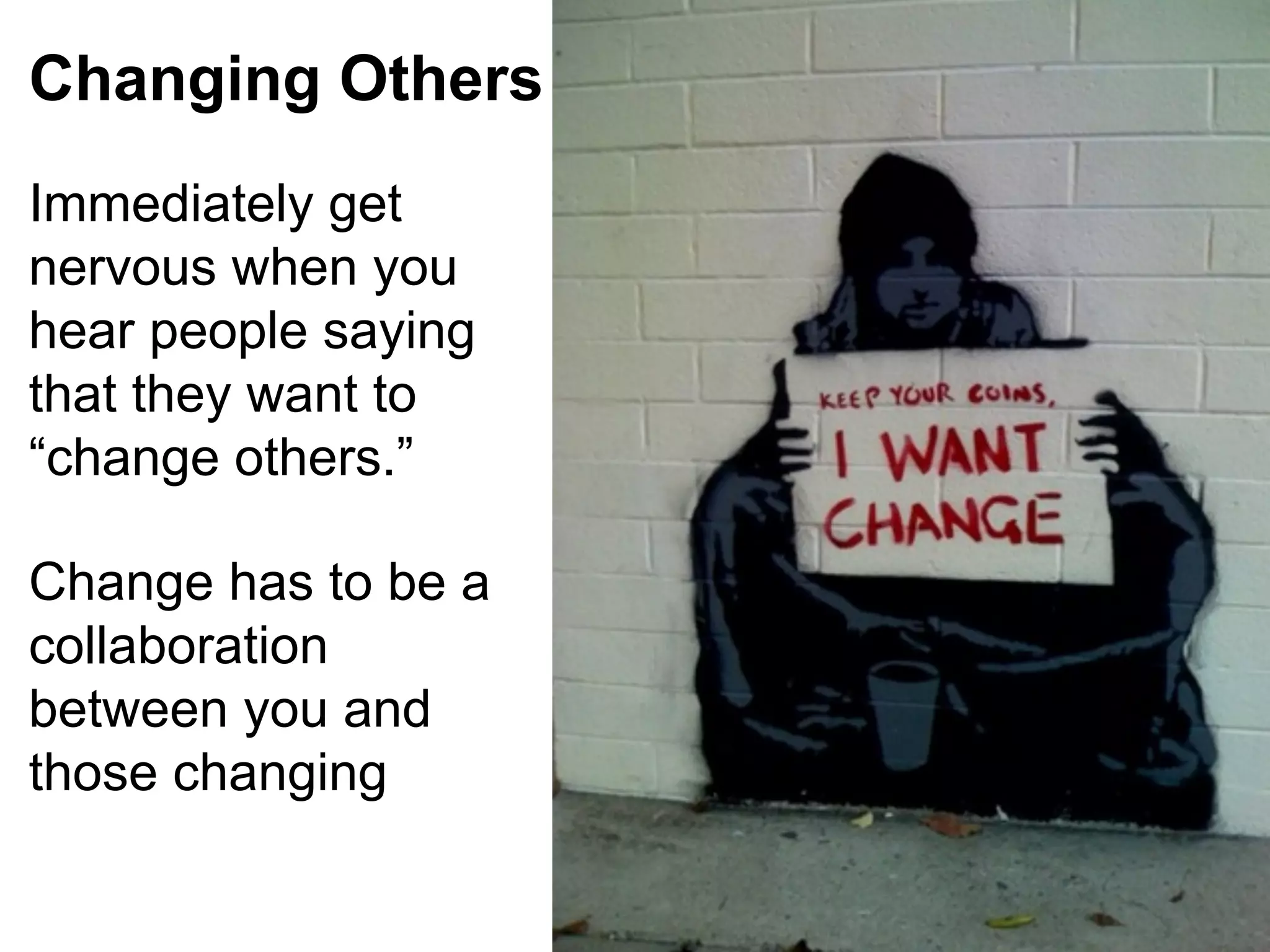
Changing Others
Immediately get
nervous when you
hear people saying
that they want to
“change others.”
Change has to be a
collaboration
between you and
those changing
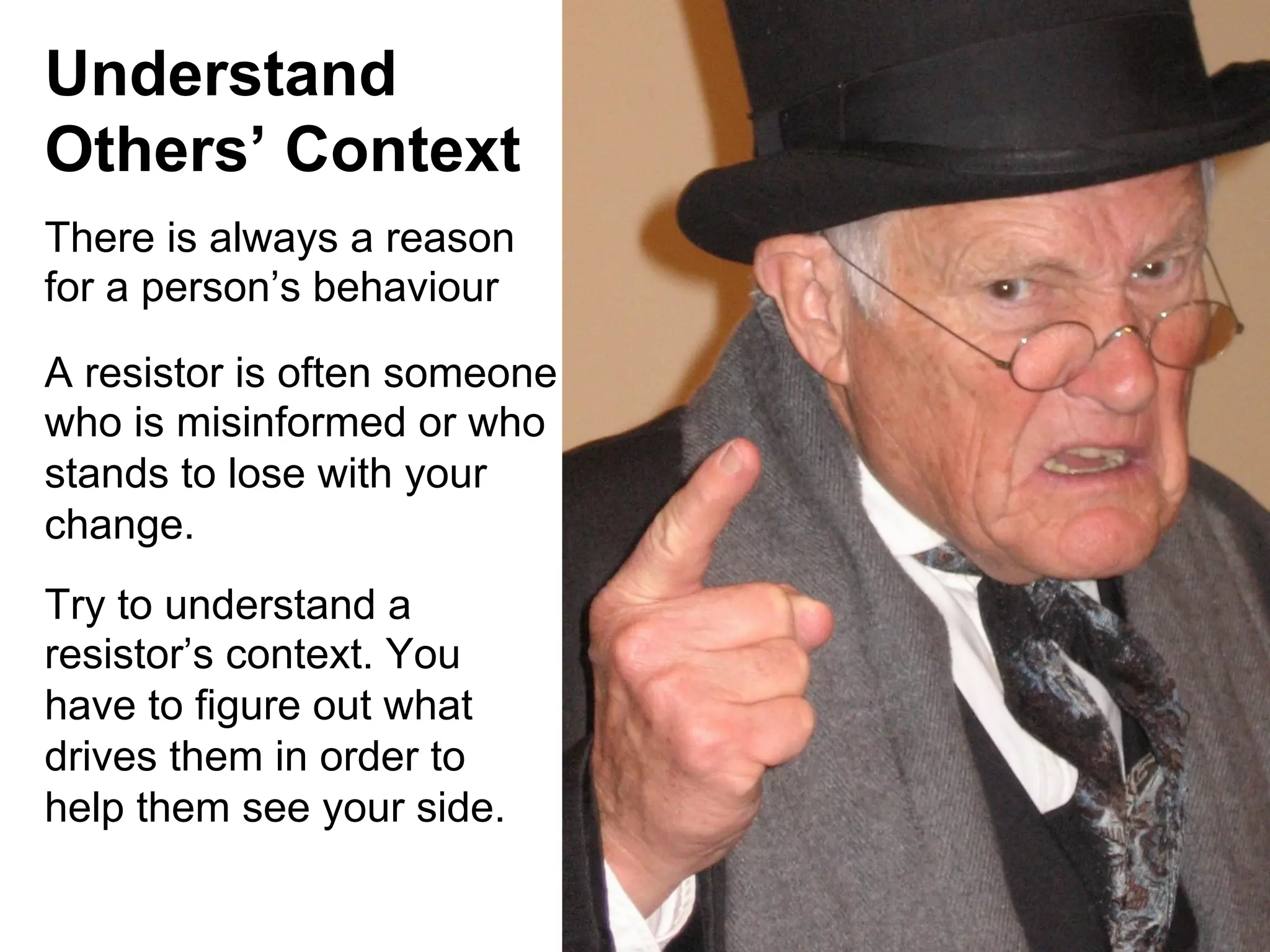
Understand
Others’ Context
There is always a reason
for a person’s behaviour
A resistor is often someone
who is misinformed or who
stands to lose with your
change.
Try to understand a
resistor’s context. You
have to figure out what
drives them in order to
help them see your side.
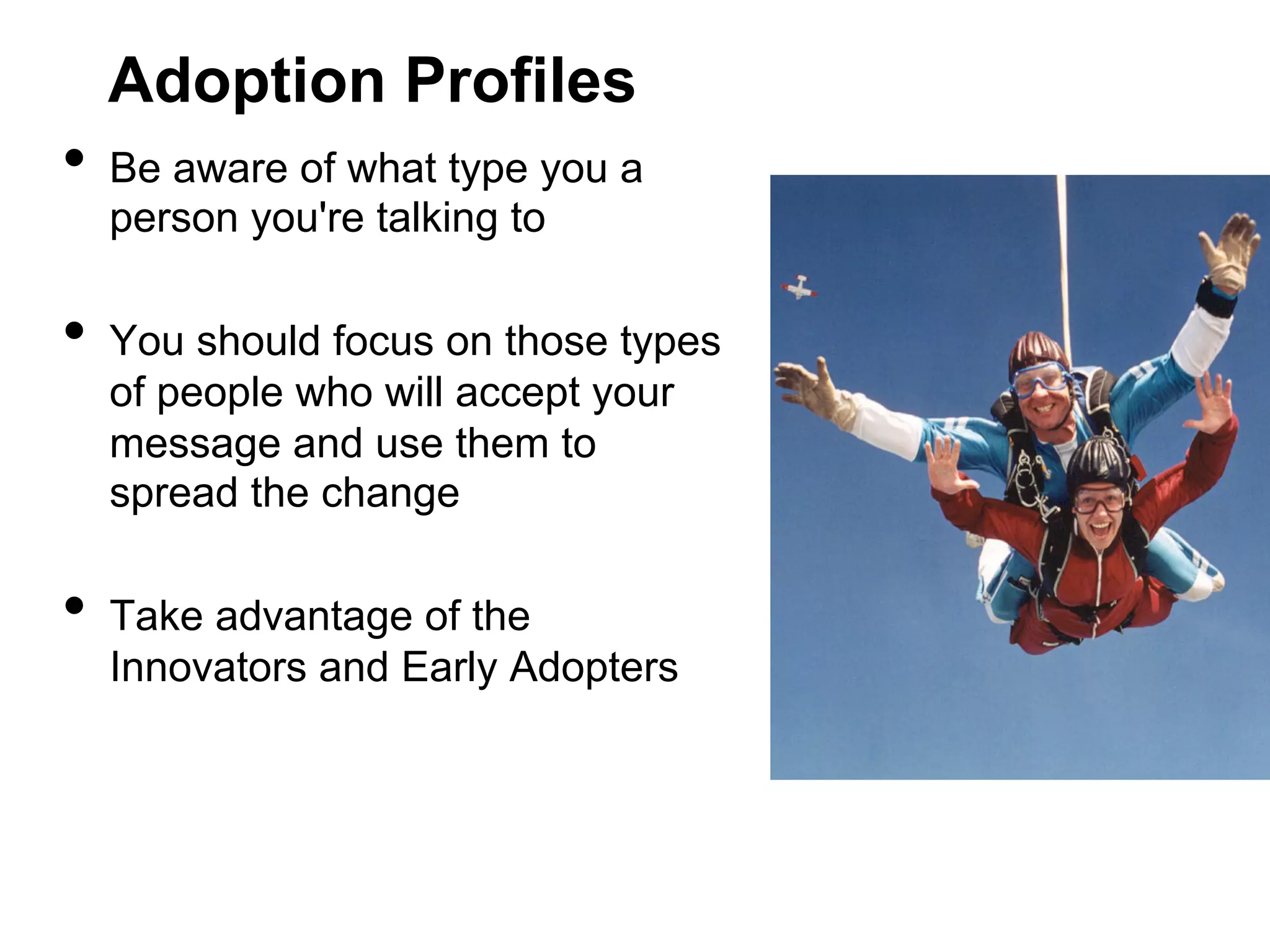
Adoption Profiles

•  Be aware of what type you a
person you're talking to

•  You should focus on those types
of people who will accept your
message and use them to
spread the change

•  Take advantage of the

Innovators and Early Adopters
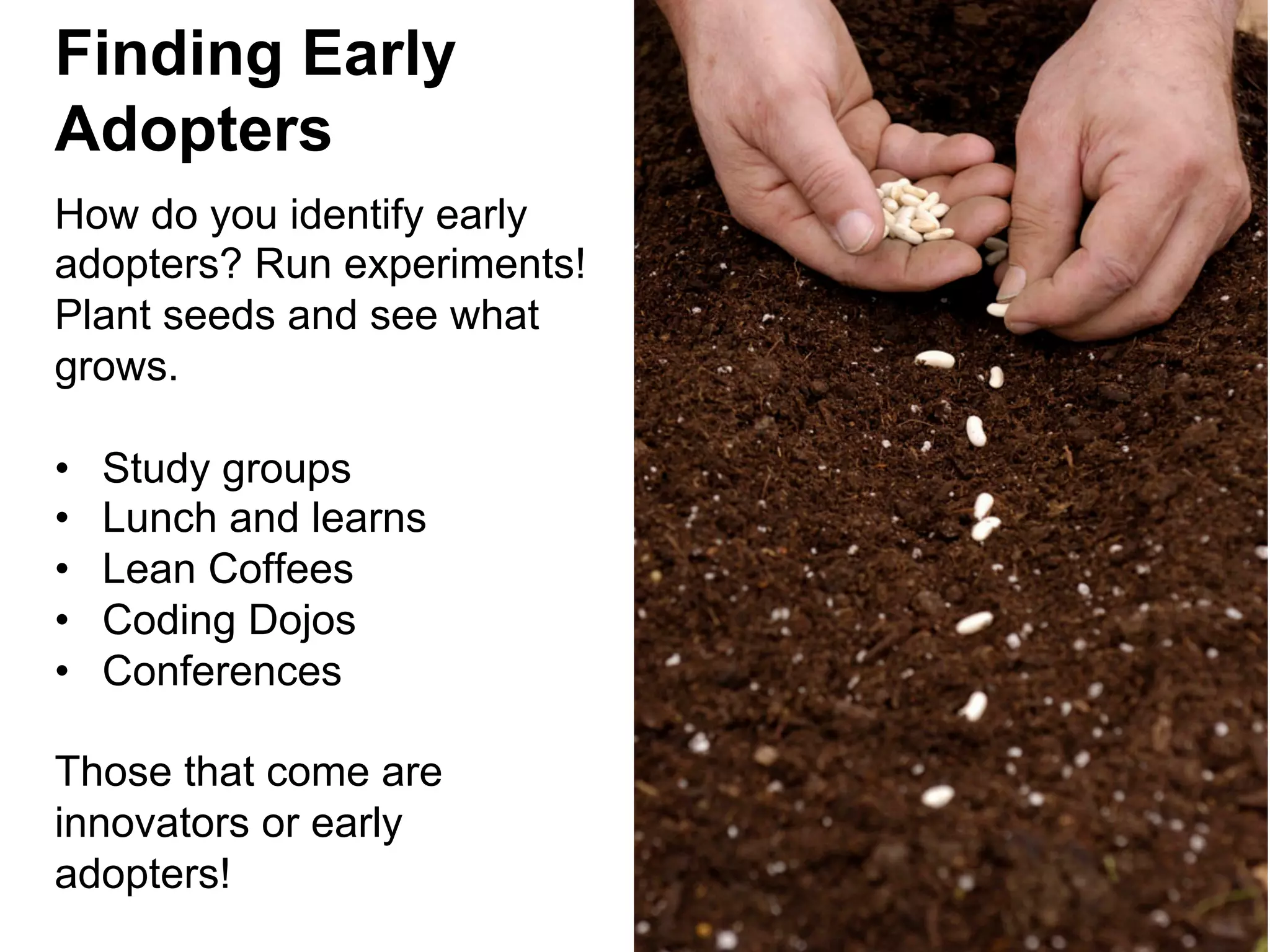
Finding Early
Adopters
How do you identify early
adopters? Run experiments!
Plant seeds and see what
grows.
• 
• 
• 
• 
• 

Study groups
Lunch and learns
Lean Coffees
Coding Dojos
Conferences

Those that come are
innovators or early
adopters!
Change Fatigue
People have different
tolerances for change. They
will resist your change if this
tolerance is exceeded. Give
them the space and time
they need.
Conserve your energy
and combat frustration.
People are better at
coping with change if they
have a hand in creating it.
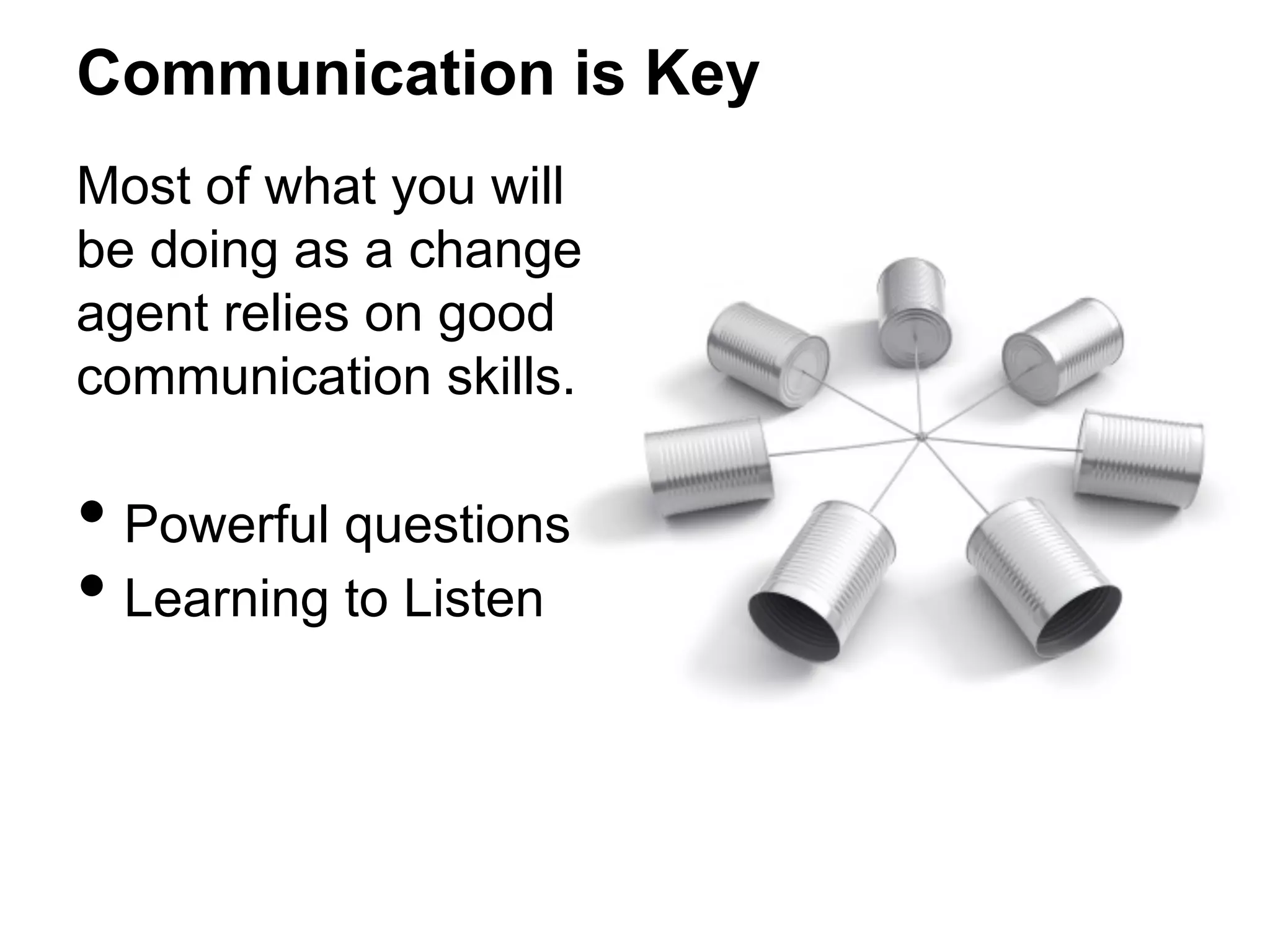
Communication is Key
Most of what you will
be doing as a change
agent relies on good
communication skills.

•  Powerful questions
•  Learning to Listen
Powerful Questions
Open-ended, provocative
questions designed to invite
the other person to clarity,
action, and discovery.
Examples:
What is an example?
What is possible?
How do you feel about it?
What is missing?

• 
• 
• 
• 
Learn to Really Listen
“Listening is the willingness to
change” - Dave Pasquesi (via
Todd Charon)

•  Truly listen
•  Tune in to non-verbal
• 

communication
Instead of “but” try saying “yes
and”
External Validation

•  People want assurance
• 
• 

an idea has validity
outside the organization.
Send out links to blog
posts, presentations,
conferences, etc.
Arrange for people to
spend time with big jolt
visitors.
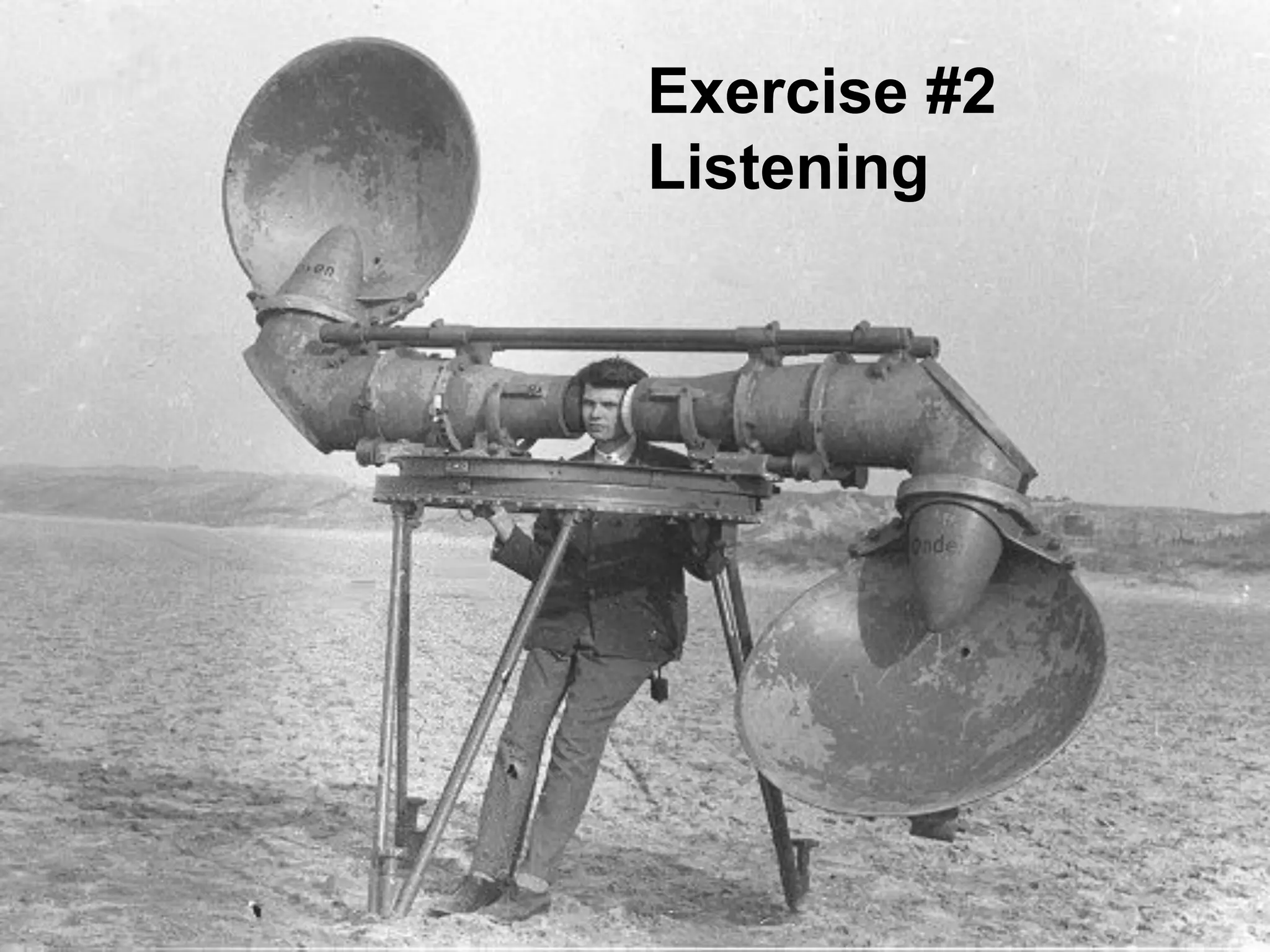
Exercise #2
Listening
Working
On
Yourself
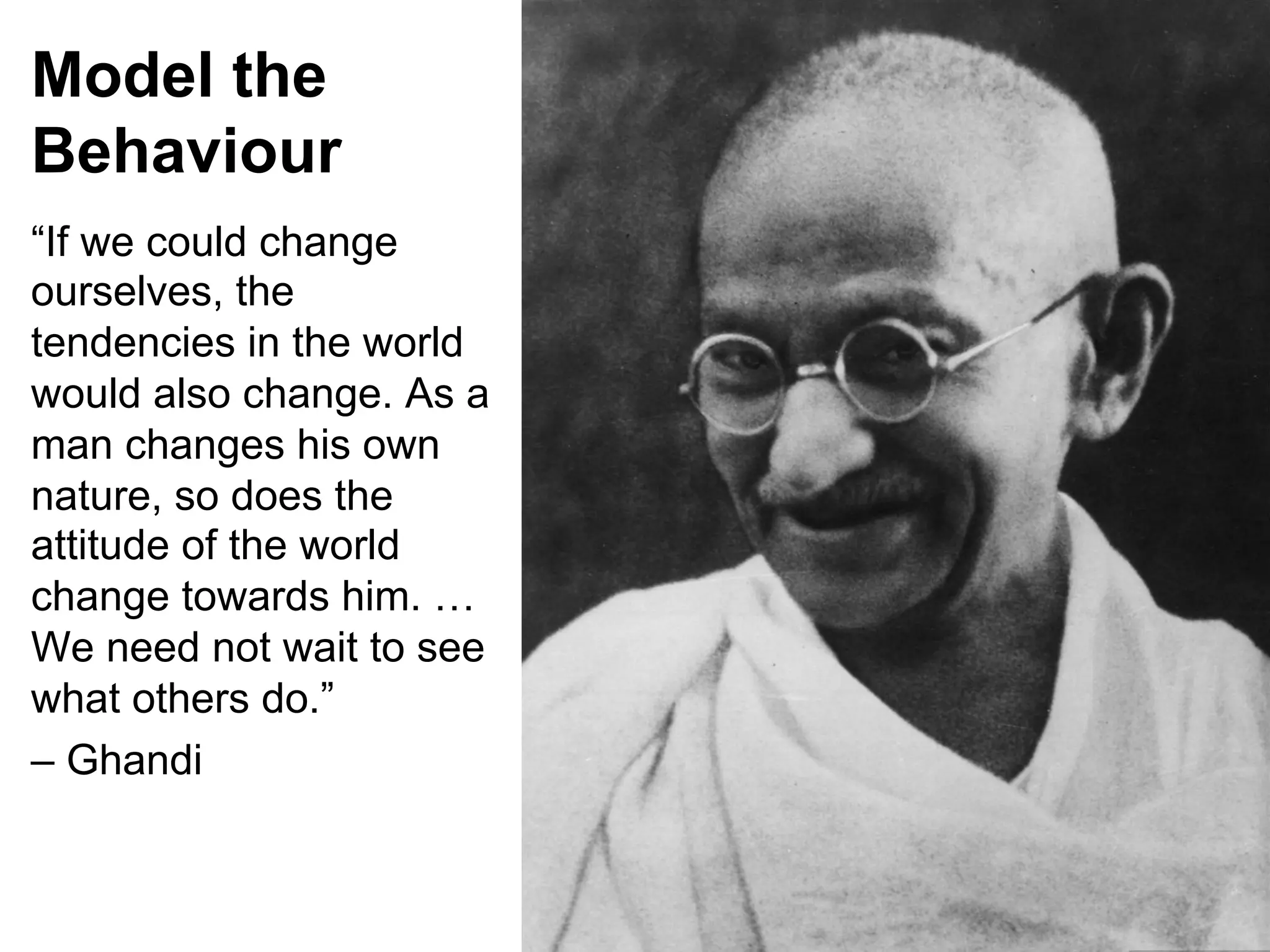
Model the
Behaviour
“If we could change
ourselves, the
tendencies in the world
would also change. As a
man changes his own
nature, so does the
attitude of the world
change towards him. …
We need not wait to see
what others do.”
– Ghandi
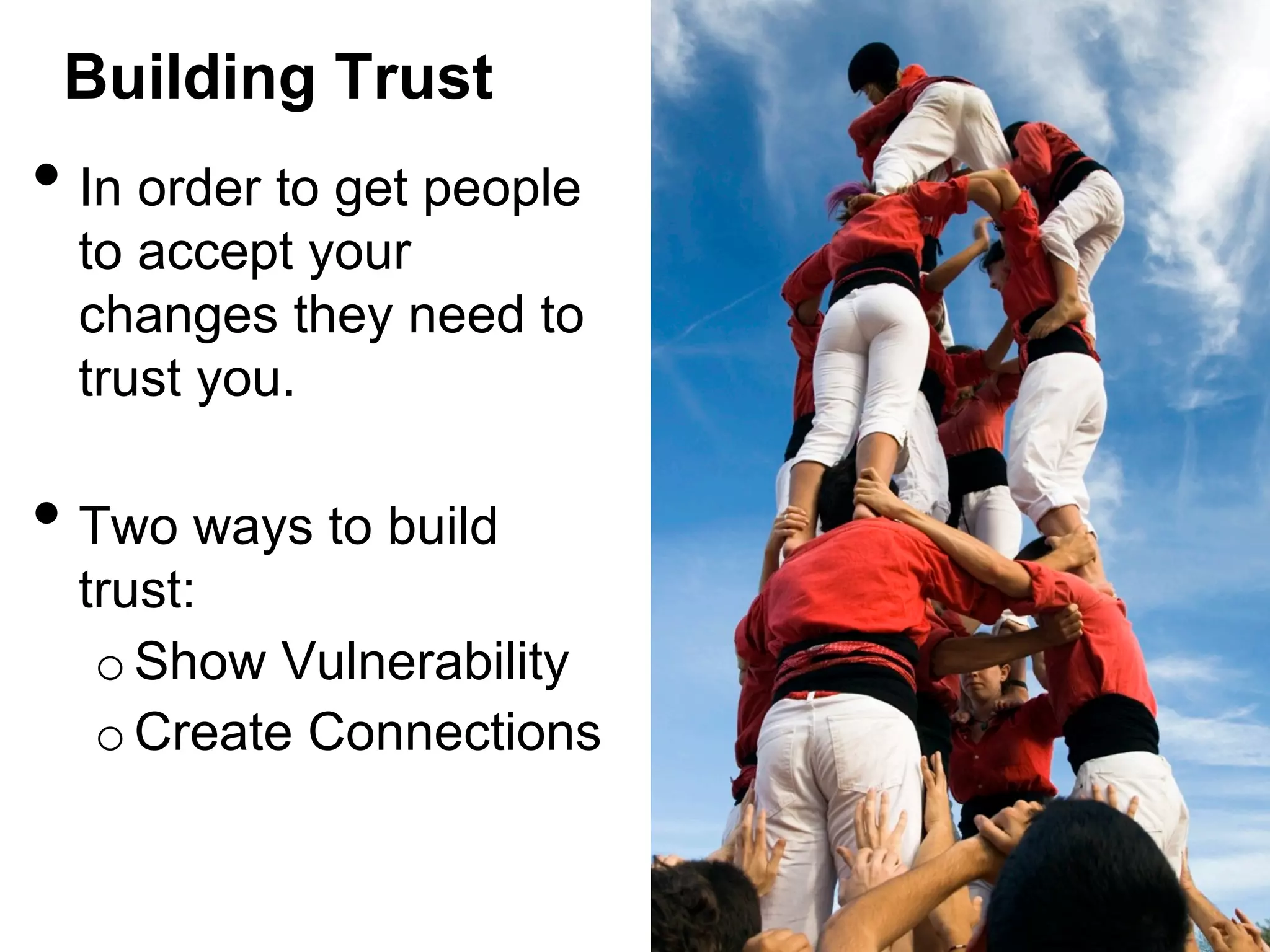
Building Trust

•  In order to get people

to accept your
changes they need to
trust you.

•  Two ways to build

trust:
o Show Vulnerability
o Create Connections
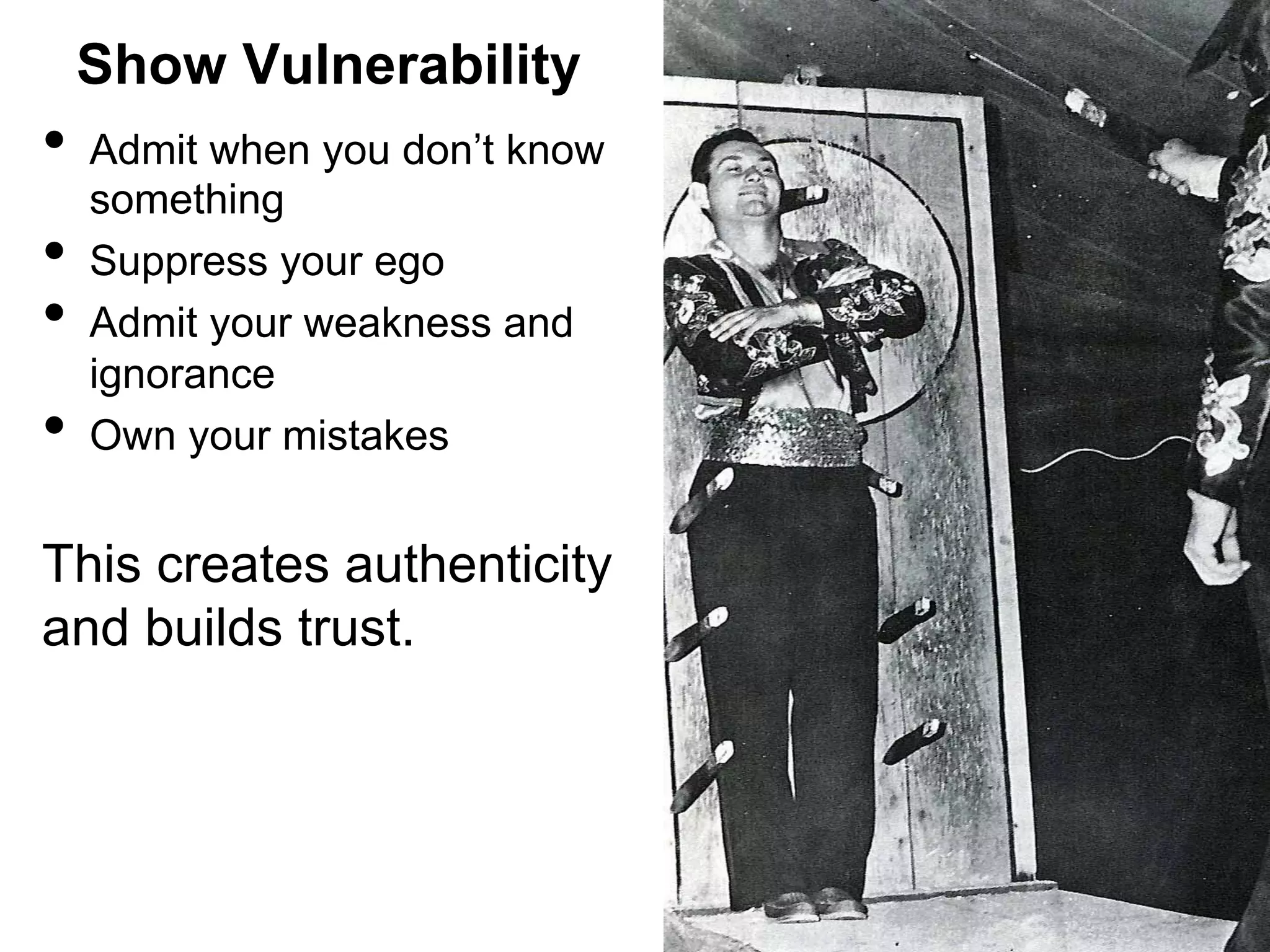
Show Vulnerability

•  Admit when you don’t know
• 
• 
• 

something
Suppress your ego
Admit your weakness and
ignorance
Own your mistakes

This creates authenticity
and builds trust.
Create Connections

•  Be empathetic
•  Take a personal interest
• 
• 

in people
Give genuine recognition
and praise
Be a Mentor
Seek help

•  Do not be afraid to
ask for help

o  Boss, co-worker,
outside people
o  Pair with others
whenever possible

•  Get a mentor or
coach
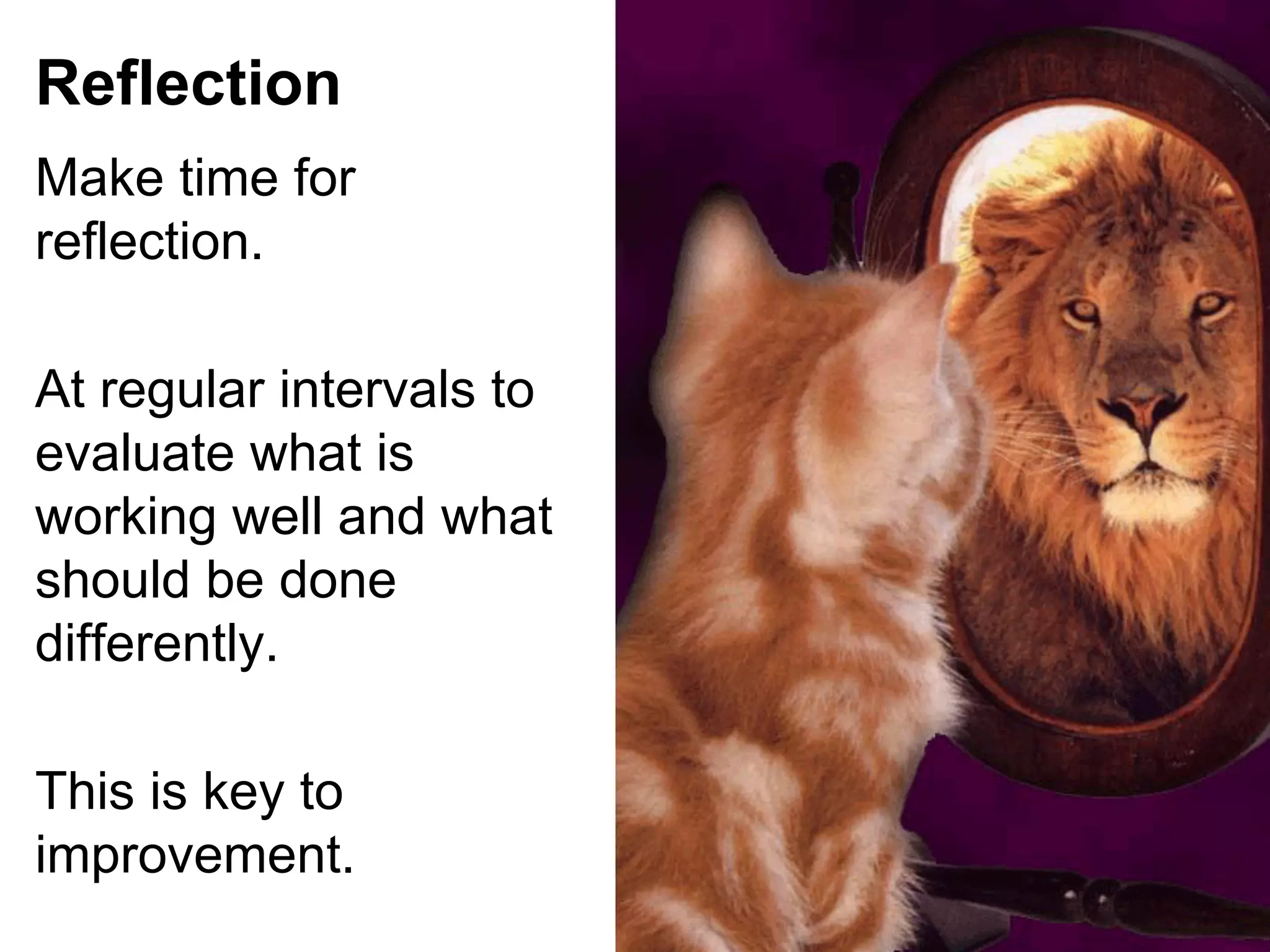
Reflection
Make time for
reflection.
At regular intervals to
evaluate what is
working well and what
should be done
differently.
This is key to
improvement.
Celebrate Success
Being a change agent
can be very very very
frustrating.
Celebrate even the
small things along the
way, instead of being
overwhelmed with all
the challenges.
Personal Effectiveness
Change is hard work.
Here are some tools
you can use to help.

•  Step by step
•  Personal kanban
•  Pomodoro
Technique
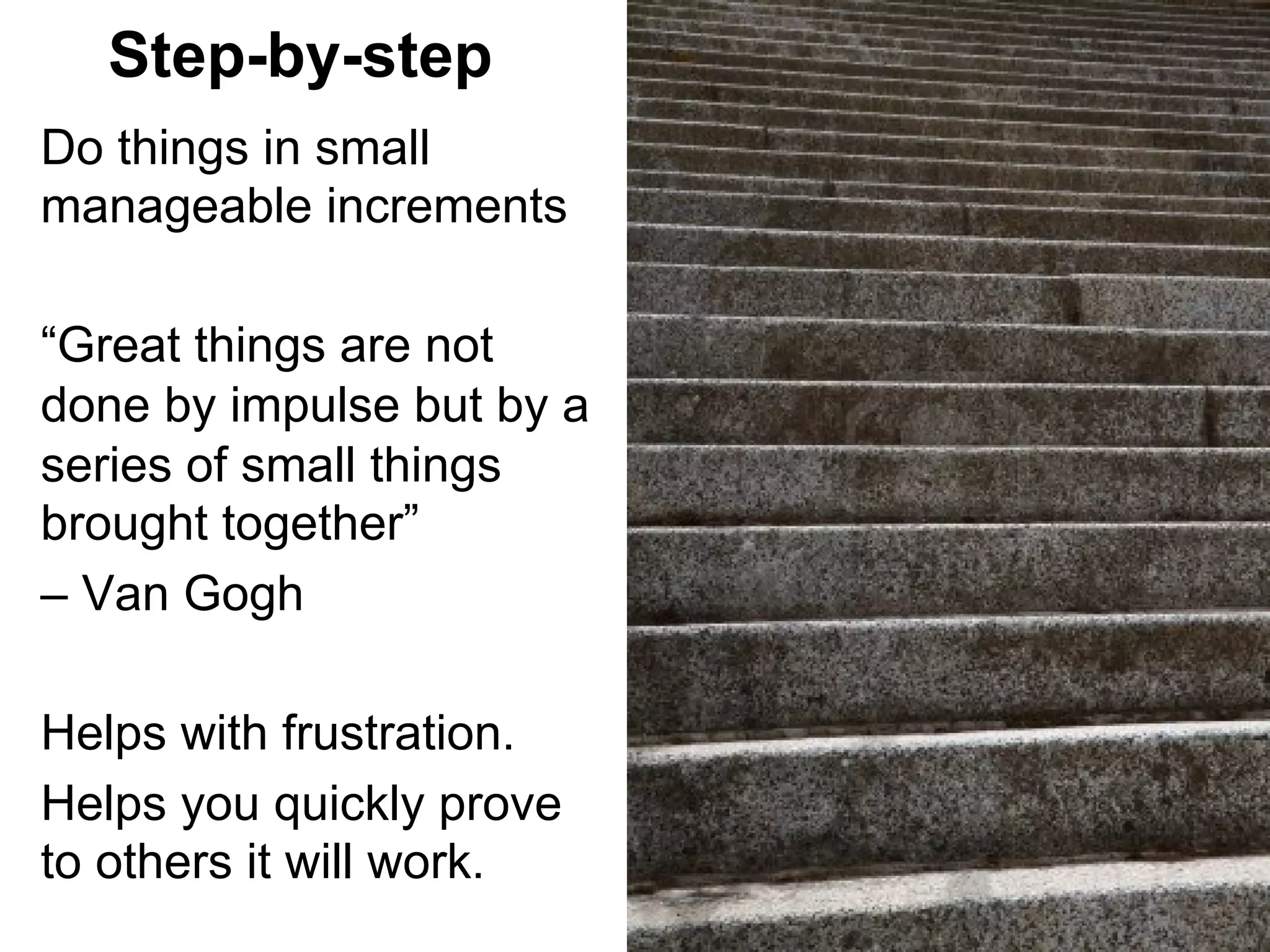
Step-by-step
Do things in small
manageable increments
“Great things are not
done by impulse but by a
series of small things
brought together”
– Van Gogh
Helps with frustration.
Helps you quickly prove
to others it will work.
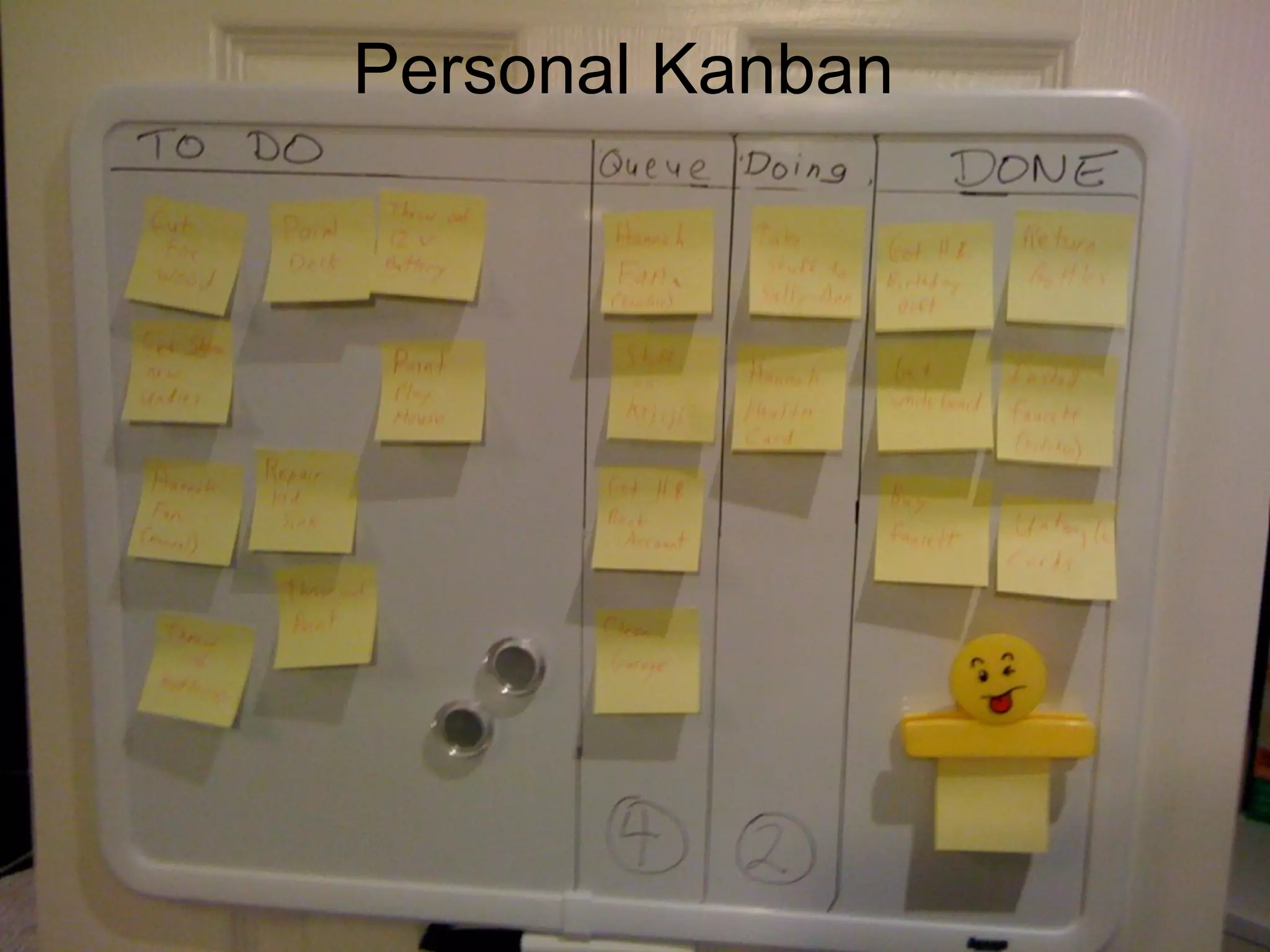
Personal Kanban
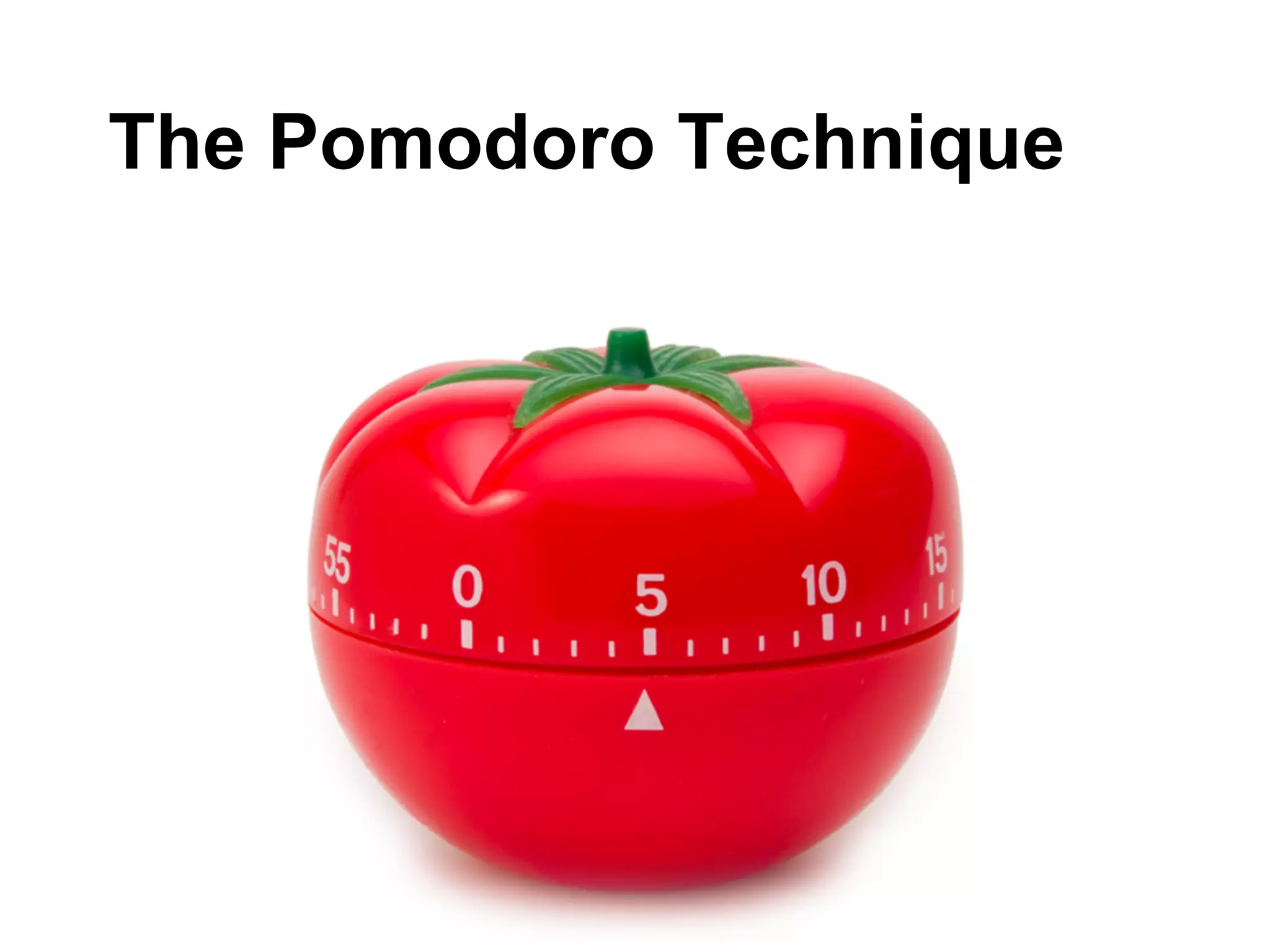
The Pomodoro Technique
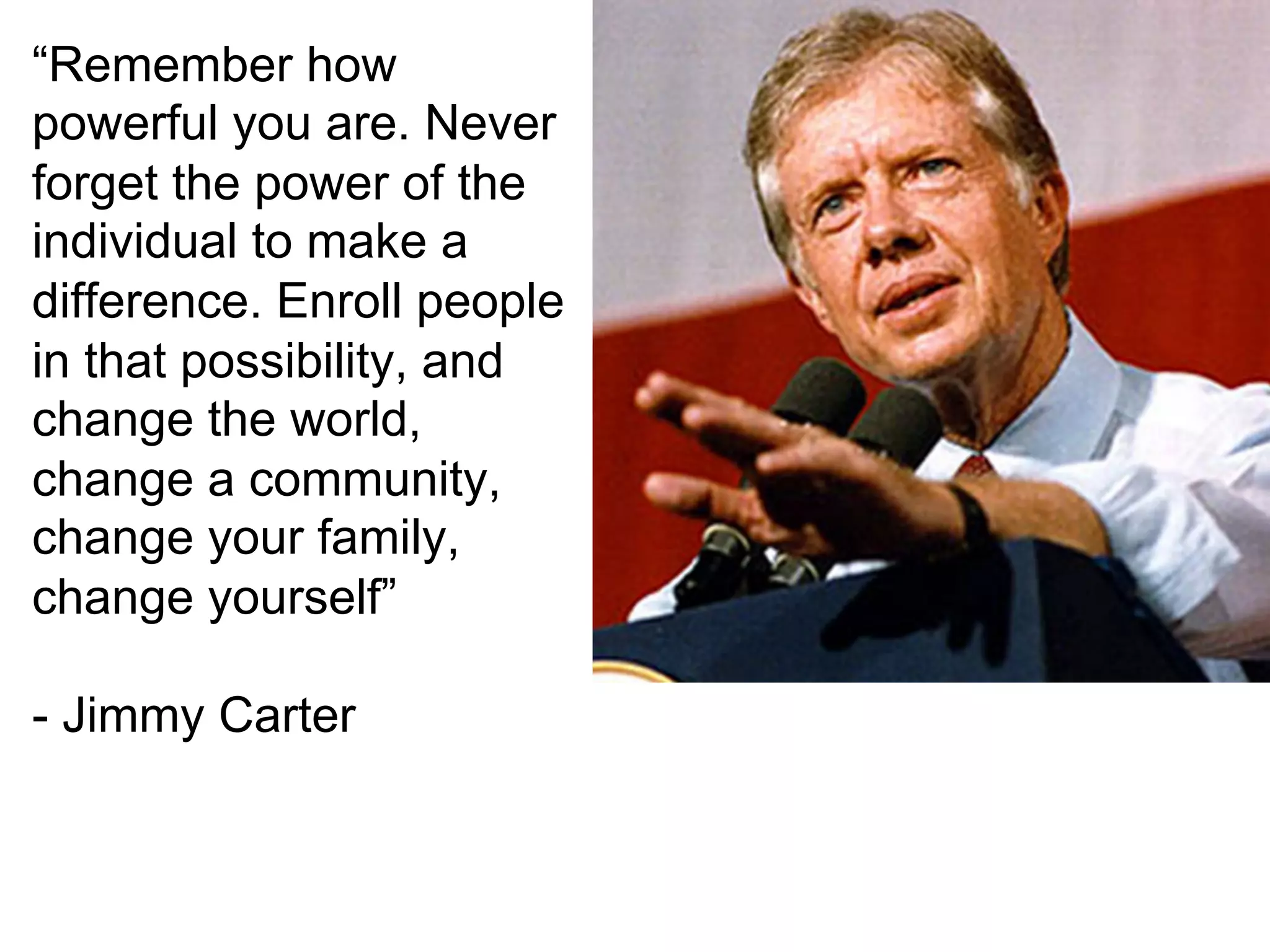
“Remember how
powerful you are. Never
forget the power of the
individual to make a
difference. Enroll people
in that possibility, and
change the world,
change a community,
change your family,
change yourself”
- Jimmy Carter
Exercise #3
Vulnerability Challenge
Everyone think of a
memorable story about
themselves
If you are comfortable
take turns sharing with
your group
Resources
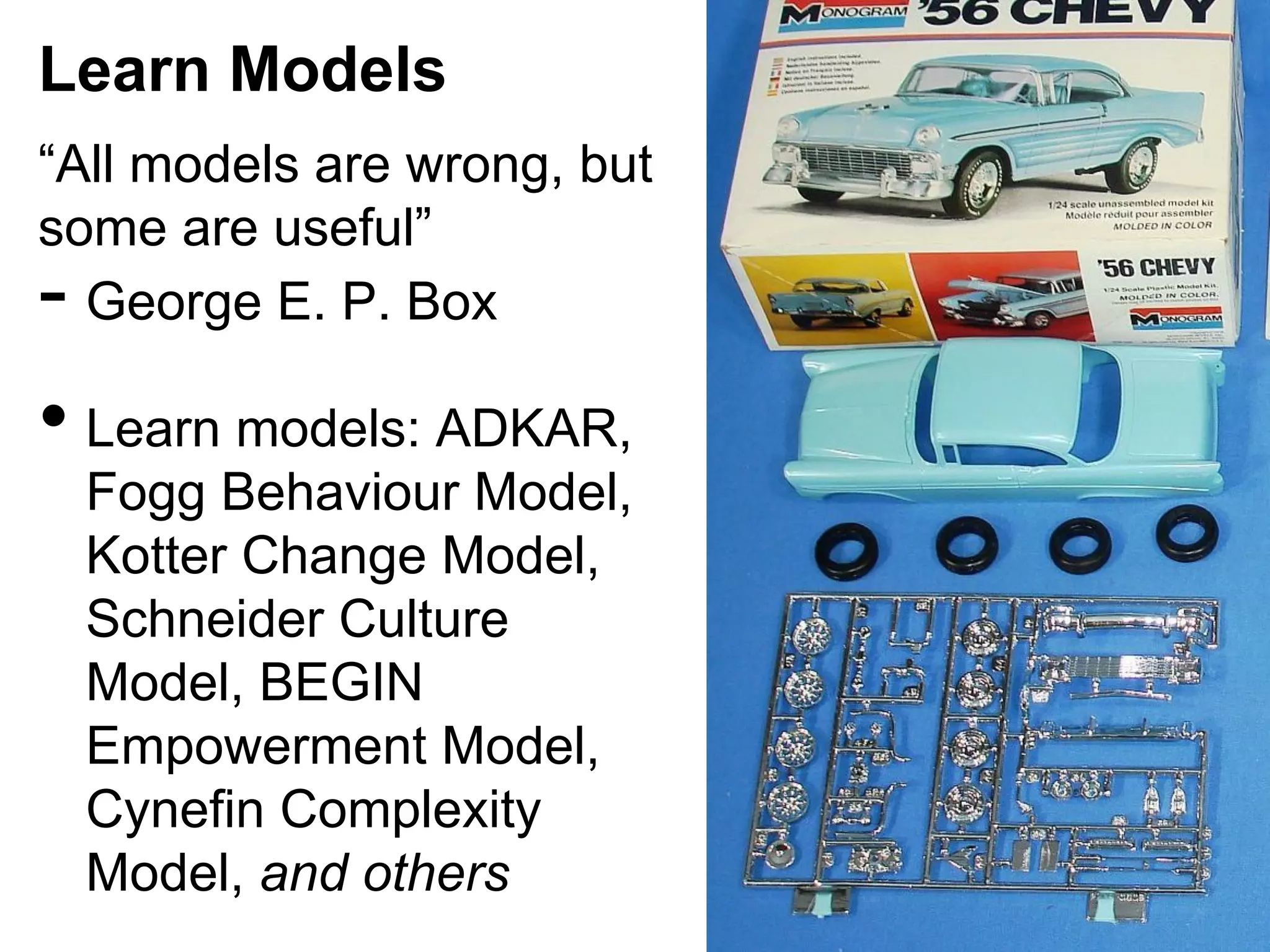
Learn Models
“All models are wrong, but
some are useful”
George E. P. Box

- 
•  Learn models: ADKAR,

Fogg Behaviour Model,
Kotter Change Model,
Schneider Culture
Model, BEGIN
Empowerment Model,
Cynefin Complexity
Model, and others
How To Be A

Secret Agent
^
change

Chris Farrell

Shawn Button

Agile Tour Toronto 2013
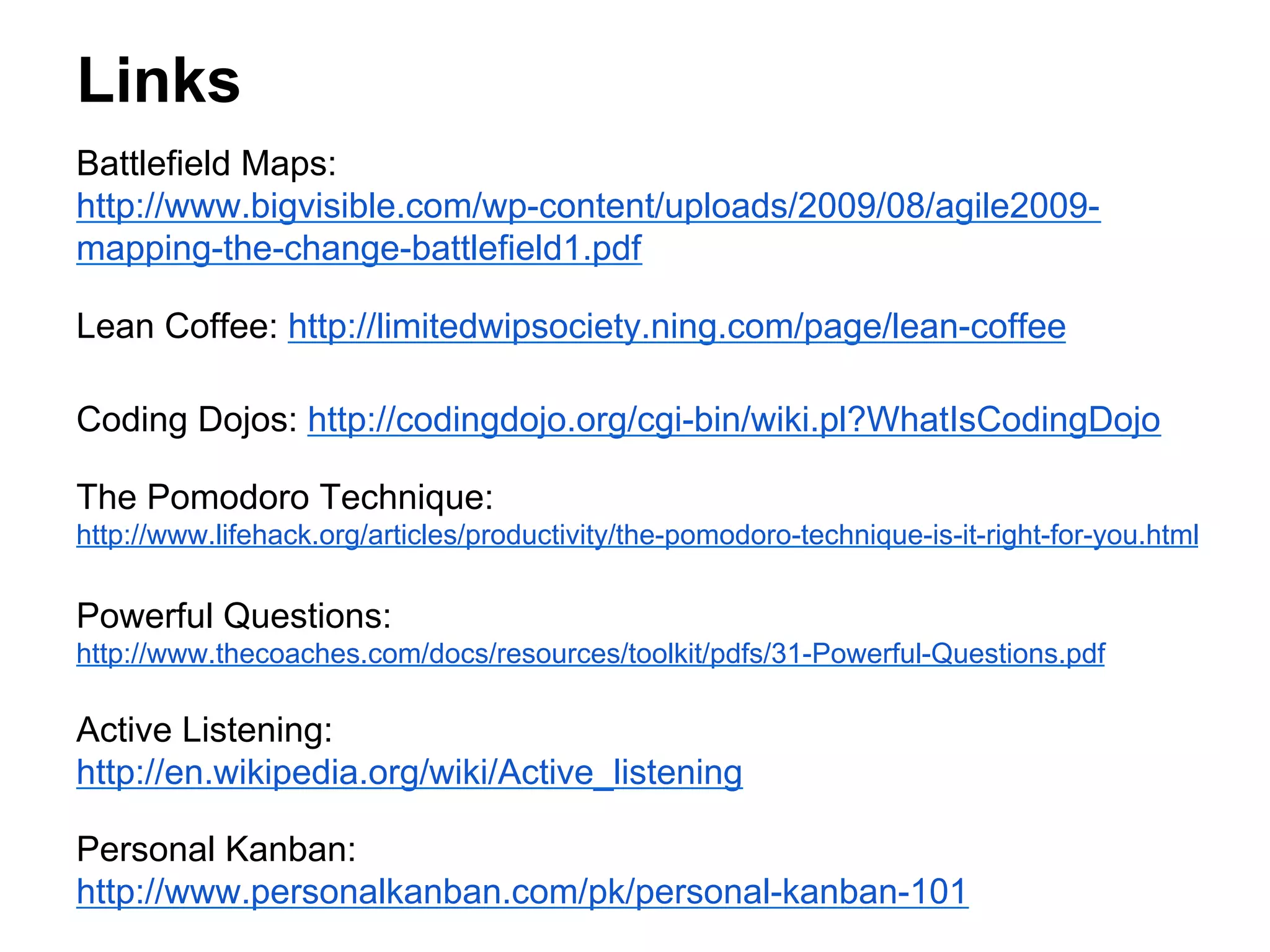
Links
Battlefield Maps:
http://www.bigvisible.com/wp-content/uploads/2009/08/agile2009mapping-the-change-battlefield1.pdf
Lean Coffee: http://limitedwipsociety.ning.com/page/lean-coffee
Coding Dojos: http://codingdojo.org/cgi-bin/wiki.pl?WhatIsCodingDojo
The Pomodoro Technique:
http://www.lifehack.org/articles/productivity/the-pomodoro-technique-is-it-right-for-you.html

Powerful Questions:
http://www.thecoaches.com/docs/resources/toolkit/pdfs/31-Powerful-Questions.pdf

Active Listening:
http://en.wikipedia.org/wiki/Active_listening
Personal Kanban:
http://www.personalkanban.com/pk/personal-kanban-101

How to be a secret change agent

  • 1.
    How To BeA Secret Agent ^ change Chris Farrell Shawn Button Agile Tour Toronto 2013
  • 3.
    “We believe thatchange can be instigated and led by anyone. Lack of power is no excuse for inactivity or for anticipating failure. In healthy companies people not only lead their peers but also lead their bosses, all without the official sanction to do so”
  • 4.
    Tools •  We aregoing to introduce you to a lot of tools that you can use to help effect change. •  We are not going to tell you what changes you should make. •  For more information on these tools see the links section at the end of this presentation or come speak to us.
  • 5.
    Agenda •  Introduction (youare here) •  Fill in problem worksheets •  Working With Your Company •  Working With Others •  Working On Yourself •  References
  • 6.
    Change Agent Worksheets Thinkof three problems that you see in your organization on a daily basis. Examples: Ineffective practices Micromanaging boss Introducing Scrum Improving Collaboration Making people aware of quality issues •  •  •  •  • 
  • 7.
  • 8.
    What is Culture? Cultureis “how we do things around here”
  • 9.
    Culture is HARD toChange • “What these [business] needs require are changes in behavior. But “changing culture” is not going to produce them. Culture … is singularly persistent.” – Peter Drucker 1991
  • 10.
    You May NotSee The Effects We are more influenced by company culture then we realize "Cucumbers get more pickled than brine gets cucumbered.” – Gerry Weinberg
  • 11.
    Create a “Bubble” ofPositive Culture •  Protect those under and around you from the negative influences of the larger company culture •  Create adapters to the rest of the company •  Teach/demonstrate to those around you this new way of working
  • 12.
    Be aware thatyour culture bubble is fragile.
  • 13.
    Make Connections Build bridgesbetween those who've accepted the new idea and those who have not Use people who are connectors. Those who seem to have many connections with many others in the organization
  • 14.
    Change is War? “Theinnovator has for enemies all those who have done well under the old conditions, and lukewarm defenders in those who may do well under the new” - Machiavelli
  • 15.
    Change is War? (It’sjust a metaphor, but a handy way of looking at it) Be strategic. Look for the highest value targets to start. There are lots of fronts. Pick one. Figure out where to put your limited time for best benefit
  • 16.
    Battlefield Maps Make adrawing of all of the involved people IT Director VP Product Identify: Compliance Program Mgr. USM •  Allies •  Supporters CIO QA Manager UPO •  Threats •  Enemies PO SM Assess Levels of Influence: •  Direct Influencers •  Indirect Influencers Evolve the Map: Team As you know more As things change © 2009 BigVisible Used with permission http://www.bigvisible.com/2009/08/agile2009-battlemapping/ Config Mgmt.
  • 17.
    Make a BattlefieldMap Make a drawing of your workplace IT Director VP Product Identify: Compliance Program Mgr. USM •  Allies •  Supporters CIO QA Manager UPO •  Threats •  Enemies PO SM Assess Levels of Influence: •  Direct Influencers •  Indirect Influencers Evolve the Map: Team As you know more As things change © 2009 BigVisible Used with permission http://www.bigvisible.com/2009/08/agile2009-battlemapping/ Config Mgmt.
  • 18.
  • 19.
    Changing Others Immediately get nervouswhen you hear people saying that they want to “change others.” Change has to be a collaboration between you and those changing
  • 20.
    Understand Others’ Context There isalways a reason for a person’s behaviour A resistor is often someone who is misinformed or who stands to lose with your change. Try to understand a resistor’s context. You have to figure out what drives them in order to help them see your side.
  • 21.
    Adoption Profiles •  Beaware of what type you a person you're talking to •  You should focus on those types of people who will accept your message and use them to spread the change •  Take advantage of the Innovators and Early Adopters
  • 22.
    Finding Early Adopters How doyou identify early adopters? Run experiments! Plant seeds and see what grows. •  •  •  •  •  Study groups Lunch and learns Lean Coffees Coding Dojos Conferences Those that come are innovators or early adopters!
  • 23.
    Change Fatigue People havedifferent tolerances for change. They will resist your change if this tolerance is exceeded. Give them the space and time they need. Conserve your energy and combat frustration. People are better at coping with change if they have a hand in creating it.
  • 24.
    Communication is Key Mostof what you will be doing as a change agent relies on good communication skills. •  Powerful questions •  Learning to Listen
  • 25.
    Powerful Questions Open-ended, provocative questionsdesigned to invite the other person to clarity, action, and discovery. Examples: What is an example? What is possible? How do you feel about it? What is missing? •  •  •  • 
  • 26.
    Learn to ReallyListen “Listening is the willingness to change” - Dave Pasquesi (via Todd Charon) •  Truly listen •  Tune in to non-verbal •  communication Instead of “but” try saying “yes and”
  • 27.
    External Validation •  Peoplewant assurance •  •  an idea has validity outside the organization. Send out links to blog posts, presentations, conferences, etc. Arrange for people to spend time with big jolt visitors.
  • 28.
  • 29.
  • 30.
    Model the Behaviour “If wecould change ourselves, the tendencies in the world would also change. As a man changes his own nature, so does the attitude of the world change towards him. … We need not wait to see what others do.” – Ghandi
  • 31.
    Building Trust •  Inorder to get people to accept your changes they need to trust you. •  Two ways to build trust: o Show Vulnerability o Create Connections
  • 32.
    Show Vulnerability •  Admitwhen you don’t know •  •  •  something Suppress your ego Admit your weakness and ignorance Own your mistakes This creates authenticity and builds trust.
  • 33.
    Create Connections •  Beempathetic •  Take a personal interest •  •  in people Give genuine recognition and praise Be a Mentor
  • 34.
    Seek help •  Donot be afraid to ask for help o  Boss, co-worker, outside people o  Pair with others whenever possible •  Get a mentor or coach
  • 35.
    Reflection Make time for reflection. Atregular intervals to evaluate what is working well and what should be done differently. This is key to improvement.
  • 36.
    Celebrate Success Being achange agent can be very very very frustrating. Celebrate even the small things along the way, instead of being overwhelmed with all the challenges.
  • 37.
    Personal Effectiveness Change ishard work. Here are some tools you can use to help. •  Step by step •  Personal kanban •  Pomodoro Technique
  • 38.
    Step-by-step Do things insmall manageable increments “Great things are not done by impulse but by a series of small things brought together” – Van Gogh Helps with frustration. Helps you quickly prove to others it will work.
  • 39.
  • 40.
  • 41.
    “Remember how powerful youare. Never forget the power of the individual to make a difference. Enroll people in that possibility, and change the world, change a community, change your family, change yourself” - Jimmy Carter
  • 42.
    Exercise #3 Vulnerability Challenge Everyonethink of a memorable story about themselves If you are comfortable take turns sharing with your group
  • 43.
  • 44.
    Learn Models “All modelsare wrong, but some are useful” George E. P. Box -  •  Learn models: ADKAR, Fogg Behaviour Model, Kotter Change Model, Schneider Culture Model, BEGIN Empowerment Model, Cynefin Complexity Model, and others
  • 50.
    How To BeA Secret Agent ^ change Chris Farrell Shawn Button Agile Tour Toronto 2013
  • 51.
    Links Battlefield Maps: http://www.bigvisible.com/wp-content/uploads/2009/08/agile2009mapping-the-change-battlefield1.pdf Lean Coffee:http://limitedwipsociety.ning.com/page/lean-coffee Coding Dojos: http://codingdojo.org/cgi-bin/wiki.pl?WhatIsCodingDojo The Pomodoro Technique: http://www.lifehack.org/articles/productivity/the-pomodoro-technique-is-it-right-for-you.html Powerful Questions: http://www.thecoaches.com/docs/resources/toolkit/pdfs/31-Powerful-Questions.pdf Active Listening: http://en.wikipedia.org/wiki/Active_listening Personal Kanban: http://www.personalkanban.com/pk/personal-kanban-101