LITERARY
ELEMENTS
LITERARY
ELEMENTS
are specific means by
which writers or
storytellers manipulate
words in specific patterns
to unfold their stories and
experiences.
REASONS WHY YOU SHOULD
UTILIZE LITERARY ELEMENTS
IN ANY PIECE OF WORK:
1. Literary elements add special effects to
your writing.
2. They establish connection with the
reader.
3. They engage and captivate readers.
4. They help you in conveying abstract
information.
5. They paint vivid pictures of your words.
6. They enhance the reader’s vicarious
experience.
4
1. Literary elements add special effects to your
writing.
2. They establish connection with the reader.
3. They engage and captivate readers.
4. They help you in conveying abstract
information.
5. They paint vivid pictures of your words.
6. They enhance the reader’s vicarious
experience.
5
6 literary elements:
character, setting, plot,
point-of-view, conflict,
and theme.
Presentation title 7
CHARACTER
A character is a figure in a literary work.
Characters can be major or minor.
Characters are classified into:
a.Flat
b.Round
Presentation title 8
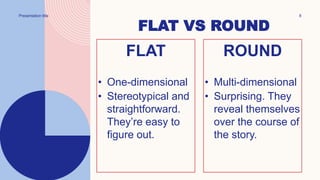
FLAT VS ROUND
FLAT
• One-dimensional
• Stereotypical and
straightforward.
They’re easy to
figure out.
ROUND
• Multi-dimensional
• Surprising. They
reveal themselves
over the course of
the story.
Presentation title 9
CHARACTER
Characters can also be:
a. Protagonist, the main character with whom the reader is
meant to identify, also the person is not necessarily good by
any conventional moral standard, but he/she is the person
in whose plight the reader is most invested. (e,g., Rizal’s
Crisostomo Ibarra)
b. Antagonist, the character who opposes the main
character, also the counterpart to the main character and
source of a story’s main conflict; may not be “bad” or “evil”
by any conventional moral standard, but he/she opposes
the protagonist in a significant way. (Rizal’s Padre Damaso)
CHARACTER
Presentation title 10
We learn about a character in five different ways:
1.What the character says.
2.What the character thinks.
3.What the character does.
4.What other characters or the narrator say about
the character.
5.What the author says about the character
11
Setting
Setting refers to the time and
place where a story occurs. It
can be used to create the mood
or atmosphere within a story. It
can also express the writer’s
view of the world.
12
Setting
The setting can be:
a.Specific
Examples:
• Thunderbird Resort, Poro Point,
City of San Fernando 2500 La
Union
• Northern Naguilian National High
School, Gusing Norte, Naguilian
2511 La Union
13
Setting
The setting can be:
b. Ambiguous
Examples:
• A large urban city during economic
hard times
• Somewhere in the 2nd floor of the
grocery store
Presentation title 14
PLOT
Plot is the sequence of
events in the story.
Presentation title 15
PLOT
a.Exposition, the beginning of the
story, characters, setting, and the
main conflict are typically introduced.
Presentation title 16
PLOT
b. Rising Action, also called Complication,
where the main character is in crisis and
events leading up to facing the conflict begin to
unfold. The story becomes complicated.
Presentation title 17
PLOT
c. Climax, the peak of the story, where a major
event occurs in which the main character faces
a major enemy, fear, challenge, or other source
of conflict. The most action, drama, change,
and excitement occur here.
Presentation title 18
PLOT
d. Falling Action, where the story
begins to slow down and work towards
its end, tying up loose ends.
Presentation title 19
PLOT
e. Resolution, like a concluding
paragraph that resolves any
remaining issues and ends the story.
POINT-OF-VIEW
20
refers to the identity of the narrative
voice. It is the person or entity through
whom the reader experiences the story.
POINT-OF-VIEW
21
a. First Person – the narrator
participates in and tells the story
using the pronoun ‘I’.
POINT-OF-VIEW
22
b. Limited Third Person – the
narrator is not in the story and
narrates using the pronouns ‘she’ or
‘he’. Also, the narrator is unable to see
into the minds of the characters.
POINT-OF-VIEW
23
c. Omniscient Third Person – the
narrator is not in the story and tells the
story using the pronouns ‘she’ or ‘he’. In
this point of view, the narrator can tell
the thoughts of the characters as he can
see into their minds.
CONFLICT
24
a struggle between
opposing forces which
is the driving force of a
story.
Conflicts can exist as:
CONFLICT
25
a.Man versus man, the typical scenario
between the protagonist and
antagonist.
Examples:
Luffy vs. Arlong
Apollo vs. Eros
Cassy vs. Marga
CONFLICT
26
b. Man versus nature, where the
character is tormented by natural forces
such as storms or animals
Examples:
2012
Jaws
Andrea’s
CONFLICT
27
Man versus self, where the conflict
develops from the protagonist’s inner
struggles, and may depend on a
character trying to decide between good
and evil or overcome self-doubts.
Example:
The Ward
CONFLICT
28
d. Man versus society, where a
character must take on society itself,
stands at odds and realizes the necessity
to work against these norms
Examples:
The Hunger Games
Divergent
CONFLICT
29
e. Man versus fate, where a protagonist
is working against what has been
foretold for that person.
Examples:
Final Destination
Maleficent
Presentation title 30
Theme
the main idea or underlying meaning
conveyed by the piece.
Examples:
• Love and friendship – Romeo and Juliet
• Religion and war – Hacksaw Ridge
• Adventure and Dreams – One Piece
IMAGERY
appeals to the reader’s
physical senses
motivating strong and
distinct mental images of
what the writer is trying to
show.
VISUAL IMAGERY
Example:
Shakespeare’s Romeo and Juliet
O, she doth teach the torches to burn
bright!
It seems she hangs upon the cheek of
night
Like a rich jewel in an Ethiop’s ear
B.OLFACTORY
IMAGERY
Example: (Patrick Suskind’s Perfume:
The Story of a Murderer
The streets stank of manure, the
courtyards of urine, the stairwells stank
of moldering wood and rat droppings, the
kitchens of spoiled cabbage and mutton
fat; the unaired parlors stank of stale
dust, the bedrooms of greasy sheets,
damp featherbeds, and the pungently
sweet aroma of chamber pots.
GUSTATORY
IMAGERY
I have eaten the plums that
were in the ice box and
which you were probably
saving for breakfast.
Forgive me they were
delicious, so sweet , and
so cold.
TACTILE
IMAGERY
When the others went swimming my son
said he was going in, too. He pulled his
dripping trunks from the line where they
had hung all through the shower and
wrung them out. Languidly, and with no
thought of going in, I watched him, his
hard little body, skinny and bare, saw
him wince slightly as he pulled up
around his vitals the small, soggy, icy
garment. As he buckled the swollen belt,
suddenly my groin felt the chill of death.
AUDITORY
IMAGERY
Or sinking as the light wind lives or dies;
And full-grown lambs loud bleat from
hilly bourn;
Hedge-crickets sing; and now with treble
soft
The redbreast whistles from a garden-
croft, And gathering swallows twitter in
the skies.
STANZA
A stanza is a smaller unit
or group of lines in poetry.
Stanza may be:
STANZA
a. Couplet, two lines
Example:
“Nature puts on little shows
Every time it rains or it snows.”
STANZA
b. Tercet, three lines
Example:
“Hugs are sweet,
For hearts they are a treat.
They make us feel complete.”
STANZA
c. Quatrain, four lines
Example:
I buried a baby bird today.
I didn’t see it die.
I found it dead beneath my tree,
And had a little cry.
STANZA
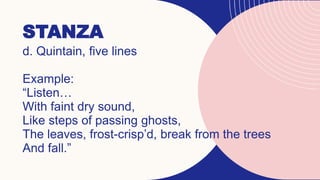
d. Quintain, five lines
Example:
“Listen…
With faint dry sound,
Like steps of passing ghosts,
The leaves, frost-crisp’d, break from the trees
And fall.”
STANZA
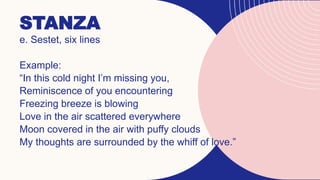
e. Sestet, six lines
Example:
“In this cold night I’m missing you,
Reminiscence of you encountering
Freezing breeze is blowing
Love in the air scattered everywhere
Moon covered in the air with puffy clouds
My thoughts are surrounded by the whiff of love.”
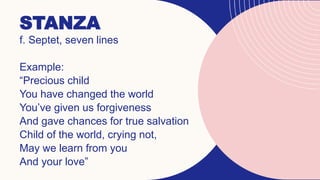
STANZA
f. Septet, seven lines
Example:
“Precious child
You have changed the world
You’ve given us forgiveness
And gave chances for true salvation
Child of the world, crying not,
May we learn from you
And your love”
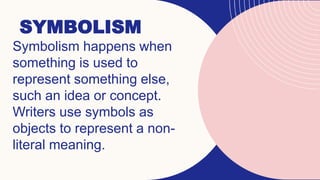
SYMBOLISM
Symbolism happens when
something is used to
represent something else,
such an idea or concept.
Writers use symbols as
objects to represent a non-
literal meaning.
SYMBOLISM
Example:
Ah Sunflower, weary of time,
Who countest the steps of the sun;
Seeking after that sweet golden
clime
Where the traveler’s journey is
done.
TONE
Tone is defined as a
speaker’s or narrator’s
attitude about a subject
and is different from the
mood a reader gets while
reading the story.
TONE
• I’m so glad that he
called! I’ve been hoping
to hear from him.
• Why is that weirdo
calling me again after all
this time?
TONE
• “I’m so glad that jerk was
fired; now I won’t have to
deal with him anymore.
• “It’s terrible that Tony was
let go; he was such a great
colleague!”
DIALOGUE
Dialogue is the
stance where
characters speak to
one another.
DIALOGUE
Rose: I love you, Jack.
Jack: Don’t you do that, don’t say your good-byes. Not yet, do you understand
me?
Rose: I’m so cold.
Jack: Listen, Rose. You’re gonna get out of here, you’re gonna go on and
you’re gonna make lots of babies, and you’re gonna watch them grow. You’re
gonna die an old… an old lady warm in her bed, not here, not this night. Not
like this, do you understand me?
Rose: I can’t feel my body.
DIALOGUE
Jack: Winning that ticket, Rose, was the best thing that ever happened to
me… it brought me to you. And I’m thankful for that, Rose. I’m thankful.
You must do me this honor. Promise me you’ll survive. That you won’t
give up, no matter what happens, no matter how hopeless. Promise me
now, Rose, and never let go of that promise.
Rose: I promise.
Jack: Never let go.
Rose: I’ll never let go, Jack. I’ll never let go.

LITERARY ELEMENTS.pptx

  • 2.
  • 3.
    LITERARY ELEMENTS are specific meansby which writers or storytellers manipulate words in specific patterns to unfold their stories and experiences.
  • 4.
    REASONS WHY YOUSHOULD UTILIZE LITERARY ELEMENTS IN ANY PIECE OF WORK: 1. Literary elements add special effects to your writing. 2. They establish connection with the reader. 3. They engage and captivate readers. 4. They help you in conveying abstract information. 5. They paint vivid pictures of your words. 6. They enhance the reader’s vicarious experience. 4
  • 5.
    1. Literary elementsadd special effects to your writing. 2. They establish connection with the reader. 3. They engage and captivate readers. 4. They help you in conveying abstract information. 5. They paint vivid pictures of your words. 6. They enhance the reader’s vicarious experience. 5
  • 6.
    6 literary elements: character,setting, plot, point-of-view, conflict, and theme.
  • 7.
    Presentation title 7 CHARACTER Acharacter is a figure in a literary work. Characters can be major or minor. Characters are classified into: a.Flat b.Round
  • 8.
    Presentation title 8 FLATVS ROUND FLAT • One-dimensional • Stereotypical and straightforward. They’re easy to figure out. ROUND • Multi-dimensional • Surprising. They reveal themselves over the course of the story.
  • 9.
    Presentation title 9 CHARACTER Characterscan also be: a. Protagonist, the main character with whom the reader is meant to identify, also the person is not necessarily good by any conventional moral standard, but he/she is the person in whose plight the reader is most invested. (e,g., Rizal’s Crisostomo Ibarra) b. Antagonist, the character who opposes the main character, also the counterpart to the main character and source of a story’s main conflict; may not be “bad” or “evil” by any conventional moral standard, but he/she opposes the protagonist in a significant way. (Rizal’s Padre Damaso)
  • 10.
    CHARACTER Presentation title 10 Welearn about a character in five different ways: 1.What the character says. 2.What the character thinks. 3.What the character does. 4.What other characters or the narrator say about the character. 5.What the author says about the character
  • 11.
    11 Setting Setting refers tothe time and place where a story occurs. It can be used to create the mood or atmosphere within a story. It can also express the writer’s view of the world.
  • 12.
    12 Setting The setting canbe: a.Specific Examples: • Thunderbird Resort, Poro Point, City of San Fernando 2500 La Union • Northern Naguilian National High School, Gusing Norte, Naguilian 2511 La Union
  • 13.
    13 Setting The setting canbe: b. Ambiguous Examples: • A large urban city during economic hard times • Somewhere in the 2nd floor of the grocery store
  • 14.
    Presentation title 14 PLOT Plotis the sequence of events in the story.
  • 15.
    Presentation title 15 PLOT a.Exposition,the beginning of the story, characters, setting, and the main conflict are typically introduced.
  • 16.
    Presentation title 16 PLOT b.Rising Action, also called Complication, where the main character is in crisis and events leading up to facing the conflict begin to unfold. The story becomes complicated.
  • 17.
    Presentation title 17 PLOT c.Climax, the peak of the story, where a major event occurs in which the main character faces a major enemy, fear, challenge, or other source of conflict. The most action, drama, change, and excitement occur here.
  • 18.
    Presentation title 18 PLOT d.Falling Action, where the story begins to slow down and work towards its end, tying up loose ends.
  • 19.
    Presentation title 19 PLOT e.Resolution, like a concluding paragraph that resolves any remaining issues and ends the story.
  • 20.
    POINT-OF-VIEW 20 refers to theidentity of the narrative voice. It is the person or entity through whom the reader experiences the story.
  • 21.
    POINT-OF-VIEW 21 a. First Person– the narrator participates in and tells the story using the pronoun ‘I’.
  • 22.
    POINT-OF-VIEW 22 b. Limited ThirdPerson – the narrator is not in the story and narrates using the pronouns ‘she’ or ‘he’. Also, the narrator is unable to see into the minds of the characters.
  • 23.
    POINT-OF-VIEW 23 c. Omniscient ThirdPerson – the narrator is not in the story and tells the story using the pronouns ‘she’ or ‘he’. In this point of view, the narrator can tell the thoughts of the characters as he can see into their minds.
  • 24.
    CONFLICT 24 a struggle between opposingforces which is the driving force of a story. Conflicts can exist as:
  • 25.
    CONFLICT 25 a.Man versus man,the typical scenario between the protagonist and antagonist. Examples: Luffy vs. Arlong Apollo vs. Eros Cassy vs. Marga
  • 26.
    CONFLICT 26 b. Man versusnature, where the character is tormented by natural forces such as storms or animals Examples: 2012 Jaws Andrea’s
  • 27.
    CONFLICT 27 Man versus self,where the conflict develops from the protagonist’s inner struggles, and may depend on a character trying to decide between good and evil or overcome self-doubts. Example: The Ward
  • 28.
    CONFLICT 28 d. Man versussociety, where a character must take on society itself, stands at odds and realizes the necessity to work against these norms Examples: The Hunger Games Divergent
  • 29.
    CONFLICT 29 e. Man versusfate, where a protagonist is working against what has been foretold for that person. Examples: Final Destination Maleficent
  • 30.
    Presentation title 30 Theme themain idea or underlying meaning conveyed by the piece. Examples: • Love and friendship – Romeo and Juliet • Religion and war – Hacksaw Ridge • Adventure and Dreams – One Piece
  • 31.
    IMAGERY appeals to thereader’s physical senses motivating strong and distinct mental images of what the writer is trying to show.
  • 32.
    VISUAL IMAGERY Example: Shakespeare’s Romeoand Juliet O, she doth teach the torches to burn bright! It seems she hangs upon the cheek of night Like a rich jewel in an Ethiop’s ear
  • 33.
    B.OLFACTORY IMAGERY Example: (Patrick Suskind’sPerfume: The Story of a Murderer The streets stank of manure, the courtyards of urine, the stairwells stank of moldering wood and rat droppings, the kitchens of spoiled cabbage and mutton fat; the unaired parlors stank of stale dust, the bedrooms of greasy sheets, damp featherbeds, and the pungently sweet aroma of chamber pots.
  • 34.
    GUSTATORY IMAGERY I have eatenthe plums that were in the ice box and which you were probably saving for breakfast. Forgive me they were delicious, so sweet , and so cold.
  • 35.
    TACTILE IMAGERY When the otherswent swimming my son said he was going in, too. He pulled his dripping trunks from the line where they had hung all through the shower and wrung them out. Languidly, and with no thought of going in, I watched him, his hard little body, skinny and bare, saw him wince slightly as he pulled up around his vitals the small, soggy, icy garment. As he buckled the swollen belt, suddenly my groin felt the chill of death.
  • 36.
    AUDITORY IMAGERY Or sinking asthe light wind lives or dies; And full-grown lambs loud bleat from hilly bourn; Hedge-crickets sing; and now with treble soft The redbreast whistles from a garden- croft, And gathering swallows twitter in the skies.
  • 37.
    STANZA A stanza isa smaller unit or group of lines in poetry. Stanza may be:
  • 38.
    STANZA a. Couplet, twolines Example: “Nature puts on little shows Every time it rains or it snows.”
  • 39.
    STANZA b. Tercet, threelines Example: “Hugs are sweet, For hearts they are a treat. They make us feel complete.”
  • 40.
    STANZA c. Quatrain, fourlines Example: I buried a baby bird today. I didn’t see it die. I found it dead beneath my tree, And had a little cry.
  • 41.
    STANZA d. Quintain, fivelines Example: “Listen… With faint dry sound, Like steps of passing ghosts, The leaves, frost-crisp’d, break from the trees And fall.”
  • 42.
    STANZA e. Sestet, sixlines Example: “In this cold night I’m missing you, Reminiscence of you encountering Freezing breeze is blowing Love in the air scattered everywhere Moon covered in the air with puffy clouds My thoughts are surrounded by the whiff of love.”
  • 43.
    STANZA f. Septet, sevenlines Example: “Precious child You have changed the world You’ve given us forgiveness And gave chances for true salvation Child of the world, crying not, May we learn from you And your love”
  • 44.
    SYMBOLISM Symbolism happens when somethingis used to represent something else, such an idea or concept. Writers use symbols as objects to represent a non- literal meaning.
  • 45.
    SYMBOLISM Example: Ah Sunflower, wearyof time, Who countest the steps of the sun; Seeking after that sweet golden clime Where the traveler’s journey is done.
  • 46.
    TONE Tone is definedas a speaker’s or narrator’s attitude about a subject and is different from the mood a reader gets while reading the story.
  • 47.
    TONE • I’m soglad that he called! I’ve been hoping to hear from him. • Why is that weirdo calling me again after all this time?
  • 48.
    TONE • “I’m soglad that jerk was fired; now I won’t have to deal with him anymore. • “It’s terrible that Tony was let go; he was such a great colleague!”
  • 49.
    DIALOGUE Dialogue is the stancewhere characters speak to one another.
  • 50.
    DIALOGUE Rose: I loveyou, Jack. Jack: Don’t you do that, don’t say your good-byes. Not yet, do you understand me? Rose: I’m so cold. Jack: Listen, Rose. You’re gonna get out of here, you’re gonna go on and you’re gonna make lots of babies, and you’re gonna watch them grow. You’re gonna die an old… an old lady warm in her bed, not here, not this night. Not like this, do you understand me? Rose: I can’t feel my body.
  • 51.
    DIALOGUE Jack: Winning thatticket, Rose, was the best thing that ever happened to me… it brought me to you. And I’m thankful for that, Rose. I’m thankful. You must do me this honor. Promise me you’ll survive. That you won’t give up, no matter what happens, no matter how hopeless. Promise me now, Rose, and never let go of that promise. Rose: I promise. Jack: Never let go. Rose: I’ll never let go, Jack. I’ll never let go.

Editor's Notes

  • #4 These are considered as the main tools in a writer’s toolbox.
  • #14 Setting will help the readers visualize the plot of the story.
  • #16 5 most important questions are introduced: who, what, where, when, why
  • #21 Perspective; panlantaw Example: Unsay imo point of view anang same sex marriage
  • #22 The narrator’s perspective. The narrator can be the main character of the story.
  • #23 the narrator’s perspective is limited. Only single person or a specific person’s mind and feelings lang ang iyang mabasa.
  • #24 All knowing.
  • #25 The protagonist or the main character needs something or someone to challenge her or him. Without conflict, the story will not go anywhere.
  • #28 The ward – multiple personalities; admitted in a psychiatric unit, wanted to escape.
  • #29 The hungergames, participants are forced to fight in a dangerous public arena The society is divided into five factions, and they must choose faction and must commit to it for life.
  • #33 sight
  • #34 smell
  • #45 A symbol must be something tangible or visible, while the idea it symbolizes must be something abstract or universal.
  • #46 sunflower as a symbol for human beings, and the sun symbolizes life. Therefore, these lines symbolically refer to their life cycle