
Aligning Architecture and Education: Building Schools ‘That Fit’. Burke and Grosvenor  Reading 10.1
Main Ideas Schools built in the C19th and C20th do not facilitate C21st learning. As conceptions of knowledge, learning, and pedagogy change, schools must also change. School design must be collaborative: students, teachers, community members, and architects.
Schools must facilitate C21st learning What IS C21st learning? •  technology •  flexibility •  informed by neo-liberal ideology •  student-centred pedagogy •  collaborative and interdisciplinary •  informal: home and workplace •  ecological sustainability •  community oriented – local and global •  incorporating modern views of childhood and children as producers of knowledge
Why do schools built in the C19th and C20th face limitations in the C21st? •  Not built to facilitate technology •  Surveillance, containment, security and discipline as a primary considerations •  Limits upon social connectedness •  Classroom (and school?) no longer the sole domain of learning •  Designed according to teacher-centred pedagogy •  Little (or no) input from students (not valuing children as producers of knowledge) – meeting political and economic needs of policy makers
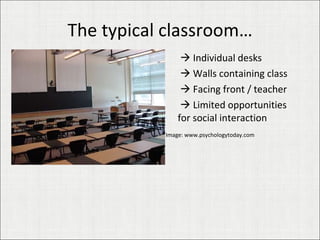
The typical classroom…    Individual desks    Walls containing class    Facing front / teacher    Limited opportunities for social interaction Image: www.psychologytoday.com
Solution? Do away with the classroom! Alternative organisation of schools: “ Learning streets”: replaces corridors, enhanced connectivity, spaces for materials/display of learning products/social interaction, natural daylight environment (like a city street!) “ Houses”: rather than class organisation (a social setting) “ Pods”: small groups form the basis of most student work environments – separate groups through use of flexible furniture rather than walls. Any more ideas? (Drawing activity) How would you feel as teachers going to teach in a school without classrooms?
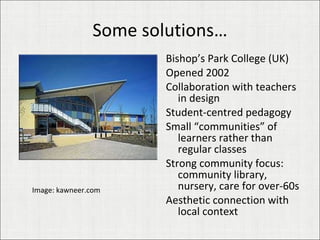
Some solutions… Bishop’s Park College (UK) Opened 2002 Collaboration with teachers in design Student-centred pedagogy Small “communities” of learners rather than regular classes Strong community focus: community library, nursery, care for over-60s Aesthetic connection with local context Image: kawneer.com
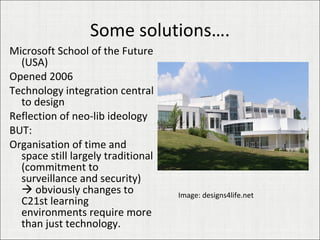
Some solutions…. Microsoft School of the Future (USA) Opened 2006 Technology integration central to design Reflection of neo-lib ideology BUT:  Organisation of time and space still largely traditional (commitment to surveillance and security)    obviously changes to C21st learning environments require more than just technology. Image: designs4life.net
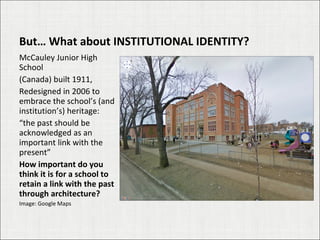
But… What about INSTITUTIONAL IDENTITY? McCauley Junior High School (Canada) built 1911, Redesigned in 2006 to embrace the school’s (and institution’s) heritage: “ the past should be acknowledged as an important link with the present” How important do you think it is for a school to retain a link with the past through architecture? Image: Google Maps
Current state of play in Australia: “ Building the Education Revolution” – Commonwealth Government’s $16.2 Billion to  ‘ provide infrastructure funding so  each of Australia’s 9540 schools can  meet the needs of 21st century students and teachers .’ http://www.deewr.gov.au/Pages/Default.aspx BUT no guidelines except refurbishment of major infrastructure – how does this relate to the C21st learning we spoke about earlier? What are the  policy objectives  behind this BER scheme?
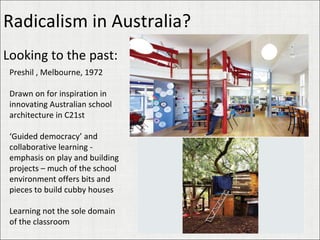
Radicalism in Australia? Looking to the past: Preshil , Melbourne, 1972 Drawn on for inspiration in innovating Australian school architecture in C21st ‘ Guided democracy’ and collaborative learning - emphasis on play and building projects – much of the school environment offers bits and pieces to build cubby houses Learning not the sole domain of the classroom
Discussion How can school design reflect more  radical  forms of pedagogy such as those we discussed at the beginning of the semester?
Too much emphasis on form? Jilk (architect and educational designer) argues that the role of design in influencing behaviour, thinking and learning is given too much weight. He says educators and architects will do more for learners if they design less. Do you think this is the case? What role do you think the design tutorial spaces and lecture spaces have in your learning at university?

School Architecture

  • 1.
    Aligning Architecture andEducation: Building Schools ‘That Fit’. Burke and Grosvenor Reading 10.1
  • 2.
    Main Ideas Schoolsbuilt in the C19th and C20th do not facilitate C21st learning. As conceptions of knowledge, learning, and pedagogy change, schools must also change. School design must be collaborative: students, teachers, community members, and architects.
  • 3.
    Schools must facilitateC21st learning What IS C21st learning? • technology • flexibility • informed by neo-liberal ideology • student-centred pedagogy • collaborative and interdisciplinary • informal: home and workplace • ecological sustainability • community oriented – local and global • incorporating modern views of childhood and children as producers of knowledge
  • 4.
    Why do schoolsbuilt in the C19th and C20th face limitations in the C21st? • Not built to facilitate technology • Surveillance, containment, security and discipline as a primary considerations • Limits upon social connectedness • Classroom (and school?) no longer the sole domain of learning • Designed according to teacher-centred pedagogy • Little (or no) input from students (not valuing children as producers of knowledge) – meeting political and economic needs of policy makers
  • 5.
    The typical classroom… Individual desks  Walls containing class  Facing front / teacher  Limited opportunities for social interaction Image: www.psychologytoday.com
  • 6.
    Solution? Do awaywith the classroom! Alternative organisation of schools: “ Learning streets”: replaces corridors, enhanced connectivity, spaces for materials/display of learning products/social interaction, natural daylight environment (like a city street!) “ Houses”: rather than class organisation (a social setting) “ Pods”: small groups form the basis of most student work environments – separate groups through use of flexible furniture rather than walls. Any more ideas? (Drawing activity) How would you feel as teachers going to teach in a school without classrooms?
  • 7.
    Some solutions… Bishop’sPark College (UK) Opened 2002 Collaboration with teachers in design Student-centred pedagogy Small “communities” of learners rather than regular classes Strong community focus: community library, nursery, care for over-60s Aesthetic connection with local context Image: kawneer.com
  • 8.
    Some solutions…. MicrosoftSchool of the Future (USA) Opened 2006 Technology integration central to design Reflection of neo-lib ideology BUT: Organisation of time and space still largely traditional (commitment to surveillance and security)  obviously changes to C21st learning environments require more than just technology. Image: designs4life.net
  • 9.
    But… What aboutINSTITUTIONAL IDENTITY? McCauley Junior High School (Canada) built 1911, Redesigned in 2006 to embrace the school’s (and institution’s) heritage: “ the past should be acknowledged as an important link with the present” How important do you think it is for a school to retain a link with the past through architecture? Image: Google Maps
  • 10.
    Current state ofplay in Australia: “ Building the Education Revolution” – Commonwealth Government’s $16.2 Billion to ‘ provide infrastructure funding so each of Australia’s 9540 schools can meet the needs of 21st century students and teachers .’ http://www.deewr.gov.au/Pages/Default.aspx BUT no guidelines except refurbishment of major infrastructure – how does this relate to the C21st learning we spoke about earlier? What are the policy objectives behind this BER scheme?
  • 11.
    Radicalism in Australia?Looking to the past: Preshil , Melbourne, 1972 Drawn on for inspiration in innovating Australian school architecture in C21st ‘ Guided democracy’ and collaborative learning - emphasis on play and building projects – much of the school environment offers bits and pieces to build cubby houses Learning not the sole domain of the classroom
  • 12.
    Discussion How canschool design reflect more radical forms of pedagogy such as those we discussed at the beginning of the semester?
  • 13.
    Too much emphasison form? Jilk (architect and educational designer) argues that the role of design in influencing behaviour, thinking and learning is given too much weight. He says educators and architects will do more for learners if they design less. Do you think this is the case? What role do you think the design tutorial spaces and lecture spaces have in your learning at university?