


By Prof. Edo Forsythe
Hirosaki Gakuin University
Navy Russian Translator
English and American Studies
Professor
 Building students’ confidence
in English
 Classroom techniques
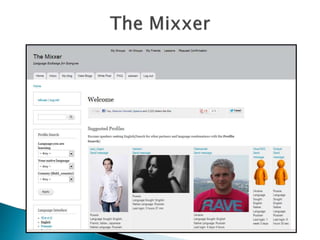
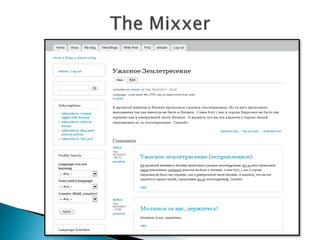
 Technology for English study
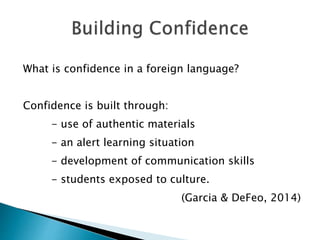
What is confidence in a foreign language?
Confidence is built through:
- use of authentic materials
- an alert learning situation
- development of communication skills
- students exposed to culture.
(Garcia & DeFeo, 2014)
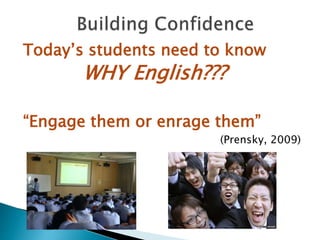
Today’s students need to know
WHY English???
“Engage them or enrage them”
(Prensky, 2009)
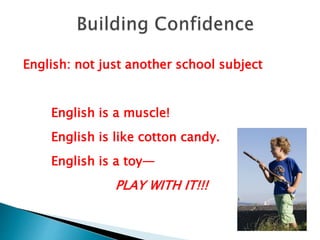
English: not just another school subject
English is a muscle!
English is like cotton candy.
English is a toy—
PLAY WITH IT!!!
 Language learning = sociocultural activity
 Development must be scaffolded for
maximum effect
(Vygotsky; Lantolf & Thorne, 2007)
 Authentic materials provide sociocultural
relevance to lessons
(Brown & Yule, 1983)
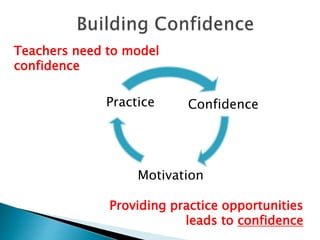
Confidence
Motivation
Practice
Providing practice opportunities
leads to confidence
Teachers need to model
confidence
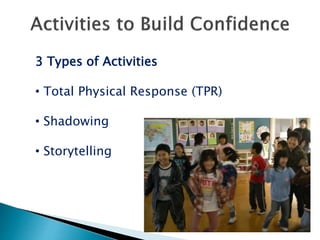
3 Types of Activities
• Total Physical Response (TPR)
• Shadowing
• Storytelling
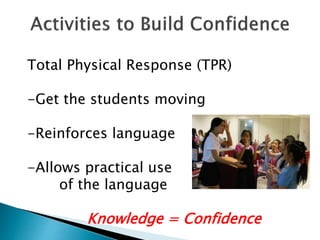
Total Physical Response (TPR)
-Get the students moving
-Reinforces language
-Allows practical use
of the language
Knowledge = Confidence
Shadowing
Immediately repeating after someone else
-Improves listening skills
-Reinforces pronunciation
-Speeds up fluency
(Murphey, 2001)
Fluency = Confidence
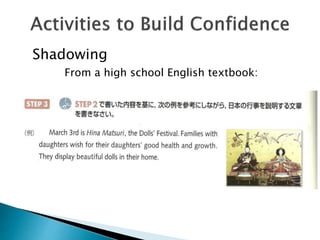
Shadowing
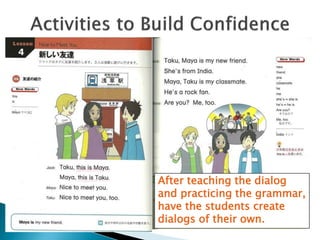
From a high school English textbook:
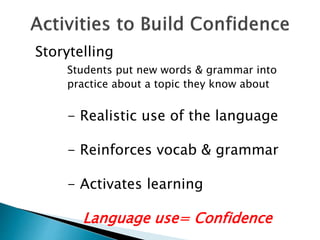
Storytelling
Students put new words & grammar into
practice about a topic they know about
- Realistic use of the language
- Reinforces vocab & grammar
- Activates learning
Language use= Confidence
After teaching the dialog
and practicing the grammar,
have the students create
dialogs of their own.
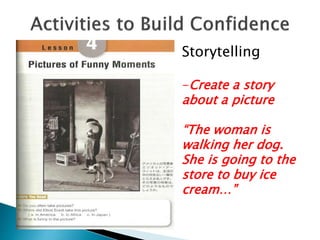
Storytelling
-Create a story
about a picture
“The woman is
walking her dog.
She is going to the
store to buy ice
cream…”
Total Physical Response (TPR)
Shadowing
Storytelling
Active learning OUTSIDE the textbook.
Engage your students & build their
CONFIDENCE!!
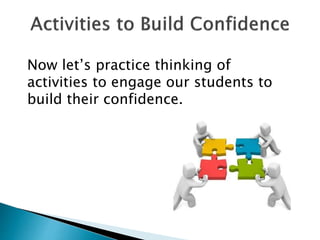
Now let’s practice thinking of
activities to engage our students to
build their confidence.
Who has a cell phone?
Technology brings the world to
you!
Connect with the English-speaking
world to improve your English
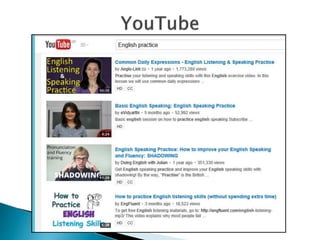
Tools for practicing English:
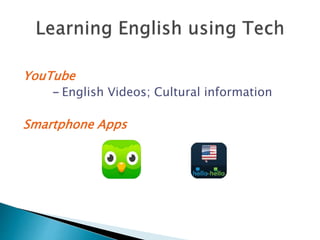
 YouTube
 Smartphone Apps
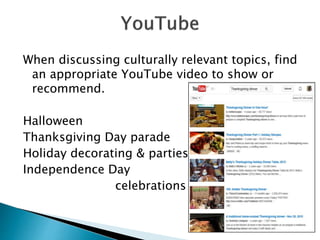
When discussing culturally relevant topics, find
an appropriate YouTube video to show or
recommend.
Halloween
Thanksgiving Day parade
Holiday decorating & parties
Independence Day
celebrations
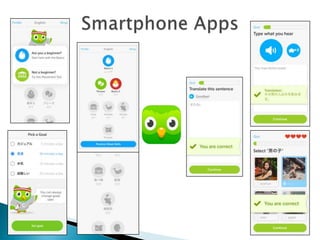
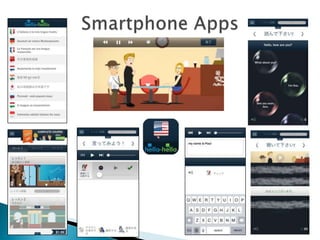
Smartphone Apps to practice English:
Duolingo Hello-Hello
(Free) English
(Lesson 1 Free)
 Can use in class with the students or suggest
they download them.
 As schools get technology, ask them to install
these (or other) apps
 THOROUGHLY check out apps before you try
to add them to classes.
YouTube
- English Videos; Cultural information
Smartphone Apps
 Building students’ confidence
in English
Practice Confidence Motivation
 Classroom techniques
TPR; Shadowing; Storytelling
 Smartphone Apps
Duolingo; Hello-Hello
Slides available at:
www.slideshare.net/EdoForsythe/
Contact me via email at
forsythe@hirogaku-u.ac.jp
Questions?

Building Students' Confidence in English

  • 1.
    By Prof. EdoForsythe Hirosaki Gakuin University
  • 2.
    Navy Russian Translator Englishand American Studies Professor
  • 3.
     Building students’confidence in English  Classroom techniques  Technology for English study
  • 4.
    What is confidencein a foreign language? Confidence is built through: - use of authentic materials - an alert learning situation - development of communication skills - students exposed to culture. (Garcia & DeFeo, 2014)
  • 5.
    Today’s students needto know WHY English??? “Engage them or enrage them” (Prensky, 2009)
  • 6.
    English: not justanother school subject English is a muscle! English is like cotton candy. English is a toy— PLAY WITH IT!!!
  • 7.
     Language learning= sociocultural activity  Development must be scaffolded for maximum effect (Vygotsky; Lantolf & Thorne, 2007)  Authentic materials provide sociocultural relevance to lessons (Brown & Yule, 1983)
  • 8.
    Confidence Motivation Practice Providing practice opportunities leadsto confidence Teachers need to model confidence
  • 9.
    3 Types ofActivities • Total Physical Response (TPR) • Shadowing • Storytelling
  • 10.
    Total Physical Response(TPR) -Get the students moving -Reinforces language -Allows practical use of the language Knowledge = Confidence
  • 11.
    Shadowing Immediately repeating aftersomeone else -Improves listening skills -Reinforces pronunciation -Speeds up fluency (Murphey, 2001) Fluency = Confidence
  • 12.
    Shadowing From a highschool English textbook:
  • 13.
    Storytelling Students put newwords & grammar into practice about a topic they know about - Realistic use of the language - Reinforces vocab & grammar - Activates learning Language use= Confidence
  • 14.
    After teaching thedialog and practicing the grammar, have the students create dialogs of their own.
  • 15.
    Storytelling -Create a story abouta picture “The woman is walking her dog. She is going to the store to buy ice cream…”
  • 16.
    Total Physical Response(TPR) Shadowing Storytelling Active learning OUTSIDE the textbook. Engage your students & build their CONFIDENCE!!
  • 17.
    Now let’s practicethinking of activities to engage our students to build their confidence.
  • 18.
    Who has acell phone? Technology brings the world to you! Connect with the English-speaking world to improve your English
  • 19.
    Tools for practicingEnglish:  YouTube  Smartphone Apps
  • 26.
    When discussing culturallyrelevant topics, find an appropriate YouTube video to show or recommend. Halloween Thanksgiving Day parade Holiday decorating & parties Independence Day celebrations
  • 27.
    Smartphone Apps topractice English: Duolingo Hello-Hello (Free) English (Lesson 1 Free)
  • 30.
     Can usein class with the students or suggest they download them.  As schools get technology, ask them to install these (or other) apps  THOROUGHLY check out apps before you try to add them to classes.
  • 31.
    YouTube - English Videos;Cultural information Smartphone Apps
  • 32.
     Building students’confidence in English Practice Confidence Motivation  Classroom techniques TPR; Shadowing; Storytelling  Smartphone Apps Duolingo; Hello-Hello
  • 33.
    Slides available at: www.slideshare.net/EdoForsythe/ Contactme via email at forsythe@hirogaku-u.ac.jp Questions?

Editor's Notes

  • #5 Garcia, R., & DeFeo, D. (2014). Finding your “Spanish voice” through popular media: Improving students’ confidence and fluency. Journal of the Scholarship of Teaching and Learning, 14(3), 110-131. doi: 10.14434/josotl.vl4i3.5033
  • #6 Prensky, M. (2009). H. sapiens digital: From digital immigrants and digital natives to digital wisdom. Innovate, 5(3). Retrieved from www.innovateonline.info/index.php?view=article&id=705
  • #8 Brown, G., & Yule, G. (1983). Teaching the spoken language. Cambridge: Cambridge University Press. Lantolf, J. & Thorne, S. L. (2007). Sociocultural theory and second language learning. In. B. van Patten & J. Williams (Eds.), Theories in second language acquisition (pp. 201-224). Mahwah, NJ: Lawrence Erlbaum.
  • #12 Murphey, T. (2001). Exploring conversational shadowing. Language Teaching Research, 5(2), 128-155.
  • #13 Text taken from Total English 1, pg. 82.
  • #15 Image taken from Total English 1, pg. 48-49.
  • #16 Image taken from My Way, pg. 47.