March 11, 2020 - Dubai, UAE
Building Products
Fast, Cheap and Good
Anand Murthy Raj
Partner, Gladwell Academy B.V.
Director, Agile Spirit private Limited
SUPPORTERS
PLATINUM PARTNERS
GOLD PARTNER BRONZE PARTNERS
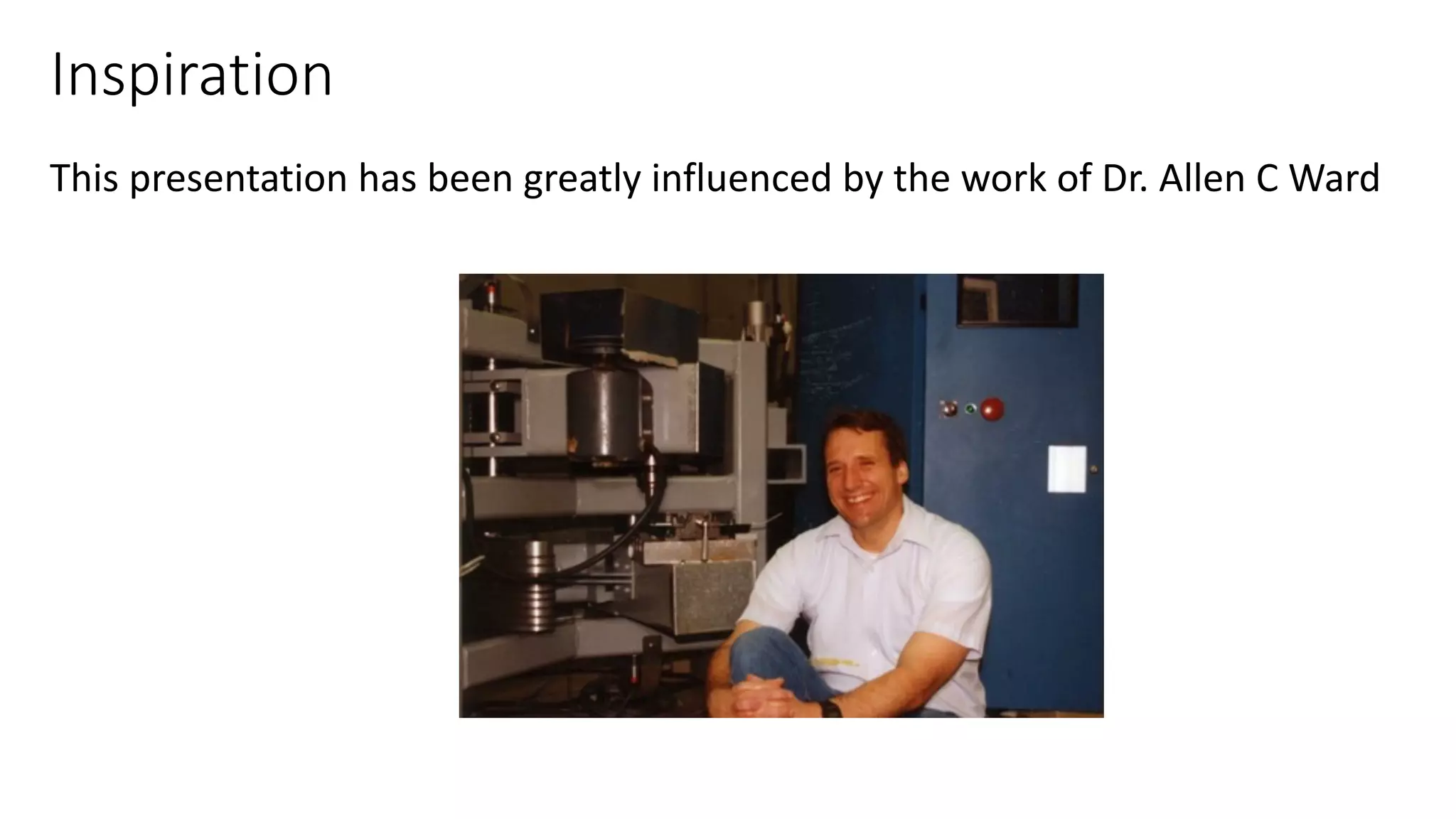
This presentation has been greatly influenced by the work of Dr. Allen C Ward
Inspiration
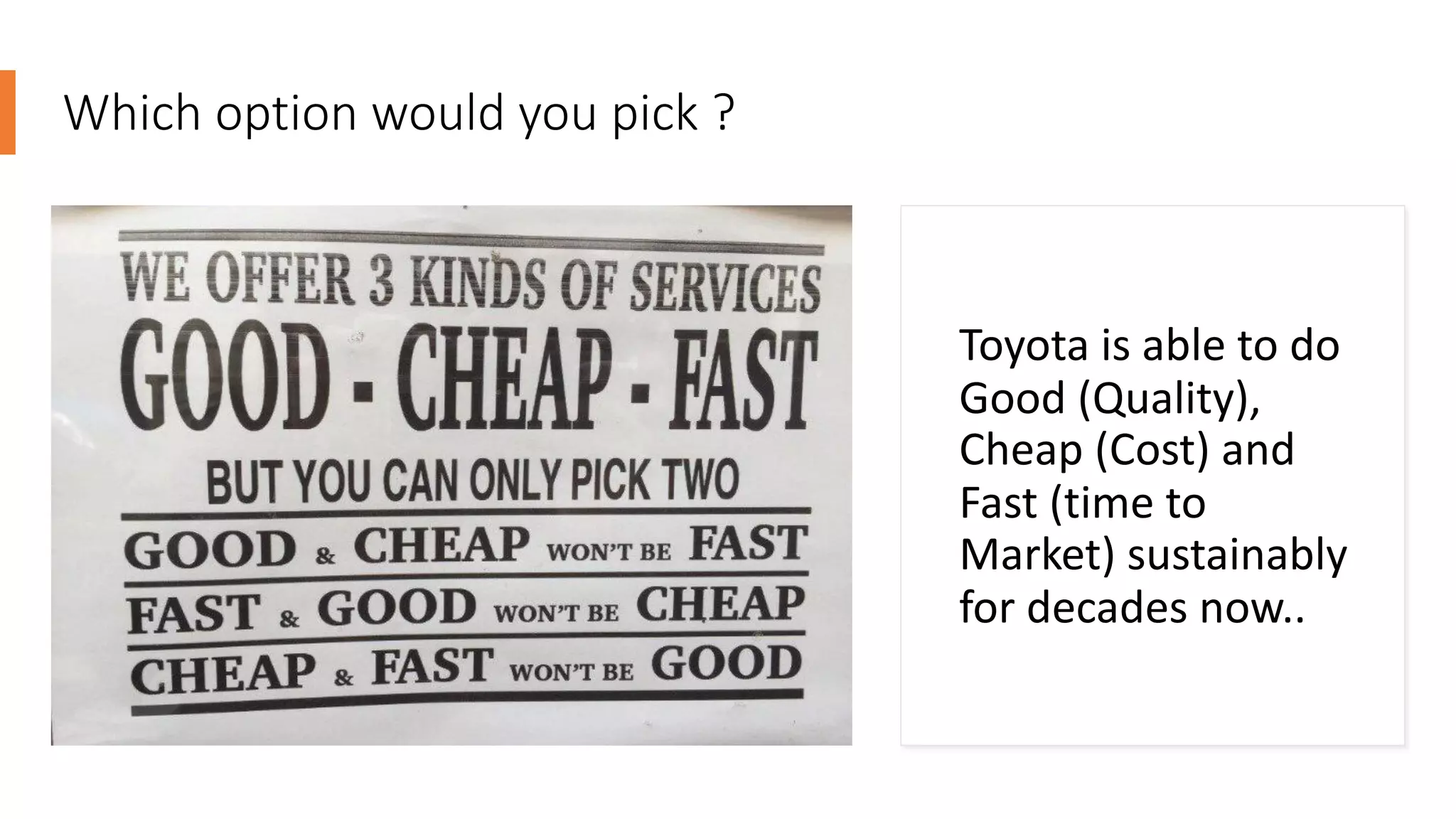
Which option would you pick ?
Toyota is able to do
Good (Quality),
Cheap (Cost) and
Fast (time to
Market) sustainably
for decades now..
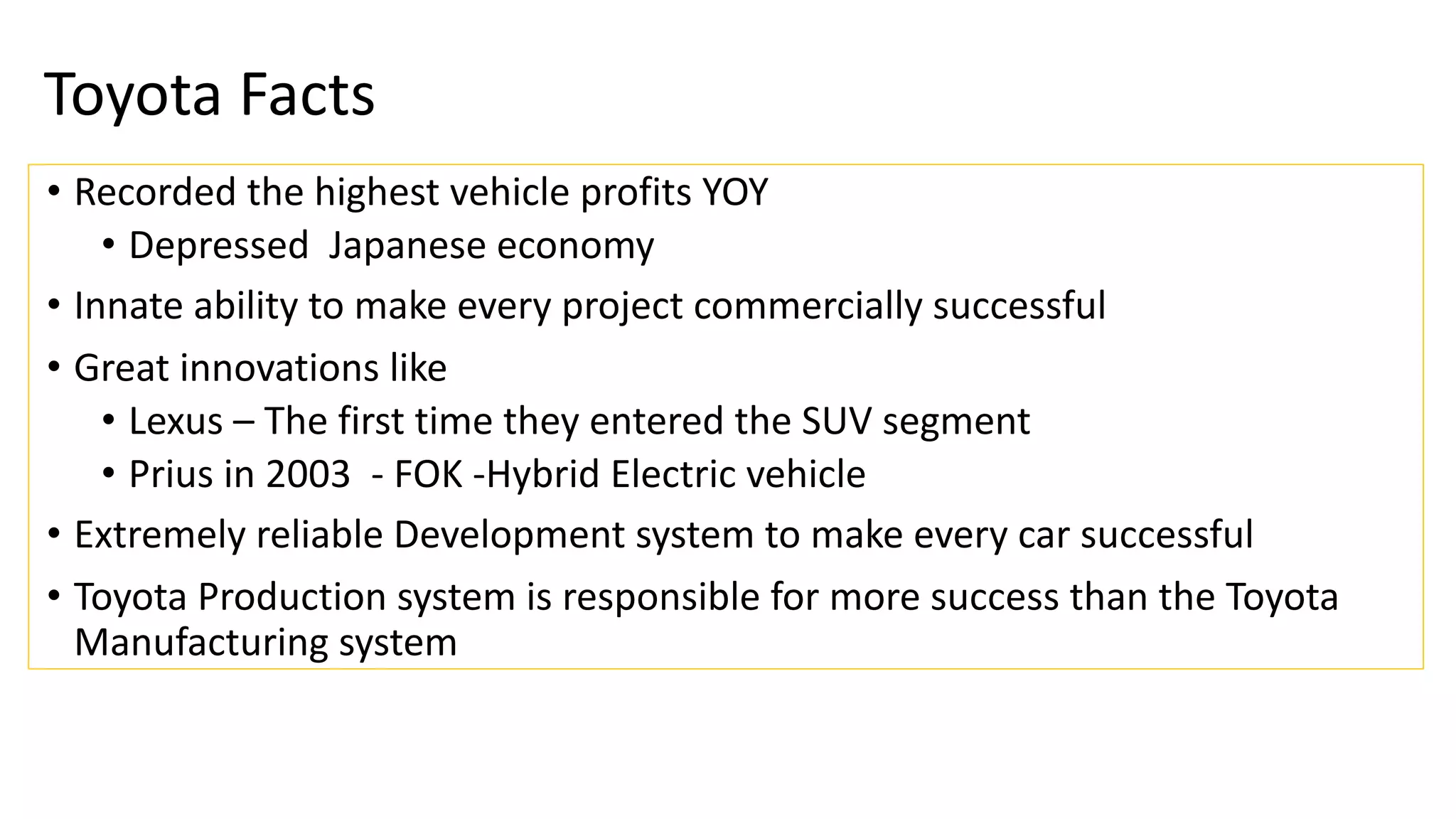
Toyota Facts
• Recorded the highest vehicle profits YOY
• Depressed Japanese economy
• Innate ability to make every project commercially successful
• Great innovations like
• Lexus – The first time they entered the SUV segment
• Prius in 2003 - FOK -Hybrid Electric vehicle
• Extremely reliable Development system to make every car successful
• Toyota Production system is responsible for more success than the Toyota
Manufacturing system
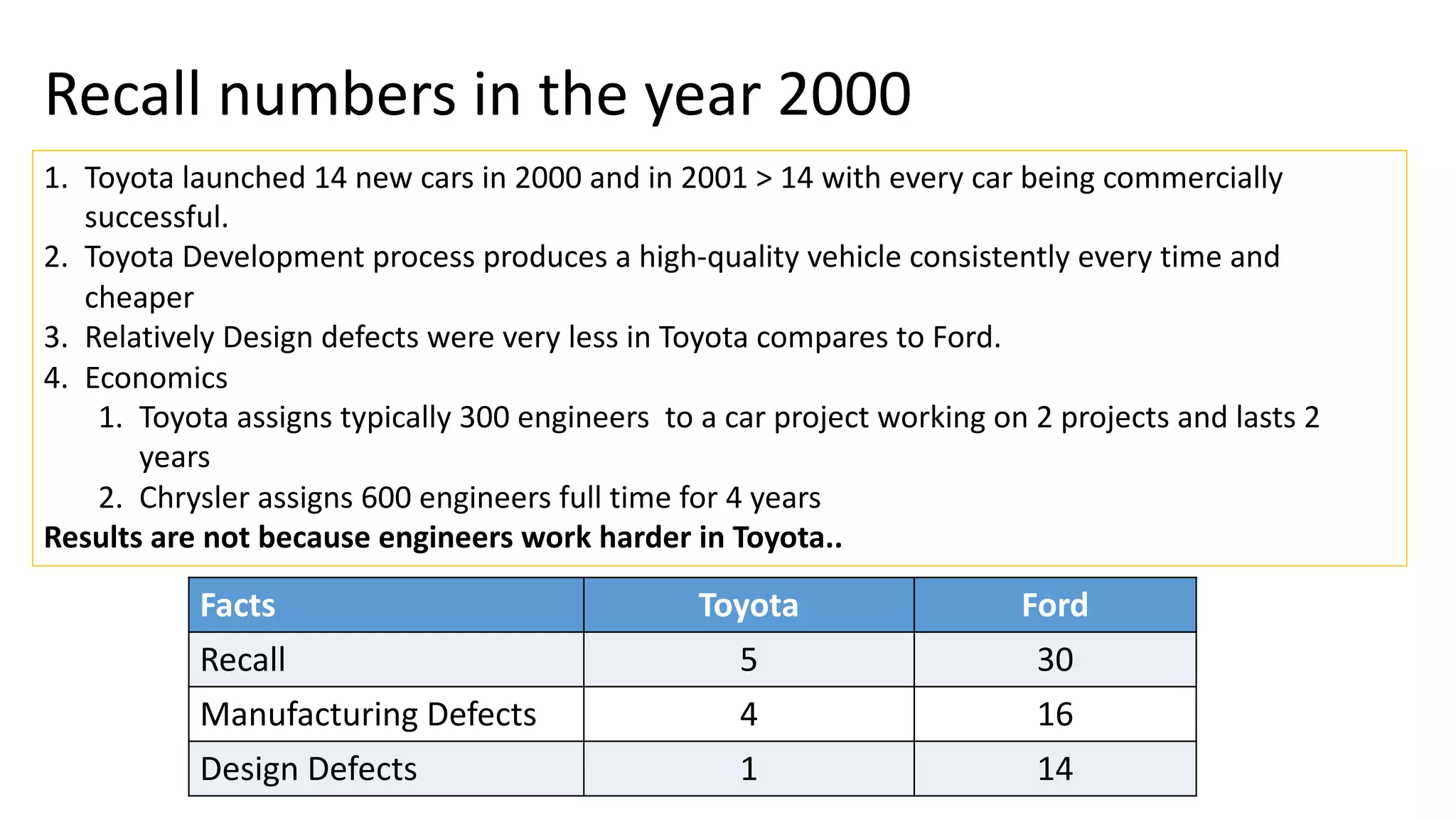
Recall numbers in the year 2000
1. Toyota launched 14 new cars in 2000 and in 2001 > 14 with every car being commercially
successful.
2. Toyota Development process produces a high-quality vehicle consistently every time and
cheaper
3. Relatively Design defects were very less in Toyota compares to Ford.
4. Economics
1. Toyota assigns typically 300 engineers to a car project working on 2 projects and lasts 2
years
2. Chrysler assigns 600 engineers full time for 4 years
Results are not because engineers work harder in Toyota..
Facts Toyota Ford
Recall 5 30
Manufacturing Defects 4 16
Design Defects 1 14
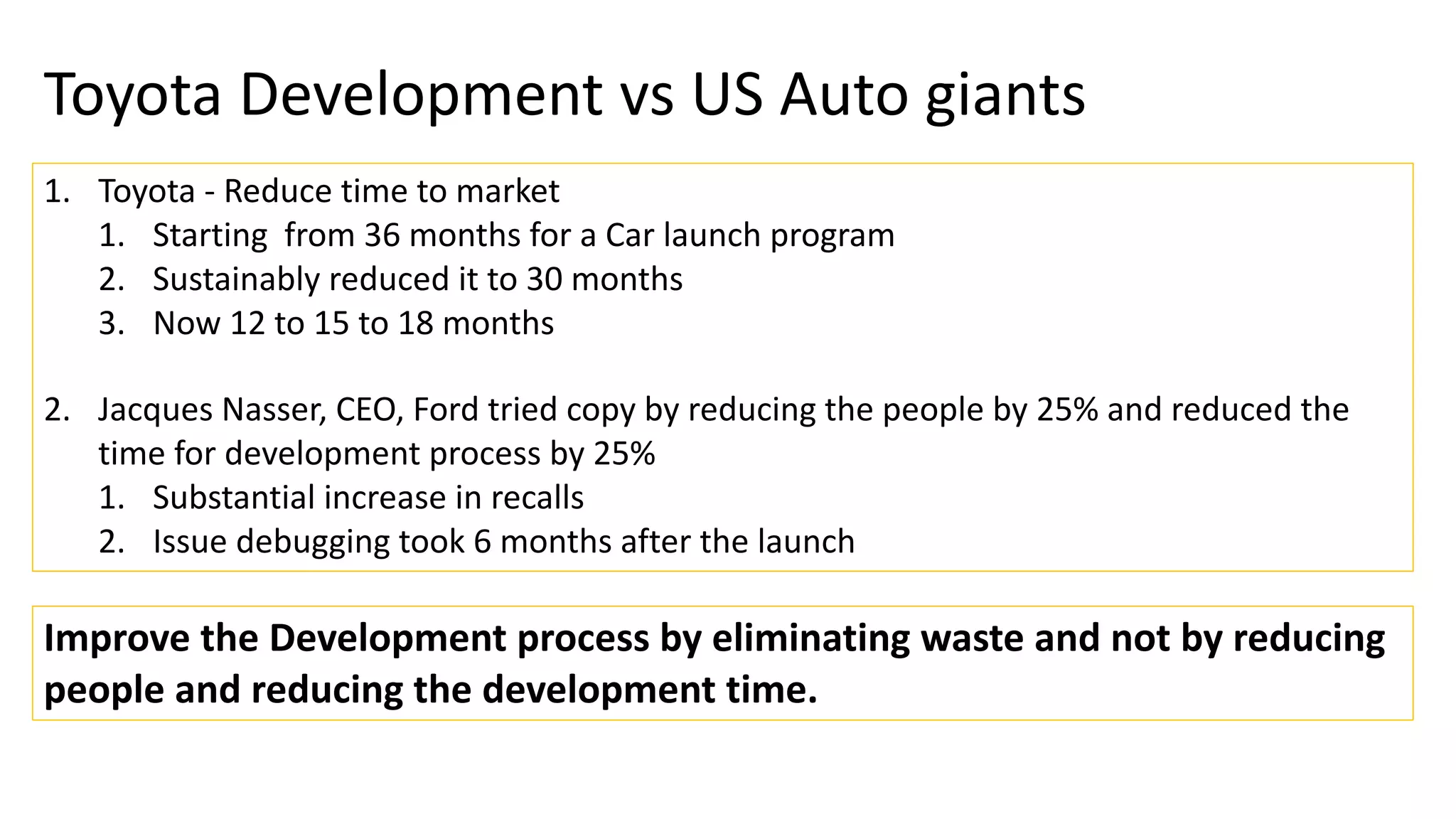
Toyota Development vs US Auto giants
1. Toyota - Reduce time to market
1. Starting from 36 months for a Car launch program
2. Sustainably reduced it to 30 months
3. Now 12 to 15 to 18 months
2. Jacques Nasser, CEO, Ford tried copy by reducing the people by 25% and reduced the
time for development process by 25%
1. Substantial increase in recalls
2. Issue debugging took 6 months after the launch
Improve the Development process by eliminating waste and not by reducing
people and reducing the development time.
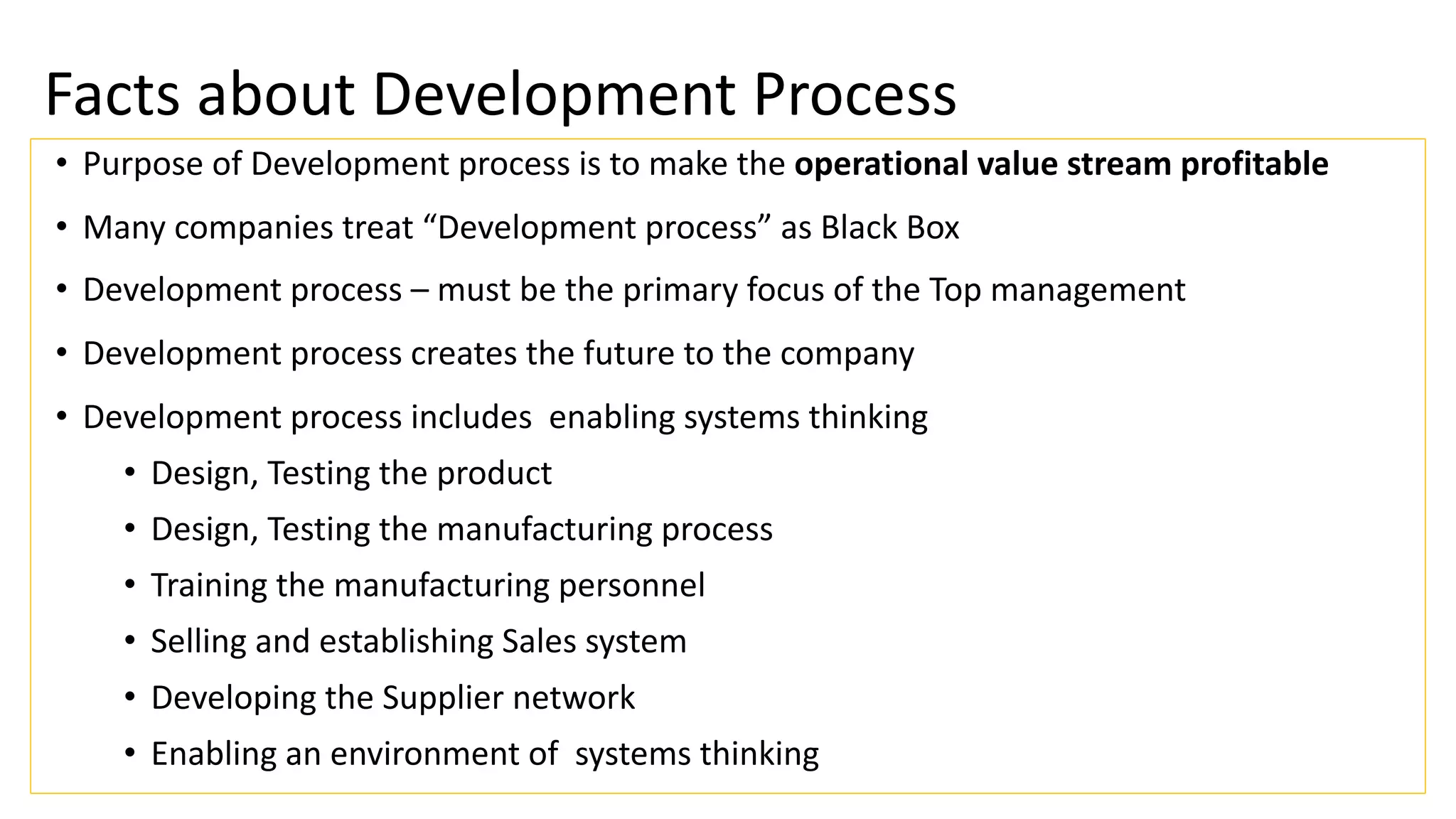
Facts about Development Process
• Purpose of Development process is to make the operational value stream profitable
• Many companies treat “Development process” as Black Box
• Development process – must be the primary focus of the Top management
• Development process creates the future to the company
• Development process includes enabling systems thinking
• Design, Testing the product
• Design, Testing the manufacturing process
• Training the manufacturing personnel
• Selling and establishing Sales system
• Developing the Supplier network
• Enabling an environment of systems thinking
What is Value and How do we add value?
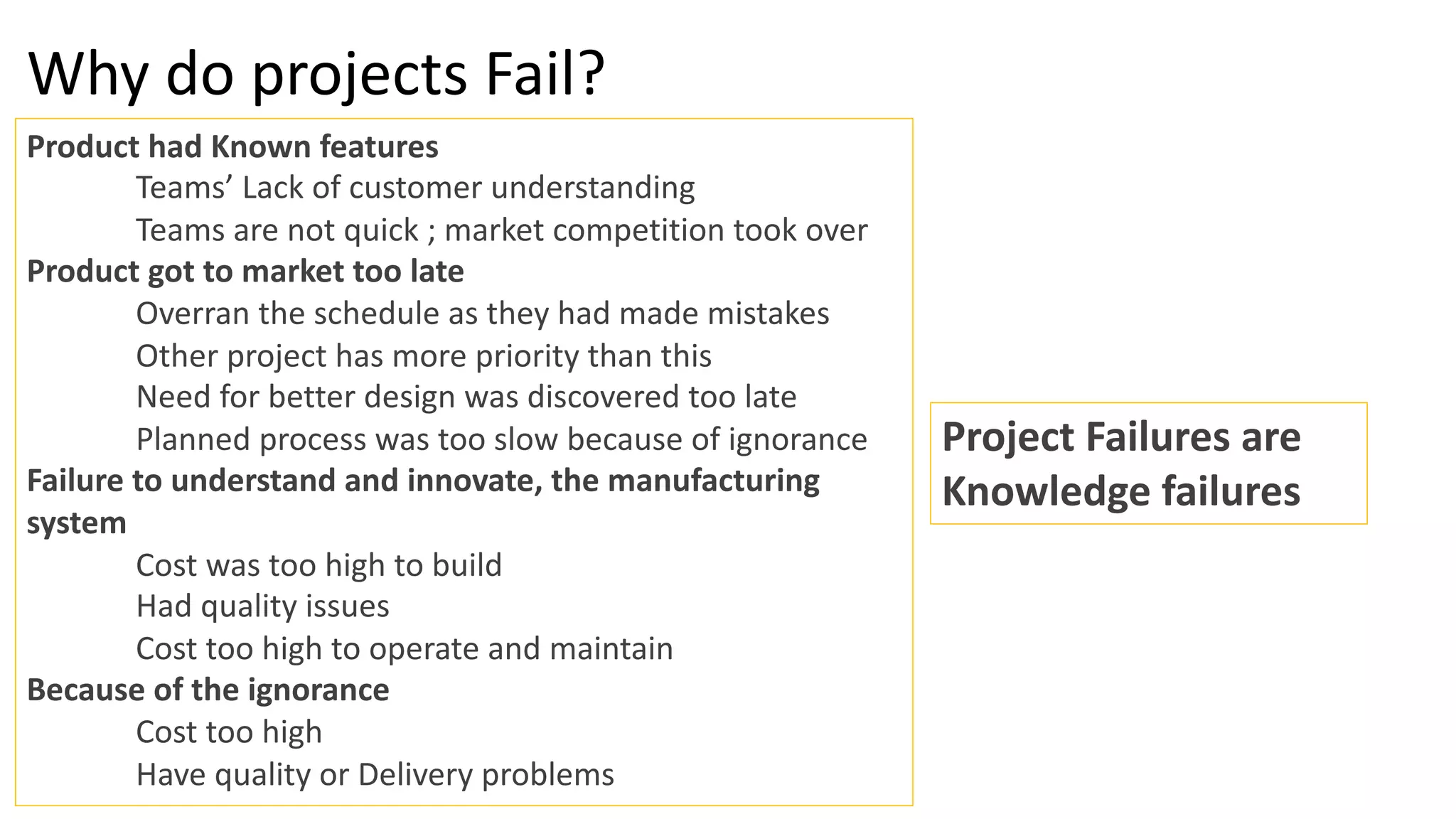
Why do projects Fail?
Product had Known features
Teams’ Lack of customer understanding
Teams are not quick ; market competition took over
Product got to market too late
Overran the schedule as they had made mistakes
Other project has more priority than this
Need for better design was discovered too late
Planned process was too slow because of ignorance
Failure to understand and innovate, the manufacturing
system
Cost was too high to build
Had quality issues
Cost too high to operate and maintain
Because of the ignorance
Cost too high
Have quality or Delivery problems
Project Failures are
Knowledge failures
What does Development process create?
1. Development process creates “Usable Knowledge”
AND
2. “Usable Knowledge” produces a better “Operational value stream”
How to create “Usable Knowledge”?
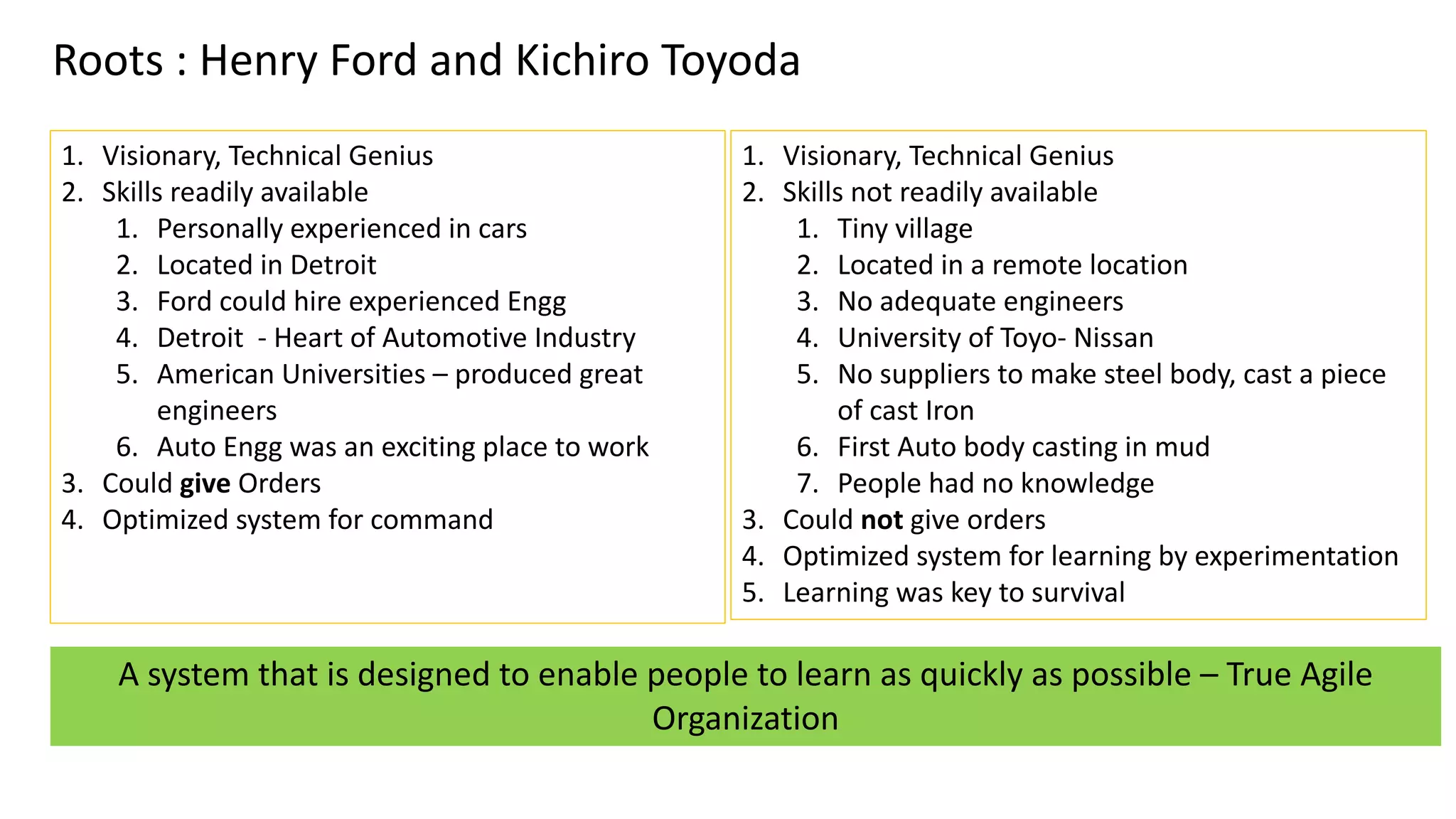
Roots : Henry Ford and Kichiro Toyoda
1. Visionary, Technical Genius
2. Skills readily available
1. Personally experienced in cars
2. Located in Detroit
3. Ford could hire experienced Engg
4. Detroit - Heart of Automotive Industry
5. American Universities – produced great
engineers
6. Auto Engg was an exciting place to work
3. Could give Orders
4. Optimized system for command
1. Visionary, Technical Genius
2. Skills not readily available
1. Tiny village
2. Located in a remote location
3. No adequate engineers
4. University of Toyo- Nissan
5. No suppliers to make steel body, cast a piece
of cast Iron
6. First Auto body casting in mud
7. People had no knowledge
3. Could not give orders
4. Optimized system for learning by experimentation
5. Learning was key to survival
A system that is designed to enable people to learn as quickly as possible – True Agile
Organization
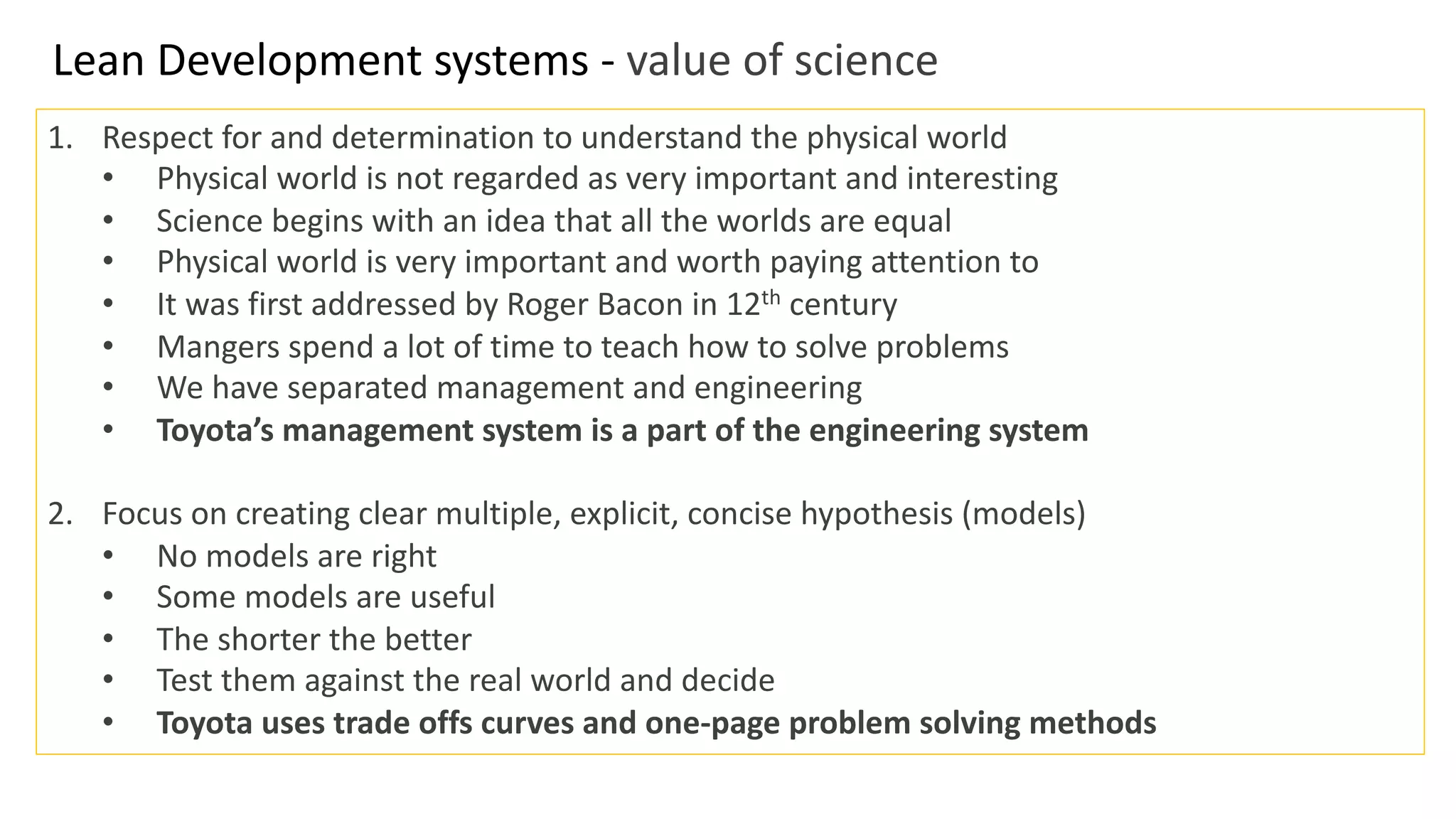
Lean Development systems - value of science
1. Respect for and determination to understand the physical world
• Physical world is not regarded as very important and interesting
• Science begins with an idea that all the worlds are equal
• Physical world is very important and worth paying attention to
• It was first addressed by Roger Bacon in 12th century
• Mangers spend a lot of time to teach how to solve problems
• We have separated management and engineering
• Toyota’s management system is a part of the engineering system
2. Focus on creating clear multiple, explicit, concise hypothesis (models)
• No models are right
• Some models are useful
• The shorter the better
• Test them against the real world and decide
• Toyota uses trade offs curves and one-page problem solving methods
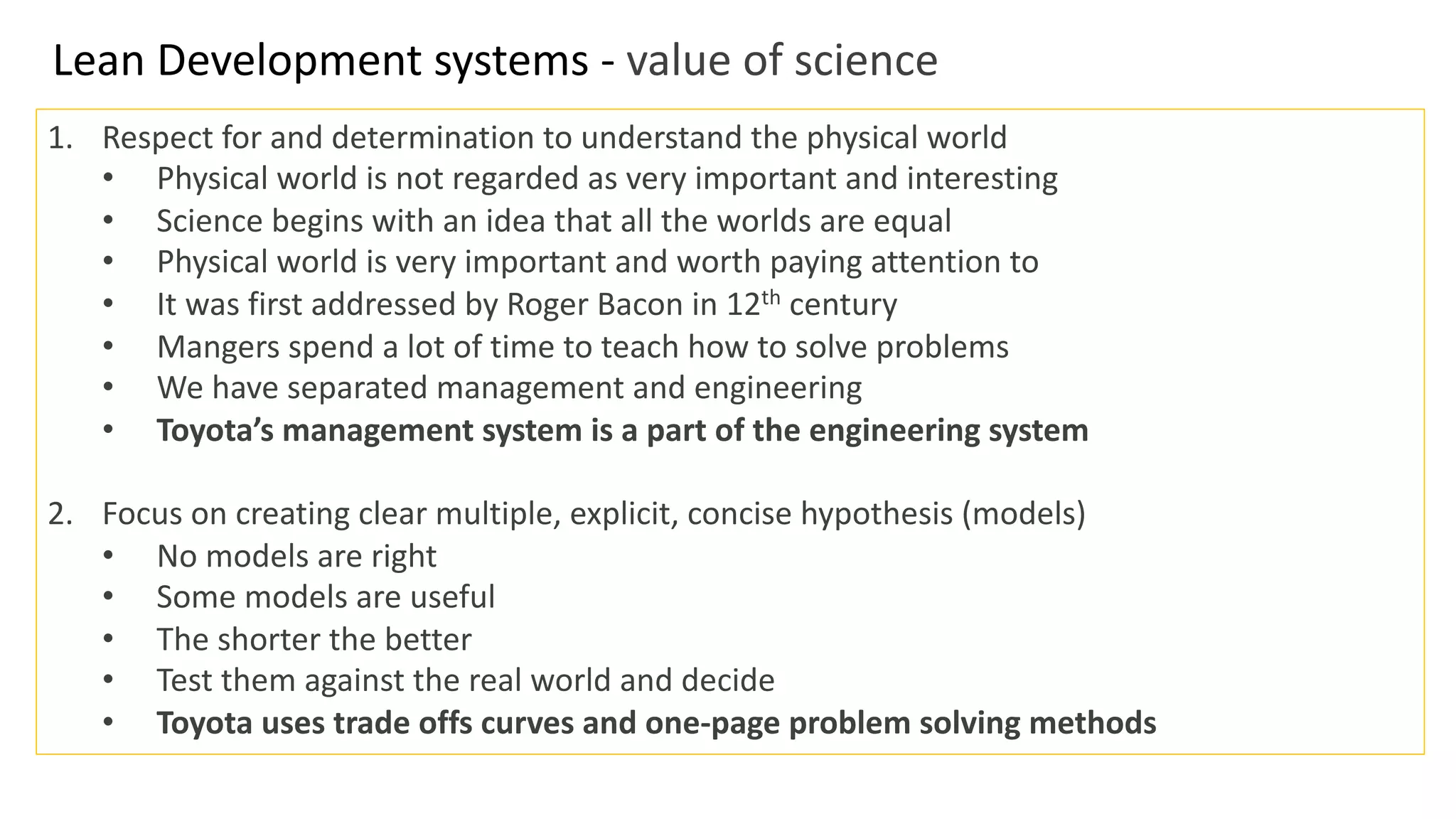
Lean Development systems - value of science
1. Respect for and determination to understand the physical world
• Physical world is not regarded as very important and interesting
• Science begins with an idea that all the worlds are equal
• Physical world is very important and worth paying attention to
• It was first addressed by Roger Bacon in 12th century
• Mangers spend a lot of time to teach how to solve problems
• We have separated management and engineering
• Toyota’s management system is a part of the engineering system
2. Focus on creating clear multiple, explicit, concise hypothesis (models)
• No models are right
• Some models are useful
• The shorter the better
• Test them against the real world and decide
• Toyota uses trade offs curves and one-page problem solving methods
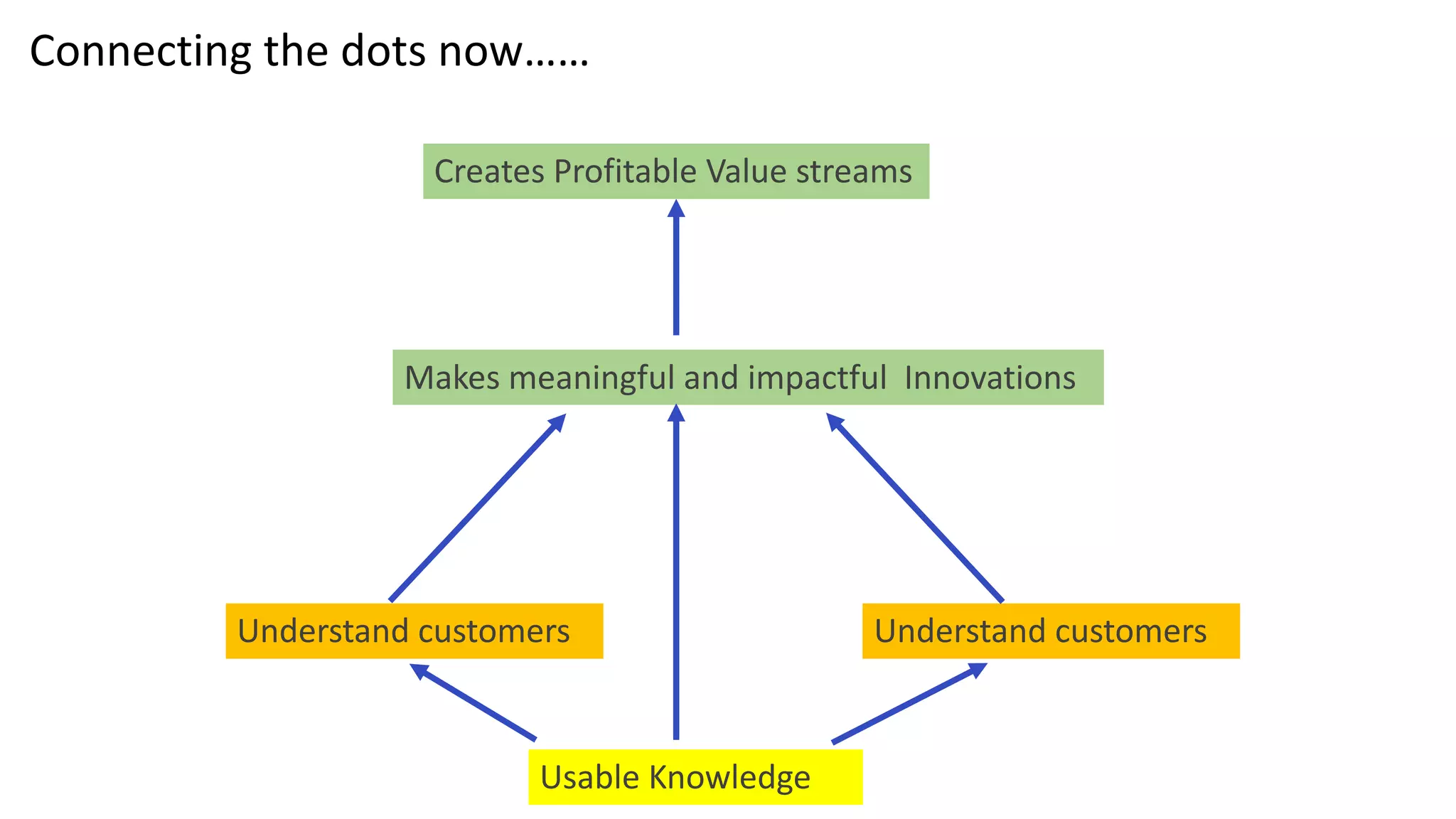
Connecting the dots now……
Usable Knowledge
Understand customers Understand customers
Makes meaningful and impactful Innovations
Creates Profitable Value streams
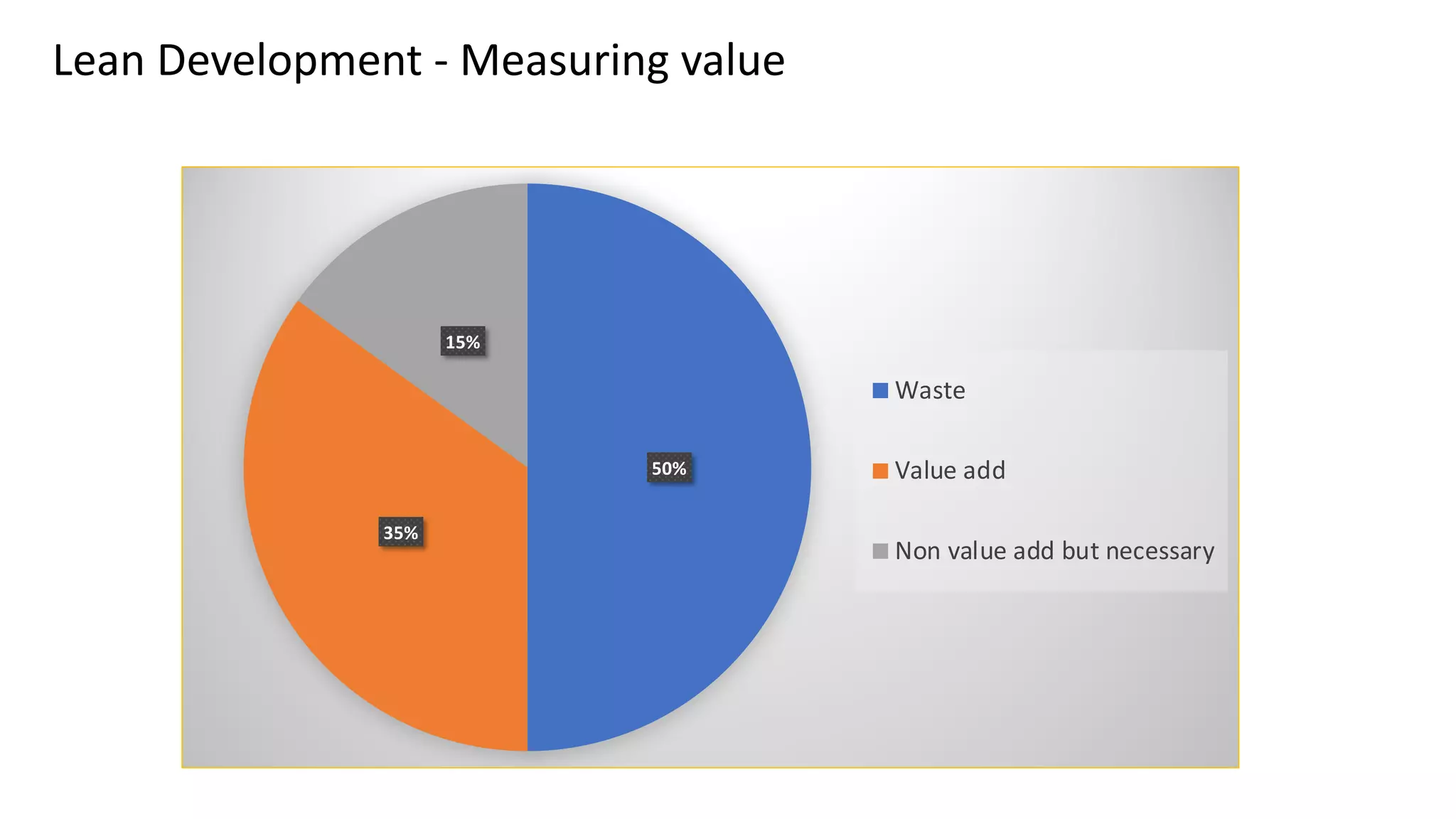
Lean Development - Measuring value
50%
35%
15%
Waste
Value add
Non value add but necessary
What is “Waste in Development”?
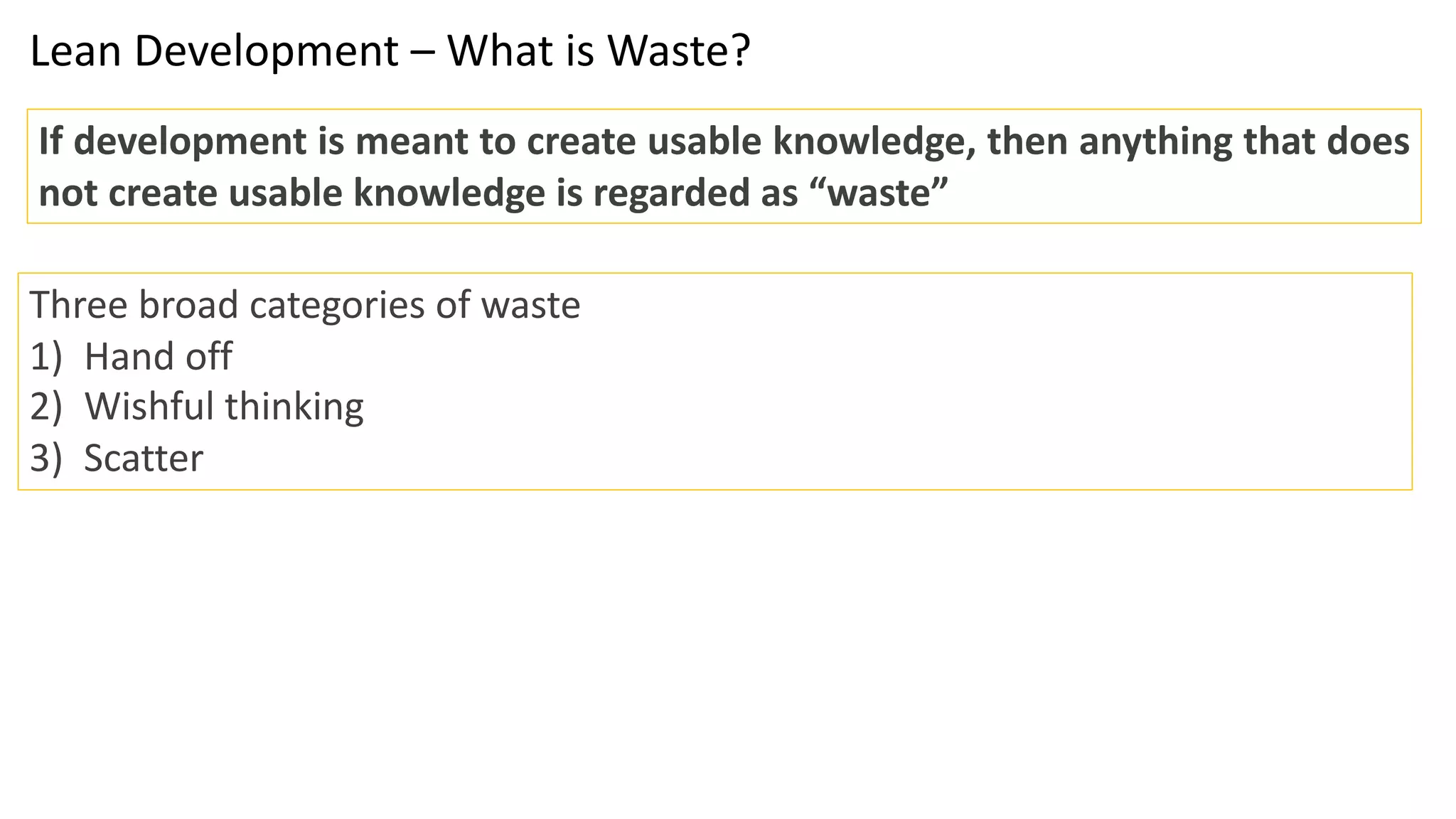
Lean Development – What is Waste?
If development is meant to create usable knowledge, then anything that does
not create usable knowledge is regarded as “waste”
Three broad categories of waste
1) Hand off
2) Wishful thinking
3) Scatter
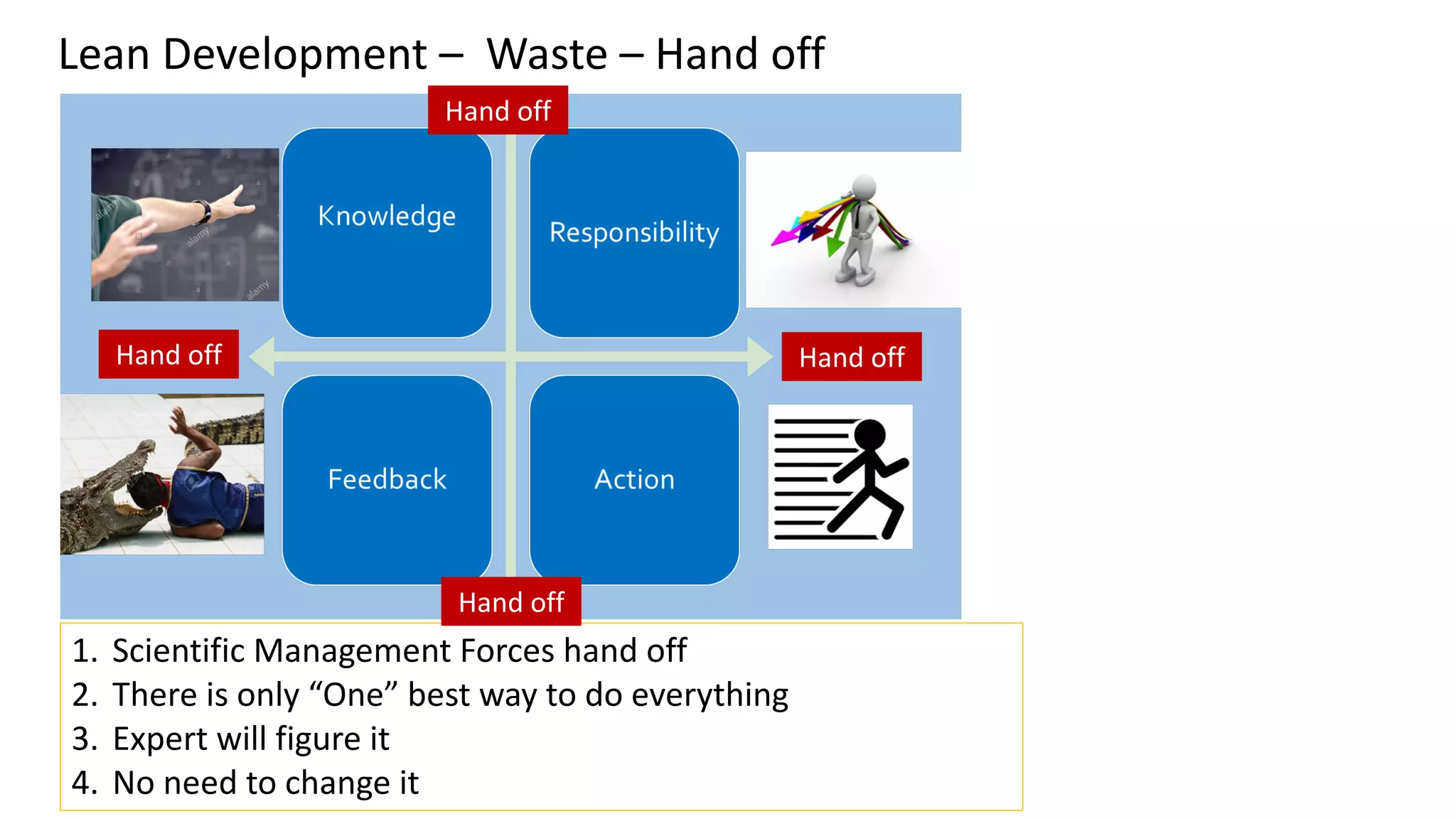
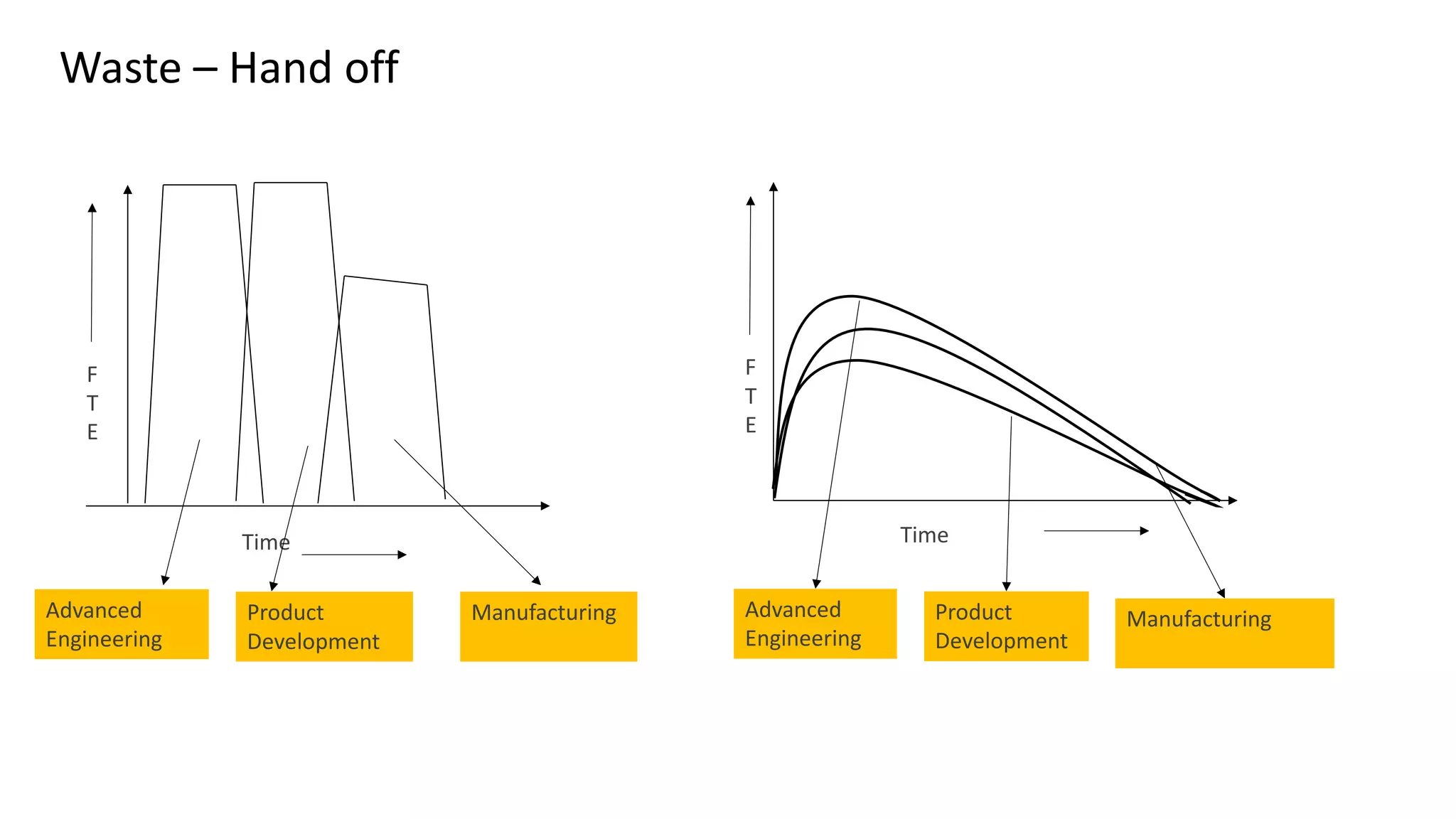
Lean Development – Waste – Hand off
1. Scientific Management Forces hand off
2. There is only “One” best way to do everything
3. Expert will figure it
4. No need to change it
Hand offHand off
Hand off
Hand off
Time
Waste – Hand off
Advanced
Engineering
Product
Development
Manufacturing Advanced
Engineering
Product
Development
Manufacturing
F
T
E
Time
F
T
E
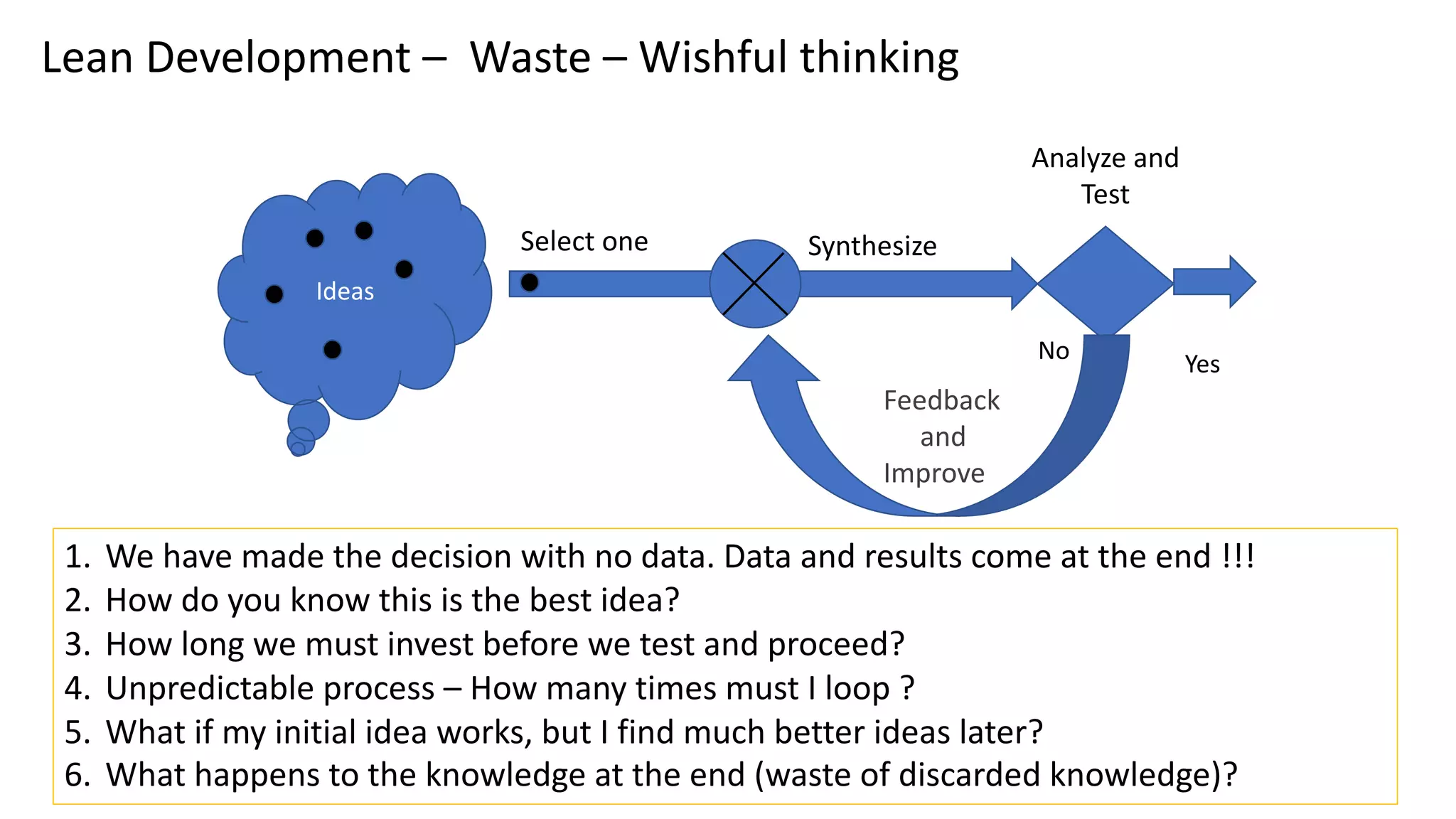
1. We have made the decision with no data. Data and results come at the end !!!
2. How do you know this is the best idea?
3. How long we must invest before we test and proceed?
4. Unpredictable process – How many times must I loop ?
5. What if my initial idea works, but I find much better ideas later?
6. What happens to the knowledge at the end (waste of discarded knowledge)?
Lean Development – Waste – Wishful thinking
Ideas
Select one Synthesize
Analyze and
Test
YesNo
Feedback
and
Improve
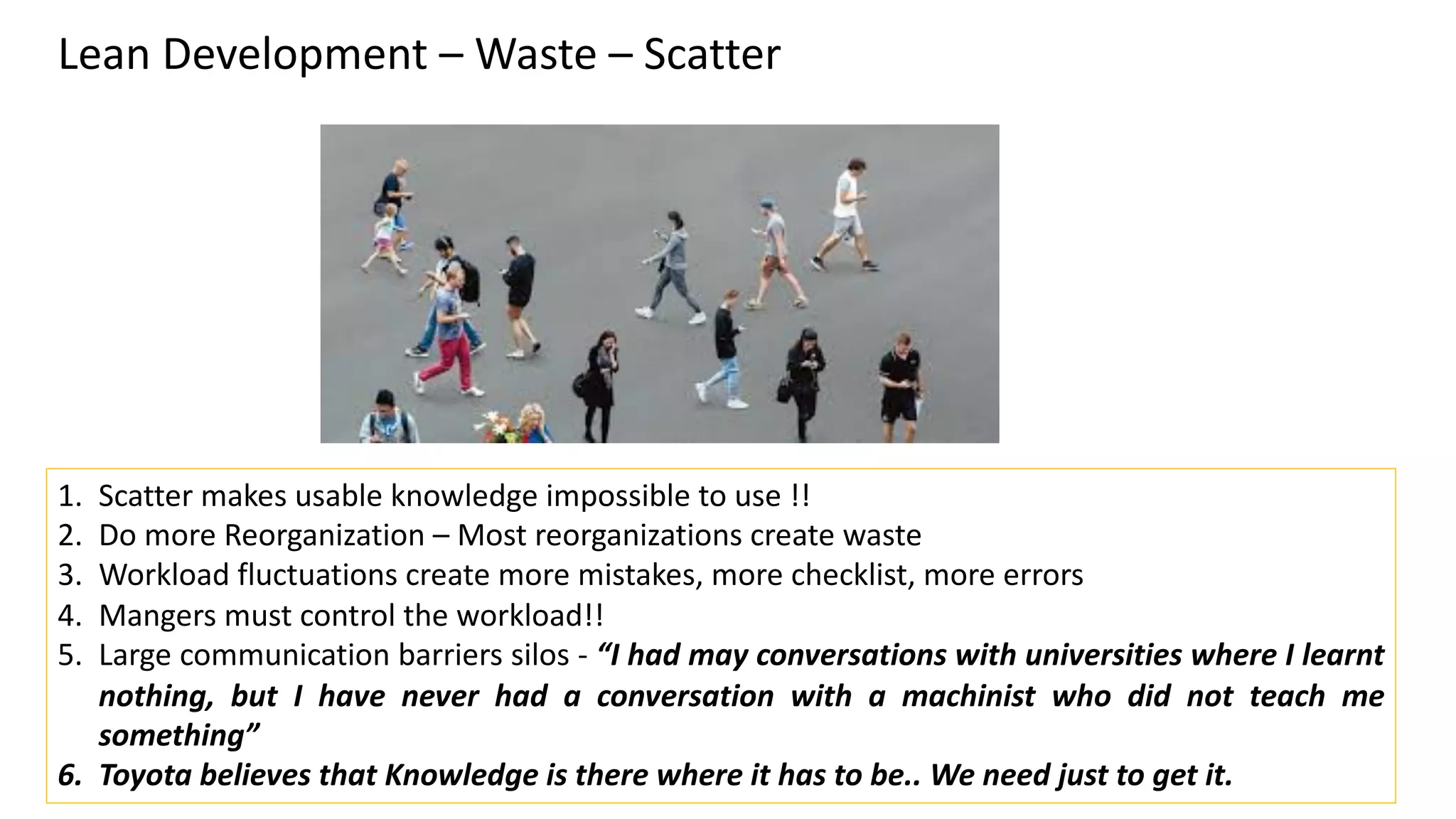
Lean Development – Waste – Scatter
1. Scatter makes usable knowledge impossible to use !!
2. Do more Reorganization – Most reorganizations create waste
3. Workload fluctuations create more mistakes, more checklist, more errors
4. Mangers must control the workload!!
5. Large communication barriers silos - “I had may conversations with universities where I learnt
nothing, but I have never had a conversation with a machinist who did not teach me
something”
6. Toyota believes that Knowledge is there where it has to be.. We need just to get it.
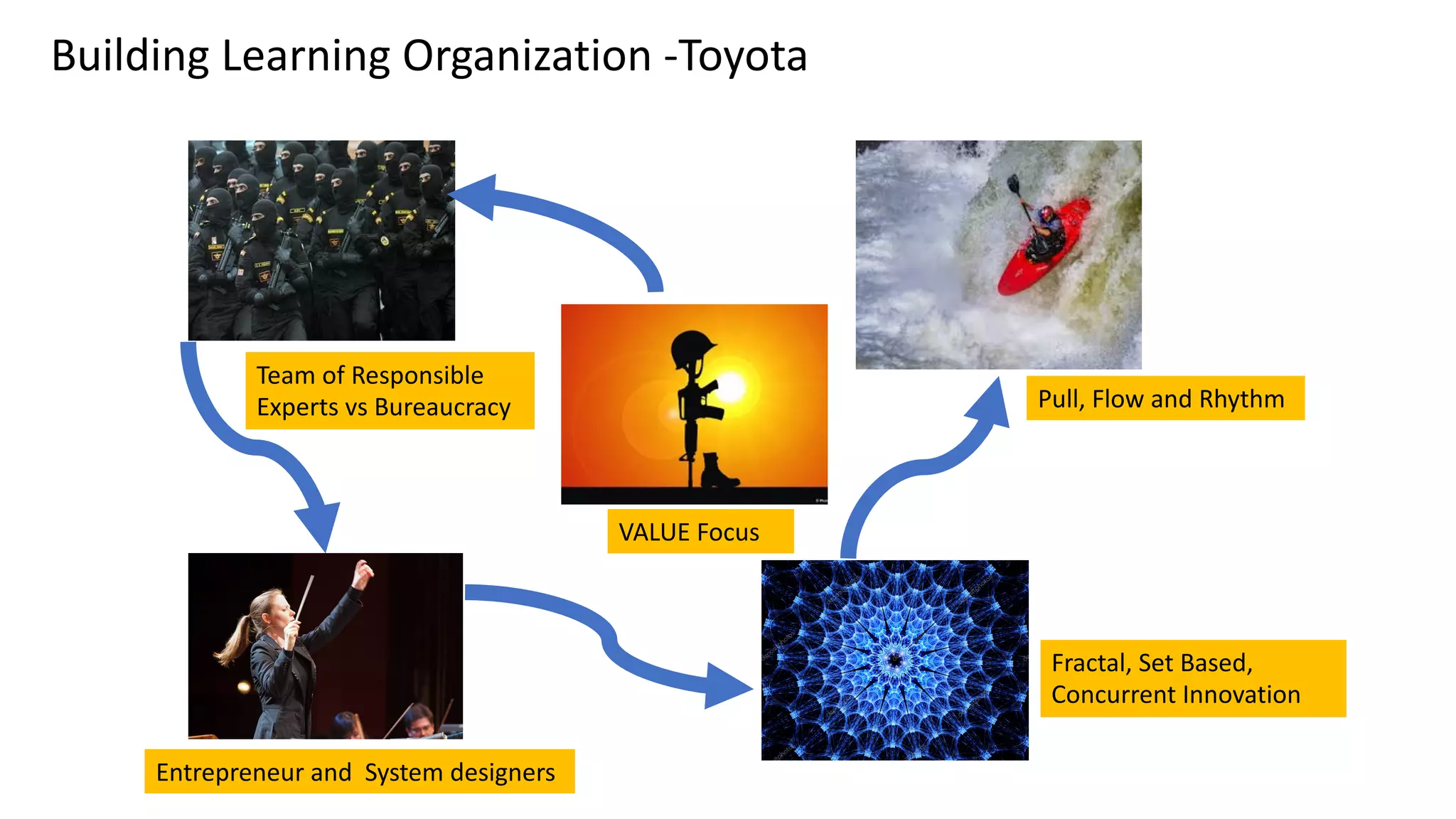
Team of Responsible
Experts vs Bureaucracy
Building Learning Organization -Toyota
VALUE Focus
Entrepreneur and System designers
Fractal, Set Based,
Concurrent Innovation
Pull, Flow and Rhythm
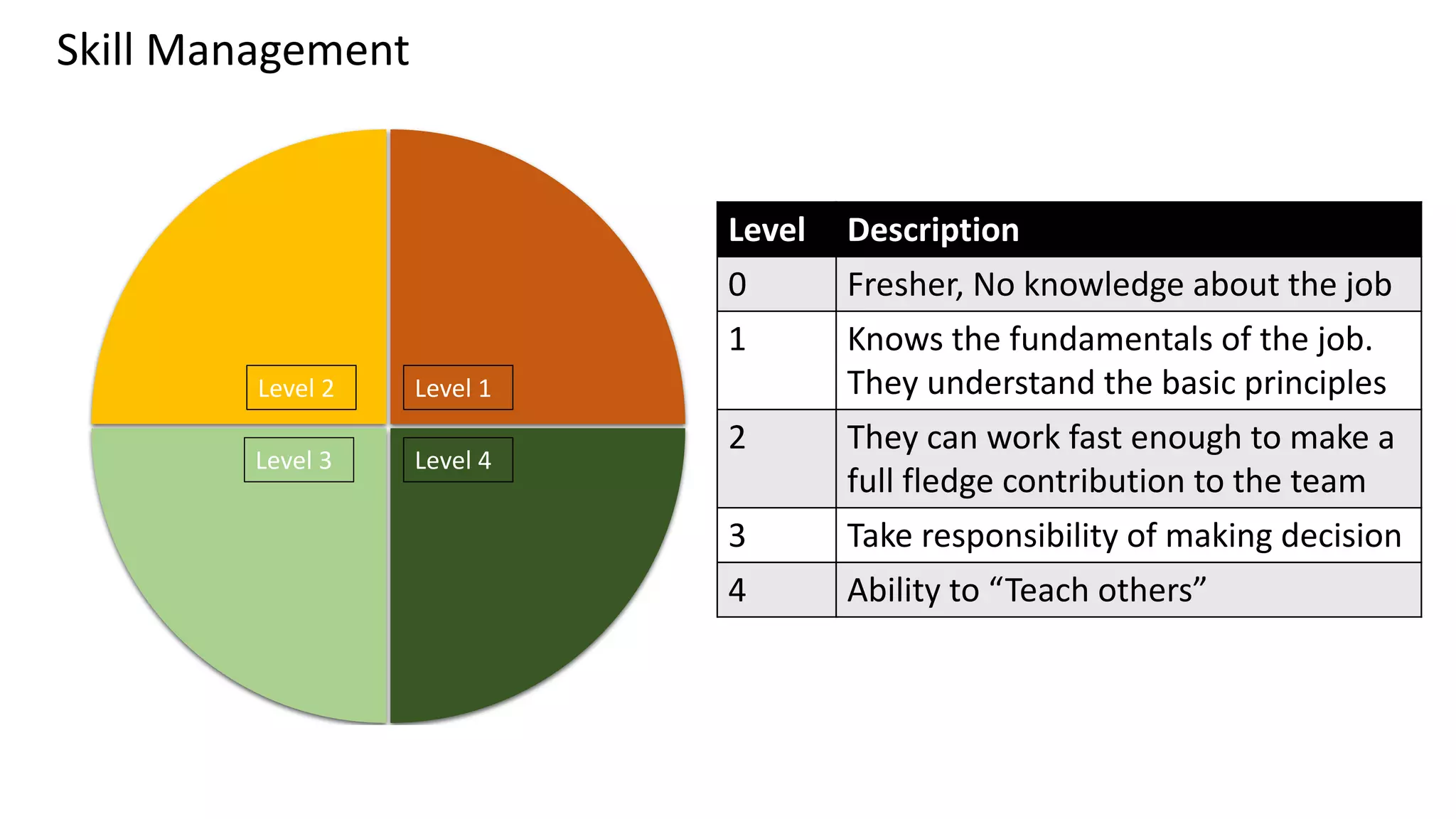
Skill Management
Level Description
0 Fresher, No knowledge about the job
1 Knows the fundamentals of the job.
They understand the basic principles
2 They can work fast enough to make a
full fledge contribution to the team
3 Take responsibility of making decision
4 Ability to “Teach others”
Level 1
Level 4Level 3
Level 2
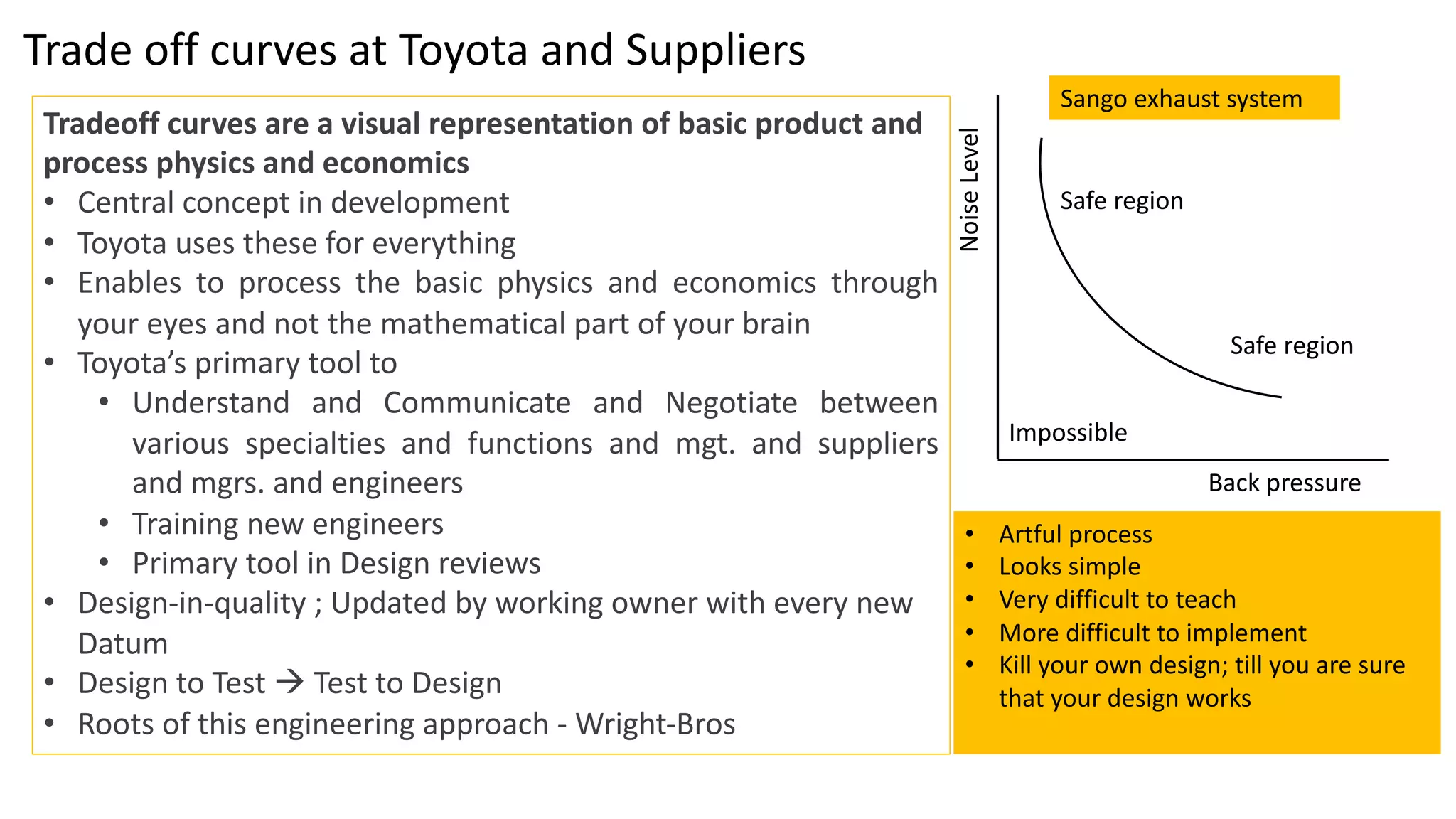
Trade off curves at Toyota and Suppliers
Back pressure
NoiseLevel
Impossible
Safe region
Sango exhaust system
Tradeoff curves are a visual representation of basic product and
process physics and economics
• Central concept in development
• Toyota uses these for everything
• Enables to process the basic physics and economics through
your eyes and not the mathematical part of your brain
• Toyota’s primary tool to
• Understand and Communicate and Negotiate between
various specialties and functions and mgt. and suppliers
and mgrs. and engineers
• Training new engineers
• Primary tool in Design reviews
• Design-in-quality ; Updated by working owner with every new
Datum
• Design to Test à Test to Design
• Roots of this engineering approach - Wright-Bros
• Artful process
• Looks simple
• Very difficult to teach
• More difficult to implement
• Kill your own design; till you are sure
that your design works
Safe region
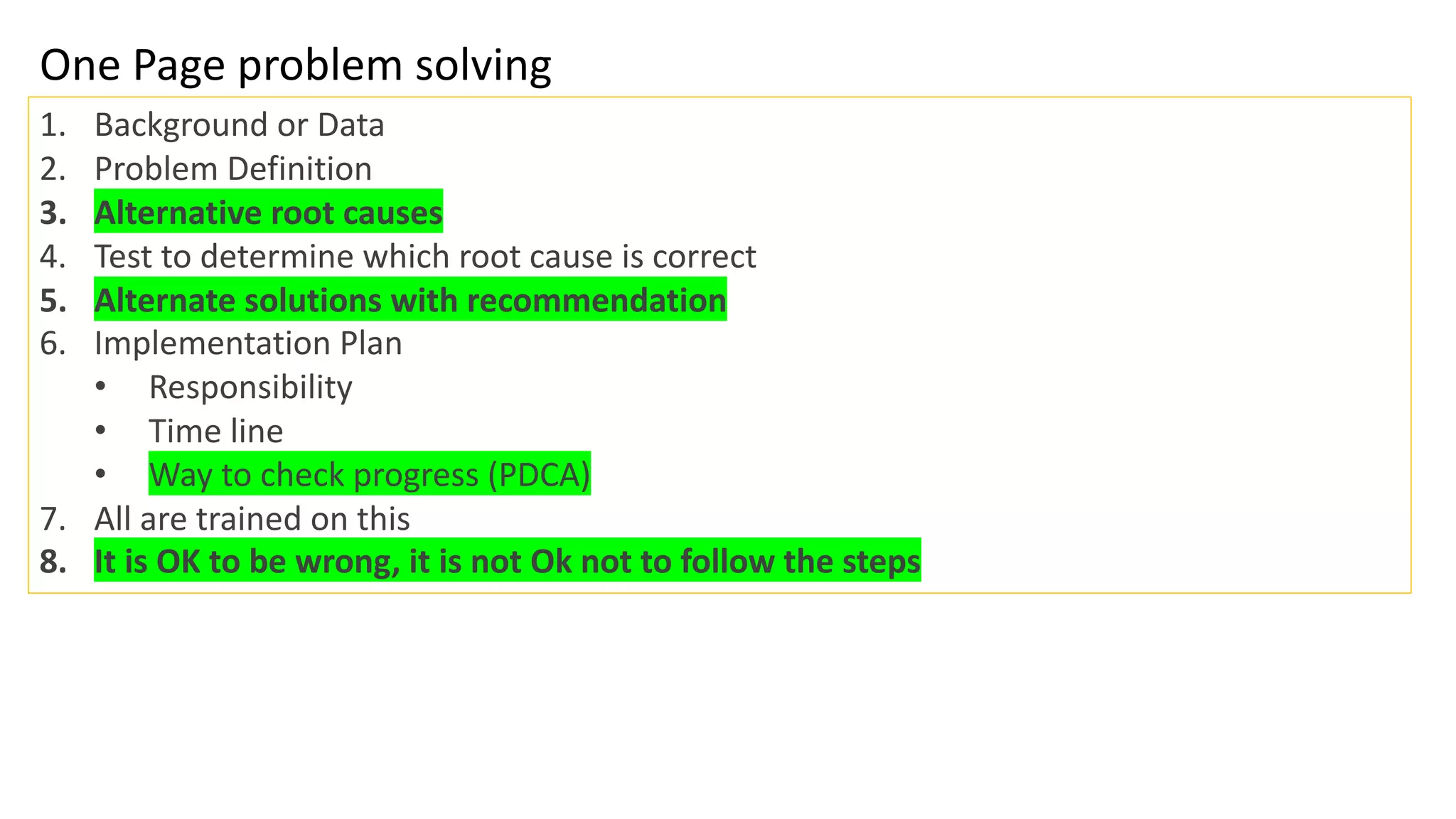
One Page problem solving
1. Background or Data
2. Problem Definition
3. Alternative root causes
4. Test to determine which root cause is correct
5. Alternate solutions with recommendation
6. Implementation Plan
• Responsibility
• Time line
• Way to check progress (PDCA)
7. All are trained on this
8. It is OK to be wrong, it is not Ok not to follow the steps
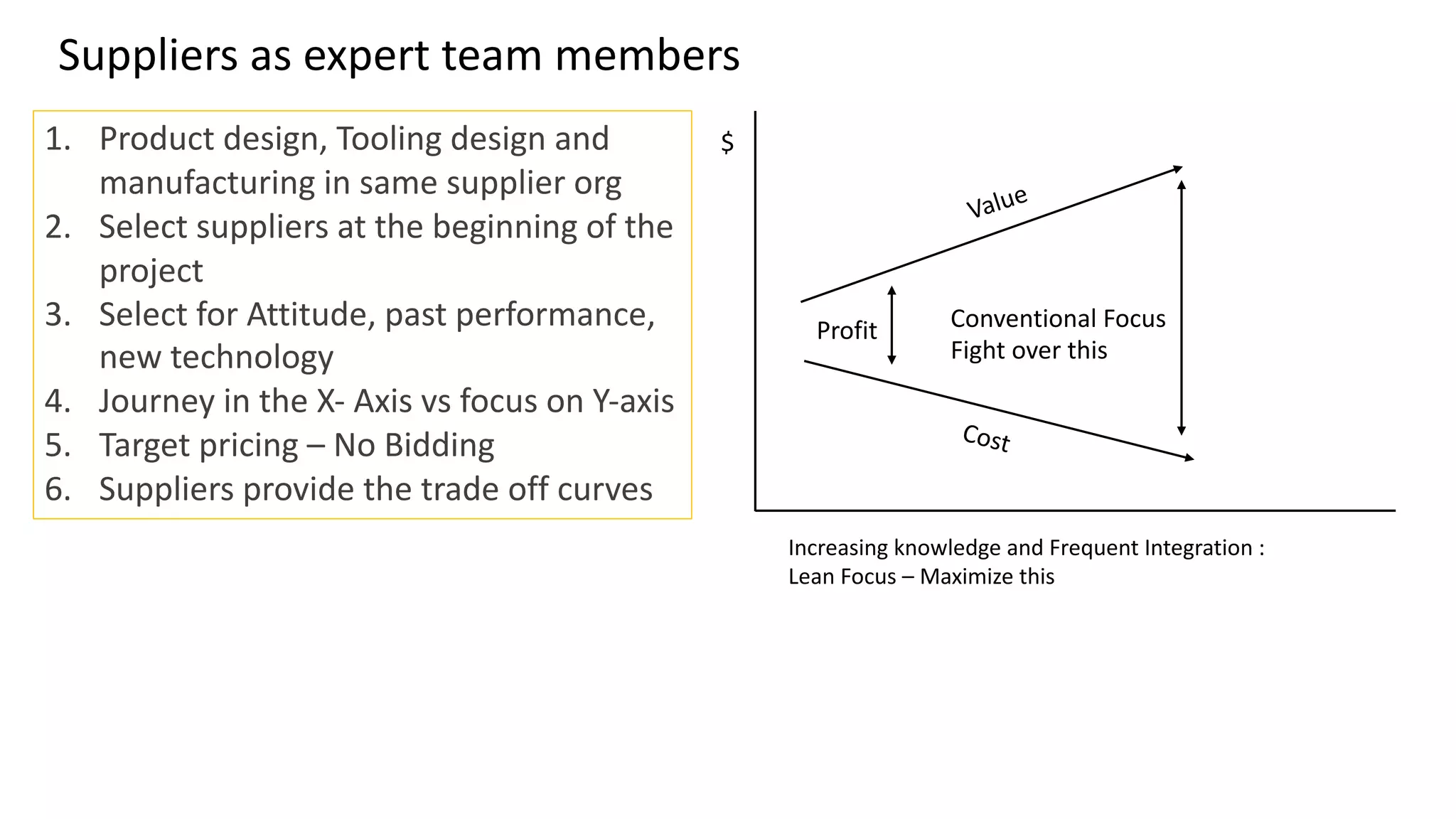
Suppliers as expert team members
1. Product design, Tooling design and
manufacturing in same supplier org
2. Select suppliers at the beginning of the
project
3. Select for Attitude, past performance,
new technology
4. Journey in the X- Axis vs focus on Y-axis
5. Target pricing – No Bidding
6. Suppliers provide the trade off curves
Increasing knowledge and Frequent Integration :
Lean Focus – Maximize this
$
Profit Conventional Focus
Fight over this
Value
Cost
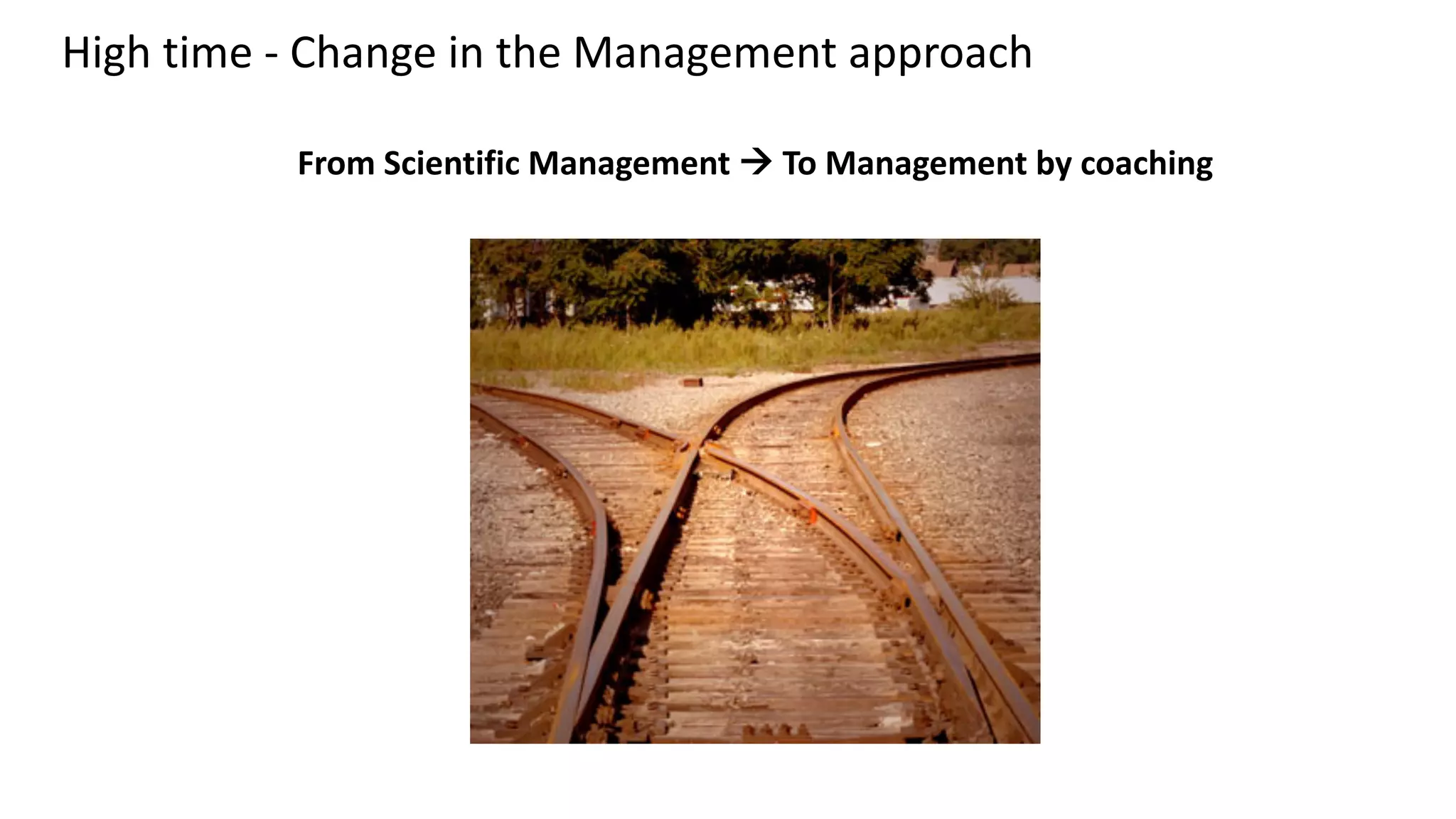
High time - Change in the Management approach
From Scientific Management à To Management by coaching
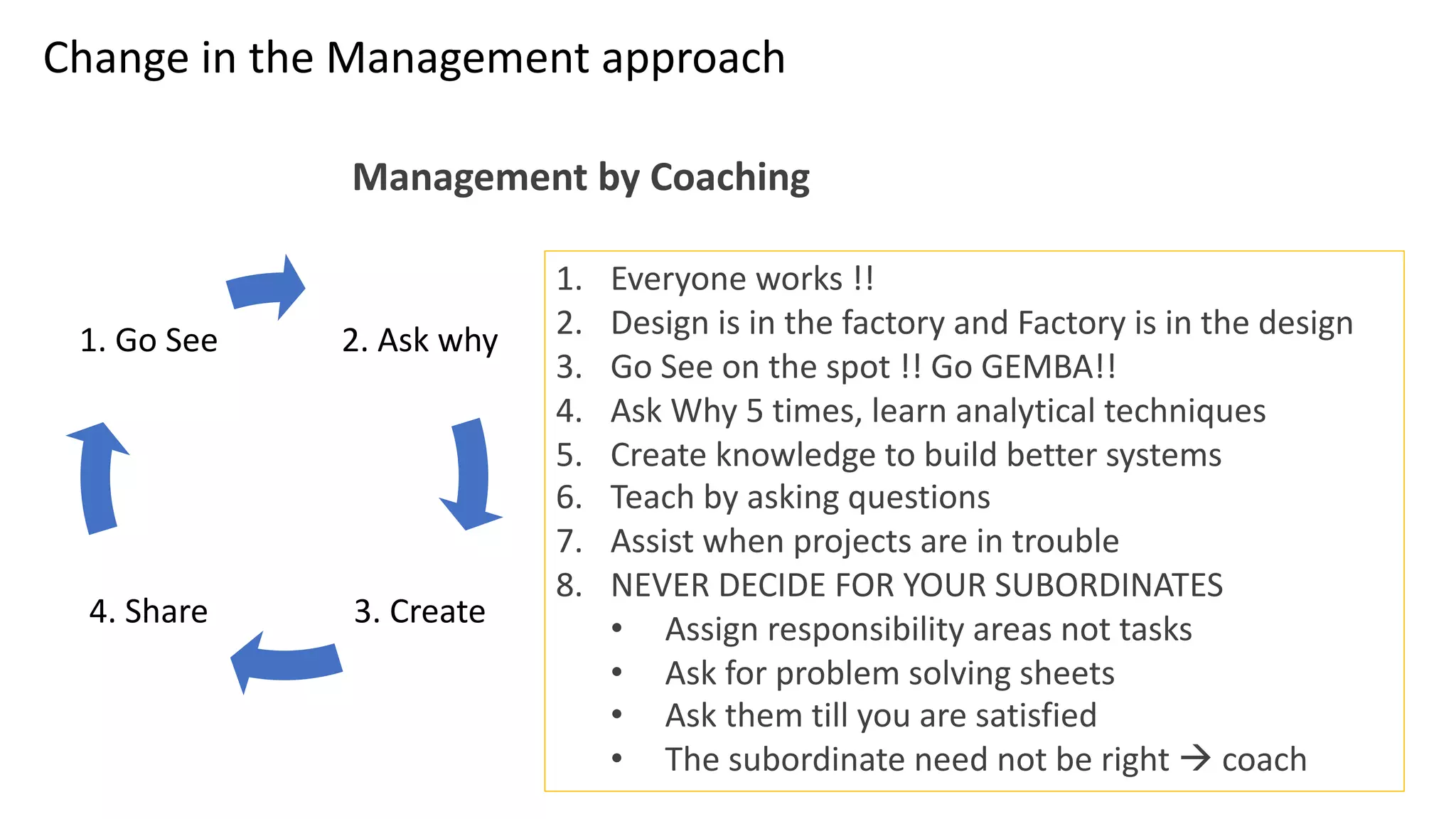
Change in the Management approach
Management by Coaching
1. Everyone works !!
2. Design is in the factory and Factory is in the design
3. Go See on the spot !! Go GEMBA!!
4. Ask Why 5 times, learn analytical techniques
5. Create knowledge to build better systems
6. Teach by asking questions
7. Assist when projects are in trouble
8. NEVER DECIDE FOR YOUR SUBORDINATES
• Assign responsibility areas not tasks
• Ask for problem solving sheets
• Ask them till you are satisfied
• The subordinate need not be right à coach
2. Ask why
3. Create4. Share
1. Go See
THANK YOU

Building products that are cheap,fast and good by Anand Murthy Raj

  • 1.
    March 11, 2020- Dubai, UAE Building Products Fast, Cheap and Good Anand Murthy Raj Partner, Gladwell Academy B.V. Director, Agile Spirit private Limited
  • 2.
  • 3.
    This presentation hasbeen greatly influenced by the work of Dr. Allen C Ward Inspiration
  • 4.
    Which option wouldyou pick ? Toyota is able to do Good (Quality), Cheap (Cost) and Fast (time to Market) sustainably for decades now..
  • 5.
    Toyota Facts • Recordedthe highest vehicle profits YOY • Depressed Japanese economy • Innate ability to make every project commercially successful • Great innovations like • Lexus – The first time they entered the SUV segment • Prius in 2003 - FOK -Hybrid Electric vehicle • Extremely reliable Development system to make every car successful • Toyota Production system is responsible for more success than the Toyota Manufacturing system
  • 6.
    Recall numbers inthe year 2000 1. Toyota launched 14 new cars in 2000 and in 2001 > 14 with every car being commercially successful. 2. Toyota Development process produces a high-quality vehicle consistently every time and cheaper 3. Relatively Design defects were very less in Toyota compares to Ford. 4. Economics 1. Toyota assigns typically 300 engineers to a car project working on 2 projects and lasts 2 years 2. Chrysler assigns 600 engineers full time for 4 years Results are not because engineers work harder in Toyota.. Facts Toyota Ford Recall 5 30 Manufacturing Defects 4 16 Design Defects 1 14
  • 7.
    Toyota Development vsUS Auto giants 1. Toyota - Reduce time to market 1. Starting from 36 months for a Car launch program 2. Sustainably reduced it to 30 months 3. Now 12 to 15 to 18 months 2. Jacques Nasser, CEO, Ford tried copy by reducing the people by 25% and reduced the time for development process by 25% 1. Substantial increase in recalls 2. Issue debugging took 6 months after the launch Improve the Development process by eliminating waste and not by reducing people and reducing the development time.
  • 8.
    Facts about DevelopmentProcess • Purpose of Development process is to make the operational value stream profitable • Many companies treat “Development process” as Black Box • Development process – must be the primary focus of the Top management • Development process creates the future to the company • Development process includes enabling systems thinking • Design, Testing the product • Design, Testing the manufacturing process • Training the manufacturing personnel • Selling and establishing Sales system • Developing the Supplier network • Enabling an environment of systems thinking
  • 9.
    What is Valueand How do we add value?
  • 10.
    Why do projectsFail? Product had Known features Teams’ Lack of customer understanding Teams are not quick ; market competition took over Product got to market too late Overran the schedule as they had made mistakes Other project has more priority than this Need for better design was discovered too late Planned process was too slow because of ignorance Failure to understand and innovate, the manufacturing system Cost was too high to build Had quality issues Cost too high to operate and maintain Because of the ignorance Cost too high Have quality or Delivery problems Project Failures are Knowledge failures
  • 11.
    What does Developmentprocess create? 1. Development process creates “Usable Knowledge” AND 2. “Usable Knowledge” produces a better “Operational value stream”
  • 12.
    How to create“Usable Knowledge”?
  • 13.
    Roots : HenryFord and Kichiro Toyoda 1. Visionary, Technical Genius 2. Skills readily available 1. Personally experienced in cars 2. Located in Detroit 3. Ford could hire experienced Engg 4. Detroit - Heart of Automotive Industry 5. American Universities – produced great engineers 6. Auto Engg was an exciting place to work 3. Could give Orders 4. Optimized system for command 1. Visionary, Technical Genius 2. Skills not readily available 1. Tiny village 2. Located in a remote location 3. No adequate engineers 4. University of Toyo- Nissan 5. No suppliers to make steel body, cast a piece of cast Iron 6. First Auto body casting in mud 7. People had no knowledge 3. Could not give orders 4. Optimized system for learning by experimentation 5. Learning was key to survival A system that is designed to enable people to learn as quickly as possible – True Agile Organization
  • 14.
    Lean Development systems- value of science 1. Respect for and determination to understand the physical world • Physical world is not regarded as very important and interesting • Science begins with an idea that all the worlds are equal • Physical world is very important and worth paying attention to • It was first addressed by Roger Bacon in 12th century • Mangers spend a lot of time to teach how to solve problems • We have separated management and engineering • Toyota’s management system is a part of the engineering system 2. Focus on creating clear multiple, explicit, concise hypothesis (models) • No models are right • Some models are useful • The shorter the better • Test them against the real world and decide • Toyota uses trade offs curves and one-page problem solving methods
  • 15.
    Lean Development systems- value of science 1. Respect for and determination to understand the physical world • Physical world is not regarded as very important and interesting • Science begins with an idea that all the worlds are equal • Physical world is very important and worth paying attention to • It was first addressed by Roger Bacon in 12th century • Mangers spend a lot of time to teach how to solve problems • We have separated management and engineering • Toyota’s management system is a part of the engineering system 2. Focus on creating clear multiple, explicit, concise hypothesis (models) • No models are right • Some models are useful • The shorter the better • Test them against the real world and decide • Toyota uses trade offs curves and one-page problem solving methods
  • 16.
    Connecting the dotsnow…… Usable Knowledge Understand customers Understand customers Makes meaningful and impactful Innovations Creates Profitable Value streams
  • 17.
    Lean Development -Measuring value 50% 35% 15% Waste Value add Non value add but necessary
  • 18.
    What is “Wastein Development”?
  • 19.
    Lean Development –What is Waste? If development is meant to create usable knowledge, then anything that does not create usable knowledge is regarded as “waste” Three broad categories of waste 1) Hand off 2) Wishful thinking 3) Scatter
  • 20.
    Lean Development –Waste – Hand off 1. Scientific Management Forces hand off 2. There is only “One” best way to do everything 3. Expert will figure it 4. No need to change it Hand offHand off Hand off Hand off
  • 21.
    Time Waste – Handoff Advanced Engineering Product Development Manufacturing Advanced Engineering Product Development Manufacturing F T E Time F T E
  • 22.
    1. We havemade the decision with no data. Data and results come at the end !!! 2. How do you know this is the best idea? 3. How long we must invest before we test and proceed? 4. Unpredictable process – How many times must I loop ? 5. What if my initial idea works, but I find much better ideas later? 6. What happens to the knowledge at the end (waste of discarded knowledge)? Lean Development – Waste – Wishful thinking Ideas Select one Synthesize Analyze and Test YesNo Feedback and Improve
  • 23.
    Lean Development –Waste – Scatter 1. Scatter makes usable knowledge impossible to use !! 2. Do more Reorganization – Most reorganizations create waste 3. Workload fluctuations create more mistakes, more checklist, more errors 4. Mangers must control the workload!! 5. Large communication barriers silos - “I had may conversations with universities where I learnt nothing, but I have never had a conversation with a machinist who did not teach me something” 6. Toyota believes that Knowledge is there where it has to be.. We need just to get it.
  • 24.
    Team of Responsible Expertsvs Bureaucracy Building Learning Organization -Toyota VALUE Focus Entrepreneur and System designers Fractal, Set Based, Concurrent Innovation Pull, Flow and Rhythm
  • 25.
    Skill Management Level Description 0Fresher, No knowledge about the job 1 Knows the fundamentals of the job. They understand the basic principles 2 They can work fast enough to make a full fledge contribution to the team 3 Take responsibility of making decision 4 Ability to “Teach others” Level 1 Level 4Level 3 Level 2
  • 26.
    Trade off curvesat Toyota and Suppliers Back pressure NoiseLevel Impossible Safe region Sango exhaust system Tradeoff curves are a visual representation of basic product and process physics and economics • Central concept in development • Toyota uses these for everything • Enables to process the basic physics and economics through your eyes and not the mathematical part of your brain • Toyota’s primary tool to • Understand and Communicate and Negotiate between various specialties and functions and mgt. and suppliers and mgrs. and engineers • Training new engineers • Primary tool in Design reviews • Design-in-quality ; Updated by working owner with every new Datum • Design to Test à Test to Design • Roots of this engineering approach - Wright-Bros • Artful process • Looks simple • Very difficult to teach • More difficult to implement • Kill your own design; till you are sure that your design works Safe region
  • 27.
    One Page problemsolving 1. Background or Data 2. Problem Definition 3. Alternative root causes 4. Test to determine which root cause is correct 5. Alternate solutions with recommendation 6. Implementation Plan • Responsibility • Time line • Way to check progress (PDCA) 7. All are trained on this 8. It is OK to be wrong, it is not Ok not to follow the steps
  • 28.
    Suppliers as expertteam members 1. Product design, Tooling design and manufacturing in same supplier org 2. Select suppliers at the beginning of the project 3. Select for Attitude, past performance, new technology 4. Journey in the X- Axis vs focus on Y-axis 5. Target pricing – No Bidding 6. Suppliers provide the trade off curves Increasing knowledge and Frequent Integration : Lean Focus – Maximize this $ Profit Conventional Focus Fight over this Value Cost
  • 29.
    High time -Change in the Management approach From Scientific Management à To Management by coaching
  • 30.
    Change in theManagement approach Management by Coaching 1. Everyone works !! 2. Design is in the factory and Factory is in the design 3. Go See on the spot !! Go GEMBA!! 4. Ask Why 5 times, learn analytical techniques 5. Create knowledge to build better systems 6. Teach by asking questions 7. Assist when projects are in trouble 8. NEVER DECIDE FOR YOUR SUBORDINATES • Assign responsibility areas not tasks • Ask for problem solving sheets • Ask them till you are satisfied • The subordinate need not be right à coach 2. Ask why 3. Create4. Share 1. Go See
  • 32.