2. History and Growth of Lean; Lean Case Studies from Toyota and Honda
But where all that began and how? (we have talked about Japanese dilemma and how lean
came out as a response to existing challenges by exploiting mass production weaknesses).
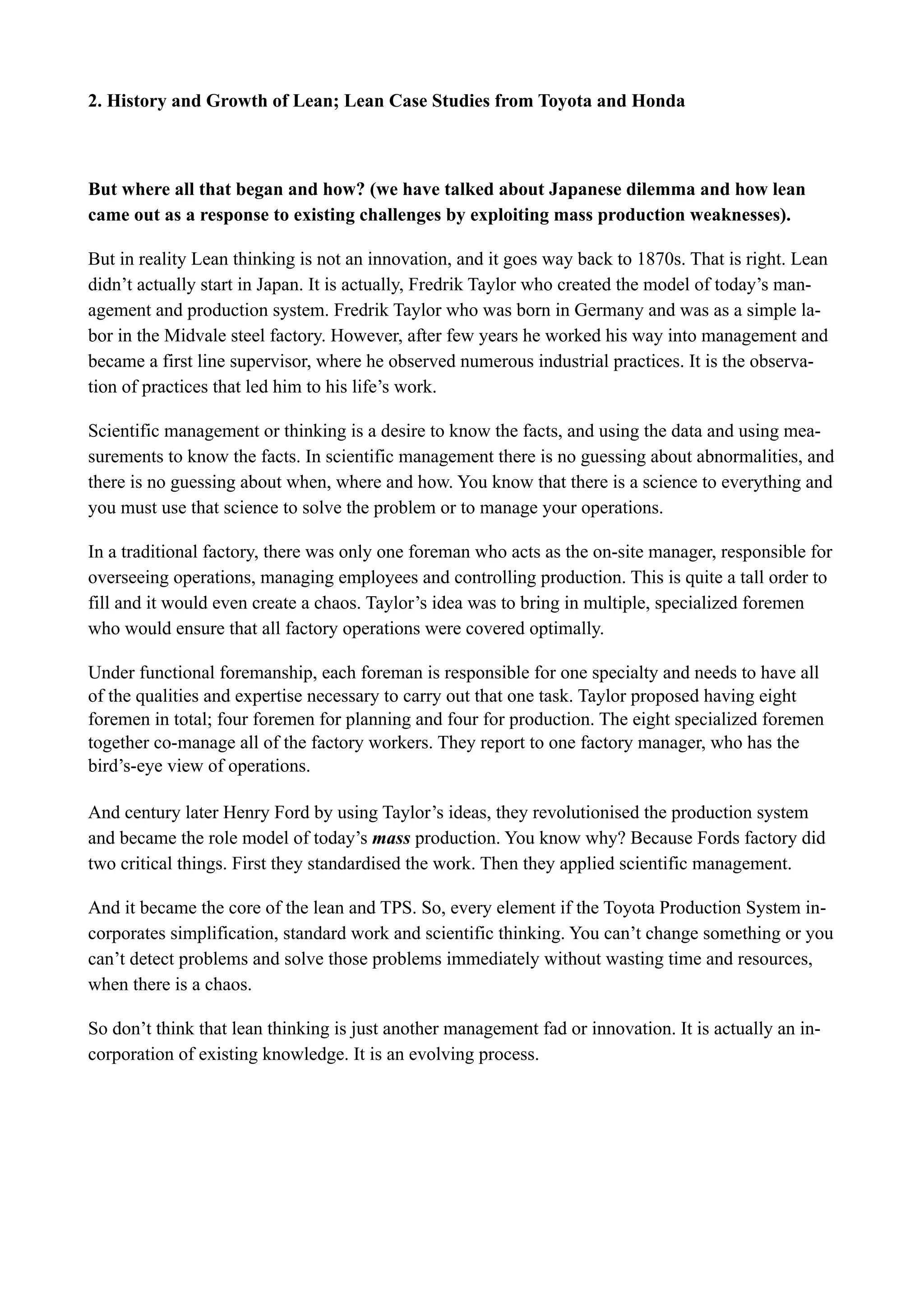
But in reality Lean thinking is not an innovation, and it goes way back to 1870s. That is right. Lean
didn’t actually start in Japan. It is actually, Fredrik Taylor who created the model of today’s man-
agement and production system. Fredrik Taylor who was born in Germany and was as a simple la-
bor in the Midvale steel factory. However, after few years he worked his way into management and
became a first line supervisor, where he observed numerous industrial practices. It is the observa-
tion of practices that led him to his life’s work.
Scientific management or thinking is a desire to know the facts, and using the data and using mea-
surements to know the facts. In scientific management there is no guessing about abnormalities, and
there is no guessing about when, where and how. You know that there is a science to everything and
you must use that science to solve the problem or to manage your operations.
In a traditional factory, there was only one foreman who acts as the on-site manager, responsible for
overseeing operations, managing employees and controlling production. This is quite a tall order to
fill and it would even create a chaos. Taylor’s idea was to bring in multiple, specialized foremen
who would ensure that all factory operations were covered optimally.
Under functional foremanship, each foreman is responsible for one specialty and needs to have all
of the qualities and expertise necessary to carry out that one task. Taylor proposed having eight
foremen in total; four foremen for planning and four for production. The eight specialized foremen
together co-manage all of the factory workers. They report to one factory manager, who has the
bird’s-eye view of operations.
And century later Henry Ford by using Taylor’s ideas, they revolutionised the production system
and became the role model of today’s mass production. You know why? Because Fords factory did
two critical things. First they standardised the work. Then they applied scientific management.
And it became the core of the lean and TPS. So, every element if the Toyota Production System in-
corporates simplification, standard work and scientific thinking. You can’t change something or you
can’t detect problems and solve those problems immediately without wasting time and resources,
when there is a chaos.
So don’t think that lean thinking is just another management fad or innovation. It is actually an in-
corporation of existing knowledge. It is an evolving process.
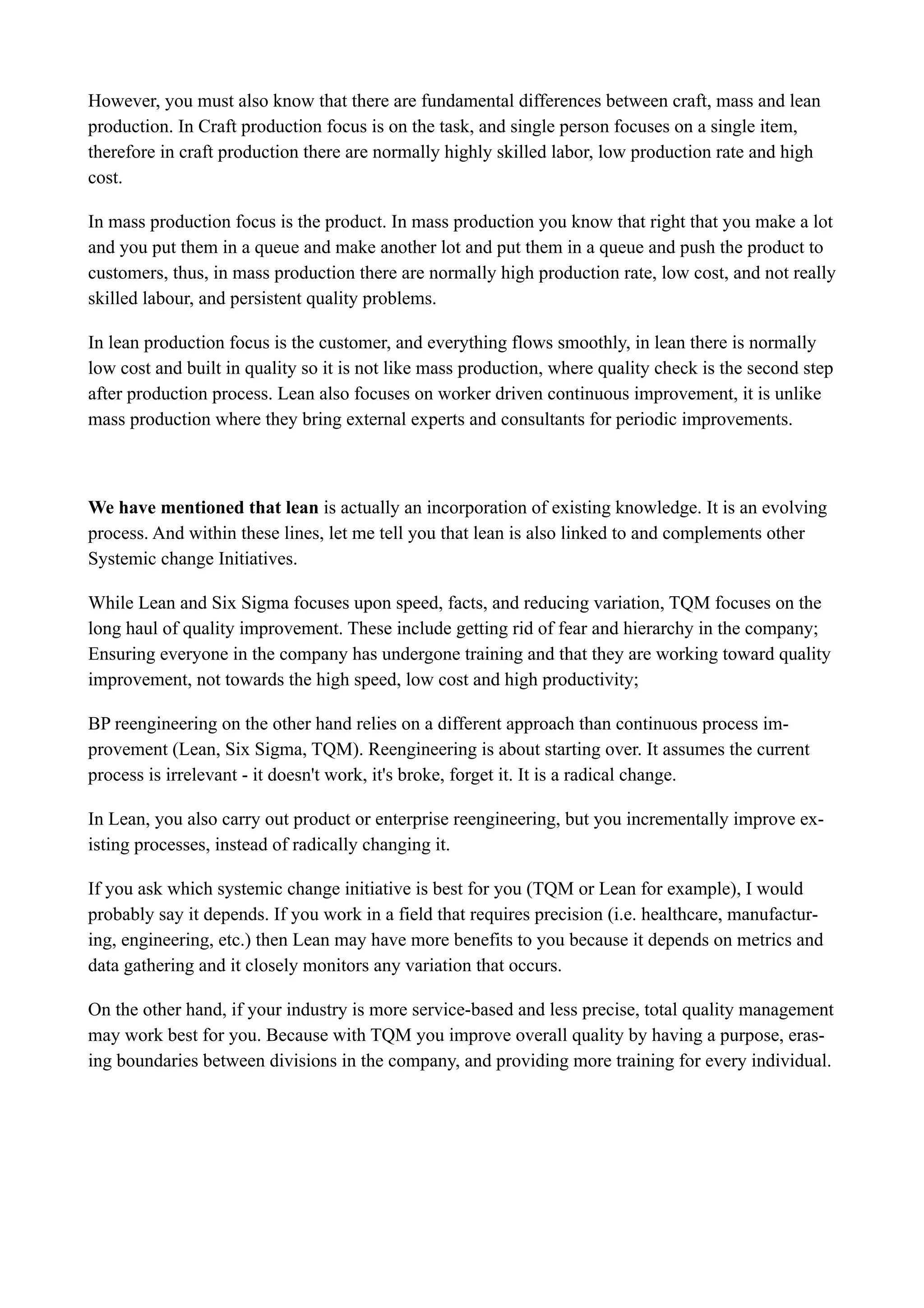
However, you must also know that there are fundamental differences between craft, mass and lean
production. In Craft production focus is on the task, and single person focuses on a single item,
therefore in craft production there are normally highly skilled labor, low production rate and high
cost.
In mass production focus is the product. In mass production you know that right that you make a lot
and you put them in a queue and make another lot and put them in a queue and push the product to
customers, thus, in mass production there are normally high production rate, low cost, and not really
skilled labour, and persistent quality problems.
In lean production focus is the customer, and everything flows smoothly, in lean there is normally
low cost and built in quality so it is not like mass production, where quality check is the second step
after production process. Lean also focuses on worker driven continuous improvement, it is unlike
mass production where they bring external experts and consultants for periodic improvements.
We have mentioned that lean is actually an incorporation of existing knowledge. It is an evolving
process. And within these lines, let me tell you that lean is also linked to and complements other
Systemic change Initiatives.
While Lean and Six Sigma focuses upon speed, facts, and reducing variation, TQM focuses on the
long haul of quality improvement. These include getting rid of fear and hierarchy in the company;
Ensuring everyone in the company has undergone training and that they are working toward quality
improvement, not towards the high speed, low cost and high productivity;
BP reengineering on the other hand relies on a different approach than continuous process im-
provement (Lean, Six Sigma, TQM). Reengineering is about starting over. It assumes the current
process is irrelevant - it doesn't work, it's broke, forget it. It is a radical change.
In Lean, you also carry out product or enterprise reengineering, but you incrementally improve ex-
isting processes, instead of radically changing it.
If you ask which systemic change initiative is best for you (TQM or Lean for example), I would
probably say it depends. If you work in a field that requires precision (i.e. healthcare, manufactur-
ing, engineering, etc.) then Lean may have more benefits to you because it depends on metrics and
data gathering and it closely monitors any variation that occurs.
On the other hand, if your industry is more service-based and less precise, total quality management
may work best for you. Because with TQM you improve overall quality by having a purpose, eras-
ing boundaries between divisions in the company, and providing more training for every individual.
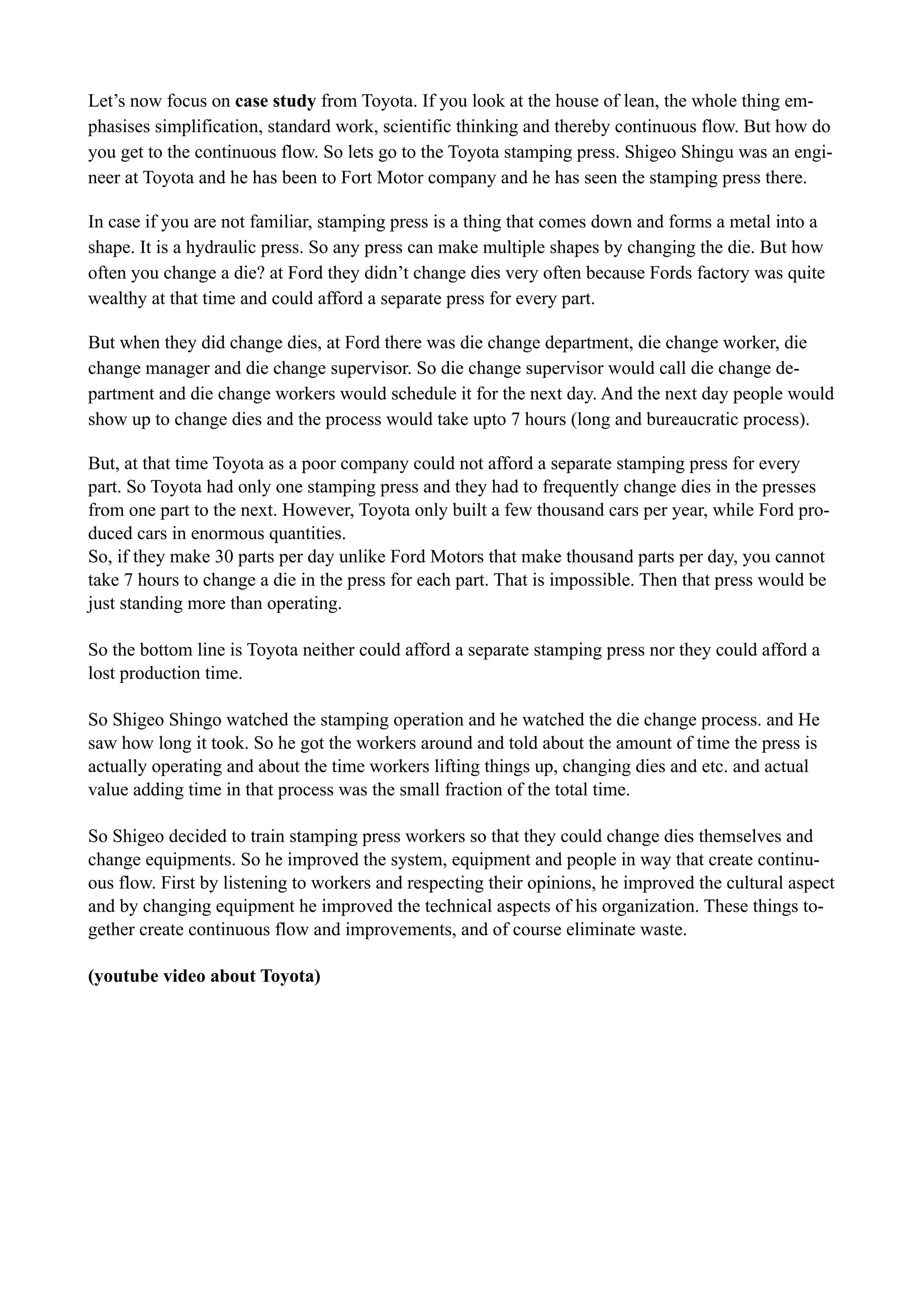
Let’s now focus on case study from Toyota. If you look at the house of lean, the whole thing em-
phasises simplification, standard work, scientific thinking and thereby continuous flow. But how do
you get to the continuous flow. So lets go to the Toyota stamping press. Shigeo Shingu was an engi-
neer at Toyota and he has been to Fort Motor company and he has seen the stamping press there.
In case if you are not familiar, stamping press is a thing that comes down and forms a metal into a
shape. It is a hydraulic press. So any press can make multiple shapes by changing the die. But how
often you change a die? at Ford they didn’t change dies very often because Fords factory was quite
wealthy at that time and could afford a separate press for every part.
But when they did change dies, at Ford there was die change department, die change worker, die
change manager and die change supervisor. So die change supervisor would call die change de-
partment and die change workers would schedule it for the next day. And the next day people would
show up to change dies and the process would take upto 7 hours (long and bureaucratic process).
But, at that time Toyota as a poor company could not afford a separate stamping press for every
part. So Toyota had only one stamping press and they had to frequently change dies in the presses
from one part to the next. However, Toyota only built a few thousand cars per year, while Ford pro-
duced cars in enormous quantities.
So, if they make 30 parts per day unlike Ford Motors that make thousand parts per day, you cannot
take 7 hours to change a die in the press for each part. That is impossible. Then that press would be
just standing more than operating.
So the bottom line is Toyota neither could afford a separate stamping press nor they could afford a
lost production time.
So Shigeo Shingo watched the stamping operation and he watched the die change process. and He
saw how long it took. So he got the workers around and told about the amount of time the press is
actually operating and about the time workers lifting things up, changing dies and etc. and actual
value adding time in that process was the small fraction of the total time.
So Shigeo decided to train stamping press workers so that they could change dies themselves and
change equipments. So he improved the system, equipment and people in way that create continu-
ous flow. First by listening to workers and respecting their opinions, he improved the cultural aspect
and by changing equipment he improved the technical aspects of his organization. These things to-
gether create continuous flow and improvements, and of course eliminate waste.
(youtube video about Toyota)
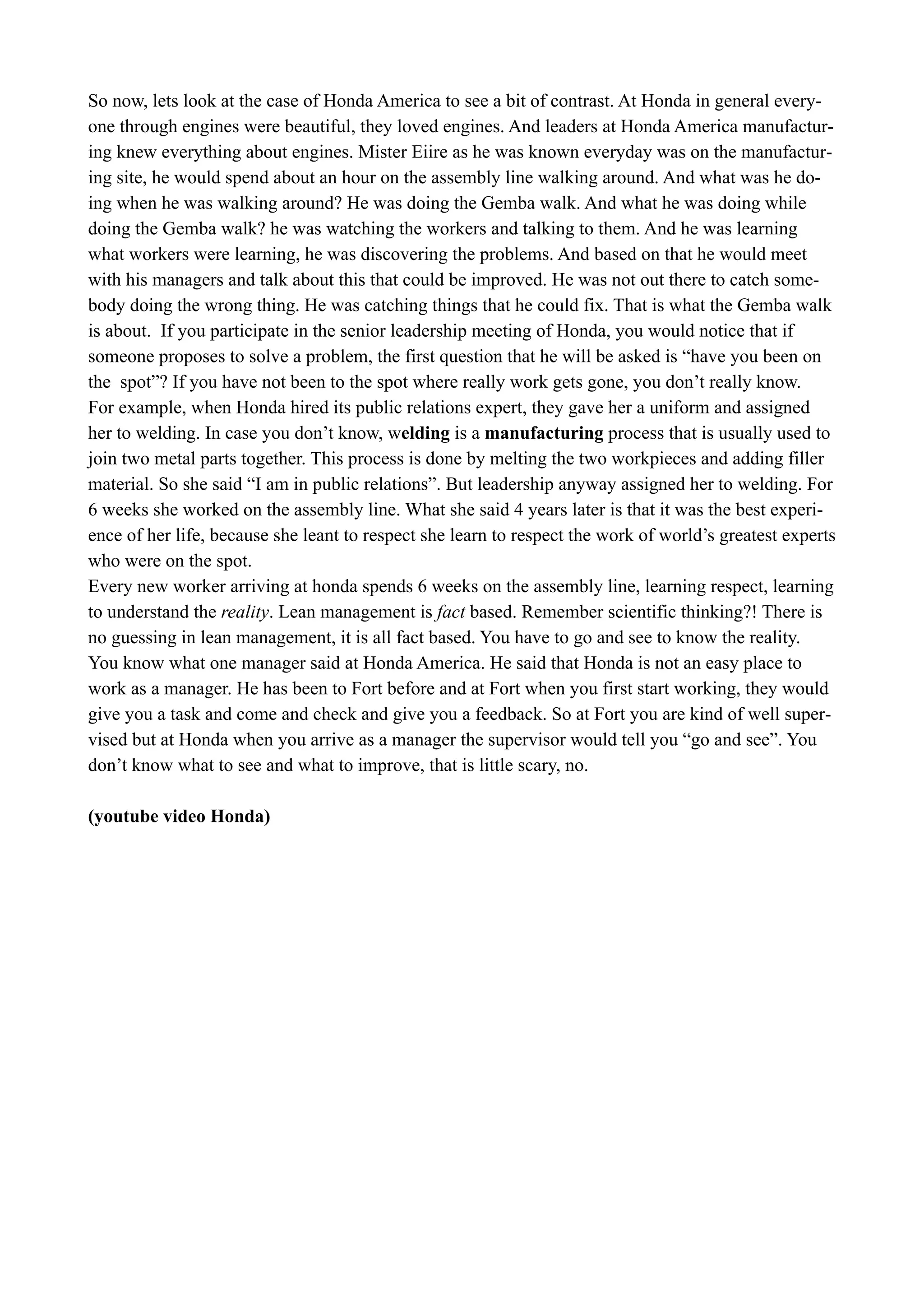
So now, lets look at the case of Honda America to see a bit of contrast. At Honda in general every-
one through engines were beautiful, they loved engines. And leaders at Honda America manufactur-
ing knew everything about engines. Mister Eiire as he was known everyday was on the manufactur-
ing site, he would spend about an hour on the assembly line walking around. And what was he do-
ing when he was walking around? He was doing the Gemba walk. And what he was doing while
doing the Gemba walk? he was watching the workers and talking to them. And he was learning
what workers were learning, he was discovering the problems. And based on that he would meet
with his managers and talk about this that could be improved. He was not out there to catch some-
body doing the wrong thing. He was catching things that he could fix. That is what the Gemba walk
is about. If you participate in the senior leadership meeting of Honda, you would notice that if
someone proposes to solve a problem, the first question that he will be asked is “have you been on
the spot”? If you have not been to the spot where really work gets gone, you don’t really know.
For example, when Honda hired its public relations expert, they gave her a uniform and assigned
her to welding. In case you don’t know, welding is a manufacturing process that is usually used to
join two metal parts together. This process is done by melting the two workpieces and adding filler
material. So she said “I am in public relations”. But leadership anyway assigned her to welding. For
6 weeks she worked on the assembly line. What she said 4 years later is that it was the best experi-
ence of her life, because she leant to respect she learn to respect the work of world’s greatest experts
who were on the spot.
Every new worker arriving at honda spends 6 weeks on the assembly line, learning respect, learning
to understand the reality. Lean management is fact based. Remember scientific thinking?! There is
no guessing in lean management, it is all fact based. You have to go and see to know the reality.
You know what one manager said at Honda America. He said that Honda is not an easy place to
work as a manager. He has been to Fort before and at Fort when you first start working, they would
give you a task and come and check and give you a feedback. So at Fort you are kind of well super-
vised but at Honda when you arrive as a manager the supervisor would tell you “go and see”. You
don’t know what to see and what to improve, that is little scary, no.
(youtube video Honda)

History and Growth of Lean.pdf

  • 1.
    2. History andGrowth of Lean; Lean Case Studies from Toyota and Honda But where all that began and how? (we have talked about Japanese dilemma and how lean came out as a response to existing challenges by exploiting mass production weaknesses). But in reality Lean thinking is not an innovation, and it goes way back to 1870s. That is right. Lean didn’t actually start in Japan. It is actually, Fredrik Taylor who created the model of today’s man- agement and production system. Fredrik Taylor who was born in Germany and was as a simple la- bor in the Midvale steel factory. However, after few years he worked his way into management and became a first line supervisor, where he observed numerous industrial practices. It is the observa- tion of practices that led him to his life’s work. Scientific management or thinking is a desire to know the facts, and using the data and using mea- surements to know the facts. In scientific management there is no guessing about abnormalities, and there is no guessing about when, where and how. You know that there is a science to everything and you must use that science to solve the problem or to manage your operations. In a traditional factory, there was only one foreman who acts as the on-site manager, responsible for overseeing operations, managing employees and controlling production. This is quite a tall order to fill and it would even create a chaos. Taylor’s idea was to bring in multiple, specialized foremen who would ensure that all factory operations were covered optimally. Under functional foremanship, each foreman is responsible for one specialty and needs to have all of the qualities and expertise necessary to carry out that one task. Taylor proposed having eight foremen in total; four foremen for planning and four for production. The eight specialized foremen together co-manage all of the factory workers. They report to one factory manager, who has the bird’s-eye view of operations. And century later Henry Ford by using Taylor’s ideas, they revolutionised the production system and became the role model of today’s mass production. You know why? Because Fords factory did two critical things. First they standardised the work. Then they applied scientific management. And it became the core of the lean and TPS. So, every element if the Toyota Production System in- corporates simplification, standard work and scientific thinking. You can’t change something or you can’t detect problems and solve those problems immediately without wasting time and resources, when there is a chaos. So don’t think that lean thinking is just another management fad or innovation. It is actually an in- corporation of existing knowledge. It is an evolving process.
  • 2.
    However, you mustalso know that there are fundamental differences between craft, mass and lean production. In Craft production focus is on the task, and single person focuses on a single item, therefore in craft production there are normally highly skilled labor, low production rate and high cost. In mass production focus is the product. In mass production you know that right that you make a lot and you put them in a queue and make another lot and put them in a queue and push the product to customers, thus, in mass production there are normally high production rate, low cost, and not really skilled labour, and persistent quality problems. In lean production focus is the customer, and everything flows smoothly, in lean there is normally low cost and built in quality so it is not like mass production, where quality check is the second step after production process. Lean also focuses on worker driven continuous improvement, it is unlike mass production where they bring external experts and consultants for periodic improvements. We have mentioned that lean is actually an incorporation of existing knowledge. It is an evolving process. And within these lines, let me tell you that lean is also linked to and complements other Systemic change Initiatives. While Lean and Six Sigma focuses upon speed, facts, and reducing variation, TQM focuses on the long haul of quality improvement. These include getting rid of fear and hierarchy in the company; Ensuring everyone in the company has undergone training and that they are working toward quality improvement, not towards the high speed, low cost and high productivity; BP reengineering on the other hand relies on a different approach than continuous process im- provement (Lean, Six Sigma, TQM). Reengineering is about starting over. It assumes the current process is irrelevant - it doesn't work, it's broke, forget it. It is a radical change. In Lean, you also carry out product or enterprise reengineering, but you incrementally improve ex- isting processes, instead of radically changing it. If you ask which systemic change initiative is best for you (TQM or Lean for example), I would probably say it depends. If you work in a field that requires precision (i.e. healthcare, manufactur- ing, engineering, etc.) then Lean may have more benefits to you because it depends on metrics and data gathering and it closely monitors any variation that occurs. On the other hand, if your industry is more service-based and less precise, total quality management may work best for you. Because with TQM you improve overall quality by having a purpose, eras- ing boundaries between divisions in the company, and providing more training for every individual.
  • 3.
    Let’s now focuson case study from Toyota. If you look at the house of lean, the whole thing em- phasises simplification, standard work, scientific thinking and thereby continuous flow. But how do you get to the continuous flow. So lets go to the Toyota stamping press. Shigeo Shingu was an engi- neer at Toyota and he has been to Fort Motor company and he has seen the stamping press there. In case if you are not familiar, stamping press is a thing that comes down and forms a metal into a shape. It is a hydraulic press. So any press can make multiple shapes by changing the die. But how often you change a die? at Ford they didn’t change dies very often because Fords factory was quite wealthy at that time and could afford a separate press for every part. But when they did change dies, at Ford there was die change department, die change worker, die change manager and die change supervisor. So die change supervisor would call die change de- partment and die change workers would schedule it for the next day. And the next day people would show up to change dies and the process would take upto 7 hours (long and bureaucratic process). But, at that time Toyota as a poor company could not afford a separate stamping press for every part. So Toyota had only one stamping press and they had to frequently change dies in the presses from one part to the next. However, Toyota only built a few thousand cars per year, while Ford pro- duced cars in enormous quantities. So, if they make 30 parts per day unlike Ford Motors that make thousand parts per day, you cannot take 7 hours to change a die in the press for each part. That is impossible. Then that press would be just standing more than operating. So the bottom line is Toyota neither could afford a separate stamping press nor they could afford a lost production time. So Shigeo Shingo watched the stamping operation and he watched the die change process. and He saw how long it took. So he got the workers around and told about the amount of time the press is actually operating and about the time workers lifting things up, changing dies and etc. and actual value adding time in that process was the small fraction of the total time. So Shigeo decided to train stamping press workers so that they could change dies themselves and change equipments. So he improved the system, equipment and people in way that create continu- ous flow. First by listening to workers and respecting their opinions, he improved the cultural aspect and by changing equipment he improved the technical aspects of his organization. These things to- gether create continuous flow and improvements, and of course eliminate waste. (youtube video about Toyota)
  • 4.
    So now, letslook at the case of Honda America to see a bit of contrast. At Honda in general every- one through engines were beautiful, they loved engines. And leaders at Honda America manufactur- ing knew everything about engines. Mister Eiire as he was known everyday was on the manufactur- ing site, he would spend about an hour on the assembly line walking around. And what was he do- ing when he was walking around? He was doing the Gemba walk. And what he was doing while doing the Gemba walk? he was watching the workers and talking to them. And he was learning what workers were learning, he was discovering the problems. And based on that he would meet with his managers and talk about this that could be improved. He was not out there to catch some- body doing the wrong thing. He was catching things that he could fix. That is what the Gemba walk is about. If you participate in the senior leadership meeting of Honda, you would notice that if someone proposes to solve a problem, the first question that he will be asked is “have you been on the spot”? If you have not been to the spot where really work gets gone, you don’t really know. For example, when Honda hired its public relations expert, they gave her a uniform and assigned her to welding. In case you don’t know, welding is a manufacturing process that is usually used to join two metal parts together. This process is done by melting the two workpieces and adding filler material. So she said “I am in public relations”. But leadership anyway assigned her to welding. For 6 weeks she worked on the assembly line. What she said 4 years later is that it was the best experi- ence of her life, because she leant to respect she learn to respect the work of world’s greatest experts who were on the spot. Every new worker arriving at honda spends 6 weeks on the assembly line, learning respect, learning to understand the reality. Lean management is fact based. Remember scientific thinking?! There is no guessing in lean management, it is all fact based. You have to go and see to know the reality. You know what one manager said at Honda America. He said that Honda is not an easy place to work as a manager. He has been to Fort before and at Fort when you first start working, they would give you a task and come and check and give you a feedback. So at Fort you are kind of well super- vised but at Honda when you arrive as a manager the supervisor would tell you “go and see”. You don’t know what to see and what to improve, that is little scary, no. (youtube video Honda)