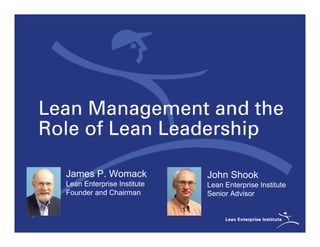
Lean Management and the
   Role of Lean Leadership

The presentation will begin momentarily.

     Please make sure that your pop-up blocker is turned off to
     view today’s full presentation.
James P. Womack             John Shook
Lean Enterprise Institute   Lean Enterprise Institute
Founder and Chairman        Senior Advisor
Webinar “Housekeeping” Tips
Disable pop-up blockers

Adjusting your volume:
   • Use the slide at the top right of the question box
   • Adjust within Windows Media Player or RealPlayer
   • Adjust the master sound control on your system (in the control
       panel)

Viewing slides
   •   Enlarge
   •   Print
Webinar “Housekeeping” Tips
Asking questions
•Use the “question” box in the lower left corner


•Submit questions as they occur to you by
typing in the box, then click submit


•Questions will be answered during the Q&A
session at the end of the presentation.
Question and Answer
We will do our best to answer as many
questions as possible in the allotted time.


Answers to the questions that we cannot get to
during the webinar will be answered on our
website soon.


We will notify you when they are available.
James P. Womack             John Shook
Lean Enterprise Institute   Lean Enterprise Institute
Founder and Chairman        Senior Advisor
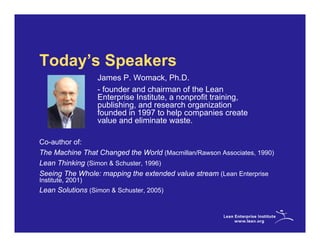
Today’s Speakers
                   James P. Womack, Ph.D.
                   - founder and chairman of the Lean
                   Enterprise Institute, a nonprofit training,
                   publishing, and research organization
                   founded in 1997 to help companies create
                   value and eliminate waste.

Co-author of:
The Machine That Changed the World (Macmillan/Rawson Associates, 1990)
Lean Thinking (Simon & Schuster, 1996)
Seeing The Whole: mapping the extended value stream (Lean Enterprise
Institute, 2001)
Lean Solutions (Simon & Schuster, 2005)
Every Organization Must Address
• Purpose – Provide value to customers in order
to prosper.
• Process – Through smoothly flowing value
streams for design, make, and use.
• People – By engaging every employee
touching value streams (including support
streams) to sustain and improve the flow.
Most Organizations Struggle
• Purpose is not clearly defined in terms of
solving the customer’s problems.
• Processes are not clearly specified.
• People are not engaged in optimizing the
whole value stream rather than the point where
they work.
Lean Management
• Addresses the purpose problem by identifying
product family value streams for specific
customers:
  Makes value easier to specify.
  Makes the flow of value easier to see.
Lean Management
• Addresses the process problem by assigning
a leader to each value stream:
   Makes current condition of entire process
clear to everyone.
  Proposes a better “future state” process and
takes responsibility for implementing it.
  Makes condition of the new “current state”
clear to everyone.
 Proposes a still better “future state”. Etc.
Vertical Versus Horizontal
• Most organizations place the organization
chart and assets in the foreground:
  Managers think vertically to optimize their
area, department, or function.
  Horizontal flow of value to customer easily
gets lost.
Horizontal Versus Vertical
• Lean management places the horizontal flow
of value in the foreground:
  Lean managers think horizontally, with the
help of value stream leaders. However…
  Functions are still strong (or even stronger):
– Repositories of deep technical knowledge
– Home base for employees
– Guardians of career paths
During Lean Transformation
• Some organizations:
  Create dedicated product/value-stream teams.
  Dramatically lessen role of their functions.
• Other organizations (including Toyota):
   Create strong horizontal advocates for product
(e.g., Toyota chief engineer.)
  Create even stronger functions, focusing on
knowledge capture and career paths.
The Matrix Problem
• If the primary focus in a lean organization is the
horizontal flow of value, as overseen by a
responsible person, yet there are strong
functions...
• How do those doing the actual work in the
functions avoid the dreaded “two boss” problem?
   By negotiations between the value stream
leader and the function ahead about what is
needed from the function to support the product.
  The employee has only one boss: the function
head.
Lean Thinking
Five step approach:
• Find a change agent.
• Find a sensei (to get the knowledge.)
• Seize or create the crisis.
• Map your value streams.
• Get started on creating better value streams.
But…how do lean leaders lead this process?
James P. Womack             John Shook
Lean Enterprise Institute   Lean Enterprise Institute
Founder and Chairman        Senior Advisor
Today’s Speakers
                  John Shook
                  - senior advisor to the Lean Enterprise Institute;
                  learned lean while working for ten years at Toyota,
                  helping to transfer its production, engineering, and
                  management systems from Japan to overseas
                  affiliates and suppliers.
 first American employee at Toyota's headquarters in Toyota City, Japan
 first American kacho (manager) at Toyota Japan
 former deputy general manager of the Toyota Supplier Support Center
 former director of the University of Michigan’s Japan Technology
Management Program
 co-author of Learning to See (Lean Enterprise Institute, 1999)
First, a note on
              “What is Lean”?
Narrow definition
  •   tools
  •   cost cutting


Broader definition
  •   thinking, systematic
  •   entire enterprise, business system
Second, a note on
     “What is Leadership”?
Peter Drucker on Leadership:
“The greatest leaders of the 20th
century were Hitler, Stalin and Mao:
If that is “leadership”, I want nothing
to do with it.”
The leader’s job at Toyota…

First, get each person to take
initiative to solve problems and
improve his or her job.
Second, ensure that each person’s
job is aligned to provide value for the
customer and prosperity for the
company.
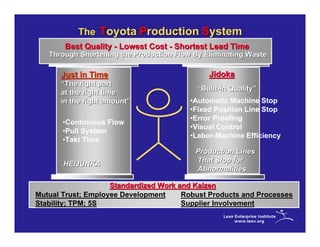
The Toyota Production System
Graphics slide. Place graphic within the white box.
      Best Quality - Lowest Cost - Shortest Lead Time
   Through Shortening the Production Flow By Eliminating Waste

      Just in Time                            Jidoka
      “The right part
                                           “Built-in Quality”
      at the right time
      in the right amount”               •Automatic Machine Stop
                                         •Fixed Position Line Stop
                                         •Error Proofing
       •Continuous Flow
                                         •Visual Control
       •Pull System
                                         •Labor-Machine Efficiency
       •Takt Time
                                          Production Lines
                                          That Stop for
       HEIJUNKA
                                          Abnormalities

                    Standardized Work and Kaizen
Mutual Trust; Employee Development     Robust Products and Processes
Stability; TPM; 5S                     Supplier Involvement
Graphics slide. Place graphic within the white box.
Kan Higashi to Gary Convis…
(NUMMI’s senior Japanese and senior
American leaders)

“Lead the organization as if you have no
power."
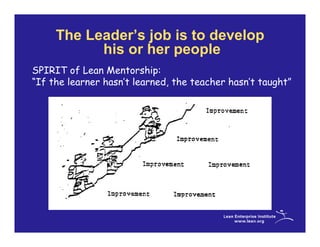
The Leader’s job is to develop
           his or her people
SPIRIT of Lean Mentorship:
“If the learner hasn’t learned, the teacher hasn’t taught”
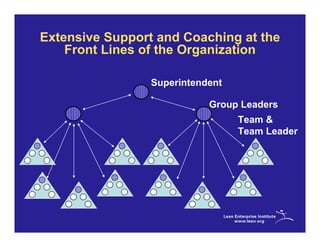
Extensive Support and Coaching at the
    Front Lines of the Organization

                 Superintendent

                            Group Leaders
                                  Team &
                                  Team Leader
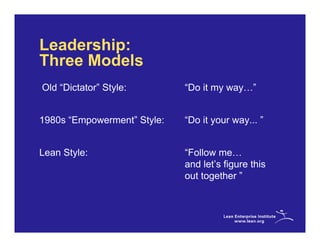
Leadership:
Three Models
Old “Dictator” Style:        “Do it my way…”


1980s “Empowerment” Style:   “Do it your way... ”


Lean Style:                  “Follow me…
                             and let’s figure this
                             out together ”
Leadership at Toyota-
From managing numbers to managing the process

Leaders at Toyota, like leaders anywhere, want to see
measurable results.

But they know that the financial result is a result of a
process.

They also realize that the financial results reflect the
past performance of that process.

Far better is to create a process that can be managed
right NOW.
Leadership at Toyota-
From the Five Who’s to the Five Whys
Good Toyota leaders don’t jump to conclusions or solutions –
they try to first size up the situation and then ask “Why?”


This focuses on the work and problem at hand, avoiding
finger-pointing seeking of where to place the blame.


It also keeps responsibility with the person who is doing the
work,


This is what truly engages and empowers the workforce.
Leadership at Toyota
From Problem-hiding to Problem-solving
All actions at Toyota revolve around planning and problem-
solving.


It is assumed that there will be problems, that everything will
not go according to plan.


“No problem is problem.”


For the system to work, problems must be exposed and dealt
with forthrightly.


Hiding problems will undermine the system.
Leadership at Toyota
Control with Flexibility

Toyota’s way provides extraordinary focus, direction,
“control.”


While at the same time providing maximum flexibility.


I believe this solves the age-old dilemma – control vs.
flexibility – that encumbers all large organizations.
Leadership at Toyota
P-D-C-A

Toyota would say this is essentially the P-D-C-A
management cycle they learned from Dr. Deming.


Yet, my own observations say this is precisely the thing
that most companies can’t seem to do.


Why?


Surely one major reason for this is the way we lead and
manage.
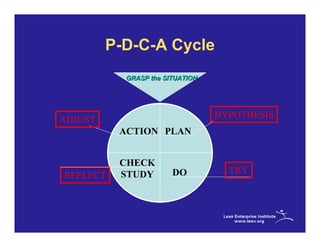
P-D-C-A Cycle
           GRASP the SITUATION


                                 HYPOTHESIS
ADJUST
          ACTION PLAN


          CHECK
          STUDY        DO          TRY
REFLECT
Lean Leadership

The Lean Leader leads a very different
way:
    It is as different from the commonly accepted
   notion of the “enlightened modern manager” as
   it is the old command and control dictator.
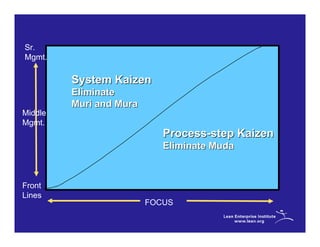
Sr.
Mgmt.

         System Kaizen
         Eliminate
         Muri and Mura
Middle
Mgmt.
                            Process-step Kaizen
                            Eliminate Muda


Front
Lines
                         FOCUS
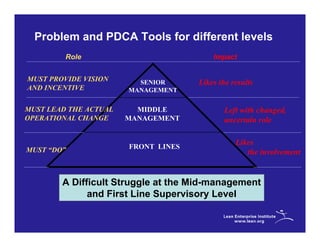
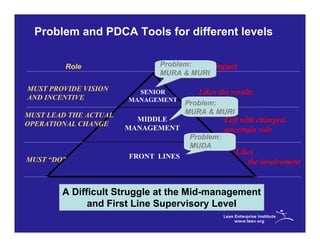
Problem and PDCA Tools for different levels
         Role                            Impact


MUST PROVIDE VISION      SENIOR      Likes the results
AND INCENTIVE          MANAGEMENT


MUST LEAD THE ACTUAL     MIDDLE              Left with changed,
OPERATIONAL CHANGE     MANAGEMENT            uncertain role

                                                Likes
MUST “DO”              FRONT LINES
                                                   the involvement


        A Difficult Struggle at the Mid-management
              and First Line Supervisory Level
Problem and PDCA Tools for different levels

         Role                Problem:    Impact
                             MURA & MURI

MUST PROVIDE VISION      SENIOR         Likes the results
AND INCENTIVE          MANAGEMENT
                                     Problem:
MUST LEAD THE ACTUAL                 MURA & MURI
                         MIDDLE                  Left with changed,
OPERATIONAL CHANGE
                       MANAGEMENT                uncertain role
                                      Problem:
                                      MUDA
                                                    Likes
MUST “DO”              FRONT LINES
                                                       the involvement


        A Difficult Struggle at the Mid-management
              and First Line Supervisory Level
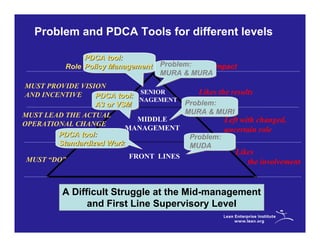
Problem and PDCA Tools for different levels

                PDCA tool:
           Role Policy Management   Problem:    Impact
                                    MURA & MURA
MUST PROVIDE VISION
AND INCENTIVE     PDCA tool:
                             SENIOR       Likes the results
                           MANAGEMENT
                  A3 or VSM            Problem:
MUST LEAD THE ACTUAL                   MURA & MURI
                             MIDDLE               Left with changed,
OPERATIONAL CHANGE
                          MANAGEMENT              uncertain role
        PDCA tool:                      Problem:
        Standardized Work               MUDA
                                                     Likes
 MUST “DO”                 FRONT LINES
                                                          the involvement


          A Difficult Struggle at the Mid-management
                and First Line Supervisory Level
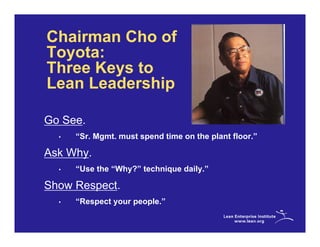
Chairman Cho of
Toyota:
Three Keys to
Lean Leadership

Go See.
  •   “Sr. Mgmt. must spend time on the plant floor.”

Ask Why.
  •   “Use the “Why?” technique daily.”

Show Respect.
  •   “Respect your people.”
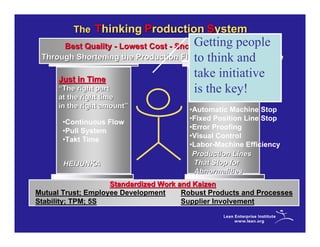
The Thinking Production System
                                         Getting people
      Best Quality - Lowest Cost - Shortest Lead Time
                                         to think and
 Through Shortening the Production Flow By Eliminating Waste

      Just in Time
                                         take initiative
                                            Jidoka
      “The right part                    isBuilt-in key!”
                                          “ the Quality
      at the right time
      in the right amount”
                                        •Automatic Machine Stop
                                        •Fixed Position Line Stop
       •Continuous Flow
                                        •Error Proofing
       •Pull System
                                        •Visual Control
       •Takt Time
                                        •Labor-Machine Efficiency
                                         Production Lines
       HEIJUNKA                          That Stop for
                                         Abnormalities
                    Standardized Work and Kaizen
Mutual Trust; Employee Development     Robust Products and Processes
Stability; TPM; 5S                     Supplier Involvement
Learning and mistakes

“There are sometimes too many nay-
sayers. In the early days of TPS we were
able to just try things, to make mistakes
and learn from them. That’s the spirit we
need.”
Mr. N. Hayashi
Former general manager of Toyota’s TPS Office
Learning and mistakes

“Continuous improvement comes from
making mistakes and learning from them."
Cheryl Jones, Toyota Group Leader


“Hilly Krystal gave us a place to try and
fail.”
Patti Smith
Learning and mistakes

“It is a mistake to suppose that men succeed
through success; they much oftener succeed
through failures. Precept, study, advice, and
example could never have taught them so well
as failure has done.”


                                    Samuel Smiles
                          British author of “Self Help”
            (favorite of Sakiichi Toyoda in late 1800s)
Questions & Answers
James P. Womack             John Shook
Lean Enterprise Institute   Lean Enterprise Institute
Founder and Chairman        Senior Advisor
Lean Events
February 28th to March 1st

Lean Transformation Summit
Join the Lean Community at the Grand Hyatt, Atlanta,
GA, for the first annual Lean Transformation Summit
sponsored by the Lean Enterprise Institute.


For more details visit:   www.lean.org
LEI Bookstore
The Lean Enterprise Institute has a large
selection of lean publications and learning
materials available for sale in our bookstore.
Visit www.lean.org to learn more.

October webinar project_slides

  • 1.
    Lean Management andthe Role of Lean Leadership The presentation will begin momentarily. Please make sure that your pop-up blocker is turned off to view today’s full presentation.
  • 2.
    James P. Womack John Shook Lean Enterprise Institute Lean Enterprise Institute Founder and Chairman Senior Advisor
  • 3.
    Webinar “Housekeeping” Tips Disablepop-up blockers Adjusting your volume: • Use the slide at the top right of the question box • Adjust within Windows Media Player or RealPlayer • Adjust the master sound control on your system (in the control panel) Viewing slides • Enlarge • Print
  • 4.
    Webinar “Housekeeping” Tips Askingquestions •Use the “question” box in the lower left corner •Submit questions as they occur to you by typing in the box, then click submit •Questions will be answered during the Q&A session at the end of the presentation.
  • 5.
    Question and Answer Wewill do our best to answer as many questions as possible in the allotted time. Answers to the questions that we cannot get to during the webinar will be answered on our website soon. We will notify you when they are available.
  • 6.
    James P. Womack John Shook Lean Enterprise Institute Lean Enterprise Institute Founder and Chairman Senior Advisor
  • 7.
    Today’s Speakers James P. Womack, Ph.D. - founder and chairman of the Lean Enterprise Institute, a nonprofit training, publishing, and research organization founded in 1997 to help companies create value and eliminate waste. Co-author of: The Machine That Changed the World (Macmillan/Rawson Associates, 1990) Lean Thinking (Simon & Schuster, 1996) Seeing The Whole: mapping the extended value stream (Lean Enterprise Institute, 2001) Lean Solutions (Simon & Schuster, 2005)
  • 8.
    Every Organization MustAddress • Purpose – Provide value to customers in order to prosper. • Process – Through smoothly flowing value streams for design, make, and use. • People – By engaging every employee touching value streams (including support streams) to sustain and improve the flow.
  • 9.
    Most Organizations Struggle •Purpose is not clearly defined in terms of solving the customer’s problems. • Processes are not clearly specified. • People are not engaged in optimizing the whole value stream rather than the point where they work.
  • 10.
    Lean Management • Addressesthe purpose problem by identifying product family value streams for specific customers: Makes value easier to specify. Makes the flow of value easier to see.
  • 11.
    Lean Management • Addressesthe process problem by assigning a leader to each value stream: Makes current condition of entire process clear to everyone. Proposes a better “future state” process and takes responsibility for implementing it. Makes condition of the new “current state” clear to everyone. Proposes a still better “future state”. Etc.
  • 12.
    Vertical Versus Horizontal •Most organizations place the organization chart and assets in the foreground: Managers think vertically to optimize their area, department, or function. Horizontal flow of value to customer easily gets lost.
  • 13.
    Horizontal Versus Vertical •Lean management places the horizontal flow of value in the foreground: Lean managers think horizontally, with the help of value stream leaders. However… Functions are still strong (or even stronger): – Repositories of deep technical knowledge – Home base for employees – Guardians of career paths
  • 14.
    During Lean Transformation •Some organizations: Create dedicated product/value-stream teams. Dramatically lessen role of their functions. • Other organizations (including Toyota): Create strong horizontal advocates for product (e.g., Toyota chief engineer.) Create even stronger functions, focusing on knowledge capture and career paths.
  • 15.
    The Matrix Problem •If the primary focus in a lean organization is the horizontal flow of value, as overseen by a responsible person, yet there are strong functions... • How do those doing the actual work in the functions avoid the dreaded “two boss” problem? By negotiations between the value stream leader and the function ahead about what is needed from the function to support the product. The employee has only one boss: the function head.
  • 16.
    Lean Thinking Five stepapproach: • Find a change agent. • Find a sensei (to get the knowledge.) • Seize or create the crisis. • Map your value streams. • Get started on creating better value streams. But…how do lean leaders lead this process?
  • 17.
    James P. Womack John Shook Lean Enterprise Institute Lean Enterprise Institute Founder and Chairman Senior Advisor
  • 18.
    Today’s Speakers John Shook - senior advisor to the Lean Enterprise Institute; learned lean while working for ten years at Toyota, helping to transfer its production, engineering, and management systems from Japan to overseas affiliates and suppliers. first American employee at Toyota's headquarters in Toyota City, Japan first American kacho (manager) at Toyota Japan former deputy general manager of the Toyota Supplier Support Center former director of the University of Michigan’s Japan Technology Management Program co-author of Learning to See (Lean Enterprise Institute, 1999)
  • 19.
    First, a noteon “What is Lean”? Narrow definition • tools • cost cutting Broader definition • thinking, systematic • entire enterprise, business system
  • 20.
    Second, a noteon “What is Leadership”? Peter Drucker on Leadership: “The greatest leaders of the 20th century were Hitler, Stalin and Mao: If that is “leadership”, I want nothing to do with it.”
  • 21.
    The leader’s jobat Toyota… First, get each person to take initiative to solve problems and improve his or her job. Second, ensure that each person’s job is aligned to provide value for the customer and prosperity for the company.
  • 22.
    The Toyota ProductionSystem Graphics slide. Place graphic within the white box. Best Quality - Lowest Cost - Shortest Lead Time Through Shortening the Production Flow By Eliminating Waste Just in Time Jidoka “The right part “Built-in Quality” at the right time in the right amount” •Automatic Machine Stop •Fixed Position Line Stop •Error Proofing •Continuous Flow •Visual Control •Pull System •Labor-Machine Efficiency •Takt Time Production Lines That Stop for HEIJUNKA Abnormalities Standardized Work and Kaizen Mutual Trust; Employee Development Robust Products and Processes Stability; TPM; 5S Supplier Involvement
  • 23.
    Graphics slide. Placegraphic within the white box.
  • 24.
    Kan Higashi toGary Convis… (NUMMI’s senior Japanese and senior American leaders) “Lead the organization as if you have no power."
  • 25.
    The Leader’s jobis to develop his or her people SPIRIT of Lean Mentorship: “If the learner hasn’t learned, the teacher hasn’t taught”
  • 26.
    Extensive Support andCoaching at the Front Lines of the Organization Superintendent Group Leaders Team & Team Leader
  • 27.
    Leadership: Three Models Old “Dictator”Style: “Do it my way…” 1980s “Empowerment” Style: “Do it your way... ” Lean Style: “Follow me… and let’s figure this out together ”
  • 28.
    Leadership at Toyota- Frommanaging numbers to managing the process Leaders at Toyota, like leaders anywhere, want to see measurable results. But they know that the financial result is a result of a process. They also realize that the financial results reflect the past performance of that process. Far better is to create a process that can be managed right NOW.
  • 29.
    Leadership at Toyota- Fromthe Five Who’s to the Five Whys Good Toyota leaders don’t jump to conclusions or solutions – they try to first size up the situation and then ask “Why?” This focuses on the work and problem at hand, avoiding finger-pointing seeking of where to place the blame. It also keeps responsibility with the person who is doing the work, This is what truly engages and empowers the workforce.
  • 30.
    Leadership at Toyota FromProblem-hiding to Problem-solving All actions at Toyota revolve around planning and problem- solving. It is assumed that there will be problems, that everything will not go according to plan. “No problem is problem.” For the system to work, problems must be exposed and dealt with forthrightly. Hiding problems will undermine the system.
  • 31.
    Leadership at Toyota Controlwith Flexibility Toyota’s way provides extraordinary focus, direction, “control.” While at the same time providing maximum flexibility. I believe this solves the age-old dilemma – control vs. flexibility – that encumbers all large organizations.
  • 32.
    Leadership at Toyota P-D-C-A Toyotawould say this is essentially the P-D-C-A management cycle they learned from Dr. Deming. Yet, my own observations say this is precisely the thing that most companies can’t seem to do. Why? Surely one major reason for this is the way we lead and manage.
  • 33.
    P-D-C-A Cycle GRASP the SITUATION HYPOTHESIS ADJUST ACTION PLAN CHECK STUDY DO TRY REFLECT
  • 34.
    Lean Leadership The LeanLeader leads a very different way: It is as different from the commonly accepted notion of the “enlightened modern manager” as it is the old command and control dictator.
  • 35.
    Sr. Mgmt. System Kaizen Eliminate Muri and Mura Middle Mgmt. Process-step Kaizen Eliminate Muda Front Lines FOCUS
  • 36.
    Problem and PDCATools for different levels Role Impact MUST PROVIDE VISION SENIOR Likes the results AND INCENTIVE MANAGEMENT MUST LEAD THE ACTUAL MIDDLE Left with changed, OPERATIONAL CHANGE MANAGEMENT uncertain role Likes MUST “DO” FRONT LINES the involvement A Difficult Struggle at the Mid-management and First Line Supervisory Level
  • 37.
    Problem and PDCATools for different levels Role Problem: Impact MURA & MURI MUST PROVIDE VISION SENIOR Likes the results AND INCENTIVE MANAGEMENT Problem: MUST LEAD THE ACTUAL MURA & MURI MIDDLE Left with changed, OPERATIONAL CHANGE MANAGEMENT uncertain role Problem: MUDA Likes MUST “DO” FRONT LINES the involvement A Difficult Struggle at the Mid-management and First Line Supervisory Level
  • 38.
    Problem and PDCATools for different levels PDCA tool: Role Policy Management Problem: Impact MURA & MURA MUST PROVIDE VISION AND INCENTIVE PDCA tool: SENIOR Likes the results MANAGEMENT A3 or VSM Problem: MUST LEAD THE ACTUAL MURA & MURI MIDDLE Left with changed, OPERATIONAL CHANGE MANAGEMENT uncertain role PDCA tool: Problem: Standardized Work MUDA Likes MUST “DO” FRONT LINES the involvement A Difficult Struggle at the Mid-management and First Line Supervisory Level
  • 39.
    Chairman Cho of Toyota: ThreeKeys to Lean Leadership Go See. • “Sr. Mgmt. must spend time on the plant floor.” Ask Why. • “Use the “Why?” technique daily.” Show Respect. • “Respect your people.”
  • 40.
    The Thinking ProductionSystem Getting people Best Quality - Lowest Cost - Shortest Lead Time to think and Through Shortening the Production Flow By Eliminating Waste Just in Time take initiative Jidoka “The right part isBuilt-in key!” “ the Quality at the right time in the right amount” •Automatic Machine Stop •Fixed Position Line Stop •Continuous Flow •Error Proofing •Pull System •Visual Control •Takt Time •Labor-Machine Efficiency Production Lines HEIJUNKA That Stop for Abnormalities Standardized Work and Kaizen Mutual Trust; Employee Development Robust Products and Processes Stability; TPM; 5S Supplier Involvement
  • 41.
    Learning and mistakes “Thereare sometimes too many nay- sayers. In the early days of TPS we were able to just try things, to make mistakes and learn from them. That’s the spirit we need.” Mr. N. Hayashi Former general manager of Toyota’s TPS Office
  • 42.
    Learning and mistakes “Continuousimprovement comes from making mistakes and learning from them." Cheryl Jones, Toyota Group Leader “Hilly Krystal gave us a place to try and fail.” Patti Smith
  • 43.
    Learning and mistakes “Itis a mistake to suppose that men succeed through success; they much oftener succeed through failures. Precept, study, advice, and example could never have taught them so well as failure has done.” Samuel Smiles British author of “Self Help” (favorite of Sakiichi Toyoda in late 1800s)
  • 44.
    Questions & Answers JamesP. Womack John Shook Lean Enterprise Institute Lean Enterprise Institute Founder and Chairman Senior Advisor
  • 45.
    Lean Events February 28thto March 1st Lean Transformation Summit Join the Lean Community at the Grand Hyatt, Atlanta, GA, for the first annual Lean Transformation Summit sponsored by the Lean Enterprise Institute. For more details visit: www.lean.org
  • 46.
    LEI Bookstore The LeanEnterprise Institute has a large selection of lean publications and learning materials available for sale in our bookstore. Visit www.lean.org to learn more.