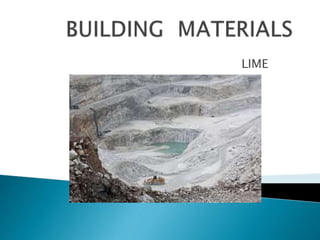
LIME
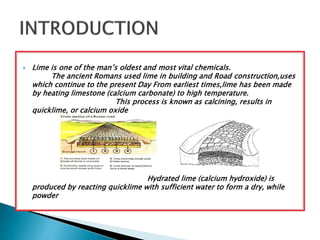
 Lime is one of the man’s oldest and most vital chemicals.
The ancient Romans used lime in building and Road construction,uses
which continue to the present Day From earliest times,lime has been made
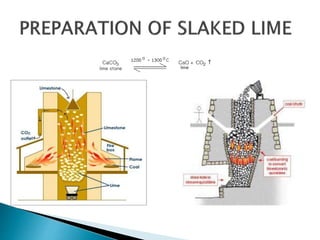
by heating limestone (calcium carbonate) to high temperature.
This process is known as calcining, results in
quicklime, or calcium oxide
Hydrated lime (calcium hydroxide) is
produced by reacting quicklime with sufficient water to form a dry, while
powder
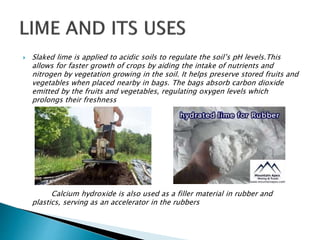
 Slaked lime is applied to acidic soils to regulate the soil’s pH levels.This
allows for faster growth of crops by aiding the intake of nutrients and
nitrogen by vegetation growing in the soil. It helps preserve stored fruits and
vegetables when placed nearby in bags. The bags absorb carbon dioxide
emitted by the fruits and vegetables, regulating oxygen levels which
prolongs their freshness
Calcium hydroxide is also used as a filler material in rubber and
plastics, serving as an accelerator in the rubbers
 Lime mortar is a type of mortar composed of lime, an aggregate such as
sand,and water,it is one of the oldest known types of mortar.dating back to
the 4th century BCE and widely used in ancient Rome and Greece, when it
largely replaced the clay and gypsum mortars common to ancient egyptian
construction.
Lime mortar is used as an alternative to ordinary portland cement.it is
made principally of lime (hydraulic,or non hydraulic),water and an aggregate
such as sand
 1. Start with an empty mixer.
 2. Add one part sand
 3. Followed by one part lime
 4. Followed by two parts sand.
 5. Mix dry for at least five minutes.
 6. After five minutes slowly add water until the desired
consistency is reached, it is very important not to drown
the mix by adding too much water.
 7. Once the desired consistency is reached mix for a
further twenty minutes. (The above example is based on a
mix ratio of 1:3). The mix, to begin with, will appear dry
but as mixing time increases the mortar will become much
‘fattier’. If too much water is added the risk of shrinkage
will increase and the final strength reduced. Do not use
any plasticisers.
 The addition of water should be considered carefully, as
it will directly affect the ultimate strength and durability
of a mortar. The more water introduced into the mortar
mix, the weaker will be the final result. However, too
little water will prevent the chemical processes taking
place and weaken the material. Generally, water should
be added sparingly, until a useable consistency is
achieved.
 The masonry background may also affect mortar
strength. Dry backgrounds can quickly ‘suck’ moisture
from newly applied mortar. This should be controlled by
dampening down the background prior to mortar
application
 NATURAL HYDRAULIC LIMES are supplied in water
resistant paper bags. If the bags are allowed to get
wet they may be irreversibly damaged. Also, once
opened the exposure to air will start to weaken the
hydraulic set. As a result any part opened bags left
at the end of the day should be carefully folded
over at the top and put into a dry store. In this
state the lime will remain useable for a further 2 or
3 days. Thereafter it should be discarded.
 AGGREGATES should also be covered. If left
exposed fines can be washed out and the material
as a whole can gradually separate
Building  materials as lime

Building materials as lime

  • 1.
  • 2.
     Lime isone of the man’s oldest and most vital chemicals. The ancient Romans used lime in building and Road construction,uses which continue to the present Day From earliest times,lime has been made by heating limestone (calcium carbonate) to high temperature. This process is known as calcining, results in quicklime, or calcium oxide Hydrated lime (calcium hydroxide) is produced by reacting quicklime with sufficient water to form a dry, while powder
  • 6.
     Slaked limeis applied to acidic soils to regulate the soil’s pH levels.This allows for faster growth of crops by aiding the intake of nutrients and nitrogen by vegetation growing in the soil. It helps preserve stored fruits and vegetables when placed nearby in bags. The bags absorb carbon dioxide emitted by the fruits and vegetables, regulating oxygen levels which prolongs their freshness Calcium hydroxide is also used as a filler material in rubber and plastics, serving as an accelerator in the rubbers
  • 7.
     Lime mortaris a type of mortar composed of lime, an aggregate such as sand,and water,it is one of the oldest known types of mortar.dating back to the 4th century BCE and widely used in ancient Rome and Greece, when it largely replaced the clay and gypsum mortars common to ancient egyptian construction. Lime mortar is used as an alternative to ordinary portland cement.it is made principally of lime (hydraulic,or non hydraulic),water and an aggregate such as sand
  • 8.
     1. Startwith an empty mixer.  2. Add one part sand  3. Followed by one part lime  4. Followed by two parts sand.  5. Mix dry for at least five minutes.  6. After five minutes slowly add water until the desired consistency is reached, it is very important not to drown the mix by adding too much water.  7. Once the desired consistency is reached mix for a further twenty minutes. (The above example is based on a mix ratio of 1:3). The mix, to begin with, will appear dry but as mixing time increases the mortar will become much ‘fattier’. If too much water is added the risk of shrinkage will increase and the final strength reduced. Do not use any plasticisers.
  • 9.
     The additionof water should be considered carefully, as it will directly affect the ultimate strength and durability of a mortar. The more water introduced into the mortar mix, the weaker will be the final result. However, too little water will prevent the chemical processes taking place and weaken the material. Generally, water should be added sparingly, until a useable consistency is achieved.  The masonry background may also affect mortar strength. Dry backgrounds can quickly ‘suck’ moisture from newly applied mortar. This should be controlled by dampening down the background prior to mortar application
  • 10.
     NATURAL HYDRAULICLIMES are supplied in water resistant paper bags. If the bags are allowed to get wet they may be irreversibly damaged. Also, once opened the exposure to air will start to weaken the hydraulic set. As a result any part opened bags left at the end of the day should be carefully folded over at the top and put into a dry store. In this state the lime will remain useable for a further 2 or 3 days. Thereafter it should be discarded.  AGGREGATES should also be covered. If left exposed fines can be washed out and the material as a whole can gradually separate