PROJECT NAME
(BUILDING LAYOUT AND ITS MARKING ON GROUND)
Subimited By Mr. Md. Wasiq
Ravi Shastri (CE) Head of Department
2004220009020
GUIDE
Mr. Divakar Singh
(Asst.Prof.)
BUILDING LAYOUT
The layout of a building or a structure shows the plan of its foundation on the ground
surface according to its drawings. So, that excavation can be carried out exactly where
required and position and orientation of the building are exactly specified.
The placement of the structure, particularly its foundations, will be determined by
controlling measurements and also references on a drawing and this process is called
Building Layout.
Why Building Layout Is Necessary
 The layout of a building or a structure shows the plan of its foundation on the ground
surface according to its drawings. So that excavation can be carried out exactly where
required and position and orientation of the building are exactly specified.
 layout errors that are not identified or properly prioritized during construction weaken
or otherwise compromise the finished structure, creating a serious safety hazard for
occupants. It's easy to see why accuracy is critically important.
Objectives of Building Layout
 The purposes of surveying for construction works are to set out the planned structure in accordance with established
designs and indicate the project’s controlling points in the most practical way for the construction forces.
 The stakes, drill holes, batter boards mostly with string lines, cut–and–fill notations, and some other traditional
methods are used to indicate the building’s corners as well as other lateral and vertical positions.
 Generally, some type of reconnaissance, as well as site assessment, precedes the exact layout of the structure. The
procedures listed below are typical of large construction projects.
 • Conducted reconnaissance (aerial, map, and ground)
 • Choosing a location (paper and instrument)
 • Specifying control (horizontal and vertical)
 • Observing topography (plane table)
Classifications of Building Plan
Drawings
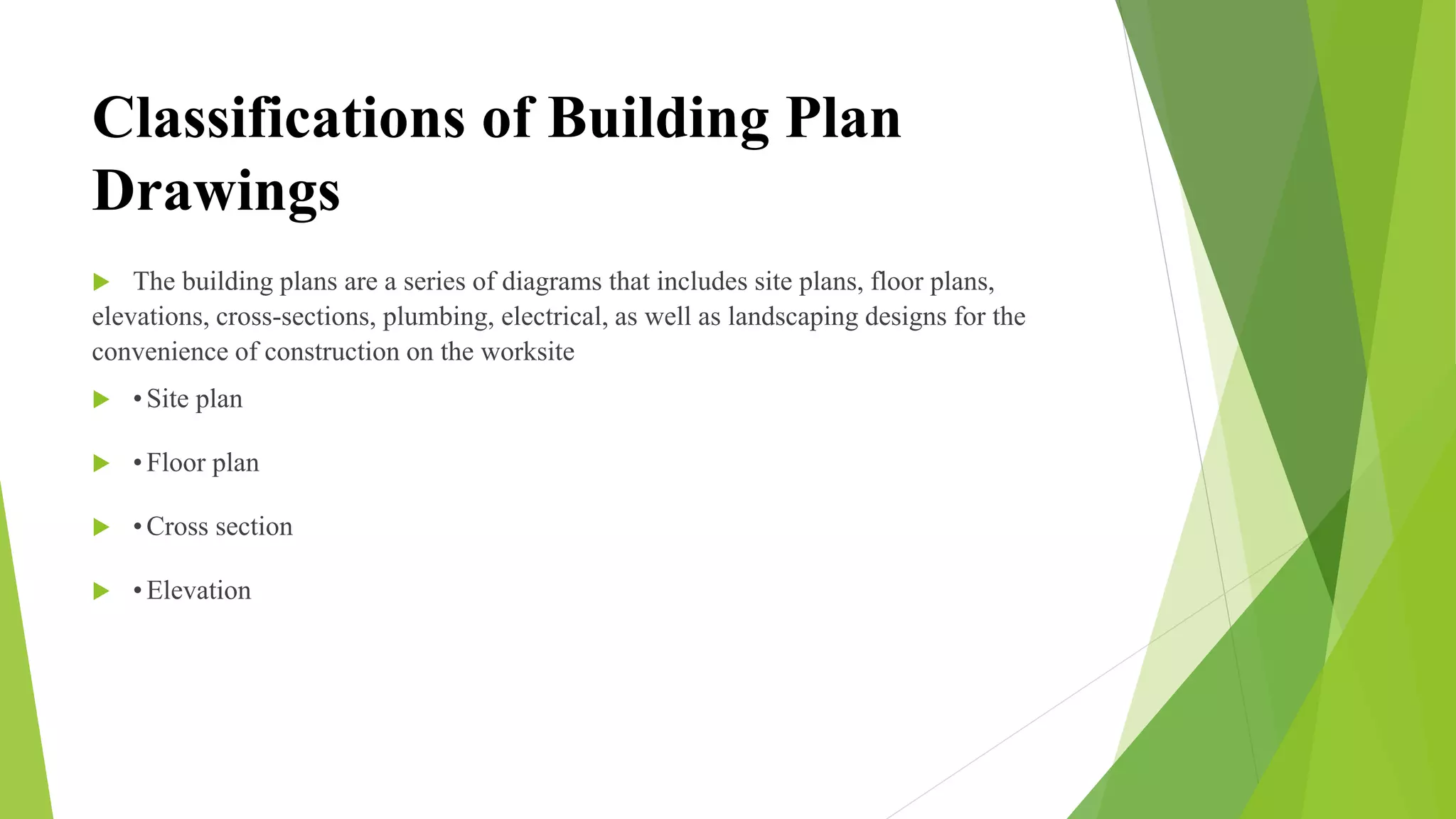
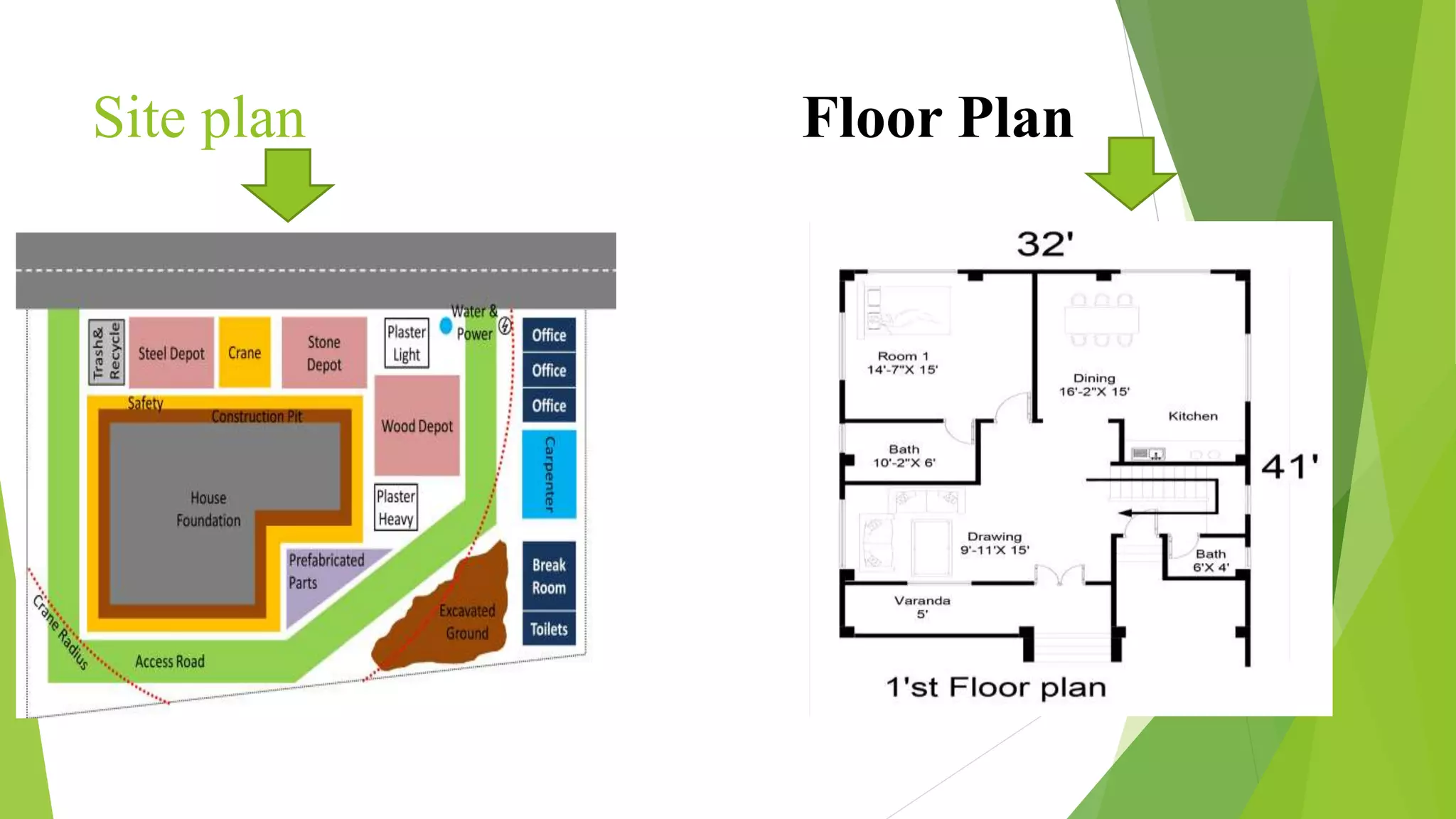
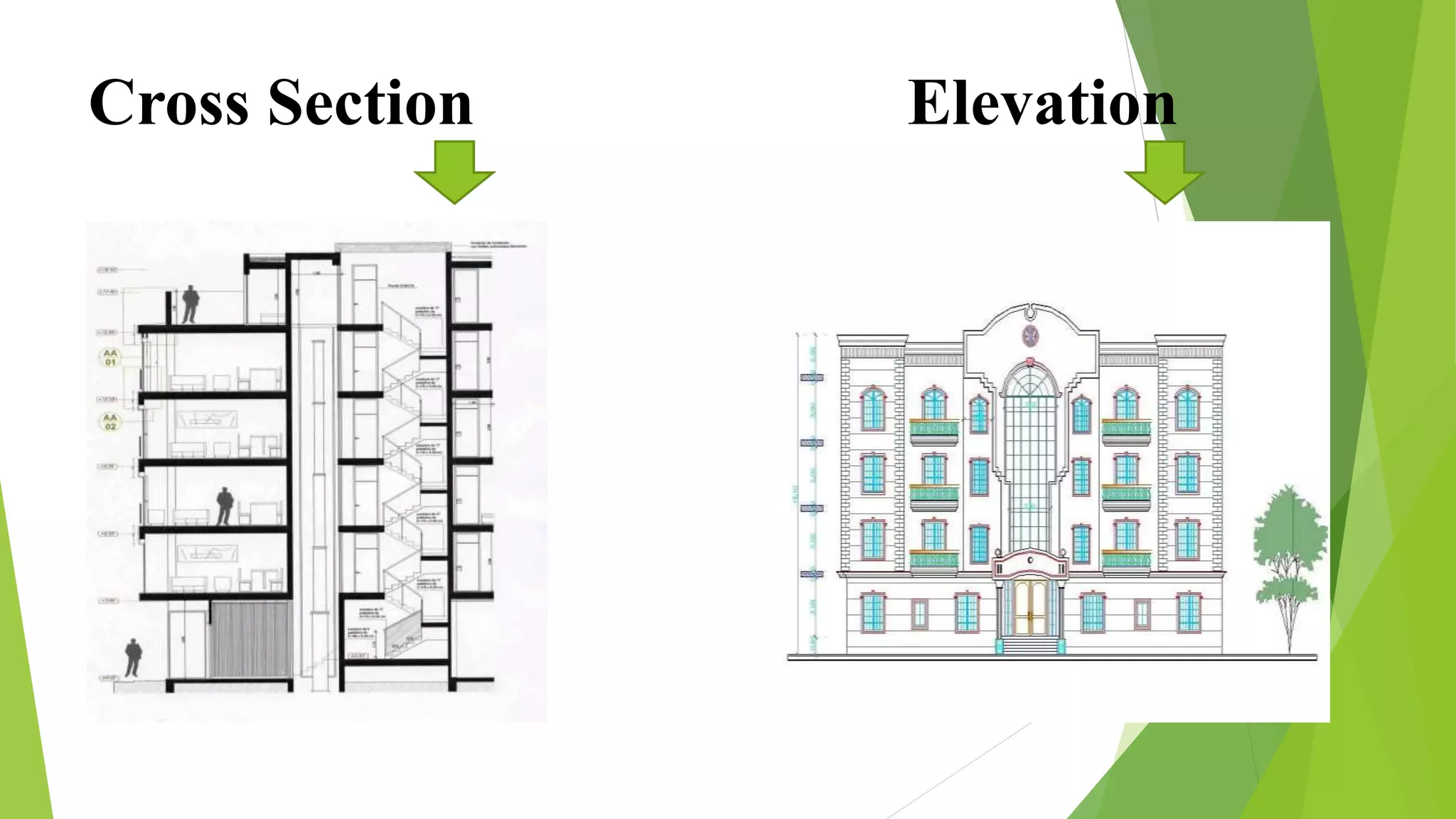
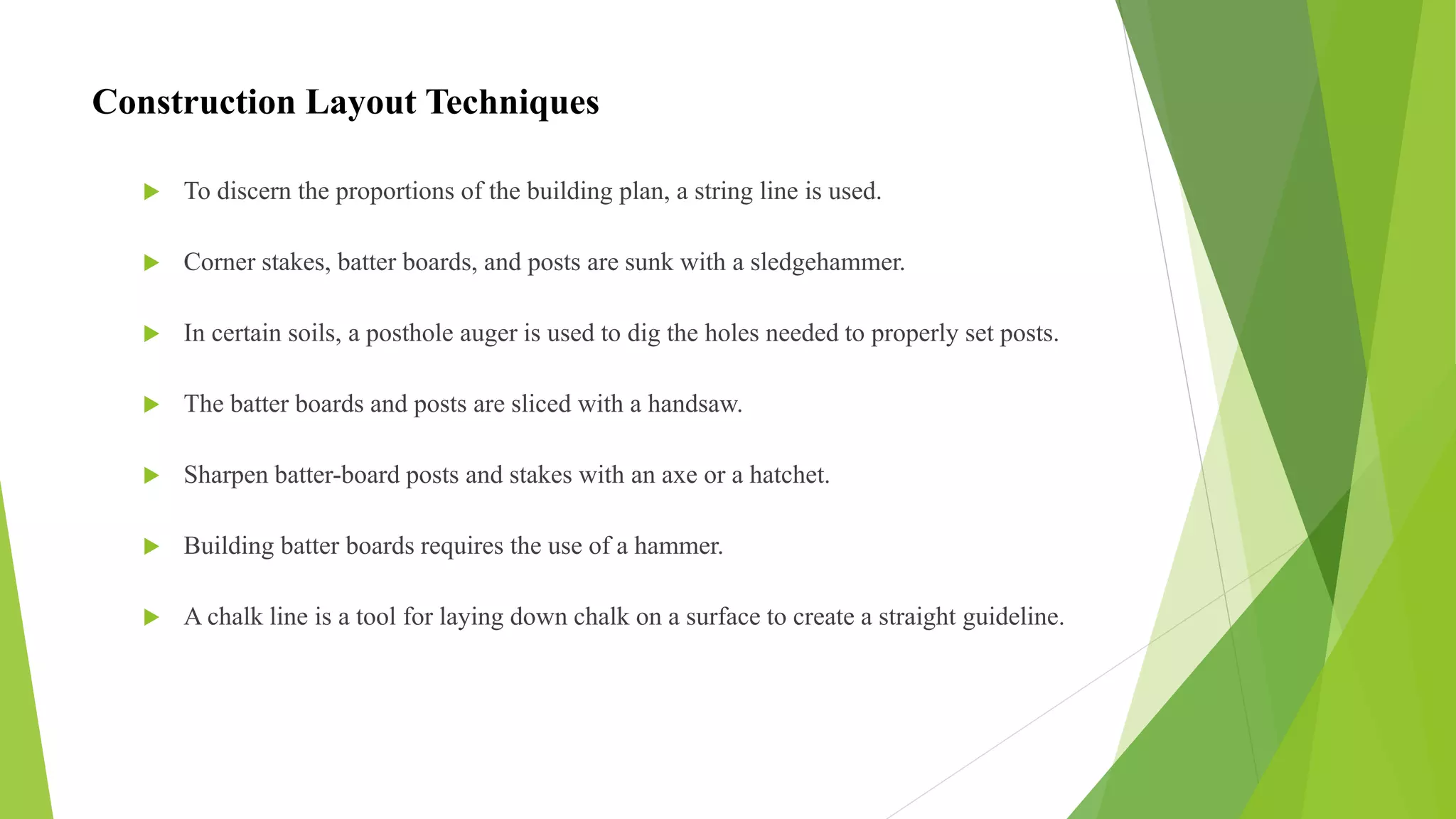
 The building plans are a series of diagrams that includes site plans, floor plans,
elevations, cross-sections, plumbing, electrical, as well as landscaping designs for the
convenience of construction on the worksite
 •Site plan
 •Floor plan
 •Cross section
 •Elevation
Site plan Floor Plan
Cross Section Elevation
BASELINE
A baseline is a straight reference line with respect to which corners of the building are located on the
ground. It may be outer boundary of a road or curb or boundary of the area or simply a line joining any
two points.
HORIZONTAL CONTROLS
Horizontal controls are the points that have known co-ordinates with respect to a specific point. These points are
then used to locate other points such as corners of a layout using various techniques. There should be plenty of
control points so that each point of foundation plan can be located precisely on the ground.
Construction Layout Techniques
 To discern the proportions of the building plan, a string line is used.
 Corner stakes, batter boards, and posts are sunk with a sledgehammer.
 In certain soils, a posthole auger is used to dig the holes needed to properly set posts.
 The batter boards and posts are sliced with a handsaw.
 Sharpen batter-board posts and stakes with an axe or a hatchet.
 Building batter boards requires the use of a hammer.
 A chalk line is a tool for laying down chalk on a surface to create a straight guideline.
THANK YOU

BUILDING LAYOUT ppt Ravi.pptx

  • 1.
    PROJECT NAME (BUILDING LAYOUTAND ITS MARKING ON GROUND) Subimited By Mr. Md. Wasiq Ravi Shastri (CE) Head of Department 2004220009020 GUIDE Mr. Divakar Singh (Asst.Prof.)
  • 2.
    BUILDING LAYOUT The layoutof a building or a structure shows the plan of its foundation on the ground surface according to its drawings. So, that excavation can be carried out exactly where required and position and orientation of the building are exactly specified. The placement of the structure, particularly its foundations, will be determined by controlling measurements and also references on a drawing and this process is called Building Layout.
  • 3.
    Why Building LayoutIs Necessary  The layout of a building or a structure shows the plan of its foundation on the ground surface according to its drawings. So that excavation can be carried out exactly where required and position and orientation of the building are exactly specified.  layout errors that are not identified or properly prioritized during construction weaken or otherwise compromise the finished structure, creating a serious safety hazard for occupants. It's easy to see why accuracy is critically important.
  • 4.
    Objectives of BuildingLayout  The purposes of surveying for construction works are to set out the planned structure in accordance with established designs and indicate the project’s controlling points in the most practical way for the construction forces.  The stakes, drill holes, batter boards mostly with string lines, cut–and–fill notations, and some other traditional methods are used to indicate the building’s corners as well as other lateral and vertical positions.  Generally, some type of reconnaissance, as well as site assessment, precedes the exact layout of the structure. The procedures listed below are typical of large construction projects.  • Conducted reconnaissance (aerial, map, and ground)  • Choosing a location (paper and instrument)  • Specifying control (horizontal and vertical)  • Observing topography (plane table)
  • 5.
    Classifications of BuildingPlan Drawings  The building plans are a series of diagrams that includes site plans, floor plans, elevations, cross-sections, plumbing, electrical, as well as landscaping designs for the convenience of construction on the worksite  •Site plan  •Floor plan  •Cross section  •Elevation
  • 6.
  • 7.
  • 8.
    BASELINE A baseline isa straight reference line with respect to which corners of the building are located on the ground. It may be outer boundary of a road or curb or boundary of the area or simply a line joining any two points.
  • 9.
    HORIZONTAL CONTROLS Horizontal controlsare the points that have known co-ordinates with respect to a specific point. These points are then used to locate other points such as corners of a layout using various techniques. There should be plenty of control points so that each point of foundation plan can be located precisely on the ground.
  • 10.
    Construction Layout Techniques To discern the proportions of the building plan, a string line is used.  Corner stakes, batter boards, and posts are sunk with a sledgehammer.  In certain soils, a posthole auger is used to dig the holes needed to properly set posts.  The batter boards and posts are sliced with a handsaw.  Sharpen batter-board posts and stakes with an axe or a hatchet.  Building batter boards requires the use of a hammer.  A chalk line is a tool for laying down chalk on a surface to create a straight guideline.
  • 11.