NICHE Building Blocks II:  Clinical Protocols John Jorgensen, RN, MPA Director, Informatics, Auxiliary Services Fort Sanders Regional Medical Center Knoxville, Tennessee Deirdre Carolan Doerflinger, CRNP, Ph.D. Geriatrics Clinical Nurse Specialist Inova Fairfax Hospital Falls Church, Virginia
Introduction The purpose of this presentation is to provide information not only on what makes a good protocol but more over how to utilize protocols to drive improvements in the care of older adults.
Objectives Discuss factors that influence the selection, implementation and dissemination of evidenced based clinical best practice protocols Describe implementation strategies for successful implementation of a protocol List at least three methods of “hardwiring”  protocols
Objectives (continued) Identify the importance of interdisciplinary collaboration for protocol implementation Delineate strategies for addressing the challenges of measuring performance
A Protocol by Any Other Name Protocol  – “Precise guidelines with a structures and logical approach to a closely specified clinical problem”  (D. Jenkins, 1991) Procedure   – “Set of action steps describing how to complete a clinical function”  Algorithms -  Set of steps that approximates the decision process of and expert clinician Clinical Practice Guidelines  – “Systematically developed statements to assist the practitioner  and patient decisions about appropriate health care for specific clinical circumstances (S. Wolf, 1990) Critical Paths  – Multidisciplinary approach that guides the nurse in what to do and when
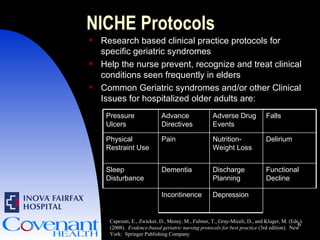
NICHE Protocols Research based clinical practice protocols for specific geriatric syndromes Help the nurse prevent, recognize and treat clinical conditions seen frequently in elders Common Geriatric syndromes and/or other Clinical Issues for hospitalized older adults are: Capezuti, E., Zwicker, D., Mezey, M., Fulmer, T., Gray-Miceli, D., and Kluger, M. (Eds.). (2008).  Evidence-based geriatric nursing protocols for best practice  (3rd edition).  New York:  Springer Publishing Company Depression Incontinence Functional Decline Discharge Planning Dementia Sleep Disturbance Delirium  Nutrition-Weight Loss Pain Physical Restraint Use Falls Adverse Drug Events Advance Directives Pressure Ulcers
Influential Factors For Protocol Adoption The high level view of the process includes: Recognition Selection of appropriate evidenced based practice (EBP) protocols Adoption/Implementation Hardwiring the protocol
Step One:  Recognition Takes many forms As simple as clinical area identifying areas of practice concerns/patient outcomes Must be data driven As robust as using an assessment tool such as the Geriatric Institutional Assessment Profile (GIAP) to identify areas for needed improvement
Step Two:  Selection of the EBP Protocol Many well researched protocols are available Why are they not used even when there is clear evidence of their effectiveness? Social influence theory   Transtheoretical model   Diffusion of innovation theory
Social Influence Theory Social influence theory  posits that behavior of one person influences others as to how they respond, feel and think about change. (Zinbardo, Leippe, 1991)  –  decisions and actions are strongly guided by prevailing practice, social norms, economic pressures and the habits, customs and values held by peers (Mittman, 1992)
Transtheoretical Model Transtheoretical model  – identifies 5 stages involving movement from knowledge and attitudinal change to action phrases where emotional and positive reinforcement need to occur and finally to practitioners adapting to the behavior enters a maintenance phase where the behavior is self sustaining as long a social support and reward systems are in place (Rogers, 1995).
Diffusion of Innovation Theory Diffusion of innovation theory  posits that change occurs when a small group of innovators believe strongly that adoption of a protocol will improve patient care.  This “change idea” then passes from the innovators to the “early adopters” and the idea takes off. (Rogers, 1995)
Step Two:  Selection of the EBP Protocol Involve end users from outset, enlist ownership Involve key players “ Nay sayers”  Champions Be flexible - may need to incorporate EBP into own protocol Lobby, lobby, lobby! Present opportunities individualized to specific audience
Step 3:  Implementation Successful implementation dependent upon recognition of factors which inhibit and encourage protocol adoption. Qualities Protocol Healthcare professional Practice setting Incentives for adoption Regulatory requirements
Step 3:  Implementation Tips Place protocols in easily accessible location  Use pocket cards with bullet points or checklists Computer prompts  Use of trigger cards such as SPICES mnemonics (Fulmer, 1991)
Step 3:  Implementation Considerations Determine opinion leaders (nurse managers or credible staff person) – gain their support Clinician factors such as age, training, knowledge base in protocol domain Irrational forces – fear, anxiety and resistance to change all tied to beliefs about self-efficacy Are the protocols too rigid
Step 3:  Implementation Publicize in every possible forum:  you never know where you will find a new champion! No surprises, no matter how insignificant Know your measurement mechanism going in
Step 4:  Hardwiring Continual review of outcomes Education New staff Annual review Competency Training Monitoring use of the protocol
Strategies for Successful Protocol Implementation – Administrative Support 8 of the top 10 barriers to using research findings in practice are related to the work environment and the organizational process Lack of authority Little support from other staff and physicians Management refusal Insufficient time  These barriers are directly influenced by management
Strategies for Successful Protocol Implementation – Committee/Council Prevailing organizational culture (customs, attitudes, beliefs) must support protocol adoption and implementation Teams are at the very root of this culture Utilize teams as the base units for change Staff survey as to key geriatric syndromes Manager conducts interviews to collect commentary to determine priorities Annual goal setting  Unit staff and manager work collaboratively to establish goals, set action plans and assigned specific tasks to complete Unit progress monitored – staff become experts
Strategies for  Successful Protocol Implementation – Social Influence Strategies The most crucial factor for successful protocol implementation is the use of multifaceted strategies (Kaluzney et al., 1995; Oxman et al., 1995; Solberg et al., 2000.
Strategies for  Successful Protocol Implementation – Social Influence Strategies Catalogues of strategies to meet specific to the situation seem most appropriate Must fit desired behavioral change Practitioner type  Technologies in use
Strategies for  Successful Protocol Implementation – Social Influence Strategies Social influence strategies useful in healthcare setting Use of opinion leaders (excellent staff clinicians, APRNs, nursing school faculty members, outside experts) Performance improvement Study groups Patient care rounds Participatory guideline development
Strategies for Successful Protocol Implementation - Consultants  Wherever possible involve internal consultations and involve them on patient care teams Pharmacy for poly pharmacy Therapies for skin care, mobility, discharge planning SLPs for swallowing protocols Risk management for elopement Involve outside consultants to assess, kick off your program and to evaluate progress GIAP services provide valuable information on institutional attitudes, education and practice
Strategies for Successful Protocol Implementation – Models of Care Fit strategies to the model of care being used. Geriatric Resource Nurse (GRN) Model Experts on each unit guide protocol development Acute Care for Elderly (ACE) Protocol development for distinct unit Social influence strategies remain in play regardless of care model
Hardwiring Protocols – Sustaining Behaviors Promote compliance with creative rewards and incentives Friendly competition between units Use of awards for unit with best project – See NICE AWARD Reports at leadership on nursing unit performance Falls rates Skin care stats Documentation screening on admission, assessments and interventions for pain and patient discharge planning. Regular study groups, sensitivity training, monthly rounds, Games that increase knowledge
Hardwiring Protocols – Sustaining Behaviors Use of special training for opinion leaders who become the role models when training of all staff is initiated Case presentations Huddles where there is a short meeting to identify patient issues and communicate to all team members Consider educating consumers through public relations Knowledge of best practice empowers consumers to make choices that are more informed A way to evaluate appropriateness of care
Hardwiring Protocols – Sustaining Behaviors New employee education should include information on the protocol & its justification for use Extends to floats & temporary employees Cover the critical protocols of fall prevention, restraint use and management of difficult behaviors Incorporate this training into annual competency training for all staff to reinforce and sustain the behavior change Titler and colleagues suggest “reinfusion” of evidenced-based practice by developing a plan of systematically reintroducing the protocol and monitoring its use.
Hardwiring Protocols – Sustaining Behaviors Agreed upon documentation can be embedded into the electronic medical record  Prompts & screen lay out are critical to success Education of staff on use of screens critical Constant monitoring via clinical electronic query provide leadership with information on performance A variety of EBP tools can be incorporated Alerts can be sent to various disciplines: for abuse, frail elder consults, pharmacy consults for med reconciliation, functional assessment screening can trigger therapy involvement and fall event data tracked more efficiently to reduce incidence.
Interprofessional Collaboration The goal of protocol implementation is to ensure the actual use of the protocol. Involvement of disciplines requires a common language and documentation that transcends petty fiefdoms within the traditional bureaucratic structure of health care organizations Intra professional teams can be formed to work jointly on issues common to all Clear examples include skin care, fall prevention, pain management, restraint reduction and  preventing the hazards of immobility
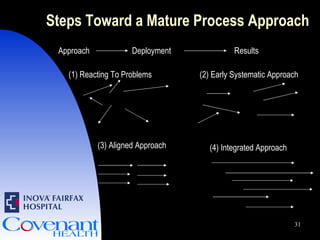
Steps Toward a Mature Process Approach Approach Deployment Results (1) Reacting To Problems (2) Early Systematic Approach (3) Aligned Approach (4) Integrated Approach
Measuring Performance (Quality is in the eye of the beholder) Different interests for multiple users a key challenge Stakeholders Internal Administration Clinical staff Quality department External Regulatory agencies Consumers – Health grades, CORE Measure information
Measuring Performance (Quality is in the eye of the beholder)  (cont’d) Must use acceptable measurement tools where care measures are identified and standardized with a common measurement language grounded in shared perspectives on quality across groups and disciplines. Once systems are in place data must be collected: Logistical issues of collecting, recording, reporting and managing data Data must be analyzed in statistically appropriate ways Health care environments are different and change frequently – finding common denominators is a major hurdle
Measurement Tools Assessment phase findings - Data allergies Collecting data without: Knowing why Seeing results Developing findings and conclusions Cataloging monitoring activities to  Determine if they are truly needed What / where they get reported Are there actionables Who is the owner so that collection can readily be accessed –important o these days of continuous readiness.
Characteristics of Good Measurement Tools Characteristics of good performance measures Usefulness What do we need to know? How do we intend to use the performance measure and can it be used this way? Targets improvement now, in the past and for the future Precisely defined – clear operational definitions Validity – does the measure measure what it is intended to measure? Sensitivity – ability to capture the “true” cases of the event being measured (false positives) Specificity – The likelihood of a negative test when the condition is actually present – indicates low specificity.
Characteristics of Good Measurement Tools Characteristics of good performance measures (cont’d) Reliability – Results that are reproducible and consistent indicate high reliability. Interpretable – the degree to which it conveys a result that can be linked to the quality of clinical care. Risk-adjusted – Some patients are sicker than others some have co morbidities, some older and more frail. – create level playing field Easy to collect – Easily retrievable data with little burden – goal quick and good rather than quick and dirty! In control – must reflect the practice being observed and must be within the control of the practitioner
Data Collection Methods Standard chart review Clinical Query in which the documentation database can be queried for specific elements Direct observation Interviews Staff Patients Physicians Tracers – essentially and interview and record review all in one
Analysis / Interpretation /Reporting Results -Begins with taking data and organizing it into categories Could be hierarchical  Based on a structural taxonomy Findings – Taking results to the next level that speak to the outcomes of the results Conclusions – An overview of findings for use in future projects or as predictors for future activities.
Healthcare Change / Differences / Considerations Healthcare is dynamic and change occurs frequently There is movement of care from one setting to another Frequent introduction of new technology Even within supposed integrated health care delivery systems there is often a lack of standardized processes between facilities Also exists a new public awareness where there is a desire to see outcome data prior to undergoing procedures or being admitted to a particular facility
Summary Elder focused practice protocols have the potential to improve patient care by fostering clinical decision making based on best practice geriatric nursing standards Administrative commitment and a comprehensive organizational strategy are pivotal. Pay close attention to how and what protocols are developed Recognize/publish small successes in winning additional support Remember imagination, courage and love are positive drivers for change.

Building Blocks: Protocols

  • 1.
    NICHE Building BlocksII: Clinical Protocols John Jorgensen, RN, MPA Director, Informatics, Auxiliary Services Fort Sanders Regional Medical Center Knoxville, Tennessee Deirdre Carolan Doerflinger, CRNP, Ph.D. Geriatrics Clinical Nurse Specialist Inova Fairfax Hospital Falls Church, Virginia
  • 2.
    Introduction The purposeof this presentation is to provide information not only on what makes a good protocol but more over how to utilize protocols to drive improvements in the care of older adults.
  • 3.
    Objectives Discuss factorsthat influence the selection, implementation and dissemination of evidenced based clinical best practice protocols Describe implementation strategies for successful implementation of a protocol List at least three methods of “hardwiring” protocols
  • 4.
    Objectives (continued) Identifythe importance of interdisciplinary collaboration for protocol implementation Delineate strategies for addressing the challenges of measuring performance
  • 5.
    A Protocol byAny Other Name Protocol – “Precise guidelines with a structures and logical approach to a closely specified clinical problem” (D. Jenkins, 1991) Procedure – “Set of action steps describing how to complete a clinical function” Algorithms - Set of steps that approximates the decision process of and expert clinician Clinical Practice Guidelines – “Systematically developed statements to assist the practitioner and patient decisions about appropriate health care for specific clinical circumstances (S. Wolf, 1990) Critical Paths – Multidisciplinary approach that guides the nurse in what to do and when
  • 6.
    NICHE Protocols Researchbased clinical practice protocols for specific geriatric syndromes Help the nurse prevent, recognize and treat clinical conditions seen frequently in elders Common Geriatric syndromes and/or other Clinical Issues for hospitalized older adults are: Capezuti, E., Zwicker, D., Mezey, M., Fulmer, T., Gray-Miceli, D., and Kluger, M. (Eds.). (2008). Evidence-based geriatric nursing protocols for best practice (3rd edition). New York: Springer Publishing Company Depression Incontinence Functional Decline Discharge Planning Dementia Sleep Disturbance Delirium Nutrition-Weight Loss Pain Physical Restraint Use Falls Adverse Drug Events Advance Directives Pressure Ulcers
  • 7.
    Influential Factors ForProtocol Adoption The high level view of the process includes: Recognition Selection of appropriate evidenced based practice (EBP) protocols Adoption/Implementation Hardwiring the protocol
  • 8.
    Step One: Recognition Takes many forms As simple as clinical area identifying areas of practice concerns/patient outcomes Must be data driven As robust as using an assessment tool such as the Geriatric Institutional Assessment Profile (GIAP) to identify areas for needed improvement
  • 9.
    Step Two: Selection of the EBP Protocol Many well researched protocols are available Why are they not used even when there is clear evidence of their effectiveness? Social influence theory Transtheoretical model Diffusion of innovation theory
  • 10.
    Social Influence TheorySocial influence theory posits that behavior of one person influences others as to how they respond, feel and think about change. (Zinbardo, Leippe, 1991) – decisions and actions are strongly guided by prevailing practice, social norms, economic pressures and the habits, customs and values held by peers (Mittman, 1992)
  • 11.
    Transtheoretical Model Transtheoreticalmodel – identifies 5 stages involving movement from knowledge and attitudinal change to action phrases where emotional and positive reinforcement need to occur and finally to practitioners adapting to the behavior enters a maintenance phase where the behavior is self sustaining as long a social support and reward systems are in place (Rogers, 1995).
  • 12.
    Diffusion of InnovationTheory Diffusion of innovation theory posits that change occurs when a small group of innovators believe strongly that adoption of a protocol will improve patient care. This “change idea” then passes from the innovators to the “early adopters” and the idea takes off. (Rogers, 1995)
  • 13.
    Step Two: Selection of the EBP Protocol Involve end users from outset, enlist ownership Involve key players “ Nay sayers” Champions Be flexible - may need to incorporate EBP into own protocol Lobby, lobby, lobby! Present opportunities individualized to specific audience
  • 14.
    Step 3: Implementation Successful implementation dependent upon recognition of factors which inhibit and encourage protocol adoption. Qualities Protocol Healthcare professional Practice setting Incentives for adoption Regulatory requirements
  • 15.
    Step 3: Implementation Tips Place protocols in easily accessible location Use pocket cards with bullet points or checklists Computer prompts Use of trigger cards such as SPICES mnemonics (Fulmer, 1991)
  • 16.
    Step 3: Implementation Considerations Determine opinion leaders (nurse managers or credible staff person) – gain their support Clinician factors such as age, training, knowledge base in protocol domain Irrational forces – fear, anxiety and resistance to change all tied to beliefs about self-efficacy Are the protocols too rigid
  • 17.
    Step 3: Implementation Publicize in every possible forum: you never know where you will find a new champion! No surprises, no matter how insignificant Know your measurement mechanism going in
  • 18.
    Step 4: Hardwiring Continual review of outcomes Education New staff Annual review Competency Training Monitoring use of the protocol
  • 19.
    Strategies for SuccessfulProtocol Implementation – Administrative Support 8 of the top 10 barriers to using research findings in practice are related to the work environment and the organizational process Lack of authority Little support from other staff and physicians Management refusal Insufficient time These barriers are directly influenced by management
  • 20.
    Strategies for SuccessfulProtocol Implementation – Committee/Council Prevailing organizational culture (customs, attitudes, beliefs) must support protocol adoption and implementation Teams are at the very root of this culture Utilize teams as the base units for change Staff survey as to key geriatric syndromes Manager conducts interviews to collect commentary to determine priorities Annual goal setting Unit staff and manager work collaboratively to establish goals, set action plans and assigned specific tasks to complete Unit progress monitored – staff become experts
  • 21.
    Strategies for Successful Protocol Implementation – Social Influence Strategies The most crucial factor for successful protocol implementation is the use of multifaceted strategies (Kaluzney et al., 1995; Oxman et al., 1995; Solberg et al., 2000.
  • 22.
    Strategies for Successful Protocol Implementation – Social Influence Strategies Catalogues of strategies to meet specific to the situation seem most appropriate Must fit desired behavioral change Practitioner type Technologies in use
  • 23.
    Strategies for Successful Protocol Implementation – Social Influence Strategies Social influence strategies useful in healthcare setting Use of opinion leaders (excellent staff clinicians, APRNs, nursing school faculty members, outside experts) Performance improvement Study groups Patient care rounds Participatory guideline development
  • 24.
    Strategies for SuccessfulProtocol Implementation - Consultants Wherever possible involve internal consultations and involve them on patient care teams Pharmacy for poly pharmacy Therapies for skin care, mobility, discharge planning SLPs for swallowing protocols Risk management for elopement Involve outside consultants to assess, kick off your program and to evaluate progress GIAP services provide valuable information on institutional attitudes, education and practice
  • 25.
    Strategies for SuccessfulProtocol Implementation – Models of Care Fit strategies to the model of care being used. Geriatric Resource Nurse (GRN) Model Experts on each unit guide protocol development Acute Care for Elderly (ACE) Protocol development for distinct unit Social influence strategies remain in play regardless of care model
  • 26.
    Hardwiring Protocols –Sustaining Behaviors Promote compliance with creative rewards and incentives Friendly competition between units Use of awards for unit with best project – See NICE AWARD Reports at leadership on nursing unit performance Falls rates Skin care stats Documentation screening on admission, assessments and interventions for pain and patient discharge planning. Regular study groups, sensitivity training, monthly rounds, Games that increase knowledge
  • 27.
    Hardwiring Protocols –Sustaining Behaviors Use of special training for opinion leaders who become the role models when training of all staff is initiated Case presentations Huddles where there is a short meeting to identify patient issues and communicate to all team members Consider educating consumers through public relations Knowledge of best practice empowers consumers to make choices that are more informed A way to evaluate appropriateness of care
  • 28.
    Hardwiring Protocols –Sustaining Behaviors New employee education should include information on the protocol & its justification for use Extends to floats & temporary employees Cover the critical protocols of fall prevention, restraint use and management of difficult behaviors Incorporate this training into annual competency training for all staff to reinforce and sustain the behavior change Titler and colleagues suggest “reinfusion” of evidenced-based practice by developing a plan of systematically reintroducing the protocol and monitoring its use.
  • 29.
    Hardwiring Protocols –Sustaining Behaviors Agreed upon documentation can be embedded into the electronic medical record Prompts & screen lay out are critical to success Education of staff on use of screens critical Constant monitoring via clinical electronic query provide leadership with information on performance A variety of EBP tools can be incorporated Alerts can be sent to various disciplines: for abuse, frail elder consults, pharmacy consults for med reconciliation, functional assessment screening can trigger therapy involvement and fall event data tracked more efficiently to reduce incidence.
  • 30.
    Interprofessional Collaboration Thegoal of protocol implementation is to ensure the actual use of the protocol. Involvement of disciplines requires a common language and documentation that transcends petty fiefdoms within the traditional bureaucratic structure of health care organizations Intra professional teams can be formed to work jointly on issues common to all Clear examples include skin care, fall prevention, pain management, restraint reduction and preventing the hazards of immobility
  • 31.
    Steps Toward aMature Process Approach Approach Deployment Results (1) Reacting To Problems (2) Early Systematic Approach (3) Aligned Approach (4) Integrated Approach
  • 32.
    Measuring Performance (Qualityis in the eye of the beholder) Different interests for multiple users a key challenge Stakeholders Internal Administration Clinical staff Quality department External Regulatory agencies Consumers – Health grades, CORE Measure information
  • 33.
    Measuring Performance (Qualityis in the eye of the beholder) (cont’d) Must use acceptable measurement tools where care measures are identified and standardized with a common measurement language grounded in shared perspectives on quality across groups and disciplines. Once systems are in place data must be collected: Logistical issues of collecting, recording, reporting and managing data Data must be analyzed in statistically appropriate ways Health care environments are different and change frequently – finding common denominators is a major hurdle
  • 34.
    Measurement Tools Assessmentphase findings - Data allergies Collecting data without: Knowing why Seeing results Developing findings and conclusions Cataloging monitoring activities to Determine if they are truly needed What / where they get reported Are there actionables Who is the owner so that collection can readily be accessed –important o these days of continuous readiness.
  • 35.
    Characteristics of GoodMeasurement Tools Characteristics of good performance measures Usefulness What do we need to know? How do we intend to use the performance measure and can it be used this way? Targets improvement now, in the past and for the future Precisely defined – clear operational definitions Validity – does the measure measure what it is intended to measure? Sensitivity – ability to capture the “true” cases of the event being measured (false positives) Specificity – The likelihood of a negative test when the condition is actually present – indicates low specificity.
  • 36.
    Characteristics of GoodMeasurement Tools Characteristics of good performance measures (cont’d) Reliability – Results that are reproducible and consistent indicate high reliability. Interpretable – the degree to which it conveys a result that can be linked to the quality of clinical care. Risk-adjusted – Some patients are sicker than others some have co morbidities, some older and more frail. – create level playing field Easy to collect – Easily retrievable data with little burden – goal quick and good rather than quick and dirty! In control – must reflect the practice being observed and must be within the control of the practitioner
  • 37.
    Data Collection MethodsStandard chart review Clinical Query in which the documentation database can be queried for specific elements Direct observation Interviews Staff Patients Physicians Tracers – essentially and interview and record review all in one
  • 38.
    Analysis / Interpretation/Reporting Results -Begins with taking data and organizing it into categories Could be hierarchical Based on a structural taxonomy Findings – Taking results to the next level that speak to the outcomes of the results Conclusions – An overview of findings for use in future projects or as predictors for future activities.
  • 39.
    Healthcare Change /Differences / Considerations Healthcare is dynamic and change occurs frequently There is movement of care from one setting to another Frequent introduction of new technology Even within supposed integrated health care delivery systems there is often a lack of standardized processes between facilities Also exists a new public awareness where there is a desire to see outcome data prior to undergoing procedures or being admitted to a particular facility
  • 40.
    Summary Elder focusedpractice protocols have the potential to improve patient care by fostering clinical decision making based on best practice geriatric nursing standards Administrative commitment and a comprehensive organizational strategy are pivotal. Pay close attention to how and what protocols are developed Recognize/publish small successes in winning additional support Remember imagination, courage and love are positive drivers for change.