
Healthcare
Quality Concepts
2
‫الجودة‬ ‫تعريف‬
‫الجودة‬
‫في‬
‫الرعاية‬
‫الصحية‬
‫الخدمة‬ ‫متلقي‬ ‫تعريف‬
‫الخدمة‬ ‫مقدم‬ ‫تعريف‬‫االدارة‬ ‫تعريف‬
3
Improving
Quality
Measuring
Quality
Defining
Quality
Quality
Assurance
The Quality Assurance Triangle
Quality
Evaluation
Regulation Accreditation Audit
Policy Making
Quality (Re)-Designing
Benchmarking
Problem Solving
Management
Actions
Structural Re-Organization
Incentives
Motivation
Standards Setting
Monitoring Systems
Supervision
4
What is Quality
 Quality means doing the right things right
the first time.
 Quality can be said to be, at least in part,
compliance with standards. Standards are
created when experts are able to understand
what the right things are and how the right
things are best achieved based on Research
and Clinical Evidence
 When recipients of care define quality, they
judge whether or not the right things are
done in ways that meet their own needs and
expectations.
5
What is Quality
The Institute of Medicine defines
quality as:
"The degree to which health care
services for individuals and
populations increase the probability of
desired health outcomes and are
consistent with current professional
knowledge of best practice."
6
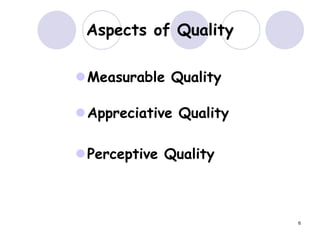
Aspects of Quality
Measurable Quality
Appreciative Quality
Perceptive Quality
7
Measurable Quality
 Can be defined objectively as compliance
with, or adherence to standards.
 Clinically, these standards may take the
form of practice parameters or protocols,
or they may establish acceptable
expectations for patient and organizational
outcomes.
 Standards serve as guidelines for
excellence.
8
Appreciative Quality
 Is the comprehension and appraisal of
excellence beyond minimal standards and
criteria.
 Requires the judgments of skilled,
experienced practitioners and sensitive,
caring persons.
 Peer review bodies rely on the judgments of
like professionals in determining the quality
or non-quality of specific patient-
practitioner interactions.
9
Perceptive Quality
 Is the degree of excellence which is
perceived by the recipient or the observer
of care rather than by the provider of
care.
 Is generally based more on the degree of
caring expressed by physicians, nurses,
and other staff than on the physical
environment and technical competence.
10
Dimensions of Quality
 The key dimensions of care/performance
provide the framework for quality
management activities in all healthcare
settings and balanced and well-integrated
quality, cost, and risk perspective. They
are foundational as ways of thinking about
patient care, what is important to patients,
and what should be prioritized in
performance measurement.
11
Dimensions of Quality
1. Appropriateness (‫مالئمة‬ )
o The degree to which the care/intervention
is given the current state of knowledge.
o “correct” suitable resource utilization, as
judged by peers.
o Doing the right things in accordance with
the purpose.
12
Dimensions of Quality…
2. Availability (‫عليها‬ ‫الحصول‬ ‫ومتاح‬ ‫متوفرة‬ )
o The degree to which appropriate
care/intervention is obtainable to meet the
patient's needs.
o The ease with which healthcare can be
obtained in the face of financial ,
organizational, procedural, emotional, and
cultural barriers (access).
13
Dimensions of Quality…
3. Competency (‫وكفاءة‬ ‫)أهلية‬
o The practitioner's ability to produce both
the health and satisfaction of customers.
o The degree to which the practitioner
adheres to professional and/or organizational
standards of care and practice.
14
Dimensions of Quality…
4. Continuity (‫ومتواصلة‬ ‫)مستمرة‬
o The coordination of needed healthcare
services for a patient or specified
population among all practitioners and
across all involved organizations over time.
o The delivery of needed healthcare as a
coherent unbroken succession of service
(truly managed care).
15
Dimensions of Quality…
5. Effectiveness (‫ومؤثر‬ ‫)فعال‬
o The degree to which care is provided in the
correct manner, given the current state of
knowledge, to achieve the desired or projected
outcome(s) for the individual.
o The degree to witch a desired outcome is
reached, the positive result of care delivery.
o Performance that is equivalent to state
requirements: (doing the right things right)
16
Dimensions of Quality
6. Efficacy (‫وفعالية‬ ‫)قدرة‬
o The potential, capacity, or capability to
produce the desired effect or outcome,
e.g., through scientific research.
(evidence-based) findings.
o The power of a procedure or treatment to
improve health status.
17
Dimensions of Quality…
7. Efficiency ( ‫فعالية‬,‫كفاية‬ )
o The relationship between the outcomes
(results of care) and the resources used to
deliver care.
o The relationship of outputs (services
produced) to inputs (resources used to
produce the services) [JCI Second Edition]
o A combination of skill and economy of
energy in producing a desired result.
18
Dimensions of Quality…
8. Respect and Caring (‫واالحترام‬ ‫)العناية‬
o The degree to which those providing
services do so with sensitivity for the
individual's needs, expectations, and
individual differences, and the degree to
which the individual is involved in his or
her own care decisions.
o The degree to which the individual or a
designee is involved in his or her own care
and service decisions [JCAHO 2003]
19
Dimensions of Quality
9. Safety (‫واألمان‬ ‫)السالمة‬
o The degree to which the risk of an
intervention ... and risk in the care
environment are reduced for a patient and
other persons including health care
practitioners.
o The degree to which the organizational
environment is free from hazard or
danger.
20
Dimensions of Quality
10.Timeliness ( (‫والمطلوب‬ ‫المحدد‬ ‫الوقت‬
o The degree to which needed care and
services are "provided to the patient at
the most beneficial or necessary time.
o The degree to which services are provided
to customers in accordance with their
perception of promptness.
21
Dimensions of Quality…
11.Prevention/Early Detection
o The degree to which interventions,
including the identification of risk
factors, promote health and prevent
disease.
22
Reference…
Healthcare Quality Handbook Of
Janet A. Brown, RN, CPHQ

Quality concepts

  • 1.
  • 2.
    2 ‫الجودة‬ ‫تعريف‬ ‫الجودة‬ ‫في‬ ‫الرعاية‬ ‫الصحية‬ ‫الخدمة‬ ‫متلقي‬‫تعريف‬ ‫الخدمة‬ ‫مقدم‬ ‫تعريف‬‫االدارة‬ ‫تعريف‬
  • 3.
    3 Improving Quality Measuring Quality Defining Quality Quality Assurance The Quality AssuranceTriangle Quality Evaluation Regulation Accreditation Audit Policy Making Quality (Re)-Designing Benchmarking Problem Solving Management Actions Structural Re-Organization Incentives Motivation Standards Setting Monitoring Systems Supervision
  • 4.
    4 What is Quality Quality means doing the right things right the first time.  Quality can be said to be, at least in part, compliance with standards. Standards are created when experts are able to understand what the right things are and how the right things are best achieved based on Research and Clinical Evidence  When recipients of care define quality, they judge whether or not the right things are done in ways that meet their own needs and expectations.
  • 5.
    5 What is Quality TheInstitute of Medicine defines quality as: "The degree to which health care services for individuals and populations increase the probability of desired health outcomes and are consistent with current professional knowledge of best practice."
  • 6.
    6 Aspects of Quality MeasurableQuality Appreciative Quality Perceptive Quality
  • 7.
    7 Measurable Quality  Canbe defined objectively as compliance with, or adherence to standards.  Clinically, these standards may take the form of practice parameters or protocols, or they may establish acceptable expectations for patient and organizational outcomes.  Standards serve as guidelines for excellence.
  • 8.
    8 Appreciative Quality  Isthe comprehension and appraisal of excellence beyond minimal standards and criteria.  Requires the judgments of skilled, experienced practitioners and sensitive, caring persons.  Peer review bodies rely on the judgments of like professionals in determining the quality or non-quality of specific patient- practitioner interactions.
  • 9.
    9 Perceptive Quality  Isthe degree of excellence which is perceived by the recipient or the observer of care rather than by the provider of care.  Is generally based more on the degree of caring expressed by physicians, nurses, and other staff than on the physical environment and technical competence.
  • 10.
    10 Dimensions of Quality The key dimensions of care/performance provide the framework for quality management activities in all healthcare settings and balanced and well-integrated quality, cost, and risk perspective. They are foundational as ways of thinking about patient care, what is important to patients, and what should be prioritized in performance measurement.
  • 11.
    11 Dimensions of Quality 1.Appropriateness (‫مالئمة‬ ) o The degree to which the care/intervention is given the current state of knowledge. o “correct” suitable resource utilization, as judged by peers. o Doing the right things in accordance with the purpose.
  • 12.
    12 Dimensions of Quality… 2.Availability (‫عليها‬ ‫الحصول‬ ‫ومتاح‬ ‫متوفرة‬ ) o The degree to which appropriate care/intervention is obtainable to meet the patient's needs. o The ease with which healthcare can be obtained in the face of financial , organizational, procedural, emotional, and cultural barriers (access).
  • 13.
    13 Dimensions of Quality… 3.Competency (‫وكفاءة‬ ‫)أهلية‬ o The practitioner's ability to produce both the health and satisfaction of customers. o The degree to which the practitioner adheres to professional and/or organizational standards of care and practice.
  • 14.
    14 Dimensions of Quality… 4.Continuity (‫ومتواصلة‬ ‫)مستمرة‬ o The coordination of needed healthcare services for a patient or specified population among all practitioners and across all involved organizations over time. o The delivery of needed healthcare as a coherent unbroken succession of service (truly managed care).
  • 15.
    15 Dimensions of Quality… 5.Effectiveness (‫ومؤثر‬ ‫)فعال‬ o The degree to which care is provided in the correct manner, given the current state of knowledge, to achieve the desired or projected outcome(s) for the individual. o The degree to witch a desired outcome is reached, the positive result of care delivery. o Performance that is equivalent to state requirements: (doing the right things right)
  • 16.
    16 Dimensions of Quality 6.Efficacy (‫وفعالية‬ ‫)قدرة‬ o The potential, capacity, or capability to produce the desired effect or outcome, e.g., through scientific research. (evidence-based) findings. o The power of a procedure or treatment to improve health status.
  • 17.
    17 Dimensions of Quality… 7.Efficiency ( ‫فعالية‬,‫كفاية‬ ) o The relationship between the outcomes (results of care) and the resources used to deliver care. o The relationship of outputs (services produced) to inputs (resources used to produce the services) [JCI Second Edition] o A combination of skill and economy of energy in producing a desired result.
  • 18.
    18 Dimensions of Quality… 8.Respect and Caring (‫واالحترام‬ ‫)العناية‬ o The degree to which those providing services do so with sensitivity for the individual's needs, expectations, and individual differences, and the degree to which the individual is involved in his or her own care decisions. o The degree to which the individual or a designee is involved in his or her own care and service decisions [JCAHO 2003]
  • 19.
    19 Dimensions of Quality 9.Safety (‫واألمان‬ ‫)السالمة‬ o The degree to which the risk of an intervention ... and risk in the care environment are reduced for a patient and other persons including health care practitioners. o The degree to which the organizational environment is free from hazard or danger.
  • 20.
    20 Dimensions of Quality 10.Timeliness( (‫والمطلوب‬ ‫المحدد‬ ‫الوقت‬ o The degree to which needed care and services are "provided to the patient at the most beneficial or necessary time. o The degree to which services are provided to customers in accordance with their perception of promptness.
  • 21.
    21 Dimensions of Quality… 11.Prevention/EarlyDetection o The degree to which interventions, including the identification of risk factors, promote health and prevent disease.
  • 22.