Building Up a
Solid Argument
     Critical Thinking Skills for Urbanism

Roberto Rocco
Spatial Planning and Strategy
TU Delft

    !"#$$%&'%()"%(*+)+,%
                                             1
Sharp
        2
Precise
          3
Critical
           4
Motivated
            5
How to build an argument?
             ✦   In every aspect of
                 life, we need to
                 communicate our
                 ideas and convince
                 people of our views.
             ✦   In order to do that
                 properly, we need to
                 be able to explain
                 WHY our
                 arguments are valid.
                                        6
How to build a strong argument

✦ Approach all issues from the
  point of view of a sceptic
  reader/viewer
✦ Use formal logic and other

  rhetorical devices
✦ Order your arguments for

  maximum effect.

                                 7
The sceptic reader


                     8
When willing to persuade, whose
point of view is most important?
             Not yours - you are already
           convinced that your points are
                       true!
      Therefore, when writing to persuade, you
      should adopt a sceptic's point of view. When
      sceptics read arguments, they raise doubts and
      questions.
      The most persuasive arguments are the ones
      that anticipate these doubts and questions and
      respond to them in advance.
      Source: http://www.galeschools.com/research_tools/src/build_arguement.htm
                                                                                  9
Use logic!
In logic, arguments are propositions that
fit together in a structure.
The structure is composed of premises
and the conclusions that follow.


                                            10
Example
✦   The Randstad is a huge and rich polycentric urban
    agglomeration located at the Delta of the river
    Rhine.
✦   River deltas are particularly affected by climate
    change, because they are characterised by heavy
    rainfalls, which are bound to become heavier as the
    climate warms up, and they need to deal with
    changing tidal regimes (sea levels might be rising).
✦   THEREFORE, the Randstad is particularly
    sensitive to climate change, and new and inventive
    solutions must be found to allow urbanisation to
    thrive.
                                                           11
But beware!
    All the
  premisses
MUST be true in
order for your
argument to be
 true as well.

                  12
Are these premisses true?
✦   The Randstad is a huge and rich polycentric urban
    agglomeration located at the Delta of the river Rhine.
✦   River deltas are particularly sensitive to climate change,
    because they are characterised by heavy rainfalls, which
    are bound to become heavier as the climate warms up,
    and they need to deal with changing tidal regimes
    (sea levels might be rising).
✦   THEREFORE, the Randstad is particularly sensitive to
    climate change, and new and inventive solutions must
    be found to allow urbanisation to thrive.


                                                                 13
You need to make your
arguments grounded by
      authority


 HOW?

                        14
Guess...


 Research!

             15
At your presentation or when
          writing a text...
✦   Make questions (e.g. the research questions
    are there to direct attention and focus)
✦   Tell a very abbreviated version of your story
    at the beginning of your presentation (in a
    text this is called an abstract!), so people
    know the story line and can follow it better
✦   Have a coherent and solid narrative (a
    story), without too many holes and where all
    pieces fit together (that’s the meaning of
    ‘coherent’)
                                                    16
Show us the way!
✦   Make sure the audience knows the structure of your
    story FIRST! (have a slide with the structure or outline
    the structure in the report)
✦   Remind the audience of the last steps before proceeding
✦   Make sure one step leads to the next in a LOGICAL
    way


                                                           17
Illustrate *and design!
                                ✦   ILLUSTRATE
                                    (after al, you are a
                                    designer!)Use maps,
                                    photographs, sound,
                                    video: be creative!


✦   Situate yourself and the
    audience
    (geographically, but also
    theoretically!)
                                                           18
Elements of an argument
✦   The Author’s position (YOUR position)
✦   An implicit or explicit world view (are
    you a poet, a medical doctor or an
    urbanist?)
✦   A line of reasoning to support a
    conclusion
✦   The intention to persuade


                                              19
But most important
✦   Introduce an
    ISSUE or a
    PROBLEM
    you want to
    discuss or
    develop.

                          20
And make questions!
        Make questions. The
        audience will try to
        answer them WITH you.
        They will follow your
        arguments closely and
        will make preliminary
        conclusions in the
        RIGHT DIRECTION!


                                21
Weakness of argumentation
✦ Poor
  structure
✦ Logical

  inconsistency
✦ Hidden

  assumptions


                            22
But most important
✦   If you do not introduce the
    issue, the problem or the
    contradiction you want to
    tackle, the audience will
    inevitably think at some point:

                                      23
Why
    am I
listening to
    this?


           24
Other causes for weakness
            ✦ Confusing cause and
              effect
            ✦ Circular
              argumentation
            ✦ Attacking the
              character of a person
              rather than evaluating
              their reasoning
            ✦ Misrepresentation
            ✦ Emotive language
                                       25
Circular argument
✦   Circular reasoning is an attempt to
    support a statement by simply repeating
    the statement in different or stronger
    terms.
✦   In this fallacy, the reason given is nothing
    more than a restatement of the conclusion
    that poses as the reason for the conclusion.

       Source:http://logicandanalysiscourse.com/Definitions.html
                                                                  26
The circular argument
  I vow to bring change
     by making things
         different!


                          27
Examples of Circular Argument
            in Urbanism
✦   Delft is a Knowledge City because there is a
    lot of knowledge being produced in the city.
✦   Chinese cities are growing fast because more
    and more people are migrating towards them
    from rural parts of China.
✦   ‘Problem neighbourhoods’ in the Netherlands
    are bad because they have several social and
    spatial problems.


                                                   28
But let’s first think of CAUSES
    It is IMPERATIVE for us to
    concentrate on causality, because we
    want to solve the right problems with
    our designs and plans.
    To be able to explain WHY your
    design or plan will work, you need to
    understand:
✦   The problem you are tackling
✦   The CAUSES of that problem
                                            29
But there are the false
             correlations
✦   The number of car crimes has increased.
✦   In the past, there used to be a limited
    number of car colours from which
    buyers could choose. Now there is
    much more variety.
✦   The wider the choice of car colours, the
    higher the rate of car crime.


                                               30
Correlation does not
  imply causation


                       31
False correlation


 A occurs in correlation
 with B.
Therefore, A causes B.

                           32
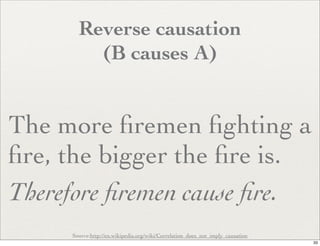
Reverse causation
         (B causes A)


The more firemen fighting a
fire, the bigger the fire is.
Therefore firemen cause fire.
     Source:http://en.wikipedia.org/wiki/Correlation_does_not_imply_causation
                                                                                33
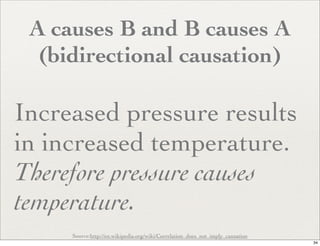
A causes B and B causes A
  (bidirectional causation)

Increased pressure results
in increased temperature.
Therefore pressure causes
temperature.
     Source:http://en.wikipedia.org/wiki/Correlation_does_not_imply_causation
                                                                                34
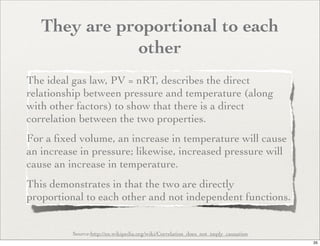
They are proportional to each
              other
The ideal gas law, PV = nRT, describes the direct
relationship between pressure and temperature (along
with other factors) to show that there is a direct
correlation between the two properties.
For a fixed volume, an increase in temperature will cause
an increase in pressure; likewise, increased pressure will
cause an increase in temperature.
This demonstrates in that the two are directly
proportional to each other and not independent functions.


          Source:http://en.wikipedia.org/wiki/Correlation_does_not_imply_causation
                                                                                     35
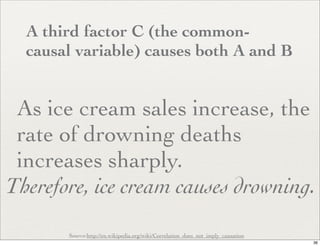
A third factor C (the common-
  causal variable) causes both A and B


 As ice cream sales increase, the
 rate of drowning deaths
 increases sharply.
Therefore, ice cream causes drowning.
       Source:http://en.wikipedia.org/wiki/Correlation_does_not_imply_causation
                                                                                  36
Determining causation
Intuitively,
causation seems to
require not just a
correlation, but a
counterfactual
dependence.
                         37
The lazy student

     Suppose that a student performed poorly on a test
     and guesses that the cause was his not studying.
     To prove this, one thinks of the counterfactual –
     the same student writing the same test under the
     same circumstances but having studied the night
     before


Source:http://en.wikipedia.org/wiki/Correlation_does_not_imply_causation

                                                                           38
Classic examples in Urbanism:
         Find the false correlations
✦   Xi’An is a large city in central China, only recently
    touched by the Chinese central government-
    sponsored developmental policy named ‘Go West’.
✦   Xi’An is now experiencing rapid economic growth.
    However, the city is not fulfilling its capacity to
    operate as a global city for China’s hinterland.
✦   The aim of this project is to build a business area in
    the model of La Defense in Paris, so that Xi’An can
    play its due role as a Chinese global city in the region.
                                                                39
Classic examples in Urbanism:
         Find the false correlations
✦   Delft is a Creative City because it is the home of the largest
    technical university of the Netherlands, as well as several
    applied sciences colleges and research institutes. Its
    “cappuccino coefficient” is very high (Florida, 2002).
    Therefore, its inhabitants enjoy an atmosphere of creativity and
    invention.
✦   The municipality wants to increase the city’s ‘creative’ profile
    by connecting the city centre to TU Delft in a more consistent
    way.
✦   By designing a new connection between the old city centre and
    the university, the municipality expects to improve the
    accessibility of inhabitants to knowledge and to give students
    more access to the ‘cappuccino’ factor.
                                                                       40
Classic examples in Urbanism:
         Find the false correlations
✦   The neighbourhood called Vrederust in the west of the Dutch
    city of The Hague is a typical example of post-war modernist
    development. It is a grey, repetitive, uninspired neighbourhood
    plagued by social problems. It is one of the so called
    ‘Vogelaarwijken’, the list of 50 ‘problem neighbourhoods’ in the
    Netherlands.
✦   The high concentration of non-Western migrants is the reason
    the place is so violent and unfriendly. The plans of the
    municipality include the demolition of 2/3 of the existing
    housing stock to be replaced with new up to date housing.
✦   By improving the living environments, the municipality expects
    to mitigate the problems in the area and attract new inhabitants.

                                                                        41
Predicting the future?

            But how do
           we investigate
           causality in a
          design project?


                            42
Investigation,
my dear Watson!


                  43
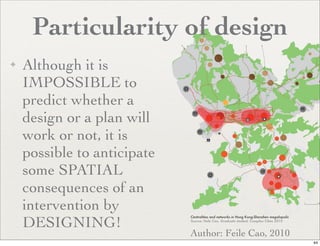
Particularity of design
✦   Although it is
    IMPOSSIBLE to
    predict whether a
    design or a plan will
    work or not, it is
    possible to anticipate
    some SPATIAL
    consequences of an
    intervention by                                                                             !


    DESIGNING!
                             !"#$%&'($(")*&#+*#"$,-%.)*(#*/-#0*1-#0234"#54"#*6"0&'-7-'()
                             3-8%9":*;"('"*!&-<*=%&+8&$"*)$8+"#$<*!-67'">*!($(")*?@A@


                             Author: Feile Cao, 2010
                                                                                           44
When explaining a design project


 You can start with an inspiring
 image of your VISION for the
  area and then explain why it is
         the best solution
                                    45
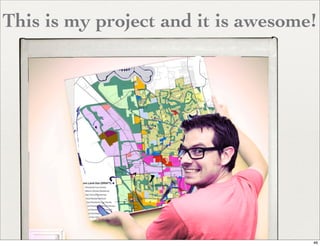
This is my project and it is awesome!


                                    46
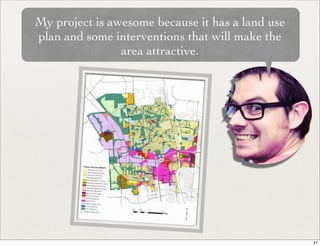
My project is awesome because it has a land use
plan and some interventions that will make the
                area attractive.


                                                  47
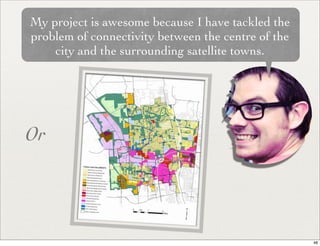
My project is awesome because I have tackled the
problem of connectivity between the centre of the
    city and the surrounding satellite towns.


Or


                                                    48
The first option
       is an example of
  circular argument. In the
  second option, I offered a
 tangible explanation why I
think my project is awesome
  by highlighting problems
  that were probably solved
           by specific
         interventions.


                               49
Thanks for listening!
Questions?
With special thanks to Matt Smith (ChernobylBob)
of Gloucester, UK, whose photos adorn these pages.
Matt’s photographs are available at:
www.flickr.com/photos/chernobylbob/

Prepared by Roberto Rocco, TU Delft
r.c.rocco@tudelft.nl

                                                     50
The
End
      51

Building Up a Solid Argument

  • 1.
    Building Up a SolidArgument Critical Thinking Skills for Urbanism Roberto Rocco Spatial Planning and Strategy TU Delft !"#$$%&'%()"%(*+)+,% 1
  • 2.
  • 3.
  • 4.
  • 5.
  • 6.
    How to buildan argument? ✦ In every aspect of life, we need to communicate our ideas and convince people of our views. ✦ In order to do that properly, we need to be able to explain WHY our arguments are valid. 6
  • 7.
    How to builda strong argument ✦ Approach all issues from the point of view of a sceptic reader/viewer ✦ Use formal logic and other rhetorical devices ✦ Order your arguments for maximum effect. 7
  • 8.
  • 9.
    When willing topersuade, whose point of view is most important? Not yours - you are already convinced that your points are true! Therefore, when writing to persuade, you should adopt a sceptic's point of view. When sceptics read arguments, they raise doubts and questions. The most persuasive arguments are the ones that anticipate these doubts and questions and respond to them in advance. Source: http://www.galeschools.com/research_tools/src/build_arguement.htm 9
  • 10.
    Use logic! In logic,arguments are propositions that fit together in a structure. The structure is composed of premises and the conclusions that follow. 10
  • 11.
    Example ✦ The Randstad is a huge and rich polycentric urban agglomeration located at the Delta of the river Rhine. ✦ River deltas are particularly affected by climate change, because they are characterised by heavy rainfalls, which are bound to become heavier as the climate warms up, and they need to deal with changing tidal regimes (sea levels might be rising). ✦ THEREFORE, the Randstad is particularly sensitive to climate change, and new and inventive solutions must be found to allow urbanisation to thrive. 11
  • 12.
    But beware! All the premisses MUST be true in order for your argument to be true as well. 12
  • 13.
    Are these premissestrue? ✦ The Randstad is a huge and rich polycentric urban agglomeration located at the Delta of the river Rhine. ✦ River deltas are particularly sensitive to climate change, because they are characterised by heavy rainfalls, which are bound to become heavier as the climate warms up, and they need to deal with changing tidal regimes (sea levels might be rising). ✦ THEREFORE, the Randstad is particularly sensitive to climate change, and new and inventive solutions must be found to allow urbanisation to thrive. 13
  • 14.
    You need tomake your arguments grounded by authority HOW? 14
  • 15.
  • 16.
    At your presentationor when writing a text... ✦ Make questions (e.g. the research questions are there to direct attention and focus) ✦ Tell a very abbreviated version of your story at the beginning of your presentation (in a text this is called an abstract!), so people know the story line and can follow it better ✦ Have a coherent and solid narrative (a story), without too many holes and where all pieces fit together (that’s the meaning of ‘coherent’) 16
  • 17.
    Show us theway! ✦ Make sure the audience knows the structure of your story FIRST! (have a slide with the structure or outline the structure in the report) ✦ Remind the audience of the last steps before proceeding ✦ Make sure one step leads to the next in a LOGICAL way 17
  • 18.
    Illustrate *and design! ✦ ILLUSTRATE (after al, you are a designer!)Use maps, photographs, sound, video: be creative! ✦ Situate yourself and the audience (geographically, but also theoretically!) 18
  • 19.
    Elements of anargument ✦ The Author’s position (YOUR position) ✦ An implicit or explicit world view (are you a poet, a medical doctor or an urbanist?) ✦ A line of reasoning to support a conclusion ✦ The intention to persuade 19
  • 20.
    But most important ✦ Introduce an ISSUE or a PROBLEM you want to discuss or develop. 20
  • 21.
    And make questions! Make questions. The audience will try to answer them WITH you. They will follow your arguments closely and will make preliminary conclusions in the RIGHT DIRECTION! 21
  • 22.
    Weakness of argumentation ✦Poor structure ✦ Logical inconsistency ✦ Hidden assumptions 22
  • 23.
    But most important ✦ If you do not introduce the issue, the problem or the contradiction you want to tackle, the audience will inevitably think at some point: 23
  • 24.
    Why am I listening to this? 24
  • 25.
    Other causes forweakness ✦ Confusing cause and effect ✦ Circular argumentation ✦ Attacking the character of a person rather than evaluating their reasoning ✦ Misrepresentation ✦ Emotive language 25
  • 26.
    Circular argument ✦ Circular reasoning is an attempt to support a statement by simply repeating the statement in different or stronger terms. ✦ In this fallacy, the reason given is nothing more than a restatement of the conclusion that poses as the reason for the conclusion. Source:http://logicandanalysiscourse.com/Definitions.html 26
  • 27.
    The circular argument I vow to bring change by making things different! 27
  • 28.
    Examples of CircularArgument in Urbanism ✦ Delft is a Knowledge City because there is a lot of knowledge being produced in the city. ✦ Chinese cities are growing fast because more and more people are migrating towards them from rural parts of China. ✦ ‘Problem neighbourhoods’ in the Netherlands are bad because they have several social and spatial problems. 28
  • 29.
    But let’s firstthink of CAUSES It is IMPERATIVE for us to concentrate on causality, because we want to solve the right problems with our designs and plans. To be able to explain WHY your design or plan will work, you need to understand: ✦ The problem you are tackling ✦ The CAUSES of that problem 29
  • 30.
    But there arethe false correlations ✦ The number of car crimes has increased. ✦ In the past, there used to be a limited number of car colours from which buyers could choose. Now there is much more variety. ✦ The wider the choice of car colours, the higher the rate of car crime. 30
  • 31.
    Correlation does not imply causation 31
  • 32.
    False correlation Aoccurs in correlation with B. Therefore, A causes B. 32
  • 33.
    Reverse causation (B causes A) The more firemen fighting a fire, the bigger the fire is. Therefore firemen cause fire. Source:http://en.wikipedia.org/wiki/Correlation_does_not_imply_causation 33
  • 34.
    A causes Band B causes A (bidirectional causation) Increased pressure results in increased temperature. Therefore pressure causes temperature. Source:http://en.wikipedia.org/wiki/Correlation_does_not_imply_causation 34
  • 35.
    They are proportionalto each other The ideal gas law, PV = nRT, describes the direct relationship between pressure and temperature (along with other factors) to show that there is a direct correlation between the two properties. For a fixed volume, an increase in temperature will cause an increase in pressure; likewise, increased pressure will cause an increase in temperature. This demonstrates in that the two are directly proportional to each other and not independent functions. Source:http://en.wikipedia.org/wiki/Correlation_does_not_imply_causation 35
  • 36.
    A third factorC (the common- causal variable) causes both A and B As ice cream sales increase, the rate of drowning deaths increases sharply. Therefore, ice cream causes drowning. Source:http://en.wikipedia.org/wiki/Correlation_does_not_imply_causation 36
  • 37.
    Determining causation Intuitively, causation seemsto require not just a correlation, but a counterfactual dependence. 37
  • 38.
    The lazy student Suppose that a student performed poorly on a test and guesses that the cause was his not studying. To prove this, one thinks of the counterfactual – the same student writing the same test under the same circumstances but having studied the night before Source:http://en.wikipedia.org/wiki/Correlation_does_not_imply_causation 38
  • 39.
    Classic examples inUrbanism: Find the false correlations ✦ Xi’An is a large city in central China, only recently touched by the Chinese central government- sponsored developmental policy named ‘Go West’. ✦ Xi’An is now experiencing rapid economic growth. However, the city is not fulfilling its capacity to operate as a global city for China’s hinterland. ✦ The aim of this project is to build a business area in the model of La Defense in Paris, so that Xi’An can play its due role as a Chinese global city in the region. 39
  • 40.
    Classic examples inUrbanism: Find the false correlations ✦ Delft is a Creative City because it is the home of the largest technical university of the Netherlands, as well as several applied sciences colleges and research institutes. Its “cappuccino coefficient” is very high (Florida, 2002). Therefore, its inhabitants enjoy an atmosphere of creativity and invention. ✦ The municipality wants to increase the city’s ‘creative’ profile by connecting the city centre to TU Delft in a more consistent way. ✦ By designing a new connection between the old city centre and the university, the municipality expects to improve the accessibility of inhabitants to knowledge and to give students more access to the ‘cappuccino’ factor. 40
  • 41.
    Classic examples inUrbanism: Find the false correlations ✦ The neighbourhood called Vrederust in the west of the Dutch city of The Hague is a typical example of post-war modernist development. It is a grey, repetitive, uninspired neighbourhood plagued by social problems. It is one of the so called ‘Vogelaarwijken’, the list of 50 ‘problem neighbourhoods’ in the Netherlands. ✦ The high concentration of non-Western migrants is the reason the place is so violent and unfriendly. The plans of the municipality include the demolition of 2/3 of the existing housing stock to be replaced with new up to date housing. ✦ By improving the living environments, the municipality expects to mitigate the problems in the area and attract new inhabitants. 41
  • 42.
    Predicting the future? But how do we investigate causality in a design project? 42
  • 43.
  • 44.
    Particularity of design ✦ Although it is IMPOSSIBLE to predict whether a design or a plan will work or not, it is possible to anticipate some SPATIAL consequences of an intervention by ! DESIGNING! !"#$%&'($(")*&#+*#"$,-%.)*(#*/-#0*1-#0234"#54"#*6"0&'-7-'() 3-8%9":*;"('"*!&-<*=%&+8&$"*)$8+"#$<*!-67'">*!($(")*?@A@ Author: Feile Cao, 2010 44
  • 45.
    When explaining adesign project You can start with an inspiring image of your VISION for the area and then explain why it is the best solution 45
  • 46.
    This is myproject and it is awesome! 46
  • 47.
    My project isawesome because it has a land use plan and some interventions that will make the area attractive. 47
  • 48.
    My project isawesome because I have tackled the problem of connectivity between the centre of the city and the surrounding satellite towns. Or 48
  • 49.
    The first option is an example of circular argument. In the second option, I offered a tangible explanation why I think my project is awesome by highlighting problems that were probably solved by specific interventions. 49
  • 50.
    Thanks for listening! Questions? Withspecial thanks to Matt Smith (ChernobylBob) of Gloucester, UK, whose photos adorn these pages. Matt’s photographs are available at: www.flickr.com/photos/chernobylbob/ Prepared by Roberto Rocco, TU Delft r.c.rocco@tudelft.nl 50
  • 51.