Greg Flay
Building a Goal-Aligned Enterprise
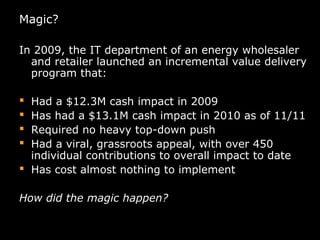
Magic?
In 2009, the IT department of an energy wholesaler
and retailer launched an incremental value delivery
program that:
 Had a $12.3M cash impact in 2009
 Has had a $13.1M cash impact in 2010 as of 11/11
 Required no heavy top-down push
 Had a viral, grassroots appeal, with over 450
individual contributions to overall impact to date
 Has cost almost nothing to implement
How did the magic happen?
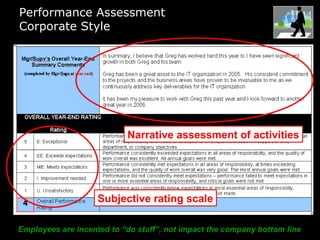
Performance Assessment
Corporate Style
Narrative assessment of activities
Subjective rating scale
Employees are incented to “do stuff”, not impact the company bottom line
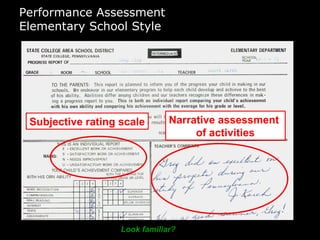
Performance Assessment
Elementary School Style
Narrative assessment
of activities
Subjective rating scale
Look familiar?
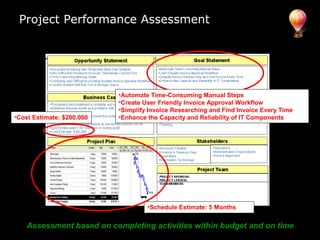
Project Performance Assessment
•Automate Time-Consuming Manual Steps
•Create User Friendly Invoice Approval Workflow
•Simplify Invoice Researching and Find Invoice Every Time
•Enhance the Capacity and Reliability of IT Components
Assessment based on completing activities within budget and on time
•Cost Estimate: $200,000
•Schedule Estimate: 5 Months
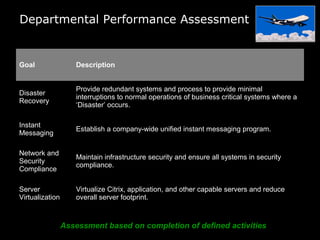
Departmental Performance Assessment
Goal Description
Disaster
Recovery
Provide redundant systems and process to provide minimal
interruptions to normal operations of business critical systems where a
‘Disaster’ occurs.
Instant
Messaging
Establish a company-wide unified instant messaging program.
Network and
Security
Compliance
Maintain infrastructure security and ensure all systems in security
compliance.
Server
Virtualization
Virtualize Citrix, application, and other capable servers and reduce
overall server footprint.
Assessment based on completion of defined activities
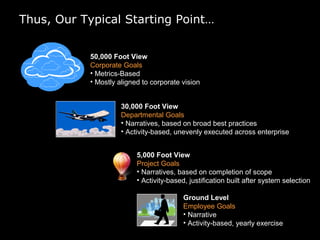
Thus, Our Typical Starting Point…
50,000 Foot View
Corporate Goals
• Metrics-Based
• Mostly aligned to corporate vision
30,000 Foot View
Departmental Goals
• Narratives, based on broad best practices
• Activity-based, unevenly executed across enterprise
5,000 Foot View
Project Goals
• Narratives, based on completion of scope
• Activity-based, justification built after system selection
Ground Level
Employee Goals
• Narrative
• Activity-based, yearly exercise
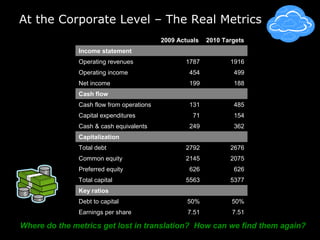
At the Corporate Level – The Real Metrics
2009 Actuals 2010 Targets
Income statement
Operating revenues 1787 1916
Operating income 454 499
Net income 199 188
Cash flow
Cash flow from operations 131 485
Capital expenditures 71 154
Cash & cash equivalents 249 362
Capitalization
Total debt 2792 2676
Common equity 2145 2075
Preferred equity 626 626
Total capital 5563 5377
Key ratios
Debt to capital 50% 50%
Earnings per share 7.51 7.51
Where do the metrics get lost in translation? How can we find them again?
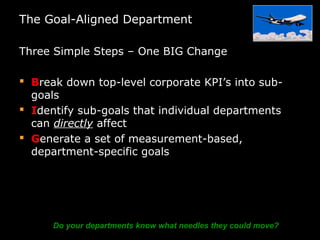
The Goal-Aligned Department
Three Simple Steps – One BIG Change
 Break down top-level corporate KPI’s into sub-
goals
 Identify sub-goals that individual departments
can directly affect
 Generate a set of measurement-based,
department-specific goals
Do your departments know what needles they could move?
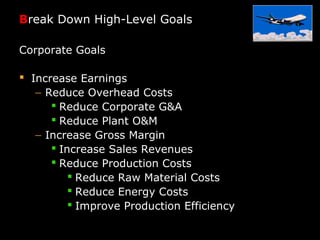
Break Down High-Level Goals
Corporate Goals
 Increase Earnings
− Reduce Overhead Costs
 Reduce Corporate G&A
 Reduce Plant O&M
− Increase Gross Margin
 Increase Sales Revenues
 Reduce Production Costs
 Reduce Raw Material Costs
 Reduce Energy Costs
 Improve Production Efficiency
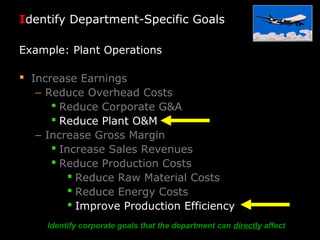
Identify Department-Specific Goals
Example: Plant Operations
 Increase Earnings
− Reduce Overhead Costs
 Reduce Corporate G&A
 Reduce Plant O&M
− Increase Gross Margin
 Increase Sales Revenues
 Reduce Production Costs
 Reduce Raw Material Costs
 Reduce Energy Costs
 Improve Production Efficiency
Identify corporate goals that the department can directly affect
Generate Department-Specific Goals
 Reduce Plant O&M spend from $15.5M in 2009 to
$14.5M in 2010
 Increase production efficiency from 32.7 widgets
per ton of steel to 33.2 widgets per ton
Less is more – don’t create confusion through too many goals
The Goal-Aligned Project
 No further work needed to define goals – don’t
create “new goals” to justify projects
 Reuse the set of departmental goals already
generated
 Fabrication Process Improvement Project
− Increase production efficiency from 32.7
widgets per ton of steel to 33.2 widgets per
ton by decreasing the amount of scrap
produced during fabrication
Do your project teams know what needles they are trying to move?
The Goal-Aligned Employee
 Another BIG Change
 Break down departmental goals into sub-goals
 Identify sub-goals that individual employees can
directly affect
 Generate a set of measurement-based,
employee-specific goals
 Thoroughly explain the rule set to staff
 Turn employees loose – they will amaze you!
Do your employees know which needles they can personally move?
Break Down Departmental Goals
Plant Operations Goals
 Reduce Plant O&M
− Reduce unit cost of spares
− Reduce likelihood of equipment failure
− Reduce duration of scheduled maintenance
− Reduce utility costs
− Reduce repeated production line breakdowns
− Reduce unscheduled down time
 Improve Production Efficiency
− Reduce time required for equipment changeovers
− Reduce production line startup costs
− Increase production line output per $ of inputs
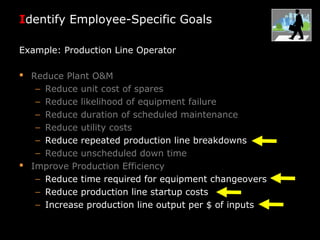
Identify Employee-Specific Goals
Example: Production Line Operator
 Reduce Plant O&M
− Reduce unit cost of spares
− Reduce likelihood of equipment failure
− Reduce duration of scheduled maintenance
− Reduce utility costs
− Reduce repeated production line breakdowns
− Reduce unscheduled down time
 Improve Production Efficiency
− Reduce time required for equipment changeovers
− Reduce production line startup costs
− Increase production line output per $ of inputs
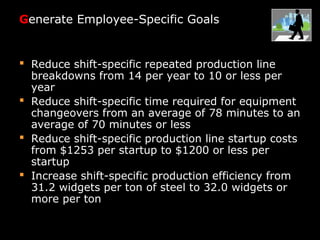
Generate Employee-Specific Goals
 Reduce shift-specific repeated production line
breakdowns from 14 per year to 10 or less per
year
 Reduce shift-specific time required for equipment
changeovers from an average of 78 minutes to an
average of 70 minutes or less
 Reduce shift-specific production line startup costs
from $1253 per startup to $1200 or less per
startup
 Increase shift-specific production efficiency from
31.2 widgets per ton of steel to 32.0 widgets or
more per ton
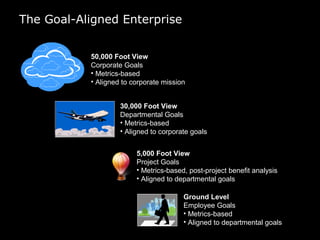
The Goal-Aligned Enterprise
50,000 Foot View
Corporate Goals
• Metrics-based
• Aligned to corporate mission
30,000 Foot View
Departmental Goals
• Metrics-based
• Aligned to corporate goals
5,000 Foot View
Project Goals
• Metrics-based, post-project benefit analysis
• Aligned to departmental goals
Ground Level
Employee Goals
• Metrics-based
• Aligned to departmental goals
Making the “Magic” Happen
 Determine the financial impact of work in each
department, of each project, of each staff
position
 Communicate the “rule set” for what counts, and
set financially-oriented goals
 Unleash employee creativity
 Track financial impact transparently
 Reward financial impact at performance review
time
Thank you.
greg.flay@verizon.net

Building A Goal Aligned Enterprise Public

  • 1.
    Greg Flay Building aGoal-Aligned Enterprise
  • 2.
    Magic? In 2009, theIT department of an energy wholesaler and retailer launched an incremental value delivery program that:  Had a $12.3M cash impact in 2009  Has had a $13.1M cash impact in 2010 as of 11/11  Required no heavy top-down push  Had a viral, grassroots appeal, with over 450 individual contributions to overall impact to date  Has cost almost nothing to implement How did the magic happen?
  • 3.
    Performance Assessment Corporate Style Narrativeassessment of activities Subjective rating scale Employees are incented to “do stuff”, not impact the company bottom line
  • 4.
    Performance Assessment Elementary SchoolStyle Narrative assessment of activities Subjective rating scale Look familiar?
  • 5.
    Project Performance Assessment •AutomateTime-Consuming Manual Steps •Create User Friendly Invoice Approval Workflow •Simplify Invoice Researching and Find Invoice Every Time •Enhance the Capacity and Reliability of IT Components Assessment based on completing activities within budget and on time •Cost Estimate: $200,000 •Schedule Estimate: 5 Months
  • 6.
    Departmental Performance Assessment GoalDescription Disaster Recovery Provide redundant systems and process to provide minimal interruptions to normal operations of business critical systems where a ‘Disaster’ occurs. Instant Messaging Establish a company-wide unified instant messaging program. Network and Security Compliance Maintain infrastructure security and ensure all systems in security compliance. Server Virtualization Virtualize Citrix, application, and other capable servers and reduce overall server footprint. Assessment based on completion of defined activities
  • 7.
    Thus, Our TypicalStarting Point… 50,000 Foot View Corporate Goals • Metrics-Based • Mostly aligned to corporate vision 30,000 Foot View Departmental Goals • Narratives, based on broad best practices • Activity-based, unevenly executed across enterprise 5,000 Foot View Project Goals • Narratives, based on completion of scope • Activity-based, justification built after system selection Ground Level Employee Goals • Narrative • Activity-based, yearly exercise
  • 8.
    At the CorporateLevel – The Real Metrics 2009 Actuals 2010 Targets Income statement Operating revenues 1787 1916 Operating income 454 499 Net income 199 188 Cash flow Cash flow from operations 131 485 Capital expenditures 71 154 Cash & cash equivalents 249 362 Capitalization Total debt 2792 2676 Common equity 2145 2075 Preferred equity 626 626 Total capital 5563 5377 Key ratios Debt to capital 50% 50% Earnings per share 7.51 7.51 Where do the metrics get lost in translation? How can we find them again?
  • 9.
    The Goal-Aligned Department ThreeSimple Steps – One BIG Change  Break down top-level corporate KPI’s into sub- goals  Identify sub-goals that individual departments can directly affect  Generate a set of measurement-based, department-specific goals Do your departments know what needles they could move?
  • 10.
    Break Down High-LevelGoals Corporate Goals  Increase Earnings − Reduce Overhead Costs  Reduce Corporate G&A  Reduce Plant O&M − Increase Gross Margin  Increase Sales Revenues  Reduce Production Costs  Reduce Raw Material Costs  Reduce Energy Costs  Improve Production Efficiency
  • 11.
    Identify Department-Specific Goals Example:Plant Operations  Increase Earnings − Reduce Overhead Costs  Reduce Corporate G&A  Reduce Plant O&M − Increase Gross Margin  Increase Sales Revenues  Reduce Production Costs  Reduce Raw Material Costs  Reduce Energy Costs  Improve Production Efficiency Identify corporate goals that the department can directly affect
  • 12.
    Generate Department-Specific Goals Reduce Plant O&M spend from $15.5M in 2009 to $14.5M in 2010  Increase production efficiency from 32.7 widgets per ton of steel to 33.2 widgets per ton Less is more – don’t create confusion through too many goals
  • 13.
    The Goal-Aligned Project No further work needed to define goals – don’t create “new goals” to justify projects  Reuse the set of departmental goals already generated  Fabrication Process Improvement Project − Increase production efficiency from 32.7 widgets per ton of steel to 33.2 widgets per ton by decreasing the amount of scrap produced during fabrication Do your project teams know what needles they are trying to move?
  • 14.
    The Goal-Aligned Employee Another BIG Change  Break down departmental goals into sub-goals  Identify sub-goals that individual employees can directly affect  Generate a set of measurement-based, employee-specific goals  Thoroughly explain the rule set to staff  Turn employees loose – they will amaze you! Do your employees know which needles they can personally move?
  • 15.
    Break Down DepartmentalGoals Plant Operations Goals  Reduce Plant O&M − Reduce unit cost of spares − Reduce likelihood of equipment failure − Reduce duration of scheduled maintenance − Reduce utility costs − Reduce repeated production line breakdowns − Reduce unscheduled down time  Improve Production Efficiency − Reduce time required for equipment changeovers − Reduce production line startup costs − Increase production line output per $ of inputs
  • 16.
    Identify Employee-Specific Goals Example:Production Line Operator  Reduce Plant O&M − Reduce unit cost of spares − Reduce likelihood of equipment failure − Reduce duration of scheduled maintenance − Reduce utility costs − Reduce repeated production line breakdowns − Reduce unscheduled down time  Improve Production Efficiency − Reduce time required for equipment changeovers − Reduce production line startup costs − Increase production line output per $ of inputs
  • 17.
    Generate Employee-Specific Goals Reduce shift-specific repeated production line breakdowns from 14 per year to 10 or less per year  Reduce shift-specific time required for equipment changeovers from an average of 78 minutes to an average of 70 minutes or less  Reduce shift-specific production line startup costs from $1253 per startup to $1200 or less per startup  Increase shift-specific production efficiency from 31.2 widgets per ton of steel to 32.0 widgets or more per ton
  • 18.
    The Goal-Aligned Enterprise 50,000Foot View Corporate Goals • Metrics-based • Aligned to corporate mission 30,000 Foot View Departmental Goals • Metrics-based • Aligned to corporate goals 5,000 Foot View Project Goals • Metrics-based, post-project benefit analysis • Aligned to departmental goals Ground Level Employee Goals • Metrics-based • Aligned to departmental goals
  • 19.
    Making the “Magic”Happen  Determine the financial impact of work in each department, of each project, of each staff position  Communicate the “rule set” for what counts, and set financially-oriented goals  Unleash employee creativity  Track financial impact transparently  Reward financial impact at performance review time
  • 20.