Place YOUR LOGO here
NAME: Michael King
TITLE: Chief Technology Officer
ORGANIZATION: Halfaker and Associates
SERVING FEDERAL
CUSTOMERS WITH
SAFE CONCEPTS
Place YOUR LOGO here
• Company founded in 2006 with the vision
of Continuing to Serve…
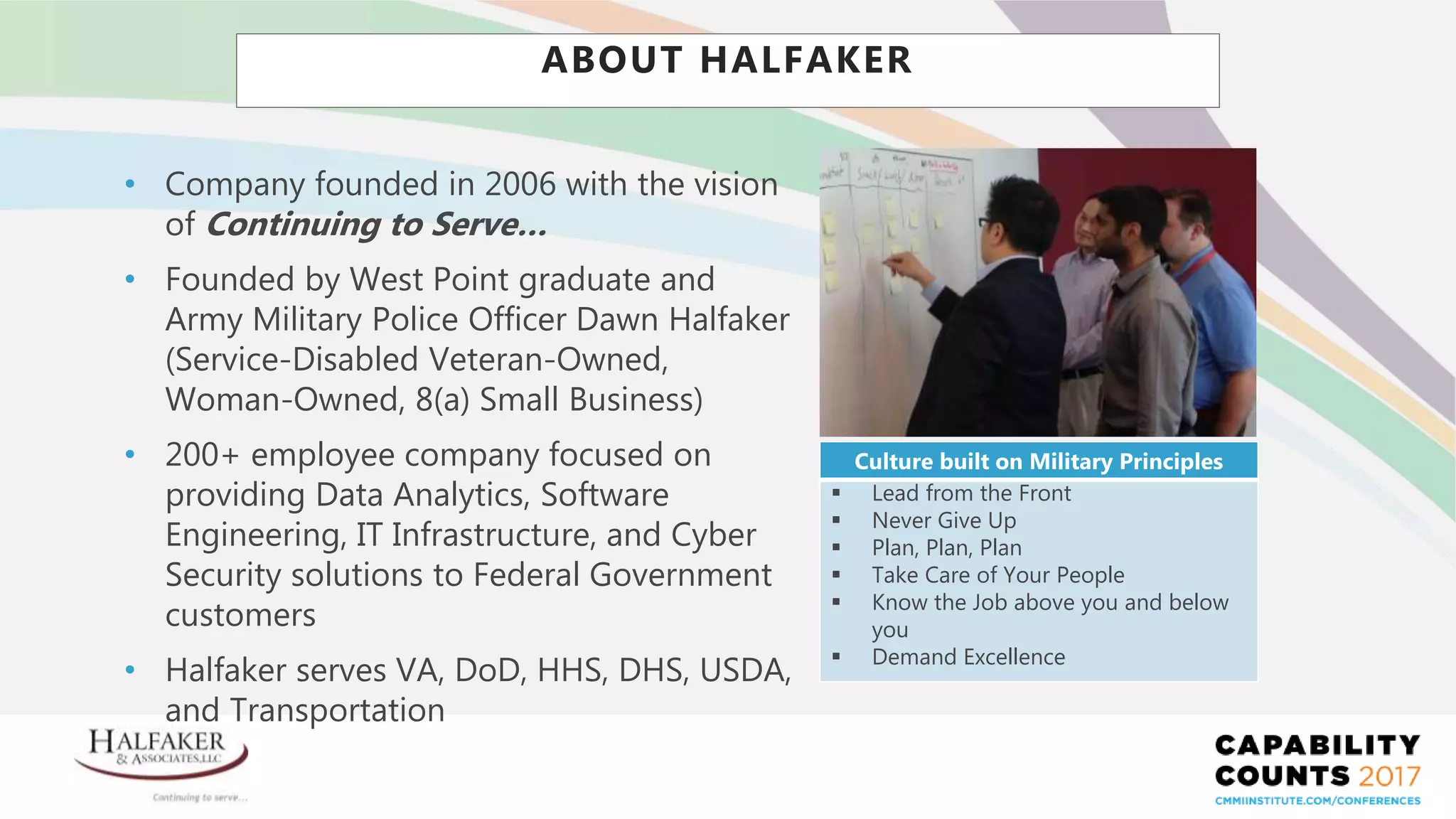
• Founded by West Point graduate and
Army Military Police Officer Dawn Halfaker
(Service-Disabled Veteran-Owned,
Woman-Owned, 8(a) Small Business)
• 200+ employee company focused on
providing Data Analytics, Software
Engineering, IT Infrastructure, and Cyber
Security solutions to Federal Government
customers
• Halfaker serves VA, DoD, HHS, DHS, USDA,
and Transportation
ABOUT HALFAKER
Culture built on Military Principles
 Lead from the Front
 Never Give Up
 Plan, Plan, Plan
 Take Care of Your People
 Know the Job above you and below
you
 Demand Excellence
Place YOUR LOGO here
AGENDA
• About Halfaker
• Business Challenge
• Approach: Build Scaled Agile System
• Many Different Scaled Frameworks
• Introduction to SAFe
• Scaled Agile Framework (SAFe)
• Portfolio (Enterprise) Level
• Effective Strategy
• Strategy Decomposition
• Consistent Enterprise Architecture
• Synchronized Value Streams
• Program Level
• Vision-based Enterprise Metrics
• Invest in Program Leaders
• Define Program Rhythm
• Invest Time in Planning
• Build Sufficient Runway
• Team Level
• Define Team Lifecycles
• Align Responsibilities with Lifecycle
• Build Quality in from the Beginning
• Questions?
Place YOUR LOGO here
• Halfaker began to accelerate in growth in 2013,
approaching 100 employees spread across 20
projects
• As the Company grew, we struggled to maintain
consistency, ensure quality, and manage risk
across increasing number of projects spread
across the country
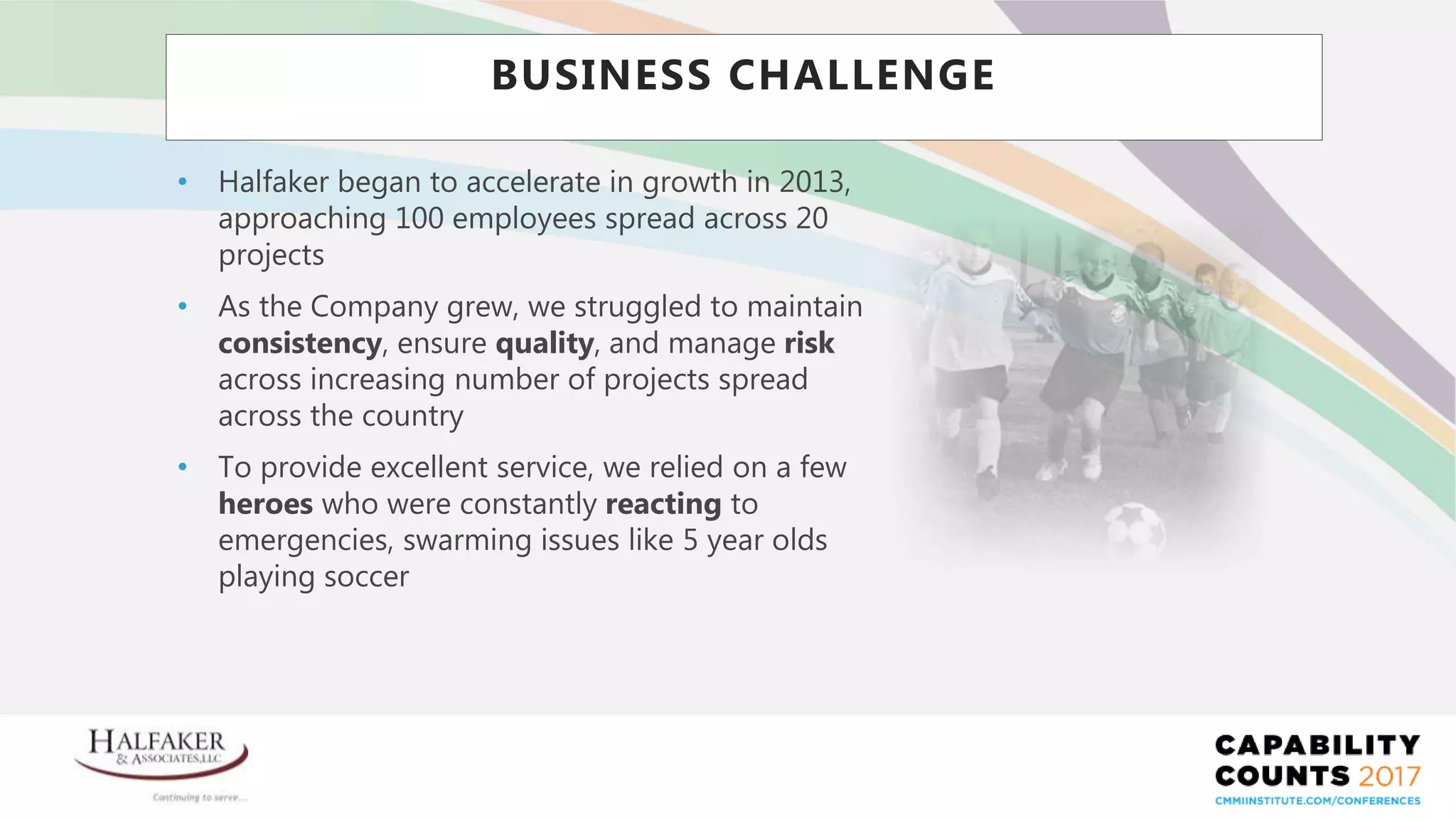
• To provide excellent service, we relied on a few
heroes who were constantly reacting to
emergencies, swarming issues like 5 year olds
playing soccer
BUSINESS CHALLENGE
Place YOUR LOGO here
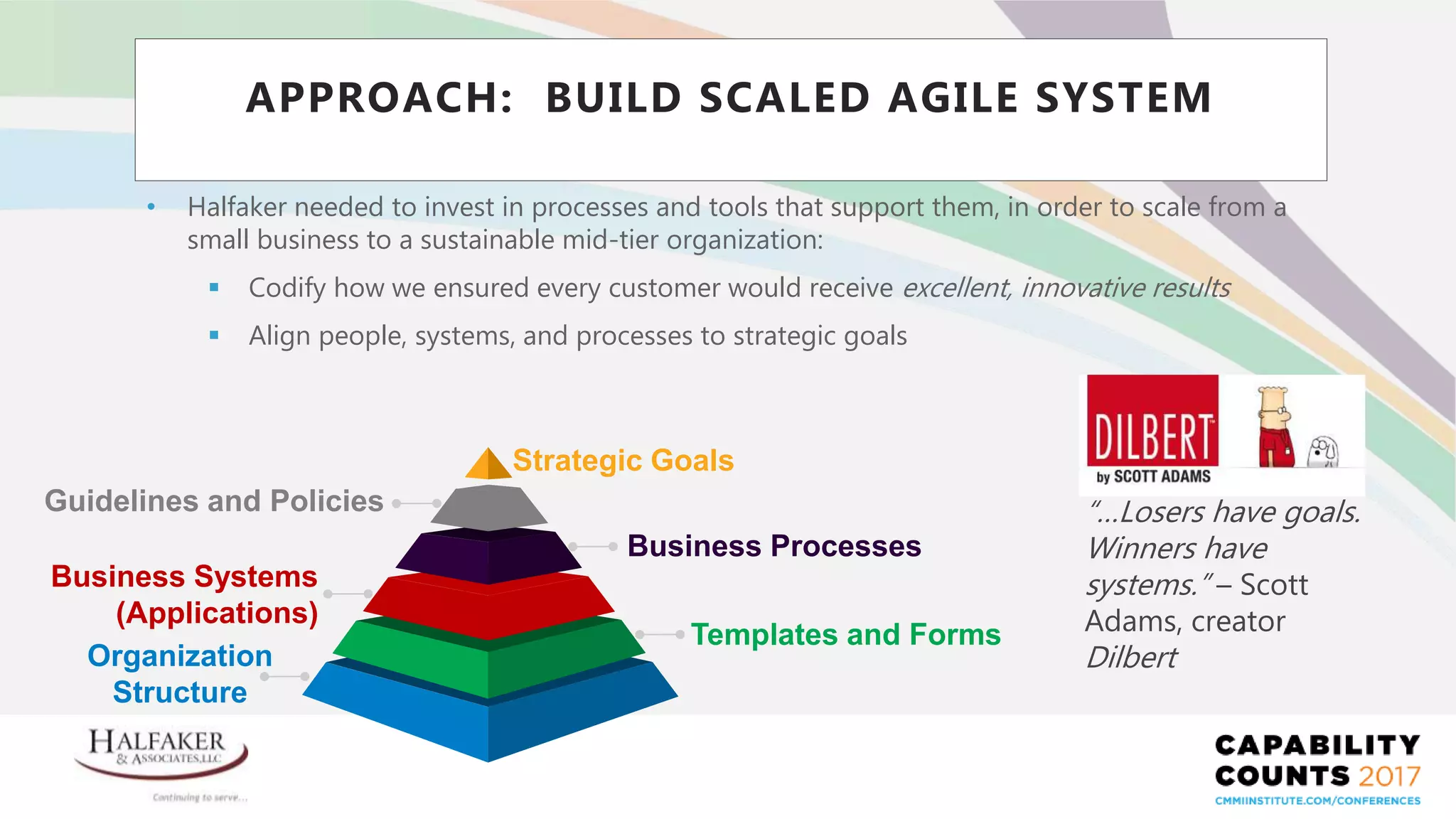
• Halfaker needed to invest in processes and tools that support them, in order to scale from a
small business to a sustainable mid-tier organization:
 Codify how we ensured every customer would receive excellent, innovative results
 Align people, systems, and processes to strategic goals
APPROACH: BUILD SCALED AGILE SYSTEM
Strategic Goals
Business Processes
Templates and Forms
Business Systems
(Applications)
Guidelines and Policies
Organization
Structure
“…Losers have goals.
Winners have
systems.” – Scott
Adams, creator
Dilbert
Place YOUR LOGO here
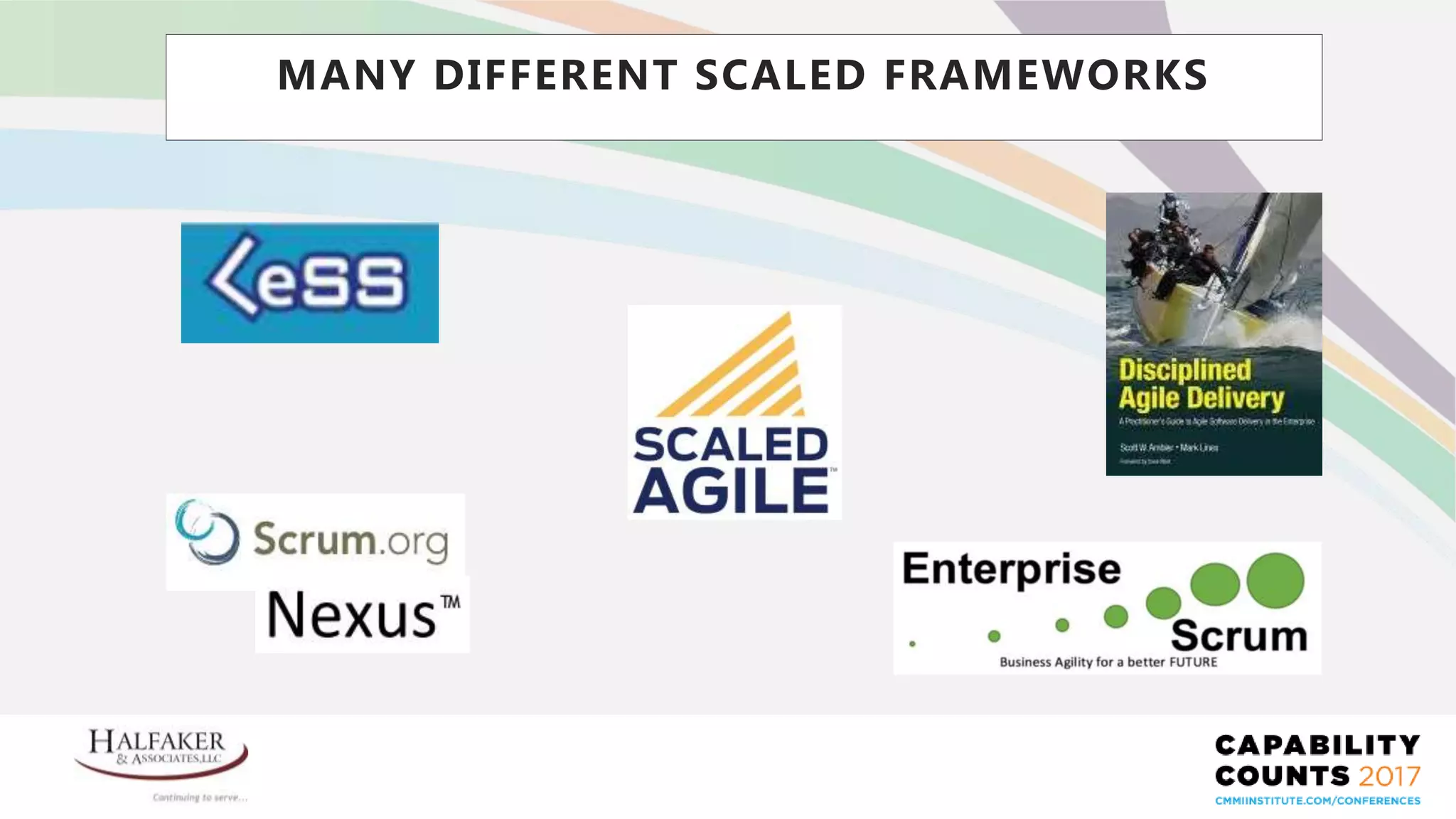
MANY DIFFERENT SCALED FRAMEWORKS
Place YOUR LOGO here
INTRODUCTION TO SAFE
• Scaled Agile Framework (SAFe)® defines itself as:
The Scaled Agile Framework® (SAFe®) is a freely revealed knowledge base of proven,
integrated patterns for enterprise-scale Lean-Agile development. It is scalable and
modular, allowing each organization to apply it in a way that provides better business
outcomes and happier, more engaged employees.
SAFe synchronizes alignment, collaboration, and delivery for large numbers of Agile
teams. It supports both software and systems development, from the modest scale of
well under 100 practitioners to the largest software solutions and complex cyber-physical
systems, systems that require thousands of people to create and maintain. SAFe was
developed in the field, based on helping customers solve their most challenging scaling
problems. It leverages three primary bodies of knowledge: Agile development, Lean
product development, and systems thinking.
• Halfaker uses SAFe as a library of best practices across the enterprise, not a one-size-fits-all
solution – we use some SAFe concepts, but not others
Place YOUR LOGO here
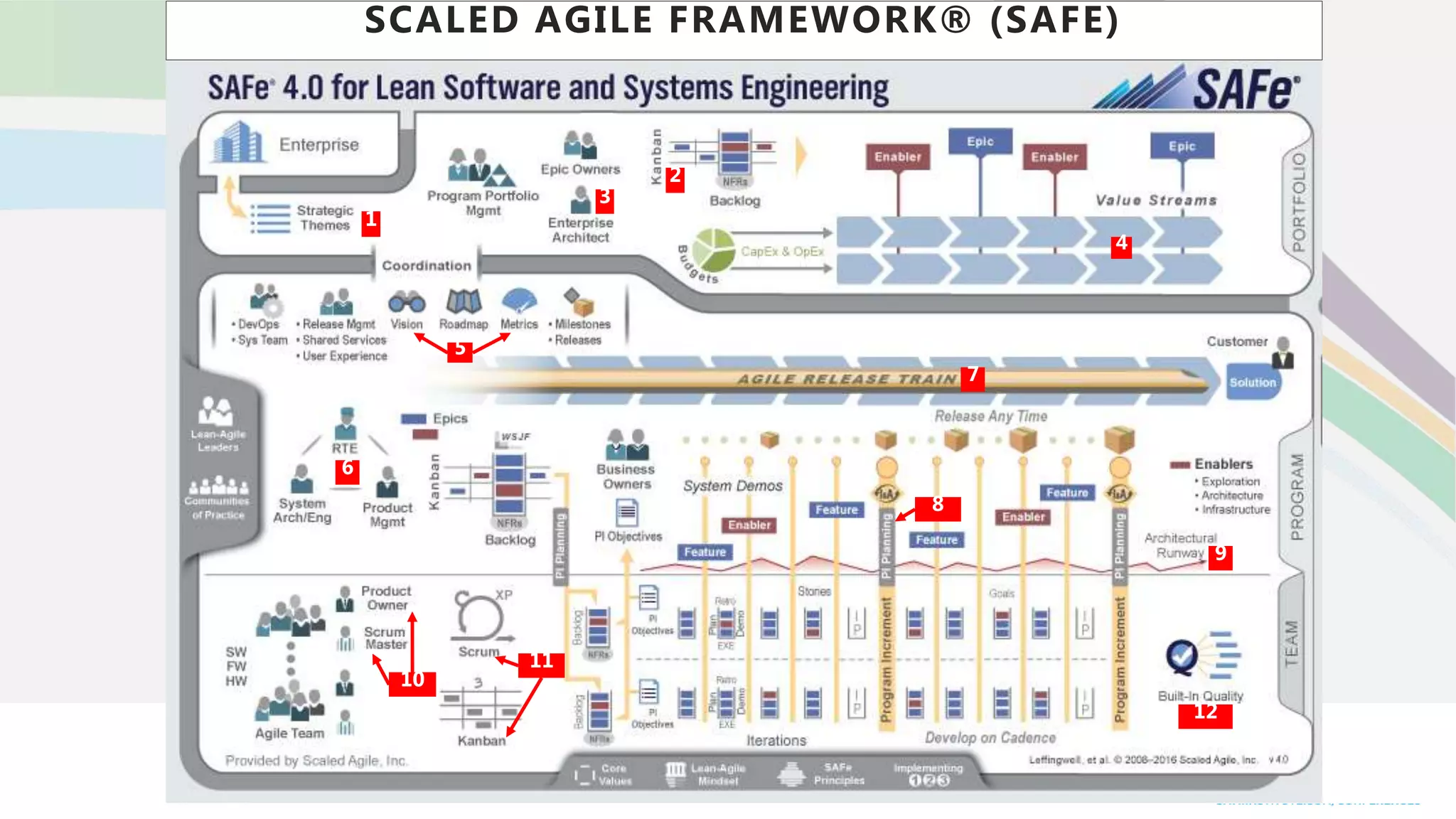
SCALED AGILE FRAMEWORK® (SAFE)
3
2
1
4
5
12
11
10
9
6
7
8
Place YOUR LOGO here
Portfolio (Enterprise) Level
Place YOUR LOGO here
EFFECTIVE STRATEGY
 Create traceable goals and associated
sub-goals, which are flowed down to a
clear primary owner within the
organization
 Meet quarterly to review progress and
priorities related to these goals
 Publish an annual strategy plan one-
pager so people can see the ‘big
picture’
 Manage a online Kanban board
showing the high-level epics so people
can visualize who owns which goals,
which upcoming quarter they’re due,
and their status
Lessons Learned / Examples
 Create Strategic Goals that can be
clearly flowed down to relevant
departments/teams
 Monitor the progress against
strategic goals, meeting periodically
(e.g. quarterly) to review progress
and priorities
 Provide a visual way to show
strategic goals and their progress
(e.g. dashboard or epic board)
Key Concepts
Place YOUR LOGO here
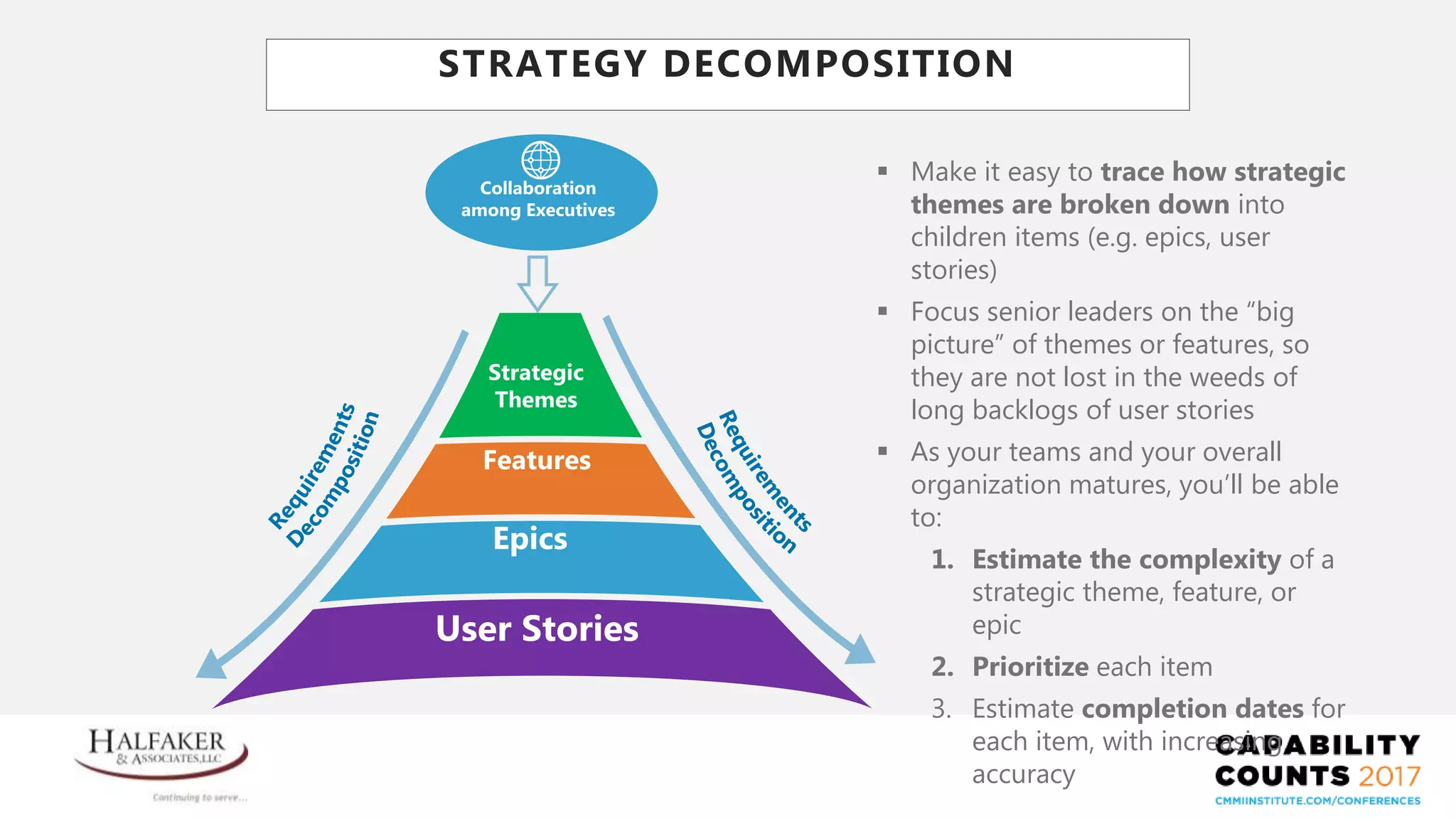
User Stories
Epics
Features
Strategic
Themes
Collaboration
among Executives
STRATEGY DECOMPOSITION
 Make it easy to trace how strategic
themes are broken down into
children items (e.g. epics, user
stories)
 Focus senior leaders on the “big
picture” of themes or features, so
they are not lost in the weeds of
long backlogs of user stories
 As your teams and your overall
organization matures, you’ll be able
to:
1. Estimate the complexity of a
strategic theme, feature, or
epic
2. Prioritize each item
3. Estimate completion dates for
each item, with increasing
accuracy
Place YOUR LOGO here
CONSISTENT ENTERPRISE ARCHITECTURE
 Provide great tools for planning (e.g.
JIRA, Microsoft Project), collaboration
(e.g. Confluence), and communication
(e.g. Skype for Business, HipChat)
 Allow teams to tailor tools or use
other tools, when appropriate (but
encourage/enforce consistency)
Lessons Learned / Examples
 Identify someone or a team to
define overall technology
architecture/tools for the
organization
 Invest in great tools for your team,
so they don’t need to resort to
Shadow IT to get their jobs done
 Invest in associated processes to
your organization does things
efficiently and consistently, when
possible
Key Concepts
Place YOUR LOGO here
SYNCHRONIZED VALUE STREAMS
 Use a battle rhythm to plan and
monitor strategic progress through
company-wide weekly, monthly, and
quarterly activities
 Publish the company battle rhythm to
all company leaders, so they can
clearly see the rhythm they are
operating within
 Organize Operations Department
(service delivery) around capabilities
instead of customers or geography, so
project teams can collaborate and
support each other with shared talent
Lessons Learned / Examples
 Organize your company around
value streams to keep value as a
clear central concept – keep the
“why” (purpose) of your
organization the clear center of
these value streams
 Synchronize the rhythm of your
organization, both within each value
stream and across them; so the
organization can prioritize and
adapt in a single ‘battle rhythm’
Key Concepts
Place YOUR LOGO here
Program Level
Place YOUR LOGO here
VISION-BASED ENTERPRISE METRICS
 We identified critical numbers related
to Customer Satisfaction (e.g.
Surveys, CPARS scores), Process
Efficiency, Growth (Pipeline and
Bookings) Development (Training
Plan Completion), and Financial
(Revenue and Profit)
 We review metrics in weekly, monthly,
and quarterly meetings that focus on
various aspects of Company
management to identify what to
prioritize
Lessons Learned / Examples
 Identify a short list of clearly
defined metrics to align with your
organization’s vision and strategic
goals
 Avoid ‘Vanity Metrics’ that don’t
actually drive improvement (e.g.
web traffic, number of subscribers)
 Use ‘Balanced Scorecard’
approach to avoid focusing on a
single type of metrics (e.g. Financial)
 Monitor performance of key goals in
frequent meetings – “What gets
measured gets done”
Key Concepts
Place YOUR LOGO here
INVEST IN DIVISION/PROGRAM LEADERS
 Allocate budget for sufficient leaders
on large programs and teams
 Invest time in identifying high-
potential leaders and helping them
advance (e.g. Leadership
Development Program where junior
leaders are given increasing
responsibilities related to task,
personnel, and financial management)
 Invest in training leaders to use
hierarchy (traceability) to keep the big
picture visible – use epics and don’t
get lost in long lists of user stories
Lessons Learned / Examples
 Invest in Leaders for Divisions and
Programs to provide sufficient
capacity in execution, coordination,
personnel development, and technical
architecture
 Release Train Engineer is a Scrum
Master across a Program (multiple
Teams)
 System Architect provides cohesive
technical leadership across a Program
 Product Manager is Product Owner
across a Program
Key Concepts
Place YOUR LOGO here
DEFINE PROGRAM RHYTHM
 Quarterly Strategy Review meeting with
company senior leaders presenting progress
across each department (release train)
and discussing priorities
 IT Department (composed of Customer
Solutions, Architecture, Internal Technology,
and Quality teams) meets quarterly to
review progress and plan upcoming
priorities (see next slide) – each team
presents approaches to the other teams for
feedback and coordination
Lessons Learned / Examples
 Synchronize teams across a Program (or
Department) to a consistent rhythm
 SAFe defines enterprise rhythm:
 Continual Portfolio-level prioritization
 3 month Program Increments (Program
level), using groups of 5-12 Scrum Teams
called Agile Release Trains (ARTs)
 2 week Iterations (Sprints) at Team level
 Insist on keeping a consistent rhythm – don’t
delay/extend sprints or releases, instead tell
people they can catch the next train
Key Concepts
Place YOUR LOGO here
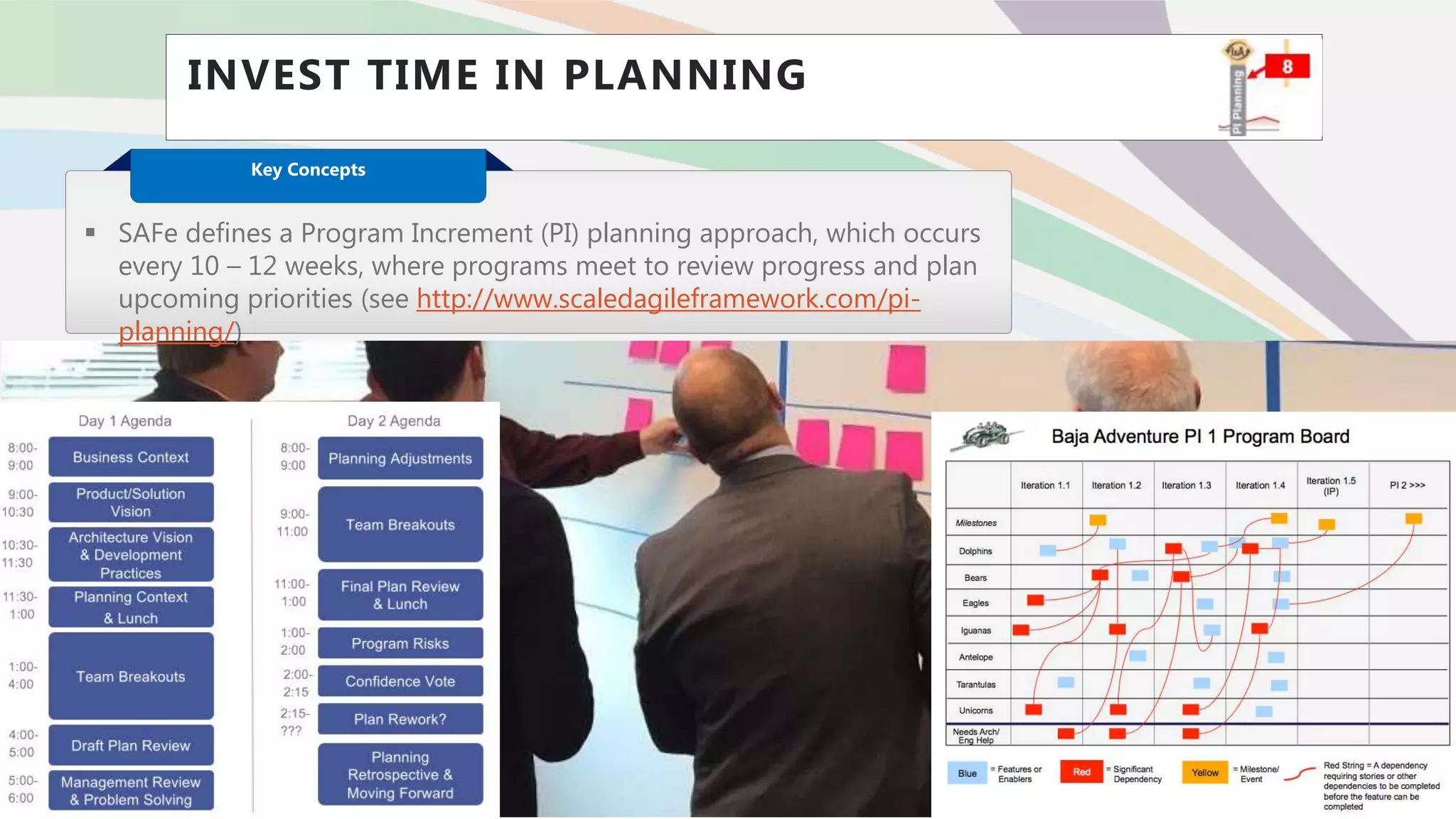
INVEST TIME IN PLANNING
 SAFe defines a Program Increment (PI) planning approach, which occurs
every 10 – 12 weeks, where programs meet to review progress and plan
upcoming priorities (see http://www.scaledagileframework.com/pi-
planning/)
Key Concepts
Place YOUR LOGO here
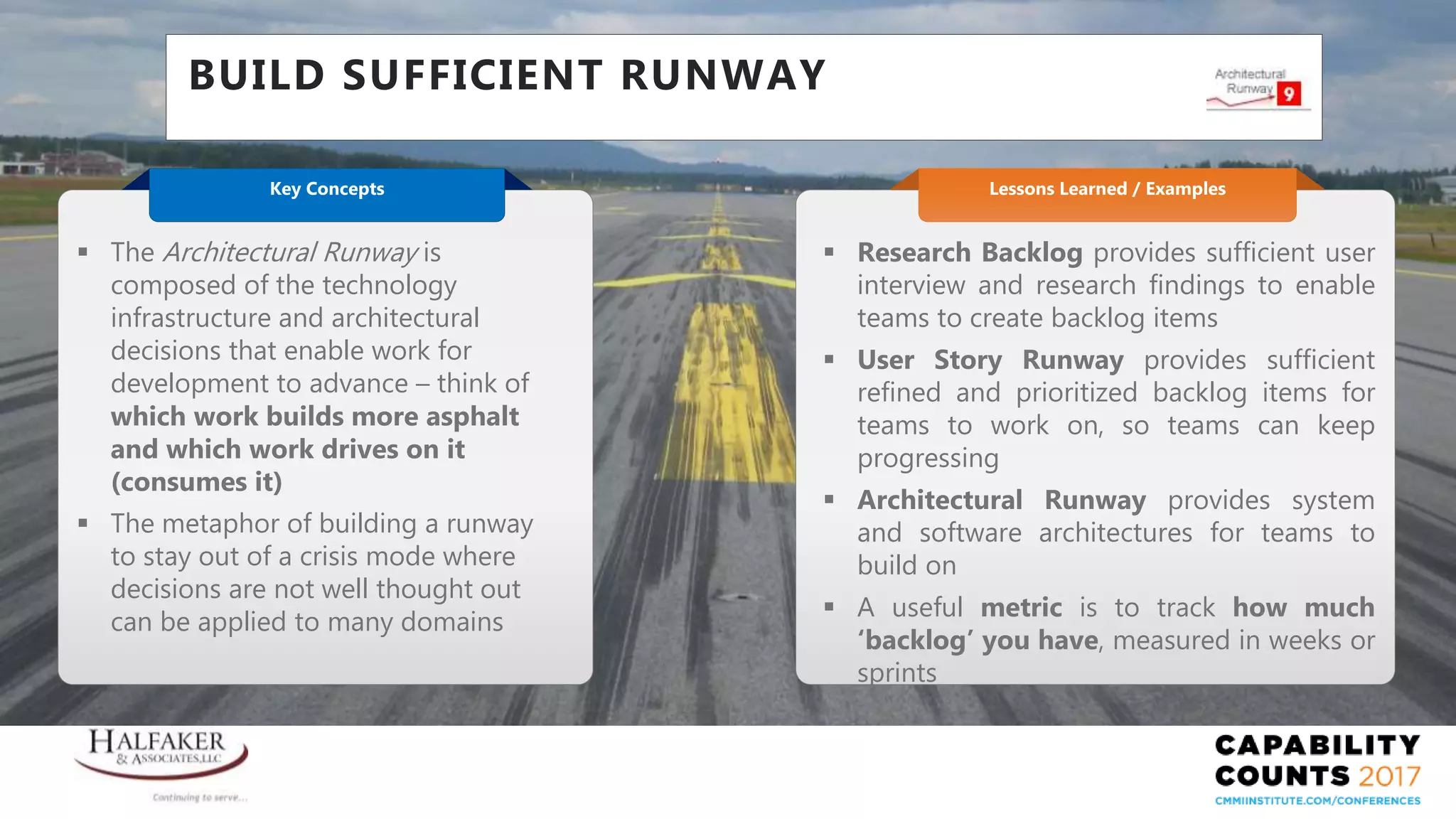
BUILD SUFFICIENT RUNWAY
 Research Backlog provides sufficient user
interview and research findings to enable
teams to create backlog items
 User Story Runway provides sufficient
refined and prioritized backlog items for
teams to work on, so teams can keep
progressing
 Architectural Runway provides system
and software architectures for teams to
build on
 A useful metric is to track how much
‘backlog’ you have, measured in weeks or
sprints
Lessons Learned / Examples
 The Architectural Runway is
composed of the technology
infrastructure and architectural
decisions that enable work for
development to advance – think of
which work builds more asphalt
and which work drives on it
(consumes it)
 The metaphor of building a runway
to stay out of a crisis mode where
decisions are not well thought out
can be applied to many domains
Key Concepts
Place YOUR LOGO here
Team Level
Place YOUR LOGO here
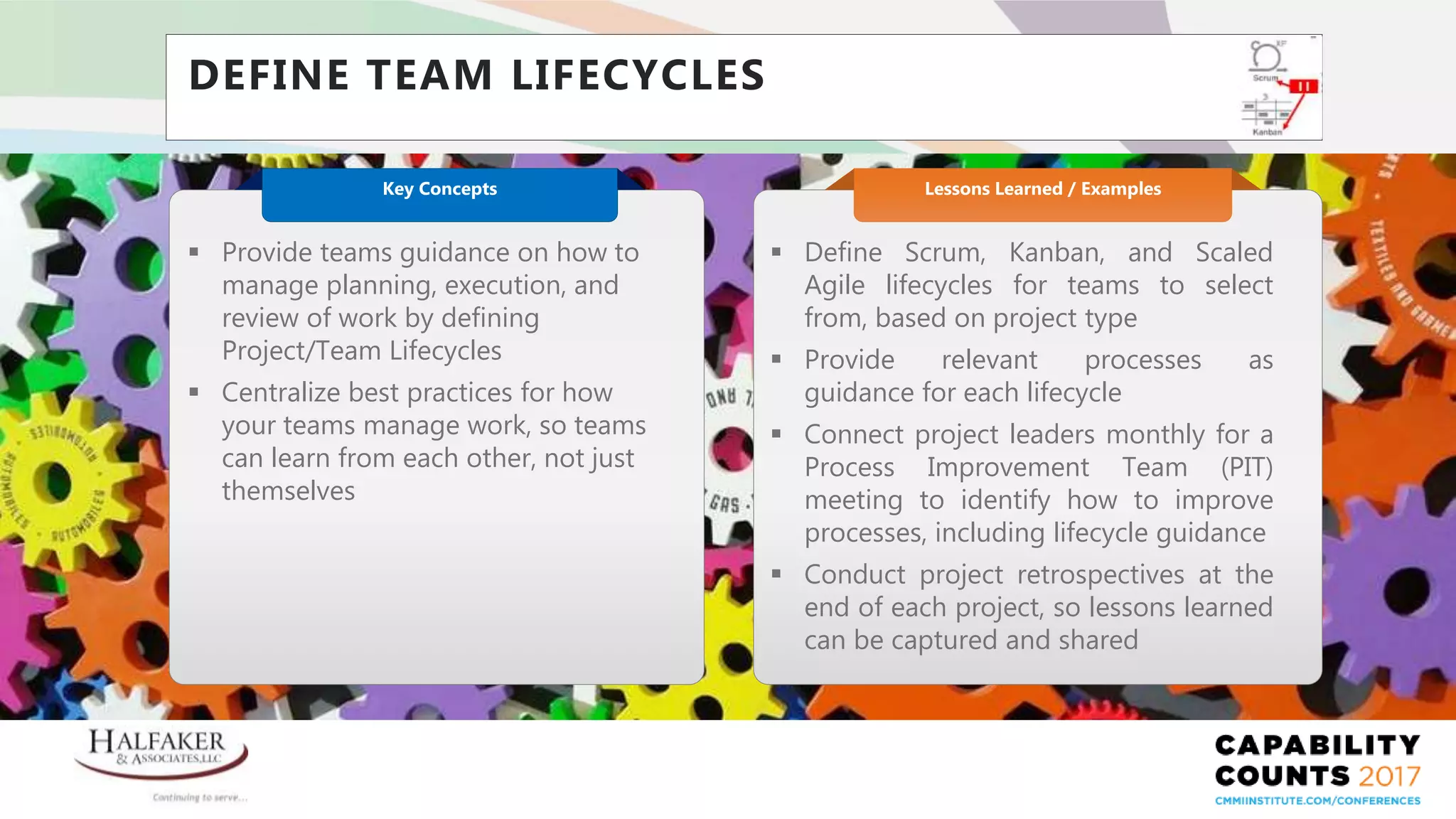
DEFINE TEAM LIFECYCLES
 Define Scrum, Kanban, and Scaled
Agile lifecycles for teams to select
from, based on project type
 Provide relevant processes as
guidance for each lifecycle
 Connect project leaders monthly for a
Process Improvement Team (PIT)
meeting to identify how to improve
processes, including lifecycle guidance
 Conduct project retrospectives at the
end of each project, so lessons learned
can be captured and shared
Lessons Learned / Examples
 Provide teams guidance on how to
manage planning, execution, and
review of work by defining
Project/Team Lifecycles
 Centralize best practices for how
your teams manage work, so teams
can learn from each other, not just
themselves
Key Concepts
Place YOUR LOGO here
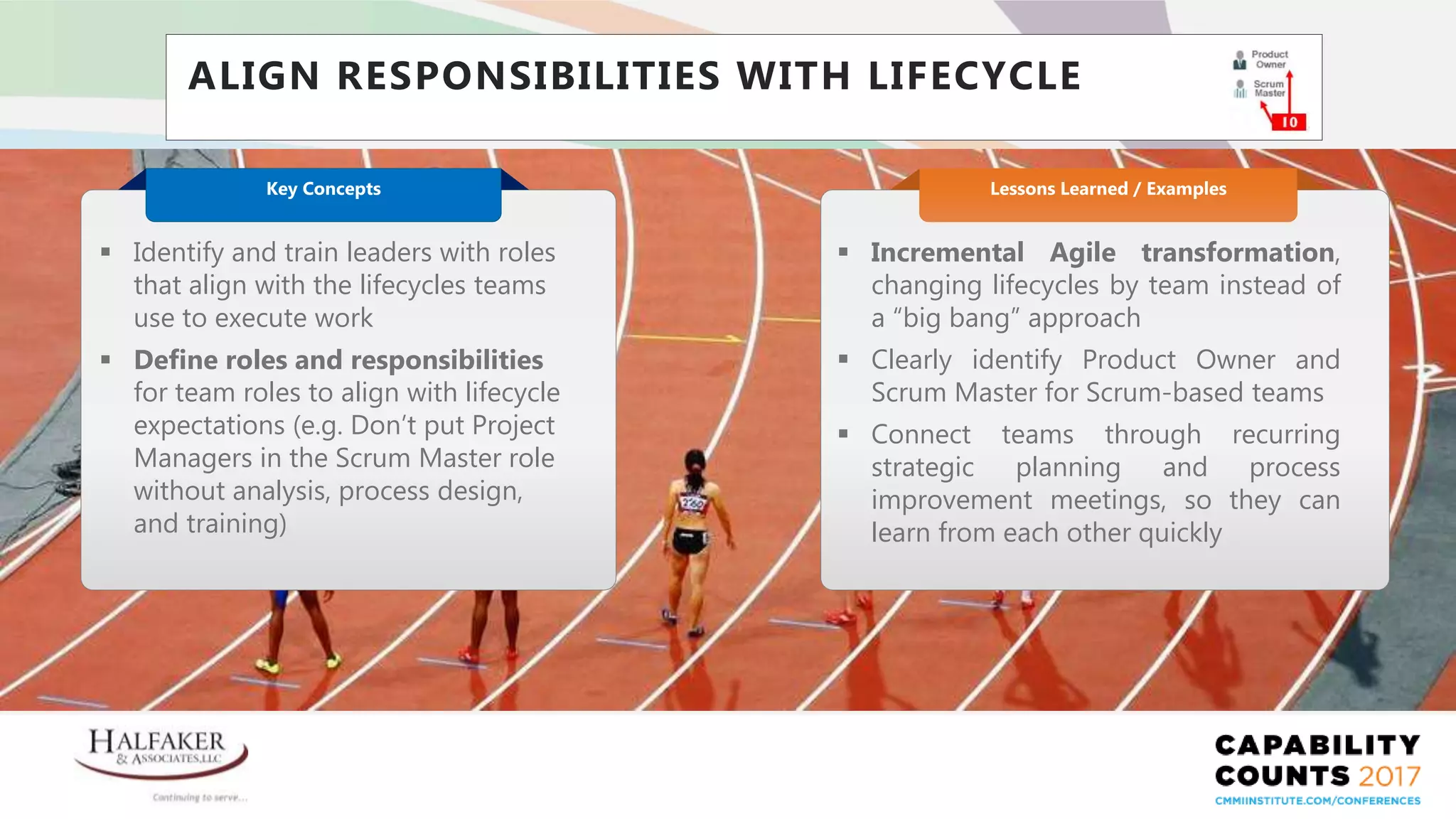
ALIGN RESPONSIBILITIES WITH LIFECYCLE
 Incremental Agile transformation,
changing lifecycles by team instead of
a “big bang” approach
 Clearly identify Product Owner and
Scrum Master for Scrum-based teams
 Connect teams through recurring
strategic planning and process
improvement meetings, so they can
learn from each other quickly
Lessons Learned / Examples
 Identify and train leaders with roles
that align with the lifecycles teams
use to execute work
 Define roles and responsibilities
for team roles to align with lifecycle
expectations (e.g. Don’t put Project
Managers in the Scrum Master role
without analysis, process design,
and training)
Key Concepts
Place YOUR LOGO here
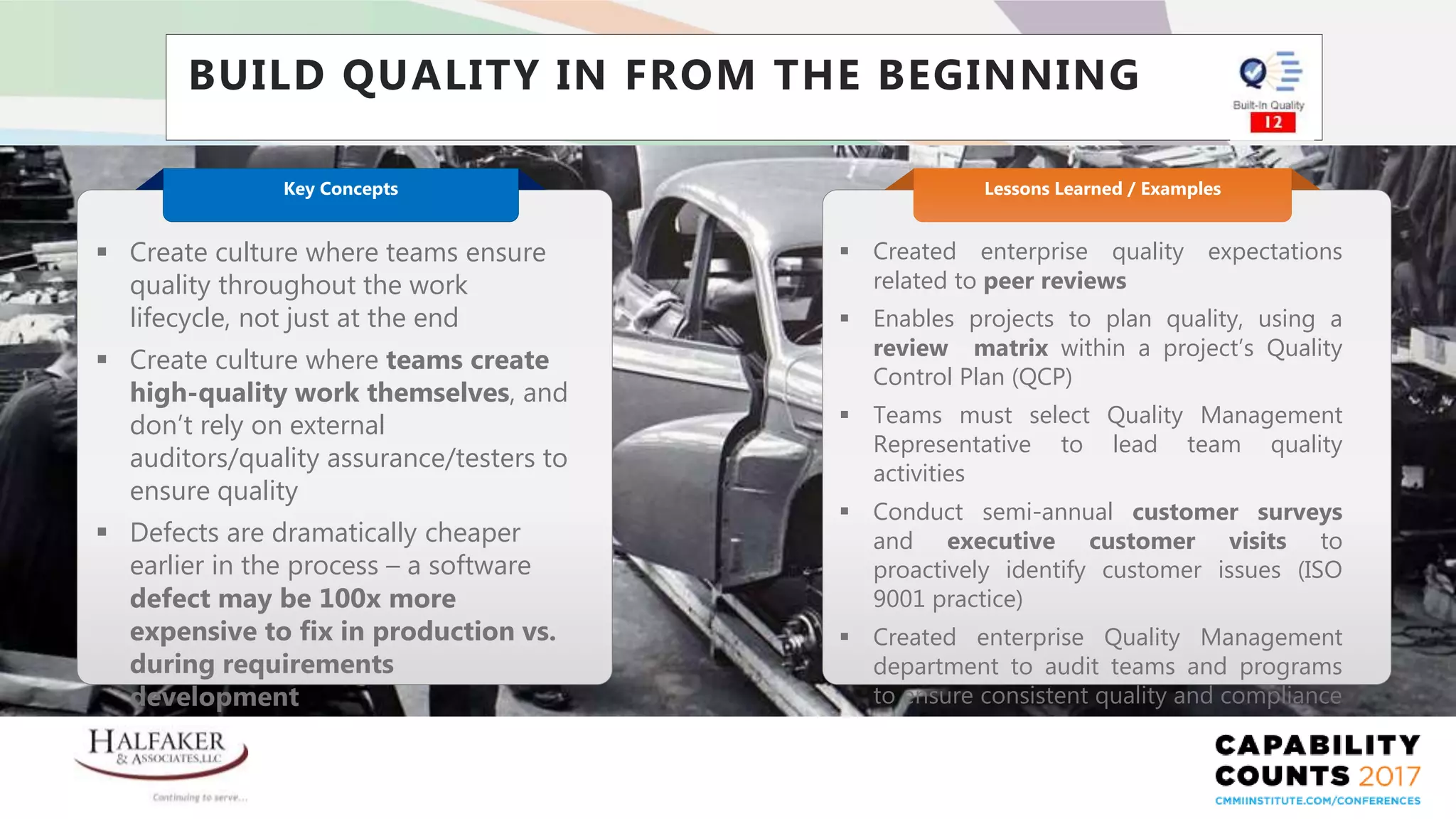
BUILD QUALITY IN FROM THE BEGINNING
 Created enterprise quality expectations
related to peer reviews
 Enables projects to plan quality, using a
review matrix within a project’s Quality
Control Plan (QCP)
 Teams must select Quality Management
Representative to lead team quality
activities
 Conduct semi-annual customer surveys
and executive customer visits to
proactively identify customer issues (ISO
9001 practice)
 Created enterprise Quality Management
department to audit teams and programs
to ensure consistent quality and compliance
Lessons Learned / Examples
 Create culture where teams ensure
quality throughout the work
lifecycle, not just at the end
 Create culture where teams create
high-quality work themselves, and
don’t rely on external
auditors/quality assurance/testers to
ensure quality
 Defects are dramatically cheaper
earlier in the process – a software
defect may be 100x more
expensive to fix in production vs.
during requirements
development
Key Concepts
Place YOUR LOGO here
QUESTIONS?
• Follow-up Questions? Want to Connect?
• Michael King, PMI-ACP, SAFe SA, PMP
• michael.king@halfaker.com
• @mikehking (Twitter)
• https://www.linkedin.com/in/mikehking

Serving Federal Government Customers with Scaled Agile Framework (SAFe)

  • 1.
    Place YOUR LOGOhere NAME: Michael King TITLE: Chief Technology Officer ORGANIZATION: Halfaker and Associates SERVING FEDERAL CUSTOMERS WITH SAFE CONCEPTS
  • 2.
    Place YOUR LOGOhere • Company founded in 2006 with the vision of Continuing to Serve… • Founded by West Point graduate and Army Military Police Officer Dawn Halfaker (Service-Disabled Veteran-Owned, Woman-Owned, 8(a) Small Business) • 200+ employee company focused on providing Data Analytics, Software Engineering, IT Infrastructure, and Cyber Security solutions to Federal Government customers • Halfaker serves VA, DoD, HHS, DHS, USDA, and Transportation ABOUT HALFAKER Culture built on Military Principles  Lead from the Front  Never Give Up  Plan, Plan, Plan  Take Care of Your People  Know the Job above you and below you  Demand Excellence
  • 3.
    Place YOUR LOGOhere AGENDA • About Halfaker • Business Challenge • Approach: Build Scaled Agile System • Many Different Scaled Frameworks • Introduction to SAFe • Scaled Agile Framework (SAFe) • Portfolio (Enterprise) Level • Effective Strategy • Strategy Decomposition • Consistent Enterprise Architecture • Synchronized Value Streams • Program Level • Vision-based Enterprise Metrics • Invest in Program Leaders • Define Program Rhythm • Invest Time in Planning • Build Sufficient Runway • Team Level • Define Team Lifecycles • Align Responsibilities with Lifecycle • Build Quality in from the Beginning • Questions?
  • 4.
    Place YOUR LOGOhere • Halfaker began to accelerate in growth in 2013, approaching 100 employees spread across 20 projects • As the Company grew, we struggled to maintain consistency, ensure quality, and manage risk across increasing number of projects spread across the country • To provide excellent service, we relied on a few heroes who were constantly reacting to emergencies, swarming issues like 5 year olds playing soccer BUSINESS CHALLENGE
  • 5.
    Place YOUR LOGOhere • Halfaker needed to invest in processes and tools that support them, in order to scale from a small business to a sustainable mid-tier organization:  Codify how we ensured every customer would receive excellent, innovative results  Align people, systems, and processes to strategic goals APPROACH: BUILD SCALED AGILE SYSTEM Strategic Goals Business Processes Templates and Forms Business Systems (Applications) Guidelines and Policies Organization Structure “…Losers have goals. Winners have systems.” – Scott Adams, creator Dilbert
  • 6.
    Place YOUR LOGOhere MANY DIFFERENT SCALED FRAMEWORKS
  • 7.
    Place YOUR LOGOhere INTRODUCTION TO SAFE • Scaled Agile Framework (SAFe)® defines itself as: The Scaled Agile Framework® (SAFe®) is a freely revealed knowledge base of proven, integrated patterns for enterprise-scale Lean-Agile development. It is scalable and modular, allowing each organization to apply it in a way that provides better business outcomes and happier, more engaged employees. SAFe synchronizes alignment, collaboration, and delivery for large numbers of Agile teams. It supports both software and systems development, from the modest scale of well under 100 practitioners to the largest software solutions and complex cyber-physical systems, systems that require thousands of people to create and maintain. SAFe was developed in the field, based on helping customers solve their most challenging scaling problems. It leverages three primary bodies of knowledge: Agile development, Lean product development, and systems thinking. • Halfaker uses SAFe as a library of best practices across the enterprise, not a one-size-fits-all solution – we use some SAFe concepts, but not others
  • 8.
    Place YOUR LOGOhere SCALED AGILE FRAMEWORK® (SAFE) 3 2 1 4 5 12 11 10 9 6 7 8
  • 9.
    Place YOUR LOGOhere Portfolio (Enterprise) Level
  • 10.
    Place YOUR LOGOhere EFFECTIVE STRATEGY  Create traceable goals and associated sub-goals, which are flowed down to a clear primary owner within the organization  Meet quarterly to review progress and priorities related to these goals  Publish an annual strategy plan one- pager so people can see the ‘big picture’  Manage a online Kanban board showing the high-level epics so people can visualize who owns which goals, which upcoming quarter they’re due, and their status Lessons Learned / Examples  Create Strategic Goals that can be clearly flowed down to relevant departments/teams  Monitor the progress against strategic goals, meeting periodically (e.g. quarterly) to review progress and priorities  Provide a visual way to show strategic goals and their progress (e.g. dashboard or epic board) Key Concepts
  • 11.
    Place YOUR LOGOhere User Stories Epics Features Strategic Themes Collaboration among Executives STRATEGY DECOMPOSITION  Make it easy to trace how strategic themes are broken down into children items (e.g. epics, user stories)  Focus senior leaders on the “big picture” of themes or features, so they are not lost in the weeds of long backlogs of user stories  As your teams and your overall organization matures, you’ll be able to: 1. Estimate the complexity of a strategic theme, feature, or epic 2. Prioritize each item 3. Estimate completion dates for each item, with increasing accuracy
  • 12.
    Place YOUR LOGOhere CONSISTENT ENTERPRISE ARCHITECTURE  Provide great tools for planning (e.g. JIRA, Microsoft Project), collaboration (e.g. Confluence), and communication (e.g. Skype for Business, HipChat)  Allow teams to tailor tools or use other tools, when appropriate (but encourage/enforce consistency) Lessons Learned / Examples  Identify someone or a team to define overall technology architecture/tools for the organization  Invest in great tools for your team, so they don’t need to resort to Shadow IT to get their jobs done  Invest in associated processes to your organization does things efficiently and consistently, when possible Key Concepts
  • 13.
    Place YOUR LOGOhere SYNCHRONIZED VALUE STREAMS  Use a battle rhythm to plan and monitor strategic progress through company-wide weekly, monthly, and quarterly activities  Publish the company battle rhythm to all company leaders, so they can clearly see the rhythm they are operating within  Organize Operations Department (service delivery) around capabilities instead of customers or geography, so project teams can collaborate and support each other with shared talent Lessons Learned / Examples  Organize your company around value streams to keep value as a clear central concept – keep the “why” (purpose) of your organization the clear center of these value streams  Synchronize the rhythm of your organization, both within each value stream and across them; so the organization can prioritize and adapt in a single ‘battle rhythm’ Key Concepts
  • 14.
    Place YOUR LOGOhere Program Level
  • 15.
    Place YOUR LOGOhere VISION-BASED ENTERPRISE METRICS  We identified critical numbers related to Customer Satisfaction (e.g. Surveys, CPARS scores), Process Efficiency, Growth (Pipeline and Bookings) Development (Training Plan Completion), and Financial (Revenue and Profit)  We review metrics in weekly, monthly, and quarterly meetings that focus on various aspects of Company management to identify what to prioritize Lessons Learned / Examples  Identify a short list of clearly defined metrics to align with your organization’s vision and strategic goals  Avoid ‘Vanity Metrics’ that don’t actually drive improvement (e.g. web traffic, number of subscribers)  Use ‘Balanced Scorecard’ approach to avoid focusing on a single type of metrics (e.g. Financial)  Monitor performance of key goals in frequent meetings – “What gets measured gets done” Key Concepts
  • 16.
    Place YOUR LOGOhere INVEST IN DIVISION/PROGRAM LEADERS  Allocate budget for sufficient leaders on large programs and teams  Invest time in identifying high- potential leaders and helping them advance (e.g. Leadership Development Program where junior leaders are given increasing responsibilities related to task, personnel, and financial management)  Invest in training leaders to use hierarchy (traceability) to keep the big picture visible – use epics and don’t get lost in long lists of user stories Lessons Learned / Examples  Invest in Leaders for Divisions and Programs to provide sufficient capacity in execution, coordination, personnel development, and technical architecture  Release Train Engineer is a Scrum Master across a Program (multiple Teams)  System Architect provides cohesive technical leadership across a Program  Product Manager is Product Owner across a Program Key Concepts
  • 17.
    Place YOUR LOGOhere DEFINE PROGRAM RHYTHM  Quarterly Strategy Review meeting with company senior leaders presenting progress across each department (release train) and discussing priorities  IT Department (composed of Customer Solutions, Architecture, Internal Technology, and Quality teams) meets quarterly to review progress and plan upcoming priorities (see next slide) – each team presents approaches to the other teams for feedback and coordination Lessons Learned / Examples  Synchronize teams across a Program (or Department) to a consistent rhythm  SAFe defines enterprise rhythm:  Continual Portfolio-level prioritization  3 month Program Increments (Program level), using groups of 5-12 Scrum Teams called Agile Release Trains (ARTs)  2 week Iterations (Sprints) at Team level  Insist on keeping a consistent rhythm – don’t delay/extend sprints or releases, instead tell people they can catch the next train Key Concepts
  • 18.
    Place YOUR LOGOhere INVEST TIME IN PLANNING  SAFe defines a Program Increment (PI) planning approach, which occurs every 10 – 12 weeks, where programs meet to review progress and plan upcoming priorities (see http://www.scaledagileframework.com/pi- planning/) Key Concepts
  • 19.
    Place YOUR LOGOhere BUILD SUFFICIENT RUNWAY  Research Backlog provides sufficient user interview and research findings to enable teams to create backlog items  User Story Runway provides sufficient refined and prioritized backlog items for teams to work on, so teams can keep progressing  Architectural Runway provides system and software architectures for teams to build on  A useful metric is to track how much ‘backlog’ you have, measured in weeks or sprints Lessons Learned / Examples  The Architectural Runway is composed of the technology infrastructure and architectural decisions that enable work for development to advance – think of which work builds more asphalt and which work drives on it (consumes it)  The metaphor of building a runway to stay out of a crisis mode where decisions are not well thought out can be applied to many domains Key Concepts
  • 20.
    Place YOUR LOGOhere Team Level
  • 21.
    Place YOUR LOGOhere DEFINE TEAM LIFECYCLES  Define Scrum, Kanban, and Scaled Agile lifecycles for teams to select from, based on project type  Provide relevant processes as guidance for each lifecycle  Connect project leaders monthly for a Process Improvement Team (PIT) meeting to identify how to improve processes, including lifecycle guidance  Conduct project retrospectives at the end of each project, so lessons learned can be captured and shared Lessons Learned / Examples  Provide teams guidance on how to manage planning, execution, and review of work by defining Project/Team Lifecycles  Centralize best practices for how your teams manage work, so teams can learn from each other, not just themselves Key Concepts
  • 22.
    Place YOUR LOGOhere ALIGN RESPONSIBILITIES WITH LIFECYCLE  Incremental Agile transformation, changing lifecycles by team instead of a “big bang” approach  Clearly identify Product Owner and Scrum Master for Scrum-based teams  Connect teams through recurring strategic planning and process improvement meetings, so they can learn from each other quickly Lessons Learned / Examples  Identify and train leaders with roles that align with the lifecycles teams use to execute work  Define roles and responsibilities for team roles to align with lifecycle expectations (e.g. Don’t put Project Managers in the Scrum Master role without analysis, process design, and training) Key Concepts
  • 23.
    Place YOUR LOGOhere BUILD QUALITY IN FROM THE BEGINNING  Created enterprise quality expectations related to peer reviews  Enables projects to plan quality, using a review matrix within a project’s Quality Control Plan (QCP)  Teams must select Quality Management Representative to lead team quality activities  Conduct semi-annual customer surveys and executive customer visits to proactively identify customer issues (ISO 9001 practice)  Created enterprise Quality Management department to audit teams and programs to ensure consistent quality and compliance Lessons Learned / Examples  Create culture where teams ensure quality throughout the work lifecycle, not just at the end  Create culture where teams create high-quality work themselves, and don’t rely on external auditors/quality assurance/testers to ensure quality  Defects are dramatically cheaper earlier in the process – a software defect may be 100x more expensive to fix in production vs. during requirements development Key Concepts
  • 24.
    Place YOUR LOGOhere QUESTIONS? • Follow-up Questions? Want to Connect? • Michael King, PMI-ACP, SAFe SA, PMP • michael.king@halfaker.com • @mikehking (Twitter) • https://www.linkedin.com/in/mikehking