ALLIANCE CREDIT COUNSELING Ed Gilliam Community Outreach 888-995-7856, ext. 385 • 704-943-0385
How to Establish Credit and Live Within a Budget
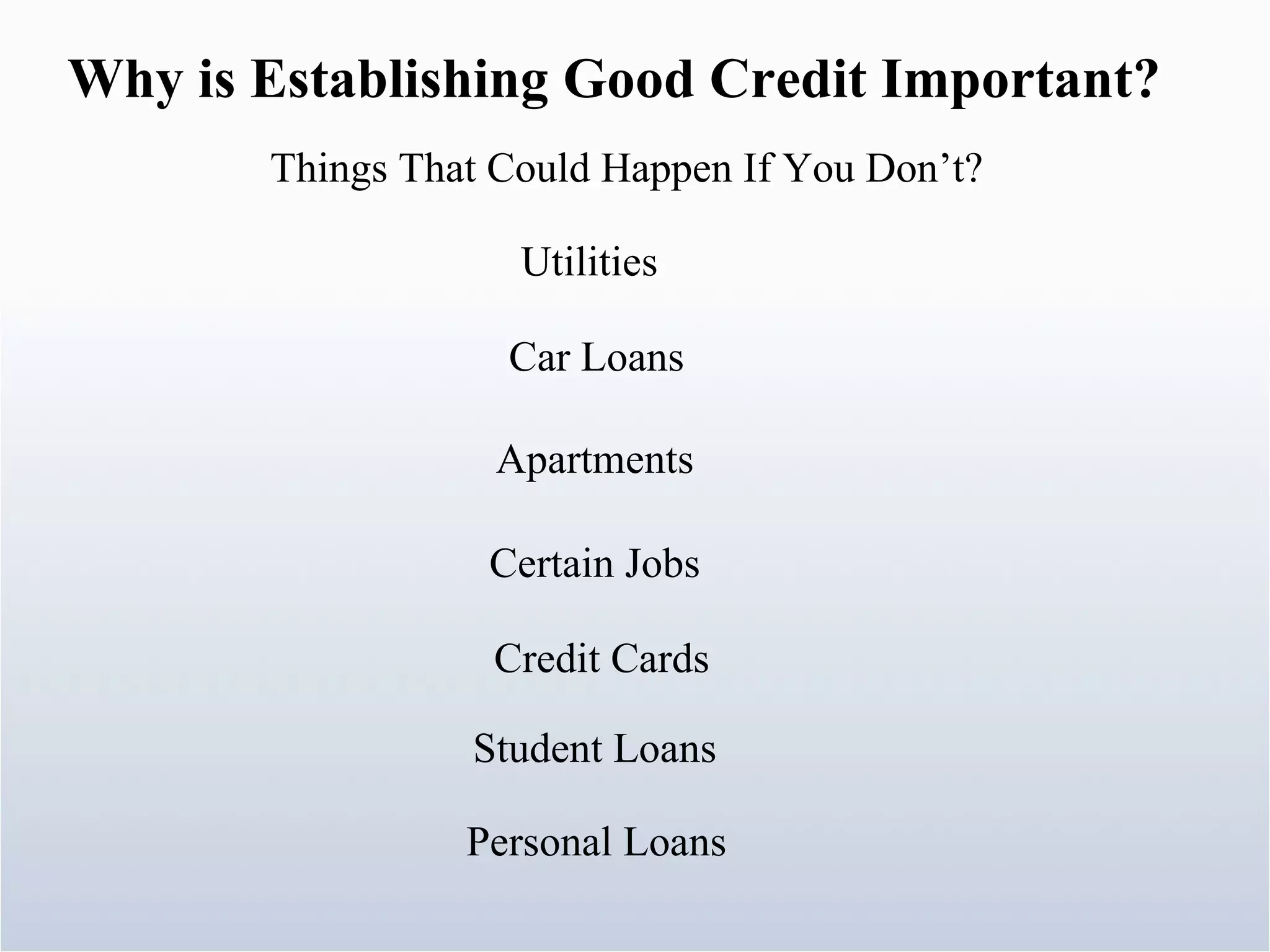
Things That Could Happen If You Don’t? Why is Establishing Good Credit Important? Utilities Car Loans Apartments Certain Jobs Credit Cards Student Loans Personal Loans
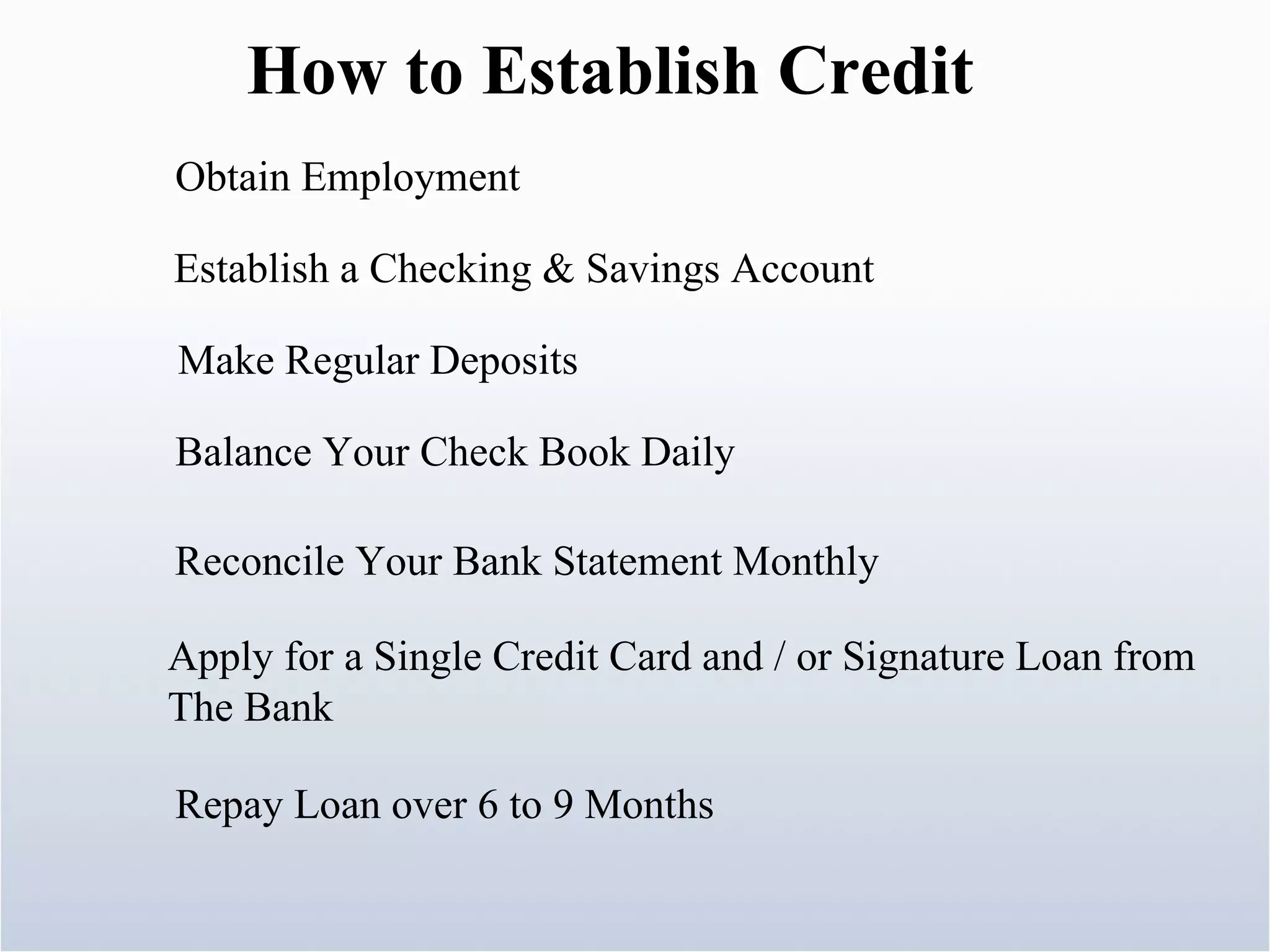
How to Establish Credit Obtain Employment  Establish a Checking & Savings Account Make Regular Deposits Balance Your Check Book Daily Reconcile Your Bank Statement Monthly Apply for a Single Credit Card and / or Signature Loan from The Bank Repay Loan over 6 to 9 Months
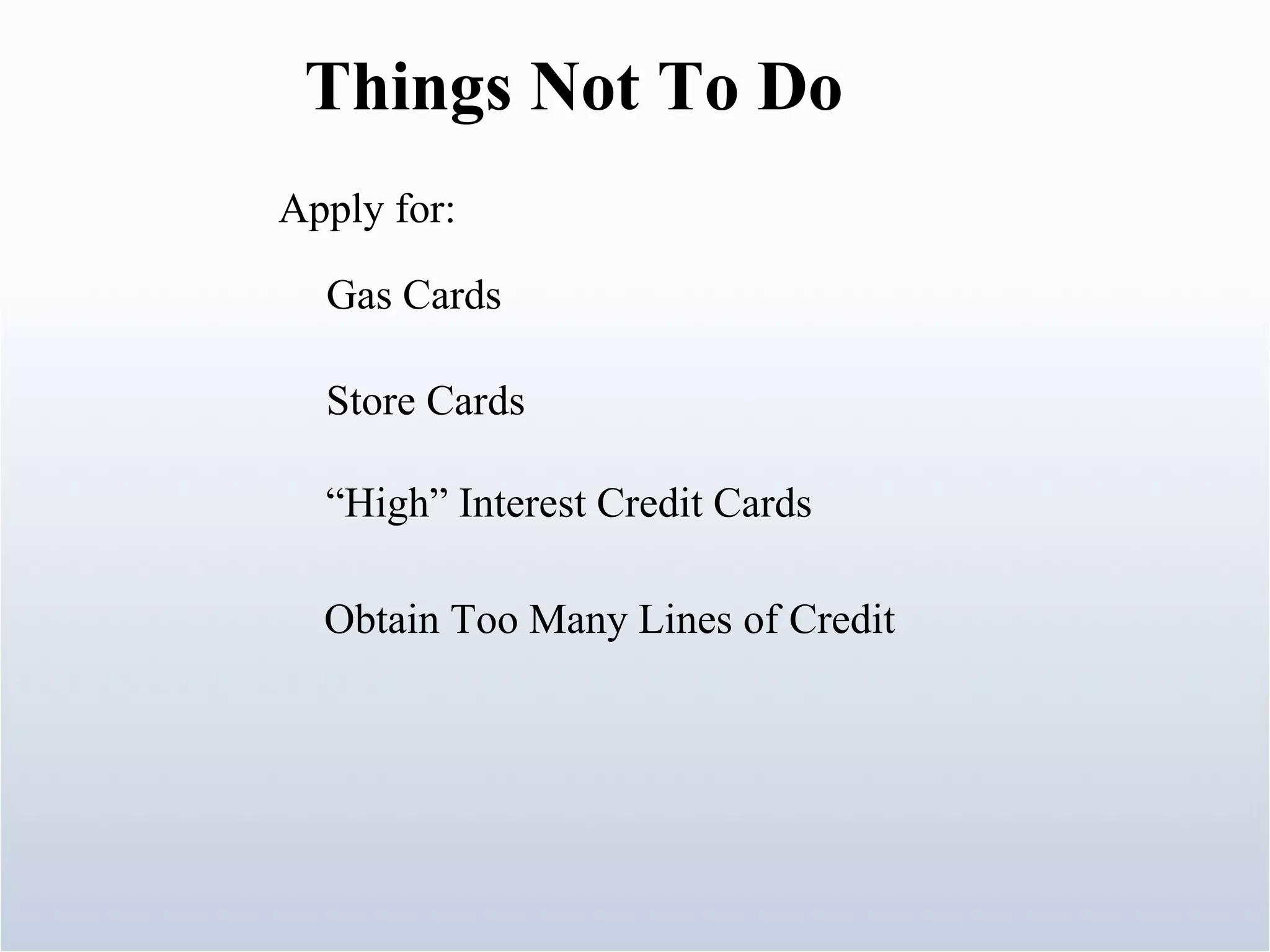
Things Not To Do Apply for: Gas Cards Store Cards “ High” Interest Credit Cards Obtain Too Many Lines of Credit
How to Manage Credit Pay Your Bills on Time  Keep Your Creditors Informed  Have Some Credit, but Not Too Much No More Than ONE Credit Card Get Free Credit Report at:  https://annualcreditreport.com
How to Manage Credit Don’t “Max” Out Credit Cards Maximum 80% or Below Limit Your use of the Cards Total Monthly Payments < 20% of Income Pay Down or Pay Off Ex. Net Monthly Income/5 = DTI Ratio 600 Net Monthly Income/5 = $120 on Debt Payments, Other Than Housing
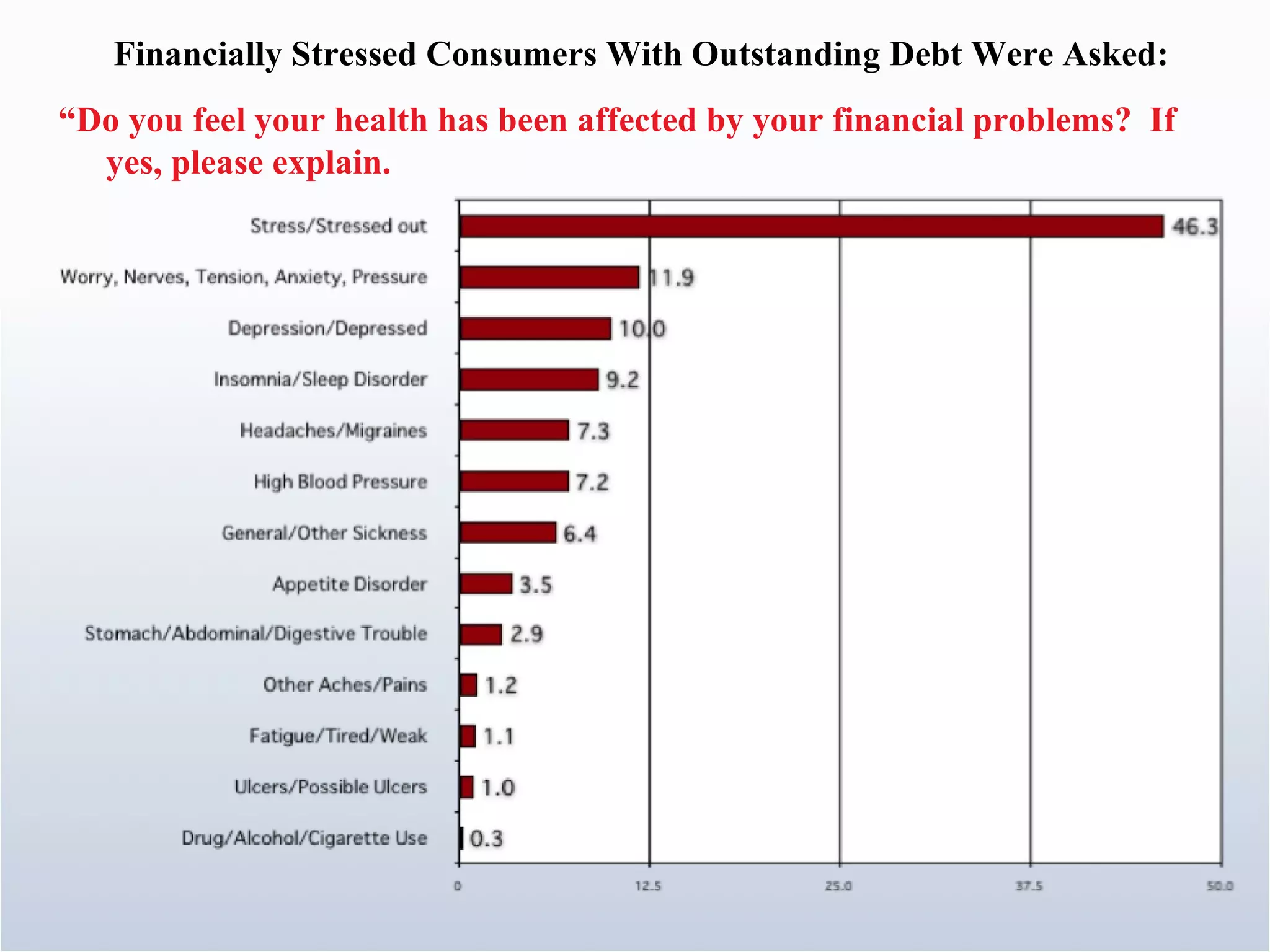
Financially Stressed Consumers With Outstanding Debt Were Asked: “ Do you feel your health has been affected by your financial problems?  If yes, please explain.
The  average  American spends $1.22 for every $1.00 they make! That means if you make $30,000 a year, you’re spending $36,600!? Nearly 70% of Americans with credit card debt only pay the minimum monthly amount If they charge a $12.00 pizza, it could take over $100 after months of payments 33% of Americans did not understand that prospective employers may pull their credit report Most do not truly understand how a credit report/score can affect their lives The  average  American adult receives a failing grade for their knowledge of basic economic concepts! They don’t understand how to properly budget, save, or invest Bottom Line? You can’t afford to be average!! Source:  Financial Literacy and Education Commission – Jan 07; National Council on Economic Education America’s Financial Culture*
CEO Real Stories Farmer Chemical Engineer Professional Football Player  Professional Baseball Scout
 
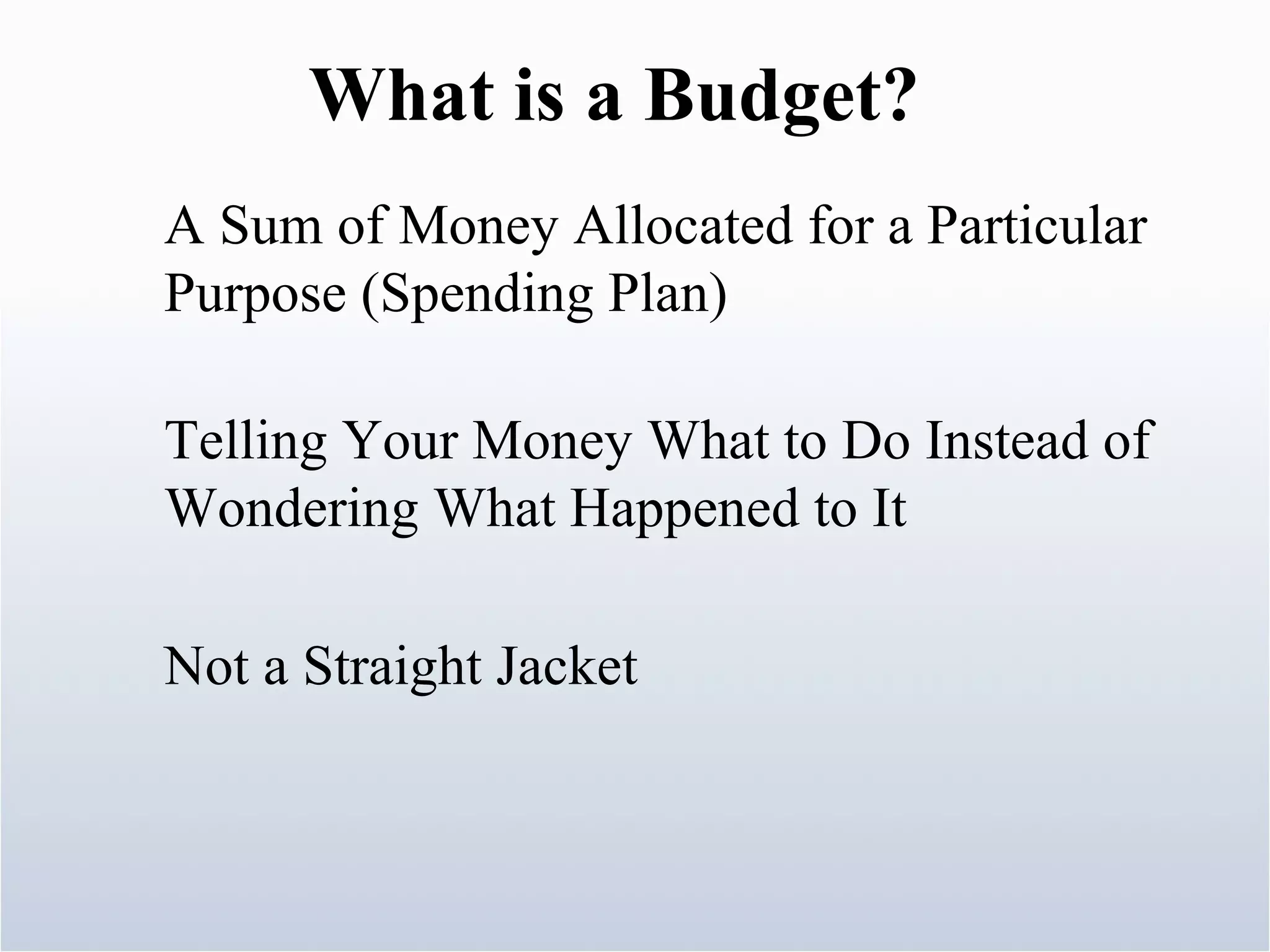
A Sum of Money Allocated for a Particular Purpose (Spending Plan) What is a Budget? Telling Your Money What to Do Instead of Wondering What Happened to It Not a Straight Jacket
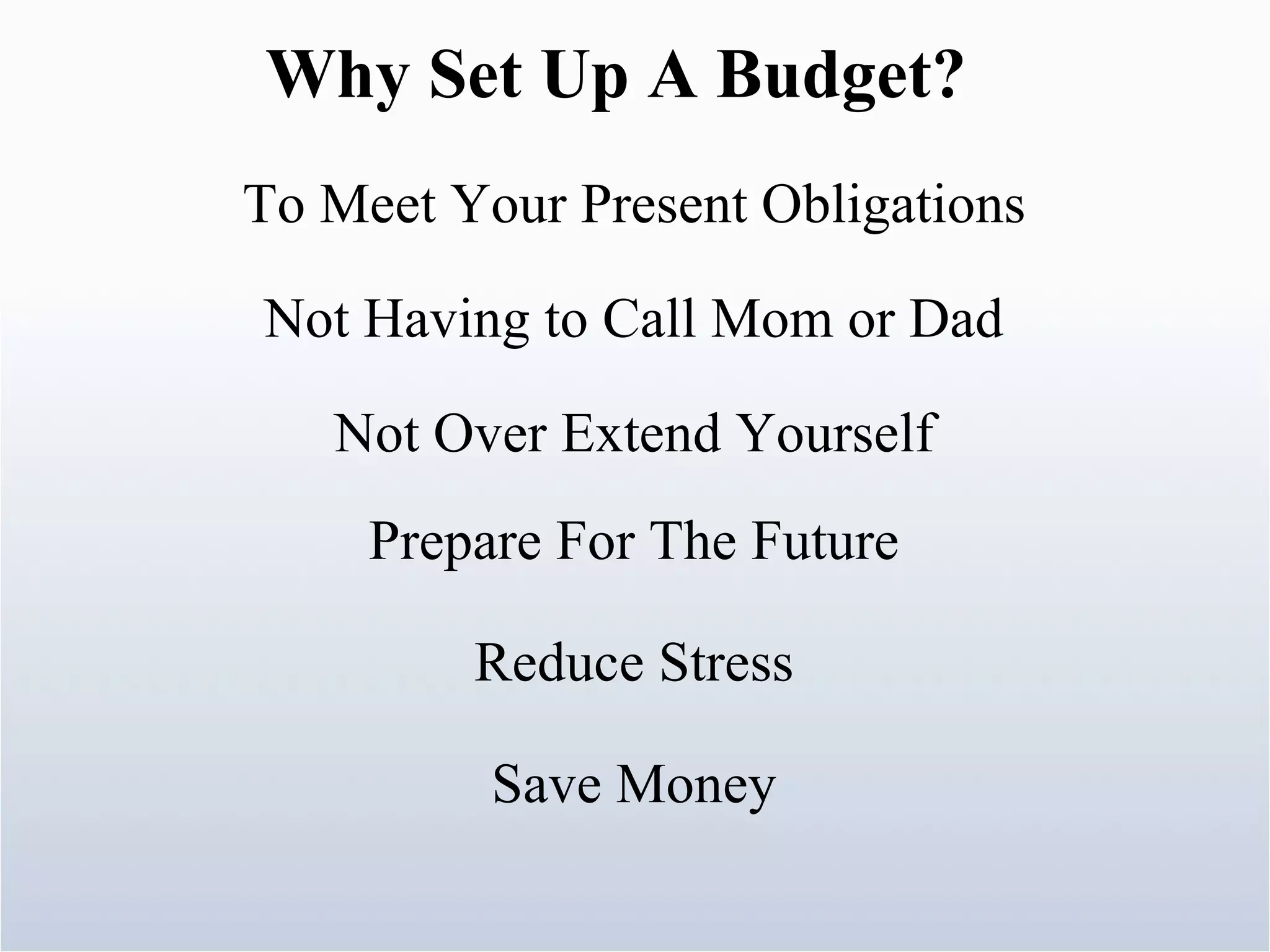
To Meet Your Present Obligations Why Set Up A Budget? Not Having to Call Mom or Dad Not Over Extend Yourself Prepare For The Future Reduce Stress Save Money
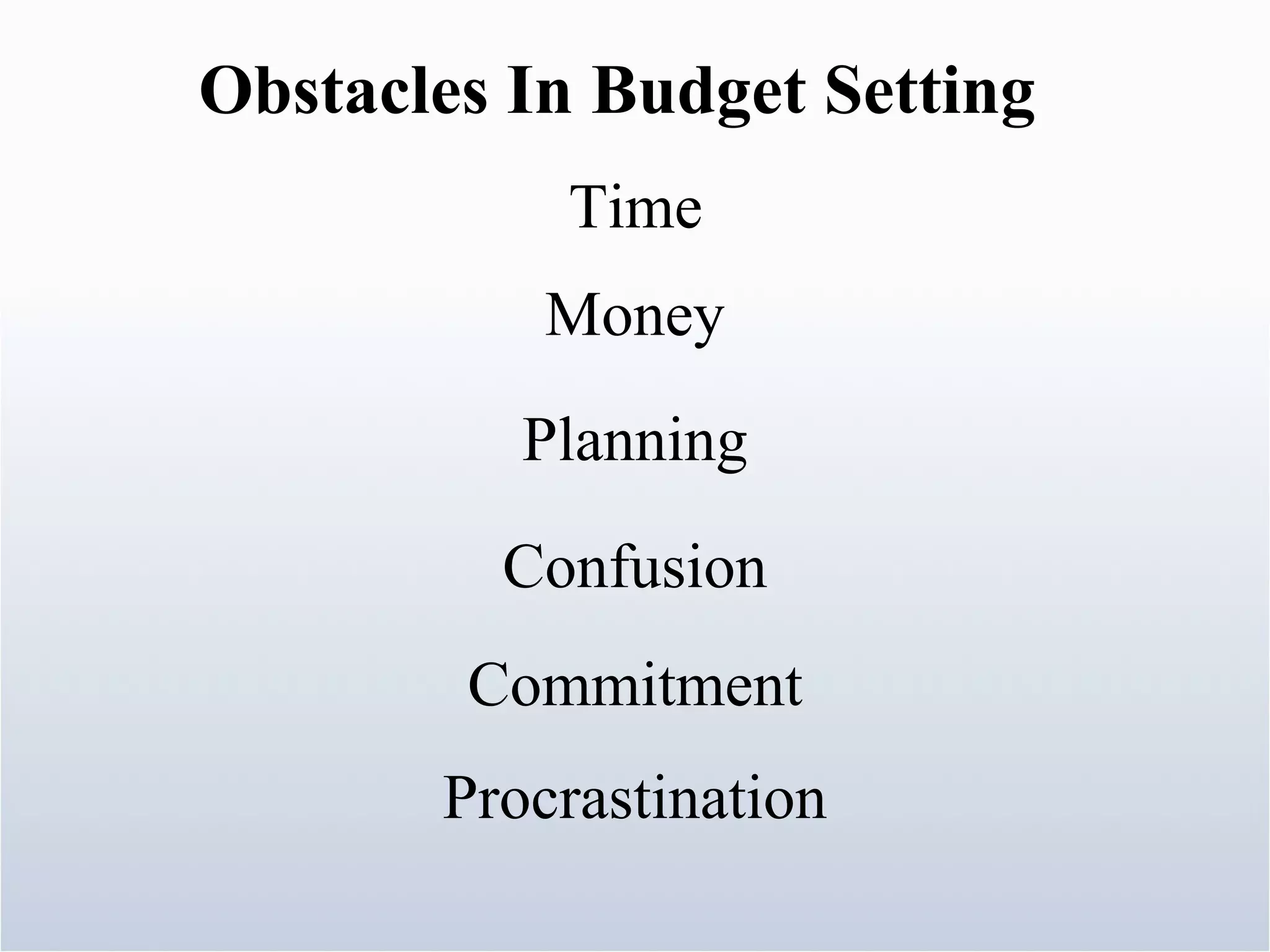
Time Obstacles In Budget Setting Money Planning Confusion Commitment Procrastination
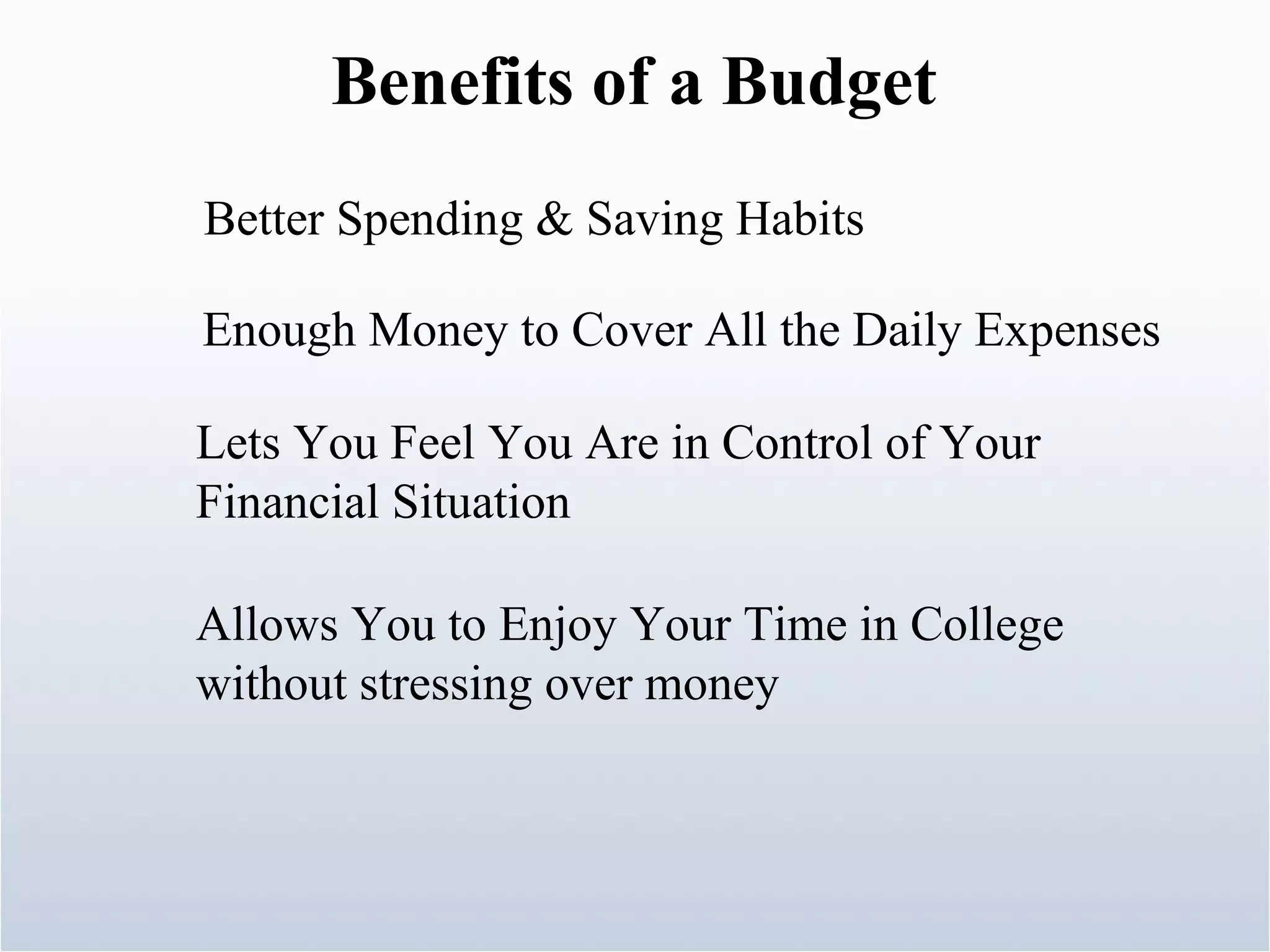
Better Spending & Saving Habits Benefits of a Budget Enough Money to Cover All the Daily Expenses Lets You Feel You Are in Control of Your Financial Situation Allows You to Enjoy Your Time in College without stressing over money
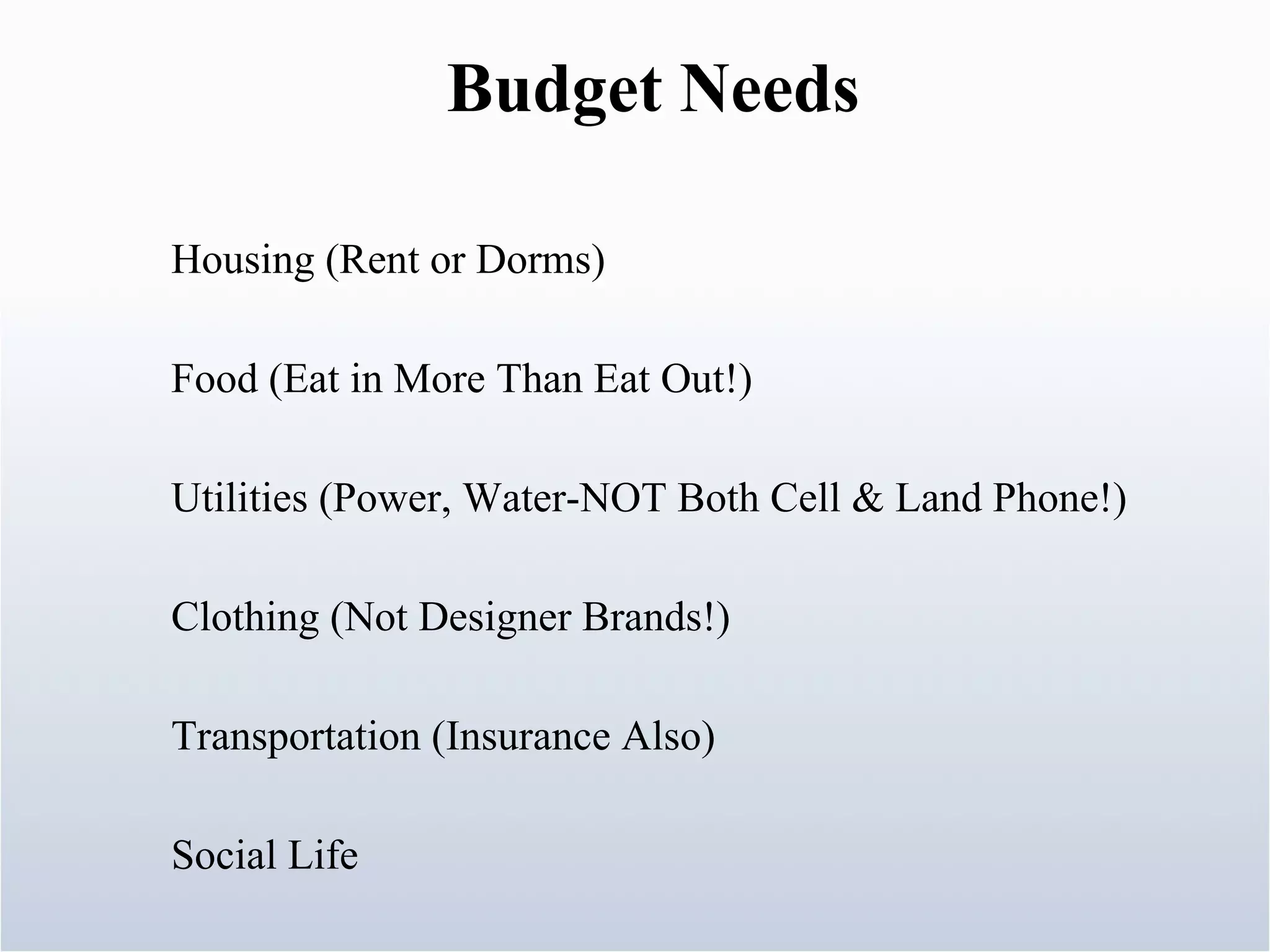
Housing (Rent or Dorms) Food (Eat in More Than Eat Out!) Utilities (Power, Water-NOT Both Cell & Land Phone!) Clothing (Not Designer Brands!) Transportation (Insurance Also) Social Life Budget Needs
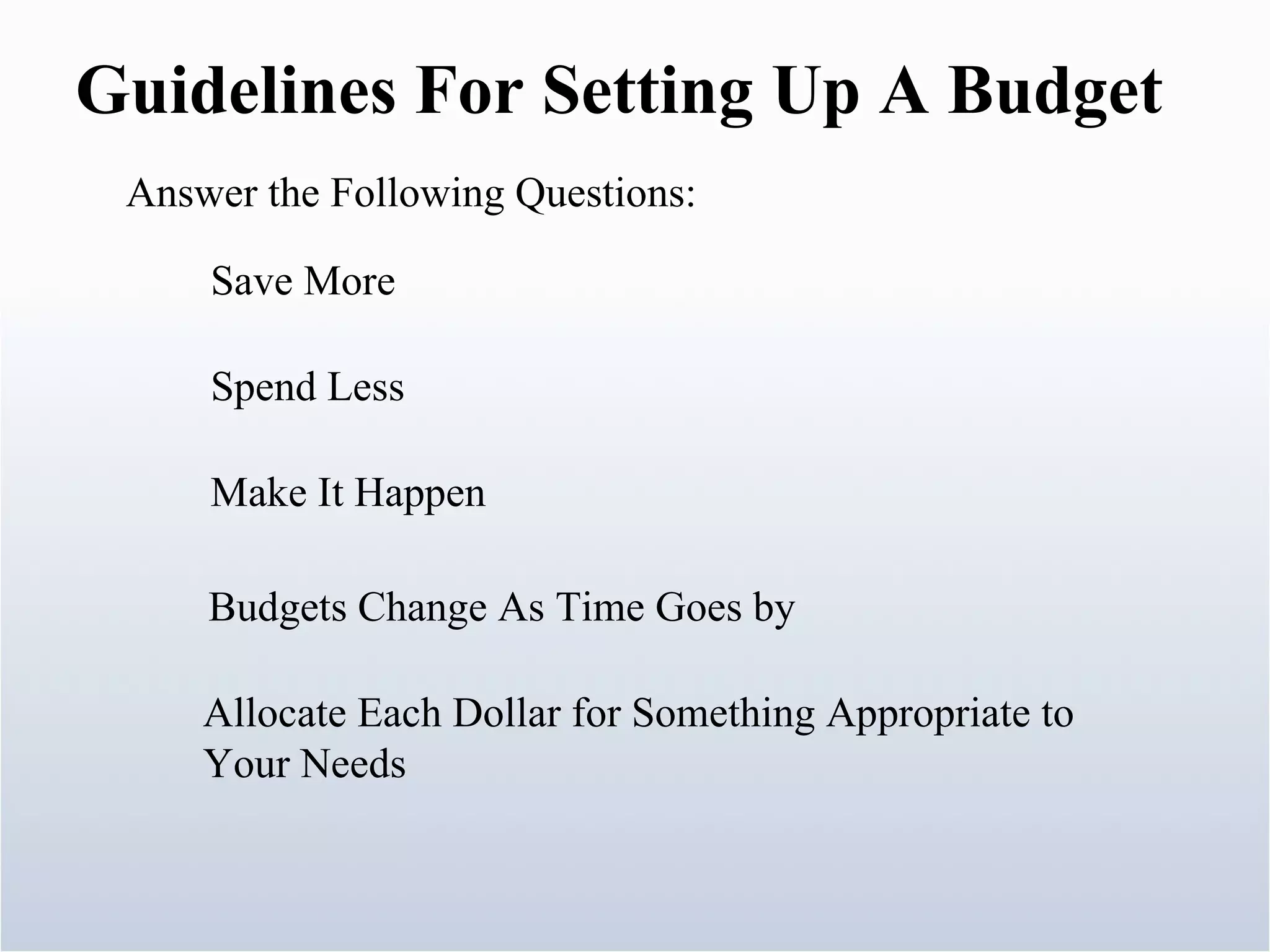
Answer the Following Questions: Guidelines For Setting Up A Budget Save More Spend Less Make It Happen Allocate Each Dollar for Something Appropriate to Your Needs Budgets Change As Time Goes by
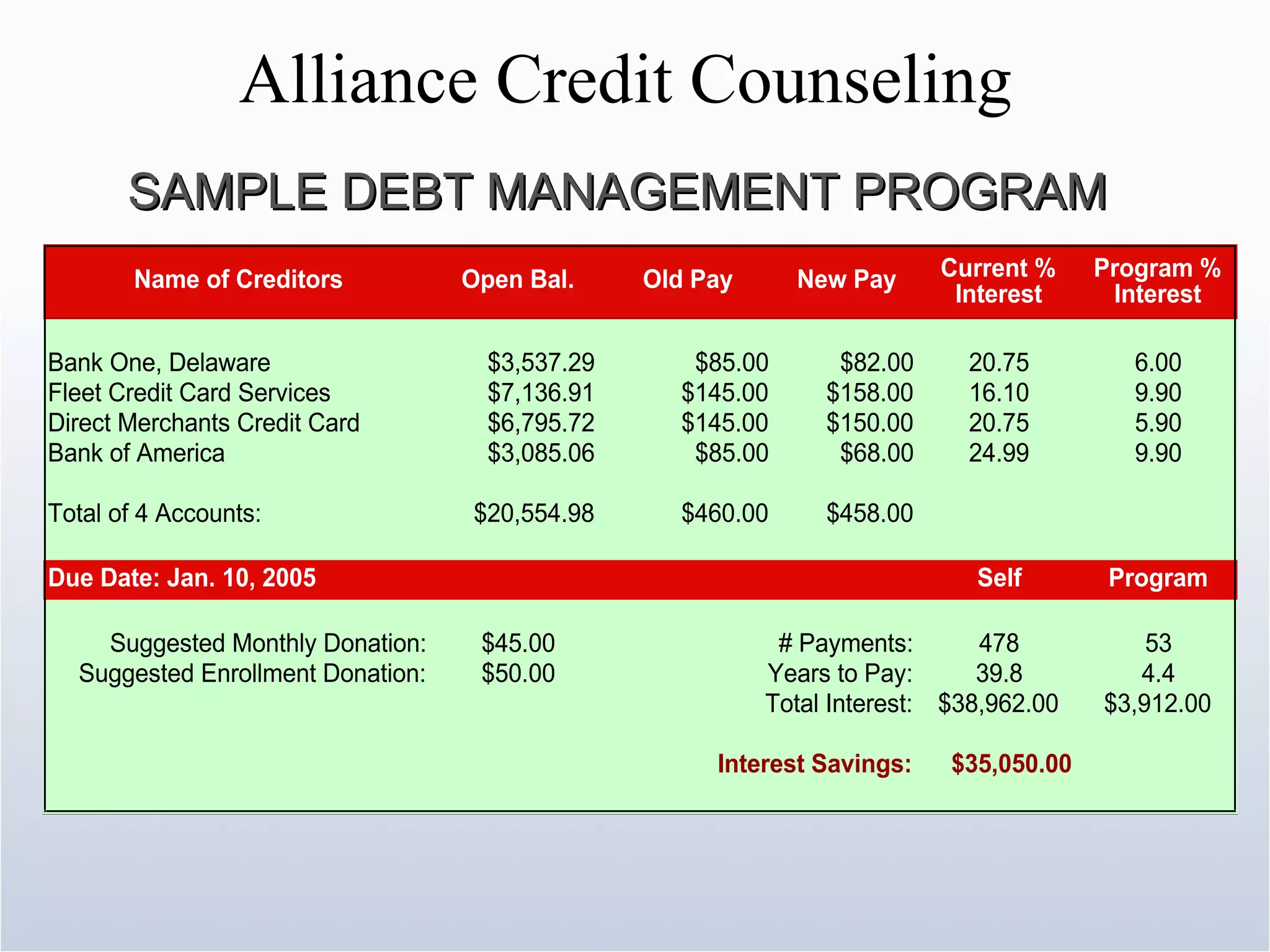
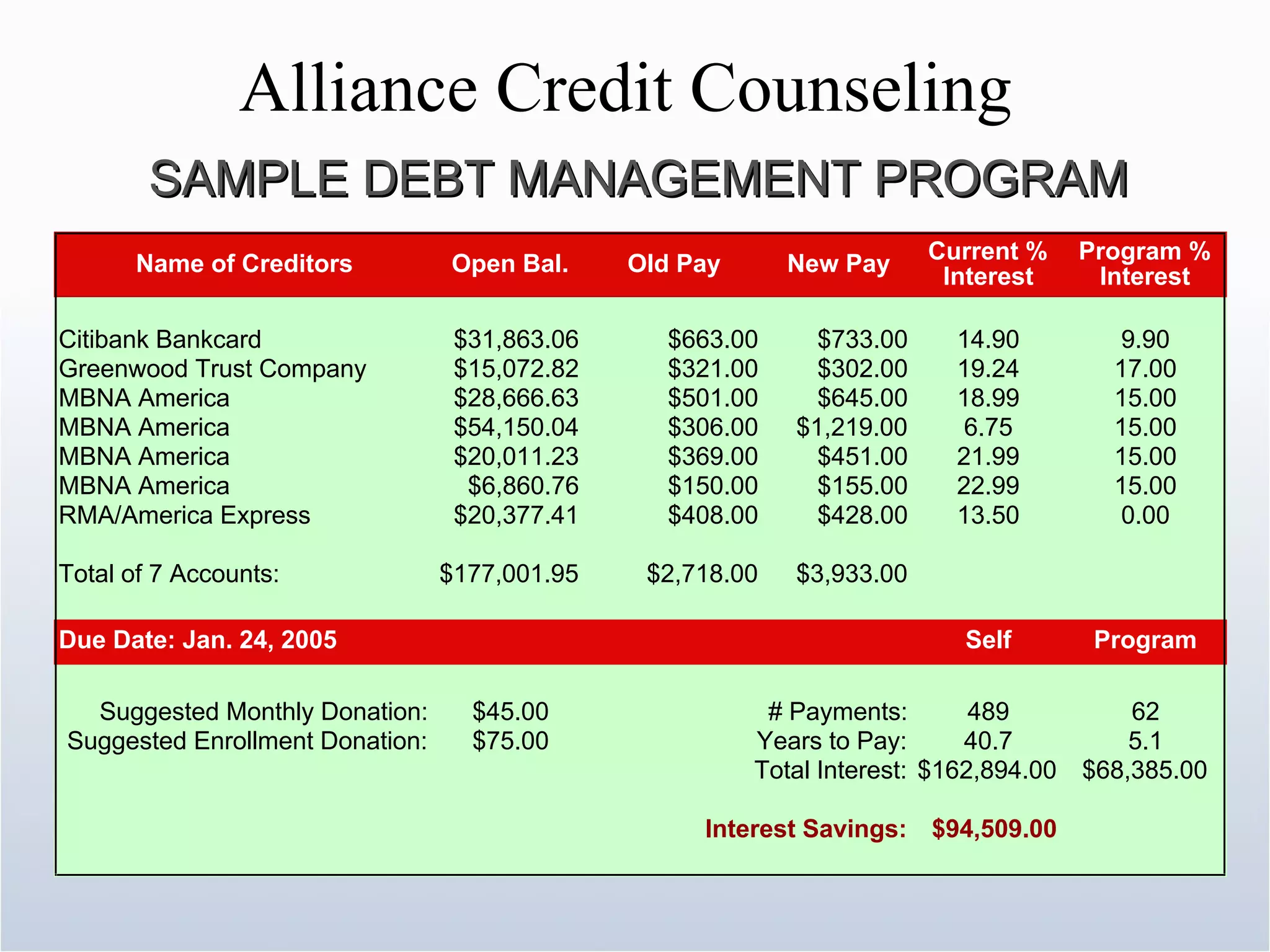
Alliance Credit Counseling SAMPLE DEBT MANAGEMENT PROGRAM
 
Time Value of Money Save $1.67/day, $50/mo, $600/year Age Invest Value 20 $600 $630 21 $600 $1,292 22 $600 $1,986 23 $600 $2,715 24 $600 $3,481 25 $600 $4,285 26 $600 $5,129 27 $600 $6,016 28 $600 $6,947 29 $600 $7,924 65 $6,000 $45,895 Based on earning a 5% return Age Invest Value 20 $600 $660 21 $600 $1,386 22 $600 $2,185 23 $600 $3,063 24 $600 $4,029 25 $600 $5,092 26 $600 $6,262 27 $600 $7,548 28 $600 $8,962 29 $600 $10,519 65 $6,000 $325,161 Based on earning a 10% return
Time Value of Money Age Invest Value 18 $3,000.00 $3,300 19 $3,000.00 $6,930 20 $3,000.00 $10,923 21 $3,000.00 $15,315 22 $3,000.00 $20,147 65 $1,213,646 Based on earning a 10% return Age Invest Value 18 $3,000.00 $3,150 19 $3,000.00 $6,458 20 $3,000.00 $9,930 21 $3,000.00 $13,577 22 $3,000.00 $17,406 65 $141,851 Based on earning a 5% return
Time Value of Money Age Invest Value 18 $2,000 $2,200 19 $2,000 $4,620 20 $2,000 $7,882 21 $2,000 $10,210 22 $2,000 $13,431 65 $10,000 $809,098 Based on earning a 10% return Based on earning a 5% return Age Invest Value 18 $2,000 $2,100 19 $2,000 $4,305 20 $2,000 $6,620 21 $2,000 $9,051 22 $2,000 $11,604 65 $10,000 $94,567
Time Value of Money Age Invest Value 18 $1,200 $1,320 19 $1,200 $2,772 20 $1,200 $4,369 21 $1,200 $6,126 22 $1,200 $8,059 65 $6,000 $441,326 Based on earning a 10% return Based on earning a 5% return Age Invest Value 18 $1,200 $1,260 19 $1,200 $2,583 20 $1,200 $3,972 21 $1,200 $5,431 22 $1,200 $6,962 65 $6,000 $54,038
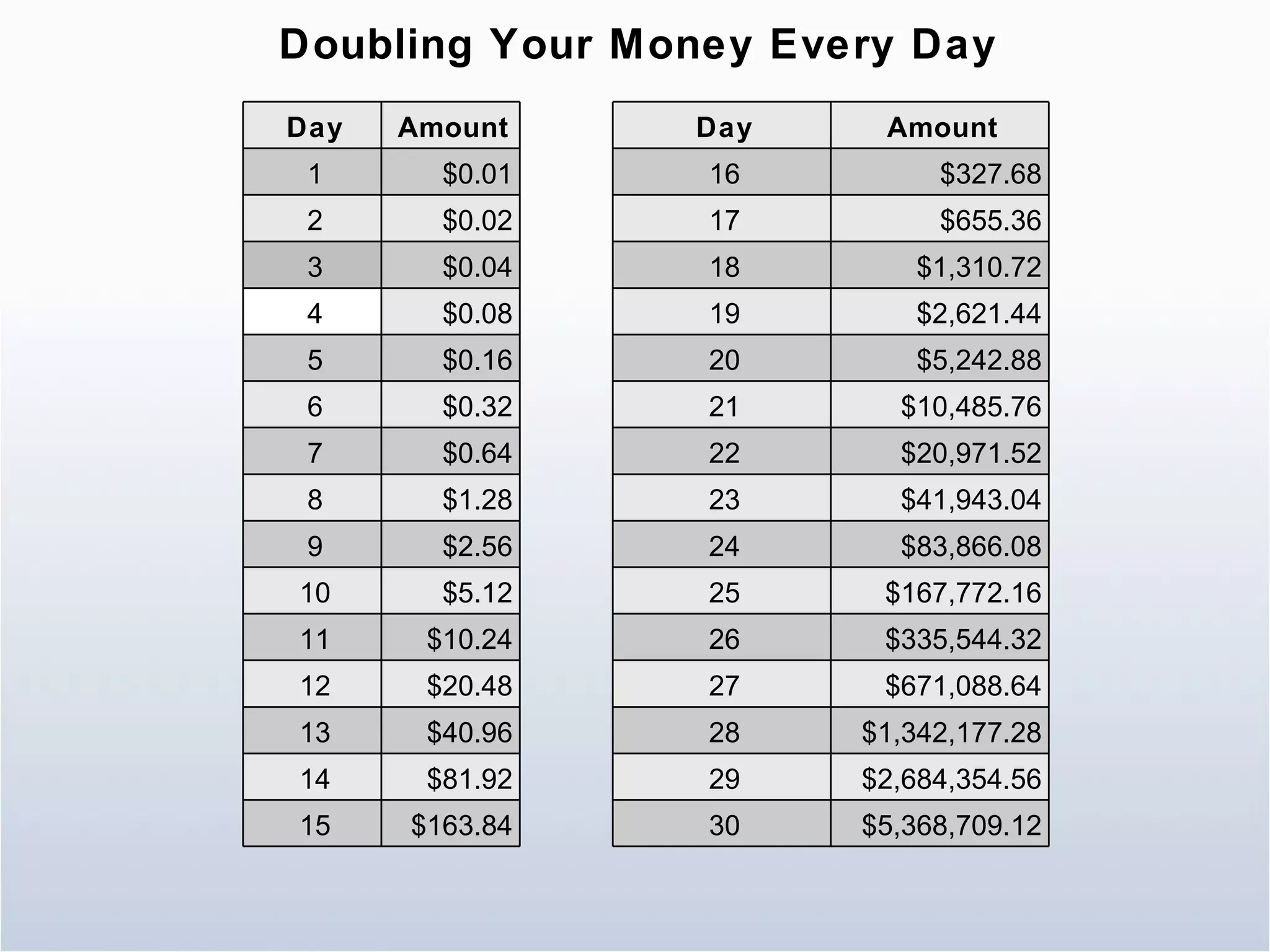
Doubling Your Money Every Day Day Amount 1 $0.01 2 $0.02 3 $0.04 4 $0.08 5 $0.16 6 $0.32 7 $0.64 8 $1.28 9 $2.56 10 $5.12 11 $10.24 12 $20.48 13 $40.96 14 $81.92 15 $163.84 Day Amount 16 $327.68 17 $655.36 18 $1,310.72 19 $2,621.44 20 $5,242.88 21 $10,485.76 22 $20,971.52 23 $41,943.04 24 $83,866.08 25 $167,772.16 26 $335,544.32 27 $671,088.64 28 $1,342,177.28 29 $2,684,354.56 30 $5,368,709.12
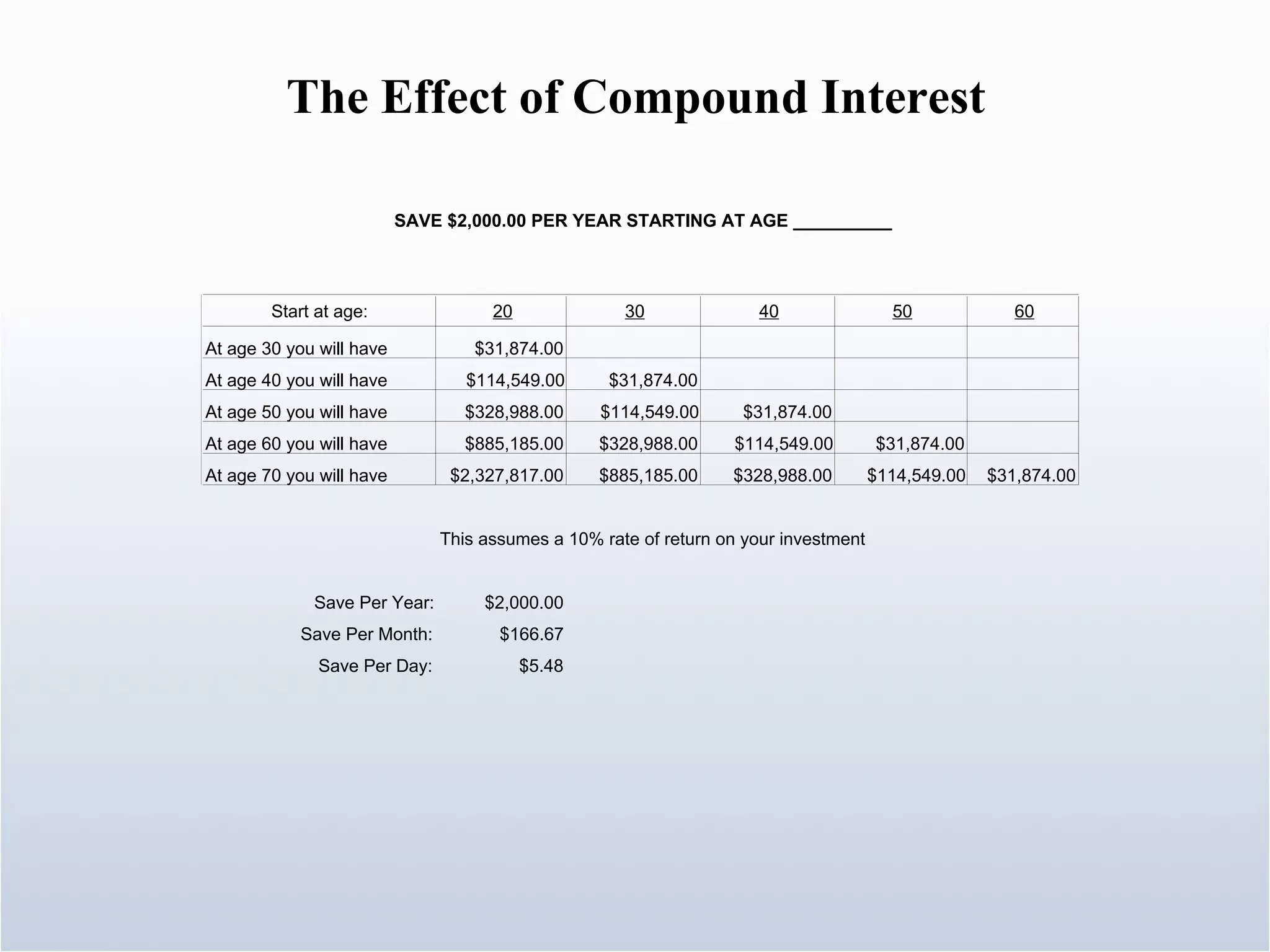
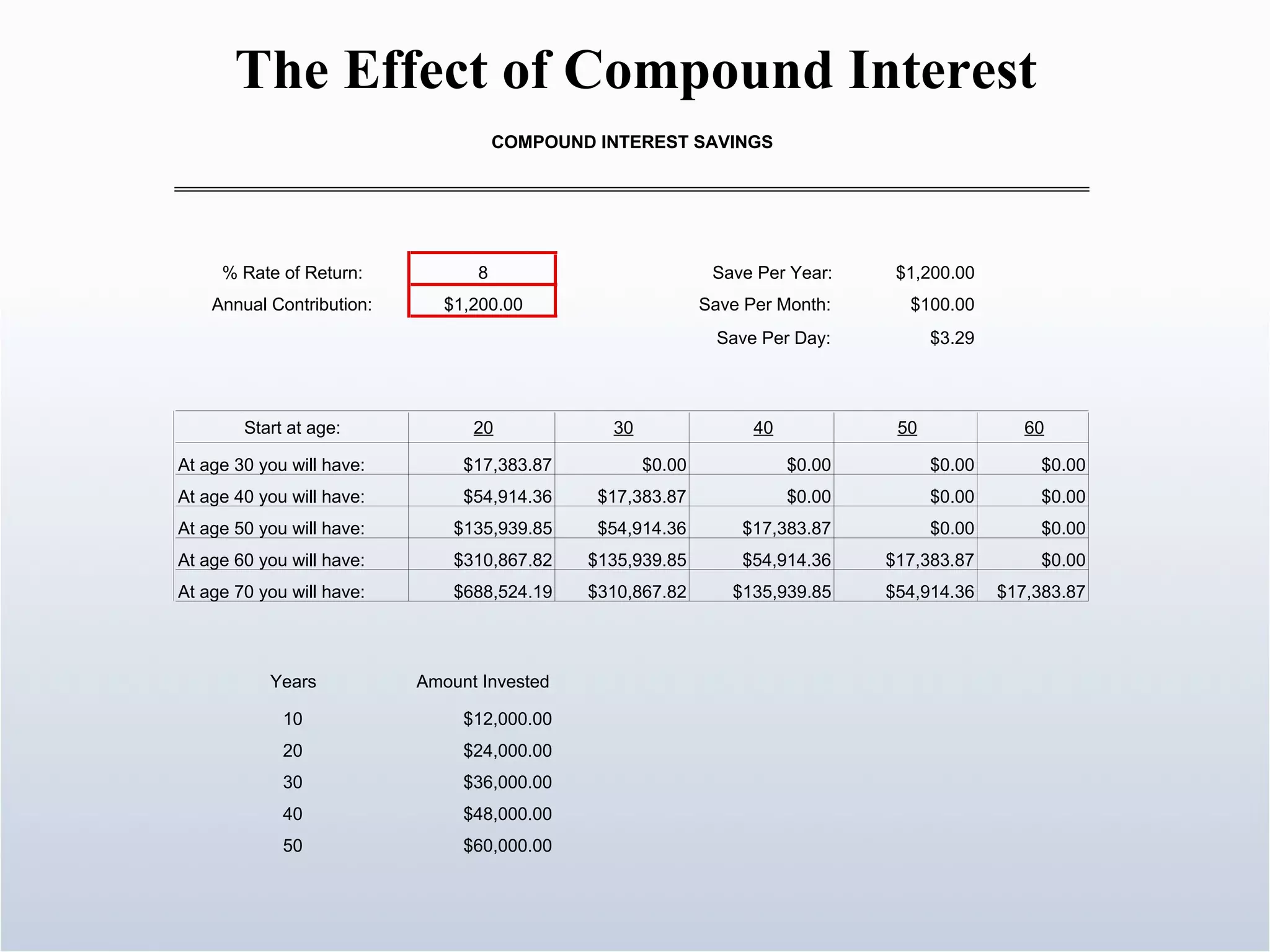
The Effect of Compound Interest
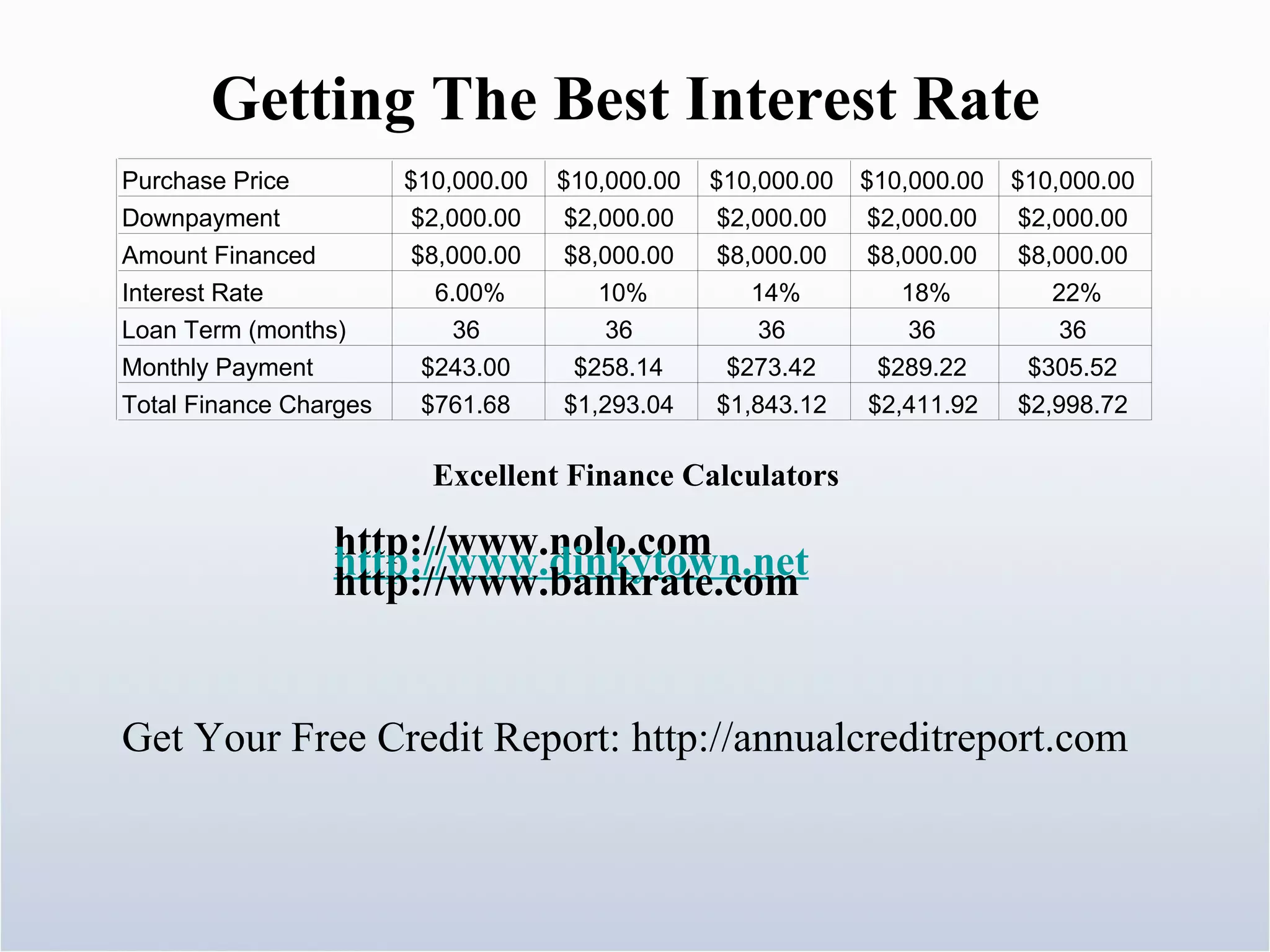
Getting The Best Interest Rate Excellent Finance Calculators http://www.nolo.com http://www.dinkytown.net http://www.bankrate.com Get Your Free Credit Report: http://annualcreditreport.com
The Effects of Compound Interest And Money Trivia Questions
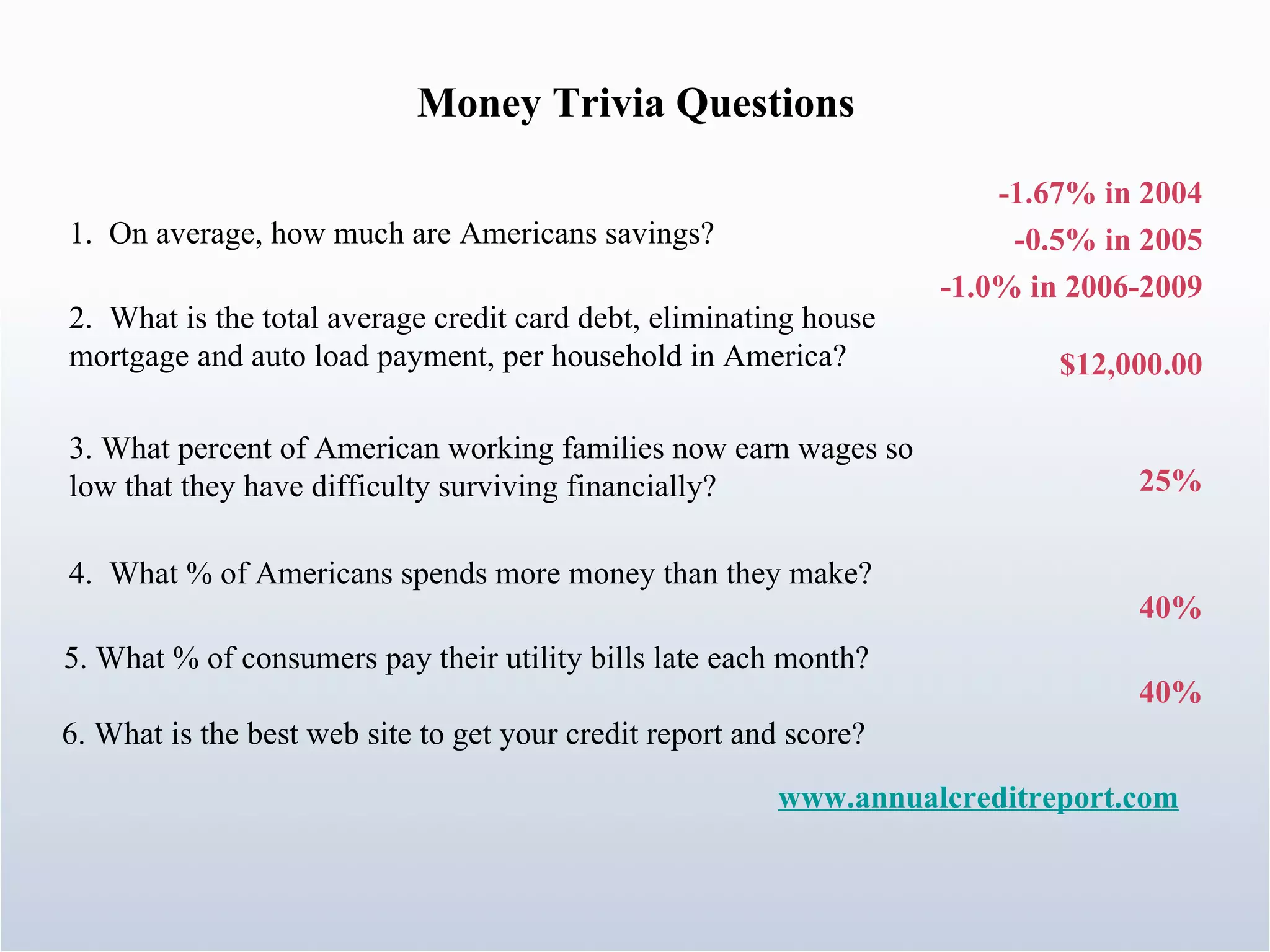
Money Trivia Questions 3. What percent of American working families now earn wages so low that they have difficulty surviving financially? 1.  On average, how much are Americans savings? -1.67% in 2004 -0.5% in 2005 -1.0% in 2006-2009 2.  What is the total average credit card debt, eliminating house mortgage and auto load payment, per household in America? $12,000.00 25% 4.  What % of Americans spends more money than they make?  40% 5. What % of consumers pay their utility bills late each month? 40% 6. What is the best web site to get your credit report and score? www.annualcreditreport.com
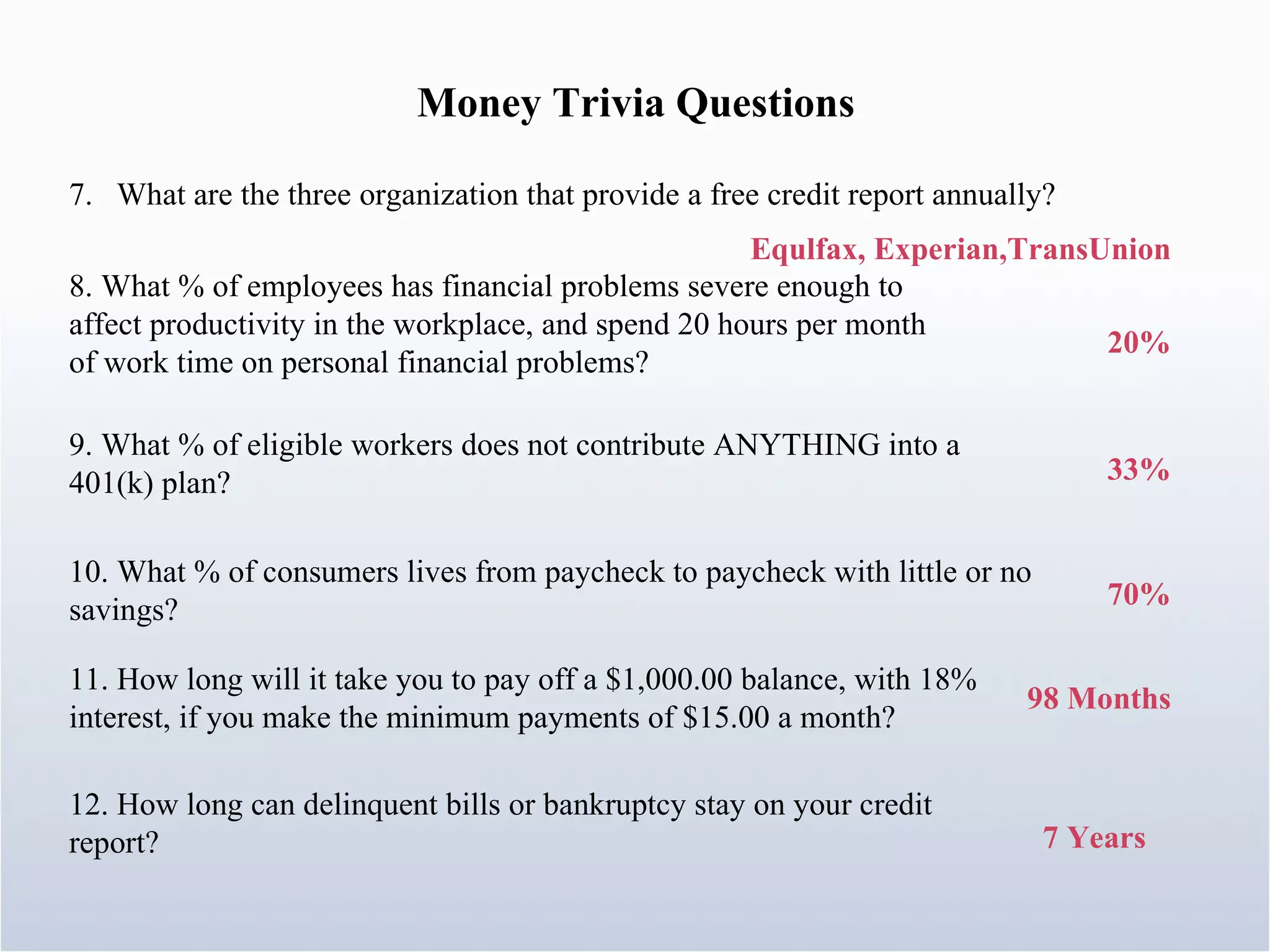
Money Trivia Questions 9. What % of eligible workers does not contribute ANYTHING into a 401(k) plan? 7. What are the three organization that provide a free credit report annually? Equlfax, Experian,TransUnion 8. What % of employees has financial problems severe enough to affect productivity in the workplace, and spend 20 hours per month of work time on personal financial problems? 20% 33% 10. What % of consumers lives from paycheck to paycheck with little or no savings?  98 Months 11. How long will it take you to pay off a $1,000.00 balance, with 18% interest, if you make the minimum payments of $15.00 a month? 12. How long can delinquent bills or bankruptcy stay on your credit report? 7 Years 70%
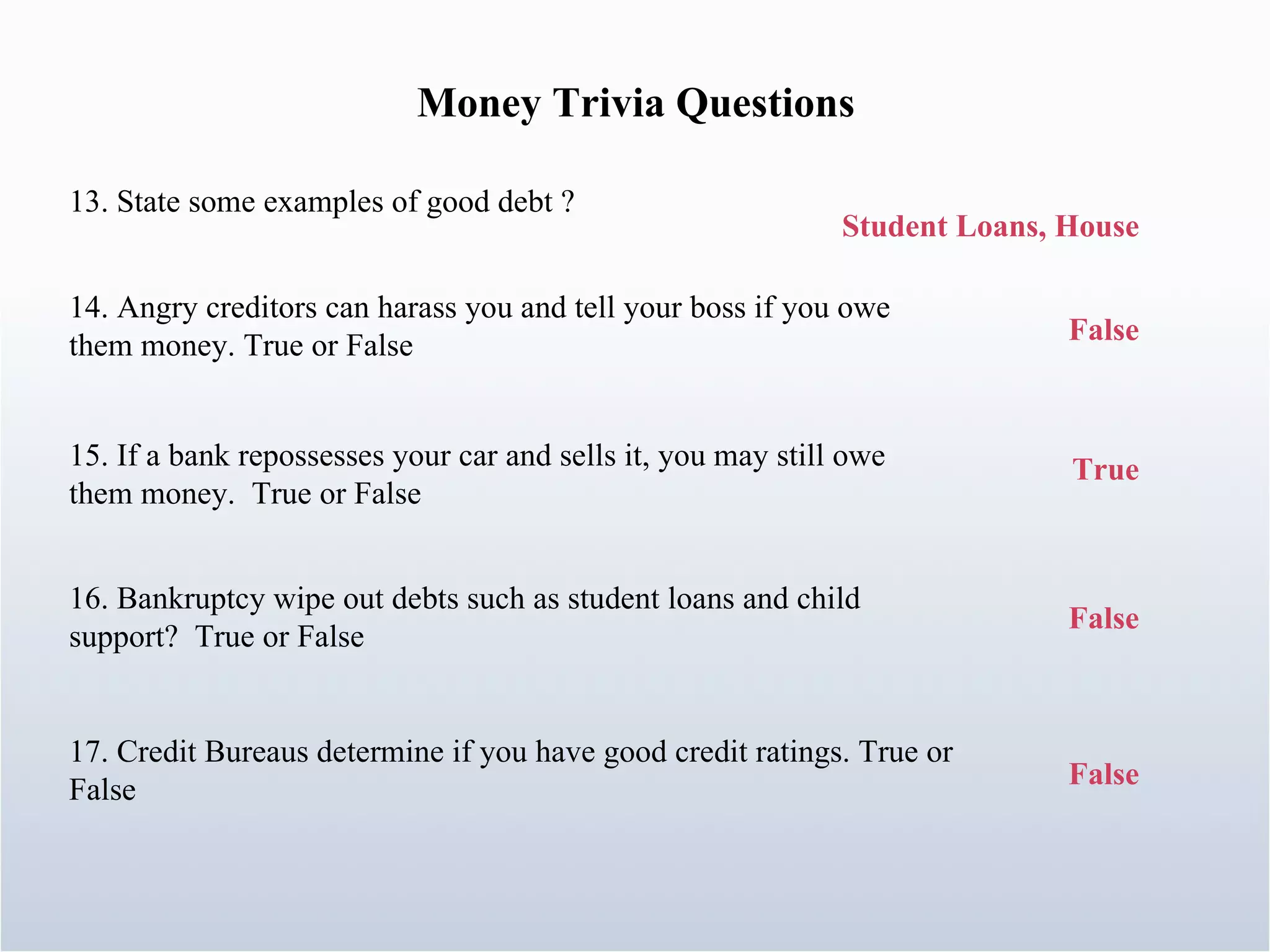
Money Trivia Questions 15. If a bank repossesses your car and sells it, you may still owe them money.  True or False 13. State some examples of good debt ? Student Loans, House 14. Angry creditors can harass you and tell your boss if you owe them money. True or False False True 16. Bankruptcy wipe out debts such as student loans and child support?  True or False 17. Credit Bureaus determine if you have good credit ratings. True or False False False
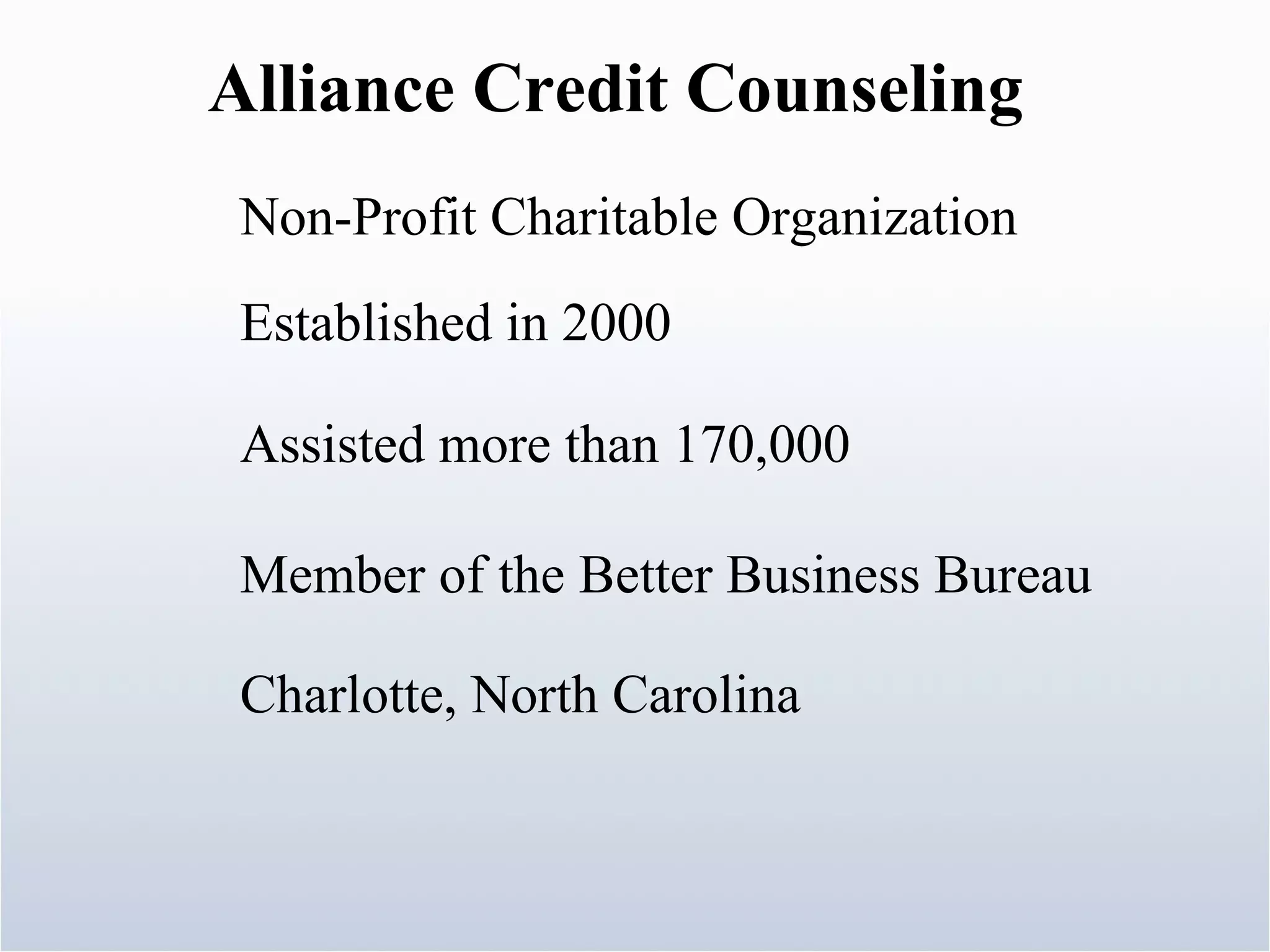
Alliance Credit Counseling Non-Profit Charitable Organization Established in 2000 Assisted more than 170,000 Member of the Better Business Bureau Charlotte, North Carolina
Monday-Thursday 9am-9pm Friday 9am-8pm Alliance Credit Counseling Saturday 9am-5pm 704-341-1010 1-888-995-7856
Alliance Credit Counseling Interactive Calculators Free Educational Information WWW.KNOWDEBT.ORG Links to Other Helpful Websites Budget Information
Our Mission: Provide help and hope through charitable relief to the poor and distressed by personalized education, counseling, and support programs that reduce and avoid the burdens of financial crisis, debt stress, bankruptcy, and their consequences. Provide empowerment to the public through charitable education programs of financial literacy, money management, credit management, and debt reduction to help meet life's challenges and opportunities.

Budget • savings • templete (august 2010) ppt

  • 1.
    ALLIANCE CREDIT COUNSELINGEd Gilliam Community Outreach 888-995-7856, ext. 385 • 704-943-0385
  • 2.
    How to EstablishCredit and Live Within a Budget
  • 3.
    Things That CouldHappen If You Don’t? Why is Establishing Good Credit Important? Utilities Car Loans Apartments Certain Jobs Credit Cards Student Loans Personal Loans
  • 4.
    How to EstablishCredit Obtain Employment Establish a Checking & Savings Account Make Regular Deposits Balance Your Check Book Daily Reconcile Your Bank Statement Monthly Apply for a Single Credit Card and / or Signature Loan from The Bank Repay Loan over 6 to 9 Months
  • 5.
    Things Not ToDo Apply for: Gas Cards Store Cards “ High” Interest Credit Cards Obtain Too Many Lines of Credit
  • 6.
    How to ManageCredit Pay Your Bills on Time Keep Your Creditors Informed Have Some Credit, but Not Too Much No More Than ONE Credit Card Get Free Credit Report at: https://annualcreditreport.com
  • 7.
    How to ManageCredit Don’t “Max” Out Credit Cards Maximum 80% or Below Limit Your use of the Cards Total Monthly Payments < 20% of Income Pay Down or Pay Off Ex. Net Monthly Income/5 = DTI Ratio 600 Net Monthly Income/5 = $120 on Debt Payments, Other Than Housing
  • 8.
    Financially Stressed ConsumersWith Outstanding Debt Were Asked: “ Do you feel your health has been affected by your financial problems? If yes, please explain.
  • 9.
    The average American spends $1.22 for every $1.00 they make! That means if you make $30,000 a year, you’re spending $36,600!? Nearly 70% of Americans with credit card debt only pay the minimum monthly amount If they charge a $12.00 pizza, it could take over $100 after months of payments 33% of Americans did not understand that prospective employers may pull their credit report Most do not truly understand how a credit report/score can affect their lives The average American adult receives a failing grade for their knowledge of basic economic concepts! They don’t understand how to properly budget, save, or invest Bottom Line? You can’t afford to be average!! Source: Financial Literacy and Education Commission – Jan 07; National Council on Economic Education America’s Financial Culture*
  • 10.
    CEO Real StoriesFarmer Chemical Engineer Professional Football Player Professional Baseball Scout
  • 11.
  • 12.
    A Sum ofMoney Allocated for a Particular Purpose (Spending Plan) What is a Budget? Telling Your Money What to Do Instead of Wondering What Happened to It Not a Straight Jacket
  • 13.
    To Meet YourPresent Obligations Why Set Up A Budget? Not Having to Call Mom or Dad Not Over Extend Yourself Prepare For The Future Reduce Stress Save Money
  • 14.
    Time Obstacles InBudget Setting Money Planning Confusion Commitment Procrastination
  • 15.
    Better Spending &Saving Habits Benefits of a Budget Enough Money to Cover All the Daily Expenses Lets You Feel You Are in Control of Your Financial Situation Allows You to Enjoy Your Time in College without stressing over money
  • 16.
    Housing (Rent orDorms) Food (Eat in More Than Eat Out!) Utilities (Power, Water-NOT Both Cell & Land Phone!) Clothing (Not Designer Brands!) Transportation (Insurance Also) Social Life Budget Needs
  • 17.
    Answer the FollowingQuestions: Guidelines For Setting Up A Budget Save More Spend Less Make It Happen Allocate Each Dollar for Something Appropriate to Your Needs Budgets Change As Time Goes by
  • 18.
    Alliance Credit CounselingSAMPLE DEBT MANAGEMENT PROGRAM
  • 19.
    Alliance Credit CounselingSAMPLE DEBT MANAGEMENT PROGRAM
  • 20.
  • 21.
    Time Value ofMoney Save $1.67/day, $50/mo, $600/year Age Invest Value 20 $600 $630 21 $600 $1,292 22 $600 $1,986 23 $600 $2,715 24 $600 $3,481 25 $600 $4,285 26 $600 $5,129 27 $600 $6,016 28 $600 $6,947 29 $600 $7,924 65 $6,000 $45,895 Based on earning a 5% return Age Invest Value 20 $600 $660 21 $600 $1,386 22 $600 $2,185 23 $600 $3,063 24 $600 $4,029 25 $600 $5,092 26 $600 $6,262 27 $600 $7,548 28 $600 $8,962 29 $600 $10,519 65 $6,000 $325,161 Based on earning a 10% return
  • 22.
    Time Value ofMoney Age Invest Value 18 $3,000.00 $3,300 19 $3,000.00 $6,930 20 $3,000.00 $10,923 21 $3,000.00 $15,315 22 $3,000.00 $20,147 65 $1,213,646 Based on earning a 10% return Age Invest Value 18 $3,000.00 $3,150 19 $3,000.00 $6,458 20 $3,000.00 $9,930 21 $3,000.00 $13,577 22 $3,000.00 $17,406 65 $141,851 Based on earning a 5% return
  • 23.
    Time Value ofMoney Age Invest Value 18 $2,000 $2,200 19 $2,000 $4,620 20 $2,000 $7,882 21 $2,000 $10,210 22 $2,000 $13,431 65 $10,000 $809,098 Based on earning a 10% return Based on earning a 5% return Age Invest Value 18 $2,000 $2,100 19 $2,000 $4,305 20 $2,000 $6,620 21 $2,000 $9,051 22 $2,000 $11,604 65 $10,000 $94,567
  • 24.
    Time Value ofMoney Age Invest Value 18 $1,200 $1,320 19 $1,200 $2,772 20 $1,200 $4,369 21 $1,200 $6,126 22 $1,200 $8,059 65 $6,000 $441,326 Based on earning a 10% return Based on earning a 5% return Age Invest Value 18 $1,200 $1,260 19 $1,200 $2,583 20 $1,200 $3,972 21 $1,200 $5,431 22 $1,200 $6,962 65 $6,000 $54,038
  • 25.
    Doubling Your MoneyEvery Day Day Amount 1 $0.01 2 $0.02 3 $0.04 4 $0.08 5 $0.16 6 $0.32 7 $0.64 8 $1.28 9 $2.56 10 $5.12 11 $10.24 12 $20.48 13 $40.96 14 $81.92 15 $163.84 Day Amount 16 $327.68 17 $655.36 18 $1,310.72 19 $2,621.44 20 $5,242.88 21 $10,485.76 22 $20,971.52 23 $41,943.04 24 $83,866.08 25 $167,772.16 26 $335,544.32 27 $671,088.64 28 $1,342,177.28 29 $2,684,354.56 30 $5,368,709.12
  • 26.
    The Effect ofCompound Interest
  • 27.
    The Effect ofCompound Interest
  • 28.
    Getting The BestInterest Rate Excellent Finance Calculators http://www.nolo.com http://www.dinkytown.net http://www.bankrate.com Get Your Free Credit Report: http://annualcreditreport.com
  • 29.
    The Effects ofCompound Interest And Money Trivia Questions
  • 30.
    Money Trivia Questions3. What percent of American working families now earn wages so low that they have difficulty surviving financially? 1. On average, how much are Americans savings? -1.67% in 2004 -0.5% in 2005 -1.0% in 2006-2009 2. What is the total average credit card debt, eliminating house mortgage and auto load payment, per household in America? $12,000.00 25% 4. What % of Americans spends more money than they make? 40% 5. What % of consumers pay their utility bills late each month? 40% 6. What is the best web site to get your credit report and score? www.annualcreditreport.com
  • 31.
    Money Trivia Questions9. What % of eligible workers does not contribute ANYTHING into a 401(k) plan? 7. What are the three organization that provide a free credit report annually? Equlfax, Experian,TransUnion 8. What % of employees has financial problems severe enough to affect productivity in the workplace, and spend 20 hours per month of work time on personal financial problems? 20% 33% 10. What % of consumers lives from paycheck to paycheck with little or no savings? 98 Months 11. How long will it take you to pay off a $1,000.00 balance, with 18% interest, if you make the minimum payments of $15.00 a month? 12. How long can delinquent bills or bankruptcy stay on your credit report? 7 Years 70%
  • 32.
    Money Trivia Questions15. If a bank repossesses your car and sells it, you may still owe them money. True or False 13. State some examples of good debt ? Student Loans, House 14. Angry creditors can harass you and tell your boss if you owe them money. True or False False True 16. Bankruptcy wipe out debts such as student loans and child support? True or False 17. Credit Bureaus determine if you have good credit ratings. True or False False False
  • 33.
    Alliance Credit CounselingNon-Profit Charitable Organization Established in 2000 Assisted more than 170,000 Member of the Better Business Bureau Charlotte, North Carolina
  • 34.
    Monday-Thursday 9am-9pm Friday9am-8pm Alliance Credit Counseling Saturday 9am-5pm 704-341-1010 1-888-995-7856
  • 35.
    Alliance Credit CounselingInteractive Calculators Free Educational Information WWW.KNOWDEBT.ORG Links to Other Helpful Websites Budget Information
  • 36.
    Our Mission: Providehelp and hope through charitable relief to the poor and distressed by personalized education, counseling, and support programs that reduce and avoid the burdens of financial crisis, debt stress, bankruptcy, and their consequences. Provide empowerment to the public through charitable education programs of financial literacy, money management, credit management, and debt reduction to help meet life's challenges and opportunities.

Editor's Notes

  • #2 Presentation copyright 2006 by Alliance Credit Counseling.