Money Talk:
Women’s Financial Education Series
Session 1
Financial Basics
Jennifer Abel
Virginia Cooperative Extension
jabel@vt.edu
703-228-641
Why a Special Financial Course
For Women?
• Women live longer, on average
• Women earn less, on average
• Women are more likely to have “gaps” in
employment
• Women are impacted more severely by divorce
& widowhood
• Many women lack financial experience
Course Series Objectives
• Increased knowledge of financial topics
• Increased desire to learn more about money
• Increased confidence in financial decisions
• Improved financial record-keeping
• Improved family communication about
financial issues
• “No question is a dumb question” philosophy
Let’s Get To Know One Another
Money Coat of Arms
What to write in the quadrants
• One thing you do well with money
• One thing you don’t do well with money
• A money motto
• One way you enjoy spending money
• A way you have a hard time spending money
Session 1 Lessons
• Understanding Your Relationship to Money
• Money Values and Goals
• Testing Your Financial Fitness
• Managing Household Cash Flow
• Calculating Your Net Worth
• Tips For Smarter Borrowing
• Financial Record-Keeping
Money Values
• Personal beliefs about what is important
• Guide how people spend time
• Guide how people spend money
• Examples:
– family togetherness
– religion/faith
– job success
– education
What are 10 things
that you like to do?
Financial Goals Reflect Values
• Goals should be SMART
– Specific
– Measurable
– Attainable
– Realistic
– Time-related
• Short-term (less than 3 years)
• Intermediate-term (3-10 years)
• Long-term (more than 10 years)
SMART Goal Example
• SPECIFIC: 2011 Honda Accord
• MEASURABLE: Save $3,500 down payment
• ATTAINABLE: Have $2,000, save $250/mo.
• REALISTIC: Yes
• TIME-RELATED: Dec. 2014
What Are Your Financial Goals?
Testing Your Financial Fitness
• As important as an annual physical
• Monitors progress
• Identifies weaknesses
• Identifies needed action Take the Financial Fitness Quiz
Exercise I-5
Managing Household Cash Flow
• Relationship between income and expenses
– Positive cash flow
– Negative cash flow
• Three ways to improve cash flow
– Increase household income
– Decrease household expenses
– Do both
Ways to Increase Income
• Adjust tax withholding/tax benefits (EITC)
• Add a second job or work overtime
• Start a small business
• Increase/collect child support/alimony
• Access public benefits
• Sell assets
• Upgrade job skills
• Charge adult children room & board
• Bartering
• Other?
Ways to Reduce Expenses
• Housing
• Food
• Transportation
• Clothing
• Utilities
• Other expenses
How to Develop a Spending Plan
• Add up take-home income
• Total fixed expenses (e.g., rent or mortgage)
• Total flexible expenses (e.g., food)
• Pro-rate (1/12 per mo.) occasional expenses
• Include money for emergencies
• Include money for financial goals
• Balance the bottom line: income = expenses
• Take Action!
Calculating Your Net Worth
All Assets (everything you own)
• Cash/liquid assets
• Investments
• Use assets/personal property
All Debts (everything you owe)
•Current debts
•Mortgages
•Loans
Assets - Debts = Net Worth
Why Calculate Net Worth?
• Measure financial progress
• Identify problems and gaps
– High household debt
– Lack of diversification
– Inadequate emergency savings
• Identify financial strengths
• Calculate home equity
• Information required for loans & divorces
Tips For Calculating Net Worth
• Try to do around the same time each year
• Use “fair market value” for property
• Use account statements or newspaper listings
for savings and investments
• You may need others for assistance:
– Real estate agent for house value analysis
– Human resources department for pension data
– Insurance agent for cash value life insurance
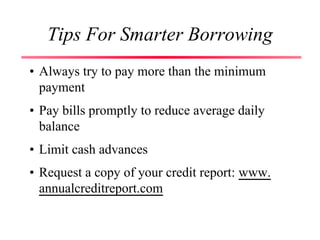
Tips For Smarter Borrowing
• Always try to pay more than the minimum
payment
• Pay bills promptly to reduce average daily
balance
• Limit cash advances
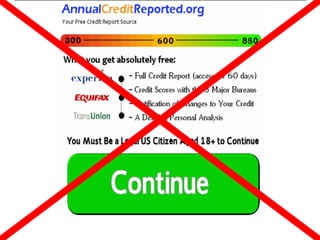
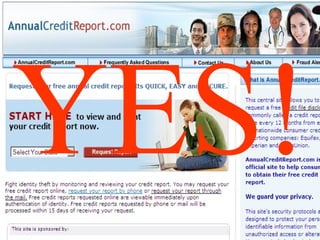
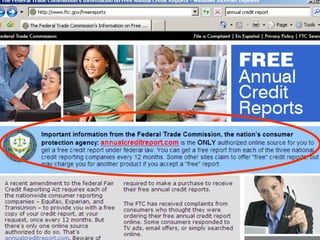
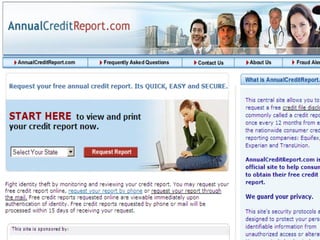
• Request a copy of your credit report: www.
annualcreditreport.com
YES!
Says
Who?
Methods of checking your report
• On-line: www.annualcreditreport.com
• By phone: 1-877-322-8228
• By mail:
– Annual Credit Report Request Service
P.O. Box 105281
Atlanta, GA 30348-5281
Credit Score: FICO
• A number between 350 and 850 that reflects
your creditworthiness
• Not provided with your free report; must pay
fee of $7.95 per report to obtain score
• Mortgage and auto lenders now required to
divulge your score when evaluating your credit
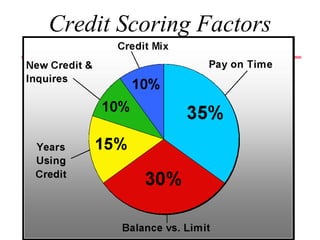
Credit Scoring Factors
More Credit Tips
• Make a list of credit card accounts
• Have a credit card in your name
• Select credit cards that match debt repayment
style
– Revolver- low interest rate
– Convenience user- no annual fee & grace
period
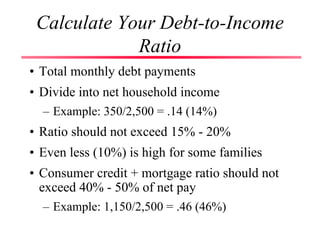
Calculate Your Debt-to-Income
Ratio
• Total monthly debt payments
• Divide into net household income
– Example: 350/2,500 = .14 (14%)
• Ratio should not exceed 15% - 20%
• Even less (10%) is high for some families
• Consumer credit + mortgage ratio should not
exceed 40% - 50% of net pay
– Example: 1,150/2,500 = .46 (46%)
Beware of Credit Card Traps
• Late fees
• Over-the-limit fees
• Penalty APRs
• Balance transfer fees
• Skip-a-month offers
Financial Records
• Prove that bills are paid
• Save time and reduce stress
• Show legal proof of events
• Document tax deductions
• Help dispute errors
• Document benefit claims
• Expedite payments
• Simplify your financial affairs
Three Places to Store Household
Records
• Safe deposit box at bank
– Papers difficult to replace (e.g., car title)
– Papers of “historical” value (e.g., deed)
• Active Home Storage
– Papers that are referred to frequently
– Recent bills, statements, tax returns, etc.
• Inactive Home Storage
– Older records
– Copies of documents in safe deposit box
Take Your Time and
Don’t Be Overwhelmed!
Each small step is progress
which moves you closer to
your goals.
“If it is to be,
it is up to me.”
Class Wrap-Up
• Questions?
• Comments?
• Experiences?
• Next week’s class topic: insurance

Money talk session #1

  • 1.
    Money Talk: Women’s FinancialEducation Series Session 1 Financial Basics Jennifer Abel Virginia Cooperative Extension jabel@vt.edu 703-228-641
  • 2.
    Why a SpecialFinancial Course For Women? • Women live longer, on average • Women earn less, on average • Women are more likely to have “gaps” in employment • Women are impacted more severely by divorce & widowhood • Many women lack financial experience
  • 3.
    Course Series Objectives •Increased knowledge of financial topics • Increased desire to learn more about money • Increased confidence in financial decisions • Improved financial record-keeping • Improved family communication about financial issues • “No question is a dumb question” philosophy
  • 4.
    Let’s Get ToKnow One Another Money Coat of Arms
  • 5.
    What to writein the quadrants • One thing you do well with money • One thing you don’t do well with money • A money motto • One way you enjoy spending money • A way you have a hard time spending money
  • 6.
    Session 1 Lessons •Understanding Your Relationship to Money • Money Values and Goals • Testing Your Financial Fitness • Managing Household Cash Flow • Calculating Your Net Worth • Tips For Smarter Borrowing • Financial Record-Keeping
  • 7.
    Money Values • Personalbeliefs about what is important • Guide how people spend time • Guide how people spend money • Examples: – family togetherness – religion/faith – job success – education What are 10 things that you like to do?
  • 8.
    Financial Goals ReflectValues • Goals should be SMART – Specific – Measurable – Attainable – Realistic – Time-related • Short-term (less than 3 years) • Intermediate-term (3-10 years) • Long-term (more than 10 years)
  • 9.
    SMART Goal Example •SPECIFIC: 2011 Honda Accord • MEASURABLE: Save $3,500 down payment • ATTAINABLE: Have $2,000, save $250/mo. • REALISTIC: Yes • TIME-RELATED: Dec. 2014
  • 10.
    What Are YourFinancial Goals?
  • 11.
    Testing Your FinancialFitness • As important as an annual physical • Monitors progress • Identifies weaknesses • Identifies needed action Take the Financial Fitness Quiz Exercise I-5
  • 12.
    Managing Household CashFlow • Relationship between income and expenses – Positive cash flow – Negative cash flow • Three ways to improve cash flow – Increase household income – Decrease household expenses – Do both
  • 13.
    Ways to IncreaseIncome • Adjust tax withholding/tax benefits (EITC) • Add a second job or work overtime • Start a small business • Increase/collect child support/alimony • Access public benefits • Sell assets • Upgrade job skills • Charge adult children room & board • Bartering • Other?
  • 14.
    Ways to ReduceExpenses • Housing • Food • Transportation • Clothing • Utilities • Other expenses
  • 15.
    How to Developa Spending Plan • Add up take-home income • Total fixed expenses (e.g., rent or mortgage) • Total flexible expenses (e.g., food) • Pro-rate (1/12 per mo.) occasional expenses • Include money for emergencies • Include money for financial goals • Balance the bottom line: income = expenses • Take Action!
  • 16.
    Calculating Your NetWorth All Assets (everything you own) • Cash/liquid assets • Investments • Use assets/personal property All Debts (everything you owe) •Current debts •Mortgages •Loans Assets - Debts = Net Worth
  • 17.
    Why Calculate NetWorth? • Measure financial progress • Identify problems and gaps – High household debt – Lack of diversification – Inadequate emergency savings • Identify financial strengths • Calculate home equity • Information required for loans & divorces
  • 18.
    Tips For CalculatingNet Worth • Try to do around the same time each year • Use “fair market value” for property • Use account statements or newspaper listings for savings and investments • You may need others for assistance: – Real estate agent for house value analysis – Human resources department for pension data – Insurance agent for cash value life insurance
  • 19.
    Tips For SmarterBorrowing • Always try to pay more than the minimum payment • Pay bills promptly to reduce average daily balance • Limit cash advances • Request a copy of your credit report: www. annualcreditreport.com
  • 22.
  • 23.
  • 25.
    Methods of checkingyour report • On-line: www.annualcreditreport.com • By phone: 1-877-322-8228 • By mail: – Annual Credit Report Request Service P.O. Box 105281 Atlanta, GA 30348-5281
  • 26.
    Credit Score: FICO •A number between 350 and 850 that reflects your creditworthiness • Not provided with your free report; must pay fee of $7.95 per report to obtain score • Mortgage and auto lenders now required to divulge your score when evaluating your credit
  • 27.
  • 28.
    More Credit Tips •Make a list of credit card accounts • Have a credit card in your name • Select credit cards that match debt repayment style – Revolver- low interest rate – Convenience user- no annual fee & grace period
  • 29.
    Calculate Your Debt-to-Income Ratio •Total monthly debt payments • Divide into net household income – Example: 350/2,500 = .14 (14%) • Ratio should not exceed 15% - 20% • Even less (10%) is high for some families • Consumer credit + mortgage ratio should not exceed 40% - 50% of net pay – Example: 1,150/2,500 = .46 (46%)
  • 30.
    Beware of CreditCard Traps • Late fees • Over-the-limit fees • Penalty APRs • Balance transfer fees • Skip-a-month offers
  • 31.
    Financial Records • Provethat bills are paid • Save time and reduce stress • Show legal proof of events • Document tax deductions • Help dispute errors • Document benefit claims • Expedite payments • Simplify your financial affairs
  • 32.
    Three Places toStore Household Records • Safe deposit box at bank – Papers difficult to replace (e.g., car title) – Papers of “historical” value (e.g., deed) • Active Home Storage – Papers that are referred to frequently – Recent bills, statements, tax returns, etc. • Inactive Home Storage – Older records – Copies of documents in safe deposit box
  • 33.
    Take Your Timeand Don’t Be Overwhelmed! Each small step is progress which moves you closer to your goals. “If it is to be, it is up to me.”
  • 34.
    Class Wrap-Up • Questions? •Comments? • Experiences? • Next week’s class topic: insurance