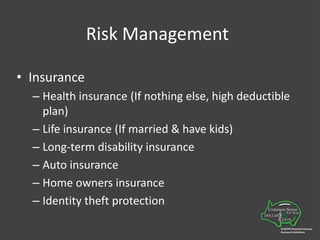
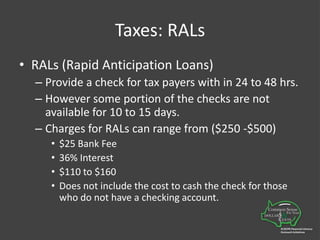
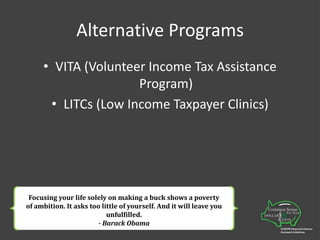
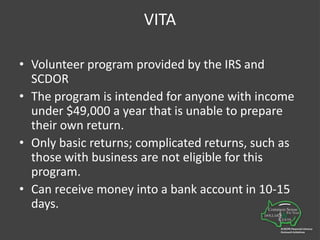
What Is Financial Literacy?Formal Definition: The ability to effectively evaluate and manage one’s finances in order to make prudent decisions toward reaching life’s goals.More simply: Knowing what you need to know to achieve your financial goals, or common sense with your dollars and cents.What we will cover:Money and savingsBudgeting (AKA cash flow)Debt/risk managementTaxes/basic financial concepts
America’s financial literacyAmerican families:The average American family spends $1.22 for every dollar it earns.One in five American families with annual household income of less than $50,000 is spending 40% of after-tax income to service its debt.In 2003, the average American household owed over $8,000 in credit cards, compared to $2,600 in 1989.In 2005, over 2 million Americans filed for bankruptcy – the highest amount in history.
America’s financial literacyAmerican families: (continued)Only 26% of teens understand how card interest and fees work. (2007 Charles Schwab Teens & Money Survey)The average college senior will graduate with $4,100 in credit card debt before they even have a job. (Sallie Mae’s 2009 National Study of Usage Rates and Trends)Nearly 20% of bankruptcy filers are college students. (Sallie Mae’s 2009 National Study of Usage Rates and Trends)
Money and SavingsTime is moneyContinuous educationSavings and the power of compounding interest“Make all you can, save all you can, give all you can.”- John Wesley
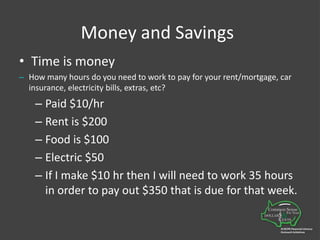
Money and SavingsTime is moneyHow many hours do you need to work to pay for your rent/mortgage, car insurance, electricity bills, extras, etc?Paid $10/hrRent is $200Food is $100Electric $50If I make $10 hr then I will need to work 35 hours in order to pay out $350 that is due for that week.
Money and SavingsContinuing EducationCongratulations!The other side of the time equationMore knowledge/skills = greater payYou will either learn to manage money, or the lack of it will always manage you! "All days are not same. Save for a rainy day. When you don't work, savings will work for you." - M.K. Soni
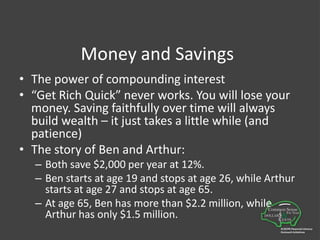
Money and SavingsThe power of compounding interest“Get Rich Quick” never works. You will lose your money. Saving faithfully over time will always build wealth – it just takes a little while (and patience)The story of Ben and Arthur:Both save $2,000 per year at 12%.  Ben starts at age 19 and stops at age 26, while Arthur starts at age 27 and stops at age 65.At age 65, Ben has more than $2.2 million, while Arthur has only $1.5 million.
Savings and Investing –8 Simple StrategiesStart smallContribute to your retirement planSave through payroll deduction plansRound up your mortgageBank your raisesKeep paying off a loanPay off your credit cardsKeep track of where the money goes"Money grows on the tree of patience." Proverb
Budgeting AKA Cash Flow ManagementBudgeting Prioritizing“Life is like a coin you can spend it only once.  Choosing one  thing over all the rest throughout life is a difficult thing to do.  This is especially true when the choices are so many and the possibilities are so close.” - Chuck SwindollYou can only spend what you have if you want to reach your financial goals.
Creating a BudgetYour financial plan
Track income and expenses
Unique to you
Budget necessities/priorities first
Communication (with family, spouse, roommate or partner)Today, there are three kinds of people: the have's, the have-not's, and the have-not-paid-for-what-they-have's. -Earl Wilson
BudgetingGross monthly incomeNet incomeFixed expensesFlexible expensesDiscretionary expensesTotal it upIncrease your savingsA nickel ain't worth a dime anymore. -Yogi Berra
Debt Management	Credit Cards	Pay Day Loans	Credit Reports
Know the EnemyIn 2003, 4 billion credit card offers were mailed
Capital One spends $280 million a year on credit cards offers
Citibank spends over $100 million a year on marketing to college students only
Debt Traps: Pay Day Loans, Title Loans, and Six month no interest credit card scamsIt is an unfortunate human failing that a full pocketbook often groans more loudly than an empty stomach. -Franklin Delano Roosevelt
Steps to Getting Out of DebtStop using credit cards and other types of creditHave a cash flow planSave $500 - $1000 for emergenciesSell something to pay off a debtUse money from a part-time job or overtime to payoff debtDevelop a plan to pay off your debt
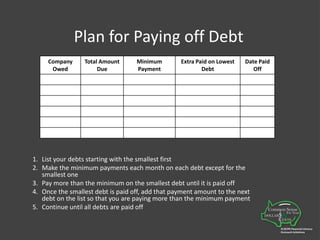
Plan for Paying off DebtList your debts starting with the smallest firstMake the minimum payments each month on each debt except for the smallest onePay more than the minimum on the smallest debt until it is paid offOnce the smallest debt is paid off, add that payment amount to the next debt on the list so that you are paying more than the minimum paymentContinue until all debts are paid off
Danger of Credit Cards – What You Don’t Know Can Hurt YouBe aware of teaser rates
Stick with one credit card
Pay in full every month
Stay within the limit
Review your statementsReport a lost or stolen card immediatelyProtect personal informationPay on timeAvoid cash advancesProtect your credit historyIf you think nobody cares if you're alive, try missing a couple of car payments. -Earl Wilson
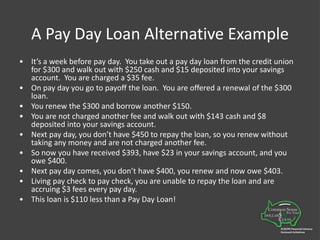
Pay Day LoansA Pay Day Loan is a small advance, usually $300 - $500
The borrower gives the lender a postdated check or other authorization to repay the loan on payday
On payday, the borrower must repay the loan, plus pay a fee, but is also given the option to renew the loan
The borrower is led to believe that he is receiving more money and the new fees applied are not explained until the debt amount is unmanageable and the borrower is trapped

Common Sense for your Dollars and Cents

  • 2.
    What Is FinancialLiteracy?Formal Definition: The ability to effectively evaluate and manage one’s finances in order to make prudent decisions toward reaching life’s goals.More simply: Knowing what you need to know to achieve your financial goals, or common sense with your dollars and cents.What we will cover:Money and savingsBudgeting (AKA cash flow)Debt/risk managementTaxes/basic financial concepts
  • 3.
    America’s financial literacyAmericanfamilies:The average American family spends $1.22 for every dollar it earns.One in five American families with annual household income of less than $50,000 is spending 40% of after-tax income to service its debt.In 2003, the average American household owed over $8,000 in credit cards, compared to $2,600 in 1989.In 2005, over 2 million Americans filed for bankruptcy – the highest amount in history.
  • 4.
    America’s financial literacyAmericanfamilies: (continued)Only 26% of teens understand how card interest and fees work. (2007 Charles Schwab Teens & Money Survey)The average college senior will graduate with $4,100 in credit card debt before they even have a job. (Sallie Mae’s 2009 National Study of Usage Rates and Trends)Nearly 20% of bankruptcy filers are college students. (Sallie Mae’s 2009 National Study of Usage Rates and Trends)
  • 5.
    Money and SavingsTimeis moneyContinuous educationSavings and the power of compounding interest“Make all you can, save all you can, give all you can.”- John Wesley
  • 6.
    Money and SavingsTimeis moneyHow many hours do you need to work to pay for your rent/mortgage, car insurance, electricity bills, extras, etc?Paid $10/hrRent is $200Food is $100Electric $50If I make $10 hr then I will need to work 35 hours in order to pay out $350 that is due for that week.
  • 7.
    Money and SavingsContinuingEducationCongratulations!The other side of the time equationMore knowledge/skills = greater payYou will either learn to manage money, or the lack of it will always manage you! "All days are not same. Save for a rainy day. When you don't work, savings will work for you." - M.K. Soni
  • 8.
    Money and SavingsThepower of compounding interest“Get Rich Quick” never works. You will lose your money. Saving faithfully over time will always build wealth – it just takes a little while (and patience)The story of Ben and Arthur:Both save $2,000 per year at 12%. Ben starts at age 19 and stops at age 26, while Arthur starts at age 27 and stops at age 65.At age 65, Ben has more than $2.2 million, while Arthur has only $1.5 million.
  • 9.
    Savings and Investing–8 Simple StrategiesStart smallContribute to your retirement planSave through payroll deduction plansRound up your mortgageBank your raisesKeep paying off a loanPay off your credit cardsKeep track of where the money goes"Money grows on the tree of patience." Proverb
  • 10.
    Budgeting AKA CashFlow ManagementBudgeting Prioritizing“Life is like a coin you can spend it only once. Choosing one thing over all the rest throughout life is a difficult thing to do. This is especially true when the choices are so many and the possibilities are so close.” - Chuck SwindollYou can only spend what you have if you want to reach your financial goals.
  • 11.
    Creating a BudgetYourfinancial plan
  • 12.
  • 13.
  • 14.
  • 15.
    Communication (with family,spouse, roommate or partner)Today, there are three kinds of people: the have's, the have-not's, and the have-not-paid-for-what-they-have's. -Earl Wilson
  • 16.
    BudgetingGross monthly incomeNetincomeFixed expensesFlexible expensesDiscretionary expensesTotal it upIncrease your savingsA nickel ain't worth a dime anymore. -Yogi Berra
  • 17.
    Debt Management Credit Cards PayDay Loans Credit Reports
  • 18.
    Know the EnemyIn2003, 4 billion credit card offers were mailed
  • 19.
    Capital One spends$280 million a year on credit cards offers
  • 20.
    Citibank spends over$100 million a year on marketing to college students only
  • 21.
    Debt Traps: PayDay Loans, Title Loans, and Six month no interest credit card scamsIt is an unfortunate human failing that a full pocketbook often groans more loudly than an empty stomach. -Franklin Delano Roosevelt
  • 22.
    Steps to GettingOut of DebtStop using credit cards and other types of creditHave a cash flow planSave $500 - $1000 for emergenciesSell something to pay off a debtUse money from a part-time job or overtime to payoff debtDevelop a plan to pay off your debt
  • 23.
    Plan for Payingoff DebtList your debts starting with the smallest firstMake the minimum payments each month on each debt except for the smallest onePay more than the minimum on the smallest debt until it is paid offOnce the smallest debt is paid off, add that payment amount to the next debt on the list so that you are paying more than the minimum paymentContinue until all debts are paid off
  • 24.
    Danger of CreditCards – What You Don’t Know Can Hurt YouBe aware of teaser rates
  • 25.
    Stick with onecredit card
  • 26.
    Pay in fullevery month
  • 27.
  • 28.
    Review your statementsReporta lost or stolen card immediatelyProtect personal informationPay on timeAvoid cash advancesProtect your credit historyIf you think nobody cares if you're alive, try missing a couple of car payments. -Earl Wilson
  • 29.
    Pay Day LoansAPay Day Loan is a small advance, usually $300 - $500
  • 30.
    The borrower givesthe lender a postdated check or other authorization to repay the loan on payday
  • 31.
    On payday, theborrower must repay the loan, plus pay a fee, but is also given the option to renew the loan
  • 32.
    The borrower isled to believe that he is receiving more money and the new fees applied are not explained until the debt amount is unmanageable and the borrower is trapped

Editor's Notes

  • #15 No interest for six months - 80% does not pay off and they go and back date the amount. Refer back to slide on 6% and 18% House & Credit Card companies building.
  • #16 Importance of an emergency fund: start with $500 to $1000. If less than 20k a year $500.What happens?Car brakes downLose your jobMedical expensesAppliance breaksAccording to Money Magazine 80% of people with have a major unexpected expense of 5 to 10 in any given 10 year period.Only 9% did not loss a job, have medical event, or a divorce.2 out 3 lost their jobs 66%“The Fragile middle class: American’s in debt” Written by Elizabeth Warren, Harvard Law School
  • #17 Give example.
  • #33 Story of Old Man.