Surviving Tough Times Series Life  Fundamental$ Money Management Seminars are a program of the  Kentucky Council on Economic Education presented by the Kentucky Society of CPAs © 2009
Credit  -  There’s No Such Thing as A Free Lunch
Learn credit statistics in America Learn how to shop for a credit card Know your debt-to-income ratio Learn the warning signs of too much debt Understand good debt/bad debt Use a repayment calculator to understand “cost” of borrowing over time Learn how to use your credit card responsibly Understand credit reports and FICO scores Learn how to order your free credit report Identify ways to build and repair credit history Learn about the new Fair Credit Report Act
Establish checking and savings bank accounts Have a good employment history H ave a good residence history Have utilities in your name Consider a department store card or gas card   Consider a secured loan   Consider  a secured credit card   Find a co-signer
First, figure out which kind of credit-card user  you are.  Are you an Emergency user Revolver Transactor   If you’re one who likes to carry a balance, your goal is to find the card with the lowest interest rate possible, so you can pay off your debt ASAP.  http://www.creditcardguide.com/ http://www.bankrate.com/funnel/credit-cards/credit-card-results.aspx http://www.creditcards.com
APR (fixed or variable) (multiple APRs) Grace period (20-25 days) Annual fee Cash advance fee  Balance-transfer fee  Late-payment fee  Over-the-credit-limit fee Credit-limit-increase fee  Return-item fee Other fees World’s Worst Credit Card  --  http://www.youtube.com/watch?v=FunpS4QXcRI&feature=related
Signed by President Obama on May 22, 2009. Goes into effect  between now and February 2010. (Dirty Little Credit Card Secrets)  http://www.youtube.com/watch?v=kHfN-YUkH1E&NR=1
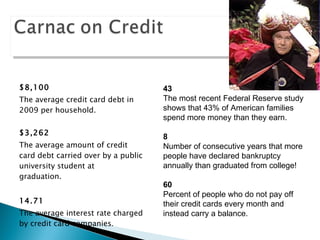
$8,100  The average credit card debt in 2009 per household.  $3,262 The average amount of credit card debt carried over by a public university student at graduation.      14.71 The average interest rate charged by credit card companies .      43 The most recent Federal Reserve study shows that 43% of American families spend more money than they earn.    8  Number of consecutive years that more people have declared bankruptcy annually than graduated from college!  60 Percent of people who do not pay off their credit cards every month and instead carry a balance.
Good Debt Secured Debt  (usually for appreciating assets  that increase wealth) New home College education Usually a low interest rate Bad Debt Unsecured loans (for consumables and depreciating assets, like food, clothing, vacations, etc.) Car loans Credit cards Usually higher interest rates
DTI Is your debt load compared to your income Should be less than 36%  (the lower the better) Debt includes all recurring debt, mortgage (PITI), credit cards, loans, Do not include food, utilities, gas in calculation. 10% or less Credit is in great shape. Loan applicants generally will be approved for low-rate loans. Will have no trouble getting credit cards. 11 - 20% Won't have trouble getting loans, but as people approach 20% they probably have too much debt. 21 – 35% Too much debt. Probably having trouble saving money 36-50% Need to develop a plan to get out of debt 50% + You need help. Make an appointment to see a credit counselor. econedlink.org
You don’t have any savings. You only make the minimum payment on your credit balance. You have more than 2 or 3 major credit cards. You are charging because you do not have the money. After you pay your credit card bill, you increase your balance by the same amount (or more) the following month. You have at least one credit card that is near or over the credit limit. You are occasionally late in making payments on bills, credit cards, or   other expenses. You don’t even know how much total debt you actually have. You use cash advances from your credit cards to pay other bills. You bounce checks or overdraw your bank accounts. You’ve been denied credit. You lie to friends or family about your spending and debt.
" My grandma used to say that if you're going to buy something that doesn't go up in value, and you can't afford to pay cash, then you can't afford it." If you eat it, drink it, or wear it, or it’s under $20, don’t use your credit card.
 
http://www.creditcardnation.com/calculator.html http://www.feedthepig.org/creditcardcalc http :// www.timevalue.com/calculators/credit-card-calculator.aspx
Highest interest rate first .  Paying off the credit card with highest interest rate will save you money in the long run, especially if the highest interest rate credit card also happens to be the card with the highest balance.  Lowest balance first .  There are immediate tangible benefits to paying off the credit card with the lowest balance first. The first balances are easier and quicker to pay off. When you finally pay off a bill, the feeling of accomplishment is motivation to keep you going.  You can then apply that month’s amount to another credit card payment!
1 .  Stop Borrowing!  2.  Know Exactly What Debts You Have  . Prioritize Your Debts and Establish a Debt Payoff Plan .  4.  Make Debt Payments Automatic. 5.  Re-evaluate your lifestyle.
Identifying Information. Your name, address, Social Security number, date of birth and employment information are used to identify you Account History. Detailed info about your accounts: balances, limits, payment history, including how many times and when you were 30, 60 or 90 days past due. Public Record and Collection Items.  i.e., bankruptcies, judgments, tax liens Credit Inquiries. The inquiries section contains a list of everyone who accessed your credit report within the last two years.   
Lenders  Insurance companies  Landlords seeking a credit check for renters  Credit card companies  Companies where you are seeking employment (only with your written consent)  Organizations considering your application for a government license or benefit (if the agency is required to consider your financial status)  State or local child support enforcement agencies  Government agencies (usually can only look at your name, address, former addresses, and current and former employers)  Other organizations you've initiated business with
Breaking down the numbers Score % of  population Score % of population 300-499 2% 650-699 15% 500-549 5% 700-749 18% 550-599 8% 750-799 27% 600-649 12% over 800 13%
History of payment (35%)  Are you paying on time? Balance and available credit (30%)  Are you keeping your balances low? Length of credit history (15%)  How long have you had accounts? Number of accounts and types of credit held (10%)  Do you  have too many open accounts? New credit (10%)  Do you apply for credit everywhere? Someone’s watching your credit activity…are you?
Pay your bills on time  (the longer you pay your bills  on time, the better your score) Keep balances low on credit cards and other “revolving  credit” Pay off debt rather than moving it around Don’t close unused credit cards as a short-term strategy to raise your score. Don’t open a number of new credit cards that you don’t need, just to increase your available credit. Note that closing an account doesn’t make it go away. Minimize the number of inquiries. If you have a bad credit history, consider opening new accounts and then paying them off on time.  http://www.youtube.com/watch?v=_Nd3ol6lLWQ http://www.youtube.com/watch?v=Sd8y9R36gcg&NR=1
Get free credit report annually from Equifax, Experian, and TransUnion Order from all three at once; or each at different times Note: you must “purchase” your credit (FICO) score If you are turned down for credit or if there is a fraud issue, you can get a free report at any time. Freecreditreport.com and others charge a “membership” fee for credit report and score.
BEWARE, if: Want you to pay for credit repair services before any services are provided  Do not tell you your legal rights an what you can do yourself– for free Recommend that you not contact a consumer reporting company directly Suggest that you try to invent a “new” credit report by applying for an EIN to use instead of your SS# Advises you to dispute all info in your credit report or take any action that seems illegal

Credit

  • 1.
    Surviving Tough TimesSeries Life Fundamental$ Money Management Seminars are a program of the Kentucky Council on Economic Education presented by the Kentucky Society of CPAs © 2009
  • 2.
    Credit - There’s No Such Thing as A Free Lunch
  • 3.
    Learn credit statisticsin America Learn how to shop for a credit card Know your debt-to-income ratio Learn the warning signs of too much debt Understand good debt/bad debt Use a repayment calculator to understand “cost” of borrowing over time Learn how to use your credit card responsibly Understand credit reports and FICO scores Learn how to order your free credit report Identify ways to build and repair credit history Learn about the new Fair Credit Report Act
  • 4.
    Establish checking andsavings bank accounts Have a good employment history H ave a good residence history Have utilities in your name Consider a department store card or gas card Consider a secured loan Consider a secured credit card Find a co-signer
  • 5.
    First, figure outwhich kind of credit-card user you are. Are you an Emergency user Revolver Transactor If you’re one who likes to carry a balance, your goal is to find the card with the lowest interest rate possible, so you can pay off your debt ASAP. http://www.creditcardguide.com/ http://www.bankrate.com/funnel/credit-cards/credit-card-results.aspx http://www.creditcards.com
  • 6.
    APR (fixed orvariable) (multiple APRs) Grace period (20-25 days) Annual fee Cash advance fee Balance-transfer fee Late-payment fee Over-the-credit-limit fee Credit-limit-increase fee Return-item fee Other fees World’s Worst Credit Card -- http://www.youtube.com/watch?v=FunpS4QXcRI&feature=related
  • 7.
    Signed by PresidentObama on May 22, 2009. Goes into effect between now and February 2010. (Dirty Little Credit Card Secrets) http://www.youtube.com/watch?v=kHfN-YUkH1E&NR=1
  • 8.
    $8,100 Theaverage credit card debt in 2009 per household. $3,262 The average amount of credit card debt carried over by a public university student at graduation.      14.71 The average interest rate charged by credit card companies .     43 The most recent Federal Reserve study shows that 43% of American families spend more money than they earn.   8 Number of consecutive years that more people have declared bankruptcy annually than graduated from college! 60 Percent of people who do not pay off their credit cards every month and instead carry a balance.
  • 9.
    Good Debt SecuredDebt (usually for appreciating assets that increase wealth) New home College education Usually a low interest rate Bad Debt Unsecured loans (for consumables and depreciating assets, like food, clothing, vacations, etc.) Car loans Credit cards Usually higher interest rates
  • 10.
    DTI Is yourdebt load compared to your income Should be less than 36% (the lower the better) Debt includes all recurring debt, mortgage (PITI), credit cards, loans, Do not include food, utilities, gas in calculation. 10% or less Credit is in great shape. Loan applicants generally will be approved for low-rate loans. Will have no trouble getting credit cards. 11 - 20% Won't have trouble getting loans, but as people approach 20% they probably have too much debt. 21 – 35% Too much debt. Probably having trouble saving money 36-50% Need to develop a plan to get out of debt 50% + You need help. Make an appointment to see a credit counselor. econedlink.org
  • 11.
    You don’t haveany savings. You only make the minimum payment on your credit balance. You have more than 2 or 3 major credit cards. You are charging because you do not have the money. After you pay your credit card bill, you increase your balance by the same amount (or more) the following month. You have at least one credit card that is near or over the credit limit. You are occasionally late in making payments on bills, credit cards, or other expenses. You don’t even know how much total debt you actually have. You use cash advances from your credit cards to pay other bills. You bounce checks or overdraw your bank accounts. You’ve been denied credit. You lie to friends or family about your spending and debt.
  • 12.
    " My grandmaused to say that if you're going to buy something that doesn't go up in value, and you can't afford to pay cash, then you can't afford it." If you eat it, drink it, or wear it, or it’s under $20, don’t use your credit card.
  • 13.
  • 14.
    http://www.creditcardnation.com/calculator.html http://www.feedthepig.org/creditcardcalc http:// www.timevalue.com/calculators/credit-card-calculator.aspx
  • 15.
    Highest interest ratefirst . Paying off the credit card with highest interest rate will save you money in the long run, especially if the highest interest rate credit card also happens to be the card with the highest balance. Lowest balance first . There are immediate tangible benefits to paying off the credit card with the lowest balance first. The first balances are easier and quicker to pay off. When you finally pay off a bill, the feeling of accomplishment is motivation to keep you going. You can then apply that month’s amount to another credit card payment!
  • 16.
    1 . Stop Borrowing! 2. Know Exactly What Debts You Have . Prioritize Your Debts and Establish a Debt Payoff Plan . 4. Make Debt Payments Automatic. 5. Re-evaluate your lifestyle.
  • 17.
    Identifying Information. Yourname, address, Social Security number, date of birth and employment information are used to identify you Account History. Detailed info about your accounts: balances, limits, payment history, including how many times and when you were 30, 60 or 90 days past due. Public Record and Collection Items. i.e., bankruptcies, judgments, tax liens Credit Inquiries. The inquiries section contains a list of everyone who accessed your credit report within the last two years.  
  • 18.
    Lenders Insurancecompanies Landlords seeking a credit check for renters Credit card companies Companies where you are seeking employment (only with your written consent) Organizations considering your application for a government license or benefit (if the agency is required to consider your financial status) State or local child support enforcement agencies Government agencies (usually can only look at your name, address, former addresses, and current and former employers) Other organizations you've initiated business with
  • 19.
    Breaking down thenumbers Score % of population Score % of population 300-499 2% 650-699 15% 500-549 5% 700-749 18% 550-599 8% 750-799 27% 600-649 12% over 800 13%
  • 20.
    History of payment(35%) Are you paying on time? Balance and available credit (30%) Are you keeping your balances low? Length of credit history (15%) How long have you had accounts? Number of accounts and types of credit held (10%) Do you have too many open accounts? New credit (10%) Do you apply for credit everywhere? Someone’s watching your credit activity…are you?
  • 21.
    Pay your billson time (the longer you pay your bills on time, the better your score) Keep balances low on credit cards and other “revolving credit” Pay off debt rather than moving it around Don’t close unused credit cards as a short-term strategy to raise your score. Don’t open a number of new credit cards that you don’t need, just to increase your available credit. Note that closing an account doesn’t make it go away. Minimize the number of inquiries. If you have a bad credit history, consider opening new accounts and then paying them off on time. http://www.youtube.com/watch?v=_Nd3ol6lLWQ http://www.youtube.com/watch?v=Sd8y9R36gcg&NR=1
  • 22.
    Get free creditreport annually from Equifax, Experian, and TransUnion Order from all three at once; or each at different times Note: you must “purchase” your credit (FICO) score If you are turned down for credit or if there is a fraud issue, you can get a free report at any time. Freecreditreport.com and others charge a “membership” fee for credit report and score.
  • 23.
    BEWARE, if: Wantyou to pay for credit repair services before any services are provided Do not tell you your legal rights an what you can do yourself– for free Recommend that you not contact a consumer reporting company directly Suggest that you try to invent a “new” credit report by applying for an EIN to use instead of your SS# Advises you to dispute all info in your credit report or take any action that seems illegal