By: 
admission.edhole.com
H. Garmestani, Professor 
School of Materials Science and Engineering 
Georgia Institute of Technology 
 Outline: 
 Materials Behavior 
Tensile behavior 
… 
admission.edhole.com
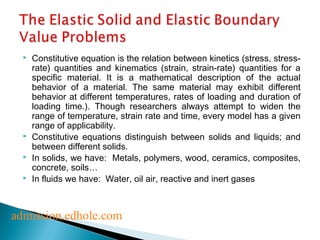
 Constitutive equation is the relation between kinetics (stress, stress-rate) 
quantities and kinematics (strain, strain-rate) quantities for a 
specific material. It is a mathematical description of the actual 
behavior of a material. The same material may exhibit different 
behavior at different temperatures, rates of loading and duration of 
loading time.). Though researchers always attempt to widen the 
range of temperature, strain rate and time, every model has a given 
range of applicability. 
 Constitutive equations distinguish between solids and liquids; and 
between different solids. 
 In solids, we have: Metals, polymers, wood, ceramics, composites, 
concrete, soils… 
 In fluids we have: Water, oil air, reactive and inert gases 
admission.edhole.com
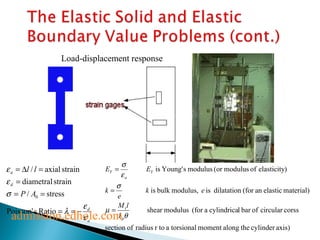
/ axial strain 
diametral strain 
/ stress 
l e 
d 
admission.edhole.com 
a 
e 
a 
e 
d 
l l 
= D = 
P A 
e 
s 
= = - 
= 
= = 
0 
Poisson's Ratio 
Load-displacement response 
is Young's modulus (or modulus of elasticity) 
E E 
Y 
k e 
is bulk modulus, is dilatation (for an elastic material) 
shear modulus (for a cylindrical bar of circular corss 
s 
e 
a 
= 
e 
M l 
t 
q 
Y 
k 
= 
m 
s 
p 
I 
= 
section of radius r to a torsional moment along the cylinder axis)
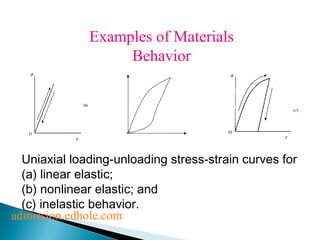
Examples of Materials 
Behavior 
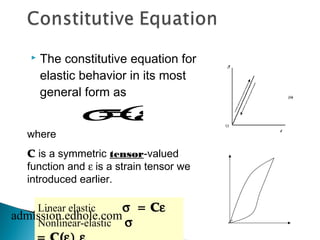
Uniaxial loading-unloading stress-strain curves for 
(a) linear elastic; 
(b) nonlinear elastic; and 
(c) inelastic behavior. 
admission.edhole.com
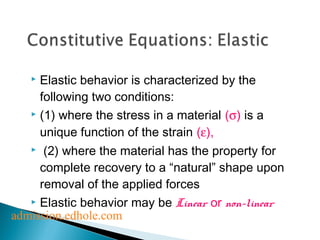
 Elastic behavior is characterized by the 
following two conditions: 
 (1) where the stress in a material (s) is a 
unique function of the strain (e), 
 (2) where the material has the property for 
complete recovery to a “natural” shape upon 
removal of the applied forces 
 Elastic behavior may be Linear or non-linear 
admission.edhole.com
 The constitutive equation for 
elastic behavior in its most 
general form as 
   
s=Ce 
where 
C is a symmetric tensor-valued 
function and e is a strain tensor we 
introduced earlier. 
Linear elastic s = Ce 
Nonlinear-elastic s 
= C(e) e 
admission.edhole.com
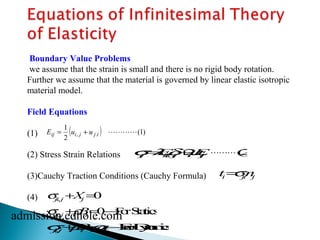
Boundary Value Problems 
we assume that the strain is small and there is no rigid body rotation. 
Further we assume that the material is governed by linear elastic isotropic 
material model. 
Field Equations 
(1) 
Eij = 1 
( ui, j + u ) j.i  
(1) 
2 
(2) Stress Strain Relations 
(3)Cauchy Traction Conditions (Cauchy Formula) 
(4) 
   
sij=lEkkdij+2mEij (2) 
   
ti=sjinj 
sji,j+Xj=0 
sji,j+rBi 
=0®For Statics 
admission.edhole.com 
sji,j+rBi 
=rai 
® For Dynamics
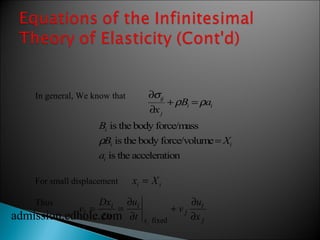
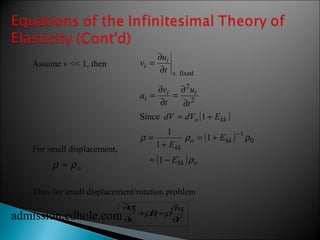
In general, We know that 
For small displacement 
Thus    
¶sij 
¶xj 
+rBi =rai 
Bi is the body force/mass 
rBi is the body force/volume=Xi 
ai is the acceleration 
i i x = X 
v u 
i 
j 
+ ¶ 
j 
admission.edhole.com x 
fixed 
u 
= = ¶ 
i i 
v Dx 
i Dt 
t 
x 
i 
¶ 

Assume v << 1, then 
For small displacement, 
fixed 
u 
v u 
t 
= ¶ 
i i 
= ¶ 
¶ 
a v 
¶ 
dV dV E 
Since 1 
o kk 
= ¶ 
r r o kk 
r 
kk 
» - 
Thus for small displacement/rotation problem 
( ) 
( ) 
( kk ) o 
i 
x 
i 
i 
E 
E 
E 
t 
t 
i 
r 
= + 
+ 
= 
= + 
¶ 
- 
1 
1 
1 
1 
0 
1 
2 
2 
r » ro 
¶sij 
¶xj 
+rBi 
=r¶2ui 
admission.edhole.com ¶t2
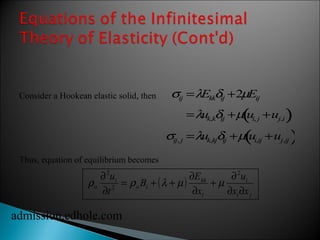
Consider a Hookean elastic solid, then 
Thus, equation of equilibrium becomes 
¶ 2 
= + + ¶ 
   
sij =lEkkdij +2mEij 
=luk,kdij +m ui, j +uj,i ( ) 
sij, j =luk,kjdij +m ui,ij +uj,ij ( ) 
B E 
( ) 
i 
u 
i j 
kk 
i 
o i 
i 
u 
+ ¶ 
o ¶ 
t 
2 
¶ 
x 
¶ x ¶ 
x 
2 
r r l m m 
admission.edhole.com
= 
ui 
0 2 
2 
¶ 
t 
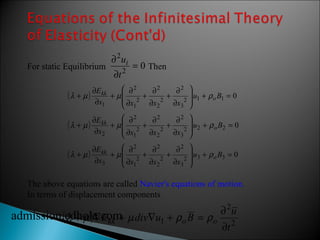
For static Equilibrium Then 
¶ 
E 
+ ¶ 
( ) 
kk 
l m m r 
x x x x 
¶ 
E 
+ ¶ 
( ) 
0 
0 
2 
ö 
u + o 
B 
= ÷ ø 
÷ 
2 1 1 
3 
2 
ö 
÷ ÷ 
u + B 
= ø 
l m m r 
o 
2 2 2 
3 
2 
2 
2 
2 
2 
2 
2 
kk 
x x x x 
2 
2 
2 
1 
2 
2 
1 
2 
1 
2 
ö 
æ 
+ ¶ 
ç ç 
è 
æ 
¶ 
+ ¶ 
ç ç 
è 
æ 
+ ¶ 
¶ 
+ ¶ 
¶ 
+ ¶ 
+ ¶ 
¶ 
+ ¶ 
¶ 
+ ¶ 
¶ 
+ ¶ 
¶ 
E 
+ ¶ 
( ) 0 
÷ ÷ 
u + B 
= ø 
l m m r 
o 
2 3 3 
3 
2 
2 
2 
1 
kk 
x x x x 
3 
ç ç 
è 
¶ 
¶ 
¶ 
¶ 
The above equations are called Navier's equations of motion. 
In terms of displacement components 
2 
E div u B u kk o o ¶ 
admission.eld+hmoleÑ.com+ m Ñ + r = r ¶ 
( ) 2 
1 t
In a number of engineering applications, the geometry of 
the body and loading allow us to model the problem using 
2-D approximation. Such a study is called ''Plane 
elasticity''. There are two categories of plane elasticity, 
plane stress and plane strain. After these, we will study 
two special case: simple extension and torsion of a circular 
cylinder. 
admission.edhole.com
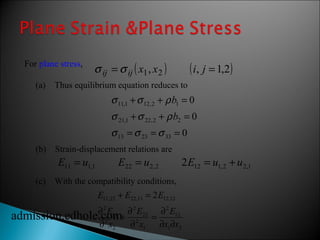
For plane stress, 
(a) Thus equilibrium equation reduces to 
s ij =s ij ( x1, x2 ) (i, j = 1,2) 
b 
s s r 
+ + = 
11,1 12,2 1 
s s r 
+ + = 
21,1 22,2 2 
s s s 
= = = 
(b) Strain-displacement relations are 
(c) With the compatibility conditions, 
0 
0 
0 
13 23 33 
b 
11 1,1 22 2,2 12 1,2 2,1 E = u E = u 2E = u + u 
E E E 
11,22 22,11 12,12 2 
E 
12 
2 
1 2 
1 
E 
2 
22 
2 
2 
E 
2 
11 
2 
= ¶ 
x x 
x 
x 
¶ ¶ 
+ ¶ 
¶ 
¶ 
¶ 
+ = 
admission.edhole.com
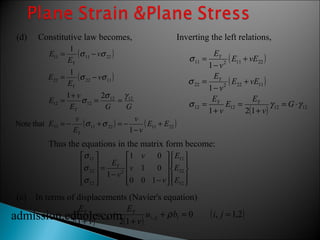
(d) Constitutive law becomes, Inverting the left relations, 
( ) 
( ) 
1 
v 
E 
= - 
s s ( ) 
11 11 22 
E 
Y 
1 
v 
= - 
s s 
22 22 11 
= + = = 
s s g 
12 12 
E 
E 
Y 
E v 
1 2 
12 12 
v 
E G G 
Y 
E v 
33 ( 11 22 ) ( 11 22 ) 
1 
E E 
v 
= - + = - 
E 
Y 
+ 
- 
s s 
s 
Y 
11 2 11 22 
1 
Y 
22 2 22 11 
1 
s g g 
Thus the equations in the matrix form become: 
Note that 
ü 
ì 
ù 
é 
ù 
s 
é 
E 
11 
22 
11 
s 
22 
1 0 
1 0 
E 
EY 
(e) In terms of displacements (Navier's equation) 
( ) 
12 1 12 2 ( 1 
) 12 12 
s 
= × 
+ 
= 
+ 
= 
+ 
- 
= 
+ 
- 
= 
G 
v 
E E 
v 
E 
E vE 
v 
E 
E vE 
v 
E 
Y Y 
ïþ 
ïý 
ïî 
ïí 
ú ú ú 
û 
ê ê ê 
ë 
- 
- 
= 
ú ú ú 
û 
ê ê ê 
ë 
12 
2 
12 
0 0 1 
1 
E 
v 
v 
v 
v 
s 
( ) ( ) 0 ( , 1,2) 
admission.edhoY le.com r 
+ 
+ = = 
2 1 + 
, 2 1 + 
, u b i j 
v 
u E 
v 
E 
i ji i 
Y 
i jj
(b) Inverting the relations, can e -s be written as: 
E v 
= + - - 
1 1 
[( ) s s 
] 
[( ) ] 
( ) 
E G 
11 11 22 
Y 
E v 
= + - - 
1 1 
s s 
22 22 11 
E v 
v v 
E 
v v 
E 
= + = 
Y 
Y 
2 2 
2 1 
12 12 
12 
s s 
(c) Navier's equation for displacement can be written as: 
E 
E 
Y ( ) u + 
Y 
u + r 
b = ( i j 
= 
) 
2 1 + 
v 
i , jj 
( 0 , 1,22 1 + v )( 1 - 
2 v 
) j , ji i 
admission.edhole.com
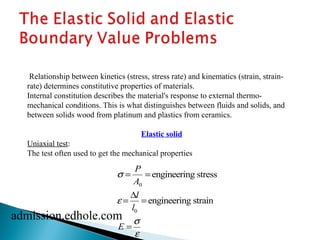
Relationship between kinetics (stress, stress rate) and kinematics (strain, strain-rate) 
determines constitutive properties of materials. 
Internal constitution describes the material's response to external thermo-mechanical 
conditions. This is what distinguishes between fluids and solids, and 
between solids wood from platinum and plastics from ceramics. 
Elastic solid 
Uniaxial test: 
The test often used to get the mechanical properties 
s = P 
A0 
=engineering stress 
e = Dl 
l0 
=engineering strain 
E =s 
e 
admission.edhole.com
If is Cauchy tensor and is small strain tensor, then in general, 
   
s ij Eij 
   
sij=CijklEkl 
Cijkl 
where is a fourth order tensor, since T and E are second order 
tensors. is called elasticity tensor. The values of these components 
with respect to the primed basis ei’ and the unprimed basis ei are related by 
the transformation law 
ijkl mi ni rk sl mnrs C¢ = Q Q Q Q C 
However, we know that E k l = E l k and then 
Cijkl = C jikl = Ciklk [C] 4´4 
   
sij=sji 
We have symmetric matrix with 36 constants, If 
elasticity is a unique scalar function of stress and strain, strain energy is given by 
dU= sijdEkl or U= sijEij 
Then sij = ¶U 
¶Eij 
ÞCijkl =Cklij 
ÞNumber of independent constants=21 
Cijkl 
admission.edhole.com
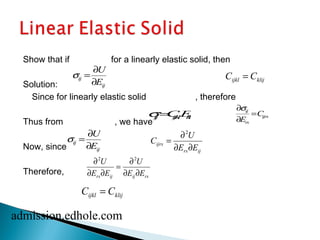
Show that if for a linearly elastic solid, then 
Solution: 
Since for linearly elastic solid , therefore 
Thus    
from , we have 
Now, since 
Therefore, 
sij = ¶U 
¶Eij 
ijkl klij C = C 
   
sij=CijklEkl 
   
¶sij 
¶Ers 
=Cijrs 
   
sij = ¶U 
2 
C = ¶ 
U 
¶Eijrs ij ¶ E ¶ 
E 
rs ij 
¶2 2 
U 
U 
E E 
= ¶ 
¶ E ¶ 
E 
rs ij ij rs ¶ ¶ 
ijkl klij C = C 
admission.edhole.com
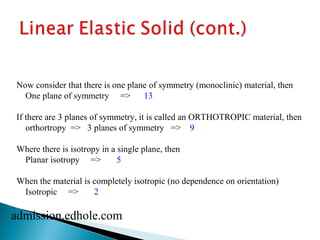
Now consider that there is one plane of symmetry (monoclinic) material, then 
One plane of symmetry => 13 
If there are 3 planes of symmetry, it is called an ORTHOTROPIC material, then 
orthortropy => 3 planes of symmetry => 9 
Where there is isotropy in a single plane, then 
Planar isotropy => 5 
When the material is completely isotropic (no dependence on orientation) 
Isotropic => 2 
admission.edhole.com
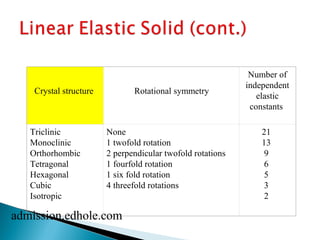
Crystal structure Rotational symmetry 
Number of 
independent 
elastic 
constants 
Triclinic 
Monoclinic 
Orthorhombic 
Tetragonal 
Hexagonal 
Cubic 
Isotropic 
None 
1 twofold rotation 
2 perpendicular twofold rotations 
1 fourfold rotation 
1 six fold rotation 
4 threefold rotations 
21 
13 
9 
6 
5 
3 
2 
admission.edhole.com
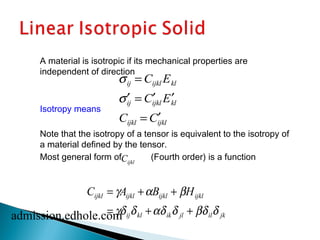
A material is isotropic if its mechanical properties are 
independent of direction 
Isotropy means 
Note that the isotropy of a tensor is equivalent to the isotropy of 
a material defined by the tensor. 
Most general form of (Fourth order) is a function 
ijkl C 
ijkl ijkl ijkl ijkl C A B H 
= g + a + 
b 
= + + 
gd d ad d bd d 
ij kl ik jl il jk 
   
sij = CijklEkl 
¢  s  ij = C ¢  ijkl E ¢  kl 
Cijkl =C ¢  ijkl 
admission.edhole.com
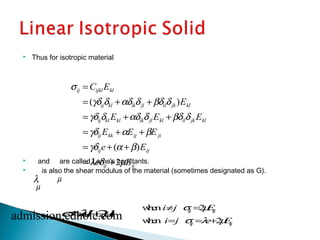
 Thus for isotropic material 
 and are called Lame's constants. 
 is also the shear modulus of the material (sometimes designated as G). 
   
sij =CijklEkl 
= (g dijdkl +adikdjl +bdildjk)Ekl 
=g dijdklEkl +adikdjlEkl +bdildjkEkl 
=g dijEkk +aEij +bEji 
=g dije+ (a +b)Eij 
=ledij +2mEij 
when i¹j sij =2mEij 
when i=j sij =le+2mEij 
l 
m 
m 
admissions.e=dlheoIl+e2.mcoEm
(3l+2m)skk 
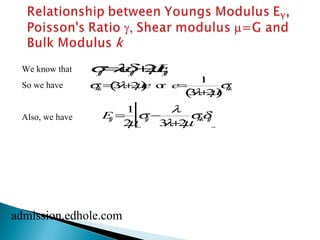
We know that 
So we have 
ù  
úû   
skkdij 
3l+2m 
sij- l 
é  
êë   
2m 
Also, w e  have 
sij=ledij+2mEij 
   
skk=(3l+2m)e or e= 1 
   
Eij=1 
admission.edhole.com
E v v E k v 
l m m m 
, , , , , 
Y Y 
v 
vE 
l l 2 
m m m 
( ) ( ) ( ) 
( ) 
v v 
E 
m 
m m Y 
m m 
( ) 
kv 
v 
3 
( ) 
( ) 
k E 
v 
l m m m 
( ) 
- 
E 
E 
v 
( ) 
( ) ( ) 
k - 
v 
3 1 2 
k 
E 
E 
v 
v 
v 
v 
2 1 
+ 
m 
3 1 2 3 3 
2 
3 3 1 2 
m ( 3 l + 
2 m 
) 2 ( 1 ) 3 ( 1 2 
) 
v ( ) v v E v 
E E m 
v E k v 
Y Y Y 
Y 
Y 
Y Y 
Y 
Y Y 
1 
l m 
l 
2 2 
2 1 
2 1 
1 
3 
2 
1 2 
1 1 2 
- 
+ 
+ - 
+ 
- - 
- 
+ 
+ 
+ 
- + 
+ - - 
l m m 
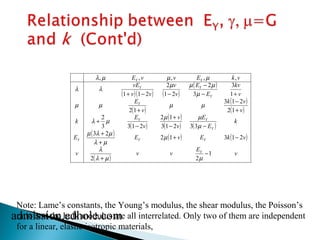
Note: Lame’s constants, the Young’s modulus, the shear modulus, the Poisson’s 
ratio and the bulk modulus are all interrelated. Only two of them are independent 
for a linear, elastic isotropic materials, 
admission.edhole.com

B.tech admission in india

  • 1.
  • 2.
    H. Garmestani, Professor School of Materials Science and Engineering Georgia Institute of Technology  Outline:  Materials Behavior Tensile behavior … admission.edhole.com
  • 3.
     Constitutive equationis the relation between kinetics (stress, stress-rate) quantities and kinematics (strain, strain-rate) quantities for a specific material. It is a mathematical description of the actual behavior of a material. The same material may exhibit different behavior at different temperatures, rates of loading and duration of loading time.). Though researchers always attempt to widen the range of temperature, strain rate and time, every model has a given range of applicability.  Constitutive equations distinguish between solids and liquids; and between different solids.  In solids, we have: Metals, polymers, wood, ceramics, composites, concrete, soils…  In fluids we have: Water, oil air, reactive and inert gases admission.edhole.com
  • 4.
    / axial strain diametral strain / stress l e d admission.edhole.com a e a e d l l = D = P A e s = = - = = = 0 Poisson's Ratio Load-displacement response is Young's modulus (or modulus of elasticity) E E Y k e is bulk modulus, is dilatation (for an elastic material) shear modulus (for a cylindrical bar of circular corss s e a = e M l t q Y k = m s p I = section of radius r to a torsional moment along the cylinder axis)
  • 5.
    Examples of Materials Behavior Uniaxial loading-unloading stress-strain curves for (a) linear elastic; (b) nonlinear elastic; and (c) inelastic behavior. admission.edhole.com
  • 6.
     Elastic behavioris characterized by the following two conditions:  (1) where the stress in a material (s) is a unique function of the strain (e),  (2) where the material has the property for complete recovery to a “natural” shape upon removal of the applied forces  Elastic behavior may be Linear or non-linear admission.edhole.com
  • 7.
     The constitutiveequation for elastic behavior in its most general form as   s=Ce where C is a symmetric tensor-valued function and e is a strain tensor we introduced earlier. Linear elastic s = Ce Nonlinear-elastic s = C(e) e admission.edhole.com
  • 8.
    Boundary Value Problems we assume that the strain is small and there is no rigid body rotation. Further we assume that the material is governed by linear elastic isotropic material model. Field Equations (1) Eij = 1 ( ui, j + u ) j.i  (1) 2 (2) Stress Strain Relations (3)Cauchy Traction Conditions (Cauchy Formula) (4)   sij=lEkkdij+2mEij (2)   ti=sjinj sji,j+Xj=0 sji,j+rBi =0®For Statics admission.edhole.com sji,j+rBi =rai ® For Dynamics
  • 9.
    In general, Weknow that For small displacement Thus   ¶sij ¶xj +rBi =rai Bi is the body force/mass rBi is the body force/volume=Xi ai is the acceleration i i x = X v u i j + ¶ j admission.edhole.com x fixed u = = ¶ i i v Dx i Dt t x i ¶ 
  • 10.
    Assume v <<1, then For small displacement, fixed u v u t = ¶ i i = ¶ ¶ a v ¶ dV dV E Since 1 o kk = ¶ r r o kk r kk » - Thus for small displacement/rotation problem ( ) ( ) ( kk ) o i x i i E E E t t i r = + + = = + ¶ - 1 1 1 1 0 1 2 2 r » ro ¶sij ¶xj +rBi =r¶2ui admission.edhole.com ¶t2
  • 11.
    Consider a Hookeanelastic solid, then Thus, equation of equilibrium becomes ¶ 2 = + + ¶   sij =lEkkdij +2mEij =luk,kdij +m ui, j +uj,i ( ) sij, j =luk,kjdij +m ui,ij +uj,ij ( ) B E ( ) i u i j kk i o i i u + ¶ o ¶ t 2 ¶ x ¶ x ¶ x 2 r r l m m admission.edhole.com
  • 12.
    = ui 02 2 ¶ t For static Equilibrium Then ¶ E + ¶ ( ) kk l m m r x x x x ¶ E + ¶ ( ) 0 0 2 ö u + o B = ÷ ø ÷ 2 1 1 3 2 ö ÷ ÷ u + B = ø l m m r o 2 2 2 3 2 2 2 2 2 2 2 kk x x x x 2 2 2 1 2 2 1 2 1 2 ö æ + ¶ ç ç è æ ¶ + ¶ ç ç è æ + ¶ ¶ + ¶ ¶ + ¶ + ¶ ¶ + ¶ ¶ + ¶ ¶ + ¶ ¶ E + ¶ ( ) 0 ÷ ÷ u + B = ø l m m r o 2 3 3 3 2 2 2 1 kk x x x x 3 ç ç è ¶ ¶ ¶ ¶ The above equations are called Navier's equations of motion. In terms of displacement components 2 E div u B u kk o o ¶ admission.eld+hmoleÑ.com+ m Ñ + r = r ¶ ( ) 2 1 t
  • 13.
    In a numberof engineering applications, the geometry of the body and loading allow us to model the problem using 2-D approximation. Such a study is called ''Plane elasticity''. There are two categories of plane elasticity, plane stress and plane strain. After these, we will study two special case: simple extension and torsion of a circular cylinder. admission.edhole.com
  • 14.
    For plane stress, (a) Thus equilibrium equation reduces to s ij =s ij ( x1, x2 ) (i, j = 1,2) b s s r + + = 11,1 12,2 1 s s r + + = 21,1 22,2 2 s s s = = = (b) Strain-displacement relations are (c) With the compatibility conditions, 0 0 0 13 23 33 b 11 1,1 22 2,2 12 1,2 2,1 E = u E = u 2E = u + u E E E 11,22 22,11 12,12 2 E 12 2 1 2 1 E 2 22 2 2 E 2 11 2 = ¶ x x x x ¶ ¶ + ¶ ¶ ¶ ¶ + = admission.edhole.com
  • 15.
    (d) Constitutive lawbecomes, Inverting the left relations, ( ) ( ) 1 v E = - s s ( ) 11 11 22 E Y 1 v = - s s 22 22 11 = + = = s s g 12 12 E E Y E v 1 2 12 12 v E G G Y E v 33 ( 11 22 ) ( 11 22 ) 1 E E v = - + = - E Y + - s s s Y 11 2 11 22 1 Y 22 2 22 11 1 s g g Thus the equations in the matrix form become: Note that ü ì ù é ù s é E 11 22 11 s 22 1 0 1 0 E EY (e) In terms of displacements (Navier's equation) ( ) 12 1 12 2 ( 1 ) 12 12 s = × + = + = + - = + - = G v E E v E E vE v E E vE v E Y Y ïþ ïý ïî ïí ú ú ú û ê ê ê ë - - = ú ú ú û ê ê ê ë 12 2 12 0 0 1 1 E v v v v s ( ) ( ) 0 ( , 1,2) admission.edhoY le.com r + + = = 2 1 + , 2 1 + , u b i j v u E v E i ji i Y i jj
  • 16.
    (b) Inverting therelations, can e -s be written as: E v = + - - 1 1 [( ) s s ] [( ) ] ( ) E G 11 11 22 Y E v = + - - 1 1 s s 22 22 11 E v v v E v v E = + = Y Y 2 2 2 1 12 12 12 s s (c) Navier's equation for displacement can be written as: E E Y ( ) u + Y u + r b = ( i j = ) 2 1 + v i , jj ( 0 , 1,22 1 + v )( 1 - 2 v ) j , ji i admission.edhole.com
  • 17.
    Relationship between kinetics(stress, stress rate) and kinematics (strain, strain-rate) determines constitutive properties of materials. Internal constitution describes the material's response to external thermo-mechanical conditions. This is what distinguishes between fluids and solids, and between solids wood from platinum and plastics from ceramics. Elastic solid Uniaxial test: The test often used to get the mechanical properties s = P A0 =engineering stress e = Dl l0 =engineering strain E =s e admission.edhole.com
  • 18.
    If is Cauchytensor and is small strain tensor, then in general,   s ij Eij   sij=CijklEkl Cijkl where is a fourth order tensor, since T and E are second order tensors. is called elasticity tensor. The values of these components with respect to the primed basis ei’ and the unprimed basis ei are related by the transformation law ijkl mi ni rk sl mnrs C¢ = Q Q Q Q C However, we know that E k l = E l k and then Cijkl = C jikl = Ciklk [C] 4´4   sij=sji We have symmetric matrix with 36 constants, If elasticity is a unique scalar function of stress and strain, strain energy is given by dU= sijdEkl or U= sijEij Then sij = ¶U ¶Eij ÞCijkl =Cklij ÞNumber of independent constants=21 Cijkl admission.edhole.com
  • 19.
    Show that iffor a linearly elastic solid, then Solution: Since for linearly elastic solid , therefore Thus   from , we have Now, since Therefore, sij = ¶U ¶Eij ijkl klij C = C   sij=CijklEkl   ¶sij ¶Ers =Cijrs   sij = ¶U 2 C = ¶ U ¶Eijrs ij ¶ E ¶ E rs ij ¶2 2 U U E E = ¶ ¶ E ¶ E rs ij ij rs ¶ ¶ ijkl klij C = C admission.edhole.com
  • 20.
    Now consider thatthere is one plane of symmetry (monoclinic) material, then One plane of symmetry => 13 If there are 3 planes of symmetry, it is called an ORTHOTROPIC material, then orthortropy => 3 planes of symmetry => 9 Where there is isotropy in a single plane, then Planar isotropy => 5 When the material is completely isotropic (no dependence on orientation) Isotropic => 2 admission.edhole.com
  • 21.
    Crystal structure Rotationalsymmetry Number of independent elastic constants Triclinic Monoclinic Orthorhombic Tetragonal Hexagonal Cubic Isotropic None 1 twofold rotation 2 perpendicular twofold rotations 1 fourfold rotation 1 six fold rotation 4 threefold rotations 21 13 9 6 5 3 2 admission.edhole.com
  • 22.
    A material isisotropic if its mechanical properties are independent of direction Isotropy means Note that the isotropy of a tensor is equivalent to the isotropy of a material defined by the tensor. Most general form of (Fourth order) is a function ijkl C ijkl ijkl ijkl ijkl C A B H = g + a + b = + + gd d ad d bd d ij kl ik jl il jk   sij = CijklEkl ¢ s ij = C ¢ ijkl E ¢ kl Cijkl =C ¢ ijkl admission.edhole.com
  • 23.
     Thus forisotropic material  and are called Lame's constants.  is also the shear modulus of the material (sometimes designated as G).   sij =CijklEkl = (g dijdkl +adikdjl +bdildjk)Ekl =g dijdklEkl +adikdjlEkl +bdildjkEkl =g dijEkk +aEij +bEji =g dije+ (a +b)Eij =ledij +2mEij when i¹j sij =2mEij when i=j sij =le+2mEij l m m admissions.e=dlheoIl+e2.mcoEm
  • 24.
    (3l+2m)skk We knowthat So we have ù úû skkdij 3l+2m sij- l é êë 2m Also, w e have sij=ledij+2mEij   skk=(3l+2m)e or e= 1   Eij=1 admission.edhole.com
  • 25.
    E v vE k v l m m m , , , , , Y Y v vE l l 2 m m m ( ) ( ) ( ) ( ) v v E m m m Y m m ( ) kv v 3 ( ) ( ) k E v l m m m ( ) - E E v ( ) ( ) ( ) k - v 3 1 2 k E E v v v v 2 1 + m 3 1 2 3 3 2 3 3 1 2 m ( 3 l + 2 m ) 2 ( 1 ) 3 ( 1 2 ) v ( ) v v E v E E m v E k v Y Y Y Y Y Y Y Y Y Y 1 l m l 2 2 2 1 2 1 1 3 2 1 2 1 1 2 - + + - + - - - + + + - + + - - l m m Note: Lame’s constants, the Young’s modulus, the shear modulus, the Poisson’s ratio and the bulk modulus are all interrelated. Only two of them are independent for a linear, elastic isotropic materials, admission.edhole.com