Dear students get fully solved assignments
Send your semester & Specialization name to our mail id :
“ help.mbaassignments@gmail.com ”
or
Call us at : 08263069601
(Prefer mailing. Call in emergency )
ASSIGNMENT
PROGRAM BSc IT
SEMESTER SIXTH
SUBJECT CODE & NAME BT9301, Computer Graphics
CREDITS 4
BK ID B0810
MARKS 60
Note: Answer all questions. Kindly note that answers for 10 marks questions should be
approximately of 400 words. Each question is followed by evaluation scheme.
Question.1. Explain image processing through picture analysis. List
the uses of interactive graphics.
Answer:In electrical engineering and computer science, image processing is any form of signal
processing for which the input is an image, such as photographs or frames of video; the output of
image processing can be either an image or a set of characteristics or parameters related to the
image. Most image-processing techniques
Question.2. Write and explain midpoint circle drawing algorithm.
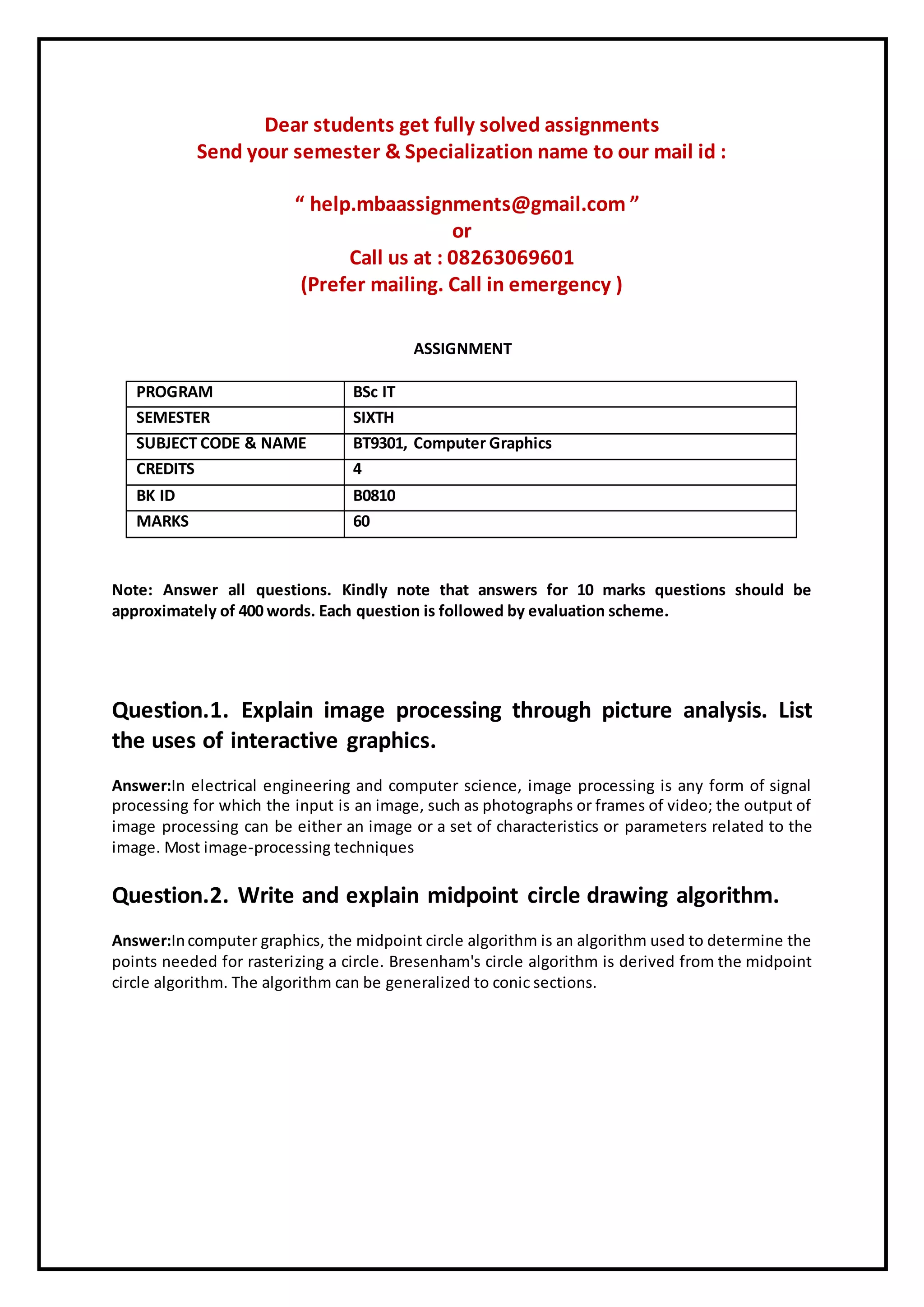
Answer:Incomputer graphics, the midpoint circle algorithm is an algorithm used to determine the
points needed for rasterizing a circle. Bresenham's circle algorithm is derived from the midpoint
circle algorithm. The algorithm can be generalized to conic sections.
Rasterisation of a circle by the Bresenham algorithm
The algorithm is related to work by Pitteway and Van Aken.
This algorithm
Question.3. Define polygon filling. Explain flood fill algorithm for
polygon filling.
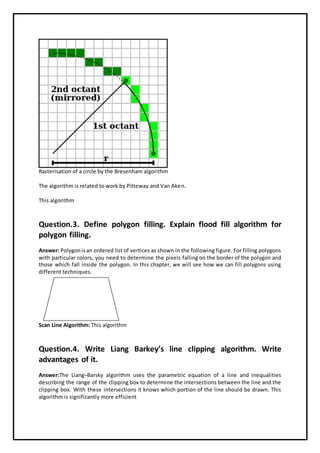
Answer: Polygonisan ordered list of vertices as shown in the following figure. For filling polygons
with particular colors, you need to determine the pixels falling on the border of the polygon and
those which fall inside the polygon. In this chapter, we will see how we can fill polygons using
different techniques.
Scan Line Algorithm: This algorithm
Question.4. Write Liang Barkey’s line clipping algorithm. Write
advantages of it.
Answer:The Liang–Barsky algorithm uses the parametric equation of a line and inequalities
describing the range of the clipping box to determine the intersections between the line and the
clipping box. With these intersections it knows which portion of the line should be drawn. This
algorithm is significantly more efficient
Question.5. Define shear. Explain X shear and Y shear.
Answer:Shearing forces are unaligned forces pushing one part of a body in one direction, and
anotherpart of the bodyinthe opposite direction.Whenthe forcesare alignedintoeachother,they
are calledcompressionforces.Anexample is a deck of cards being pushed one way on the top, and
the otherat the bottom,causingthe cards to slide.Anotherexample iswhenwind blows at the side
of a peaked roof of a home -
Question.6. Explain the various types of parallel projections.
Answer:Parallel projections have lines of projection that are parallel both in reality and in the
projection plane.
Parallel projectioncorrespondstoa perspectiveprojectionwithaninfinitefocal length(the distance
from the image plane to the projection point), or "zoom".
Within parallel projection there is an ancillary category known as "pictorials". Pictorials show an
image of an object as viewed from a skew direction in order to reveal all three directions (axes) of
space in one picture. Because pictorial projections innately contain this distortion, in the rote,
drawinginstrumentforpictorials,some libertiesmaybe takenforeconomyof effortandbesteffect.
There are two different types of parallel projections:
If the direction of projection
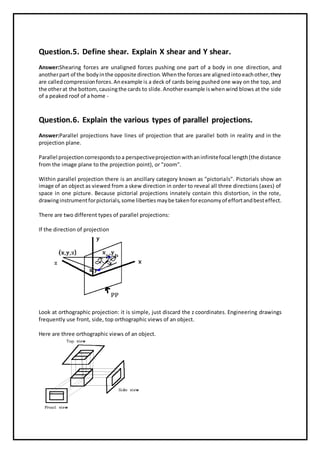
Look at orthographic projection: it is simple, just discard the z coordinates. Engineering drawings
frequently use front, side, top orthographic views of an object.
Here are three orthographic views of an object.
Dear students get fully solved assignments
Send your semester & Specialization name to our mail id :
“ help.mbaassignments@gmail.com ”
or
Call us at : 08263069601
(Prefer mailing. Call in emergency )

Bt9301 computer graphics

  • 1.
    Dear students getfully solved assignments Send your semester & Specialization name to our mail id : “ help.mbaassignments@gmail.com ” or Call us at : 08263069601 (Prefer mailing. Call in emergency ) ASSIGNMENT PROGRAM BSc IT SEMESTER SIXTH SUBJECT CODE & NAME BT9301, Computer Graphics CREDITS 4 BK ID B0810 MARKS 60 Note: Answer all questions. Kindly note that answers for 10 marks questions should be approximately of 400 words. Each question is followed by evaluation scheme. Question.1. Explain image processing through picture analysis. List the uses of interactive graphics. Answer:In electrical engineering and computer science, image processing is any form of signal processing for which the input is an image, such as photographs or frames of video; the output of image processing can be either an image or a set of characteristics or parameters related to the image. Most image-processing techniques Question.2. Write and explain midpoint circle drawing algorithm. Answer:Incomputer graphics, the midpoint circle algorithm is an algorithm used to determine the points needed for rasterizing a circle. Bresenham's circle algorithm is derived from the midpoint circle algorithm. The algorithm can be generalized to conic sections.
  • 2.
    Rasterisation of acircle by the Bresenham algorithm The algorithm is related to work by Pitteway and Van Aken. This algorithm Question.3. Define polygon filling. Explain flood fill algorithm for polygon filling. Answer: Polygonisan ordered list of vertices as shown in the following figure. For filling polygons with particular colors, you need to determine the pixels falling on the border of the polygon and those which fall inside the polygon. In this chapter, we will see how we can fill polygons using different techniques. Scan Line Algorithm: This algorithm Question.4. Write Liang Barkey’s line clipping algorithm. Write advantages of it. Answer:The Liang–Barsky algorithm uses the parametric equation of a line and inequalities describing the range of the clipping box to determine the intersections between the line and the clipping box. With these intersections it knows which portion of the line should be drawn. This algorithm is significantly more efficient
  • 3.
    Question.5. Define shear.Explain X shear and Y shear. Answer:Shearing forces are unaligned forces pushing one part of a body in one direction, and anotherpart of the bodyinthe opposite direction.Whenthe forcesare alignedintoeachother,they are calledcompressionforces.Anexample is a deck of cards being pushed one way on the top, and the otherat the bottom,causingthe cards to slide.Anotherexample iswhenwind blows at the side of a peaked roof of a home - Question.6. Explain the various types of parallel projections. Answer:Parallel projections have lines of projection that are parallel both in reality and in the projection plane. Parallel projectioncorrespondstoa perspectiveprojectionwithaninfinitefocal length(the distance from the image plane to the projection point), or "zoom". Within parallel projection there is an ancillary category known as "pictorials". Pictorials show an image of an object as viewed from a skew direction in order to reveal all three directions (axes) of space in one picture. Because pictorial projections innately contain this distortion, in the rote, drawinginstrumentforpictorials,some libertiesmaybe takenforeconomyof effortandbesteffect. There are two different types of parallel projections: If the direction of projection Look at orthographic projection: it is simple, just discard the z coordinates. Engineering drawings frequently use front, side, top orthographic views of an object. Here are three orthographic views of an object.
  • 4.
    Dear students getfully solved assignments Send your semester & Specialization name to our mail id : “ help.mbaassignments@gmail.com ” or Call us at : 08263069601 (Prefer mailing. Call in emergency )