Bombay Stock Exchange Ltd.
BSE SME Exchange
Bombay Stock Exchange Limited
16th
July, 2011
Soyal Gupta
BSE SME Exchange
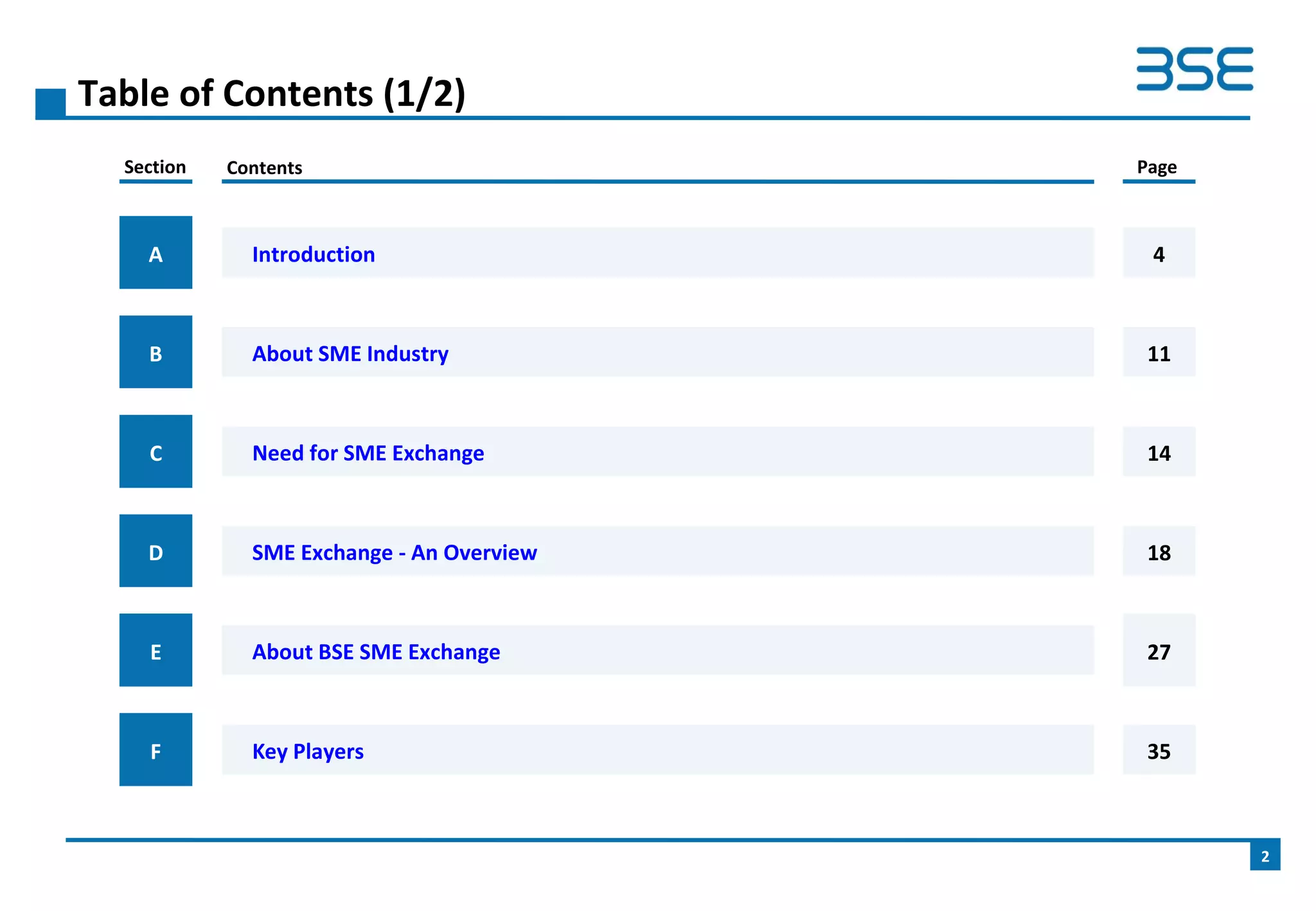
Section Contents Page
Table of Contents (1/2)
2
A Introduction 4
B About SME Industry 11
C Need for SME Exchange 14
D SME Exchange - An Overview 18
E About BSE SME Exchange 27
F Key Players 35
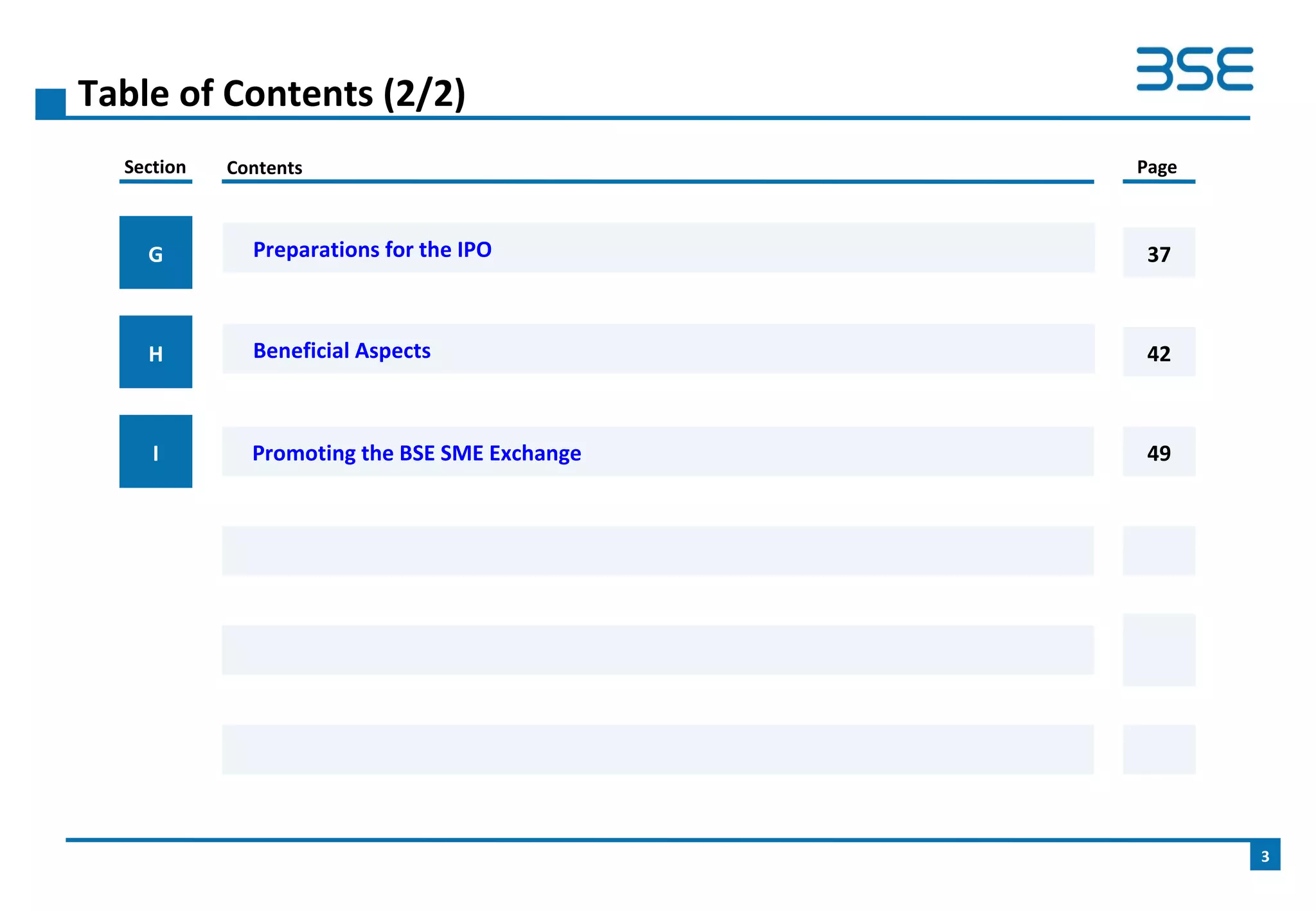
Section Contents Page
Table of Contents (2/2)
3
G Preparations for the IPO 37
H Beneficial Aspects 42
I Promoting the BSE SME Exchange 49
Introduction
Vision and Mission
Vision
Wealth creation by the SMEs
through inclusive economic growth.
Mission
Provide the world class platform for the SMEs and Investors
to come together and raise the equity capital.
Message to the Entrepreneurs and Investors
“BSE SME Platform provides a great opportunity to the entrepreneurs to raise
the equity capital for the growth and expansion of SMEs. It also provides the
immense opportunity to the investors to identify and invest in the good
companies at early stage. It will help unleash the valuation of the company and
in the process create wealth for all the stakeholders including investors,
besides considerable long term capital gains tax benefits and facility to exit at
any point of time”
 Capital Market Regulator SEBI has given ‘In Principle’ Approval to Bombay Stock
Exchange (BSE) Ltd. to launch the BSE SME Exchange/Platform .
 BSE is leveraging the existing ‘Equity platform’ i.e. BOLT System for launching the
BSE SME Exchange. Negligible cost in launching the platform.
 All Merchant Bankers empanelled with SEBI are by default MBs for this segment.
Additional responsibility of secondary market for market making.
 All Members registered with BSE are by default Members for this segment. No
additional infrastructure required by Members for secondary market trading.
Introduction
7
 SME companies with post issue paid up capital up to 25 crore can list on the BSE SME
Exchange.
 100% under writing by the Merchant bankers mean that the SME listing-cum-IPO
issue will be 100% success.
 Larger participation of investors – exit option
 Liquidity in the secondary market – Market Making
 Better opportunity for SMEs for equity fund raising.
Introduction
8
 The new thing about the SME Exchange is that the issue will be 100%
underwritten and this means that the issue will be 100% success. Other new
aspect is that there will be support of three years in the secondary market
through market making activity.
 The SMEs with paid up capital up to Rs. 10 crores can come on the SME
Exchange, in contrast to the paid up capital of Rs. 10 crores or more for the main
board.
 The Listing norms have been simplified. The issuer has to take the approval of
the Exchange and SEBI approval is not required. A copy of the offer document
will be sent to the SEBI for their information.
How Different from Main Board (1/2)
9
 The Compliance norms are simplified. Half yearly compliance is required instead
of quarterly compliance.
 The abridged version of the annual reports need to be sent to the investors
instead of the entire annual report and posting the soft copy of the report on the
website is sufficient.
 The issue expenses will be minimal on the marketing and stationery. However,
the issue will be charged for underwriting, sub-underwriting and responsibility of
three years market making.
 Market Making is compulsory for 3 years, unlike on main platform.
How Different from Main Board (2/2)
10
About SME Industry
About SME Industry
12
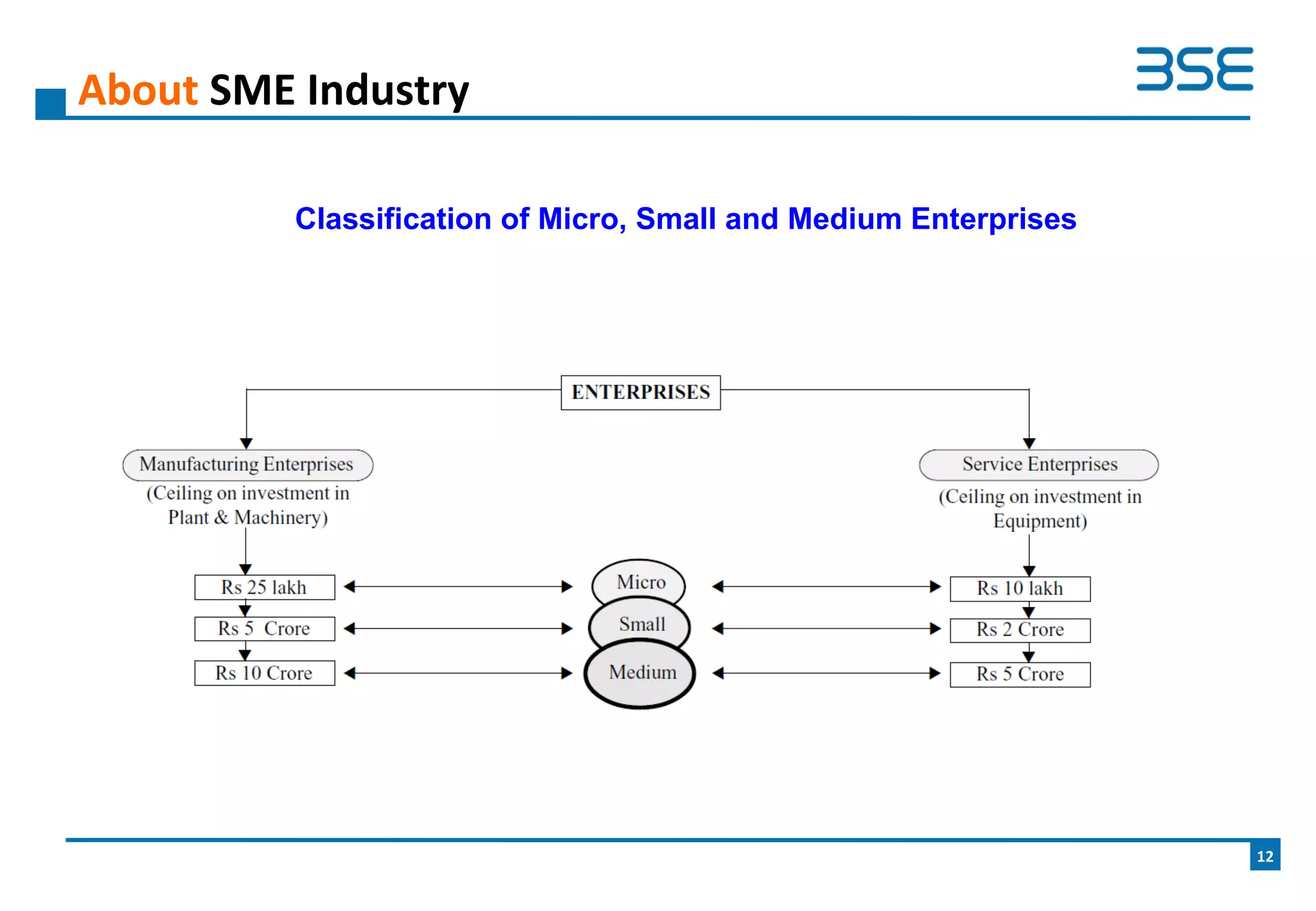
Classification of Micro, Small and Medium Enterprises
 Micro, Small and Medium Enterprises (MSMEs) contribute
- 8% of the country's GDP
- 45% of the manufactured output
- 40% of our exports
 Provide employment to about 6 cr. people through 2.6 cr. enterprises.
 The Micro Small and Medium Enterprise (MSME) sector forms the largest
generator of employment in the Indian economy.
 The MSME sector forms a major portion of the industrial activity.
About SME Industry
13
Need for SME Exchange
 Provide the SMEs with equity financing opportunities to grow their business –
from expansion to acquisition
 Equity Financing will lower the Debt burden leading to lower financing cost and
healthier balance sheet
 Expand the investors base, which in turn will help in getting secondary equity
financing, including private placement
 Enhance company’s visibility. Media coverage can provide SME with greater
profile and credibility leading to increase in the value of its shares
 Incentives for greater venture capital participation by providing an exit option
thus reducing their lock-in period
Need for SME Exchange
15
 Greater incentive for the employees as they can participate in the ownership of
the company and benefit from being its shareholders
 Encourage innovation and entrepreneurial spirit
 Capital Market will help distribute risk more efficiently
 SME sector will grow better on two pillars of Financial system i.e. Banking and
Capital Market
Initiating a dedicated Stock Exchange for SMEs’ will lead to mobilization of the
diversified resources of finance and build a bridge between the SMEs, Private
Equity and the Venture Capital by providing an exit route.
Need for SME Exchange
16
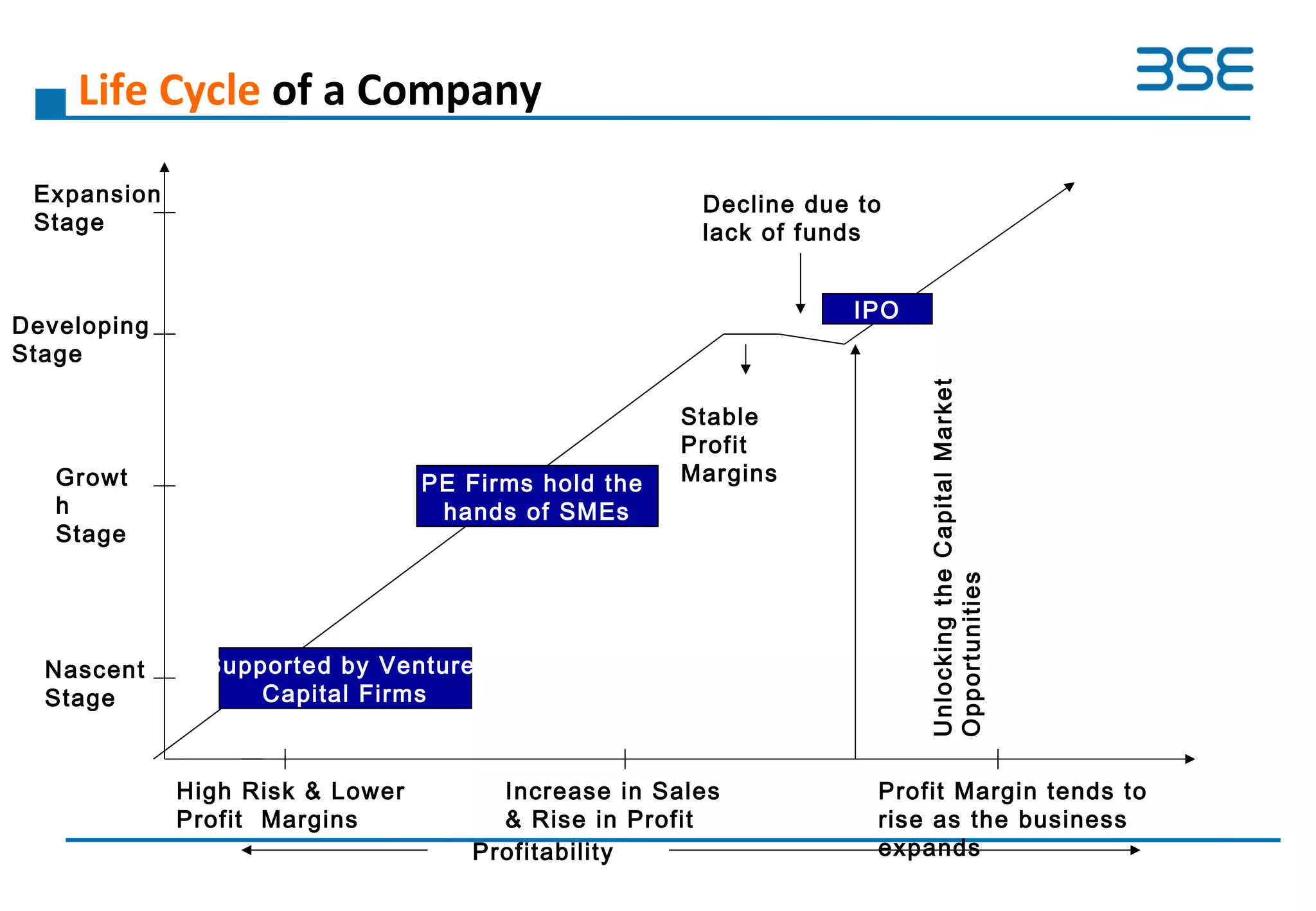
Life Cycle of a Company
PE Firms hold the
hands of SMEs
Supported by Venture
Capital Firms
IPO
Decline due to
lack of funds
Nascent
Stage
Growt
h
Stage
Developing
Stage
Expansion
Stage
UnlockingtheCapitalMarket
Opportunities
Profitability
High Risk & Lower
Profit Margins
Increase in Sales
& Rise in Profit
Stable
Profit
Margins
Profit Margin tends to
rise as the business
expands
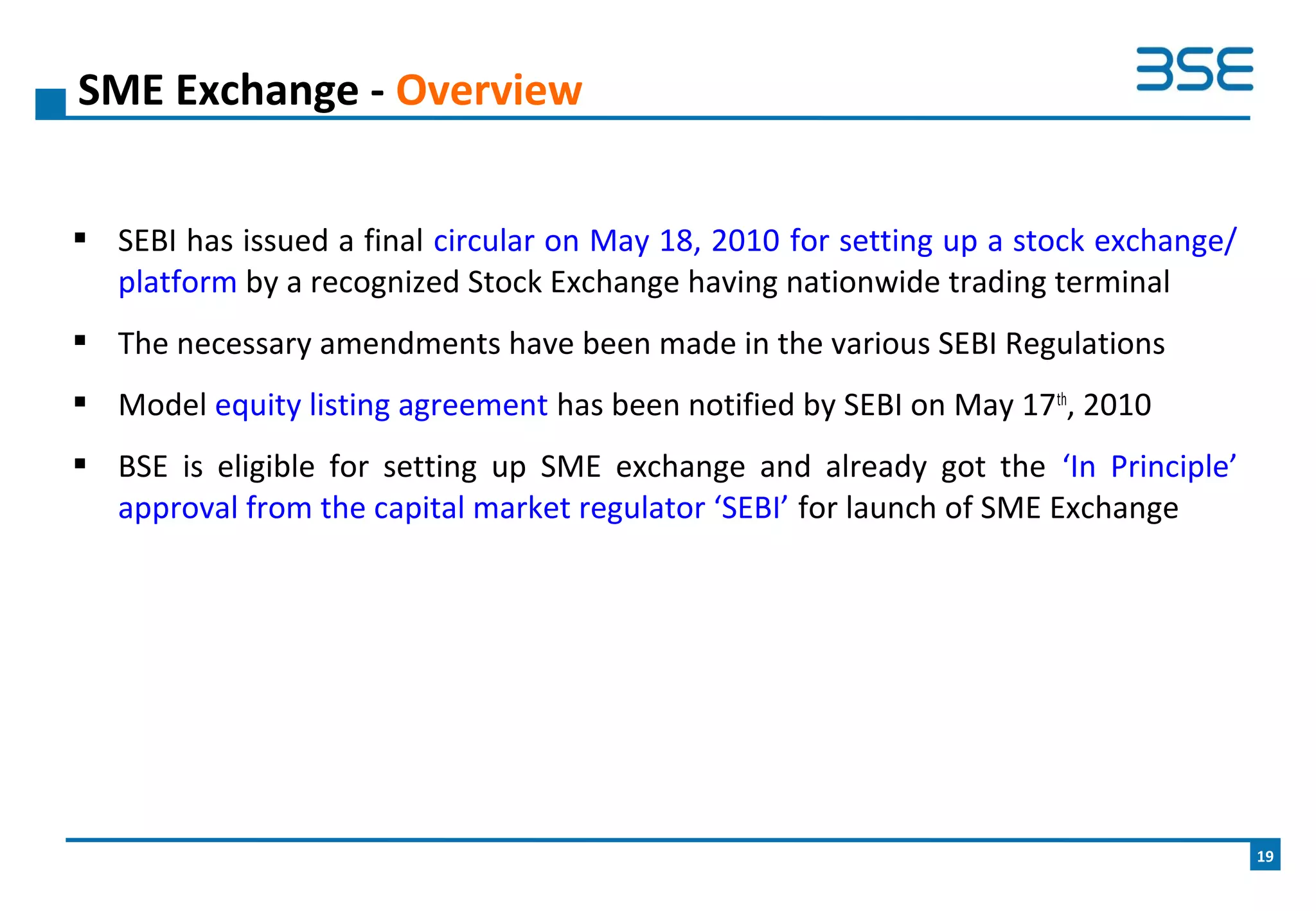
SME Exchange - Overview
 SEBI has issued a final circular on May 18, 2010 for setting up a stock exchange/
platform by a recognized Stock Exchange having nationwide trading terminal
 The necessary amendments have been made in the various SEBI Regulations
 Model equity listing agreement has been notified by SEBI on May 17th
, 2010
 BSE is eligible for setting up SME exchange and already got the ‘In Principle’
approval from the capital market regulator ‘SEBI’ for launch of SME Exchange
SME Exchange - Overview
19
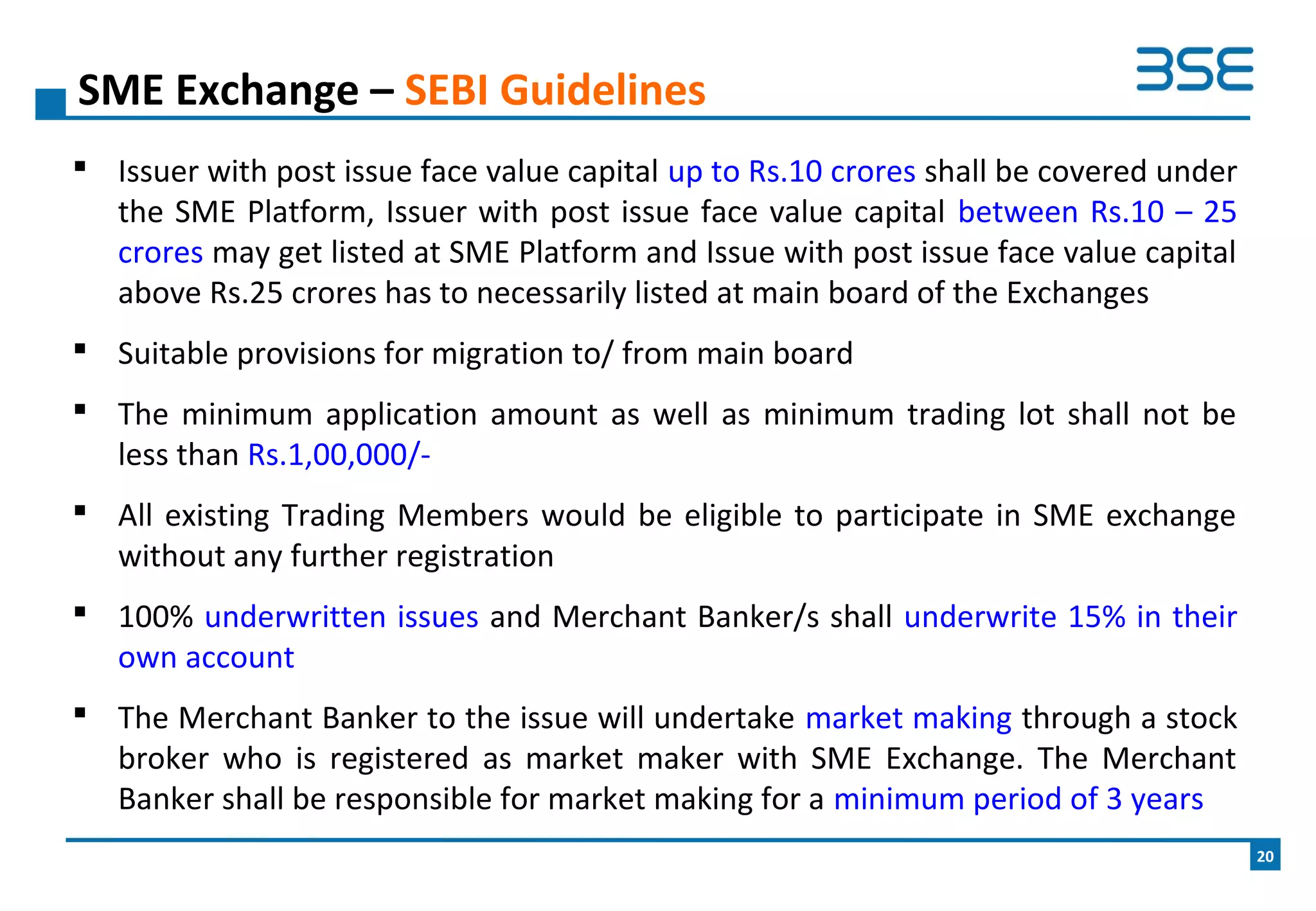
 Issuer with post issue face value capital up to Rs.10 crores shall be covered under
the SME Platform, Issuer with post issue face value capital between Rs.10 – 25
crores may get listed at SME Platform and Issue with post issue face value capital
above Rs.25 crores has to necessarily listed at main board of the Exchanges
 Suitable provisions for migration to/ from main board
 The minimum application amount as well as minimum trading lot shall not be
less than Rs.1,00,000/-
 All existing Trading Members would be eligible to participate in SME exchange
without any further registration
 100% underwritten issues and Merchant Banker/s shall underwrite 15% in their
own account
 The Merchant Banker to the issue will undertake market making through a stock
broker who is registered as market maker with SME Exchange. The Merchant
Banker shall be responsible for market making for a minimum period of 3 years
SME Exchange – SEBI Guidelines
20
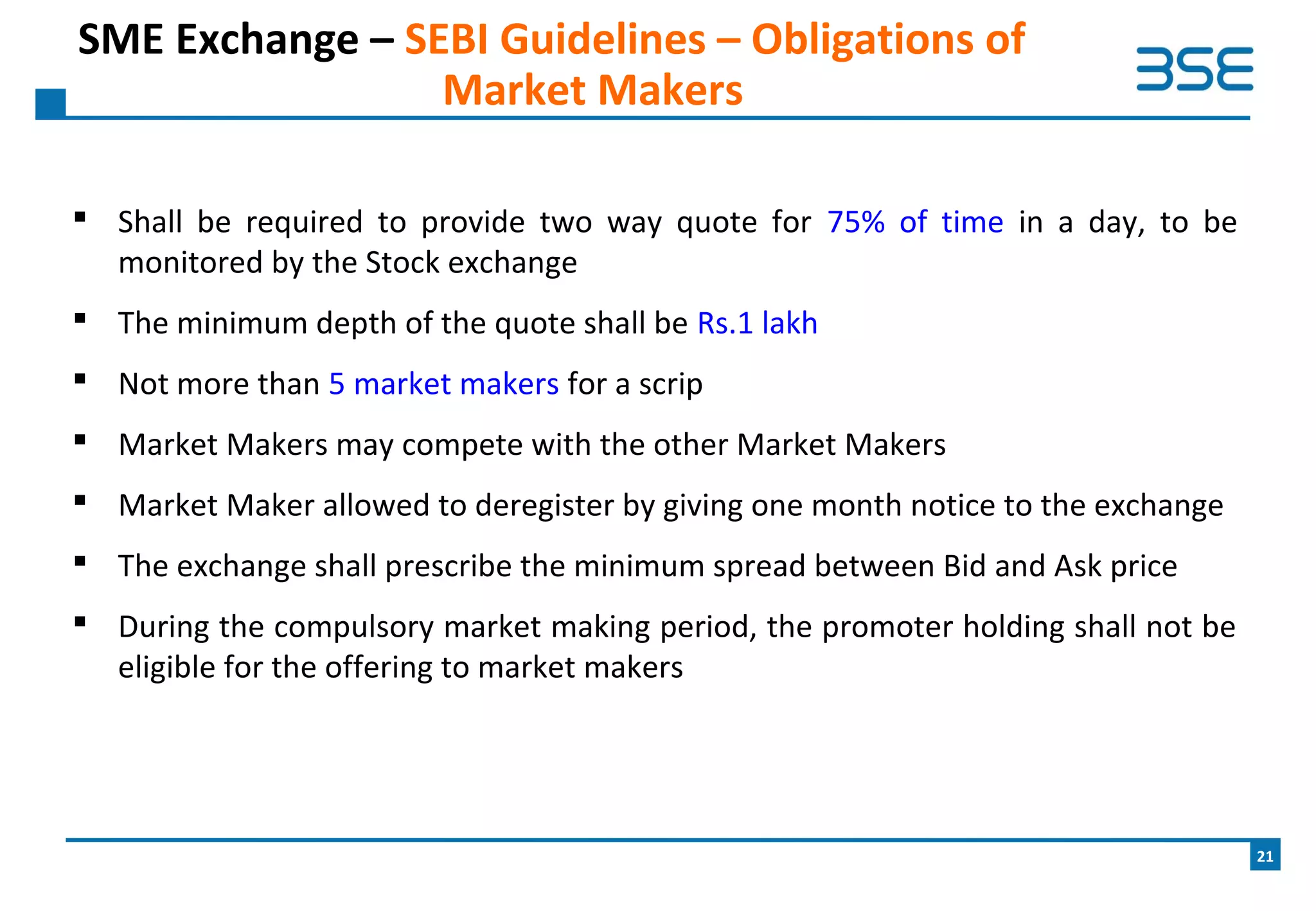
 Shall be required to provide two way quote for 75% of time in a day, to be
monitored by the Stock exchange
 The minimum depth of the quote shall be Rs.1 lakh
 Not more than 5 market makers for a scrip
 Market Makers may compete with the other Market Makers
 Market Maker allowed to deregister by giving one month notice to the exchange
 The exchange shall prescribe the minimum spread between Bid and Ask price
 During the compulsory market making period, the promoter holding shall not be
eligible for the offering to market makers
SME Exchange – SEBI Guidelines – Obligations of
Market Makers
21
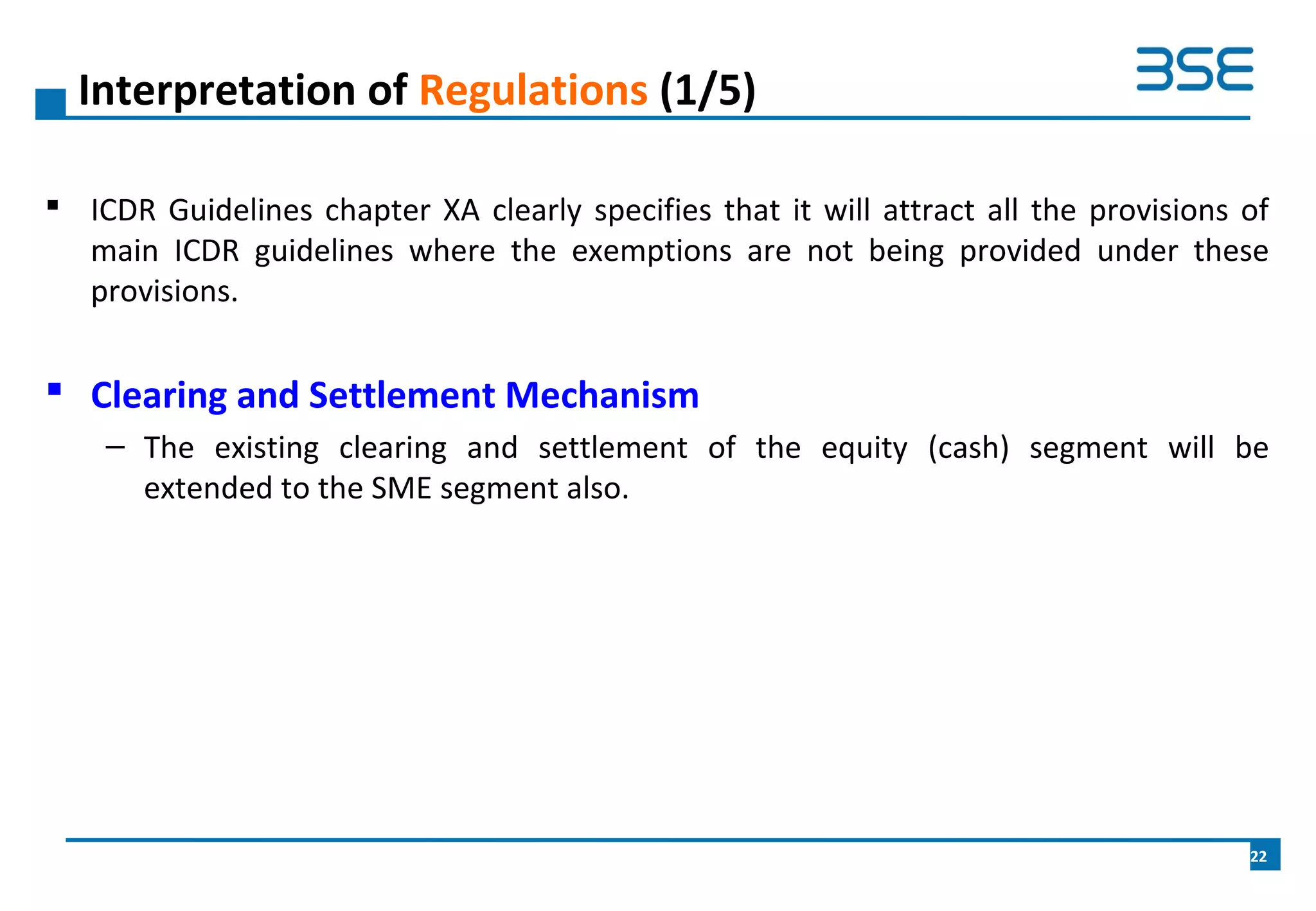
 ICDR Guidelines chapter XA clearly specifies that it will attract all the provisions of
main ICDR guidelines where the exemptions are not being provided under these
provisions.
 Clearing and Settlement Mechanism
– The existing clearing and settlement of the equity (cash) segment will be
extended to the SME segment also.
Interpretation of Regulations (1/5)
22
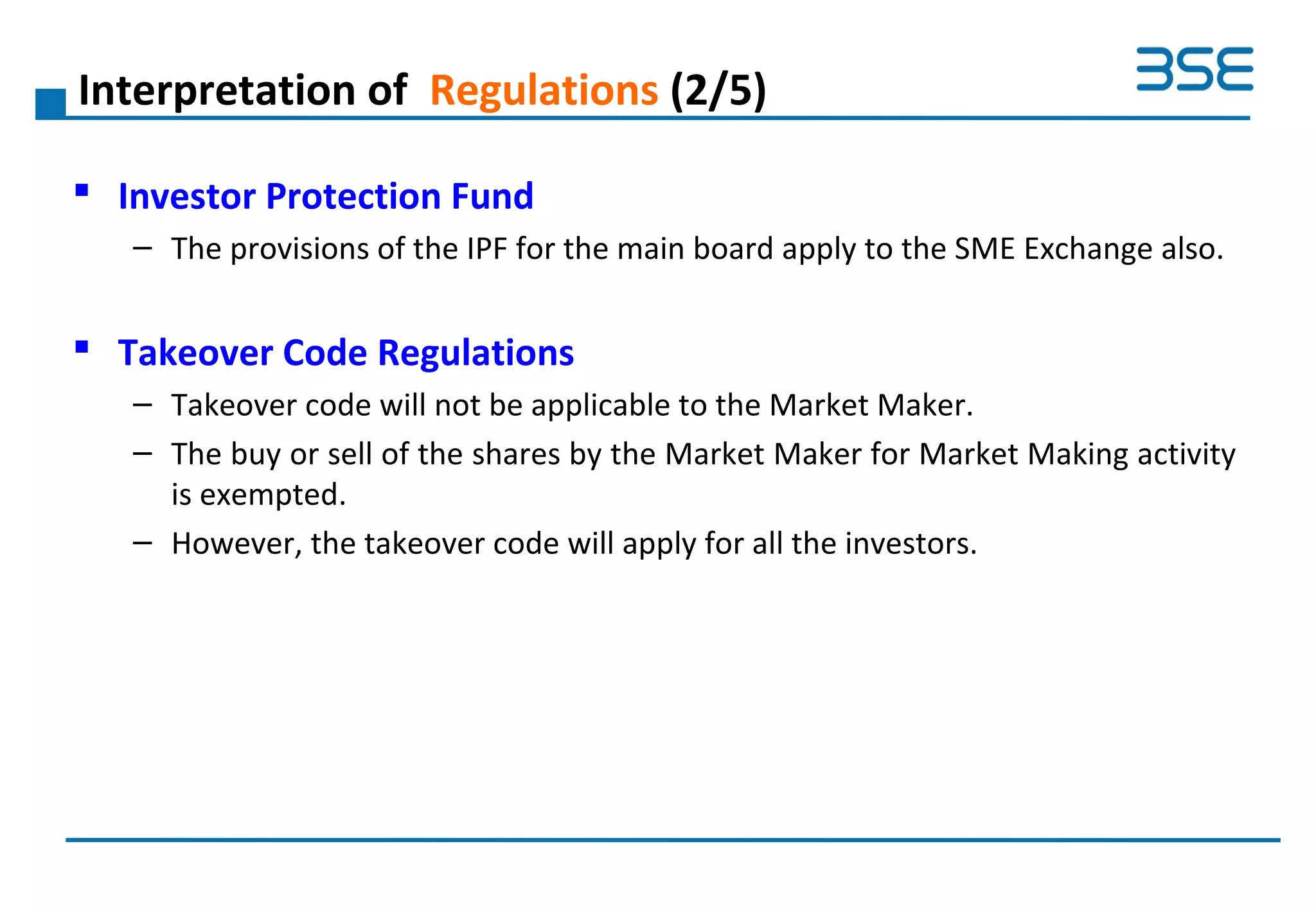
Interpretation of Regulations (2/5)
 Investor Protection Fund
– The provisions of the IPF for the main board apply to the SME Exchange also.
 Takeover Code Regulations
– Takeover code will not be applicable to the Market Maker.
– The buy or sell of the shares by the Market Maker for Market Making activity
is exempted.
– However, the takeover code will apply for all the investors.
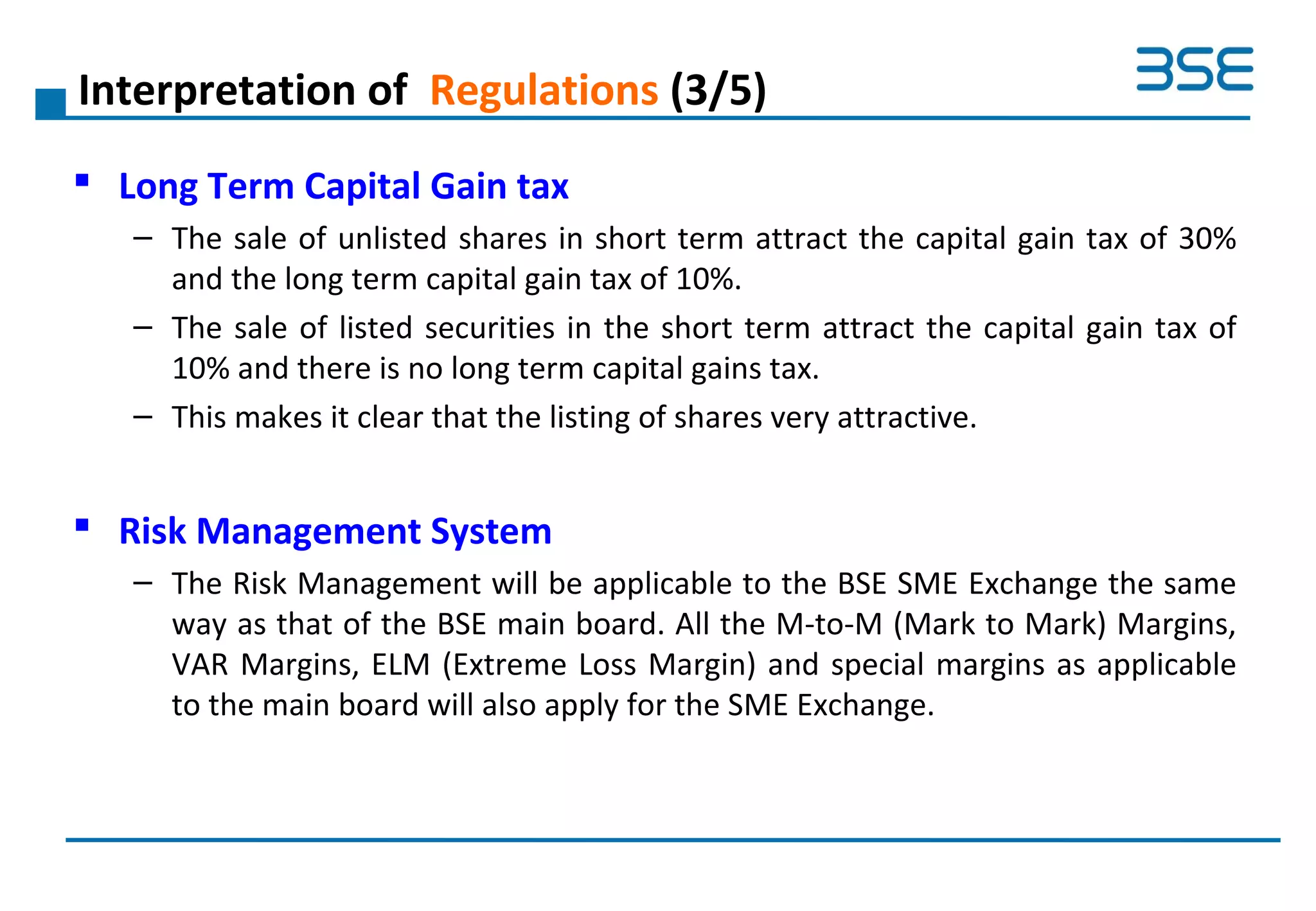
Interpretation of Regulations (3/5)
 Long Term Capital Gain tax
– The sale of unlisted shares in short term attract the capital gain tax of 30%
and the long term capital gain tax of 10%.
– The sale of listed securities in the short term attract the capital gain tax of
10% and there is no long term capital gains tax.
– This makes it clear that the listing of shares very attractive.
 Risk Management System
– The Risk Management will be applicable to the BSE SME Exchange the same
way as that of the BSE main board. All the M-to-M (Mark to Mark) Margins,
VAR Margins, ELM (Extreme Loss Margin) and special margins as applicable
to the main board will also apply for the SME Exchange.
Interpretation of Regulations (4/5)
 Grading of IPOs
– As per ICDR guidelines, the grading of IPOs is compulsory. The same applies
to the companies to be listed on the BSE SME Exchange also.
 Website for the SME Companies
– The Regulator has made it mandatory for the companies to have websites, if
they propose to be listed on the main board.
– The same applies to the SME companies, if they want to get listed on the BSE
SME Exchange.
 Investor Grievance Redressal System
– The Exchange has the IGRC (Investor Grievance Redressal Committee) to redress
the complaints of the investors against the members.
– If amicable solution is not reached, the members can opt for arbitration.
– The Grievance Redressal System of the equity (cash) segment will be made
available for the SME Exchange also.
 Corporate Governance
– Clause 49 of the listing agreement and corporate governance will be applicable
for the SME Exchanges also.
– There has to be 50% independent Directors and the remaining 50% will be
promoter Directors.
Interpretation of Regulations (5/5)
26
About BSE SME Exchange
 The BSE is leveraging the existing equity platform for the BSE SME.
The BSE SME Segment will be part of the BSE BOLT System.
 The companies on the SME Exchange will be included as a group in the BSE’s BOLT
system – ‘M’ and ‘MT’ Groups.
 The systems necessary for monitoring the market making activity and providing the
quotes are made ready to comply with SEBI Regulations.
 The trading time of this platform is from 09:00 am to 03:30 pm
 BSE is fully equipped to launch the BSE SME Platform.
Trading System of SME Exchange
28
 Only the Members of the stock exchanges recognized by the SEBI can act as
Market Makers.
 The members desirous of becoming market maker have to get themselves
registered as market maker with the BSE SME Exchange by filing the registration
form.
 These members should have a minimum experience of 3 years, minimum net
worth of Rs. 5 crore and a daily turn over of Rs. 10 crore. The market maker shall
have additional net worth of Rs. 2 crore for additional scrip.
Market Makers
29
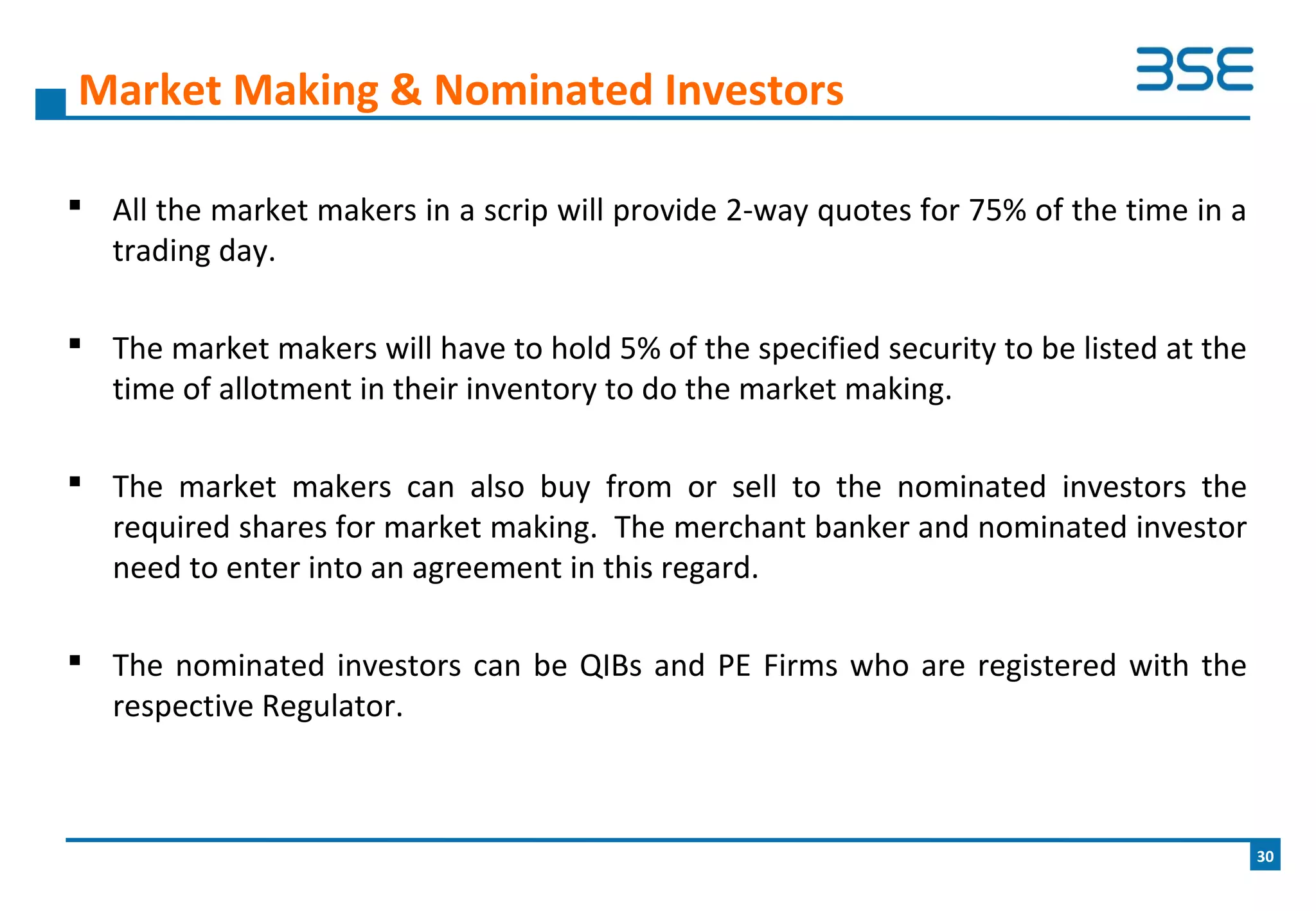
 All the market makers in a scrip will provide 2-way quotes for 75% of the time in a
trading day.
 The market makers will have to hold 5% of the specified security to be listed at the
time of allotment in their inventory to do the market making.
 The market makers can also buy from or sell to the nominated investors the
required shares for market making. The merchant banker and nominated investor
need to enter into an agreement in this regard.
 The nominated investors can be QIBs and PE Firms who are registered with the
respective Regulator.
Market Making & Nominated Investors
30
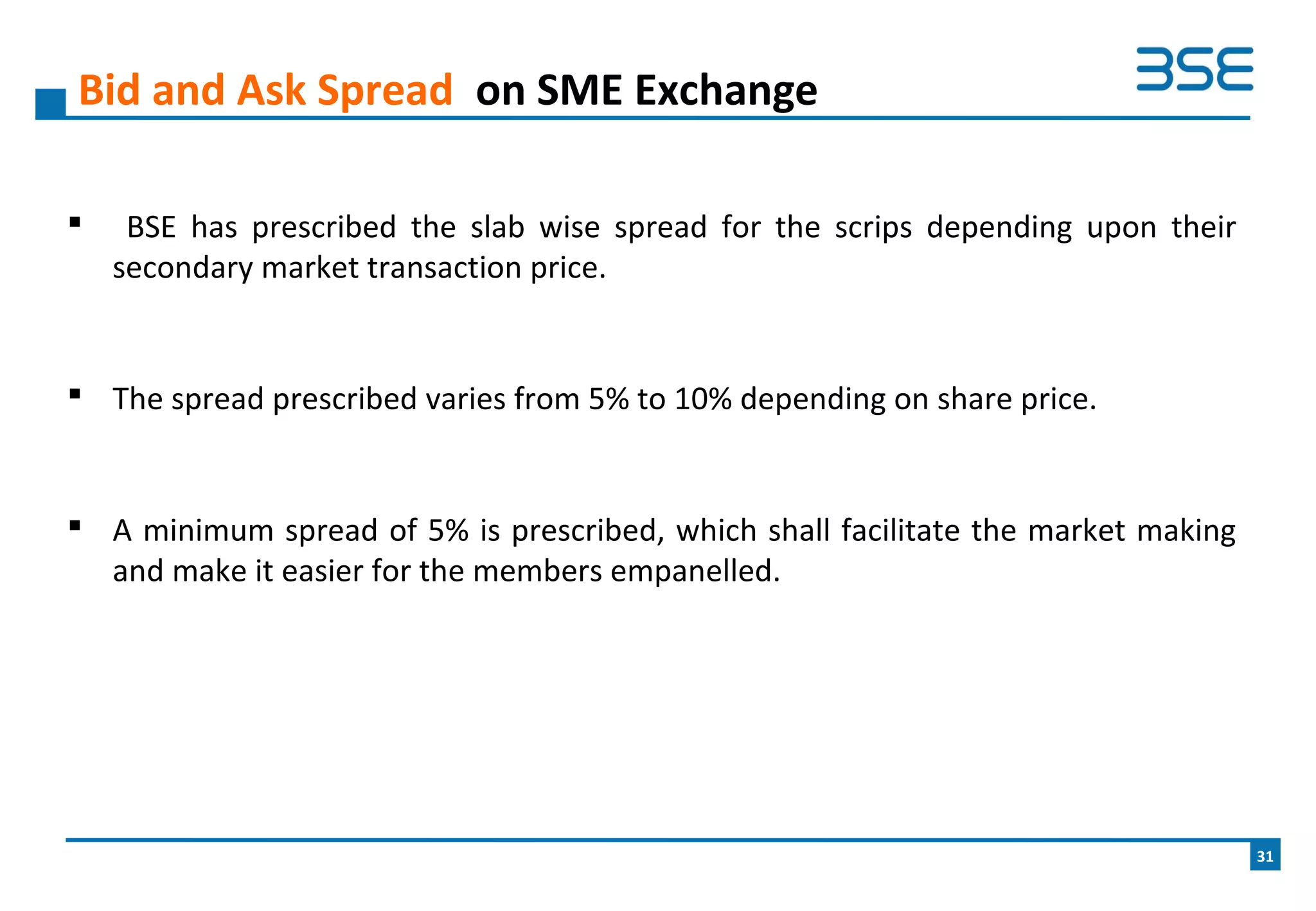
 BSE has prescribed the slab wise spread for the scrips depending upon their
secondary market transaction price.
 The spread prescribed varies from 5% to 10% depending on share price.
 A minimum spread of 5% is prescribed, which shall facilitate the market making
and make it easier for the members empanelled.
Bid and Ask Spread on SME Exchange
31
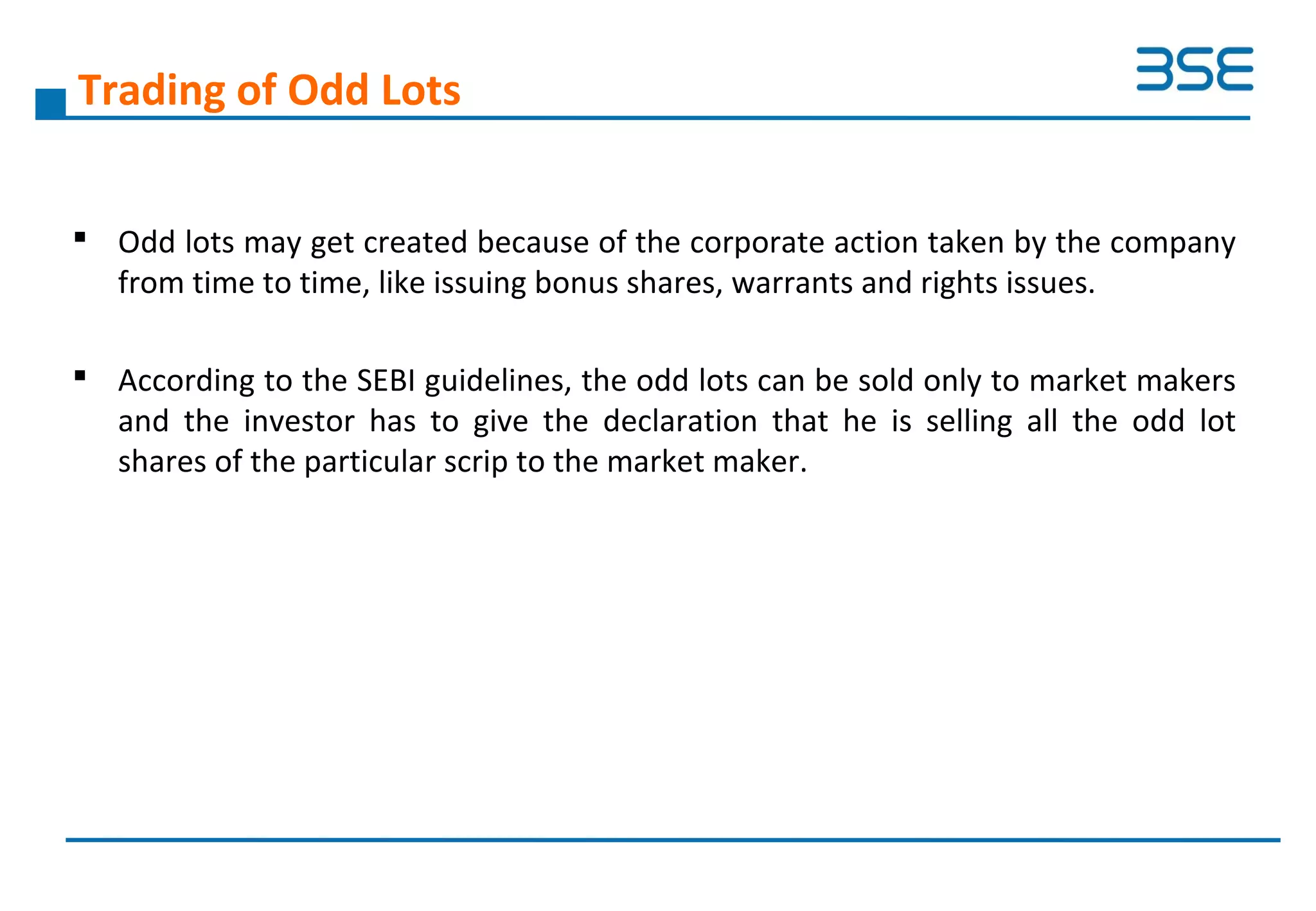
Trading of Odd Lots
 Odd lots may get created because of the corporate action taken by the company
from time to time, like issuing bonus shares, warrants and rights issues.
 According to the SEBI guidelines, the odd lots can be sold only to market makers
and the investor has to give the declaration that he is selling all the odd lot
shares of the particular scrip to the market maker.
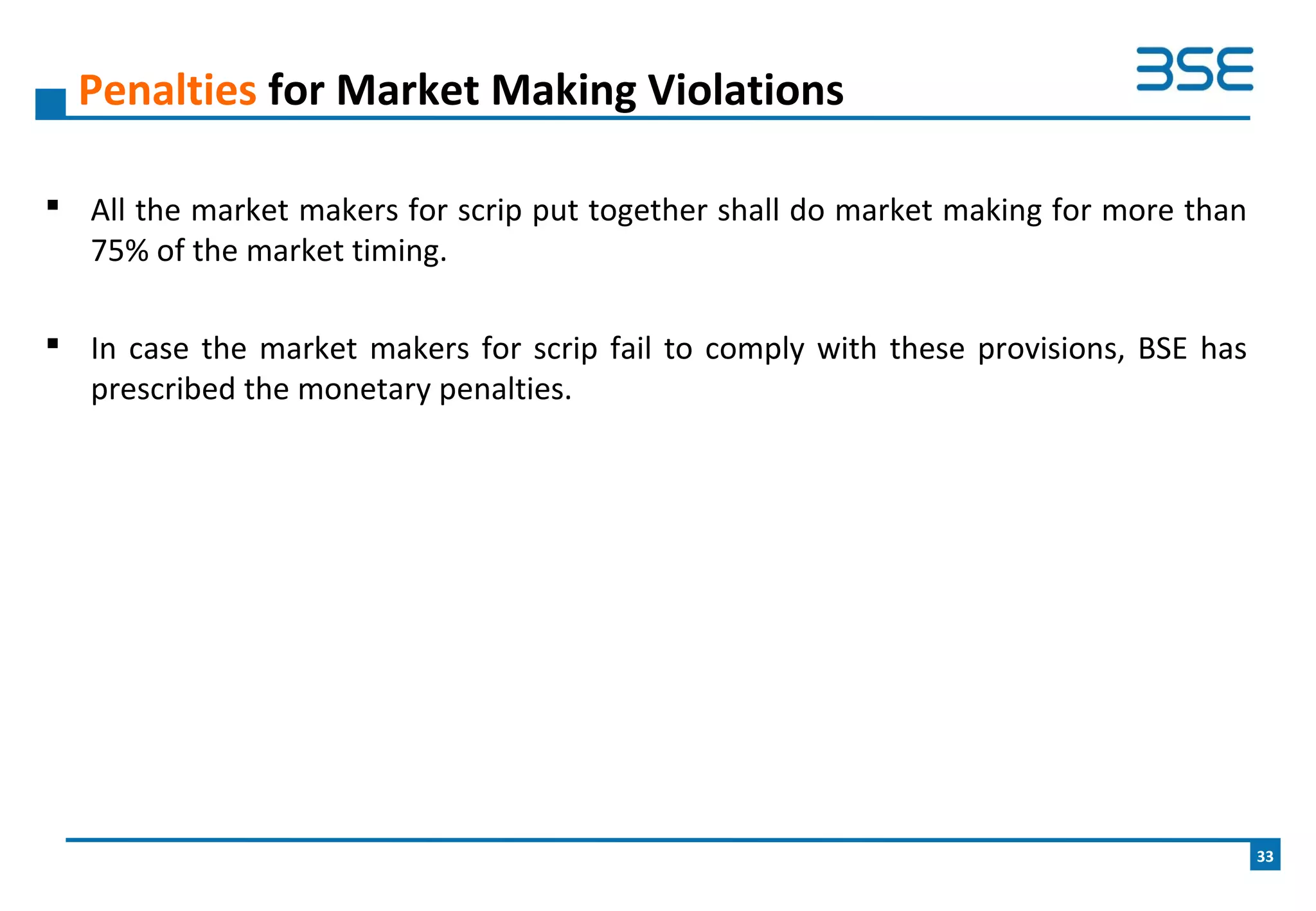
 All the market makers for scrip put together shall do market making for more than
75% of the market timing.
 In case the market makers for scrip fail to comply with these provisions, BSE has
prescribed the monetary penalties.
Penalties for Market Making Violations
33
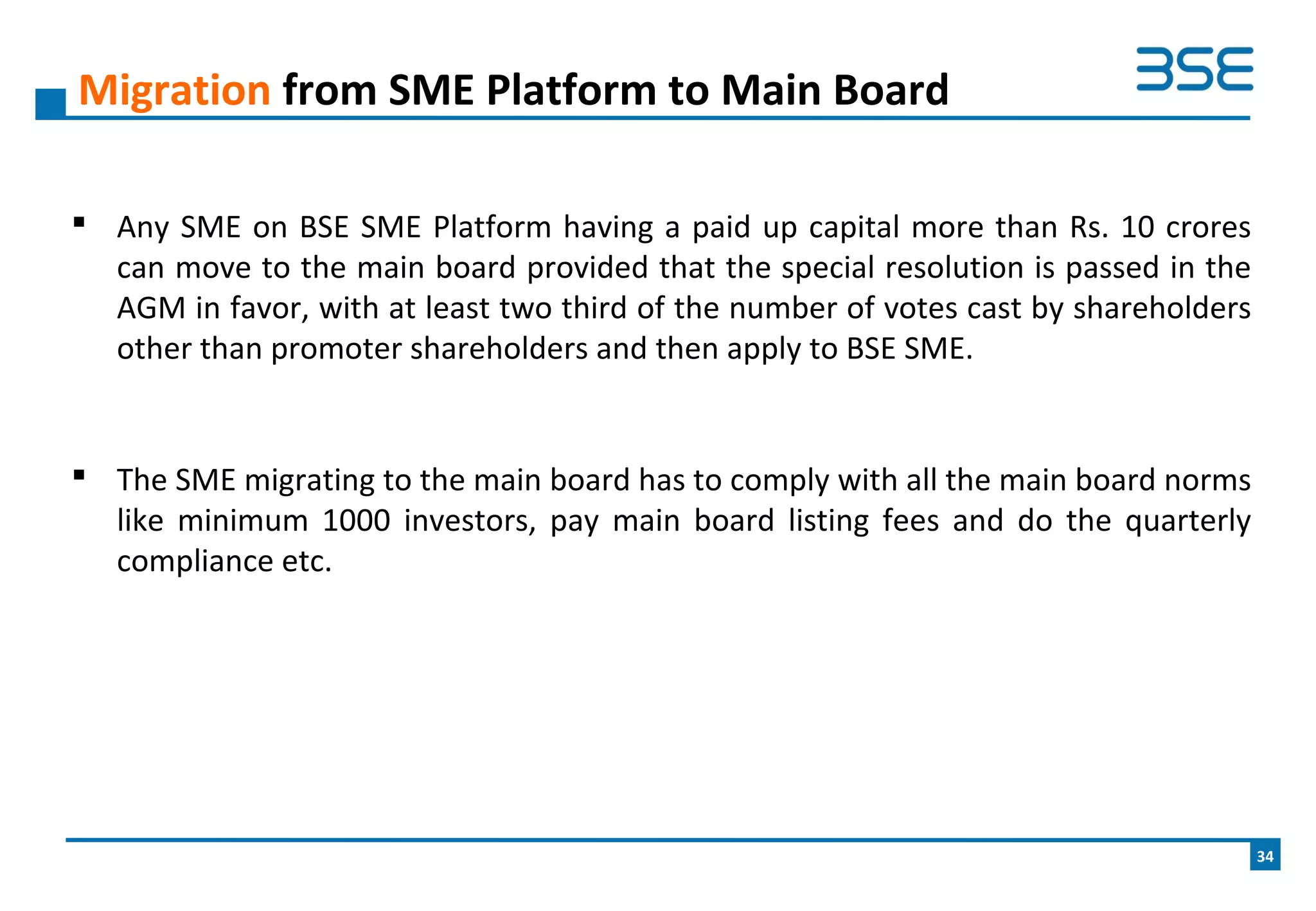
 Any SME on BSE SME Platform having a paid up capital more than Rs. 10 crores
can move to the main board provided that the special resolution is passed in the
AGM in favor, with at least two third of the number of votes cast by shareholders
other than promoter shareholders and then apply to BSE SME.
 The SME migrating to the main board has to comply with all the main board norms
like minimum 1000 investors, pay main board listing fees and do the quarterly
compliance etc.
Migration from SME Platform to Main Board
34
Key Players
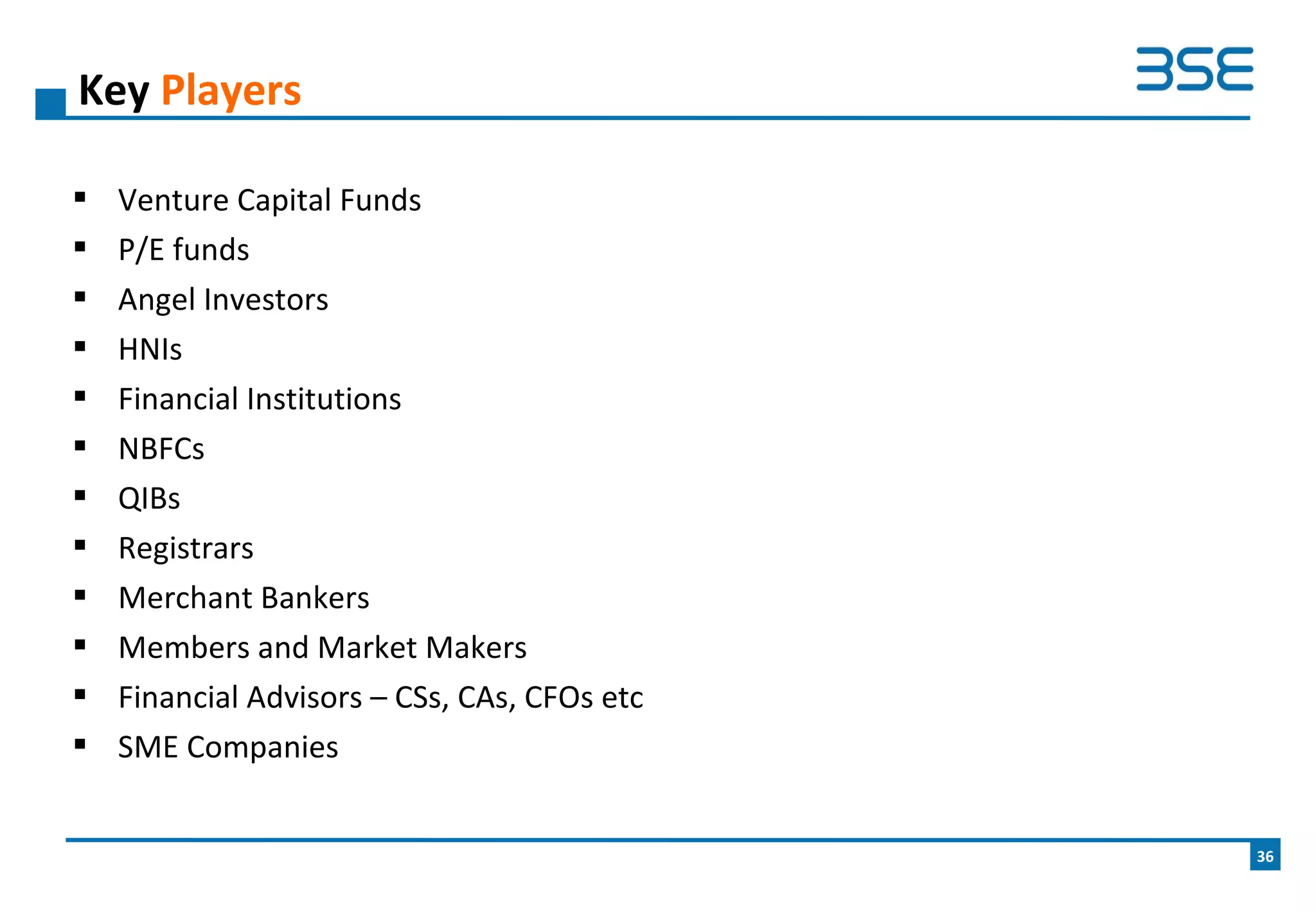
 Venture Capital Funds
 P/E funds
 Angel Investors
 HNIs
 Financial Institutions
 NBFCs
 QIBs
 Registrars
 Merchant Bankers
 Members and Market Makers
 Financial Advisors – CSs, CAs, CFOs etc
 SME Companies
Key Players
36
Preparations for the IPO
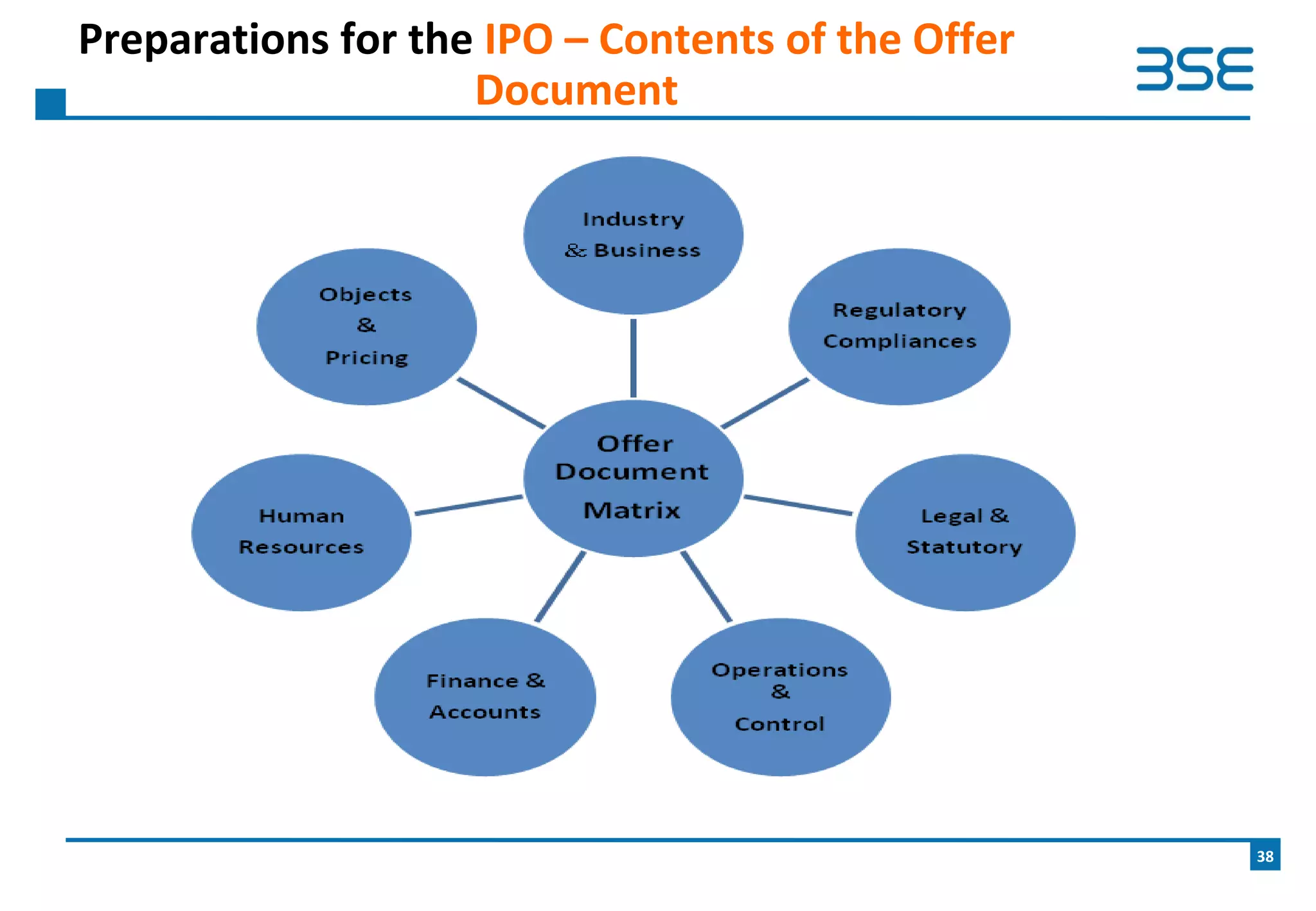
Preparations for the IPO – Contents of the Offer
Document
38
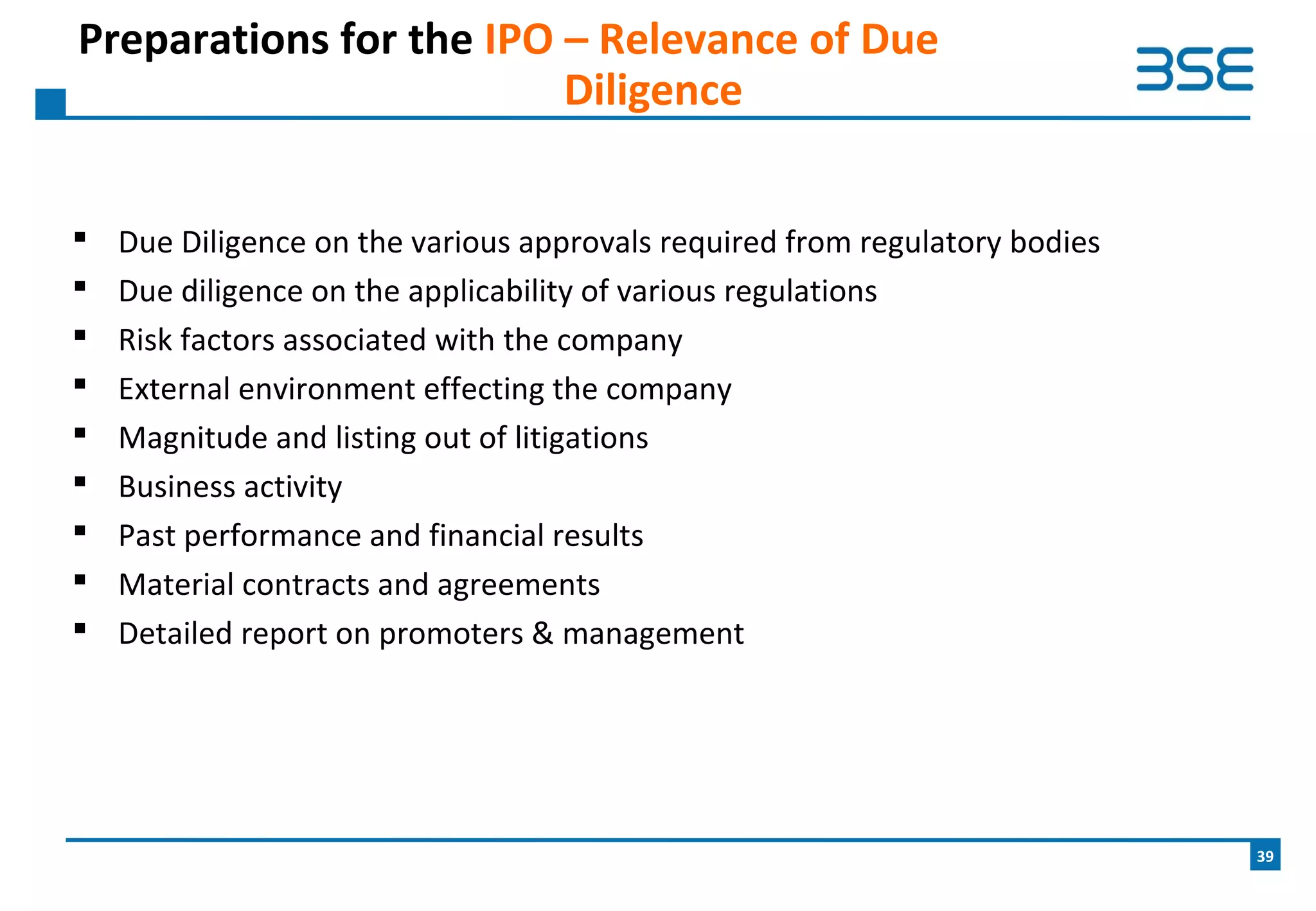
 Due Diligence on the various approvals required from regulatory bodies
 Due diligence on the applicability of various regulations
 Risk factors associated with the company
 External environment effecting the company
 Magnitude and listing out of litigations
 Business activity
 Past performance and financial results
 Material contracts and agreements
 Detailed report on promoters & management
Preparations for the IPO – Relevance of Due
Diligence
39
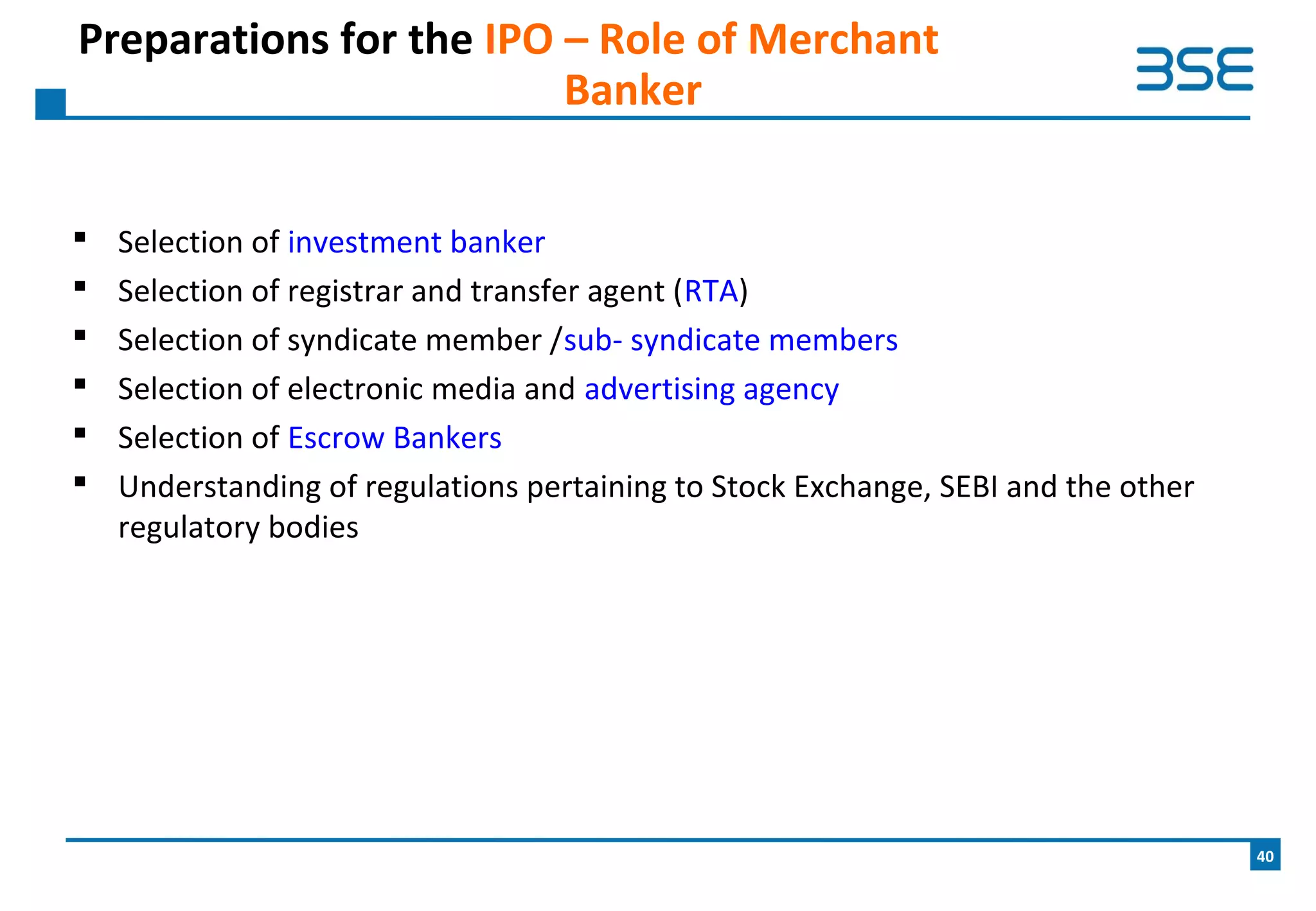
 Selection of investment banker
 Selection of registrar and transfer agent (RTA)
 Selection of syndicate member /sub- syndicate members
 Selection of electronic media and advertising agency
 Selection of Escrow Bankers
 Understanding of regulations pertaining to Stock Exchange, SEBI and the other
regulatory bodies
Preparations for the IPO – Role of Merchant
Banker
40
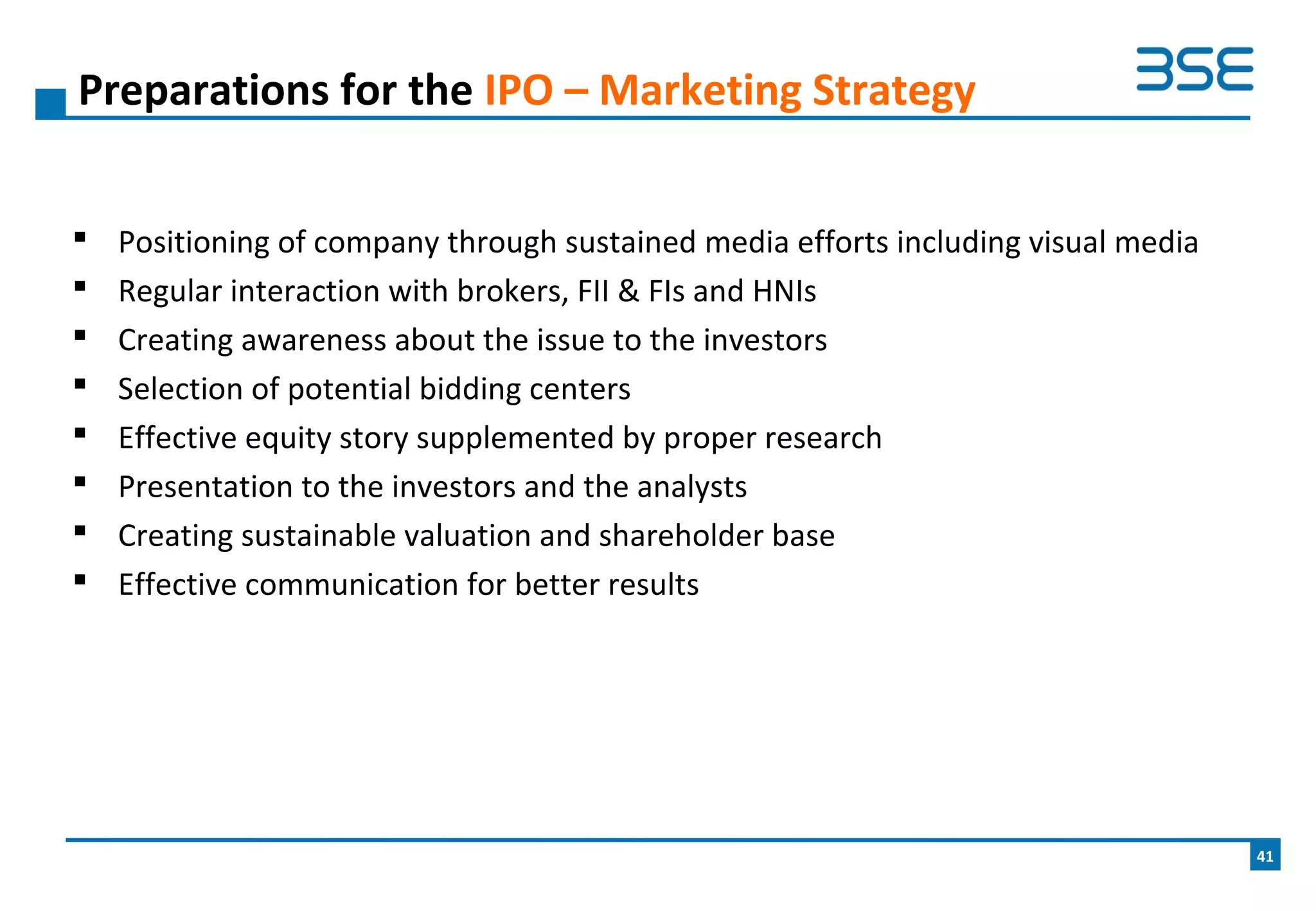
 Positioning of company through sustained media efforts including visual media
 Regular interaction with brokers, FII & FIs and HNIs
 Creating awareness about the issue to the investors
 Selection of potential bidding centers
 Effective equity story supplemented by proper research
 Presentation to the investors and the analysts
 Creating sustainable valuation and shareholder base
 Effective communication for better results
Preparations for the IPO – Marketing Strategy
41
Beneficial Aspects
 A dedicated exchange for these SMEs will help them in finding a solution to their
financial requirements and crunching expansion plans.
 Listing of a company gives better valuation to the company. The debt and equity
ratios will improve and balance sheet will look much healthier.
 The listed SMEs will unlock their wealth in the medium to long term and will do the
wealth creation for the promoters and the investors.
 The listed SMEs will get better visibility among the investors. The investor base of the
company improves for the listed companies in medium term.
How does the SME Exchange help SMEs (1/2)
43
 The repose of faith by the investors – domestic and foreigners in the listed SMEs is
high. Transparency and corporate governance will improve manifold by listing on
SME Platform.
 Listed company will have easy accessibility to alternate funding options. The banks,
P/E funds and other financial institutions provide them the loans very easily. The fund
raising through ADRs and GDRs become easier. Also, the company can raise more
funds through follow on public offering.
 The tax benefits are also immense. The long term capital gain tax on listed company is
zero.
How does the SME exchange help SMEs (2/2)
44
 The working of SME Exchange is not well understood by the SMEs in the country. The
SMEs are mostly not well informed of the capital market issues and modalities of
raising equity capital. There is need for conducting lot of awareness programs to
educate them.
 Merchant Bankers used to handle only the primary market issues so far. On the SME
platform, he has to assist the company in the secondary market through market
making for three years.
 Merchant banker, issuer and market maker have to work as team for three years to
make the market making activity a success. This is a huge challenge.
 The investor base is limited and only the investors with a minimum investment of Rs.
One lakh are allowed to participate.
Challenges for launch of SME Exchange (1/2)
45
 We have interacted with the market intermediaries over the last six months. There
were apprehensions about the SME model in the beginning.
 After few rounds of discussions, we see the substantial change in the perception of
the SME platform. Many merchant bankers are optimistic and the members with
market making experience are positive about the SME Platform.
 We are hopeful that these challenges will not be a roadblock for the successful take
off of the BSE SME Platform.
Challenges for launch of SME Exchange (2/2)
46
 A large number of merchant bankers are optimistic about the SME Exchange/
Platform. Except top 5 MBs, most of the medium size MBs are keen and already
started working.
 The market makers will get the fees out of the issue expenses, like the merchant
bankers. The members who have the experience of market making in the past are
positive on the scope of market making in this segment.
 Investors’ outlook is not yet clear. But the investors with medium to long term
perspective are optimistic on wealth creation opportunity in this segment.
 Regarding the SMEs, the response has been extra ordinarily exciting. The SMEs are
enthusiastic about the opportunity to raise the equity capital on BSE SME.
Outlook on the SME Exchange (1/2)
47
 The professionals like Company Secretaries and Chartered Accountants have an
important role to play in educating the promoters of the SMEs and guiding them in
raising equity capital on BSE SME Platform.
 The member brokers and the sub brokers having branches and franchises spread
across the country can play important role in mobilizing and educating the SMEs with
their market knowledge and experience.
Outlook on the SME Exchange (2/2)
48
Promoting the BSE SME Exchange
 Approaching SMEs with high growth potential
 Illustrating Advantages of Listing
 Co-coordinating with Banks and Angel Investors for bringing the companies on
this platform
 Target industries at different locations and SME clusters
 Attract promising SMEs and the start- ups by professionals
 Attracting the SMEs through
– Chamber of commerce
– Industry department under state government
– Industry Associations
Attracting Promising SMEs
50
 Road Shows
 Jointly organizing seminars with the ‘Chamber of Commerce' of different states
for illustrating advantages of listing
 Training Programs
 Advisory Committee
 Segment Awareness Programs
 Reaching the potential SME companies through web portals and mails
Marketing Activities
51
 We have been conducting the Seminars for educating the SMEs on the benefits of
listing and preparations required for listing on the SME Platform.
 We have already conducted the Seminars in Maharashtra, Gujarat, Andhra Pradesh,
New Delhi, Kolkata etc and lined up large number of Seminars to cover other parts of
the country. We have detailed Marketing plan to reach out to the SMEs spread across
the country.
 We are tying up with channel partners which include various institutes and
associations engaged in the development of SMEs so as to create awareness among
the SME companies about the benefits of listing at this platform.
 We are also educating the professionals through the platform of ICSI and ICAI , as the
professionals can play important role in educating the promoters and management of
SMEs.
Reaching SMEs across the country
52
Bse sme exchange   business ppt

Bse sme exchange business ppt

  • 1.
    Bombay Stock ExchangeLtd. BSE SME Exchange Bombay Stock Exchange Limited 16th July, 2011 Soyal Gupta BSE SME Exchange
  • 2.
    Section Contents Page Tableof Contents (1/2) 2 A Introduction 4 B About SME Industry 11 C Need for SME Exchange 14 D SME Exchange - An Overview 18 E About BSE SME Exchange 27 F Key Players 35
  • 3.
    Section Contents Page Tableof Contents (2/2) 3 G Preparations for the IPO 37 H Beneficial Aspects 42 I Promoting the BSE SME Exchange 49
  • 4.
  • 5.
    Vision and Mission Vision Wealthcreation by the SMEs through inclusive economic growth. Mission Provide the world class platform for the SMEs and Investors to come together and raise the equity capital.
  • 6.
    Message to theEntrepreneurs and Investors “BSE SME Platform provides a great opportunity to the entrepreneurs to raise the equity capital for the growth and expansion of SMEs. It also provides the immense opportunity to the investors to identify and invest in the good companies at early stage. It will help unleash the valuation of the company and in the process create wealth for all the stakeholders including investors, besides considerable long term capital gains tax benefits and facility to exit at any point of time”
  • 7.
     Capital MarketRegulator SEBI has given ‘In Principle’ Approval to Bombay Stock Exchange (BSE) Ltd. to launch the BSE SME Exchange/Platform .  BSE is leveraging the existing ‘Equity platform’ i.e. BOLT System for launching the BSE SME Exchange. Negligible cost in launching the platform.  All Merchant Bankers empanelled with SEBI are by default MBs for this segment. Additional responsibility of secondary market for market making.  All Members registered with BSE are by default Members for this segment. No additional infrastructure required by Members for secondary market trading. Introduction 7
  • 8.
     SME companieswith post issue paid up capital up to 25 crore can list on the BSE SME Exchange.  100% under writing by the Merchant bankers mean that the SME listing-cum-IPO issue will be 100% success.  Larger participation of investors – exit option  Liquidity in the secondary market – Market Making  Better opportunity for SMEs for equity fund raising. Introduction 8
  • 9.
     The newthing about the SME Exchange is that the issue will be 100% underwritten and this means that the issue will be 100% success. Other new aspect is that there will be support of three years in the secondary market through market making activity.  The SMEs with paid up capital up to Rs. 10 crores can come on the SME Exchange, in contrast to the paid up capital of Rs. 10 crores or more for the main board.  The Listing norms have been simplified. The issuer has to take the approval of the Exchange and SEBI approval is not required. A copy of the offer document will be sent to the SEBI for their information. How Different from Main Board (1/2) 9
  • 10.
     The Compliancenorms are simplified. Half yearly compliance is required instead of quarterly compliance.  The abridged version of the annual reports need to be sent to the investors instead of the entire annual report and posting the soft copy of the report on the website is sufficient.  The issue expenses will be minimal on the marketing and stationery. However, the issue will be charged for underwriting, sub-underwriting and responsibility of three years market making.  Market Making is compulsory for 3 years, unlike on main platform. How Different from Main Board (2/2) 10
  • 11.
  • 12.
    About SME Industry 12 Classificationof Micro, Small and Medium Enterprises
  • 13.
     Micro, Smalland Medium Enterprises (MSMEs) contribute - 8% of the country's GDP - 45% of the manufactured output - 40% of our exports  Provide employment to about 6 cr. people through 2.6 cr. enterprises.  The Micro Small and Medium Enterprise (MSME) sector forms the largest generator of employment in the Indian economy.  The MSME sector forms a major portion of the industrial activity. About SME Industry 13
  • 14.
    Need for SMEExchange
  • 15.
     Provide theSMEs with equity financing opportunities to grow their business – from expansion to acquisition  Equity Financing will lower the Debt burden leading to lower financing cost and healthier balance sheet  Expand the investors base, which in turn will help in getting secondary equity financing, including private placement  Enhance company’s visibility. Media coverage can provide SME with greater profile and credibility leading to increase in the value of its shares  Incentives for greater venture capital participation by providing an exit option thus reducing their lock-in period Need for SME Exchange 15
  • 16.
     Greater incentivefor the employees as they can participate in the ownership of the company and benefit from being its shareholders  Encourage innovation and entrepreneurial spirit  Capital Market will help distribute risk more efficiently  SME sector will grow better on two pillars of Financial system i.e. Banking and Capital Market Initiating a dedicated Stock Exchange for SMEs’ will lead to mobilization of the diversified resources of finance and build a bridge between the SMEs, Private Equity and the Venture Capital by providing an exit route. Need for SME Exchange 16
  • 17.
    Life Cycle ofa Company PE Firms hold the hands of SMEs Supported by Venture Capital Firms IPO Decline due to lack of funds Nascent Stage Growt h Stage Developing Stage Expansion Stage UnlockingtheCapitalMarket Opportunities Profitability High Risk & Lower Profit Margins Increase in Sales & Rise in Profit Stable Profit Margins Profit Margin tends to rise as the business expands
  • 18.
  • 19.
     SEBI hasissued a final circular on May 18, 2010 for setting up a stock exchange/ platform by a recognized Stock Exchange having nationwide trading terminal  The necessary amendments have been made in the various SEBI Regulations  Model equity listing agreement has been notified by SEBI on May 17th , 2010  BSE is eligible for setting up SME exchange and already got the ‘In Principle’ approval from the capital market regulator ‘SEBI’ for launch of SME Exchange SME Exchange - Overview 19
  • 20.
     Issuer withpost issue face value capital up to Rs.10 crores shall be covered under the SME Platform, Issuer with post issue face value capital between Rs.10 – 25 crores may get listed at SME Platform and Issue with post issue face value capital above Rs.25 crores has to necessarily listed at main board of the Exchanges  Suitable provisions for migration to/ from main board  The minimum application amount as well as minimum trading lot shall not be less than Rs.1,00,000/-  All existing Trading Members would be eligible to participate in SME exchange without any further registration  100% underwritten issues and Merchant Banker/s shall underwrite 15% in their own account  The Merchant Banker to the issue will undertake market making through a stock broker who is registered as market maker with SME Exchange. The Merchant Banker shall be responsible for market making for a minimum period of 3 years SME Exchange – SEBI Guidelines 20
  • 21.
     Shall berequired to provide two way quote for 75% of time in a day, to be monitored by the Stock exchange  The minimum depth of the quote shall be Rs.1 lakh  Not more than 5 market makers for a scrip  Market Makers may compete with the other Market Makers  Market Maker allowed to deregister by giving one month notice to the exchange  The exchange shall prescribe the minimum spread between Bid and Ask price  During the compulsory market making period, the promoter holding shall not be eligible for the offering to market makers SME Exchange – SEBI Guidelines – Obligations of Market Makers 21
  • 22.
     ICDR Guidelineschapter XA clearly specifies that it will attract all the provisions of main ICDR guidelines where the exemptions are not being provided under these provisions.  Clearing and Settlement Mechanism – The existing clearing and settlement of the equity (cash) segment will be extended to the SME segment also. Interpretation of Regulations (1/5) 22
  • 23.
    Interpretation of Regulations(2/5)  Investor Protection Fund – The provisions of the IPF for the main board apply to the SME Exchange also.  Takeover Code Regulations – Takeover code will not be applicable to the Market Maker. – The buy or sell of the shares by the Market Maker for Market Making activity is exempted. – However, the takeover code will apply for all the investors.
  • 24.
    Interpretation of Regulations(3/5)  Long Term Capital Gain tax – The sale of unlisted shares in short term attract the capital gain tax of 30% and the long term capital gain tax of 10%. – The sale of listed securities in the short term attract the capital gain tax of 10% and there is no long term capital gains tax. – This makes it clear that the listing of shares very attractive.  Risk Management System – The Risk Management will be applicable to the BSE SME Exchange the same way as that of the BSE main board. All the M-to-M (Mark to Mark) Margins, VAR Margins, ELM (Extreme Loss Margin) and special margins as applicable to the main board will also apply for the SME Exchange.
  • 25.
    Interpretation of Regulations(4/5)  Grading of IPOs – As per ICDR guidelines, the grading of IPOs is compulsory. The same applies to the companies to be listed on the BSE SME Exchange also.  Website for the SME Companies – The Regulator has made it mandatory for the companies to have websites, if they propose to be listed on the main board. – The same applies to the SME companies, if they want to get listed on the BSE SME Exchange.
  • 26.
     Investor GrievanceRedressal System – The Exchange has the IGRC (Investor Grievance Redressal Committee) to redress the complaints of the investors against the members. – If amicable solution is not reached, the members can opt for arbitration. – The Grievance Redressal System of the equity (cash) segment will be made available for the SME Exchange also.  Corporate Governance – Clause 49 of the listing agreement and corporate governance will be applicable for the SME Exchanges also. – There has to be 50% independent Directors and the remaining 50% will be promoter Directors. Interpretation of Regulations (5/5) 26
  • 27.
    About BSE SMEExchange
  • 28.
     The BSEis leveraging the existing equity platform for the BSE SME. The BSE SME Segment will be part of the BSE BOLT System.  The companies on the SME Exchange will be included as a group in the BSE’s BOLT system – ‘M’ and ‘MT’ Groups.  The systems necessary for monitoring the market making activity and providing the quotes are made ready to comply with SEBI Regulations.  The trading time of this platform is from 09:00 am to 03:30 pm  BSE is fully equipped to launch the BSE SME Platform. Trading System of SME Exchange 28
  • 29.
     Only theMembers of the stock exchanges recognized by the SEBI can act as Market Makers.  The members desirous of becoming market maker have to get themselves registered as market maker with the BSE SME Exchange by filing the registration form.  These members should have a minimum experience of 3 years, minimum net worth of Rs. 5 crore and a daily turn over of Rs. 10 crore. The market maker shall have additional net worth of Rs. 2 crore for additional scrip. Market Makers 29
  • 30.
     All themarket makers in a scrip will provide 2-way quotes for 75% of the time in a trading day.  The market makers will have to hold 5% of the specified security to be listed at the time of allotment in their inventory to do the market making.  The market makers can also buy from or sell to the nominated investors the required shares for market making. The merchant banker and nominated investor need to enter into an agreement in this regard.  The nominated investors can be QIBs and PE Firms who are registered with the respective Regulator. Market Making & Nominated Investors 30
  • 31.
     BSE hasprescribed the slab wise spread for the scrips depending upon their secondary market transaction price.  The spread prescribed varies from 5% to 10% depending on share price.  A minimum spread of 5% is prescribed, which shall facilitate the market making and make it easier for the members empanelled. Bid and Ask Spread on SME Exchange 31
  • 32.
    Trading of OddLots  Odd lots may get created because of the corporate action taken by the company from time to time, like issuing bonus shares, warrants and rights issues.  According to the SEBI guidelines, the odd lots can be sold only to market makers and the investor has to give the declaration that he is selling all the odd lot shares of the particular scrip to the market maker.
  • 33.
     All themarket makers for scrip put together shall do market making for more than 75% of the market timing.  In case the market makers for scrip fail to comply with these provisions, BSE has prescribed the monetary penalties. Penalties for Market Making Violations 33
  • 34.
     Any SMEon BSE SME Platform having a paid up capital more than Rs. 10 crores can move to the main board provided that the special resolution is passed in the AGM in favor, with at least two third of the number of votes cast by shareholders other than promoter shareholders and then apply to BSE SME.  The SME migrating to the main board has to comply with all the main board norms like minimum 1000 investors, pay main board listing fees and do the quarterly compliance etc. Migration from SME Platform to Main Board 34
  • 35.
  • 36.
     Venture CapitalFunds  P/E funds  Angel Investors  HNIs  Financial Institutions  NBFCs  QIBs  Registrars  Merchant Bankers  Members and Market Makers  Financial Advisors – CSs, CAs, CFOs etc  SME Companies Key Players 36
  • 37.
  • 38.
    Preparations for theIPO – Contents of the Offer Document 38
  • 39.
     Due Diligenceon the various approvals required from regulatory bodies  Due diligence on the applicability of various regulations  Risk factors associated with the company  External environment effecting the company  Magnitude and listing out of litigations  Business activity  Past performance and financial results  Material contracts and agreements  Detailed report on promoters & management Preparations for the IPO – Relevance of Due Diligence 39
  • 40.
     Selection ofinvestment banker  Selection of registrar and transfer agent (RTA)  Selection of syndicate member /sub- syndicate members  Selection of electronic media and advertising agency  Selection of Escrow Bankers  Understanding of regulations pertaining to Stock Exchange, SEBI and the other regulatory bodies Preparations for the IPO – Role of Merchant Banker 40
  • 41.
     Positioning ofcompany through sustained media efforts including visual media  Regular interaction with brokers, FII & FIs and HNIs  Creating awareness about the issue to the investors  Selection of potential bidding centers  Effective equity story supplemented by proper research  Presentation to the investors and the analysts  Creating sustainable valuation and shareholder base  Effective communication for better results Preparations for the IPO – Marketing Strategy 41
  • 42.
  • 43.
     A dedicatedexchange for these SMEs will help them in finding a solution to their financial requirements and crunching expansion plans.  Listing of a company gives better valuation to the company. The debt and equity ratios will improve and balance sheet will look much healthier.  The listed SMEs will unlock their wealth in the medium to long term and will do the wealth creation for the promoters and the investors.  The listed SMEs will get better visibility among the investors. The investor base of the company improves for the listed companies in medium term. How does the SME Exchange help SMEs (1/2) 43
  • 44.
     The reposeof faith by the investors – domestic and foreigners in the listed SMEs is high. Transparency and corporate governance will improve manifold by listing on SME Platform.  Listed company will have easy accessibility to alternate funding options. The banks, P/E funds and other financial institutions provide them the loans very easily. The fund raising through ADRs and GDRs become easier. Also, the company can raise more funds through follow on public offering.  The tax benefits are also immense. The long term capital gain tax on listed company is zero. How does the SME exchange help SMEs (2/2) 44
  • 45.
     The workingof SME Exchange is not well understood by the SMEs in the country. The SMEs are mostly not well informed of the capital market issues and modalities of raising equity capital. There is need for conducting lot of awareness programs to educate them.  Merchant Bankers used to handle only the primary market issues so far. On the SME platform, he has to assist the company in the secondary market through market making for three years.  Merchant banker, issuer and market maker have to work as team for three years to make the market making activity a success. This is a huge challenge.  The investor base is limited and only the investors with a minimum investment of Rs. One lakh are allowed to participate. Challenges for launch of SME Exchange (1/2) 45
  • 46.
     We haveinteracted with the market intermediaries over the last six months. There were apprehensions about the SME model in the beginning.  After few rounds of discussions, we see the substantial change in the perception of the SME platform. Many merchant bankers are optimistic and the members with market making experience are positive about the SME Platform.  We are hopeful that these challenges will not be a roadblock for the successful take off of the BSE SME Platform. Challenges for launch of SME Exchange (2/2) 46
  • 47.
     A largenumber of merchant bankers are optimistic about the SME Exchange/ Platform. Except top 5 MBs, most of the medium size MBs are keen and already started working.  The market makers will get the fees out of the issue expenses, like the merchant bankers. The members who have the experience of market making in the past are positive on the scope of market making in this segment.  Investors’ outlook is not yet clear. But the investors with medium to long term perspective are optimistic on wealth creation opportunity in this segment.  Regarding the SMEs, the response has been extra ordinarily exciting. The SMEs are enthusiastic about the opportunity to raise the equity capital on BSE SME. Outlook on the SME Exchange (1/2) 47
  • 48.
     The professionalslike Company Secretaries and Chartered Accountants have an important role to play in educating the promoters of the SMEs and guiding them in raising equity capital on BSE SME Platform.  The member brokers and the sub brokers having branches and franchises spread across the country can play important role in mobilizing and educating the SMEs with their market knowledge and experience. Outlook on the SME Exchange (2/2) 48
  • 49.
    Promoting the BSESME Exchange
  • 50.
     Approaching SMEswith high growth potential  Illustrating Advantages of Listing  Co-coordinating with Banks and Angel Investors for bringing the companies on this platform  Target industries at different locations and SME clusters  Attract promising SMEs and the start- ups by professionals  Attracting the SMEs through – Chamber of commerce – Industry department under state government – Industry Associations Attracting Promising SMEs 50
  • 51.
     Road Shows Jointly organizing seminars with the ‘Chamber of Commerce' of different states for illustrating advantages of listing  Training Programs  Advisory Committee  Segment Awareness Programs  Reaching the potential SME companies through web portals and mails Marketing Activities 51
  • 52.
     We havebeen conducting the Seminars for educating the SMEs on the benefits of listing and preparations required for listing on the SME Platform.  We have already conducted the Seminars in Maharashtra, Gujarat, Andhra Pradesh, New Delhi, Kolkata etc and lined up large number of Seminars to cover other parts of the country. We have detailed Marketing plan to reach out to the SMEs spread across the country.  We are tying up with channel partners which include various institutes and associations engaged in the development of SMEs so as to create awareness among the SME companies about the benefits of listing at this platform.  We are also educating the professionals through the platform of ICSI and ICAI , as the professionals can play important role in educating the promoters and management of SMEs. Reaching SMEs across the country 52